
Business
NYTimes Stock Slides as Sub Growth Slows


The company said it added about 280,000 net digital-only subscribers in the second quarter, compared with roughly 310,000 net digital subscribers the previous quarter.



Seeking Alpha’s transcripts team is responsible for the development of all of our transcript-related projects. We currently publish thousands of quarterly earnings calls per quarter on our site and are continuing to grow and expand our coverage. The purpose of this profile is to allow us to share with our readers new transcript-related developments. Thanks, SA Transcripts Team

Consumers’ behaviors change due to new technologies, trends, economic environment, and customer needs. Organizations unable to track these changes often experience difficulties with competitiveness, while firms capable of doing this can respond quickly and thus improve customer experience and increase revenues.
Today’s consumers expect a personalized approach, faster services, an efficient digital experience, and customized products.
Monitoring changes in consumer behaviors can help organizations to learn how customers find products, compare different offers, buy items, interact with companies, and behave after sales. In turn, this information is useful to enhance marketing initiatives, design innovative solutions, offer high-quality support, and retain customers.
What is the concept of consumer behavior?
Consumers’ behaviors are the actions, decisions, and emotional reactions of customers during each step of their purchasing journey. They include:
- How do consumers search for the required goods and services?
- What factors influence people’s choices in favor of one brand rather than another?
- Which channels are the main ones for customers?
- How do consumers react to marketing and advertising efforts?
- Why do clients stop making purchases?
- How do customers use the purchased goods or services?
- What causes them to make new orders?
Consumer behaviors involve offline and online activities. Companies examine customers’ visits to websites, social media profiles, search histories, app usage, reviews left by consumers, purchase histories, and customer service interactions to learn more about clients and their needs. Businesses often combine these insights with data collected through social listening tools to better understand customer sentiment and online engagement patterns.
Through behavioral monitoring, firms can detect changes, predict new trends, and adapt to evolving consumer needs.
Why is monitoring consumer behavior important?
Knowing customers’ behaviors allows businesses to compete successfully by providing a better customer experience, improving products, and developing effective marketing campaigns.
Improving Personalization
Nowadays, consumers require more personalized approaches. Firms use behavioral data to personalize product recommendations, marketing campaigns, emails, and other elements of their websites.
For example, streaming service providers examine video-watching behaviors of customers to come up with content recommendations. E-commerce companies use data collected about the browsing and purchasing activity of customers to recommend additional items.
Personalized customer experience increases satisfaction and boosts revenues since customers tend to purchase products that correspond to their interests and needs.
Improving Marketing Performance
Through monitoring consumers’ behaviors, organizations get to know which marketing campaigns are more successful and efficient. Businesses may understand what audiences should be addressed by particular campaigns, on what channels ads work better, what types of marketing messages catch consumers’ attention, and which factors motivate people to buy a product.
Thus, marketing specialists are able to run targeted campaigns and save resources. For instance, a company selling vacations can find out that middle-aged women living on the West Coast react well to ads offering travel packages to Hawaii. In such a case, this firm would be able to develop targeted marketing campaigns aimed at this target audience.
Effective personalization usually brings significant profit. As recent studies demonstrate, organizations using personalized marketing strategies tend to receive a much higher return on investment than companies utilizing generic campaigns.
Tip: Small businesses may rely on basic analytics or manual research to understand customer preferences and online engagement. However, as customer conversations grow across multiple channels and regions, larger organizations often turn to enterprise platforms such as Sprinklr Social Listening tool to analyze customer sentiment, monitor brand perception, identify emerging trends, and gain deeper insights into consumer behavior at scale
Key ways businesses use to monitor consumer behaviors
Firms apply different methods to track customer behaviors in the process of researching and analyzing them.
Quantitative Research
The primary purpose of quantitative research is to measure numerical indicators. Businesses examine various metrics, including:
- Number of sales
- Conversion rate
- Retention rate
- Click-through rate
- Purchase frequency
- Average purchase size
Using this method of research allows firms to spot global trends in the behavior of large audiences.
For example, a retail company may notice that mobile sales have risen by 40% over the last year. It shows consumers’ preferences for mobile purchasing processes.
Qualitative Research
The goal of qualitative research is to uncover emotions, motivations, and perceptions of consumers. Researchers conduct interviews, focus groups, open questionnaires, and user testing to understand how people act.
For example, customers could tell why difficult navigation or slow-loading pages prevent them from finishing the purchasing process. Such insights can contribute greatly to improving customer experience.
Predictive Analytics
Predictive analytics is a set of technologies used for predicting future behaviors of customers. Organizations use this tool to predict:
- Possibilities to convert leads into clients
- Chances of customers’ churn
- Product demand
- Customer lifetime value
- Clients’ response to special offers
Predictive AI systems enable businesses to take care of customer needs beforehand.
For example, a company may discover that some customers show symptoms of dissatisfaction or loss of interest. In such a situation, businesses can run a campaign aimed at retaining clients.
Customer Journey Mapping
Customer journey mapping is a technique allowing businesses to trace every interaction of customers with a firm. Such interactions may relate to:
- Ads seen by customers
- Social media interactions
- Website visits
- Contacts with customer support
- Payment process
- Interactions that occur after the purchasing process
Customer journey mapping helps firms to detect points that cause trouble for users and prevent them from completing the desired actions.
For example, a company may find out that a lot of users leave websites without buying goods because of complicated registration. To avoid losing potential customers, firms need to optimize these processes.
New AI systems for customer journey mapping analyze data coming from surveys, phone calls, client reviews, and other interactions to detect key touchpoints. Many organizations also integrate social listening tools into journey mapping strategies to identify customer concerns and trending discussions across online communities.
Cohort Analysis
In cohort analysis, clients are divided into groups based on their common traits or events and monitored for changes in behavior. Cohorts may consist of people who:
- Bought something in a certain month
- Are customers from a particular marketing campaign
- Live in certain regions
- Belong to a specific age group
- Have started subscriptions at a certain point in time
Analyzing cohorts makes it possible to see general behavioral tendencies and draw conclusions from them.
For example, an organization could find out that clients recruited via influencer marketing remain loyal for a much longer period than those obtained via paid search ads.
Cohort analysis gives businesses an understanding of how marketing campaigns affect retention rates and customer lifetime value.
Conclusion
Monitoring changes in consumer behavior has become critical for modern organizations. By discovering customers’ behaviors, businesses may be able to develop efficient marketing campaigns, invent innovative products, offer good support, and establish connections with clients.
Organizations obtain valuable data on customer behaviors from their websites, mobile apps, CRM systems, social media, interactions with customer support services, surveys, and AI-powered analytical platforms. Combining the methods of qualitative and quantitative research allows organizations to learn more about customers and their needs. The use of social listening tools further helps companies track customer opinions, industry trends, and brand reputation in real time.
Technologies, such as predictive analytics, customer journey mapping, cohort analysis, and A/B testing, help companies identify important tendencies and predict future trends.
Business
(VIDEO) Prince William and Kate Bring Their Three Children to 2026 Commonwealth Games in Glasgow

GLASGOW, Scotland — Prince William and Catherine, the Princess of Wales, brought all three of their children to a public outing at the 2026 Commonwealth Games on Aug. 1, marking Prince George, Princess Charlotte and Prince Louis’ first official engagement in Scotland and prompting a royal biographer to describe the appearance as evidence the family has finally moved past what he called the hardest year of their lives.
The family attended the Games at Glasgow’s SEC Centre, watching a netball match between Australia and Jamaica from the stands before George, 13, Charlotte, 11, and Louis, 8, joined their parents for meet-and-greets with volunteers and athletes. According to a press officer at the Games who spoke with ABC News, the children exchanged high-fives with attendees, including the event’s official mascot. The family later moved to the velodrome to watch track cycling alongside two of Britain’s most decorated Olympic cyclists, Sir Chris Hoy and Dame Laura Kenny.
A Symbolic Family Outing
Royal biographer Robert Jobson told The Daily Mail that the appearance amounted to a snapshot of family happiness, showing that William and Catherine had come out the other side of an especially difficult period tied to the Princess of Wales’ cancer treatment. Catherine announced her cancer diagnosis in March 2024, shared in September of that year that she had completed a course of chemotherapy, and told the public in January 2025 that her cancer was in remission.
Jobson pointed specifically to a moment during the outing in which Catherine spoke with Hoy, who has been diagnosed with stage 4 prostate cancer, describing the interaction as revealing the princess’ genuine, unguarded side. He said Catherine appeared thoroughly engrossed in the conversation, a moment he suggested reflected her authentic engagement with someone navigating a serious health challenge similar in some respects to her own recent experience.
Reading the Children’s Ease as a Sign of Strong Parenting
Jobson also drew attention to the relaxed demeanor displayed by George, Charlotte and Louis throughout the outing, framing their comfort in public as a direct reflection of how their parents managed an extraordinarily difficult stretch of family life. He said the children’s ease was visible immediately, noting that George appeared comfortable navigating a crowd, that Charlotte engaged genuinely with strangers rather than out of obligation, and that Louis behaved in a way Jobson described as typical for an 8-year-old, calling that ordinariness the healthiest element of the entire scene. He said none of the children carried the wariness one might expect given the circumstances the family had recently navigated, adding that such composure was not a matter of luck but rather a direct result of how their parents handled the situation, even while one of them was seriously ill.
Jobson further described William as visibly proud during the outing, saying the prince flashed a smile throughout the appearance. Of Catherine specifically, he said there is nothing ordinary about her, adding that every room she enters seems to recognize that quality. He noted that she is now in remission, back at work, and appears to be genuinely enjoying her return to public engagements.
Part of a Broader Pattern This Summer
The Commonwealth Games appearance follows a series of public outings for the Wales family in recent weeks, including a visit to the men’s singles final at Wimbledon with George and Charlotte. While in Scotland, William and Catherine are formally known by their Scottish titles, the Duke and Duchess of Rothesay, a distinction the family maintains specifically for engagements north of the border.
Beyond the netball and cycling events, the family also visited SportsAid, an organization supporting young athletes, of which Catherine has served as patron since 2013, according to reporting from Just Jared. The Commonwealth Games, held every four years, bring together competitors representing nations and territories across the Commonwealth, with this year’s edition hosted in Glasgow.
Looking Ahead to Balmoral
With the Commonwealth Games appearance now behind them, William and Catherine are expected to travel imminently to Balmoral, the royal family’s Scottish estate, for their traditional summer stay. Former BBC royal correspondent Jennie Bond told The Mirror that the annual retreat has long served as a time for William, Catherine and the wider family to gather away from the demands of public life in London, describing Balmoral as a place built for breathing, relaxing and being still. Bond said the estate’s remoteness requires the family to create their own entertainment, something she said generations of royals have proven well equipped to do.
Bond also suggested that Catherine would likely use this year’s Balmoral stay to spend extra time with George specifically, given the major transition awaiting him this fall: George is set to begin as a full-time boarder at Eton College in September, a significant milestone in the young royal’s life that will mark his first extended time away from his immediate family.
A Tradition Passed Through Generations
Bond described the Balmoral holiday as an important family tradition, offering a rare stretch of time during which many family members can gather together away from work, cameras and public scrutiny. She said the appeal of the Scottish estate has captivated generation after generation of the royal family, suggesting its particular blend of natural beauty and isolation continues to hold special significance for the Wales family as they prepare for the coming autumn.
With George’s transition to full-time boarding school looming in September, this summer’s combination of public engagements, including the Commonwealth Games appearance, and private family time at Balmoral appears to carry particular significance for the Wales family. For a family that has spent much of the past two years navigating a highly publicized health crisis, the relaxed, visibly happy tenor of the August 1 outing has been interpreted by royal watchers as a meaningful signal of the family’s continued recovery, even as they prepare for a new chapter with their eldest child’s upcoming departure for school.

Earnings call transcript: Clipper Realty Q2 2026 revenue misses forecast

Invoice factoring is a form of business finance that lets a company sell its unpaid invoices to a specialist provider in exchange for an immediate cash advance, rather than waiting the usual 30, 60 or 90 days for customers to pay.
For UK businesses trading on credit terms, it has become one of the more widely used ways to release working capital that would otherwise sit locked in the sales ledger.
This guide explains what invoice factoring is, how the process works step by step, what it typically costs in 2026, how it differs from invoice discounting, and which businesses tend to benefit most from it.
Key takeaways
- Invoice factoring converts unpaid B2B invoices into an upfront cash advance, usually worth 80–90% of the invoice value.
- The factoring provider takes over credit control and collects payment directly from your customers, which means the arrangement is visible to them.
- Once the customer pays, the provider releases the remaining balance minus its fees.
- Costs are made up of a service fee (a percentage of turnover) and a discount charge (interest on the funds advanced).
- Eligibility is based largely on the creditworthiness of your customers, so it is often accessible to newer businesses that cannot yet secure a conventional loan.
What is invoice factoring?
Invoice factoring is a funding arrangement in which a business sells some or all of its outstanding invoices to a third party, known as a factor, and receives most of the invoice value in cash straight away. It is not a loan. Rather than borrowing against an asset, the business is effectively bringing forward money it is already owed.
Because the factor also takes over collecting the debt, factoring bundles two things together: fast access to cash and an outsourced credit control function. That second element is what distinguishes it most clearly from other forms of invoice finance, and it is the reason factoring appeals to businesses that would rather not spend time chasing late payers.
How does invoice factoring work?
Invoice factoring follows a consistent sequence, from the moment an invoice is raised to the point the balance is settled. In practice, most facilities work like this:
- You invoice your customer as usual. The business delivers goods or services and issues an invoice on its standard payment terms.
- You submit the invoice to the factor. The provider verifies the invoice and checks the creditworthiness of the customer who owes the money.
- The factor advances the bulk of the value. Typically 80–90% of the invoice is paid to the business within a day or two, sometimes on the same day once the facility is established.
- The factor collects payment. The provider manages credit control and chases the invoice to term, dealing with the customer directly.
- The balance is released, minus fees. When the customer pays in full, the factor forwards the remaining 10–20% to the business, less its service fee and discount charge.
A worked example
Suppose a business raises an invoice for £10,000 on 60-day terms and factors it at an 85% advance rate.
- The factor advances £8,500 within a couple of working days.
- The customer later pays the full £10,000 to the factor.
- The factor deducts its fees – say £250 in total – and releases the remaining £1,250.
- The business receives £9,750 of the original £10,000, but gets the majority of it weeks earlier than it otherwise would.
The trade-off is straightforward: the business gives up a portion of the invoice value in return for faster, more predictable cash flow.
Invoice factoring vs invoice discounting
Invoice factoring and invoice discounting both release cash tied up in unpaid invoices. The difference comes down to who chases the money and whether the arrangement is visible to your customers:
- Who collects the debt: with factoring, the provider takes over collections and chases payment to term; with discounting, the business continues to collect from its customers itself.
- Customer visibility: factoring is disclosed, so customers pay the provider directly and know a third party is involved; discounting is usually confidential, so customers need never know a facility is in place.
- Credit control: factoring outsources credit control to the provider; discounting keeps it in-house.
- Best suited to: factoring tends to suit smaller businesses or those without a dedicated credit control team; discounting is more common among larger firms that want to protect the customer relationship and are comfortable managing collections themselves.
In short, factoring hands both the funding and the collections to a specialist, while invoice discounting funds the invoices but leaves the business in control of its own ledger.
Types of invoice factoring
Factoring is not a single product. UK providers offer several variations, and the right one depends on how much risk a business wants to carry and how many invoices it wants to fund.
- Recourse factoring. The most common arrangement. If a customer ultimately fails to pay, the business is liable and must repay the advance. Because the provider carries less risk, recourse factoring is generally cheaper.
- Non-recourse factoring. The provider absorbs the loss if a customer becomes insolvent, subject to the terms agreed. This offers greater protection against bad debt but typically costs more, and providers usually restrict it to invoices raised against creditworthy customers.
- Selective (spot) factoring. The business chooses which individual invoices to factor rather than committing its entire ledger. This suits companies that only occasionally need to bridge a cash flow gap, or that want to factor a single large invoice.
- Whole-turnover factoring. The business factors all of its eligible invoices on an ongoing basis. This provides consistent funding and continuous credit control, and is often priced more competitively than selective facilities because of the volume involved.
How much does invoice factoring cost in the UK?
Invoice factoring costs are usually built from two main charges, plus occasional extras. Understanding both components makes it easier to compare providers on a like-for-like basis.
- The service fee. This covers credit control, collections and administration, and is charged as a percentage of gross turnover – often somewhere between 0.5% and 3%, depending on turnover, invoice volume and sector.
- The discount charge. This is effectively the interest on the money advanced, applied only while the funds are outstanding. In 2026 it is typically calculated as a margin over the Bank of England base rate, so the prevailing rate environment affects the total cost.
- Additional fees. Some agreements carry set-up costs, minimum monthly fees, invoice processing charges or termination fees. These vary widely, so it is worth reading the terms closely before committing.
Because pricing depends heavily on turnover, customer profile and the type of facility, published headline rates are only ever a starting point. Two businesses of similar size can be quoted quite differently based on the perceived risk of their customer base.
Advantages of invoice factoring
- Faster access to working capital. Cash is released in days rather than waiting out lengthy payment terms.
- Outsourced credit control. The provider chases payment, freeing up internal time and resource.
- Funding that scales with sales. As turnover and invoice volume grow, the available funding grows with it – unlike a fixed loan.
- Accessible to newer businesses. Because eligibility rests largely on customer creditworthiness, factoring is often available to firms that would struggle to secure a traditional loan.
- Protection against bad debt. Under a non-recourse arrangement, the provider can absorb losses if a customer becomes insolvent.
Disadvantages of invoice factoring
- It reduces the amount received per invoice. Fees and the discount charge eat into margins, so factoring is more expensive than simply waiting for payment.
- Customers are aware of the arrangement. Because the provider collects directly, factoring is visible in a way that invoice discounting is not.
- Loss of control over collections. How the provider communicates with your customers is largely out of your hands.
- Contractual commitments. Whole-turnover facilities can require you to factor all eligible invoices, and some agreements carry minimum terms or exit fees.
- Not every invoice qualifies. Providers may decline to fund invoices to customers with weak credit, or in sectors they consider higher risk.
Who is invoice factoring suitable for?
Invoice factoring works best for businesses that sell to other businesses on credit terms and that experience a gap between delivering work and getting paid. It is particularly common in sectors where long payment cycles and payroll pressures collide, including:
- Recruitment and staffing, where contractors must be paid before agency invoices are settled.
- Manufacturing and wholesale, where suppliers often wait weeks for large orders to clear.
- Construction and logistics, where contract values are high and payment terms are long.
It tends to suit smaller and growing businesses that would rather hand credit control to a specialist than build the function in-house. Companies that already run a strong internal finance team, or that place a high value on keeping funding arrangements confidential, may find invoice discounting a better fit.
How to choose an invoice factoring provider
Choosing a provider is about more than the headline rate. When comparing options, it is worth weighing several factors together:
- Recourse terms. Understand exactly who carries the risk if a customer does not pay, and what the buy-back period is.
- Disclosed or confidential. Confirm whether the facility is visible to your customers, and whether that matters for your relationships.
- Fee transparency. Ask for the total cost of the facility – service fee, discount charge and any extras – rather than a single rate.
- Contract length and flexibility. Check the minimum term, notice period and any termination fees.
- Regulation and reputation. In the UK, reputable providers are typically authorised and regulated by the Financial Conduct Authority. Independent reviews and sector experience are useful additional signals.
Comparing several providers, rather than accepting the first quote, is the surest way to find terms that genuinely fit the business.
Frequently asked questions
Is invoice factoring a loan?
No. Invoice factoring is not borrowing. Instead of taking on debt, the business sells its unpaid invoices and receives an advance against money it is already owed. Because it is not a loan, it does not typically add debt to the balance sheet in the same way.
How quickly can you get funds through invoice factoring?
Once a facility is set up, funds are usually advanced within 24–48 hours of an invoice being verified, and some providers offer same-day funding. The initial set-up, which involves credit checks on your customers, can take anywhere from a few days to a couple of weeks.
Will my customers know I am using invoice factoring?
Yes. With standard invoice factoring the provider collects payment directly, so customers pay the factor rather than the business and are aware of the arrangement. Businesses that want to keep the facility private usually opt for confidential invoice discounting instead.
Can a new business use invoice factoring?
Often, yes. Because eligibility depends largely on the creditworthiness of your customers rather than your own trading history, factoring can be more accessible than a conventional loan for newer businesses. Some providers still apply a minimum trading period, so it is worth checking the criteria.
Is invoice factoring regulated in the UK?
Invoice factoring itself is not regulated in the same way as consumer lending, but the majority of established UK providers are authorised and regulated by the Financial Conduct Authority for related activities. Checking a provider’s regulatory status and industry membership is a sensible first step.
What is the difference between recourse and non-recourse factoring?
Under recourse factoring, the business remains liable if a customer fails to pay and must repay the advance. Under non-recourse factoring, the provider absorbs the loss if a customer becomes insolvent, subject to the agreed terms. Non-recourse offers more protection but usually costs more.
Summary
Invoice factoring gives UK businesses a way to turn unpaid invoices into working capital quickly, while handing credit control to a specialist provider. It suits B2B companies dealing with long payment terms – particularly in recruitment, manufacturing, construction and logistics – and it is often available to newer businesses that cannot yet access traditional lending. The main trade-offs are cost and visibility: factoring reduces the net value of each invoice, and customers are aware of the arrangement. Whether it is the right choice depends on a business’s cash flow needs, its appetite for cost, and how much it values keeping collections in-house.
This article is intended as general information about invoice factoring and does not constitute financial advice. Costs, eligibility and terms vary between providers and according to individual circumstances. Businesses should compare providers and seek advice from a qualified professional before entering into any finance agreement.

- China has become a net exporter of industrial robots, shipping cost-competitive automation hardware to 148 countries. Several leading Chinese robotics firms are now localizing production in Thailand, with a 10 billion baht investment approved in the Eastern Economic Corridor and joint technology development underway with Thai government agencies and manufacturers.
- Chinese industrial robots are priced at roughly a third of competing imports, giving them an advantage in logistics and material-handling automation over higher-end precision applications. Thai suppliers and integrators face practical decisions about entering supplier networks, focusing on application-layer services, and partnering early with Chinese firms as they shift from product exports to full system exports with local infrastructure.
China’s robotics industry crossed a threshold this year that manufacturing economies across Southeast Asia are still absorbing. In April, Chinese firms exported more than 25,000 industrial robots in a single month, up nearly 90 percent from a year earlier, while full-year 2025 export volume had already surged close to 49 percent. China is no longer simply the world’s largest buyer of robots. It has become a net exporter, shipping standardized, cost-competitive automation hardware to 148 countries and regions in the first quarter of this year alone. For Thai manufacturers, the more consequential story is not the export statistic itself but where a meaningful share of that supply chain is now being built.
From exporter to embedded partner
Rather than simply shipping finished machines into Thailand, several of China’s leading robotics firms are localizing production here. The government has approved a 10 billion baht robotics investment inside the Eastern Economic Corridor, led by five Chinese technology companies, which will build a humanoid-robot components cluster in Chachoengsao province and generate more than a thousand high-skilled jobs.
This sits alongside the SMC-Siasun Innovation Center at EECi in Rayong, where Thailand’s National Science and Technology Development Agency is co-developing robotics and automation systems directly with Chinese partners rather than simply importing their hardware. Somboon Advance Technology, one of Thailand’s largest automotive parts suppliers, has already built what it describes as Southeast Asia’s first fully operational 5G smart factory in partnership with Siasun Robot & Automation and Huawei, using 3D vision robots and automated guided vehicles to lift productivity on its production floor. This kind of on-the-ground technology transfer is part of a broader pattern of Chinese innovation reshaping Thailand’s economy, extending well beyond finished-goods trade.
Why the price gap matters
China’s export data reveals something useful for procurement planning. The average unit export price for a Chinese industrial robot is roughly a third of the average unit import price into China, implying that Chinese suppliers are first winning on standardized, high-volume, cost-performance categories such as mobile robots and warehouse automation, rather than the most complex six-axis systems used in precision automotive welding or final assembly. For Thai factory operators, this suggests the clearest near-term opportunity lies in logistics and material-handling automation, where deployment cycles are shorter and payback periods more predictable, while the highest-end automotive and precision-assembly applications remain more contested ground between Chinese, Japanese, and European suppliers.
Where this fits in Thailand’s investment landscape
Robotics and automation sit among the priority sectors the Thai government continues to court through Board of Investment incentives, alongside electric vehicles, intelligent electronics, and digital infrastructure, all part of a wider push to position the kingdom among the top business opportunities in Thailand for 2026. The Eastern Economic Corridor’s role as the delivery mechanism for this strategy is not new. When the EEC’s five-year development plan was approved, automation and robotics were already named among the corridor’s targeted industries, well before the current wave of Chinese humanoid and mobile-robot investment arrived. What has changed is the speed and specificity: Chinese firms are no longer treating Thailand as a market to sell into, but as a base to manufacture from.
What Thai suppliers and integrators should watch
Three practical questions follow for businesses positioned around this shift. First, domestic content and technology-transfer requirements attached to EEC incentives will shape how much of the value from this cluster stays onshore versus flowing back to component suppliers in China, making the fine print of BOI conditions worth close attention for any Thai firm hoping to enter the supplier network. Second, the widening gap between China’s cheap, standardized exports and its higher-value imports suggests the real competitive opening for Thai system integrators is in application-layer work, deployment, calibration, and after-sales service, rather than trying to compete on hardware cost. Third, as Chinese humanoid and mobile robot makers shift from simple product exports toward full system exports, complete with local R&D and service networks, Thai firms partnering early are more likely to become embedded in that ecosystem than those waiting for the technology to mature elsewhere first.
None of this guarantees a smooth outcome. China’s own robotics executives describe the current phase of overseas expansion as closer to the start of a marathon than a finished breakout, with brand trust, after-sales service networks, and compliance with local rules still the deciding factors in whether early deployments turn into durable market positions. For Thailand, the question is no longer whether China’s robotics industry is going global. It already has. The question is how much of that global build-out Thailand can capture as a manufacturing base rather than simply a customer.
Other People are Reading

Kellum Dietz has built a career around one simple idea: great art begins with understanding people. Based in York, Pennsylvania, he is best known as a caricature artist at Hershey Park and other major amusement parks, where he has spent years creating memorable experiences for guests through illustration and conversation.
Originally from Baltimore, Maryland, Dietz discovered his love of drawing as a child. That passion led him to study commercial art at the Joe Kubert School of Art in New Jersey. His favourite subject was storyboarding for film and animation, where he learned how visual storytelling can capture personality, emotion and movement.
Rather than following a traditional studio career, Dietz chose a path that combines creativity with direct customer interaction. Alongside his work as a caricature artist, he has gained more than 15 years of experience in customer service through roles including bartending, gym management, wedding DJ work, videography and live event entertainment. Each position strengthened his ability to communicate, adapt and build genuine connections with people.
Dietz also believes creative work should have a positive impact beyond business. He has supported food drives, cancer research, the Red Cross and Make-A-Wish events, using his artistic talents to bring smiles to children and families. His experience as a background extra in the 2025 Superman film reflects his continued interest in visual storytelling and entertainment.
Today, Kellum Dietz continues to demonstrate that long-term success comes from combining technical skill with authenticity, adaptability and a genuine commitment to helping others.
Q&A with Kellum Dietz: Building a Career Through Art and Human Connection
Q: What first inspired you to become an artist?
I grew up in Baltimore, Maryland, and I’ve been drawing for as long as I can remember. As a kid, I was always filling notebooks with cartoons and sketches. Drawing never felt like homework. It was simply something I enjoyed doing every day. Looking back, I realise those early years built the foundation for everything I’ve done since.
Q: How did your education shape your career?
I attended the Joe Kubert School of Art in New Jersey and studied commercial art. One class really stood out for me, and that was storyboarding for film and animation. I enjoyed learning how a sequence of drawings could tell a complete story. Even today, I think about storytelling whenever I’m creating a caricature because every drawing captures a person’s personality in a unique way.
Q: How did you find your way into caricature art?
I wanted a career where I could combine drawing with meeting people. Working as a caricature artist gave me exactly that. Every day is different because every person who sits in front of me has their own expressions, personality and sense of humour. My job isn’t simply to draw someone’s face. It’s to create an experience they’ll remember.
Q: You’ve worked in several different industries. How have those experiences helped you?
I’ve spent more than 15 years working with people. I’ve been a waiter, bartender, gym manager, wedding DJ, videographer and character performer at children’s parties and special events. At first glance, those jobs seem unrelated, but they all taught me how to communicate, solve problems and make people feel comfortable. Those lessons have become just as valuable as my artistic training.
Q: What makes customer service so important in your work?
People often remember how you made them feel more than what you created. When someone sits down for a caricature, they’re trusting you to make the experience enjoyable. I always try to make people laugh, relax and leave with a positive memory. The drawing is important, but the interaction matters just as much.
Q: Has your career taken you in any unexpected directions?
Definitely. One fun experience was working as a background extra in the 2025 Superman film. It was fascinating to see how much planning and teamwork goes into a major production. It reminded me that every successful project depends on many people doing their part, whether they’re on screen or behind the scenes.
Q: What role does creativity play in today’s world?
I think creativity helps people connect. We’re surrounded by technology, but people still value something that’s made by hand. Watching someone create a drawing in front of them feels personal. That connection is something I don’t think will ever go out of style.
Q: Community work has also been important to you. Why?
I’ve always believed that if you have the opportunity to help, you should. I’ve supported food drives, cancer research, the Red Cross and worked as a character actor for Make-A-Wish events. Those experiences remind me that small actions can make a real difference to someone’s day.
Q: What habits have helped you build a lasting career?
Consistency is probably the biggest one. I still draw regularly because practice never stops. I also try to stay curious. Every conversation teaches you something if you’re willing to listen. Working with thousands of people over the years has shown me that everyone has an interesting story.
Q: What advice would you give someone starting out in a creative career?
Keep practising, but don’t focus only on your technical skills. Learn how to communicate with people. Be reliable. Be willing to take opportunities that don’t seem directly connected to your long-term goal. Many of the skills I use every day came from jobs outside the art world.
Q: What continues to motivate you today?
I still enjoy meeting new people. Every day brings different faces, different conversations and different stories. That’s what keeps the work interesting. If I can create something that makes someone smile and gives them a memory they’ll keep for years, then I’ve done my job well.
Business
Is T-Mobile Down Right Now? What to Know About Reported Outages and Service Issues This Thursday

Some T-Mobile customers searching online Thursday for answers about spotty service are asking a familiar question: is T-Mobile down right now? Based on current outage-tracking data, the answer appears to be no, at least not on a widespread scale, though a normal background level of scattered user complaints continues to show up across monitoring services.
According to outage-tracking site StatusGator, T-Mobile is currently listed as operational, with 255 user-submitted reports of problems logged over the past 24 hours, a volume the service does not currently flag as indicating a broad outage. A separate tracking site, Outage.Report, similarly reported that T-Mobile appears to be working normally, with report volume falling within the typical range expected for this time of day, and noted that the last recorded T-Mobile incident occurred roughly six days earlier.
What the Data Shows
Outage-tracking services like StatusGator, Outage.Report and Downdetector work by aggregating user-submitted reports and comparing current complaint volume against each carrier’s typical baseline for a given time of day and region. When reports spike well above that baseline, these services flag a potential outage; when volume stays within the expected range, as appears to be the case for T-Mobile as of Thursday, the service is generally listed as operating normally.
That said, individual users can still experience localized service disruptions even when no broad, carrier-wide outage is detected. Recent user reports collected by outage-tracking sites have included complaints ranging from slow or unusable Wi-Fi speeds in specific ZIP codes to intermittent loss of data signal in individual cities, issues that often reflect localized network congestion, tower maintenance or device-specific problems rather than a nationwide service failure.
If You’re Experiencing Problems
For T-Mobile customers currently dealing with connectivity issues despite the absence of a confirmed widespread outage, outage-tracking services generally recommend a standard troubleshooting sequence. Restarting the T-Mobile app, followed by restarting the device itself and then the home router if applicable, resolves many localized connectivity issues without requiring further escalation. If problems persist after those steps, checking whether other users in the same specific area are reporting similar issues, through outage-tracking websites or T-Mobile’s own service status tools, can help determine whether the problem is isolated to an individual account, device or location.
Users experiencing ongoing issues are also encouraged to submit their own reports through outage-tracking platforms, since anonymous, crowdsourced reporting is the primary mechanism these services use to detect emerging problems, often before a company issues any official acknowledgment.
A Carrier With a History of Periodic Disruptions
While Thursday does not appear to represent a significant outage day for T-Mobile, the carrier, like its major competitors, has experienced periodic service disruptions in the past that have drawn national attention. In one previous incident, complaints to Downdetector jumped sharply within the span of an hour, climbing from roughly 82 reports to more than 700, with users in cities including Chicago, Los Angeles, Detroit, Seattle, Houston, Atlanta, Indianapolis, Charlotte and Minneapolis reporting problems. In that case, roughly half of the complaints centered on T-Mobile’s 5G Home Internet service, while a similar share involved difficulty connecting to a mobile signal on phones, and a smaller portion described vague “no signal” issues without further detail.
A separate previous outage saw complaint volume surpass 1,300 reports within a relatively short window, with the Los Angeles and Dallas areas emerging as the primary hot spots for user complaints. In that instance, Mint Mobile, a low-cost carrier that operates on T-Mobile’s network infrastructure, also experienced simultaneous service disruptions, illustrating how outages affecting T-Mobile’s core network can cascade to the various smaller carriers that lease access to its towers.
How to Verify Service Status Yourself
Customers looking to check T-Mobile’s current service status have several options beyond general web searches. Third-party outage-tracking sites like Downdetector, StatusGator and Outage.Report continuously monitor user-submitted reports and display real-time status information, often including interactive maps showing which specific regions are experiencing elevated complaint volume. T-Mobile also maintains its own official channels, including customer service accounts on social media platforms, where the company has previously responded directly to individual customers experiencing service problems, typically requesting that affected users send details through direct message so a representative can review the specific issue affecting their account or location.
Distinguishing a Local Problem From a Broader Outage
For any customer unsure whether a connectivity problem reflects a personal device or account issue versus a broader network disruption, checking whether reports are clustering heavily in a specific city or region, as opposed to appearing scattered and isolated, can offer a useful signal. A genuine widespread outage typically produces a sharp, sudden spike in reports concentrated in particular geographic hot spots, as seen in past T-Mobile disruptions, rather than the steady, low-level trickle of complaints that outage-tracking services describe as normal background activity on any given day.
What to Watch For
As of Thursday, available outage-tracking data does not indicate a significant, ongoing T-Mobile service disruption. Customers experiencing problems are more likely dealing with a localized issue tied to their specific device, account, home router or regional tower coverage rather than a broader nationwide outage. Should report volumes begin climbing sharply on tracking platforms like Downdetector or StatusGator later in the day, that would represent the clearest early signal of a genuine, more widespread disruption developing, at which point official updates from T-Mobile’s customer service channels would likely follow as the company works to identify and resolve the underlying cause.

Caitlin Clark of the Indiana Fever and Shaquille O’Neal.
Mike Lawrence | National Basketball Association | Rob Kim | Getty Images
NBA great Shaquille O’Neal told CNBC he thinks Caitlin Clark is facing a rite of passage that “all the greats went through” as the Indiana Fever guard navigates her third season in the WNBA.
“Once she passes through that, the league will belong to her,” O’Neal said during a CNBC Sport interview on the set of his show, “Dunkman.”
Clark has been the target of some harsh fouls that include hip checks, eye pokes and a recent blow to the throat. That, combined with league officiating, has spurred national debate and even prompted some lawmakers to seek “accountability” from the league for its handling of behavior against Clark.
O’Neal said he experienced similar treatment during his playing days and that he watched the same take place with basketball legends such as Michael Jordan, Kobe Bryant, LeBron James and Magic Johnson and with boxer Muhammad Ali.
“All the greats have to go through what we call rites of passage. She’s a fabulous player, but we’re not giving you anything, ever. You have to earn it,” O’Neal said. “So for her, she needs to toughen up, take those licks, and show them that, ‘These licks don’t bother me.’”
Three-time WNBA champion Diana Taurasi, who played 20 seasons in the league, recently disputed the idea that the game has become more physical.
“If you think the game is physical now, go back and watch the girls’ Finals 15 [or] 16 years ago,” she said, speaking at the CNBC Sport x Boardroom Game Plan Summit last month.
The physical play against Clark intensified on June 24, with a hit to the throat from Phoenix Mercury forward Alyssa Thomas. No foul was called on the play, but following widespread criticism, the league reviewed the play and Thomas received a one-game suspension for “recklessly making contact with her fist to the throat area.”
On July 3, Clark addressed the incident, saying the “reffing needs to be better” and the “league’s just gotta do better protecting players.”
“Ultimately, the issues around Caitlin Clark are not largely about officiating,” NBA Commissioner Adam Silver said at the July Game Plan event. “She’s become a bit of a political football in this country, and I think that’s incredibly unfair to her.”
O’Neal said that Clark has to continue to prove herself to the other players in the league.
“There’s a lot of other girls with similar skills, who get no play, who get no mention, and there’s jealousy — professional jealousy,” he said.
The three-time All-Star has already become the fastest player to hit 1,000 points, 250 rebounds and 250 assists — in just 54 career games, breaking Taurasi’s previous record of 62 games.
On July 17, she scored a career-high 45 points against the Seattle Storm.
“Keep doing that, and the rites of passage will start to open up, and they will invite you in and give you the throne,” O’Neal said.

Check out what’s clicking on FoxBusiness.com.
Kentucky-based Louisville Ladder is recalling roughly 1.77 million attic stairway ladders after receiving reports that bolts can break while the products are being used, creating a potentially deadly fall hazard.
The recall involves certain Louisville, Featherlite, Lite and Century attic stairway ladders equipped with gas struts, according to a notice issued Thursday by the U.S. Consumer Product Safety Commission (CPSC).
“The bolts on the attic stairway ladders can break while in use, posing a risk of serious injury or death from fall hazard,” the CPSC said.
RECALL ISSUED FOR DOG AND HORSE MEDICATION AFTER FIBERGLASS FOUND IN VIALS
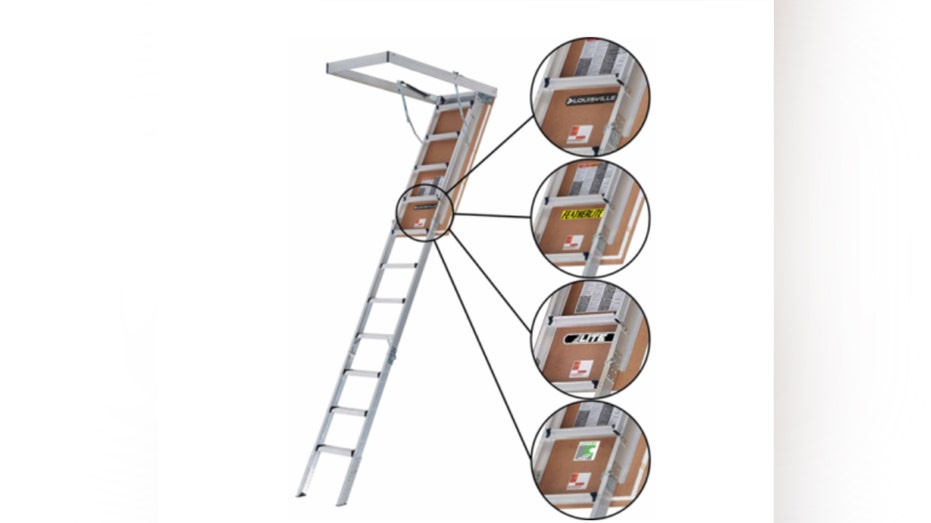
The recall involves certain Louisville, Featherlite, Lite and Century attic stairway ladders equipped with gas struts. (U.S. Consumer Product Safety Commission)
The company has received 11 reports of bolts breaking. One incident resulted in injuries to a consumer’s neck, head and back, according to the agency.
The affected aluminum- and wood-frame ladders include handrails and fold into attic openings. They were sold in several frame sizes, including widths of 22.5, 25.5 and 30 inches and lengths of 54 and 60 inches.
The ladders were designed for ceiling heights ranging from 7 feet, 8 inches to 12 feet, the CPSC noted.
POPULAR WALMART NUT BUTTER RECALLED AFTER TESTING DETECTS SALMONELLA

The ladders were sold at Home Depot, Lowe’s, Do It Best, Orgill and other retailers nationwide, as well as on Amazon. (U.S. Consumer Product Safety Commission)
Consumers can find the brand name and model number on the inside of the attic door.
The ladders were sold at Home Depot, Lowe’s, Do It Best, Orgill and other retailers nationwide, as well as on Amazon, from November 2012 through July 2026, according to the notice.
Prices ranged from approximately $170 to $600.
An additional 13,054 ladders were sold in Canada.
TARGET, KROGER, MEIJER FRUIT PURÉE POUCHES RECALLED OVER PLASTIC RISK: FDA

The Kentucky-based company has received 11 reports of bolts breaking. One incident resulted in injuries to a consumer’s neck, head and back, according to the agency. (U.S. Consumer Product Safety Commission)
Consumers are being urged to stop using the recalled ladders immediately and register for a free repair kit.
CLICK HERE TO GET FOX BUSINESS ON THE GO
For more information about the recalled products, visit the CPSC’s website.
Louisville Ladder could not immediately be reached by FOX Business for comment.

PostNL N.V. 2026 Q2 – Results – Earnings Call Presentation (OTCMKTS:PSTNY) 2026-08-06

US Senate Will Vote on CLARITY Crypto Bill ‘Without Any Question’ This Week: Tim Scott

QVC’s Toni Brattin Goes Viral After Saying ‘B*** Job’ on TV


-

 Fashion6 days ago
Weekend Open Thread: Wit & Wisdom
-

 Politics6 days ago
Meta enters AI-training agreement with far-right ‘propaganda rag’ Newsmax
-

 Politics4 days ago
Zack Polanski: an incitement to murder Nigel Farage?
-

 Crypto World5 days ago
MicroStrategy Post-Earnings CLARITY Act Push Could Add New Catalyst for Its Stock
-

 Crypto World6 days ago
XRP Ledger v3.3.0 brings five institutional features
-

 Crypto World6 days ago
New York sues Kalshi over prediction market gambling
-

 Sports7 days ago
Seema Kaliramna Wins Discus Throw Bronze, Takes India’s CWG Medals Tally To 17
-

 Crypto World5 days ago
Crypto PAC spending tops $2M in Michigan House race
-

 Business4 days ago
DTCR: Deleveraging And A Hedge Fund Collapse Point To A Possible AI Bottom
-

 Business6 days ago
Trump Announces Hamas Disarmament Agreement as Iran Strikes Kuwait Air Base and US Attacks Pause Overnight
-
 Crypto World6 days ago
3 Fed Officials Just Explained Their Rate Hike Vote: Is Inflation Winning?
-

 Tech5 days ago
ESET tracks rise in malicious AI skills and adaptable malware
-
 Tech7 days ago
Gemini Spark can now use Chrome logins and saved passwords to run errands on your behalf
-

 Tech6 days ago
Building A Reproduction PlayStation Motherboard
-
Crypto World4 days ago
XRP Ledger urges node upgrade after manifest flood
-

 Sports5 days ago
France Cricket implodes: letters hidden in a drawer and a board at war
-

 Crypto World6 days ago
Moneyflip CEO charged in $40K murder-for-hire plot
-
 Sports6 days ago
Bruno Fernandes decision made as Man United ‘discuss’ striker transfer option
-

 News Videos5 days ago
Financial Crash Expert: The 90-Day Collapse Timeline They Are Desperately Hiding.
-

 NewsBeat7 days ago
Spain sending troops as thousands enter enclave of Ceuta from Morocco
You must be logged in to post a comment Login