In his book Celebration of Discipline, American theologian Richard Foster warned that noise, hurry and crowds were the most significant obstacles to a vibrant spiritual life. The same could be said of successful value investing. When it comes to investing, ignoring the noise, exhibiting patience and being indifferent to the prevailing sentiment of the crowds sounds like the right thing to do. Most people would not argue with these principles, yet behavior suggests otherwise.
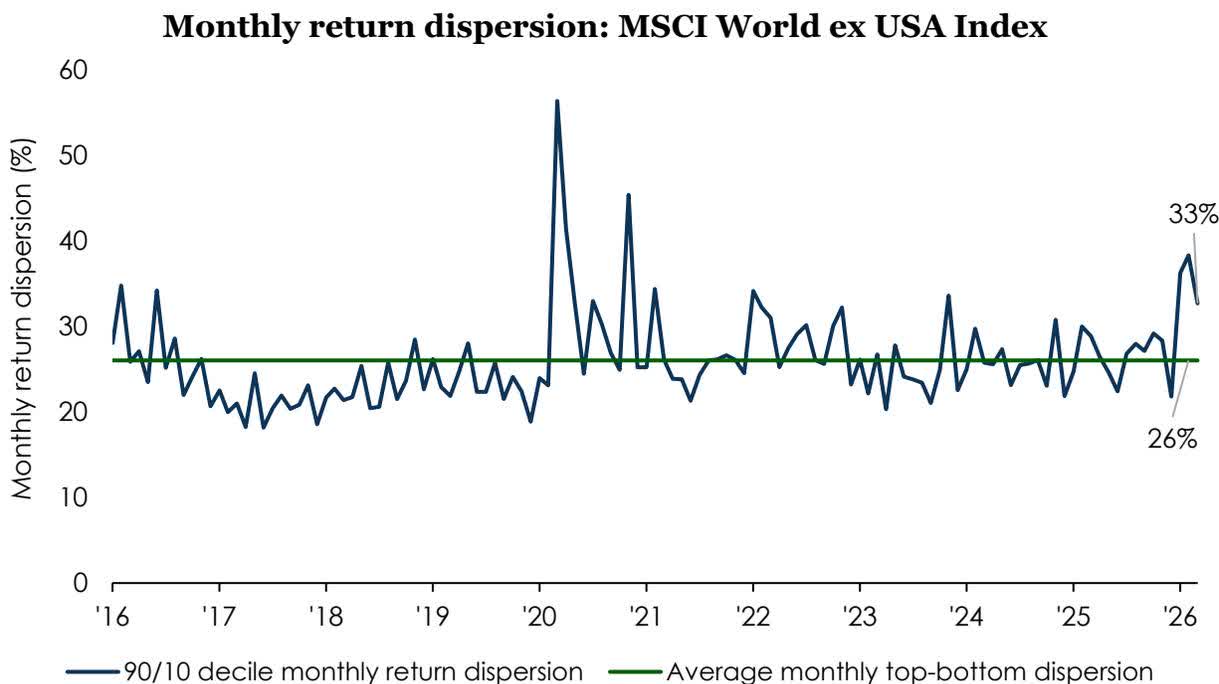
If there ever were a quarter of noise, this may have been it. The first 90 days of 2026 experienced near-record stock dispersion—that is, an unusually wide spread between the best- and worst-performing stocks—based on whatever company or industry the market happened to view that day as an AI winner or loser. For instance, the difference between the highest- and lowest-return stocks in the MSCI World ex-USA Index has been well above average, with a gap in performance of over 80 percentage points in the quarter, as investors debated the impact of AI. Then, in the last month of the quarter, bombs started falling in Iran and oil ran up well past $100 per barrel. As I write today, trying to make a deadline for publication with something timely and relevant, the White House announced progress toward a de-escalation. Noise galore.
Source: FactSet. Monthly data from 12/31/2015 through 3/31/2026. Returns represent the average performance of top and bottom decile stocks within the MSCI World ex USA Index; spreads are calculated as top decile minus bottom decile. Charts are for informational purposes only and do not depict the performance of any Harris | Oakmark strategy or product.
Advertisement
We aren’t technology neophytes; we believe AI is for real and is changing the way many of us work, and there will be winners and losers. However, we do believe the market has been too eager to declare victory and defeat. Where there is a real threat of change, we lower our estimate of value by reflecting a higher risk of disruption. In the case of large, deeply embedded enterprise software companies such as SAP, we think the market has skewed too negative on the risks introduced by AI, when in fact, there is a real possibility that AI is additive. We do not pretend to know how the Iran conflict is going to end, but there have been scores of these conflicts over my nearly 27 years at Harris | Oakmark and the world keeps turning. Remember, WTI (West Texas Intermediate) oil futures have both been in the triple digits and negative over the past six years. Meanwhile, population and incomes grow and the global economic pie along with them. We see the same bewildering headlines you do, but remain focused on the clarity of business values, which are far more stable than daily headlines.
The only way to really hurry your way to success in the equity markets is to have insight into the next tick and the ability to act before it moves. This requires an advantage in physics, not insight. At Harris | Oakmark, we estimate the intrinsic value of a business. There is an identifiable reason (or reasons) why the market price and our estimate differ. Often it boils down to our time horizon being longer than the marginal market participant. It takes time for value to be realized. Fixed income investors seem to understand this better than equity investors. In the bond world, one typically starts the conversation with duration—in other words, the desired time horizon for the securities you are looking to own. Equities are perpetual in duration, which means their theoretical time horizon is longer than that of even the longest bonds. Yet much of the market coverage focuses on one-minute charts, and the financial press seems to like or dislike a company based on how well it performed over the last quarter relative to broader expectations, with almost no airtime given to the long-term outlook for the business. Today, an estimated 60% of index options tied to the S&P 500 have same-day expirations and there are even new 5- and 10-minute option contracts being marketed for indices and cryptocurrencies. This short-termism reflects investors losing touch with the actual duration of the assets they own. Just because you can trade a stock one minute at a time (or less) doesn’t mean you should. At Harris | Oakmark, we think of equities as proportionate interests in real businesses that have real value based on the total future cash flows of the business. We have more insight into what the business ought to look like over time than where the stock will go over the next day, quarter or year. Don’t get me wrong, we would love the value gap to close the second we buy a stock, but unfortunately that is not how markets function.
Following the crowd is the easier—but more dangerous—path. I’m sure I’m not the only one who pleaded with my parents that, “everyone else was doing it” to which they replied, “if everyone else jumped off a cliff would you?” In markets, it is generally cause for concern when everyone seems to believe the same thing. Market participants make markets and markets price assets. Crowding occurs when there is more than typical agreement between market participants. That “agreement” gets priced into the asset such that there is little room for different outcomes without the stock getting pummeled. Beyond that, crowding introduces endogenous (or self-inflicted) risks that go beyond fundamentals, such as distorting liquidity dynamics on a security such that the distribution of future price outcomes skews negatively. By nature, as value investors we seek mispriced stocks—specifically, stocks selling well below their intrinsic value. Often this means going against the “crowd”. In our view, if everyone seems to believe something, you should assume a good portion of that belief is priced into the security. Meaning, if you and the crowds are right, there is little to no excess return and if wrong, painfully below average returns are likely. When a stock is undervalued, investors can afford to be wrong given the stock is unlikely priced to perfection. This is the essence of the “margin of safety” concept and the reason we require a significant discount before investing in any company.
We cannot promise much as regulated investment advisors but know that we are truly committed to a disciplined process that ignores the noise, exhibits patience, and is indifferent to the crowd.
Advertisement
Thank you for your partnership with us in our international equity portfolios.
We are eager to hear from you, so please do not be shy.
Tony Coniaris, CFA, Portfolio Manager
Advertisement
Important Disclosure
The securities mentioned above comprise the following percentages of the Oakmark International Fund’s total net assets as of 03/31/2026: SAP 2.0%. Portfolio holdings are subject to change without notice and are not intended as recommendations of individual stocks.
This material is not intended to be a recommendation or investment advice, does not constitute a solicitation to buy, sell or hold a security or an investment strategy, and is not provided in a fiduciary capacity. The information provided does not take into account the specific objectives or circumstances of any particular investor, or suggest any specific course of action. Investment decisions should be made based on an investor’s objectives and circumstances and in consultation with his or her financial professionals.
The information, data, analyses, and opinions presented herein (including current investment themes, the portfolio managers’ research and investment process, and portfolio characteristics) are for informational purposes only and represent the investments and views of the portfolio managers and Harris Associates L.P. as of the date written and are subject to change and may change based on market and other conditions and without notice. This content is not a recommendation of or an offer to buy or sell a security and is not warranted to be correct, complete or accurate.
Advertisement
Certain comments herein are based on current expectations and are considered “forward-looking statements.” These forward-looking statements reflect assumptions and analyses made by the portfolio managers and Harris Associates L.P. based on their experience and perception of historical trends, current conditions, expected future developments, and other factors they believe are relevant. Actual future results are subject to a number of investment and other risks and may prove to be different from expectations. Readers are cautioned not to place undue reliance on the forward-looking statements.
Investing involves risk; principal loss is possible. There is no guarantee the Fund’s investment objective will be achieved. Value stocks may fall out of favor with investors and underperform growth stocks during given periods. Foreign securities presents risks that in some ways may be greater than investments in U.S. investments. Those risks include: currency fluctuation; different regulation, accounting standards, trading practices and levels of available information; generally higher transaction costs; and political risks. The Fund’s portfolio tends to be invested in a relatively small number of stocks. As a result, the appreciation or depreciation of any one security held by the Fund will have a greater impact on the Fund’s net asset value than it would if the Fund invested in a larger number of securities. Although that strategy has the potential to generate attractive returns over time, it also increases the Fund’s volatility. These and other risk considerations are described in detail in the Fund’s prospectus.
Before investing in any Oakmark Fund, you should carefully consider the Fund’s investment objectives, risks, management fees and other expenses. This and other important information is contained in a Fund’s prospectus and summary prospectus. Please read the prospectus and summary prospectus carefully before investing. For more information, please visit Oakmark.com or call 1-800-OAKMARK (1-800-625-6275).
Harris Associates Securities L.P., Distributor, Member FINRA.
LOS ANGELES — HBO’s hit series “Euphoria” returns for its third season with exactly eight episodes, maintaining the episode count of its previous two seasons while shifting the story forward several years into the characters’ post-high school lives. The season premiered on April 12, 2026, and airs weekly on Sundays, with the finale scheduled for May 31.
Euphoria Season 3
As of Memorial Day 2026, viewers have seen seven episodes, with the eighth and final episode set to drop next Sunday. The consistent eight-episode structure has become a hallmark for the Sam Levinson-created drama, allowing for deep character exploration amid its signature stylish, intense storytelling.
Season 3 picks up with Zendaya’s Rue Bennett navigating life after high school, facing new challenges including debts and dangerous entanglements. The time jump moves the ensemble — including Sydney Sweeney’s Cassie, Jacob Elordi’s Nate, and Hunter Schafer’s Jules — into young adulthood, exploring themes of faith, consequence and fractured relationships in a more mature but no less chaotic setting.
HBO confirmed early that the third season would consist of eight episodes, each running approximately movie-length at around 60 to 90 minutes. This format has enabled ambitious storytelling, with some installments drawing comparisons to feature films in scope and production value.
The season opened strongly, drawing 8.5 million viewers across HBO and Max in its first three days — a notable increase from Season 2’s premiere. Early episodes like “Ándale,” “America My Dream,” and “The Ballad of Paladin” introduced high-stakes plots involving cartel dealings, chaotic weddings and personal reckonings.
Advertisement
By mid-season, the show continued pushing boundaries with storylines featuring Cassie’s OnlyFans success, Rue’s deepening involvement in criminal activities, and Jules navigating life as an art school dropout. Recent episodes, including Episode 7 “Rain or Shine,” have sparked intense fan discussions around character arcs and shocking developments.
Creator Sam Levinson has described the season as the show’s strongest yet, urging fans to watch the final episodes live to avoid spoilers. “There’s some big things that happen,” he noted during recent promotional events. The ambitious scope includes longer runtimes and cinematic influences, such as references to classic films in specific episodes.
The decision to stick with eight episodes reflects HBO’s strategy for premium dramas, balancing depth with audience engagement. Previous seasons also featured eight main episodes, supplemented by holiday specials during the pandemic era. Season 3 maintains this focused approach while delivering heightened production elements.
Viewership and cultural impact remain significant. The series continues to dominate social media conversations, with hashtags related to specific episodes trending weekly. Fans have reacted strongly to shifts in character focus, including limited screen time for some favorites, prompting discussions about narrative choices.
Advertisement
Critics have offered mixed but engaged responses. Some praise the visual flair and performances, particularly Zendaya’s nuanced portrayal of Rue’s ongoing struggles. Others note the heightened intensity and tonal shifts as the characters age. The season’s exploration of faith, referenced in multiple episodes, adds a new layer to the drama’s emotional core.
Production details highlight the show’s commitment to quality. Each episode features elaborate sets, costumes and soundtracks that have become signatures of the series. Composer Hans Zimmer’s involvement has been highlighted as elevating key moments.
As the season nears its conclusion, anticipation builds for the 93-minute finale titled “In God We Trust.” Levinson wrote and directed the episode, promising a fitting close to this chapter of the story. Whether the series will continue beyond Season 3 remains unconfirmed, though strong performance could open doors for future installments.
The eight-episode run has allowed for serialized storytelling that rewards dedicated viewers. Weekly releases have kept engagement high, with each new installment dropping at 9 p.m. ET on HBO and streaming simultaneously on Max. This cadence mirrors successful models used by other prestige series.
Advertisement
Behind the scenes, the cast’s chemistry continues to drive the narrative. Returning stars like Zendaya, Sweeney, Elordi and Schafer anchor the ensemble, while supporting players contribute to the expanded world. Challenges such as scheduling and the time jump required careful handling to maintain continuity.
Audience reception has been robust despite the four-year gap since Season 2. The show’s ability to evolve with its characters — moving from high school turmoil to adult complexities — has resonated with both longtime fans and new viewers discovering the series.
Marketing efforts included multiple trailers showcasing the darker, more mature tone. HBO positioned Season 3 as a major event, capitalizing on the built-in anticipation following the long hiatus. Social media campaigns and cast interviews helped maintain buzz throughout the rollout.
Looking at the broader television landscape, “Euphoria” stands out for its bold approach to youth and young adult storytelling. Its influence extends beyond screens into fashion, music and cultural conversations about mental health, addiction and identity. The eight-episode structure supports this depth without overstaying its welcome in a single season.
Advertisement
As Memorial Day 2026 passes, many viewers are catching up or rewatching earlier episodes ahead of the finale. Online forums and review sites show active discussions analyzing symbolism, predicting outcomes and debating character motivations. The show’s visual style continues to spark imitation and analysis.
HBO’s investment in the series reflects confidence in its staying power. With strong premiere numbers and sustained interest, Season 3 positions “Euphoria” as a flagship title for the network and streaming service. The consistent episode count provides a reliable framework for Levinson’s vision.
In the final stretch, the remaining episode promises to tie together threads involving Rue’s spiritual awakening, interpersonal conflicts and larger criminal elements. Fans hope for satisfying resolutions while bracing for the emotional intensity the series is known for.
The eight-episode season represents both a continuation and potential culmination of a cultural phenomenon. As audiences prepare for the conclusion, “Euphoria” reaffirms its place as one of television’s most talked-about dramas, delivering raw storytelling wrapped in cinematic packaging.
Advertisement
Whether this marks the end or a new beginning for the franchise, Season 3’s structured yet expansive narrative has given viewers a compelling next chapter in the lives of its complex characters.
FTSE Russell is a leading global provider of index and benchmark solutions, spanning diverse asset classes and investment objectives. As a trusted investment partner we help investors make better-informed investment decisions, manage risk, and seize opportunities.Market participants look to us for our expertise in developing and managing global index solutions across asset classes. Asset owners, asset managers, ETF providers and investment banks choose FTSE Russell solutions to benchmark their investment performance and create investment funds, ETFs, structured products, and index-based derivatives. Our clients use our solutions for asset allocation, investment strategy analysis and risk management, and value us for our robust governance process and operational integrity.For over 40 years we have been at the forefront of driving change for the investor, always innovating to shape the next generation of benchmarks and investment solutions that open up new opportunities for the global investment community.
The £250,000 office review will be funded using the council’s reserves
11:00, 25 May 2026Updated 11:08, 25 May 2026
Newport civic centre.(Image: Copyright Unknown)
The future of Newport’s civic centre could be decided in a new review of the city council’s office buildings. Cabinet members have agreed to spend £250,000 on a new strategy for its various offices – including its headquarters.
The civic centre is a listed building containing the council chamber and is the base for many of the local authority’s administrative functions, but in recent years has faced an uncertain future.
Advertisement
It is currently closed on Fridays for cost-cutting purposes.
A relocation plan was previously considered and then shelved by decision-makers, and the council said in mid-2025 it had “no plans to” move its headquarters to another location.
Some critics have argued the civic centre is underused, however.
Advertisement
Freedom of Information Act disclosures last year showed its running costs reached £1.05 million in 2024, and there were typically between 200 and 350 staff working daily at a building which contains around 380 “office rooms”.
At the time, Cllr David Fouweather, a Conservative, said a move could save the council money, and by encouraging more people to return to the office would provide a “better service” than working from home.
Independent councillor Mark Howells said last year staff should return to the office to improve customer service levels.
However, the council has defended its home-working policies as having “clear benefits to it around recruitment and retention, congestion and climate change”.
Advertisement
The £250,000 office strategy will be funded using the council’s reserves, following cabinet approval
They also approved a £750,000 purchase of a property to serve as an additional children’s home, as well as the use of reserves to fund £631,000 of work “on developing a clearer understanding of the key drivers of demand and cost within adult social care”, and £40,000 for a review of the council’s fees and charges.
Laurence Escalante’s VGW Holdings has seen a 19 per cent increase in revenue to $7.3 billion from rising online gaming, pushing net profit up by a third to more than $650 million.





















































You must be logged in to post a comment Login