
Business
One Arrest Made, But Experts Say FBI Still Far From Solving It


TUCSON, Ariz. — Five months after Nancy Guthrie vanished from her Tucson home, leaving behind her medication, wallet and cellphone, federal investigators are still pursuing the case as a kidnapping for ransom, one arrest has been made in connection with fraudulent communications, and experts outside the investigation are increasingly skeptical that any of the ransom notes publicly reported so far are genuine.
The 84-year-old mother of “Today” show co-anchor Savannah Guthrie disappeared in the early hours of February 1 after being dropped off at her Catalina Foothills home the previous evening. Blood found on her front porch was confirmed by DNA testing to belong to her. Surveillance footage recovered from corrupted camera data showed a masked individual tampering with her doorbell camera that night. Her pacemaker app disconnected from her phone at 2:28 a.m., a timestamp investigators believe may correspond to when she was forcibly removed from the home.
Despite that physical evidence, no suspects or persons of interest have been publicly named in connection with the actual disappearance, and the investigation now enters its sixth month without a confirmed account of what happened or where Guthrie is.
Criminal defense attorney and trial lawyer Mark Geragos told NewsNation’s “Cuomo” program that he believes the FBI has consolidated its control over the investigation and that any breakthrough is most likely to come from inside the alleged criminal network rather than from external tip lines or media pressure.
“The FBI now, I think, has pretty firm control over the investigation, and they believe at this point that if it’s going to be solved, it’s going to be solved by somebody who I always call a confederate or somebody who’s going to give some information,” Geragos said.
Criminologist Casey Jordan offered a blunter assessment of the ransom notes that have circulated through media channels since February, telling NewsNation she believes none of them are credible based on a fundamental absence of verification.
“The No. 1 reason, and this is probably 90% of it, is that nothing, no communication is offered, any proof of life, proof of death, evidence of anything,” Jordan said.
She elaborated on why the absence of verifiable details undermines the notes’ credibility even when they contain accurate-sounding information about the case.
“The bottom line is, whatever they’re mentioning that we know of is stuff they could have just learned online or picked up from AI and, you know, the satellite images of the scene and everything else. So, without any proof of life or death, there is no reason to believe that they’re real. But I agree with Mark, the FBI is just kind of hedging their bets,” Jordan added.
The FBI itself struck a careful balance in its most recent public statement on the ransom notes, declining either to fully authenticate or entirely dismiss the body of communications it has received.
“The FBI and its task force partners have received several ransom notes over the course of this investigation. Some have been deemed to be extortion attempts without legitimacy. Other ransom demands may potentially be legitimate and are still being investigated as such. This case continues to be investigated as a kidnapping for ransom case. The FBI has and will continue to offer all assistance possible in the investigation — however, local authorities remain the lead,” the agency said.
The one concrete enforcement outcome from the ransom note investigation came Thursday, July 2, when Derrick Callella, 42, of Hawthorne, California, pleaded guilty to two counts of harassment using a telecommunication device. The U.S. Attorney’s Office for the District of Arizona confirmed the plea, which addressed Callella’s decision to call and text members of the Guthrie family on February 4, just days after Nancy’s disappearance, demanding a Bitcoin transfer in exchange for information about her return. Callella acknowledged in his plea that he knew an earlier ransom demand had already been made and that his goal was to harass the family and attempt to extract details about the investigation rather than to provide genuine information. He faces a maximum of two years in federal prison and a fine of up to $250,000 at a sentencing scheduled for September.
The broader chronology of communications in the case is complicated. Tucson television station KOLD-TV received two notes, one demanding millions in Bitcoin for Guthrie’s safe return and another claiming she had died. Entertainment outlet TMZ separately confirmed it had received a ransom note and subsequently reported receiving additional emails from what appeared to be the same sender. The FBI said its anonymous official’s earlier characterization to Reuters, which suggested all three widely publicized notes had been deemed fraudulent, was an incomplete representation of the bureau’s actual assessment, which distinguishes between notes fully dismissed as extortion attempts and others still under active investigation. Pima County Sheriff Chris Nanos had already expressed skepticism about the most recent TMZ note publicly, calling it consistent with the pattern of fake ransom demands the FBI had seen throughout the case.
The Callella guilty plea is the only confirmed criminal outcome so far. FBI special agent Heith Janke had disclosed at a February 5 press conference that someone had been arrested for sending an “imposter ransom demand” to family members, with Callella having initially pleaded not guilty before changing his plea this week.
The investigation has produced several pieces of physical evidence without leading to a named suspect. Blood confirmed as Nancy Guthrie’s was found on her front porch. A strand of hair was recovered inside the home. DNA from a glove found roughly two miles from the property failed to match any profile in the FBI’s national CODIS database, prompting investigators to pursue genetic genealogy testing. A separate human bone found near the property in May was ruled unrelated to the case. The masked individual seen on doorbell footage remains unidentified.
The Guthrie family’s combined reward for information remains at $1.1 million, covering both a $1 million family pledge and the FBI’s existing $100,000 offer. Savannah Guthrie has continued anchoring “Today” during much of the investigation while making periodic on-air appeals for public assistance, most recently describing the experience as “five months of agony and unending trauma” for her family as the investigation shows no sign of imminent resolution despite the substantial evidence collected and the federal resources deployed since February 1.


AstraZeneca holds talks with Bristol Myers Squibb on $400 billion megadeal, FT reports
Business
These 9 equity mutual funds delivered over 10% returns in July. Did you invest in any of them?

Technology-focused mutual funds dominated the performance charts in July, with nine equity schemes delivering returns of over 10%. HDFC Technology Fund topped the list with a 16.91% gain, while international funds accounted for most of the double-digit losers during the month.
US lawmaker Kaptur injured in car crash, her office says
Eleven penny stocks delivered multibagger returns of up to 198% over the past six months. Screened using a market capitalisation below Rs 1,000 crore, a share price under Rs 20, and a minimum latest trading volume of 5 lakh shares, these low-priced stocks stood out for their strong price momentum despite the high risks typically associated with the segment.
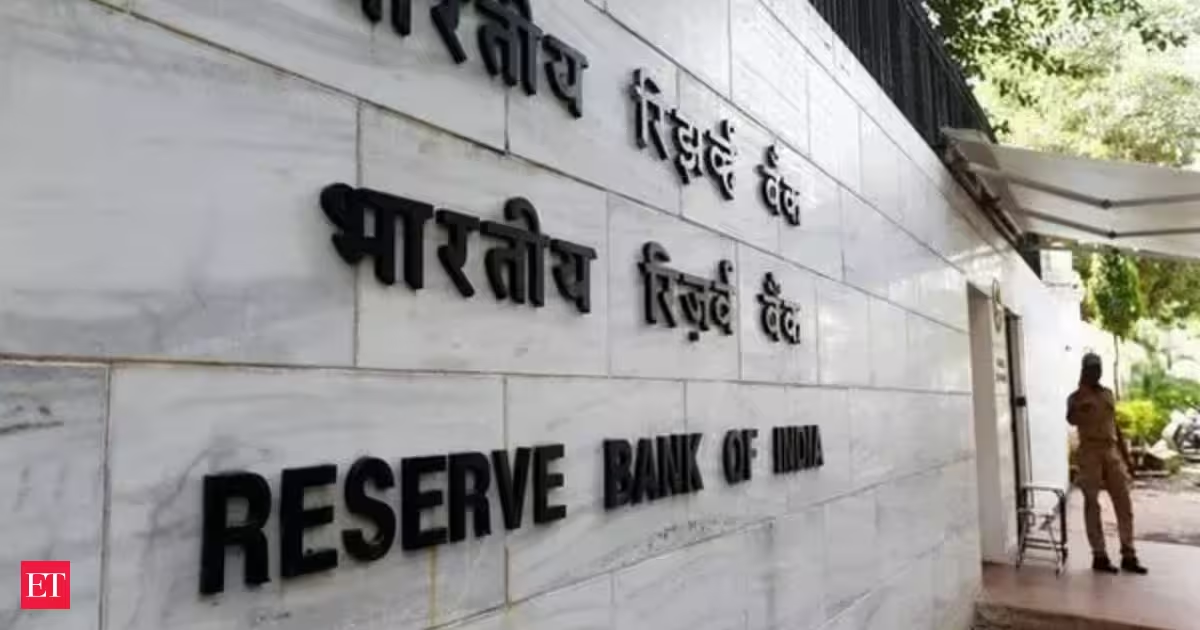
“If the current pace of FCNR(B) inflows, as reflected in the central bank data, continues, we may well see three-digit US dollar billion mobilisation, significantly exceeding the initial estimates of $50-60 billion,” said VRC Reddy, head of treasury, Karur Vysya Bank. “The momentum so far has been a pleasant surprise.”
The Reserve Bank of India (RBI) Saturday said the special programmes between them had mobilised $40.81 billion in foreign exchange inflows up to July 31. Of this, FCNR(B) deposits accounted for $36.72 billion, despite the current programme having been operational only since June 8. The strong response has prompted economists to raise their estimates of the eventual mobilisation under the scheme.
“The cumulative inflows across FCNR(B), ECB and OFCB could reach $90 billion or even higher. Collections so far have been much stronger than expected,” said Gaura Sengupta, chief economist, IDFC First Bank.

She has consequently revised FY27 balance of payments surplus forecasts to $40 billion from $25 billion earlier.

The dedicated facilities, announced by the RBI on June 5 and operationalised on June 8, provide concessional foreign exchange swaps to banks to encourage capital inflows, support the balance of payments, cushion the rupee and contain imported inflation. The FCNR(B) window remains open until September 30, while the ECB and OFCB windows will remain available until December 31.
Robust Flows
“We continue to see up to $75 billion being raised under these concessional schemes, helping fund the current account gap, with a possible balance of payments surplus of nearly $35 billion in FY27,” said Madhavi Arora, chief economist at Emkay Global Financial Services.
Madan Sabnavis, chief economist, Bank of Baroda, estimates the overall mobilisation around $70 billion. “We believe around $70 billion can come through the total window, with $50-60 billion from FCNR(B) alone and another $10 billion from ECB and OFCB, though those flows are likely to pick up only after September,” he said.
Business
Dividends & stock splits: Maruti Suzuki, ICICI Bank among nearly 100 stocks turning ex-date this week. Do you own?

Interested investors need to hold shares of these companies in their demat accounts on the record date to be eligible for the respective corporate actions. The list remains tentative, as more companies may announce record dates for dividends, bonus issues and stock splits during the week.
Here is a day-wise list of corporate actions to watch out for this week.
August 3 (Monday)
Around 12 companies have fixed August 3 (Monday) as the record date for their respective dividends. The most notable name among them is ICICI Bank. The heavyweight private lender has fixed Monday as the record date for its final dividend of Rs 12 per share.
IT player Coforge also has fixed Monday as the record date for its interim dividend of Rs 4 per share, while Emkay Global Financial Services will turn ex-record date for a final dividend of Rs 1.5 per share.
Other stocks that will turn ex-record date on this day include Bannari Amman Spinning Mills (Rs 0.25 per share), Ganesh Infraworld (Rs 0.1 per share), Kakatiya Cement Sugar & Industries (Rs 3 per share), Kanpur Plastipack (Rs 1.2 per share), Khazanchi Jewellers (Rs 0.5 per share), Lakshmi Engineering and Warehousing (Rs 10 per share), Prima Plastics (Rs 2 per share), Sai Silks (Rs 1.5 per share) and Transrail Lightning (Rs 3 per share).August 4 (Tuesday)
Bosch accounts for the highest dividend payout among the stocks turning ex-record date for dividends on Tuesday. The company will pay a dividend of Rs 270 per share to its eligible shareholders.
CONCOR will pay an interim dividend of Rs 1.6 per share, while Alembic Pharma and Balkrishna Industries will pay dividends worth Rs 2.4 per share and Rs 4 per share, respectively. Other stocks turning ex-record date on Tuesday include Andhra Paper (Rs 0.5 per share), CE Info Systems (Rs 3.5 per share), Eveready Industries (Rs 2.5 per share), Greenply Industries (Rs 0.5 per share), Hirect (Rs 1.4 per share), Mysore Petro Chemicals (Rs 2 per share), PCBL Chemical (Rs 4.5 per share), Sonam (Rs 0.3 per share), TCPL Packaging (Rs 25 per share) and The Grob Tea Company (Rs 2 per share).
August 5 (Wednesday)
Disa India accounts for the highest dividend payout among the stocks turning ex-record date for dividends on Wednesday, with a final dividend of Rs 200 per share.
Bayer CropScience and Automotive Axles will pay final dividends of Rs 60 per share and Rs 32 per share, respectively, while Goodyear India will pay a final dividend of Rs 26.5 per share. Gandhi Special Tubes will pay a final dividend of Rs 15 per share, Matrimony.Com will pay Rs 5 per share, Munjal Showa will pay Rs 4.5 per share, Berger Paints India will pay Rs 4 per share, Fermenta Biotech will pay Rs 3.75 per share, and Sika Interplant Systems will pay Rs 3.5 per share.
Other companies turning ex-record date for final dividends on Wednesday include Brigade Enterprises (Rs 2 per share), Indef Manufacturing (Rs 2 per share), Somany Ceramics (Rs 2 per share), Anuh Pharma (Rs 1.5 per share), Indag Rubber (Rs 1.5 per share), Shreyans Industries (Rs 1.5 per share), Mukesh Babu Financial Services (Rs 1.2 per share), TD Power Systems (Rs 1.1 per share), ADF Foods (Rs 0.6 per share), and Oriental Aromatics (Rs 0.5 per share).
In addition, Ajanta Pharma, IRB Infrastructure Developers, and Vedanta Aluminium Metal will turn ex-record date for their respective dividends, while Tembo Global Industries will turn ex-record date for a stock split from Rs 10 to Rs 1 per share.
August 6 (Thursday)
Lumax Industries accounts for the highest dividend payout among the stocks turning ex-record date for dividends on Thursday, with a final dividend of Rs 55 per share.
Rane Holdings will pay a final dividend of Rs 47 per share, while Linde India will pay a combined dividend payout comprising a final dividend of Rs 4 per share and a special dividend of Rs 8 per share. Tasty Bite Eatables will pay a final dividend of Rs 10 per share, Lumax Auto Technologies will pay Rs 5.5 per share, Praj Industries will pay Rs 3.6 per share, and Hercules Investments will pay Rs 2.5 per share.
Other companies turning ex-record date for final dividends on Thursday include Bharat Gears (Rs 1 per share), Investment & Precision Castings (Rs 1 per share), Mindteck (India) (Rs 1 per share), and Bemco Hydraulics (Rs 0.1 per share).
August 7 (Friday)
Maruti Suzuki India accounts for the highest dividend payout among the stocks turning ex-record date for dividends on Friday, with a final dividend of Rs 140 per share.
Chennai Petroleum Corporation will pay a final dividend of Rs 54 per share, while Avanti Feeds, Grasim Industries, Jasch Gauging Technologies, PI Industries, United Breweries, and Venus Remedies will pay dividends of Rs 10 per share each. Sharda Cropchem will pay a final dividend of Rs 9 per share, Ipca Laboratories will pay Rs 6 per share, KEC International and Nava will pay Rs 5.5 per share each, BDH Industries will pay Rs 5 per share, and Lodha Developers will pay Rs 4.25 per share.
Bhagwati Autocast will pay a final dividend of Rs 3.5 per share, while Mukand, Netweb Technologies India, and Quess Corp will pay Rs 3 per share each. Shyam Metalics And Energy will pay Rs 2.7 per share, and Aarvi Encon and Wonderla Holidays will pay Rs 2 per share each.
Arvind Fashions will pay a final dividend of Rs 1.6 per share, while Rubicon Research, Sahyadri Industries, Shri Dinesh Mills, Tube Investments of India, and Varroc Engineering will pay Rs 1.5 per share each. Cholamandalam Financial Holdings will pay Rs 1.3 per share, Aditya Birla Lifestyle Brands and BN Rathi Securities will pay Rs 0.5 per share each, Steelcast will pay an interim dividend of Rs 0.45 per share, Westlife Foodworld will pay an interim dividend of Rs 0.4 per share, and IDFC First Bank, Manba Finance, and Sagility will pay Rs 0.25 per share, Rs 0.25 per share, and Rs 0.1 per share, respectively.
In addition, JOJO Ltd. will turn ex-record date for a stock split from Rs 10 to Rs 5 per share.
Also read | Odyssey of stock market: What investors can learn from the Greek epic hero’s journey back home?
(Disclaimer: Recommendations, suggestions, views and opinions given by the experts are their own. These do not represent the views of The Economic Times)
Business
AI may hurt IT today, but it could create the sector’s next growth engine: Baroda BNP Paribas MF

The fund house believes the recent correction in IT stocks reflects concerns over tariffs, AI-led disruption and weak near-term earnings guidance, but says the long-term opportunity lies in the industry’s transition from pilot AI projects to large-scale enterprise deployments. Korde sees emerging demand for data engineering, cybersecurity, cloud integration, specialised semiconductor infrastructure and AI-enabled hardware as potential growth drivers, even if traditional revenue streams come under pressure.
“While the existing revenue pools may get impacted, every disruption provides an opportunity as well, as has been witnessed in the past,” he said in an interview with ETMarkets.
Edited excerpts from a chat:
The government’s policy thrust is firmly behind manufacturing, yet you are more bullish on services. What is the market underestimating about the services opportunity?
While there has been a visible thrust on the manufacturing sector through various measures such as introduction of Production Linked Incentives (PLI) and promoting Make in India, it is also quite noticeable that the service sector has not been ignored. Various policies such as national Tourism Policy 2015, National Education Policy 2016, National Health Policy 2017, and initiatives like the National Mission on Pilgrimage Rejuvenation and Spiritual, Heritage Augmentation Drive (PRASAD) to name just a few, have helped drive growth in the services sector as well. Interestingly, The Gross Value Added by the Services sector has averaged 7.1%* year on year growth in the past 20 years, higher than both Industry and Agriculture average growth rate.
Which segments within services—financials, IT, healthcare, telecom, travel or digital businesses—offer the strongest earnings visibility over the next three to five years?The services sector offers multiple sectoral opportunities to invest in: Financial Services, Information Technology, Consumer Services, Power, Healthcare, Telecommunication, Oil & Gas, Telecommunication, Services, and Media & Publication. A lot of companies within these sectors have been growing at a fair clip in the past 5 years. We project good growth visibility in Financial Services (on low credit penetration and financialization of savings), Healthcare (aging demographics, expanding middle class, lifestyle diseases and wellness focus, and potential to see increase in medical value tourism), and Consumer Services (rapid digital acceleration boosting growth in e-commerce and quick commerce driving volumes across audience).
Indian IT services face uncertainty from AI-led disruption. Do you see AI as a threat to existing revenue pools or as the sector’s next growth driver?
The IT Sector has corrected by 23% over the last 1 year led by concerns around uncertainty led by tariffs and AI dominance. Even the growth guidance for FY27 remains weak, though the sector is a beneficiary of the weaker local currency. So, while the impact on stock prices has been immediate, there hasn’t been adequate clarity on how the opportunities might manifest. However, there can be potential prospects as the move from pilot AI projects to scaled enterprise deployments occur, which may be in the form of massive data engineering, new cybersecurity frameworks, or cloud integration & architectures and specialized semiconductors (GPUs, NPUs, TPUs), edge-AI devices, and data center infrastructure on the hardware side. To sum up, while the existing revenue pools may get impacted, every disruption provides an opportunity as well, as has been witnessed in the past.
Financial services represent a significant part of the listed services universe. Where do you currently see the best risk-reward—banks, NBFCs, insurers, asset managers or capital-market businesses?
Within the Financial Services space, we have a preference for Mid cap banks, NBFCs and platform companies in that order.
From a broader market perspective, do you expect returns over the next year to be driven by earnings growth, valuation expansion or sector rotation?
Generally, the markets do well when there is confidence in the earnings growth trajectory. IMF projects India’s GDP growth at ~6.4% for FY27* and identifies India as the fastest-growing major global economy, bolstered by resilient domestic consumption, robust services activity, and reduced external tariffs. This is higher than their projected growth rate of 3.9% for emerging markets and developing economies and 3.1% for the World. In this scenario, earnings growth, especially if the war scenario tapers off, can be a good growth driver for the markets. Of course, if this war extends further, or in case of additional hostilities elsewhere, corporate earnings are vulnerable to the tune of 300-500bps, in which case instead of earnings growth, sector rotation can be the driver.
Midcap valuations remain elevated despite uneven earnings delivery. Where do you still find a favorable risk-reward, and which segments appear priced for perfection?
While Midcap valuations may appear expensive in isolation, the current valuation is at a 6% discount to the past 8 year average PE multiple of the index. Similarly, even the large cap Nifty 100 index is trading at a lower valuation (by~8%) to its past 8 year average. At the same time, the small cap index is trading at a premium to its historical valuation. Hence risk reward broadly appears to be favourable in valuation terms for both mid cap and large cap segments.
Which sectors currently offer the strongest overlap between the midcap and value frameworks, and will return over the next three years be driven primarily by earnings growth, valuation rerating or successful corporate turnarounds?
To answer the latter part of the question, as mentioned earlier, earnings growth for India should be a key driver for returns. Successful corporate turnarounds are unique and company specific events, so they cannot be classified as a category driver, while valuation rerating is often derived as a function or outcome of improved earnings growth trajectory.
In the context of Indian markets, the mid cap framework is largely growth oriented, but following the Growth at Reasonable Prices (GARP) philosophy helps in identifying some themes closer to the value philosophy. We see Financial Services and IT offering good overlap between these frameworks due to stock correction, discounted valuation as compared to historical averages, overall good management quality, and healthy cash flow generation.
If you must start an SIP of Rs 10,000 as an investor with moderate risk appetite at this stage, how would it be spread out across various fund categories? Consider a long-term horizon of 10 years.
While it is difficult to be generic when individual investor risk return profile and tenure are different, and a planner with a holistic view of the client can be a better judge on these aspects, we believe a broad core portfolio from a longer term perspective would appear as spread 20% in hybrid (BAF), 20% each in the large / mid / small categories and the balance 20% in a thematic (value / services / consumption).
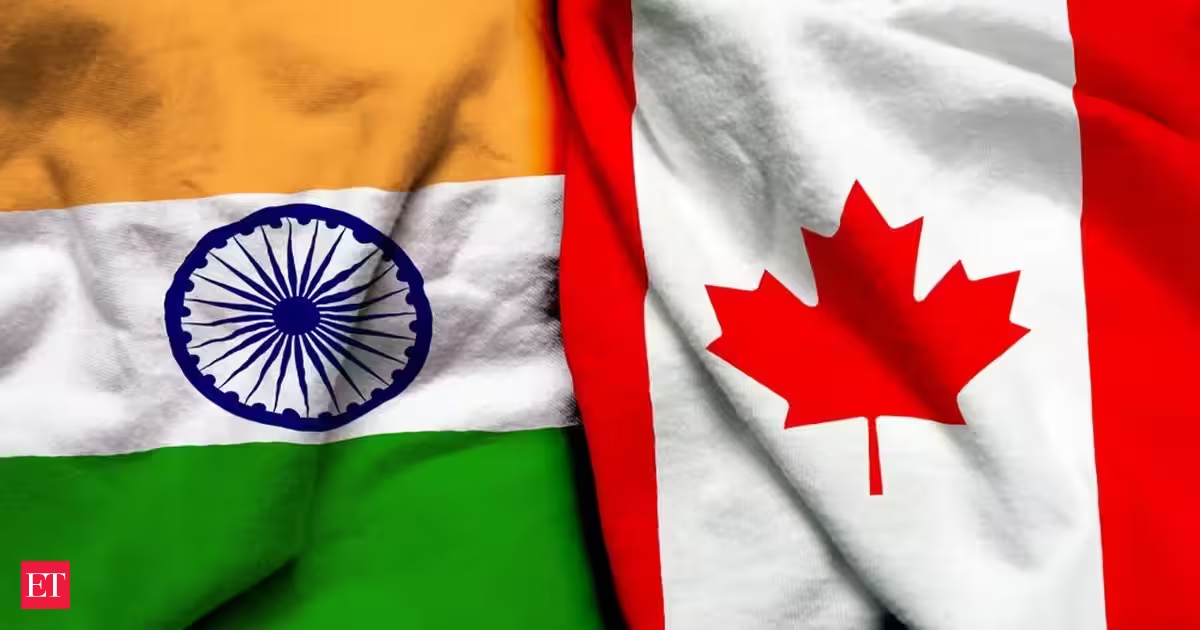
In a written reply in the Rajya Sabha, minister of state for external affairs Kirti Vardhan Singh said on Friday that three rounds of CEPA negotiations have been held so far, with the latest round taking place in Ottawa from July 6-10. “Progress has been made across multiple negotiating tracks, with both sides working towards concluding the process by late 2026,” he said. PM Narendra Modi plans to visit Canada later this year to give further momentum to bilateral ties, which have improved under the current dispensation in Ottawa. The MEA said the proposed India-Canada CEPA aims to establish a free trade area by eliminating or reducing tariffs and other trade restrictions. The agreement is also intended to progressively liberalise trade in goods and services, promote a more transparent, predictable and facilitative trade and investment regime, and strengthen economic cooperation and people-to-people ties.
Canada represents a market of 41.65 million people, as of 2025, and $2.34 trillion in terms of GDP in terms of purchasing power parity.
The India-Canada CEPA holds significant potential to unlock and expand bilateral trade, which stood at $8.66 billion in 2024-25, comprising exports worth $4.22 billion from India and imports of $4.44 billion, according to an official.
Business
Govt’s urban reset: Centre divides ministry of Housing and Urban Affairs into two specialised verticals
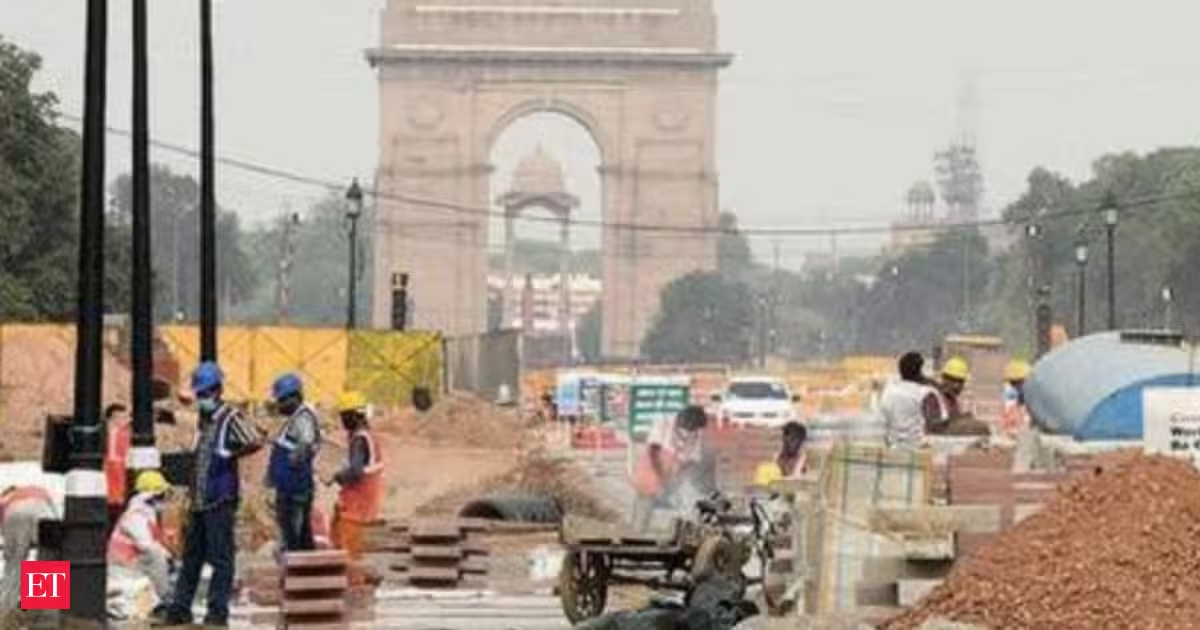
The administrative revamp follows the government’s decision last Thursday to split the ministry into two specialised verticals: Department of Capital Development (Rajdhani Vikas Vibhag) and the Department of Urban Development (Shehari Vikas Vibhag). The division is designed to enable dedicated focus on distinct aspects of urban planning while streamlining service delivery, execution, and policy interventions.
The administrative reshuffle moved at breakneck speed. Within 24 hours of the Gazette notification, secretary Srinivas Katikithala (a 1989-batch IAS officer of Gujarat cadre) handed over charge of the newly-created department of capital development to D Thara, a 1995-batch IAS officer from the same cadre. Simultaneously, the Centre posted Satendra Singh (a 1995-batch Jharkhand cadre IAS officer) as secretary to lead the Department of Urban Development. The overhaul extends deep into the operational leadership of Centre’s core urban schemes.
Crucial personnel shifts include Kuldeep Narayan, who was directing the flagship housing scheme Pradhan Mantri Awas Yojana (Urban), moving to Niti Aayog. Roopa Mishra, who spearheaded the Swachh Bharat Mission (Urban), has also been reassigned. New directors are slated to assume charge within the next fortnight to ensure seamless administrative continuity. At the heart of this structural realignment is a targeted policy focus on the national capital. The Centre has set its sights on resolving Delhi’s long-standing, complex urban challenges through a bifurcated strategy. With a BJP government in power in Delhi, the ministry bifurcation will also help in better implementation of infrastructure projects, including the ambitious Central Vista project.
Business
US Senator Moreno says Ohio’s Miller should not serve in Congress, citing abuse allegations

US Senator Moreno says Ohio’s Miller should not serve in Congress, citing abuse allegations

Karlissa Saffold Reacts To Kai Bandz & Yaya Mayweather’s Link-Up

financial accounting 4th semester || financial accounting

Andy Burnham insists Labour is restoring control of Britain’s borders despite 2,000 illegal migrant crossings since he became Prime Minister


-

 Business4 days ago
Why Trees Belong on the Risk Register
-

 Fashion2 days ago
Weekend Open Thread: Wit & Wisdom
-

 Tech7 days ago
Intel is reversing course and bringing hyper-threading back to its server chips
-

 Politics2 days ago
Meta enters AI-training agreement with far-right ‘propaganda rag’ Newsmax
-

 Politics6 days ago
Luke Littler dismantles Gerwyn Price to retain title in Blackpool
-

 Crypto World1 day ago
MicroStrategy Post-Earnings CLARITY Act Push Could Add New Catalyst for Its Stock
-

 Politics5 days ago
The Part of the Electric Transition Nobody Wants to Discuss
-
 Entertainment5 days ago
‘Stargate’ Creator’s New Sci-Fi Series Returns for Season 3 Tomorrow
-

 News Videos7 days ago
BITCOIN JUST ENTERED THIS CRITICAL ZONE…
-

 Business5 days ago
Major shareholder moves on Canyon
-

 News Videos3 days ago
Bitcoin Enters the 3rd Stage of the Bear Market
-

 Crypto World2 days ago
XRP Ledger v3.3.0 brings five institutional features
-

 Crypto World5 days ago
Kraken Enables Retail Access to Jersey Mike’s IPO via Tokenized Shares
-

 Tech6 days ago
New macOS Sequoia & Sonoma security updates for older Macs
-

 News Videos5 days ago
Claude: Build Financial Dashboards in Minutes (2026)
-

 Politics3 days ago
Luke Littler’s dominance sparks GOAT debate
-

 Business5 days ago
Johnson & Johnson agrees to $5.5B settlement over talc cancer claims
-

 Sports3 days ago
Seema Kaliramna Wins Discus Throw Bronze, Takes India’s CWG Medals Tally To 17
-

 Crypto World11 hours ago
Crypto PAC spending tops $2M in Michigan House race
-

 Business2 days ago
Trump Announces Hamas Disarmament Agreement as Iran Strikes Kuwait Air Base and US Attacks Pause Overnight
You must be logged in to post a comment Login