






Architect of the South Wales Metro rail project Professor Mark Barry of Cardiff University on addressing rail underfunding in Wales

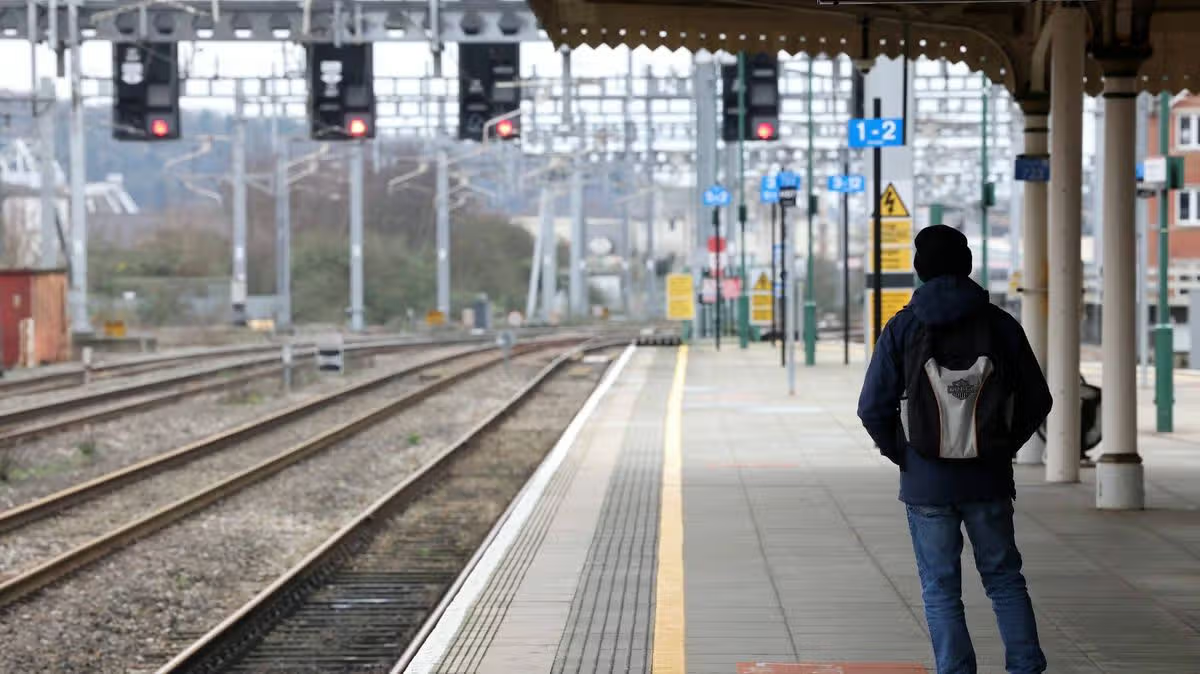
Andy Burnham has to address underfunding of rail in Wales.(Image: WalesOnline/Rob Browne)
Some £94bn was invested in rail enhancements across Great Britain in the period 2009 to 2025.
Of that total, some £44bn was for HS2, while UK Government rail enhancement expenditure in Wales was just circa £1.2bn – a meagre 1.3%.
While rail is not devolved, to get projects realised, the Welsh Government funded £1.4bn – more than the UK Government total – giving a £2.6bn of rail enhancements in Wales over that 16-year period.
So, in effect the Welsh Government has had to use funding meant for health, education to make up the UK Government shortfall.
Had Wales received just a 5% population share – an a more equitable settlement may need to be higher for good reason – then we would have seen circa £3.4bn more from the UK Government over that 16-year period and receiving an additional £200m per financial year.
Under the current arrangements this funding dysfunction is set to persist, with an estimated £80bn to £120bn of rail enhancements likely in England for the period from 2025 to 2040.
To note, the £14bn of political commitments to further rail investment in Wales, while welcomed, is just that – a political statement. The UK Government Treasury in the last spending review, allocated just £300m to Wales versus £34bn for England. The next comprehensive spending review will be the acid test.
For me, this constitutional dysfunction is undefendable and needs to be addressed.
So, should we devolve rail?
Clearly, we have a problem. The systemic underfunding has had and continues to have, a very substantive impact on Welsh Government finances. However, as I am sure previous Welsh Government ministers have found, Wales has limited leverage in any negotiations with Treasury and the Department for Transport ( DfT). Furthermore, in my view, any deal has to go beyond just a 5% population share.
One key point I also like to restate, and this often gets lost in translation, the current unfair funding position, via the Barnett Formula – is not just about HS2, butrail funding. The way Barnett works currently (and this could be changed) means that just focusing on HS2 undercooks the amount of underspend in Wales very significantly as making HS2 “England only” will only change the comparability factor from 33% to about 52%.
A previous letter from Mark Drakeford on this matter showed a £431m gap (for the period 2016/17-2024/25) if HS2 was defined as “England only” under the current non-devolved arrangements. However, this figure would be circa £1.5bn if rail was fully devolved. Furthermore, Barnett allocations have also been squeezed given HS2 has also resulted in reductions elsewhere in the DfT budget, reducing the scale of Barnett adjustments in any case.
What happens if rail is devolved and what are the key issues to address?
If, as it should, rail is fully devolved, then any future changes to the DfT budget could be subject to a more equitable Barnett adjustment and a 90% plus Barnett comparability figure. In so doing, the more challenging issue is how the block grant should be adjusted to reflect these new devolved powers. How should it be calculated?
And how does this impact future Barnett adjustments? This does not necessarily need to be related to the population, other factors are relevant, for example: The Wales and Borders Route is circa 10% of the UK rail network (and circa 8% of the track) and includes some sections in England (Marches Line, Severn Tunnel).
Should the Severn Tunnel be included? This a piece of UK strategic cross-border infrastructure that may merit different treatment.
The Network Rail (NR)Wales and Borders Route has supported the UK economy for 200 years.
Its condition, one might argue, is more depreciated than other parts of the UK network, and that depreciation has been built up over those 200 years – not the last 25 since devolution.
It is more exposed to unsighted issues and liabilities and to the need to mitigate climate change impact. For example, it is understood that on the CVL, rain intensity measurements (which are monitored) have already exceed expectations for 2040 in 2025. Rainfall intensity and the susceptibility to unsighted issues is an increasing challenge – and one with ongoing costs implications.
Based on this, it could be argued 5% of UK expenditure may not be a sufficient basis to calculate a block grant adjustment; rather it may form the baseline for a more protracted and bespoke negotiation.
Just looking at the comprehensive spending review publications last year and combining the committed annual expenditure to HS2 and NR, one can see a total of £23bn. With a 5% allocation for Wales and an adjustment to the block grant would be circa £1.1bn per annum, while 10% would be circa £2.3bn.
Wales is supposed to be part of an equitable union where more nuance can and should be applied in situations like this.
Also, if Welsh Government did take full responsibility for rail it would have to fund not only the full costs and enhancement to the Core Valley Lines (CVL) and Wales and Borders Route, but operations, maintenance and renewal (OMR). OMR for the Core Valley Lines and NR Wales and Borders Route is currently £400-500m per year. One might include the entire Marches line given its strategic importance to Wales and the reality that Welsh Government are much more likely to invest to enhance the Marches line than the DfT. If I was living in Shrewsbury or Hereford, I would get behind this.
GB Railways
The UK Rail industry and ecosystem is going through its biggest upheaval in 30 years as part of the GB Railways Bill. This is a generational opportunity to get it right. However, that bill falls a long way short of what Wales needs.
The bill needs a radical overhaul and include the full devolution of rail powers and funding to Welsh Government (and a NR Wales and Borders organisation subordinate to and eventually to merge with, Transport for Wales to create a vertically integrated organisation like GBR in England). This needs to be accompanied by a block grant adjustment and bespoke Barnett arrangement (or ideally a new funding mechanism) that reflects and accommodates the considerations I set out above
An interim alternative to a fully devolved settlement would be for Welsh Government to agree with the UK Government a dedicated line in the DfT budget for Wales rail enhancements (separate from the current England and Wales rail network enhancement programme) that is more proportional and transparent, which is not the case currently. A minimum of £450m a year is a reasonable ask, which is circa 5% of the current annual enhancement total (circa £9bn to10nn) across Great Britain.
The Welsh Government is making the case for a fair funding deal. If new Prime Minister Andy Burnham is serious about constitutional reform, and taking power out of Whitehall, this should be centre stage for his new government. If not, then he will rightly be accused of engaging in performative politics.
So, show us what you are about Andy and let’s fix it once and for all.























































You must be logged in to post a comment Login