







Connect with us

Tech

PlotDrive Lets You Write a Floppy, Walk Away, and Then Watch the Printer Work

Published

on

PlotDrive Floppy Disk Drive Printer
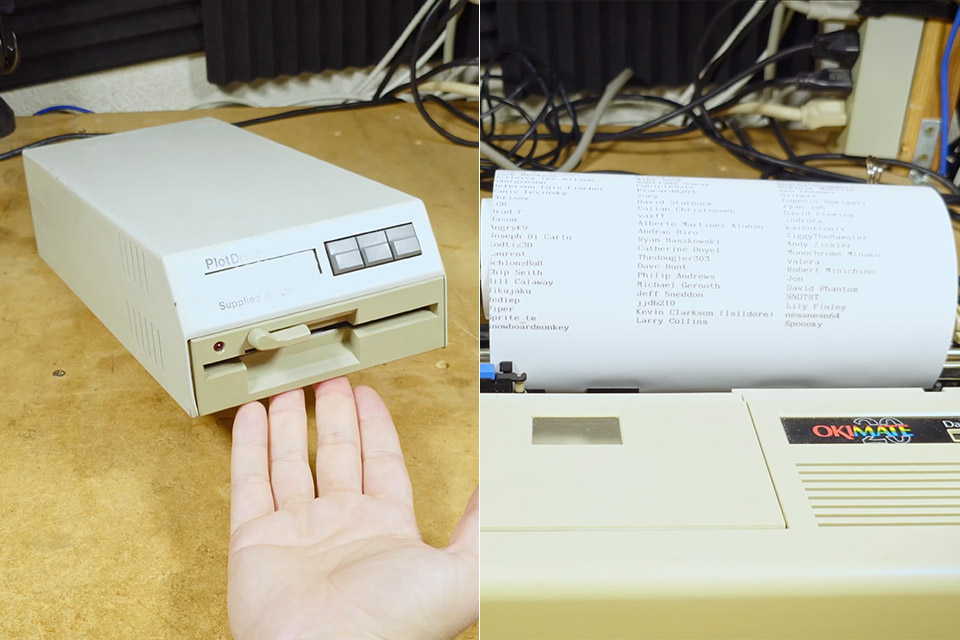
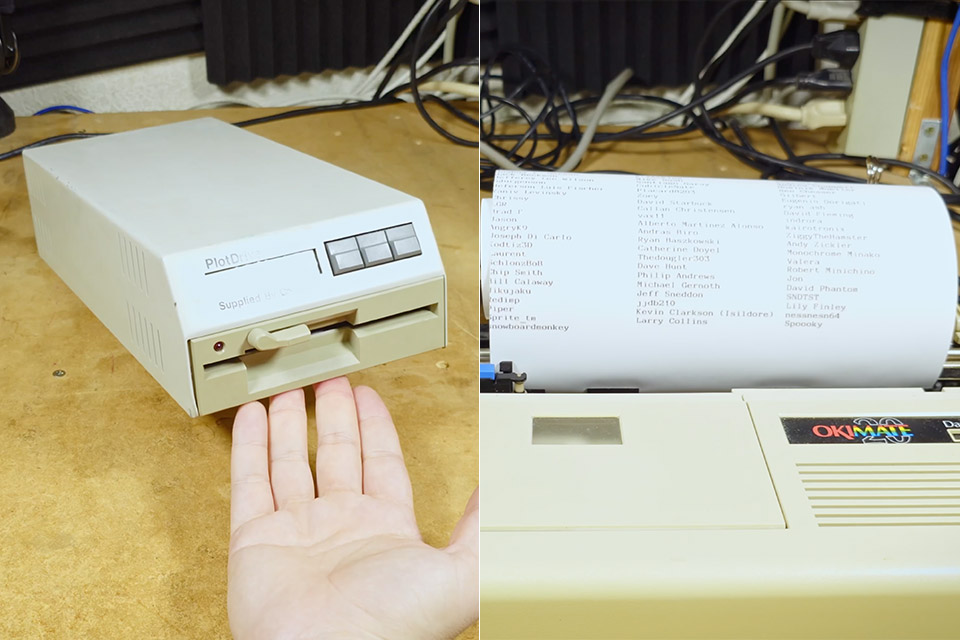
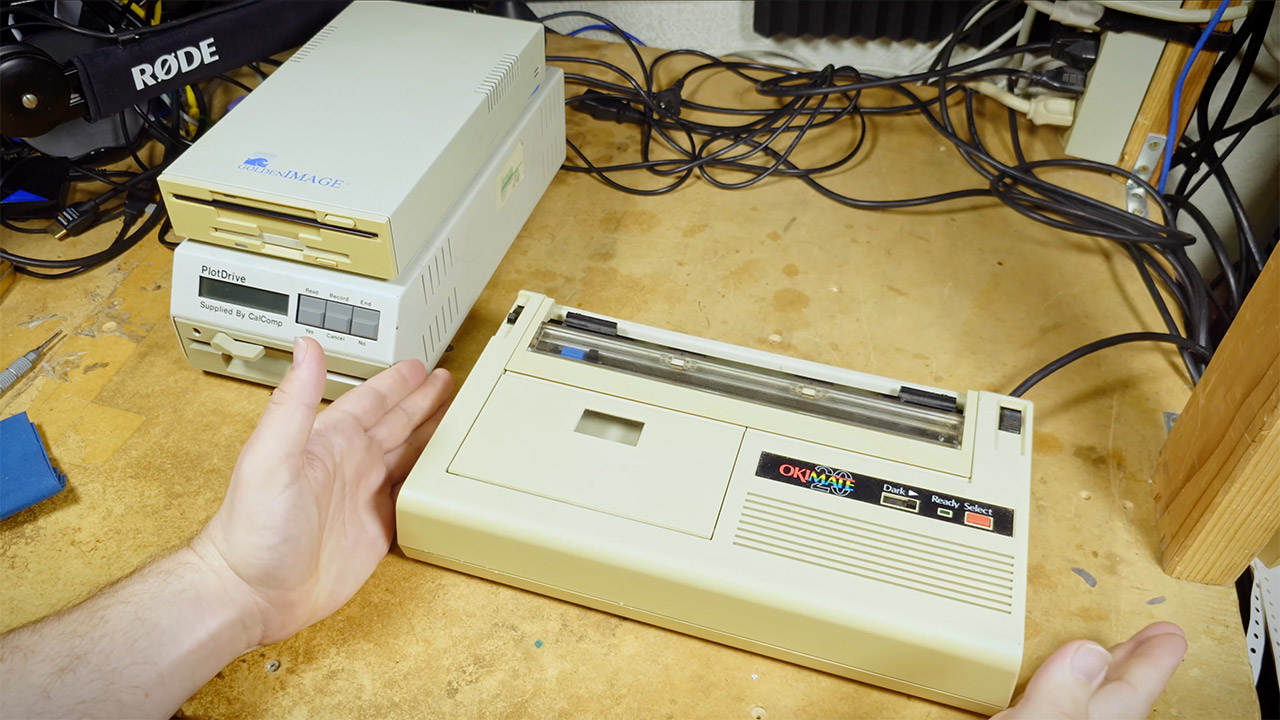
Lucky Bob handed Tech Tangents a beige lab box and a simple pitch. Printing is miserable. What if a job were as simple as writing a floppy? That box is PlotDrive, a CalComp serial and parallel print server that never needed Ethernet, a PC sitting idle, or a driver that still installs in 2026. You copy a file onto a 5.25-inch disk, latch the door, pick the file on a two-line LCD, and the machine streams the data out to whatever printer or plotter is plugged into the back.


CalComp built its name on machines that drew buildings, maps, and circuit boards one motor step at a time. Offices already knew how to walk a disk down the hall. PlotDrive sits in that gap: a sneakernet print queue with its own CPU, its own drive, and ports that speak the languages CAD labs actually used.

Sale


Gloryang Inkless Portable Printer for Travel, Wireless Thermal Printer Supports 8.5 x 11 Inch Thermal…
  • Inkless Printing – Gloryang portable printer uses advanced thermal technology, requiring no ink, toner, or ribbons. The package includes the…
  • Seamless Bluetooth Connectivity – The Gloryang mobile sticker printer connects easily to iOS and Android via Bluetooth through the “Jadens…
  • Ultra-Portable Design – Weighing just 1.75lb and measuring 1.7in thick, the Gloryang portable printer is incredibly lightweight and compact. Perfect…

PlotDrive Floppy Disk Drive Printer
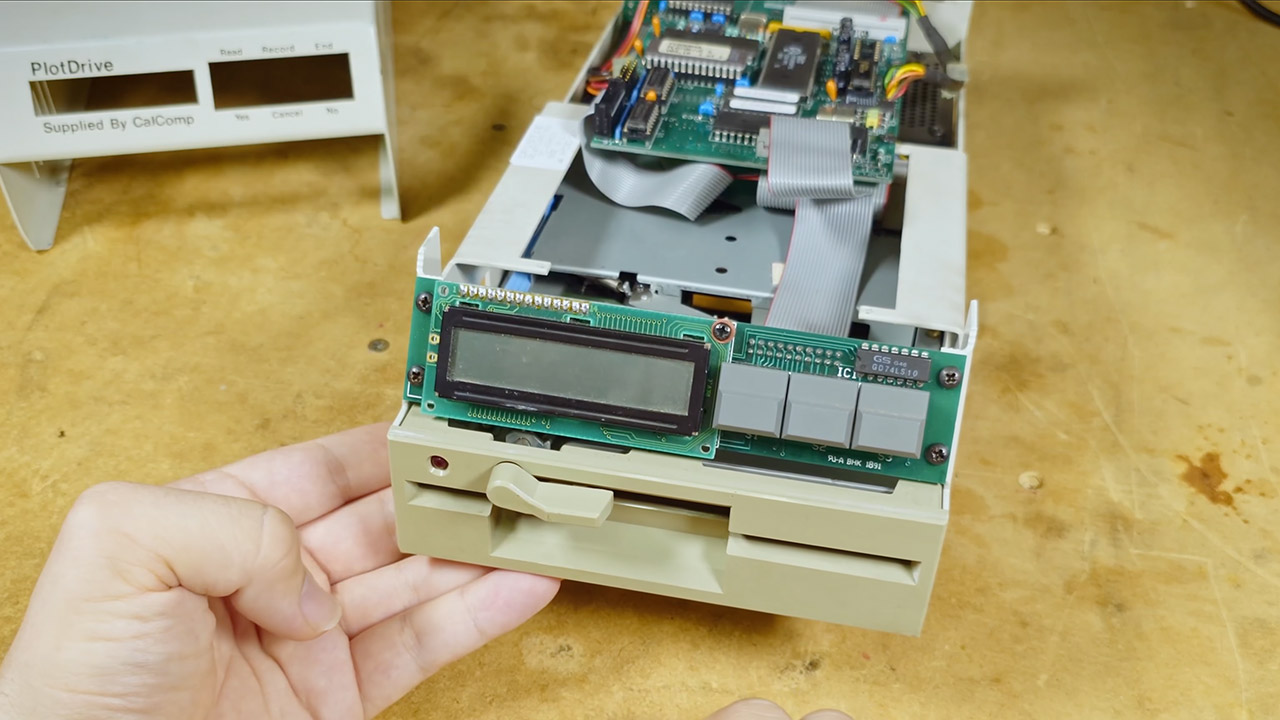
Tech Tangents II opened the case after the unit arrived during a live stream meant for other parts. Unfortunately, the firmware and instructions were unable to be located in the regular repositories. So users had to figure it out the old-fashioned way: by pressing buttons and observing what happened on the screen. Which, as it turned out, was plenty. Plot Drive shows on a Hitachi 16×2 LCD, coupled with a brief message. Front switches are hinged and allow you to read, explore the directory, pick a file, cancel, or write incoming data to disk in record mode. There’s also a rocker switch for selecting whether to transfer data in parallel or serial format, as well as a jumper block that very definitely allows you to configure the serial side’s baud rate, parity, and bit length. Flip the output switch after power-on and nothing changes until the next boot.

PlotDrive Floppy Disk Drive Printer
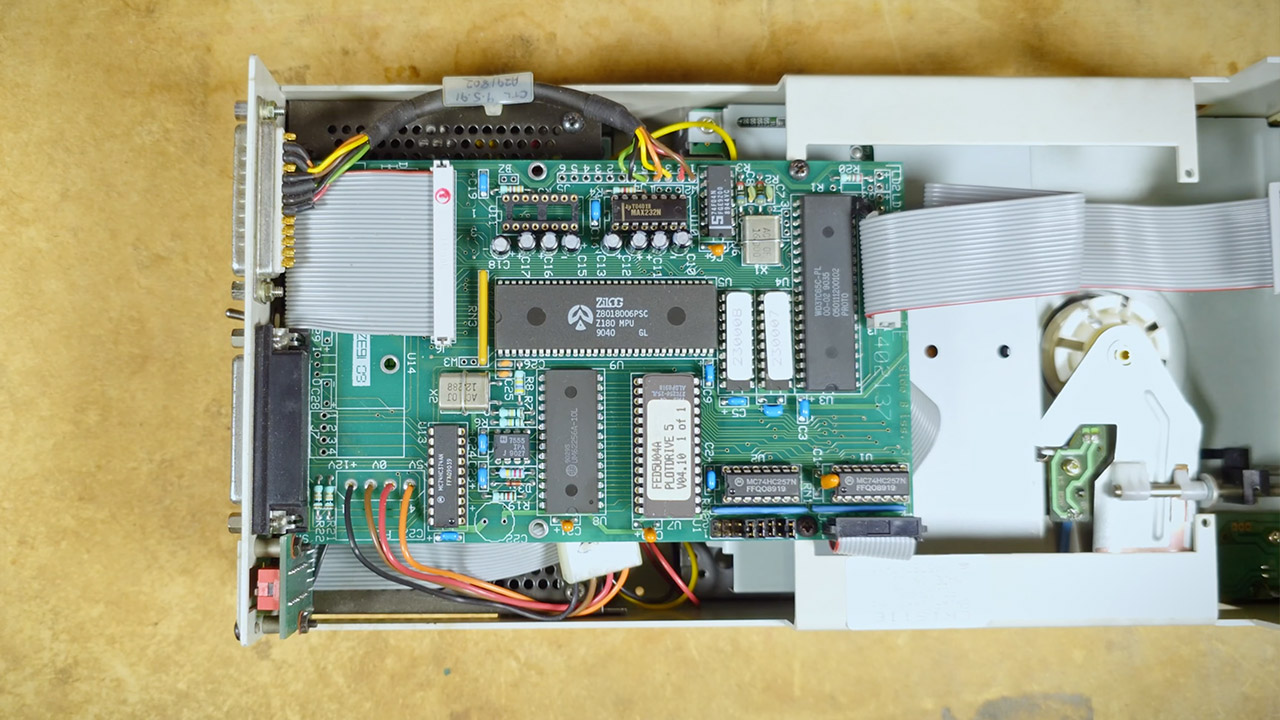
Inside sits a Zilog Z80 dated week 40 of 1990, custom ROM, a Goldstar controller, and a Western Digital floppy chip. The electricity is delivered by a normal molex connector and a large power supply with numerous safety covers. Drive tasks are handled by a Chinon FZ506 1.2MB 5.25-inch mechanism, so you should use high-density disks rather than older double-density disks. A double step for 360KB media is certainly possible with a switch someplace, but unless you have one of those extremely uncommon double-density disks, it’s not worth it.

PlotDrive Floppy Disk Drive Printer
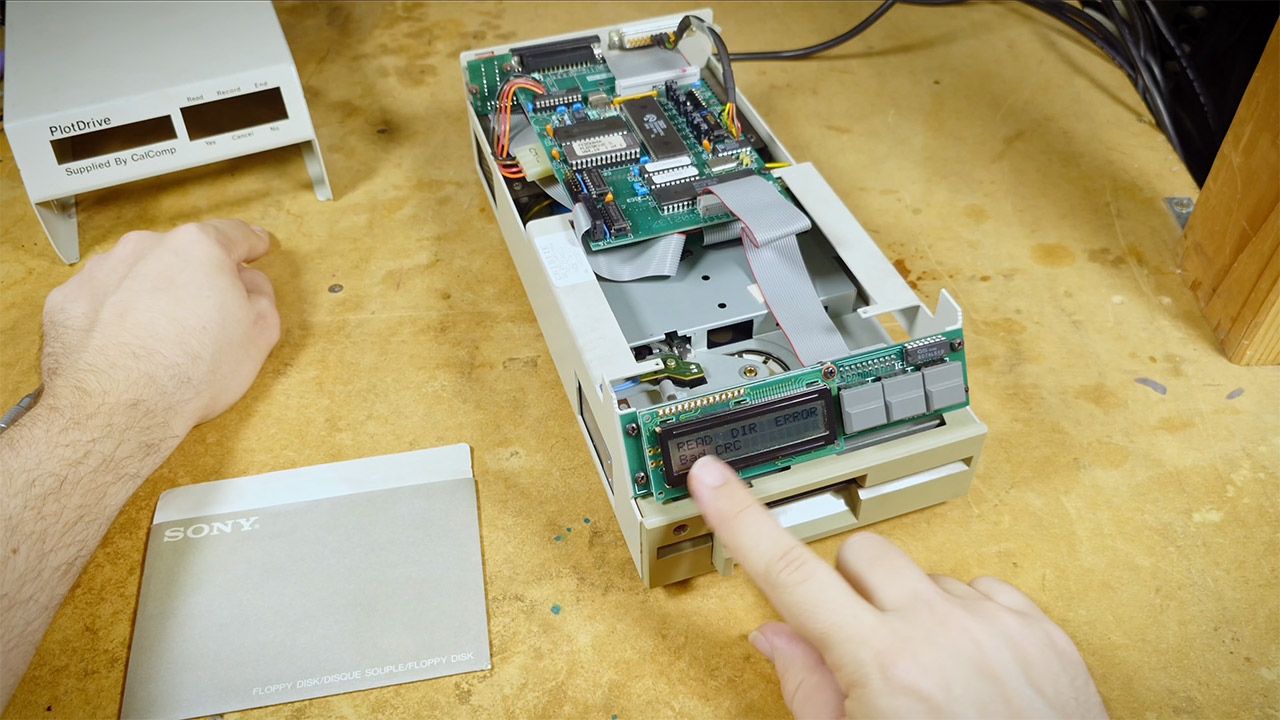
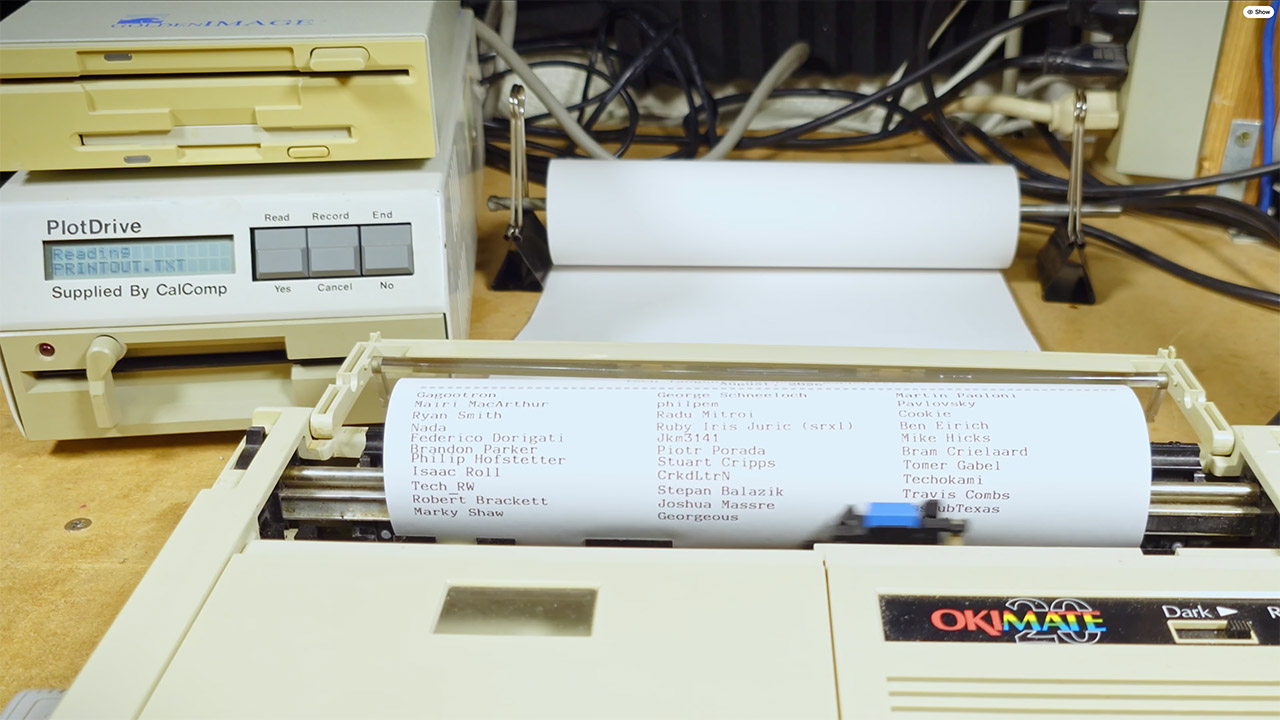
Now comes the fun part: inserting the first disk and receiving a nice ‘Read error. Bad CRC’ message. An unformatted or oddly formatted disk will do that. A fresh 1.2MB diskette fixed the path. If you have a Linux machine, you can erase a disk, install a FAT filesystem with mtools, and then copy the file in. Greaseweazle is pleased to transfer the image to the actual oxide. Then simply insert the disk, press read, skip through all of the files, and stop at something like printout.txt. PlotDrive buffers a chunk, feeds the printer, then reaches back to the disk for more

PlotDrive Floppy Disk Drive Printer
The test equipment was an Okimate 20 with a proper Centronics cable, the same type of parallel link that has been causing problems with a Sabrent USB adapter for months. Paper alignment on the first pass wandered because the tractor was ignored. Second pass landed clean. The PlotDrive simply accepts bytes and sends them out the port you choose. Of course, plain old ASCII text works very well. What truly makes sense is that if you link it to a terminal or a modem, you might eventually be able to utilize it as a disk-fed serial spreader.

PlotDrive Floppy Disk Drive Printer
Record mode is the other half of the idea. Feed data in over parallel (serial is plausible, unproven in the video) and PlotDrive writes a file to the disk. A workstation can dump a plot without staying tied to the plotter for the whole run. That is the lab use people remember in comments: AutoCAD or a CalComp driver writes a file, someone carries the disk, the plotter keeps drawing while the PC goes back to drafting. Offline CalComp systems used magnetic tape the same way in the 1970s. PlotDrive is that ritual shrunk to a 5.25-inch sleeve.

Advertisement

Source link

Continue Reading
Click to comment

You must be logged in to post a comment Login

Leave a Reply

Tech

CXMT sues U.S. to take it off the supplier blacklist

Published

on

Memory maker CXMT has waded into the Apple memory sourcing debate, suing the Pentagon for designating it as a risky “Chinese military company.”

In June, Apple petitioned the Trump administration to allow it to buy memory chips from a blacklisted Chinese supplier. Now, that same supplier is bringing the fight to the U.S. government.

Memory chip producer CXMT sued the Pentagon on Friday, reports Reuters, for including it on the Chinese Military Company Blacklist, or 1260H list.

It’s a list of companies that the Pentagon believes have links to China’s People’s Liberation Army. The companies on it are deemed to potentially be a risk to U.S. national security.

Advertisement

CXMT insists that it is not a military company with no affiliation with the country’s army. It says it designs chips for civilian and commercial use.

The Pentagon, meanwhile, made its decision arbitrarily without any real supporting evidence. As a result, CXMT says says that it has damaged its business and reputation.

Getting off the list

CXMT has been classified as a risk by the Pentagon since January 2025, with the designation maintained in June 2026 under the Trump administration.

However, CXMT has spent over a year providing information to the Defense Department to try and convince it the classification is unjustified.

Advertisement

In February 2026, there seemed to be progress, as the Pentagon briefly said CXMT would be taken off the list, the company claims. However, later that day, the notice was pulled with no explanation.

In June, the Pentagon called CXMT “directly affiliated with MIIT and indirectly affiliated with SASAC,” referring to the Ministry of Industry and Information Technology as well as the China-controlled Assets Supervision and Administration Commission.

A bad list

The function of the list is to dissuade U.S. companies from buying goods from listed firms. The list doesn’t specifically forbid purchases from CXMT, but there are consequences.

The main repercussion is that the Department of Defense cannot make agreements with companies that exist on the list. However, it also won’t use products or services from third parties that use those components.

Advertisement

If Apple sells goods using the memory, it would endanger other sales to the U.S. government.

It’s also not the worst list, as there’s also the Entity List. Companies on the Entity List are blocked from trade with all companies in the U.S.

For Apple, if it proceeded to use CXMT, there would be a risk of the memory supplier being included on the Entity List, scuppering Apple’s new supply source.

Apple’s request to use CXMT as a supplier has so far been a political issue. It’s had lot of pushback on the topic from Washington as well as rival memory supplier Micron.

Advertisement

CXMT’s legal challenge forces the issue, and could make the whole debate conclude on a much faster schedule.

Source link

Advertisement
Continue Reading

Tech

Federal appeals court rules Kalshi’s sports prediction markets are gambling

Published

on

What just happened? A federal appeals court ruled on Friday that Nevada can enforce its gambling laws against Kalshi’s sports prediction markets, dealing the company a major setback in its fight to keep state regulators out of the business. The decision could give regulators across the West more leverage to challenge sports contracts offered on federally regulated prediction exchanges, while moving the industry closer to a Supreme Court fight over whether those products are financial derivatives or gambling.

The Ninth Circuit Court of Appeals found that Kalshi’s sports contracts amount to sports betting, even though the company offers them through a federally regulated exchange. The decision could have implications well beyond Nevada, particularly in states that have been trying to limit or block sports-related prediction markets.

Kalshi lets users trade contracts based on event outcomes. The platform lists markets tied to sports, elections, economic data, weather, entertainment, and other subjects. Its sports contracts have become a major part of its activity as prediction markets have grown quickly this year.

The company has argued that its contracts are federally regulated financial products, not gambling. Kalshi is regulated by the Commodity Futures Trading Commission and has said that federal oversight should prevent states from applying their own gaming laws to its operations.

Advertisement

The Ninth Circuit rejected that argument.

“The substance of the sports event contracts offered on Kalshi’s (exchange) is sports gambling, regardless of whether Kalshi calls them swaps,” the three-judge panel wrote.

The court also said Kalshi had not shown a meaningful difference between its sports markets and traditional sportsbook wagers. “Kalshi’s attempts to distinguish its sports event contracts from sportsbooks betting are unpersuasive,” the ruling said.

The panel took particular issue with Kalshi’s position that its products were not sports betting. The judges said it was “disingenuous” for the company to make that argument after using sports-betting language in earlier marketing materials.

Advertisement

The case began after Nevada regulators moved against Kalshi and similar prediction-market offerings from Crypto.com and Robinhood. Nevada has long treated sports wagering as a tightly regulated activity, and state officials argued that the platforms should be subject to the same rules and taxes as other betting operators.

Gov. Joe Lombardo said the ruling would help “safeguard the integrity of our gaming industry.” Mike Dreitzer, chair of the Nevada Gaming Control Board, said it “completely vindicates what we have been saying all along.”

Kalshi said it intends to challenge the ruling. Spokeswoman Dani Lever said the company believes CFTC regulations do not bar sports contracts and noted that the agency is considering further clarification of its rules.

“Despite the Ninth Circuit’s opinion, we still believe the CFTC regulations as written do not prohibit sports contracts, and in any event, the CFTC is working to clarify those regulations,” Lever said in a statement. “We will be seeking further review.”

Advertisement

The decision conflicts with a ruling earlier this year from the Third Circuit Court of Appeals. In that case, the court blocked New Jersey from enforcing its gaming laws against Kalshi and other prediction-market companies.

That split raises the odds that the Supreme Court will eventually decide whether federally regulated prediction exchanges can offer sports contracts without state gaming licenses.

“It’s the first ruling against Kalshi at the appellate level, and the opinion seemed to be pretty brutal for the company,” Dustin Gouker, an independent journalist who covers the prediction industry, told CNN. “This gets us one step closer to an almost inevitable Supreme Court case on the legality of sports event contracts.”

The Ninth Circuit’s ruling now applies to federal courts in California, Arizona and six other states in the circuit. It could give regulators in those states more leverage as they challenge prediction-market companies.

Advertisement

The ruling comes as the industry is gaining users and trades. Kalshi has reported billions of dollars in weekly trading volume, with sports markets driving much of that activity. Polymarket, the second-largest prediction platform in the United States, was not part of the Nevada case, but the legal issues raised by the ruling could affect its business as well.

Source link

Advertisement
Continue Reading

Tech

This 694-Foot Vessel Is Built To Sink And Resurface While Holding Navy Destroyers

Published

on


The United States Navy has utilized a lot of different types of vessels since its inception in 1775, with everything from the USS Constitution, better known as “Old Ironsides,” to the USS Gerald R. Ford, the largest warship ever constructed. While most people today are familiar with aircraft carriers, submarines, cruisers, and destroyers, there are far more vessels the Navy uses for a variety of purposes. One of the most peculiar-looking of these isn’t your typical ocean-going vessel, as it’s used to facilitate repairs of destroyers, cruisers, Freedom-variant Littoral Combat Ships, and Whidbey Island and Harpers Ferry Dock Landing Ships.

On July 28, 2026, Austal USA launched the U.S. Navy’s Auxiliary Floating Dry Dock Medium (AFDM), and it’s easily one of the strangest-looking vessels used by the service. As you can see from the picture, it’s not shaped like a traditional ship because, well, it isn’t one. Instead, the AFDM is known as a Rennie-type floating dry dock, featuring continuous wing walls and pontooned sections reaching 65 feet high from the baseline to wing deck.

Advertisement

The AFDM weighs 12,000 tons and measures 694 feet long with a deck that has a working surface area of 90,800 square feet. The AFDM has a lifting capacity of 18,000 long tons (LT), making it more than capable of lifting destroyers and cruisers. A newly modernized Arleigh Burke-class destroyer displaces 8,558 LT, while a Ticonderoga-class cruiser displaces 9,600 LT. To function as a dry dock, the AFDM sinks itself below a target ship, secures it in place, and lifts it to facilitate repairs, making it an incredibly useful, if unusual-looking, vessel.

Advertisement

This unique vessel has historical roots

It’s easy to look at the AFDM and think that it’s something entirely new, but it’s merely the latest in a line of similar vessels used by the U.S. Navy over the years. The service has used variations of auxiliary floating dry docks for decades, as they’re incredibly useful. They work by submerging beneath a ship that requires repairs, using buoyancy to do so. Once they’re beneath the vessel, water is pumped out, causing the AFDM to rise, taking the captured ship along for the ride.

Typically, this type of floating dry dock has no engines of its own, requiring tugs to move it into place. When World War II kicked off for the United States in 1941, the Navy already had three such vessels, the YFD-2, the YFD-1 (USS Dewey), and the USS ARD-1. Over the course of the conflict, more than 150 floating dry docks were constructed to facilitate repairs of ships in overseas areas, and they were absolutely needed. There have been many different types utilized by the Navy over the years, each of which was distinguished by its lifting capacity.

The first of these built for the U.S. Navy was the YFD-2, which stands for Yard Floating Dock. It was the first of its kind and began serving the Navy in 1902. It was among the ships sunk during the Japanese sneak attack on Pearl Harbor on December 7, 1941, but was raised, repaired, and placed back into service for the war effort. The AFDM is an unusual-looking vessel, to be sure, but it’s also a member of a long line of auxiliary floating docks that has served the Navy well for over a century.

Advertisement


Source link

Advertisement
Continue Reading

Tech

Energy biz SSE smacked around in court by a guy and AI

Published

on

ai and ml

Company’s three year pursuit of debt from non-existent address ended by Oxford judge

British energy company SSE Energy Supply refused to believe that there was no unit 8b at the property of Lyle Hopkins, a doctoral student at the University of Oxford.

Advertisement

For more than 20 months, the company billed Hopkins at business rates, a total of £1,091.01, for an unused electricity meter on the property that had been associated with a previous owner’s unsuccessful effort to convert the property into flats.

A company representative even sent an email on June 15, 2024, stating that Hopkins was not liable. Nonetheless, SSE then sent in debt collectors to recover debt attributed to a disconnected meter for a non-existent address.

He never paid the bill. But he wanted the harassment to end.

So Hopkins, a software engineer working on his PhD at Oxford Interdisciplinary Bioscience DTP, turned to GPT-5.5 and Claude Fable for legal guidance to challenge the unwarranted and annoying collection effort. Representing himself in court, he prevailed on July 17, when a judge at the County Court at Oxford (St Aldate) awarded him £1,087.88, including expenses and interest.

Advertisement

Citing The Register’s coverage of how courts have required lawyers to declare and verify AI-generated documents, Hopkins said his experience has been that it’s the verification that matters.

“I used AI to test an energy company’s court claims against its own records, then ran the hearing myself and won,” he said.

Hopkins said he wouldn’t have been able to quote the case law without the help of AI.

“I had to review everything and give it steering, and make sure the case law actually existed,” he said. “I mostly just gave it the facts and it came up with the arguments, checked the laws, court rules, case law, and regulations. Really I just knew what they had done couldn’t be right, and relied on the AI to find the legal justifications as to why.”

Advertisement

Hopkins said that when he first submitted his claim back on October 7, 2025, GPT models hallucinated more and weren’t as good at checking case law.

“If Fable had been around at the time, I probably would have claimed for a lot more, probably around £5,000 and included harassment, which would have been more in line with the case law it found when we were preparing the court documents about three weeks before the hearing.”

Hopkins didn’t consider a solicitor because the cost would have been prohibitive. His spending on AI was more modest but not trivial – three active AI subscriptions and extra API fees.

“I burned a lot of tokens on this, on my Github Copilot subscription, OpenAI subscription, and Anthropic subscription,” he said. “Due to the deadlines I ended up paying API rates for some of it, which was painful.” (~£175).

Advertisement

His award could have been higher. “Before the hearing, SSE offered me more than the court ultimately awarded, conditional on confidentiality and non-disparagement clauses,” Hopkins said. “I refused because it was more important to be able to tell people what they had done.”

A rollercoaster ride

The judge hearing the case – shared with The Register – said Hopkins, who sought the intercession of an Energy Ombudsman after repeated communication with SSE, could not have done more to make clear that he was not liable for claimed debt.

“The defendant has subjected Mr Hopkins to a rollercoaster ride and not a good one,” the judge said, adding, “pursuing Mr Hopkins for that liability, if continued, would amount to harassment.”

Yet even after Hopkins won, the billing contniued. Following the judgement on July 17, another bill  datedJuly 23 went out.

Advertisement

“Since the judgment…in direct contradiction to the ruling which stated any further attempts to claim the invalid debt from me would constitute harassment, they have sent me another bill with payment demand,” Hopkins told The Register.

He’s unsure whether he will pursue a harassment claim.

“This dragged on for nearly three years and cost hundreds of hours, lost sleep, and time that should have gone into my medical-research doctorate at Oxford,” he said. “My exhibits alone were over 100 pages. Given how difficult this was, I struggle to see how people less academic than me wouldn’t end up with CCJs and ruined credit ratings over debts they never owed.”

Hopkin’s doctoral funding ended before he could finish his degree, a delay he attributes to time spent on this case. So he has launched a funding campaign to support the completion of his doctorate. 

Advertisement

The Register emailed SSE seeking comment and received an autoreply indicating that that SSE media team was unavailable outside of business hours in the UK. The urgent inquiry number yielded a representative who indicated that he only handled questions about outages. If company representatives reply after returning to the office, we’ll update this story. ®

Source link

Continue Reading

Tech

Microsoft is finally going to stop nagging you to back up your files to OneDrive in Windows 11

Published

on


  • Microsoft has made a welcome change to OneDrive in Windows 11
  • Prompts to use the backup service can now be permanently dismissed
  • The change has been positively received by most users online

There have been complaints about this going back years, but Microsoft has finally caved in and decided to stop nagging users to back up their files to OneDrive: these alerts can now be permanently dismissed with an Opt out of backup button.

As spotted by Windows Latest, the move is going to please users who have no intention of using OneDrive to store their files, and would rather not have occasional reminders from their operating system that this is an option.

Source link

Advertisement
Continue Reading

Tech

Windows 11 is finally rolling out the option to kick Bing out of Search

Published

on

Microsoft has spent the past few months testing a much cleaner version of Windows Search, and it is finally starting to reach regular Windows 11 PCs.

According to Windows Latest, the redesigned Search experience is included in the August 2026 optional update, KB5120998, for Windows 11 24H2 and 25H2. Microsoft confirms that the update moves PCs to builds 26100.9278 and 26200.9278, respectively, although some of its new features are being enabled gradually.

We first covered these Search changes in July, when they were limited to Windows Insiders in the Experimental channel.

You can finally keep Bing out of Windows Search

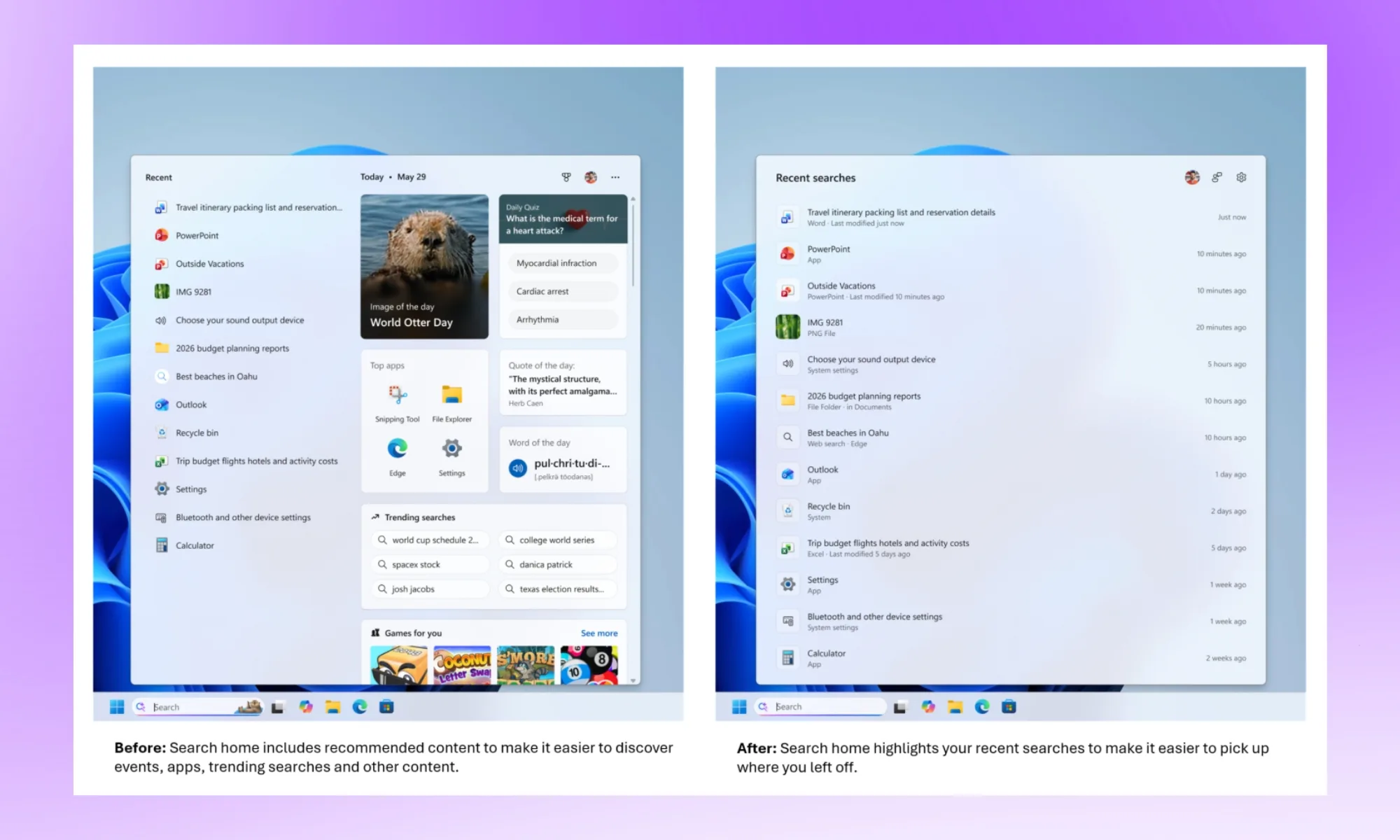
The biggest improvement is a pair of controls under Settings > Privacy & security > Search. One toggle controls web results, while another handles Microsoft Store suggestions.

Turning off web results removes Bing suggestions from Search, while disabling both leaves Windows focused almost entirely on results from the PC. Windows Latest also found that Search feels faster this way because it no longer waits for an online Bing request before returning results.

Advertisement

The Search home screen is cleaner as well. Microsoft has removed much of the old Bing-powered clutter, including trending searches and promotional content, while results now clearly identify whether they come from an app, file, setting, the web, or Microsoft Store. Typo handling and local result prioritization have also been improved.

The rollout is still gradual

Installing KB5120998 does not necessarily mean the new Search will appear immediately. Microsoft is using its Controlled Feature Rollout system, meaning the necessary components can already be installed while the feature itself remains disabled on some PCs.

Windows Latest says users who do not want to wait can force-enable it through ViVeTool, although everyone else can simply wait for Microsoft to activate the feature automatically.

Windows Search should never have needed a web request to help someone find Calculator, Settings, or a file sitting on their own PC. Microsoft has taken its time getting here, but the option to remove Bing finally makes Search behave much closer to what a desktop search tool should be.

Advertisement

Source link

Continue Reading

Tech

The Easy Way to Stay Private Online

Published

on

In an age when every click counts and digital footprints are incessantly monitored, maintaining true privacy online feels increasingly like an elusive luxury. Most people who browse the internet are, all the time, being identified by one digital address: their IP address. At its simplest level, this address communicates to the world (or, at least, what websites you visit) exactly where you are and who you could be.

It’s a little more than the digital equivalent of a name tag that broadcasts your home address, too. What now, though, is a smart and rapidly emerging answer that empowers users to regain anonymity and look assuredly: residential proxies.

In short, a residential proxy is a middleman connecting homeowners via an actual, physical IP address allocated by an Internet Service Provider (ISP) to an actual homeowner. Your connection looks to be one that comes from an average house, not a corporate data centre, when you use one. That distinction is also important for privacy and access.

Real IP Addresses and the Advantages of Them

So, to grasp the full benefits of residential proxies, we must also keep in mind the alternative, which is your data centre proxies. Data centre IPs are easy to spot. They are available in enormous blocks owned by cloud providers, and many websites, for their part, are designed to instantly identify and block them.

Advertisement

Think of a data centre IP as an office building: it looks professional on the outside, yet is obviously not a private home. Trying to access private content or perform the same thing over and over with a data centre IP, you are likely to be met with a painful wall of security checks or outright denial.

This is entirely circumvented by residential proxies. With the IP being affiliated with a legitimate, consumer ISP — say Comcast or AT&T or Orange — it is indistinguishable from the address every average internet user uses. For a site, a request is made by some average person scrolling through the web, not a system that is giant automated system. This authenticity is also the foundation of their power to restore privacy.

Parting Your Digital Footprint

Privacy online is a lot more than hiding your location. That means regulating the information companies capture about your behaviours. Every search query, every product you see and every news article you read under that single, recognisable marker gets logged when you open your native IP. This data is then aggregated to make a full profile of you that is used with targeted advertising, price discrimination and content tailoring.

A residential proxy serves as an advanced digital disguise. By cycling over and over again, through a range of thousands or even millions of valid, unique residential IPs, you are essentially splintering your digital identity. In the opinion of an outsider, your action almost seems to have been performed by thousands or millions of different people over a period of time. This rotation means no one thing can really create an all-around accurate overview of your browsing activity. This rotation is what renders them a simple and efficient form of remaining truly private.

Advertisement

Upholding the Consumer Advantage: Unbiased Access

This newfound privacy is vital for numerous areas and functions, the most obvious of which is market research and price comparison. Let’s say you want to see the price of a flight or a product. Companies commonly use dynamic pricing where they reflect higher prices to those they think are wealthier, more frequent or visiting from a particular place. If you visit the website using your home IP, they already know your history.

If you visit it by plugging into a residential proxy from another city or region, the site is fooled into believing you are an entirely new, unique visitor, so you can see unadulterated, normal pricing. In doing so, it transforms the technology from an industrial tool of surveillance to a tool of customer empowerment and promotes a more equitable online marketplace.

Stability Means Simplicity

Further, the convenience or convenience of residential proxies is dependable and easy to integrate. The most serious problem faced by online work in recent years has been constant safety warnings, CAPTCHA issues or soft-bans. For low-quality and easily visible IPs, your work grinds to a halt.

Residential IPs face fewer such challenges because they are genuine. The connection is seen as a normal and common request, which helps for a smooth, consistent experience, and less downtime and red tape. And that stability results directly in more efficiency and peace of mind — for everyone dependent on the internet to accomplish complex tasks, from handling multiple social media accounts to gathering information on the web.

Advertisement

In addition, setting up and using these proxies is also not as problematic as we think. Modern proxy services present the technology to all, not just technologists. There’s a simple interface that you’ll be able to configure and work out pretty easily on your own — you pay for a service, install a small application or add a browser function, and it starts instantly routing traffic through a bunch of residential IP networks.

The proxy manager manages the hard work of changing addresses, location requests and speed of connections. At the end of the day, the end users are free to browse the internet the way they wish when it suits them — privately and safely.

Finally, no privacy was built into the internet. Nowadays, people need to actively protect the people who take care of their information and identity. Residential proxies are a robust but uncomplicated solution.

These proxies hide your real and personal locations behind a real IP address of a real home user, providing your anonymity, keeping you hidden from aggressive tracking and surveillance, providing objective information that’s useful and complex, and performing the tasks of using the internet without ever having to be disturbed. It’s not just an expert tool, but the key to making the most of the true online world of the new normal. 

Advertisement

Source link

Continue Reading

Tech

Honda and Nissan will share the software in their cars from 2029

Published

on

Eighteen months after their merger fell apart over who would control whom, Honda and Nissan have agreed to share the software inside their cars.

The two signed a joint development agreement on Monday covering electronic control units, an in-vehicle operating system, middleware and vehicle control software, with the first cars arriving from fiscal 2029.

The agreement is narrower than a merger and, in engineering terms, more intimate. Standardising core ECUs means agreeing on the computers that run the brakes, the steering, the battery and the cabin, and on the interfaces between them.

Both companies framed the decision as a matter of pace and cost. Faster development cycles and more efficient investment were the stated reasons, after what they described as extensive studies of where collaboration in the software domain might work.

Advertisement

Neither disclosed what it will cost or save. No supplier was named, no executive was quoted by name, and the specific ECUs to be standardised were not identified.

Fiscal 2029 is the part worth sitting with. That is roughly three years from now for architecture work that has to be locked long before the first vehicle reaches a showroom, which tells you how far ahead this kind of decision is made and how little room there is to change it afterwards.

The pieces being standardised are the ones customers never see and never forgive. An operating system that stutters, an over-the-air update that fails, a control unit that disagrees with another: these are the faults that define whether a car feels modern.

The problem they are addressing is real and not specific to Japan. A modern car runs on tens of millions of lines of code across dozens of controllers, and every manufacturer is discovering that writing all of it alone is expensive in a way that engines never were.

Advertisement

Scale is the only available answer. Arm has been arguing that the industry needs common foundations rather than dozens of bespoke stacks, which is precisely what two carmakers sharing an operating system amounts to.

The competitive pressure is coming from a specific direction. BYD has built its own 4nm driving chip and is fitting LiDAR to a $10,000 car, which is a level of vertical integration neither Japanese company can match alone.

Chinese brands have been taking share in Europe at a record rate, and the software experience inside the vehicle is a large part of why. Buyers comparing a Chinese EV with a Japanese one in 2029 will be comparing operating systems as much as drivetrains.

What makes this agreement notable is the history behind it. Merger talks collapsed in February 2025 after Honda proposed making Nissan a wholly owned subsidiary, an arrangement Nissan would not accept, and the two walked away.

Advertisement

Sharing an operating system without sharing ownership is a considerably harder thing to sustain. Every future disagreement about a feature, a release schedule or a security patch now has to be resolved between two independent boards with different product cycles and different problems.

There is a precedent both will know well. Shared platforms have worked in this industry for decades, but they involved metal and tooling with fixed specifications, whereas software has to keep being decided long after the vehicle ships.

Nissan has the more urgent problems of the two, having spent the period since the merger collapse restructuring. Honda is the larger and steadier partner, which is the imbalance that sank the merger and has not gone anywhere.

The pair have said they will keep exploring collaboration elsewhere, naming carbon neutrality and the elimination of traffic fatalities as areas of shared interest. Those are aspirations rather than agreements, and the distinction is doing work in the announcement.

Advertisement

What exists today is a signed document, a defined technical scope, and a date in 2029. Whether it holds together until then is a question about two organisations rather than about software.

Source link

Advertisement
Continue Reading

Tech

Getting An ‘iPhone Unavailable’ Message? Here’s How To Fix It

Published

on

You’ll need your old passcode or Apple Account password.

Getting an “iPhone Unavailable” message on your lockscreen is never a welcome sight. The issue is a common one, caused by entering an incorrect passcode too many times. It’s a system meant as a safeguard against unwanted access, but it can just as easily be triggered by unintentional pocket presses or plain old forgetfulness. Thankfully, there are several ways to get access to your iPhone again, though some are a bit more labor-intensive, depending on the circumstances of your lockout.

Advertisement

How to fix an iPhone Unavailable message

Your options for an iPhone Unavailable error vary slightly depending on your iOS version, if you’ve changed your passcode recently and what other technology you have available.

Use Passcode Reset

If you’re using iOS 17 or later and have reset your phone’s passcode within the last 72 hours, you have the option to revert back to your old passcode to solve the issue.

  1. After five incorrect passcode attempts, the iPhone Unavailable screen will appear, and you can select the Forgot Passcode option in the lower righthand corner

  2. Select Enter Previous Passcode

  3. After entering your previous passcode and unlocking your phone, you’ll immediately need to reset the passcode to a new number

Reset your iPhone without a computer

To reset your iPhone without a computer, you’ll need to be using iOS 15.2 or later, have Find My previously enabled, have an active cellular or Wi-Fi connection and know your Apple Account and password. Apple recommends that, if you’re using an eSIM on iOS 16 or later, you should contact your carrier before following these steps, as they may be able to give you a QR code that allows you to set up your eSIM again.

  1. From the iPhone Unavailable screen, select Forgot Passcode

  2. Select iPhone Reset

  3. Enter your Apple Account password to sign out of your account

  4. Select Erase iPhone, which will delete all your data and settings. If you’re using an eSIM and iOS 17 or later, you’ll have the option to keep your eSIM but erase your data, or delete both your data and eSIM

  5. Your phone will restart; from there follow the instructions to set up your device again

Reset your iPhone with a computer

To reset your iPhone with a computer (either PC or Mac), you’ll need a cable to connect your phone to your computer and an internet connection. On PC, you’ll also need the Apple Devices app, which can be found on the Microsoft Store. After resetting your iPhone, you’ll only be able to restore it if you have an existing iCloud backup.

  1. Turn off your iPhone by holding down the side button and volume down button, then using the power slider

  2. Connect the cable to your computer, then plug in your iPhone and quickly hold down the side button

  3. Keep holding the button when the Apple logo appears, and continue holding until the image of a computer and cable appears; this means your phone is in recovery mode

From here, the directions differ slightly depending on if you’re using a PC or Mac.

Advertisement

Resetting an iPhone on PC

  1. Open the Apple Devices app and select your phone from the sidebar

  2. If needed, opt to trust the device, then select General

  3. Choose Restore and follow the instructions

  4. Once your iPhone has been restored, you can disconnect the phone from your PC and set up your iPhone

Resetting an iPhone on Mac

  1. Open Finder and select your phone from the sidebar

  2. If necessary, allow the accessory to connect to your Mac

  3. A window will pop up stating there’s a problem with the phone that requires it to be updated or restored; choose Restore

  4. Once restored, you can disconnect your iPhone and set it up again

Apple notes that you may need to update your iPhone before you can finish the restoration process; if your phone restarts during this process, you’ll need to shut your phone off and repeat the steps for entering recovery mode.

Source link

Advertisement
Continue Reading

Tech

Caterpillar is bringing to AI deployment what it learned from automating mining

Published

on

Nearly every company that’s trying to deploy artificial intelligence runs into the same problem: it’s hard to integrate the tech into everyday operations. Industrial heavyweight Caterpillar has spent decades dealing with a version of that problem in the physical world, and now it’s using its experience to deploy AI.

Caterpillar’s push into the autonomous space started with mining, where labor shortages and hazardous conditions can make automation particularly useful. Today, it sells automated haul trucks, drilling, underground loaders, dozers, remote-controlled construction equipment, and more. It also offers a software command center, fleet management, and even remote terrain intelligence as part of its autonomous toolkit.

“Now we’re in this super exciting time where we can take all of that learning from mining and bring it into much more dynamic environments, jobsites, quarries, and construction sites,” the company’s CTO, Jaime Mineart, told TechCrunch on during a fireside chat at the Ai4 conference in Las Vegas earlier this month.

The industrial giant is now applying AI more broadly, including in tools used by technicians and its own employees. One example is the Cat AI Assistant, which lets field technicians standing next to a machine use voice commands to pull up repair procedures, troubleshoot potential problems, and identify parts that may be needed before beginning a repair. Mineart said the tool is now being used by customers, operators and technicians.

Advertisement

The assistant draws on Caterpillar’s proprietary data, which spans information generated by its connected machines. Mineart said Caterpillar has about 1.6 million connected assets globally and more than 16 petabytes of structured data.

The company is also using AI to power software for scanning sites and generating digital twins in manufacturing to analyze operations, she said. And like nearly every other company, Caterpillar is using AI across its enterprise operations, as well as for software development. “We use AI agents to modernize legacy code, generate and test new software, and identify defects earlier,” Mineart said.

But Mineart is quick to point out that building the technology is only part of the challenge, as deploying an autonomous machine is not the same as transforming a site to use AI. Companies also have to rethink how people work alongside the technology and how existing processes need to change.

“The hard part about autonomy and about physical AI is incorporating that technology into the customer jobsite and into the workflows,” she said.

Advertisement

Mineart said the company leans on experienced operators to help train AI systems, leveraging institutional knowledge built over decades. And as machines become more autonomous, some operators may shift from controlling a single machine to overseeing multiple machines from a remote command center.

That transition, however, is creating a new challenge for Caterpillar: training its 118,000 employees. Mineart said the company plans to spend $100 million over the next five years to train its workforce in AI, autonomy and robotics.

That investment is likely being put towards helping the company make the most of the broader boom in AI infrastructure, which is already helping its top-line. Caterpillar’s quarterly revenue reached an all-time high of $20.5 billion in the second quarter, helped by strong demand for power-generation equipment used in data centers. Its power-generation division saw sales spike 72% to $3.10 billion, and CEO Joe Creed said that “no one is slowing down” when it comes to demand for cloud computing and generative AI infrastructure.

When you purchase through links in our articles, we may earn a small commission. This doesn’t affect our editorial independence.

Advertisement

Source link

Continue Reading

Trending

Copyright © 2025