Connect with us

Business

Phoenix Court wins NatWest and British Business Bank backing

Published

on

Phoenix Court wins NatWest and British Business Bank backing

The British Business Bank and NatWest have agreed to invest in funds run by Phoenix Court, the UK venture capital firm, in a deal its co-founder described as a “watershed moment” for domestic investment in start-ups.

The state-backed lender will commit £50m. NatWest, HSBC and M&G are investing alongside it and did not disclose the size of their commitments, but said the total would run to “several hundreds of millions”. It is the first time NatWest has invested in a venture capital fund. HSBC and M&G have backed earlier Phoenix Court funds.

Saul Klein, co-founder of Phoenix Court, said: “The UK innovation economy is absolutely steaming ahead. This is a watershed moment to have four major institutions, including some of the high street banks, coming together to demonstrate the scale of the opportunity. Hopefully this is the moment when we can start to see more domestic capital crowding in, and more British allocators backing our innovation economy.”

Free newsletters
Advertisement

The stories that matter to UK business, straight to your inbox.

Advertisement

UK start-ups raised $17bn in the first half of this year, according to HSBC, more than France, Germany and Sweden combined. HSBC’s figures show only 30 per cent of the capital in funding rounds above $100m came from the UK, falling to 16 per cent in rounds above $250m, as shown in the record half-year funding figures.

“It’s not as if the capital isn’t there, but we would love more of that capital to be domestic,” Klein said. “It’s a real shame that the people benefiting from the growth of our innovation economy historically have not been British savers, or British beneficiaries.”

Klein, who has previously urged UK pension funds to back domestic tech scale-ups, said the fund would aim for a threefold return. It will mainly target the capital shortfall at the scale-up stage, but will look across all growth phases.

Paul Thwaite, chief executive of NatWest, said capital was not the only problem for start-ups, and that large investors could also provide “the expertise and networks that innovative businesses need to grow”.

Advertisement

“Too often, promising British businesses look overseas for the capital and support they need to reach the next stage,” Thwaite said. “If Britain wants to compete for the industries and jobs of the future, we need to get better at backing our most promising companies with the capital, connections and confidence to scale here in the UK.”

The British Business Bank was set up by the coalition government in 2014 to use state funds to support fast-growing businesses. The Labour government has raised its total financial capacity to £25.6bn, from £15.3bn, giving it a target of investing about £2.5bn a year. Ministers have told it to direct more than 60 per cent of its funds at scale-ups and given it more scope to invest alongside private-sector organisations. The bank has already put more than £600m directly into UK scale-ups.

Leandros Kalisperas, chief investment officer at the British Business Bank, said the announcement was “a milestone in the development of the BBB’s activity”, describing the bank as “a physical convener” as well as a deployer of capital.

The bank is also trying to co-ordinate a £1bn scale-up fund with leading pension funds. “Every week some of the largest pension funds in the country are coming together to consider how … to invest a billion pounds in scale-ups,” Kalisperas said. “That has never happened before.”

Advertisement

Institutional investors have been wary of start-ups and scale-ups because of their higher risk profile, regulatory barriers and a lack of expertise among investors. In May 2025, 17 workplace pension providers signed the voluntary Mansion House Accord, agreeing to invest at least 10 per cent of their funds in private markets by 2030. It followed the 2023 Mansion House Compact, which set a 5 per cent target.

Kalisperas, who previously worked in pension funds, said there were “many good reasons” why institutional investors had been slow to move into venture capital, and that there was “clearly so much more to do”. He said: “The institutional base in this country doesn’t know about venture.”

He said the bank needed to “showcase” its activities by “sharing our due diligence and information with domestic capital”. Of the reluctance to date, he said: “that’s almost the past.”

Amy Ingham
About the author
Advertisement

Amy Ingham

Amy Ingham is a reporter at Business Matters, covering UK business news with a focus on breaking news, business policy, late payments and insolvency. She joined the magazine in 2026 after completing the NCTJ Diploma in Journalism at Harlow College’s journalism school. Her recent reporting includes British Steel’s nationalisation and its impact on SME suppliers, the decline in late payments by large firms, and Insolvency Service director disqualifications. Reach her at aingham@cbmeg.co.uk.

Advertisement

Continue Reading
Click to comment

You must be logged in to post a comment Login

Leave a Reply

Business

German institutes raise 2026 and 2027 economic growth forecasts

Published

on


German institutes raise 2026 and 2027 economic growth forecasts

Continue Reading

Business

Sebi board meeting: PMS rules overhaul, FPI commodity trades among key decisions to watch out

Published

on

Sebi board meeting: PMS rules overhaul, FPI commodity trades among key decisions to watch out
A Sebi board meeting on Thursday (September 24) is likely to consider a wide set of capital-market reforms at its meeting with changes to portfolio management services, settlement rules, accredited investors, commodity derivatives and REIT-InvIT fundraising.

The board may take up around a dozen proposals, according to reports, many of which have already gone through the consultation route. The agenda comes at a time when the regulator is trying to widen market participation, reduce regulatory friction and deepen long-term capital pools, while keeping investor protection safeguards intact.

PMS overhaul in focus

One of the biggest proposals before the board is a revamp of Portfolio Management Services regulations. Sebi has proposed several changes to the PMS framework, including allowing discretionary portfolio managers to invest in pre-IPO securities and unlisted debt. Portfolio managers may also be allowed to invest in overseas markets.

Advertisement

A new MF-PMS category is also proposed. This would allow PMS products that invest only in mutual funds, with a lower entry barrier compared with regular PMS products.

The regulator has also proposed changes to derivative limits for discretionary PMS, qualification requirements for principal officers, net worth norms and the definition of related party. Another proposal would allow independent fund managers to operate under registered PMS players.


If cleared, the changes could widen the PMS market and give fund managers more flexibility in portfolio construction.
Also Read:Sebi weighs lower margins for longer-term derivatives as F&O losses stay high: Tuhin Kanta Pandey

Accredited investor pool may widen

The Sebi board is also expected to consider changes to the accredited investor framework. Under the proposal, individuals holding securities-market assets of Rs 5 crore and body corporates with securities-market assets of Rs 20 crore may qualify as accredited investors. This would be in addition to the existing income and net-worth criteria.

The move is aimed at expanding the pool of sophisticated investors who can access products such as AIFs with more flexibility. Sebi’s proposal indicates that the eligible accredited investor base could expand to around 4 lakh, compared with the existing AIF investor base of about 1 lakh.

Advertisement

Settlement rules

The board may also review Sebi’s proposed overhaul of settlement regulations. The draft framework seeks to simplify how settlement amounts are calculated. The regulator has proposed changes that could make settlement a more practical route in enforcement matters while retaining deterrence.

The proposed changes include lower values linked to the stage of proceedings in some cases, a more balanced treatment of mitigating and aggravating factors, and a revised approach to determining base amounts.

The draft also seeks to clarify how defaults are counted, how repetitive defaults are treated, and how wrongful gains or investor losses are dealt with. Wrongful gains may be factored only towards disgorgement rather than being counted again in the base amount.

Other proposals include lower additional amounts for refiling withdrawn applications, removal of surcharge for settling multiple proceedings, more standardised interest rates on disgorgement and a weighted-average method for interest calculation in cases involving many transactions.

Advertisement

Common ad code for Sebi-regulated entities

A common advertisement code for all Sebi-regulated entities may also come up before the board. The regulator has proposed replacing different entity-specific and exchange-specific advertisement codes with one unified framework. The proposal also seeks to move from mandatory prior approval to post-issue reporting within 24 hours.

Another important change is the possible permission for celebrity endorsements at the brand or entity level, subject to conditions and prior approval. The aim is to reduce regulatory overlap and bring consistency across regulated entities.

FPIs may get wider commodity access

Sebi may also consider allowing foreign portfolio investors to participate in physically settled non-agricultural commodity derivative contracts on recognised domestic exchanges. At present, FPIs are allowed in cash-settled non-agricultural commodity derivatives and commodity indices, except deliverable options contracts. The proposed change would allow them into non-cash-settled contracts, subject to safeguards.

The move is aimed at improving liquidity and institutional participation in India’s commodity derivatives market.

Advertisement

REITs and InvITs on agenda

The board may also take up proposals linked to REITs and InvITs. One proposal would allow REITs and listed InvITs to issue depository receipts backed by their units. This would give them a route to raise foreign capital through overseas exchanges. The framework may allow fresh DR issuance against new units as well as transfer of existing units by unitholders to foreign depositories. Indian residents and NRIs would not be eligible to hold these DRs.

Another proposal would allow REITs and InvITs to invest minority stakes in under-construction third-party projects within existing exposure limits. Sebi may also consider reducing the OFS cooling-off period and recognising remote common infrastructure as real estate.

The board may also deliberate proposals related to AIFs, certification requirements for associated persons, research analyst call recordings and vault manager regulations.

Disclosure: This article has been written by Podishetti Akash, who is not a SEBI-registered Research Analyst or an Investment Adviser. Podishetti Akash and her ‘relative(s)’ (as defined under Section 2(77) of the Companies Act, 2013) do not hold any financial interest in the companies mentioned in this article as of the date of publication. The views/recommendations mentioned in this article, wherever applicable, are those of the respective SEBI-registered Research Analyst/brokerage and have been reproduced/reported with due attribution. They should not be construed as the views or recommendations of The Economic Times Digital or the journalist. Readers are advised to consider the original research report and make their investment decisions based on their own assessment. Brokerage disclaimers here.

Advertisement
Continue Reading

Business

PB Fintech shares crash 30%, bloodbath wipes off Rs 26,200 cr from m-cap after IRDAI’s reform plans. What Citi and Jefferies are warning

Published

on

PB Fintech shares crash 30%, bloodbath wipes off Rs 26,200 cr from m-cap after IRDAI’s reform plans. What Citi and Jefferies are warning
Shares of insurance distributor PB Fintech, the parent company of Policybazaar, bore the brunt of IRDAI’s proposed overhaul of the insurance sector, with the stock crashing up to 30% and wiping out more than Rs 26,200 crore from its market capitalisation.

PB Fintech shares breached multiple circuit limits, crashing 30% to trade at Rs 1,320.10 apiece on the NSE. The stock is on track to record its worst single-day plunge since listing in November 2021.

The sharp downturn has wiped out nearly Rs 26,200 crore from the company’s market capitalisation, dragging it down to Rs 61,087.99 crore.

Another insurance distributor, Turtlemint Fintech Solutions, saw its shares plunge 20% to Rs 109.04 apiece, hitting the lower circuit. The stock was headed for its steepest decline since listing in June.

Advertisement

The selloff has wiped out around Rs 803 crore from the newly listed company’s market capitalisation, pulling it down to Rs 3,211 crore.


Also read | Explained: Why PB Fintech, Turtlemint, SBI Life, HDFC Life and other insurance stocks tanked up to 26% on Thursday
The Insurance Regulatory and Development Authority of India (IRDAI) has proposed a major overhaul of the way insurers pay commissions to distributors, with limits to be linked to the type of product, distribution channel, size of the policy and the effort required to sell. The insurance regulator also plans to prohibit ‘dark patterns’ on insurance websites, including practices that require customers to provide personal details before accessing product features and pricing information.

Jefferies says proposed norms negative for distributors

Jefferies noted that IRDA’s distribution consultation paper proposes stricter Expense of Management (EOM) limits for insurers, and 1/2-⅓ rd commission cuts in health, term and motor insurance. Jefferies said this is a risk for PB Fintech and Turtlemint, noting 10% cut in new business commission rates translate to 10-12% fall in their earnings.

Also read: Irdai proposes big changes to insurance commissions; companies, agents may feel the pinch

“The scope for insurers to compensate distributors through opex is also limited, due to overall EOM caps and the regulator stating that any payments to distributors will be considered as commissions,” it added.

Advertisement

The international brokerage sees limited impact for SBI Life and LIC. It currently has a ‘Buy’ rating on the shares of PB Fintech and Turtlemint.

Citi on IRDAI’s proposed reforms

Citi said proposed commission caps could significantly tighten insurance distribution economics, ET Now reported, adding that the Wall Street major estimates distribution economics to compress 70-90% in several high margin categories if implemented as proposed.

Also read | Why is market falling today? Sensex tumbles over 650 points, Nifty below 23,250. 5 factors behind Rs 4 lakh crore wipeout

Disclaimer: This article has been written by Debaroti Adhikary, who is not a SEBI-registered Research Analyst or an Investment Adviser. Debaroti Adhikary and his/her ‘relative(s)’ (as defined under Section 2(77) of the Companies Act, 2013) do not hold any financial interest in the companies mentioned in this article as of the date of publication. The views/recommendations mentioned in this article, wherever applicable, are those of the respective SEBI-registered Research Analyst/brokerage and have been reproduced/reported with due attribution. They should not be construed as the views or recommendations of The Economic Times Digital or the journalist. Readers are advised to consider the original research report and make their investment decisions based on their own assessment. Brokerage disclaimers here.

Advertisement
Continue Reading

Business

Bradesco: A Turnaround That Is Working, And Still Cheap Enough To Buy (NYSE:BBD)

Published

on

Night view of a Bradesco bank branch facade on Avenida Paulista. Pedestrians walk on the illuminated tactile sidewalk in the main financial district.

This article was written by

I have a strong interest in fundamental equity research, with a focus on companies with smaller market capitalizations. I look for underfollowed or misunderstood businesses with solid fundamentals, attractive long-term potential, and valuations that may not fully reflect their prospects.My approach emphasizes business quality, financial performance, management, capital allocation, valuation, and downside risk. I write on Seeking Alpha to share independent investment ideas, refine my research, and engage with other investors.Closely associated with Rafael Binatti Costa.

Analyst’s Disclosure: I/we have no stock, option or similar derivative position in any of the companies mentioned, and no plans to initiate any such positions within the next 72 hours. I wrote this article myself, and it expresses my own opinions. I am not receiving compensation for it (other than from Seeking Alpha). I have no business relationship with any company whose stock is mentioned in this article.

Seeking Alpha’s Disclosure: Past performance is no guarantee of future results. No recommendation or advice is being given as to whether any investment is suitable for a particular investor. Any views or opinions expressed above may not reflect those of Seeking Alpha as a whole. Seeking Alpha is not a licensed securities dealer, broker or US investment adviser or investment bank. Our analysts are third party authors that include both professional investors and individual investors who may not be licensed or certified by any institute or regulatory body.

Advertisement
Continue Reading

Business

Somerset nuclear site evacuation plans scaled back as decommissioning looms

Published

on

Business Live

Hinkley Point B ceased generating electricity in 2022 after 46 years of operation

The Hinkley Point B nuclear power station. CREDIT: EDF Energy. Free to use for all BBC wire partners.

The Hinkley Point B nuclear power station(Image: Local Democracy Reporting Service / EDF Energy)

Emergency evacuation plans for one of Somerset’s nuclear sites have been scaled back as the facility edges closer to formal decommissioning.

Advertisement

Every nuclear power station in the UK operates within a detailed emergency planning zone (DEPZ), with comprehensive arrangements in place to evacuate all residents within the zone should a meltdown or other nuclear incident occur.

Hinkley Point B ceased generating electricity in 2022 after 46 years of operation, was declared free of nuclear fuel in January 2026, and is now progressing towards decommissioning.

Following a report submitted by EDF Energy in March, Somerset Council has agreed to scrap the DEPZ surrounding the former power station, concluding that “urgent protective actions are no longer justified”.

The DEPZ previously covered all land and properties within a 3.5km radius – just over two miles – of the Hinkley Point B site, encompassing the village of Stogursey, the hamlets of Burton and Shurton, and a small portion of the Steart Marshes nature reserve.

Advertisement

Under the newly agreed changes, the DEPZ will be removed in its entirety, with EDF Energy arguing it could “no longer justify” its retention following the defuelling of the site.

The associated outline planning zone (OPZ, which accounts for the impact of an “extremely unlikely incident”) will be reduced from 30km, which previously stretched beyond the M5 as far as Glastonbury and Langport, down to just 1km.

The new outline planning zone (OPZ) at Hinkley Point B. CREDIT: Somerset Council. Free to use for all BBC wire partners.

The new outline planning zone (OPZ) at Hinkley Point B(Image: Local Democracy Reporting Service / Somerset Council)

Neil Kimmins, from the council’s emergency planning, response and recovery team, revealed that a public consultation held in June had drawn only a minimal response from local residents.

In his written report, he said: “People living near to Hinkley Point or who work in the area were asked questions about how close they resided to the site and how they felt the changes at Hinkley Point B may affect them and their properties.

Advertisement

“Attendance at the two drop-in sessions organised was relatively low, with eight members of the public attending the events, who were also offered the same opportunity to give any formal feedback via our online portal.

“As one local parish councillor said to the team: ‘Local people know about the lowering risk at Hinkley Point B and are simply not worried’.”

Councillor Leigh Redman, speaking on behalf of the Hinkley Point A & B site stakeholder group, said there was broad acknowledgement that Hinkley Point B had “moved into a fundamentally different phase of its life” and that these changes were therefore fitting.

Mr Redman, who represents the Bridgwater North and Central division, added: “We do not object in principle to a proportionate revision of the off-site emergency planning arrangements, including the removal of the DEPZ and the establishment of a 1km outline planning zone.

Advertisement

“The proposal must not be presented, or understood, as simply ‘ending the emergency plan’. Hinkley Point B will remain a nuclear licensed site and it will remain regulated.

“The public will need clear, plain English information about what is changing, what is not changing, and who remains responsible for warning, informing and protecting communities if any incident were to occur.

“Community confidence depends not only on the technical assessment, but also on transparency, continuity and clarity.”

Advertisement
Continue Reading

Business

Western Power trio leave over rapist references

Published

on

Western Power trio leave over rapist references

Yes. Corporate subscriptions are available for teams and organisations, with discounted rates as user numbers increase. Pricing starts from $1,625 + GST per user.
Get in touch
to discuss the right option for your organisation.

Business News subscriptions are used by executives, investors, consultants and professionals who need to stay informed and make better decisions about the WA market. When you subscribe you’ll get

  • Unlimited access to WA’s most trusted business journalism
  • Data & Insights — detailed profiles of WA companies, people, projects and deals
  • MyBN — a personalised feed based on the companies, people and sectors you follow
  • Special publications and industry reports
  • Daily and weekly email newsletters

Data & Insights is a research tool built specifically for the WA market. It draws on more than 30 years of Business News reporting, updated regularly to reflect what’s happening now. Use it to:

  • Look up detailed profiles of WA companies, including financials, directors and ownership
  • Find decision-makers and track their career movements
  • Research live and completed projects across WA industries
  • Monitor deals, appointments and market activity
  • Access industry rankings and league tables

Data & Insights is updated daily by our dedicated research team, which uses the latest announcements, ASX filings and editorial coverage to keep our person, company, list and project records up to date.

Business News welcome all opportunities to make our dataset accurate, complete and current, so if you have an update request, please email the team at
general@businessnews.com.au, and we’d be happy to assist.

Advertisement

MyBN
is part of every subscription. It’s your personalised view of Business News. You can follow the companies, people, sectors and projects that matter to you, and get a news feed and alerts tailored to your interests. You can save articles to read later and retain only what you need.

Only subscribers have full access to all content on the Business News website.

Advertisement

If staying informed about the WA economy is part of your job, and/or you’re looking for networking opportunities in WA, Business News is built for you.

Business News subscribers are:

  • Executives and directors tracking competitors, clients and market movements
  • Investors and advisers researching companies, deals and industry trends
  • Consultants and professionals staying across sectors relevant to their clients
  • Business owners looking for leads, context and market intelligence

Most Business News publications cover national or global markets. Business News is focused entirely on Western Australia, which means the journalism, the data and the intelligence are all built around WA companies, people and projects — not adapted from a national feed. Data & Insights, included with every subscription, combines more than 30 years of WA-specific editorial research with live business data. There’s no comparable product for the WA market.

Advertisement

The Morning Digest Email provides a comprehensive wrap of the major headlines, relevant to WA business, and includes with a snapshot of the overnight news covering oil, gold and ASX-listed companies.

The Afternoon Wrap Email focuses on the news covered by our team of journalists during the course of the working day, including exclusive stories and analysis, all of which relates to WA business and the local economy.

The BN Weekender Email contains a wrap of the Business News from the week that was, highlighting the top stories in each area of WA business.
Sign up for free.

Advertisement

We’re happy to help.
Get in touch
and our team will come back to you.

Advertisement
Continue Reading

Business

WRU on its finances and strategy of growing events and revenues at the Principality Stadium

Published

on

Former Principality Building Society chief operating officer Rob Regan

The WRU’s revenues for its last financial year are expected to come in well below an initial forecast at £110m

WRU.(Image: Huw Evans Picture Agency Ltd)

The Welsh Rugby Union is expected to have generated revenues of around £110m in its last financial year, having initially been confident of a figure £7m higher.

The governing body was initially projecting a figure of around £117m, but took a significant hit from lower-than-expected ticket, hospitality and food and beverage sales during last year’s Six Nations and, more markedly, during its autumn international series.

Advertisement

For the current 2026-27 financial year, the union’s chief financial and operating officer, Gavin Marshall, who joined the governing body last November from English Premiership rugby side Bristol Bears, where he was chief executive, is confident of a similar turnover, despite Wales only hosting five men’s internationals at the Principality Stadium compared to seven in its 2025-26 financial year.

As part of a new five-year hospitality and food and beverage partnership with US firm Aramark, he remains confident that a five-year target of growing related revenue from £18m per year towards the £25m to £30m level is achievable.

He said the union was having success in positioning the Principality Stadium as more of a year-round venue, with an increasingly diversified programme of non-rugby events, including concerts and the staging of major football finals. A number of headline events will be confirmed shortly, alongside an already confirmed sell-out concert from classical crossover singer Andrea Bocelli next May.

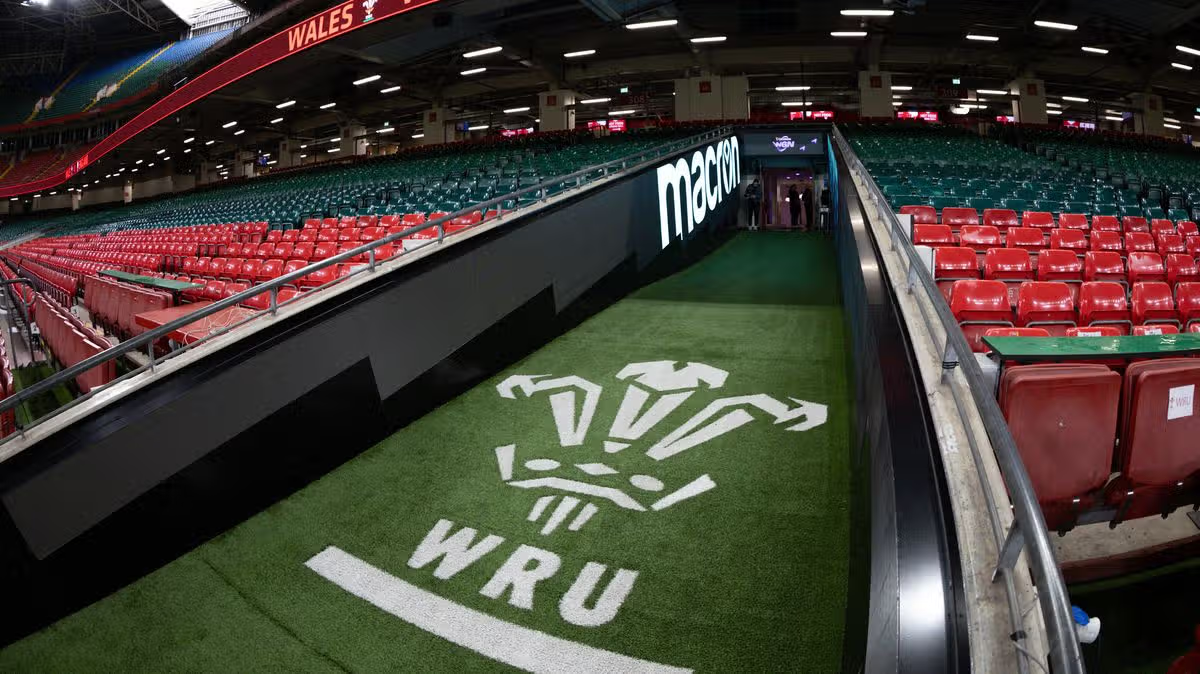
Aramark has committed an undisclosed capital contribution to support the widening of the hospitality offer at the stadium, including some 14,000 new padded seats on level four, which will replace plastic seats that have been in the ground since it opened back in 1999.

Advertisement

The initial £117m projected revenue figure was outlined by the union’s former chief commercial officer, Leighton Davies, with the support of the wider executive team and board in September 2025. It is not uncommon for firms to have to revise forecasts during a financial year.

Gavin Marshall.

Mr Marshall said: “In terms of the numbers, those assumptions haven’t materialised. When you budget, and you miss your budget, you need to understand why and learn from it.”

He stressed it wasn’t a criticism of his predecessor. He added: “It is just an observation and you learn and reflect. There are a number of variables in this business that move materially, like the number of events, attendance, ticket yield, team performance, but ultimately we have to take responsibility for budgeting accurately and we need to focus on that going forward.”

Mr Marshall, who hails from Pembrokeshire, said he could not give an actual turnover figure for the union’s last financial year to the end of June, as the accounts, which will be published next month, were still being audited by Grant Thornton.

Advertisement

However, he said that, based on historic outcomes and taking inflation into account, a figure of £110m could be seen as a responsible assessment.

He added: “The accounts have not been audited yet, so I cannot be specific, but in general terms we have had a challenging year.

“There is substantial cost around generating that revenue, like staging international rugby, putting on events, the cost of delivering hospitality and food and beverage for those events and the cost of the hotel. The cost of sales is around £50m, so we have a gross profit of £60m, a figure that is more relevant than turnover.

“After that we have our overhead costs, the cost of running the stadium and corporate costs of running a business, and the professional and community rugby programme. Those costs are around £30m. That leaves us with an Ebitda of around £30m, and that is a figure we are not too far away from this time.

Advertisement

“But when you get to £30m, we have the cost of community rugby clubs, Super Rygbi Cymru, the servicing of the debt, and we have to find capital expenditure for the stadium. What is left we spend on professional rugby, and that includes the optimum investment we have identified for our pathways, where we have under-invested.”

Four teams not sustainable

The WRU is committed to reducing the number of regions from four to three, with it looking for the Ospreys and the Scarlets to bid for one licence for west Wales. Cardiff, which is WRU-owned, and the Dragons will be invited to take up the other two licences.

He argued that maintaining funding for four regions was not sustainable. However, opponents to the strategy, including the so-called Coalition of the Willing, counter that there is very little difference financially between funding four – although requiring significant benefactor backing – and three regions, with the latter providing increased investment of around £28m over five years to invest in the pathway development of the game.

Mr Marshall said: “Nobody wants to reduce investment in professional rugby for the sake of it. We want successful professional teams in Wales. What we are saying is that we cannot afford the level of investment we are currently making in professional rugby. That argument will be strengthened when we publish our accounts next month.”

Advertisement

He added: “It is an affordability issue and we want our professional teams to be competitive and have the right level of investment, and the current level of investment we cannot afford. We need to have spending on professional rugby at a level where the game can be sustainable.

“Abi [chief executive Abi Tierney] has talked about investment of £20m in professional rugby, but at the moment it is significantly more than that in terms of our investment and it is more like £26m. We cannot afford that level of investment and, where we are at as a business, that is why we need to change.”

The Coalition of the Willing, which includes the founder of price comparison firm Hayley Parsons and former chief operating officer of Hodge Bank and Principality Building Society, Rob Regan, has called on the union to provide in full the business case for three regions and the risk assessment undertaken on the implications of a loss of a region.

Mr Marshall said he was aware of the public appetite for an Anglo-Welsh league or a British and Irish one. The respective stakeholders in the English Premiership, the governing bodies, CVC and the URC, have been holding exploratory discussions over a possible new league structure.

Advertisement

However, it would need enough of a commercial uplift, starting with a lucrative TV deal, to be appealing to all parties, but most importantly the English Premiership clubs.

Mr Marshall would not be drawn on the nature of any talks or whether he had any involvement. He added: “We are a member of the URC (United Rugby Championship, which the Welsh regions play in) and I want to respect that competition, but I acknowledge the public sentiment on Anglo-Welsh competitions and fully understand why it attracts such interest.

“It is worth noting that we have put in an application to PRW (Premiership Women’s Rugby) for two Welsh women’s teams to play in the English league.”

He said the union had no plans to reduce its headcount. In 2024-25, when the union posted revenues of £106.1m and pre-tax losses of £7.2m, it had a total workforce of 344.

Advertisement

He said: “Our headcount is pretty stable and that will be seen in the accounts, but we cannot cut our way to success. We need to grow our commercial revenues and we are happy with the cost base, which is appropriate for our business, although it is really important to control costs appropriately and we scrutinise every new hire, but we have no plans to run a redundancy programme.”

Its current financial year is the first with the WRU feeling the full impact of giving up equity, along with the other unions, to CVC in the Six Nations. That deal, struck in 2021, gave the private equity firm a 14% interest and rights to a share of commercial income generated by the Six Nations.

Last year the WRU received its last phased payment (£8.5m) for its £40m share in what was a £360m deal. The full impact of the dilution will see the union being around £3m down.

Wales match ticket sales

Ticket sales were tricky for some Wales matches last season

Ticket sales were tricky for some Wales matches last season(Image: PA Wire)

Mr Marshall said for the current 2026-27 financial year, despite fewer Welsh home rugby internationals, revenues should come in around the same as the last financial year.

Advertisement

He explained: “On the rugby side there will be five games rather than seven, but historically England and Ireland are very strong. We are ahead of where we were previously in terms of those sales. It is really important to have a strong autumn.

“It is still early days in terms of ticket sales for those games. We are really positive about the new tournament structure of the Nations Championship, and having three games to sell in quick succession is probably easier than four, which was a bit of a stretch last year.

“So, we are probably expecting a relatively flat year revenue-wise. We have got fewer games, but we would expect to drive a better yield and we have got some premium games in there with New Zealand, England and Ireland. In terms of events, the calendar for 2027 is looking very strong, with a lot of announcements over the next month or so for events between now and the end of the year.”

The union has increased its number of ticket price categories from three to six for rugby internationals. Mr Marshall said: “Our most expensive tickets are a jump, but we are already sold out. We need to drive increasing yields and I think we can do that with our six categories rather than three. We want to keep it affordable and accessible. We are only selling family tickets in the lower tier to create that family zone.”

Advertisement

On a full ground for the New Zealand game in November, Mr Marshall said: “We are not complacent, but confident.” With regards the other two autumn games against Australia and Japan, he added: “We got a great crowd last year against Japan, with a great family crowd and a great game of rugby. We are looking to replicate a similar crowd to what we had last year, with just over 60,000.

“We have kept the tickets affordable for Japan. The Australia game at 8pm on a Saturday is a challenging time as it potentially rules out families, with a lot of competition on a Saturday night. So we recognise that Australia is the most challenging due to the time, but we haven’t played them for a couple of years and we have got the Stickmen with the half-time show, which has proved really popular previously.”

New concerts and football matches

On the concert market, he said: “We are really happy and have a couple of concerts booked, with discussions ongoing in a really strong pipeline. We are really confident that 2027 will be a great summer for concerts. We have Andrea Bocelli announced and we are expecting that to sell out, with ticket sales really strong for May. We were delighted to get him and it fits in with our strategy of trying to get a broader mix of events here.

“We have been very strong with pop and rock concerts, but having a different genre and financial model for that event, we are really happy with, and we plan to make it a biennial event.

Advertisement

“We have been very successful with concerts, but what we are looking at is attracting elite football to the stadium, like the Community Shield, and we are delighted to secure the Women’s Champions League final in 2029, so we have really identified football as an area of growth.

On getting to £30m over a five-year period from around £18m from hospitality and food and beverage sales at the stadium, while an ambitious target, he is confident it is achievable.

He said: “Yes, we are (confident). So far we have focused on technology-led improvements, with speed of service and e-bars across the stadium, which were a big success at the Community Shield. But that is just part of it. With the deal with Aramark, we have a capital fund to spend to improve facilities.

“We are looking to develop level four as a real premium experience, including replacing around 14,000 seats on level four with new padded ones

Advertisement

“The seats are just part of it, with investment in the concourse and the whole area to create a premium experience around level four. We are also looking to increase our hospitality capacity and have different types of hospitality that we can offer. We are confident that these things will help us drive food and beverage revenue, but also ticket yield.”

As part of its strategy to create an all-year-round venue, the union has opened a new riverside bar (with a licensed bar) on the River Taff walkway side of the Principality Stadium.

The Parkgate Hotel

With grand brasserie-style decor, leather banquettes, chandeliers, and a wide-ranging menu of British dishes, it's certainly a swanky hangout for a dinner date.

Parkgate Hotel.(Image: Parkgate Hotel)

Mr Marshall said the Parkgate Hotel, next to the Principality Stadium, continues to perform strongly. The union owns a 75% stake in the hotel, with the remainder held by Cardiff-based property development firm Rightacres.

In its last audited financial year to the end of June 2025, the hotel, next to the Principality Stadium, posted revenues of nearly £13m, with a profit of £498,000. The hotel was financed with a £45m funding deal with L&G, repayable over 45 years.

Advertisement

With cash of more than £1m, Mr Marshall wouldn’t be drawn ahead of the accounts being published as to whether the union has now received its first dividend from the hotel. He added: “It is trading profitably and we are really pleased with its performance. It was always seen as a long-term investment rather than a short-term cash exercise. The objective is to create long-term value by the investment.

In 2024-25 the union had a net debt position of £124m. Mr Marshall said; “The focus is on ensuring that our debt is affordable and we maintain liquidity and do not constrain our ability to invest in rugby. Our debt levels are pretty stable in terms of the facility with Goldman Sachs and HSBC, but also the facility with Parkgate (around a £45m lease finance with L&G) and our debentures.”

He said that the union had not explored, although previous regimes did, a possible securitisation against future income from stadium events or a sale-and-leaseback deal. While it would provide significant upfront capital, it would have to be repaid with a profit margin for an institution or institutions prepared to do a deal.

Mr Marshall said: “There is a real cost around debt, so it is not something we are considering at the moment. What we are focusing on is getting value out of our assets, and what we are focused on is growing the events business from the stadium and driving more revenue and profit.

Advertisement

“We recognise that we need to broaden the mix of events. There is effectively a rental payment, but also the upside of food and beverage income, which is a similar financial arrangement to concerts.”

In January the union struck a new £60m funding deal, with a revolving facility element that can flex up and down when required, and £5m specifically for capital expenditure projects, with HSBC and Goldman Sachs. In what is a three-year deal around half was deployed by the WRU to refinance loans with the Welsh Government and NatWest. The facility has added to the overall debt position, but is carrying a lower interest rate than the previous debt deals.

Mr Marshall: “We are on better terms and will still have headroom in that facility, but the more we eat into it, the higher the interest payment.”

On striking a long-term deal with its funders he said: “It would be wrong to disclose confidential discussions around different options, but Goldman Sachs and HSBC are great partners and we hope they will continue to be beyond this period.”

Advertisement

The stadium zip wire

Stadium roof walk.

Last year the union terminated its partnership with Wire & Sky as operator of its stadium roof walk and zipwire attraction Scale. The attraction, using CVC monies, cost around £5m. Its performance was extremely disappointing and was failing to cover operational costs.

However, Mr Marshall said he is confident that new operators, Welsh firm Zip World, will turn things around. He said: “It is still early days with the new operator and we have not had the first full year yet, but we are seeing increased revenue and it is worth saying that in terms of customer feedback that is very strong.

“We know that people who are using it are enjoying it and are happy with the product. It is growing, but yes the original model didn’t perform as we hoped and we have to be open about that and acknowledge that, but we

Advertisement
Continue Reading

Business

Why is the price of protein powder rising?

Published

on

A young woman is sat in a gym drinking a protein shake. She is wearing a purple cropped top and navy blue leggings.

Why is the price of protein powder rising?

Continue Reading

Business

The 8 Best HR Software for Small Business in 2026

Published

on

hr software for small business

The first time I hired an employee, I made her fill out her W-4 by hand, emailed her offer letter from my personal Gmail, and tracked her PTO in a spreadsheet tab I labeled “vacation??” I found out three weeks later that I’d never actually set her up for direct deposit. She was very patient about it. I was not proud of myself.

That’s the thing nobody tells you about growing a small business: the moment you hire your first employee, you’ve also hired yourself as an HR department. Payroll, tax withholding, benefits, onboarding, time-off requests, compliance with labor laws you didn’t know existed, it’s all yours now, on top of everything else you were already doing.

So is dedicated HR software worth paying for, or is a well-organized spreadsheet good enough? I spent weeks digging through pricing pages, user reviews, and a fair amount of conflicting third-party pricing trackers to find out and to land on the tools that are actually worth a small business’s money in 2026.

The best HR software for small business, at a glance

  • Rippling — best all-around HR platform for teams that want room to grow, from roughly $8/employee/month plus a base fee (custom quote required)
  • Gusto — best for payroll-first small teams, from $49/month plus $6/employee/month
  • BambooHR — best dedicated HR/HRIS platform, from $10/employee/month (or a $250/month flat rate for 25 or fewer employees)
  • Homebase — best for hourly and shift-based teams, free for one location with up to 10 employees; paid plans from $30/month
  • Zoho People — best for affordability, free for up to 5 employees; paid plans from $1.50/employee/month
  • Justworks — best PEO for benefits without an in-house HR team, from $50/month plus $8/employee/month for payroll-only, or $79+/employee/month for full PEO service
  • Deel — best for hiring and managing a global or remote team, core HR platform free; global payroll from $29/employee/month
  • OnPay — best value for the features you get, from $49/month plus $6/employee/month

What makes HR software worth paying for?

Not every small business needs the same things from an HR tool, but there’s a fairly short list of jobs it has to do well once you’ve got even a handful of W-2 employees:

  • Payroll and tax filing. This is the one area where “just use a spreadsheet” stops being a viable option. Miscalculate a withholding or miss a filing deadline, and you’re not dealing with an annoyed employee — you’re dealing with a government agency.
  • Benefits administration. Health insurance, retirement plans, workers’ comp — even if you’re not offering much yet, you’ll want software that can grow into this rather than force a total platform switch later.
  • Onboarding and self-service. New hires should be able to fill out their own tax forms and direct deposit info online, and existing employees should be able to check their own pay stubs and PTO balance without emailing you about it.
  • Compliance support. Labor laws vary by state, and sometimes by city, and they change often enough that “we’ll figure it out” is a real risk, not just an inconvenience.
  • Room to grow. The tool that fits 3 employees shouldn’t require a full migration at 15. Add-on modules beat a hard ceiling.

I weighted these picks toward platforms that nail the basics cheaply, since most small businesses don’t need, and shouldn’t pay for enterprise HR complexity.

One more thing before we get into it: HR software pricing is a genuine mess to research. Almost none of these companies publish a single, stable rate card, and the numbers shift by a few dollars between the vendor’s own pages and whatever third-party tracker you check next. I’ve used each company’s most recently published figures below. Treat them as a strong starting estimate, not gospel, and confirm the current number before you sign anything.

Advertisement

1. Rippling

Best for: small businesses that want room to grow into IT and finance tools later

Pros:

  • Combines HR, IT device management, and finance in one system
  • Powerful no-code workflow automation (“if this happens, do that”)
  • Modular pricing means you pay only for what you use

Cons:

  • No published starting price you can fully trust — everything requires a custom quote
  • No free trial, only a sales demo

Rippling’s whole pitch is that HR shouldn’t live in a silo. Its “Rippling Unity” platform starts with core HR, employee records, onboarding, time off, org charts and then lets you bolt on payroll, benefits, IT device provisioning, and even company card and expense management, all sharing the same employee data. That’s the actual differentiator: when someone’s hired, Rippling can automatically provision their laptop and software access in the same workflow that processes their first paycheck. Fire someone, and it can pull that access back just as fast.

The flexibility comes at the cost of a straight answer on price. Rippling’s own materials cite the core platform at around $8 per employee per month, though the base monthly fee attached to that number has shown up as anywhere from $35 to $40 depending on which page you land on and payroll, benefits, and IT are all separate add-ons priced on request. For a 50-person company running HR, payroll, and benefits together, published estimates land somewhere in the $15–$25-per-employee-per-month range, though your mileage will vary considerably.

If you’re a five-person team that just needs payroll and PTO tracking, this is probably more firepower than you need. But if you can already picture needing device management or multi-entity payroll a year or two out, the sales call is worth your time.

Advertisement

Rippling pricing: From roughly $8/employee/month plus a monthly base fee; full pricing (payroll, benefits, IT) requires a custom quote

2. Gusto

Best for: small teams that want payroll handled correctly and don’t want to think about it again

Pros:

  • Unlimited payroll runs and automatic federal, state, and local tax filing on every plan
  • Transparent, published pricing, a rarity in this category
  • Easy to set up without outside help

Con:

  • HR features stay fairly basic until you reach the Premium plan, and multi-state payroll requires upgrading to Plus

Gusto built its reputation on making payroll boring in the best possible way. Run payroll, and it calculates and files the taxes; W-2s and 1099s show up automatically at year-end, no separate accountant conversation required for the basics. The Simple plan covers single-state payroll and a self-service portal where employees can view pay stubs and manage their own benefits enrollment.

Where Gusto asks you to pay more is HR depth. Plus ($80/month plus $12 per employee) adds multi-state payroll, time tracking, PTO policies, and next-day direct deposit — the stuff most growing teams need within their first year anyway. Premium ($180/month plus $22 per employee) adds access to certified HR experts and compliance alerts, which starts to look less like software and more like an HR hotline with a payroll system attached.

Advertisement

If payroll accuracy and tax compliance are the actual headache, not performance reviews or org charts, Gusto is the least complicated fix.

Gusto pricing: Simple, $49/month + $6/employee/month; Plus, $80/month + $12/employee/month; Premium, $180/month + $22/employee/month

3. BambooHR

Best for: businesses that want a dedicated HR system without folding in IT or finance tools

Pros:

Advertisement
  • Clean interface that doesn’t require weeks of onboarding to learn
  • Solid applicant tracking built in, not bolted on
  • Automatic volume discounts as headcount grows

Cons:

  • Payroll, benefits, and time tracking all cost extra
  • Pricing climbed in 2026, with a new top-tier Elite plan landing at $25 per employee per month

BambooHR is HR software built by people who apparently remember what it’s like to actually do HR. Employee records, time-off requests, onboarding checklists, and reporting all live in one dashboard that reviewers consistently describe as easy to pick up without training, a real advantage when you’re also the one training yourself. Core (from $10 per employee per month) covers the essentials: records, workflows and approvals, applicant tracking, and time-off management, plus a basic AI assistant that can tell you how much PTO someone has left without you digging through a report.

Move up to Pro ($17/employee/month) for performance management and employee community features, or Elite ($25/employee/month) for the top tier. Companies with 25 or fewer employees skip per-employee pricing entirely and pay a flat $250 a month instead — worth knowing before you assume the per-seat math applies to you.

Payroll, full benefits administration, and time tracking are all separate paid add-ons requiring their own quotes, though BambooHR does offer a bundle discount for combining payroll and benefits. Budget for that ahead of time rather than assuming Core covers everything.

BambooHR pricing: Core, from $10/employee/month; Pro, from $17/employee/month; Elite, from $25/employee/month; flat $250/month for companies with 25 or fewer employees

4. Homebase

Best for: restaurants, retail shops, and any small business built around hourly, shift-based work

Advertisement

Pros:

  • A genuinely usable free plan, not just a trial
  • Scheduling and time tracking built specifically for hourly teams, including GPS clock-ins
  • Payroll syncs cleanly with the scheduling and timesheet data you’re already generating

Cons:

  • Priced per location, which can work against multi-site businesses with small headcounts per site
  • PTO controls are locked behind the $70/month Plus tier

If your team clocks in and out rather than logging on from a laptop, most HR software wasn’t really built with you in mind, Homebase was. The free Basic plan covers one location and up to 10 employees with real scheduling and time-tracking tools, not a stripped-down demo. Outgrow that, and Essentials ($30/month per location) unlocks unlimited employees at that location, plus advanced scheduling, GPS-verified time punches, and team messaging.

The scheduling-and-time-clock combination is where Homebase earns its keep: managers build a schedule and watch labor costs update in real time, while employees get alerts if their shift changes or they’re about to miss a break, which matters for labor law compliance in a lot of states, not just convenience.

Payroll isn’t bundled into any tier, it’s a $39/month plus $6-per-active-employee add-on regardless of plan but it pulls straight from your existing timesheets, so hours worked and hours paid match without extra reconciling.

Homebase pricing: Free for one location (up to 10 employees); Essentials, $30/month/location; Plus, $70/month/location; All-in-One, $120/month/location; payroll add-on, $39/month + $6/employee/month

Advertisement

5. Zoho People

Best for: small businesses that want solid HR features without a big monthly bill

Pros:

  • The cheapest genuinely full-featured HR software on this list
  • Free plan for teams of 5 or fewer, no time limit
  • Zia, Zoho’s AI assistant, can handle time-off requests and answer basic HR questions conversationally

Cons:

  • Payroll and recruiting require separate Zoho products, purchased and billed on their own
  • Fewer employee-experience extras than pricier competitors like BambooHR

Zoho has an app for nearly every business function, and Zoho People is its HR entry, built to stay affordable at every tier rather than just the entry level. Essential HR runs $1.50 per employee per month with no minimum headcount, covering onboarding, employee records, time-off management, shift scheduling, and document management. That’s a usable feature set for the price of a coffee per employee.

Higher tiers add real depth without a steep jump: Professional ($2/employee/month) adds attendance management and timesheets, Premium ($3/employee/month) adds performance management and HR analytics, and Enterprise ($4.50/employee/month) adds an HR help desk and learning management tools.

The real limitation is that Zoho People can’t run payroll or hiring on its own, those jobs go to Zoho Payroll and Zoho Recruit, separate subscriptions with their own bills. If you’re fine managing two connected apps instead of one, the combined cost still beats most of this list.

Advertisement

Zoho People pricing: Free for up to 5 employees; Essential HR, $1.50/employee/month; Professional, $2/employee/month; Premium, $3/employee/month; Enterprise, $4.50/employee/month

6. Justworks

Best for: small businesses that want big-company benefits without hiring an HR department to manage them

Pros:

  • Full PEO service gives small teams access to enterprise-level health benefits
  • 24/7 support and compliance guidance included on PEO plans
  • Straightforward per-employee pricing with no base fee on the PEO tiers

Cons:

  • Meaningfully pricier than standard HRIS [human resources information system, the general category of employee-records-and-workflow software, as opposed to a PEO] or payroll software
  • No free trial
  • Co-employment isn’t the right structure for every business type

Everything else on this list is HR software. Justworks is a PEO, which means it doesn’t just sell you a dashboard, it becomes a co-employer of your team on paper, which lets a five-person company plug into the same large-group health insurance rates a 500-person company gets. For a small business competing for talent against bigger employers, that can be the whole ballgame.

The standalone Payroll plan ($50/month plus $8/employee/month) is the entry point if you’re not ready for full PEO service: tax filing, PTO management, and basic HR tools, no co-employment structure attached. PEO Basic (around $79/employee/month, no base fee) adds compliance support, 401(k) access, and workers’ comp. PEO Plus (roughly $109–$124/employee/month) layers in health, dental, and vision benefits administration on top.

Advertisement

Read our full breakdown of what a PEO actually is if you’re weighing this against a standard HRIS. Short version: this isn’t the cheapest way to run payroll, but it’s often the cheapest way to offer benefits that compete with a bigger employer’s.

Justworks pricing: Payroll only, $50/month + $8/employee/month; PEO Basic, from ~$79/employee/month; PEO Plus, from ~$109/employee/month

7. Deel

Best for: startups and small businesses hiring across borders

Pros:

Advertisement
  • Core HR platform is free
  • Employer of Record [EOR — a service that legally employs your workers in a country where you don’t have your own entity, so you can hire there compliantly] service in 150+ countries
  • One system for managing employees and international contractors together

Cons:

  • EOR pricing is steep: $599 per employee per month at the standard tier
  • Global payroll carries a roughly $1,000 setup fee on top of the monthly rate

Deel exists for a problem most HR software ignores: what happens when your third hire lives in Lisbon and your fourth lives in Manila? The free Deel HR tier covers the basics – employee directories, time-off management, document storage for any team, domestic or global. From there, Global Payroll runs $29 per employee per month for countries where you already have a legal entity, and Contractor Management ($49/contractor/month) handles compliant agreements and payments in 120-plus currencies.

No local entity, and need Deel to be the legal employer instead? That’s Employer of Record, and it’s expensive – $599 per employee per month, climbing to $899 at the enterprise tier – reflecting the legal and compliance infrastructure required in each country. Against the cost and timeline of setting up a foreign subsidiary, though, it’s often still the faster and cheaper option for a growing startup.

Every employee living in the same state as you makes Deel’s global machinery overkill. A distributed or growth-stage startup, on the other hand, may find it’s the only tool on this list built for the way hiring actually happens now.

Deel pricing: Core HR platform, free; Global Payroll, $29/employee/month; Contractor Management, $49/contractor/month; Employer of Record, from $599/employee/month

8. OnPay

Best for: small businesses that want solid payroll and HR features without paying for a big brand name

Advertisement

Pros:

  • Straightforward, published pricing with no hidden per-plan tiers to decode
  • Free HR tools bundled with the base payroll plan
  • First month free, including setup and data migration

Cons:

  • No dedicated time-tracking tool built in
  • No volume discounts for larger teams

OnPay doesn’t try to be everything – it’s a well-built payroll platform with useful HR tools layered on top, priced simply enough that you can do the math yourself instead of requesting a quote. Payroll Essentials ($49/month plus $6 per worker) covers unlimited payroll runs, tax filing across all 50 states, contractor payments, and a self-service employee portal.

The HR add-on ($15/month plus $2 per employee) brings in PTO workflows, org charts, expanded onboarding, and document management – handy once you’re managing more than payroll, skippable if payroll is genuinely all you need right now. Compliance Resources and Live HR Support round out the optional add-ons for businesses that want more hand-holding on the regulatory side.

It won’t out-feature the platforms built for enterprise scale. For a small business that mostly needs payroll done right, plus a few HR basics and no steep learning curve, it punches well above its price tag.

OnPay pricing: Payroll Essentials, $49/month + $6/employee/month; HR add-on, +$15/month + $2/employee/month

Advertisement

So which one should you pick?

It mostly comes down to what’s breaking right now. Payroll errors and tax deadlines are the most urgent to fix, so start with Gusto or OnPay if that’s the pain point. Managing hourly shift workers? Homebase was built for exactly that. Trying to offer real health benefits on a small-business budget? Look at Justworks. And if the whole story is budget, Zoho People gives you more HR software per dollar than almost anything else on the market.

Whatever you land on, the real win isn’t the software. It’s never filling out anyone’s W-4 by hand again.

For readers who just want payroll and nothing else, our roundup of free payroll software for small business covers the $0 options before you consider paying for any of this.

Advertisement
Continue Reading

Business

A Recalibration, Not A Rate Hike Cycle

Published

on

The Fed's PCE Problem: Why Its Preferred Inflation Gauge Misreads The Economy

A Recalibration, Not A Rate Hike Cycle

Continue Reading

Trending

Copyright © 2025