
Business
Phreesia, Inc. (PHR) Q2 2027 Earnings Call Transcript


Operator
Good evening, ladies and gentlemen, and welcome to the Phreesia Second Quarter Fiscal 2027 Earnings Conference Call. [Operator Instructions] First, I would like to introduce Balaji Gandhi, Phreesia’s Chief Financial Officer. Mr. Gandhi, you may begin.
Balaji Gandhi
Chief Financial Officer
Thank you, operator. Good evening, and welcome to Phreesia’s earnings conference call for the second quarter of fiscal 2027, which ended on July 31, 2026. Joining me on today’s call is Chaim Indig, our Chief Executive Officer. A more complete discussion of our results can be found in our earnings press release and in our related Form 8-K submission to the SEC, including our quarterly stakeholder letter, both issued after the markets closed today. These documents are available on the Investor Relations section of our website at ir.phreesia.com.
As a reminder, today’s call is being recorded, and a replay will be available on our Investor Relations website at ir.phreesia.com following the conclusion of the call. During today’s call, we may make forward-looking statements, including statements regarding trends, our anticipated growth, our strategies, predictions about our industry and the anticipated performance of our business, including our outlook and visibility regarding future financial results.


There is another, less tangible ingredient: Lady Beckham herself.
The woman who once seemed almost comically aloof has become increasingly willing to show the person behind the brand. She’s been known to post videos demonstrating her beauty products – often with wet hair, seemingly filmed in her bathroom.
Lisa Maynard-Atem, a business strategy adviser, said this has been crucial.
“She hasn’t abandoned the polish or aspiration that you expect from a luxury brand, but she has added personality,” she said. “That creates connection and people buy into brands emotionally as well as commercially.”
Maynard-Atem added that Lady Beckham’s openness about the firm’s struggles has also helped.
“By acknowledging the losses and some of the mistakes that were made, she makes the eventual turnaround more credible. The failure hasn’t been edited out of the story. It has become part of the story,” she said.
Luxury fashion remains a competitive business, and one profitable year is no guarantee of future success.
The key is to keep innovating, according to Bedford.
“Success changes with the trends and probably the biggest factor is the creative director,” she said.
“Fashion is not an easy industry to enter and certainly not for the faint of heart. The founders who last are the ones who treat setbacks as information to learn and then build from, rather than something to hide.”

SEC Chairman Paul Atkins details what he calls the agency’s most historic step yet on crypto regulation and expresses hope that the CLARITY Act will reach President Trump’s desk.
The Securities and Exchange Commission (SEC) is moving to give crypto companies a clearer path to raise capital in the United States as the agency seeks to bring crypto-asset investment and innovation back onshore while keeping activity under U.S. law.
SEC Chairman Paul Atkins joined FOX Business’ Cheryl Casone on “Mornings with Maria” to discuss the agency’s new crypto proposal, its exemptions and the broader push to make the U.S. the “crypto capital” of the world.

SEC Chair Paul Atkins unveils proposal to bring crypto investment back to the U.S. (Al Drago/The Washington Post/Bloomberg / Getty Images)
“Our regulation crypto assets that we’re calling it, that we’ve proposed is our most historic step yet to try to bring reality to the president’s call to make the United States the crypto capital world,” Atkins said.
The proposal comes as Congress considers the CLARITY Act, which Atkins said he hopes will ultimately reach the president’s desk. The SEC is moving ahead with its own proposal and seeking public comment as it develops a regulatory framework alongside Congress’ work on the legislation.
SEC Commissioner Mark Uyeda discusses OpenAI and Anthropic’s IPO ambitions, new crypto regulations and President Donald Trump’s digital asset agenda on ‘Mornings with Maria.’
Atkins framed the proposal as an effort to reverse an exodus of crypto innovators and give companies more reason to develop products and raise money in the United States.
TRUMP-LINKED WORLD LIBERTY CRYPTO VENTURE GETS PRELIMINARY APPROVAL FROM CURRENCY COMPTROLLER
“I think this is an important step to try to reassure, to bring back on to the United States shore, innovators whom we have over the past administration’s four year term, chased offshore, frankly, for them to develop their products and raise money abroad,” he said.
Pennsylvania Senator Dave McCormick discusses the Senate’s upcoming priorities. McCormick expresses frustration over the recess delay on the critical third reconciliation package to pass the Save America Act.
He also argued that keeping investment opportunities in the U.S. matters because Americans can already move capital across borders online.
GET FOX BUSINESS ON THE GO BY CLICKING HERE
“We can’t fool ourselves. American investors in the age of the internet can send their money anywhere. So we need to make sure that they can do it here in the United States under United States law,” Atkins said.

Junior workers can often face the biggest dilemma. Felicity, now mid-career, remembers one horror story from her first job as a teenager.
Working at a car garage aged 17, she was suddenly thrust an envelope to give money for a mechanic who was retiring. The team was small and tight-knit, so everyone was expected to contribute.
“Not only did I not really know anyone at that stage, but I also had no money to give – I was still living at home and being paid hardly anything.
“As it was after lunch, I’d used my notes. In a panic I threw in all the spare change I had left, basically a load of coppers.”
She says: “I thought I’d got away with it until the person collecting shouted ‘who on earth put in all this change’. Everyone laughed and I couldn’t ever admit it was me.”
Today, Felicity usually gives between £5 and £10 but goes up to £20 for a close work friend or long-time colleague.

Londoners are able to hail the UK’s first robotaxis – as Uber today becomes the first company to launch a self-driving minicab.
Initially, it only has 15 autonomous vehicles with a licence to operate in the city, and each one must have a human safety driver behind the wheel ready to take control if anything goes wrong.
Uber said it surveyed London-based customers via the app and more than 100,000 said they would choose a self-driving taxi if one was available, despite incidents of driverless rides malfunctioning in US cities where they already operate.
As I found out when I became the first UK journalist to hail one, it was mostly smooth but the safety driver did intervene on one occasion.
At the moment the UK fare for a robotaxi ride will be the same fare as a standard UberX, Uber Electric, or Uber Comfort journey, with upfront fares shown in the app.
Taking a self-driving ride will only appear as an option in the app after the journey has been booked, and if one of its cars is available nearby.
Uber’s global head of autonomous mobility and delivery Sarfraz Maredia said the plan was to phase them in over a period of several years.
“We always want consumers to be able to request a human ride or an autonomous vehicle, and because the market’s growing, we expect that there will be human drivers on Uber London for a long time to come,” he said.
The Ford Mustang electric vehicles which make up Uber’s current small fleet are fitted with the UK tech firm Wayve’s driverless car technology, which uses AI to analyse data about what is going on around it in real time, gathered by sensors in a bar on the roof of the vehicle and elsewhere.
The vehicles are not pre-programmed – their actions are determined on the spot depending on what is going on.
Google’s autonomous car company Waymo and the Chinese tech giant Baidu are also vying to launch services in the UK, and the competition is fierce.
Wayve chief executive Alex Kendall described developing the technology as “the space race for our generation” but added there were some “really hard problems to solve” along the way.
“What we’ve done over time is pioneer a completely new approach to autonomous driving, making it possible to bring this to a busy and complex city like London and scale it globally,” he said.
A widespread outage affecting Microsoft 365 stretched into its third day this week, with users of Outlook, Teams, SharePoint and OneDrive for Business continuing to report intermittent access problems even as Microsoft said the vast majority of the disruption had been resolved.
The outage, which Microsoft is tracking internally under the incident number MO1465074, began at 3:08 p.m. UTC on Monday, Aug. 31, according to the company. Microsoft attributed the root cause to a problem within a core authentication configuration shared across multiple Microsoft 365 services, rather than an issue isolated to any single product.
“The root cause of the outage is an issue within a core authentication configuration used by multiple Microsoft 365 services,” the company said in a status update, adding that the disruption had triggered a broader service degradation designation for Microsoft 365 Business and Enterprise customers.
Outlook was among the first and most visibly affected services, with users reporting delays and outright failures in sending and receiving email, along with authentication errors and problems searching mailbox content. User reports on the crowdsourced outage-tracking site Downdetector began surging around 11:30 a.m. ET on Monday and had climbed past 5,000 by early afternoon, with additional complaints flooding social media platforms throughout the day.
Microsoft said its investigation initially pointed to a misconfiguration affecting how authentication components were deployed across a portion of its infrastructure.
“Our investigation indicates that a misconfiguration issue may be preventing authentication components from deploying as expected to a portion of infrastructure, and we’re reexamining recent changes made to the service to determine why this is occurring,” the company said in an update posted to its Microsoft 365 Status account.
As the outage continued into Monday evening, Microsoft confirmed that its impact extended well beyond Outlook and Exchange Online, the email and calendaring backbone used by millions of businesses. The company said OneDrive for Business, SharePoint Online, Microsoft Teams, Microsoft Purview and Microsoft Defender XDR were also affected, along with the Microsoft 365 Admin Center and Universal Print.
“Additionally, we’ve confirmed that the authentication component issue impacts other services beyond Exchange Online,” Microsoft said, directing customers to its status page for details on the specific ways each affected service was behaving.
By Tuesday, the outage had not fully resolved, prompting Microsoft to continue publishing incremental updates as engineers worked through a remediation process that included restarting affected infrastructure and reapplying a targeted fix to the authentication systems at the center of the problem.
“Our mitigation actions are continuing to progress within the remaining affected infrastructure,” Microsoft said in a Tuesday update. “Indications from telemetry remain positive, and we’ve confirmed service availability is improving. We’re entering a period of extended monitoring to ensure a full resolution is in place.”
The company’s messaging throughout the incident emphasized gradual, uneven recovery rather than a single clean fix, a pattern consistent with prior large-scale Microsoft 365 outages that have often required extended monitoring periods even after initial telemetry data showed improvement.
By early Wednesday morning, Microsoft indicated that conditions had stabilized significantly for most customers.
“Service availability remains stable above 99 percent,” Microsoft said in a status update posted at 6:29 a.m. ET Wednesday, adding that “the majority of users should no longer be seeing impact from this issue.”
Even so, scattered reports of ongoing trouble continued to surface into Wednesday, including separate tracking on outage-monitoring sites showing renewed spikes in complaints specifically tied to Microsoft Teams, suggesting that while the broader authentication issue had largely subsided, some customers and services continued to experience residual effects.
Microsoft 365, the cloud-based subscription suite formerly known as Office 365, provides access to core productivity applications including Word, Excel, PowerPoint, Outlook and Teams, along with enterprise-focused services such as SharePoint and OneDrive that many businesses rely on for document storage, collaboration and internal communication. Because so many organizations depend on these tools for day-to-day operations, outages affecting the platform tend to generate an outsized wave of public complaints and business disruption relative to their technical scope, particularly when authentication systems are involved, since login failures can lock users out of multiple services simultaneously rather than affecting a single isolated feature.
This week’s incident adds to a string of significant Microsoft 365 disruptions in 2026. In January, a separate outage tied to authentication and mail-flow problems in North American infrastructure stretched for roughly ten hours, affecting Outlook, Defender and Purview before Microsoft confirmed the impact had been resolved. At the peak of that earlier incident, outage reports on Downdetector topped 15,000, with some affected businesses describing significant disruption to daily operations, including delayed communications with clients.
Independent monitoring services that track Microsoft 365’s uptime over time have noted that the platform has experienced a handful of major disruptions each year in recent years, with durations typically ranging from a few hours to, in more severe cases, closer to a full day. Analysts who study cloud infrastructure reliability have pointed to the increasing complexity of large, interconnected cloud platforms as a persistent challenge for major providers, even as those same companies continue investing heavily in redundancy and failover systems designed to prevent exactly this kind of widescale service degradation.
Microsoft has not yet published a full post-incident report detailing the underlying technical root cause of this week’s authentication misconfiguration or outlining specific steps the company plans to take to prevent similar disruptions in the future. Such detailed retrospectives typically follow major outages after monitoring periods conclude and engineering teams complete a full review of the incident.
For now, Microsoft has continued to direct affected customers to its official Microsoft 365 Status page and social media account for the most current information as monitoring continues, while cautioning that some users may still experience intermittent effects even as overall service availability holds above the 99% threshold the company reported Wednesday morning.

Almost half of people in Britain live in areas where economic growth does not translate into a better quality of life with a “stark” North-South divide in the spending power of households, a new report finds.
Researchers at consultancy firm PwC said every region the north of England, midlands and Wales had a lower spending power than the country’s average, with London and the South East comfortably above.
The findings come as Prime Minister Andy Burnham has pledged to tackle the cost of living and regional inequalities in order to boost living standards.
But questions remain over the new PM’s economic policies with surges in UK government borrowing costs set to impact public spending choices.
The report released on Thursday said the equivalent of 12.5 million households – 46% – lived in parts of the country where economic growth, often seen through increased business investment and job opportunities, were not leading to better living standards.
It said households in the north east of England had a spending power 6.6% below the national average, equivalent to £1,542 less a year. The north west was £1,493 less, while Yorkshire and the Humber were worst off with spending power down £1,917 comparatively.
Meanwhile, households in the South East were found to have spending power 9% above the national average, worth an additional £2,154 a year, followed by London.
Household spending power is seen as a good measure of whether economic growth is improving living standards.
PwC says it measures this by looking at income after taxes and housing costs, and takes into account the size and makeup of a household – which is aimed at giving a better idea of the money available to meet other expenses.
The UK has seen years of weak growth, although the economy expanded by 1.2% in the first six months of this year, according to official figures.
Most countries want economic growth because it usually means people spend more, extra jobs are created, more tax is paid to the government and workers get better pay rises.
All this together, in theory, leaves people better off – but it takes time for the benefits to be felt, and it does not necessarily benefit everyone. According to PwC, “only a fraction” of a rise in GDP – which a measures economic growth – leads to increased spending power.
Researchers said while there was a clear North-South divide in the spending power of households, there were also such examples of spending power differences within areas deemed better off, such as London and the south east.
For example, Richmond’s average annual disposable income was the highest in London at £35,448 – almost double the £18,384 recorded in neighbouring Hammersmith and Fulham.
“The research shows just how differently prosperity is experienced across the UK, with stark variations not only between regions but on each other’s doorstep,” said Rachel Taylor, government and health industries leader at PwC.

Tricia McLaughlin explains how data centers in Loudoun County, Virginia, have allowed the community to slash property taxes by 30 percent while funding state-of-the-art schools, hospitals and community centers.
The rapid buildout of artificial intelligence (AI) infrastructure is expected to accelerate in the years ahead, with a new analysis projecting investment in the sector will top $31 trillion through 2050.
A report by PwC projects that capital expenditures on AI infrastructure will reach $31.6 trillion by 2050 as companies invest in building the computing capacity to power models, as well as upgrade the tech as it advances.
It added that the $31.6 trillion estimate represents the central scenario within a plausible range of about $22 trillion to nearly $50 trillion.
Annual investment in data centers is expected to rise from roughly $800 billion a year in 2026 to $1.8 trillion per year in 2050.
X REVEALS FOREIGN ADVERSARY BEHIND FAKE ACCOUNTS DISSEMINATING ANTI-DATA CENTER MESSAGING

Investment in data centers is expected to top an estimated $31.6 trillion by 2050, according to an analysis by PwC. (Tom Fox/The Dallas Morning News via Getty Images)
“AI infrastructure is becoming one of the defining capital allocation challenges of the next generation. It cuts across technology, energy, real estate, supply chains, regulation and financing. This changes how infrastructure investors need to think about capital requirements, risk and returns,” said Clara Cutajar, global infrastructure leader at PwC Australia.
The Americas are projected to account for $16.5 trillion of the $31.6 trillion in estimated investment through 2050, with the U.S. alone accounting for about $15.1 trillion – or about 48% of the global total.
Cumulative capex in the Americas could rise to $27.1 trillion through 2050 in the upside scenario.
NEW REPORT WARNS AI DATA CENTER BOOM SQUEEZES MEMORY-CHIP SUPPLY, COULD RAISE EVERYDAY TECH COSTS
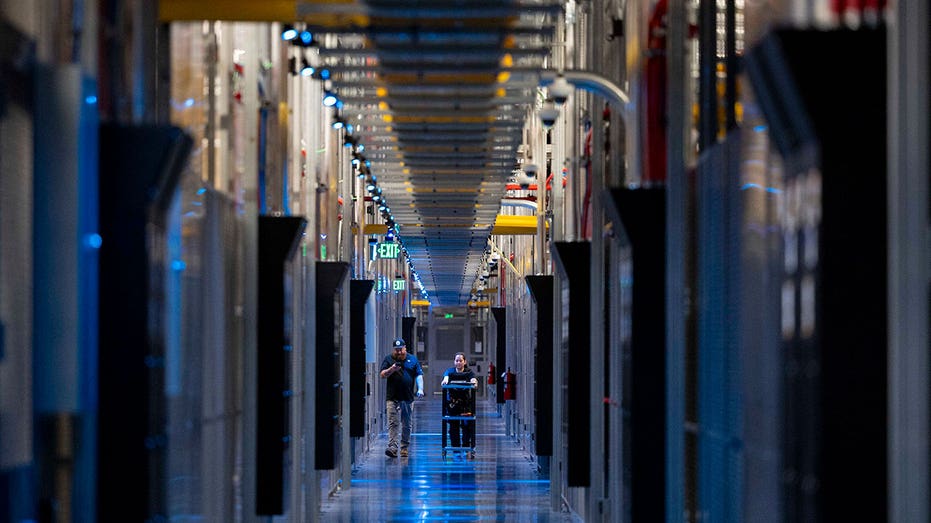
The report said the Americas would receive $16.5 trillion in investment through 2050 in the central estimate, with an upside of $27.1 trillion. (Amanda Andrade-Rhoades for The Washington Post via Getty Images)
PwC wrote that the “lead in AI infrastructure is wider than in any major industrial category since postwar manufacturing. That’s because the U.S. remains central to the advanced chip ecosystem and is home to the largest AI model developers, hyperscalers, and AI-native businesses.”
“Talent, capital, and new ventures continue to cluster around that base, and facilitative state-level policy compounds the country’s lead,” it added.
The report said that of the $31.6 trillion estimate, the Asia-Pacific region would account for $8.2 trillion in cumulative capex through 2050.
China and India are the largest sources of demand, owing to their large populations, rapidly expanding digital economies, and headroom for AI to embed in business and consumer activity.
NVIDIA CEO JENSEN HUANG RIPS ‘THE BAND-AID OFF’ AS AI CHIP GIANT RESETS EXPECTATIONS
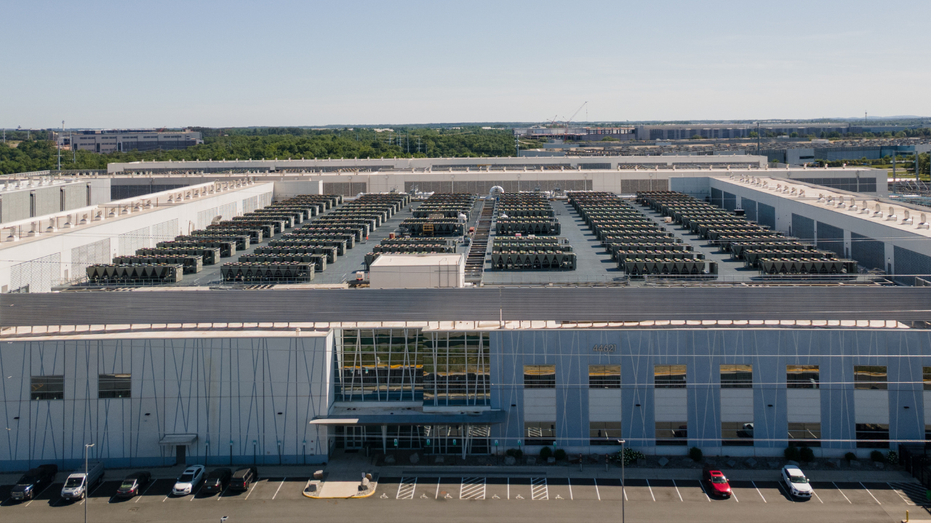
The level of investment in AI infrastructure is projected to vary across different regions of the world. (Lexi Critchett/Bloomberg)
Europe’s share of the cumulative capex estimate would be $5.6 trillion through 2050, well below its proportion of global GDP, due to power constraints, planning friction and fragmented regulation across countries.
The Nordic countries were cited as a credible alternative to constrained Western European hubs, given their energy grids that are heavy on renewables and have electricity prices 40%-50% below other parts of Europe, as well as climates that reduce cooling loads.
Other regions detailed in the report include the Middle East, which would see an estimated $1.1 trillion in cumulative capex through 2050, while Africa would see $255 billion over that period.
GET FOX BUSINESS ON THE GO BY CLICKING HERE
“The AI buildout is not a rising tide that will naturally lift all boats. Capturing this investment requires active positioning. Investors should recognize data centers as hybrid assets with a complicated risk profile,” Cutajar said.
Virtuoso Vice President Misty Belles joins Cheryl Casone on Mornings with Maria to analyze the post-pandemic surge in luxury travel sales. Belles breaks down top global destinations, the rise of wellness travel, and fall booking trends.
JetBlue on Tuesday unveiled a new domestic first-class experience that will be available for booking this fall.
The new offering, called BlueFirst, will feature redesigned seats, premium amenities and upgraded seatback technology, the airline said.
“Domestic first class has become easy to predict. We think it’s time for a fresh take,” JetBlue CEO Joanna Geraghty said in a statement.
“Customers are increasingly looking for more premium experiences, and BlueFirst gives them an elevated experience that feels distinctly JetBlue, with thoughtful touches, caring service and great value.”
CALIFORNIA AIRPORT CONSIDERING SCRAPPING POST-9/11 POLICY THAT BARRED GOODBYES AT TERMINAL GATES
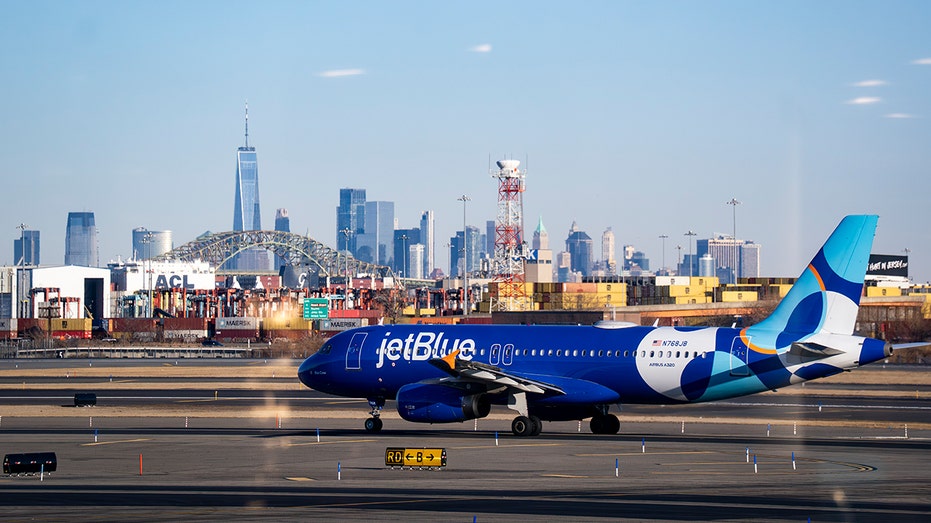
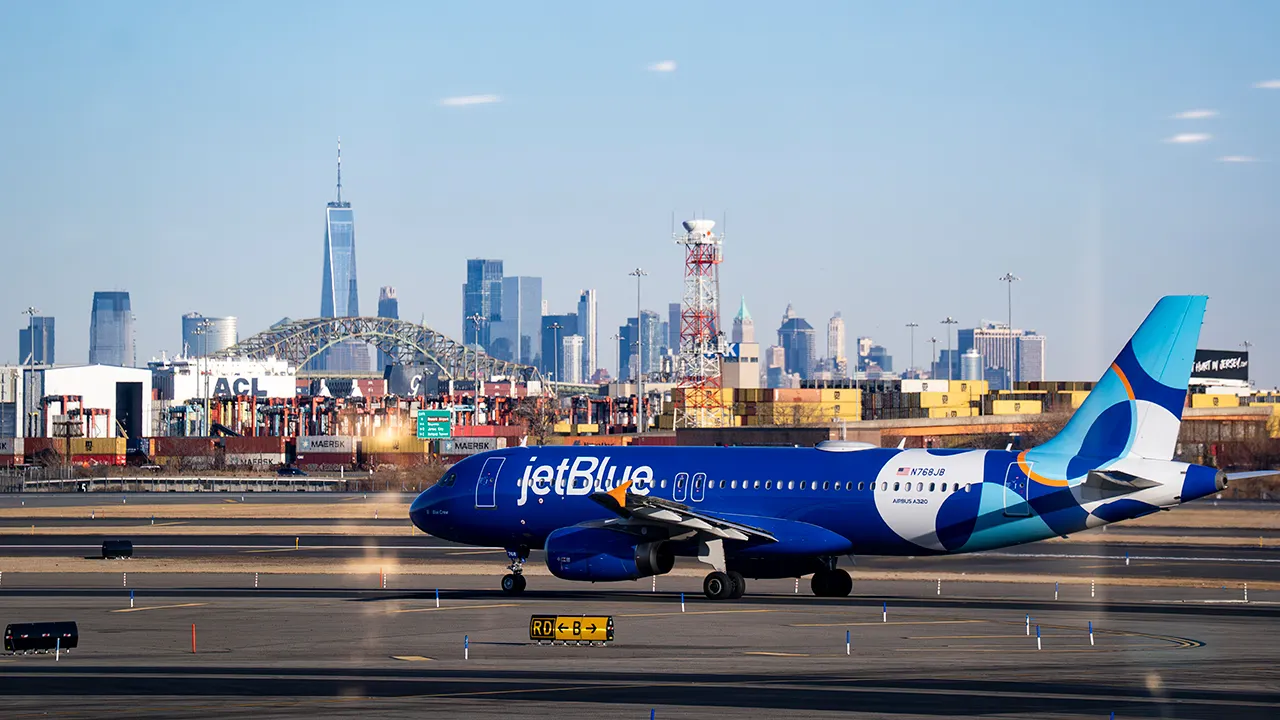
JetBlue unveiled a new domestic first-class experience that will be available for booking this fall. (Al Drago/Getty Images)
The first aircraft featuring JetBlue’s new BlueFirst cabin is expected to enter service later this year.
The redesigned seats will be arranged in a two-by-two configuration and offer 5 inches of recline and up to 7 additional inches of legroom compared with JetBlue’s standard economy seats.
The seats will also feature Tuft & Needle foam designed to “offer each customer personalized support and responsive pressure relief throughout the flight,” the airline said.
Travelers will also have access to 13.3-inch seatback screens with Bluetooth connectivity, free Fly-Fi internet and USB-A, USB-C and AC power outlets.
JetBlue’s BlueFirst cabin features 13.3-inch seatback screens with Bluetooth connectivity, free Fly-Fi Wi-Fi and in-seat power outlets.
BlueFirst passengers on overnight flights will receive a blanket and snooze kit.
“Customers told us loud and clear that comfort matters most, so that’s where we started,” Geraghty added.
The cabin will also feature seatback ordering and a “Mixologist Mode,” allowing passengers to create custom cocktails.
On flights of 899 miles or longer, customers will receive a meal featuring an entrée, side and dessert.
The airline will also offer rotating premium snacks, sommelier-selected wines, specialty coffee and teas.
MAJOR CASINO OPERATOR DISCLOSES ‘SUBSTANTIAL DOUBT’ OVER FUTURE AS DEBT PRESSURES MOUNT
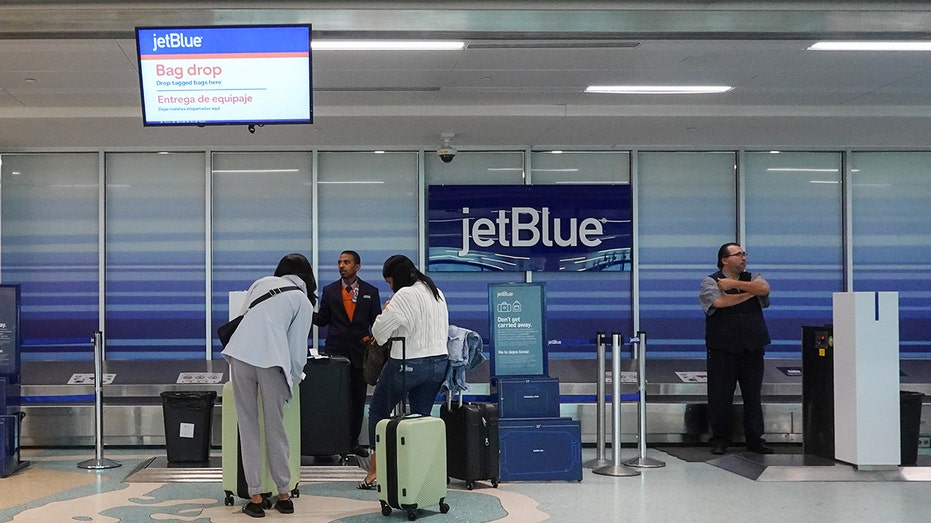
The first aircraft featuring JetBlue’s new BlueFirst cabin is expected to enter service later this year. (Joe Raedle/Getty Images)
Additionally, BlueFirst customers will receive Group 1 boarding, dedicated overhead-bin space, priority check-in, expedited security access at more than 30 airports, two free checked bags and priority baggage delivery, according to JetBlue.
Change and cancellation fees will be waived on BlueFirst and BlueFirst Flex fares.
GET FOX BUSINESS ON THE GO BY CLICKING HERE
JetBlue said BlueFirst will be offered in markets where it does not currently operate Mint, its premium business-class cabin.
The airline said it plans to announce additional details later this year.
Business
Scorpio Gold Shares Rocket 129% As Newly Listed Nasdaq Micro-Cap Extends Volatile Debut-Week Rally

VANCOUVER, British Columbia — Shares of Scorpio Gold Corporation surged more than 129% Wednesday morning, extending a wildly volatile first week of trading for the small-cap Canadian gold miner just two days after its American Depositary Shares began trading on the Nasdaq Capital Market.
Scorpio Gold’s ADSs, which trade under the ticker SGLD, jumped $6.57 to $11.66 as of 9:34 a.m. ET Wednesday, according to market data, marking a second consecutive session of extreme price swings for the newly listed security. The move came just one trading day after the stock gained nearly 300% on its Nasdaq debut Tuesday, according to market tracking services monitoring the stock’s early performance.
The dramatic price action follows Scorpio Gold’s formal transition onto U.S. markets. The company’s ADSs commenced trading on Nasdaq effective at the opening of trading on Sept. 1, 2026, after the exchange approved the listing in late August. Each ADS represents 20 common shares of the Vancouver-based company, with the Bank of New York Mellon serving as depositary for the program.
In conjunction with the Nasdaq listing, Scorpio Gold’s trading symbol on the TSX Venture Exchange, its home Canadian market, also changed from “SGN” to “SGLD,” unifying the company’s ticker across both markets. The shares continue to trade as well on the OTCQB Venture Market under the symbol “SRCRF” and on the Frankfurt Stock Exchange under “RY9.”
Scorpio Gold said the Nasdaq listing was designed to broaden the company’s access to American investors without requiring a share consolidation, a structural approach the company said preserved its existing capital structure for current shareholders while still meeting Nasdaq’s initial listing requirements.
Zayn Kalyan, Scorpio Gold’s chief executive officer and a director of the company, described the listing as a pivotal step in the company’s growth strategy when it was first announced.
“Listing on NASDAQ is a defining milestone for Scorpio Gold,” Kalyan said. “The United States is home to the deepest pool of capital in the world, and this listing places the Company squarely in front of that audience — without a share consolidation and without disrupting the capital structure our existing shareholders have supported.”
Kalyan added that the timing of the listing coincided with favorable conditions in the broader gold market, pointing to macroeconomic trends he said were reinforcing investor interest in the sector.
“We are doing this against the backdrop of one of the strongest gold markets in a generation, underpinned by a powerful macro case for de-dollarization as central banks and investors alike seek harder assets,” Kalyan said, adding that a single “SGLD” ticker across both the U.S. and Canadian markets would give investors “one clear identity for the Company as we enter this next phase of growth.”
Scorpio Gold’s core business centers on the exploration and development of mineral resource properties in the United States, with its flagship holding being a 100% interest in the Manhattan District, located in the Walker Lane Trend of Nevada. The roughly 4,780-hectare property includes the advanced exploration-stage Goldwedge Mine, along with the Kinross Manhattan properties and the Keystone and Jumbo gold deposits.
Market analysts who track newly listed small-cap stocks have noted that extreme volatility of the kind seen in Scorpio Gold’s shares this week is a common pattern among micro-cap companies transitioning onto major U.S. exchanges, particularly those with relatively small public floats and limited trading history on American markets. Thin trading volume in a stock’s early days on a new exchange can amplify price swings in both directions, as relatively small buy or sell orders move the price disproportionately compared with more heavily traded, established securities.
Scorpio Gold’s rapid share price gains this week have also unfolded against a broader backdrop of strength in gold prices, which have climbed sharply over the past year as investors have sought safe-haven assets amid persistent inflation concerns, geopolitical tensions and continued gold purchases by central banks around the world. That environment has generally proven favorable for gold mining and exploration companies, whose share prices often move in tandem with, and sometimes amplify, swings in the underlying price of the metal itself.
The company has separately disclosed an ongoing engagement with Investor Insights Systems Inc., a Vancouver-based firm providing digital marketing services including content creation, search engine marketing, pay-per-click advertising and market awareness campaigns. Scorpio Gold said the extended agreement, initially announced earlier this year, was intended to support broader visibility for the company as it works to build awareness among investors following its cross-border listing.
Trading in newly listed micro-cap stocks on Nasdaq has drawn increased scrutiny in recent years, as sharp early price swings in thinly traded names have occasionally prompted questions from market watchers about volatility, liquidity and the mechanics behind rapid share price appreciation shortly after a listing. Nasdaq maintains ongoing monitoring processes for newly listed securities, and companies experiencing significant and sudden price volatility are sometimes required to address unusual market activity through public disclosures, though Scorpio Gold had not issued any such statement addressing Wednesday’s price movement as of midmorning trading.
With the stock’s share price nearly doubling over just two trading sessions, Scorpio Gold’s market capitalization has climbed sharply since its Nasdaq debut, though the company’s underlying operations, centered on its Nevada-based gold exploration assets, have not changed materially since the listing took effect. Investors and analysts will likely be watching closely in the coming days to see whether the stock’s dramatic early gains prove durable or give way to a pullback, a pattern that has played out with other newly listed small-cap resource companies that have experienced similarly outsized initial trading activity following a major exchange listing.
Scorpio Gold’s common shares continue to trade in parallel on the TSX Venture Exchange in Canada, where the stock’s price action Wednesday broadly mirrored the sharp gains recorded on Nasdaq, reflecting the unified ticker structure the company implemented as part of its cross-border listing strategy.
Business
McDonald’s Stock Ticks Higher After 52-Week Low As Dividend Hike, Menu Revamp Aim To Boost Sales Growth

CHICAGO — Shares of McDonald’s Corp. edged higher Wednesday morning, trading at $261.90, up 30 cents, or 0.30%, as of 9:53 a.m. ET, a modest rebound after the fast-food giant’s stock touched a fresh 52-week low earlier this week amid ongoing concerns over slowing U.S. customer traffic.
McDonald’s shares had fallen as low as $260.06 in recent trading, marking a new 52-week low and putting the stock roughly 1% below its previous floor set in late July, according to market data. The decline has come as investors continue to weigh a slowdown in the company’s domestic same-store sales growth against a backdrop of broader consumer pullback affecting several restaurant chains this year.
In its most recent quarterly results, McDonald’s reported U.S. same-store sales growth of just 0.8%, a notable slowdown from the 2.5% gain the company posted in the same period a year earlier, as domestic guest counts declined. Globally, comparable sales rose 1.3% for the quarter, reflecting steadier performance in international markets even as the company’s home market showed signs of strain.
Despite the softer domestic traffic figures, McDonald’s continued its long-running streak of annual dividend increases this week. The company raised its quarterly dividend by 5.1% to $1.86 a share, marking the 26th consecutive year the burger chain has increased its payout to shareholders. The stock’s dividend yield now sits at roughly 3.53%, a figure income-focused investors have increasingly pointed to as a core part of the investment case for McDonald’s even as consumer-facing peers across the restaurant industry pull back on spending and, in some cases, dividend growth.
The stock’s ex-dividend date fell on Sept. 1, meaning investors who purchased shares on or after that date will need to wait a full quarter before receiving the next payment.
McDonald’s dividend increase stands in contrast to moves by some competitors in the space. Wendy’s, for instance, has moved to cut its own payout this year, a divergence that analysts have said reflects differing confidence levels among fast-food operators navigating a more cautious consumer environment.
To help reverse softening domestic traffic, McDonald’s has leaned heavily on limited-time menu offerings throughout 2026. Earlier this year, the company introduced the Big Arch, a double-patty burger featuring white cheddar cheese and a proprietary sauce, which the company said contributed to a 3.9% domestic same-store sales gain in the first quarter. That early-year momentum, however, did not fully carry through to the second quarter, when growth slowed considerably.
The company’s latest push to reignite customer interest came this week with the return of Spicy Chicken McNuggets, which came back to participating U.S. restaurants nationwide starting Sept. 1, alongside a new Mighty Hot Sauce dipping option. The spicy nuggets, coated in a tempura breading made with aged cayenne and chili peppers, first debuted in September 2020 and have returned for several limited-time regional runs since then. The sauce blends crushed red pepper, chilis, garlic and a touch of sweetness.
McDonald’s USA’s official Menu Spotter account marked the return with an enthusiastic message to fans: “We’re so back. And just as spicy as ever.”
The chain is also planning additional new offerings later this year, including a lineup of McCafe-branded energy drinks, iced coffees and fruity refreshers inspired by its short-lived CosMc’s restaurant concept, part of a broader effort to diversify its beverage lineup and attract customers throughout the day beyond traditional meal periods.
Alongside its menu strategy, McDonald’s has also made a significant leadership change in recent weeks. The company named Skye Anderson as president of McDonald’s USA, succeeding Joe Erlinger in the role. Anderson, who has spent 26 years at McDonald’s and most recently served as chief operating officer of McDonald’s USA, takes on the domestic leadership post at a pivotal moment for the company as it works to reverse the traffic declines weighing on its U.S. business.
The broader restaurant industry has faced a more challenging operating environment in 2026, with several major chains announcing store closures amid tighter consumer spending. Pizza Hut, for example, is shuttering more than 250 locations this year, following a wave of closures at Wendy’s in 2024. Analysts have said this competitive backdrop could ultimately work in McDonald’s favor over the longer term, given the company’s scale and continued investment in value-oriented menu options, even as it navigates near-term softness in guest counts.
McDonald’s has also expanded its McValue menu strategy this year, which includes meal deals starting at $5 and a “Buy One, Add One for $1” promotion available at breakfast and lunch or dinner for select items, part of a broader push to reassert its value positioning with cost-conscious consumers. The company has also tested new secret-menu items inspired by viral customer hacks in some international markets, including a Surf N’ Turf burger and a Big Mac sauce dipping option in the United Kingdom, though it remains unclear when, or if, similar offerings might roll out in the United States.
Longer-term investors have increasingly compared McDonald’s performance against faster-growing names in the restaurant sector. According to data compiled by financial analysts, a three-year investment in McDonald’s stock has produced only modest gains, while comparable investments in faster-growing chains such as Cava have delivered substantially higher, if considerably more volatile, returns over the same period.
Despite Wednesday’s modest gain, McDonald’s stock remains down significantly from its 52-week high, reflecting a stretch of lower highs over the past six months as the company works to stabilize its domestic business. Investors will likely continue watching upcoming same-store sales data closely, along with the performance of the company’s newest menu initiatives, for signs of whether McDonald’s traffic slowdown in the U.S. is beginning to reverse or represents a more prolonged challenge for the world’s largest fast-food chain heading into the final months of 2026.

Brydon Carse left out of England squad for Pakistan Test after nightclub scandal

Victoria Beckham has finally made her fashion firm profitable – how did she do it?

Zoox’s Aicha Evans Is Reimagining Urban Mobility





-

 Fashion5 days ago
Weekend Open Thread: Maeve – Corporette.com
-

 Crypto World6 days ago
Bitcoin’s 22% rally now needs real demand to outlast Treasury liquidity boost
-

 Business6 days ago
Apple Confirms September 9 Keynote and Reveals Its Full Pre-Order Schedule
-

 Business6 days ago
Salesforce Stock Soars 19% as Blowout Earnings and Agentforce AI Growth Silence Software Skeptics
-

 Business5 days ago
Onto Innovation Stock: AI’s Next Bottleneck Is Yield (NYSE:ONTO)
-

 Crypto World7 days ago
NVIDIA revenue hits $96.2B as AI demand doubles
-

 Crypto World5 days ago
Bitcoin price tests $82K resistance as Brandt stays long
-
 Tech4 days ago
Hugging Face built a $4.5 billion empire on free AI models. Now Nvidia is buying it for $12.9 billion
-

 Business5 days ago
iPhone 18 Pro Pre-Orders Could Shift to Saturday as Apple Reportedly Avoids September 11 Anniversary
-
 Tech7 days ago
Claude Cowork gets its own browser that doesn’t touch your tabs, bookmarks, or saved passwords
-

 Crypto World6 days ago
Truflation calls for Fed rate cut after PCE forecast
-

 News Videos4 days ago
Charlie Munger on Robinhood: No one should believe that Robinhood’s trades are free
-

 Crypto World7 days ago
GENIUS Act missed its deadline as OCC writes rules anyway
-

 Tech5 days ago
PaperCut releases second emergency patch for exploited flaws
-
 Entertainment6 days ago
‘Adults’ Creators Break Down Season 2’s Most Shocking Moments and Tease a Potential Season 3
-

 Tech4 days ago
Tamagotchi Ring Takes the 30-Year Digital Pet and Places it on Your Finger
-

 Business7 days ago
AI Assistant Startup Instinct Rockets to $2.5 Billion Valuation in Weeks Amid Investor Feeding Frenzy
-

 Tech6 days ago
The fix for the AI agent that hijacked a company’s DNS: it can propose the change, but it can’t approve it
-

 Tech4 days ago
As the influencer economy drives retail sales, Seattle startup raises $22M to play matchmaker
-
 NewsBeat4 days ago
Trump posts AI video of ‘Lake America’ being protected by an army of bequiffed ‘Donald Ducks’
You must be logged in to post a comment Login