








Welsh Fire co-chair Mark Rhydderch-Roberts dissects The Hundred season, and urges doubters to give it a go

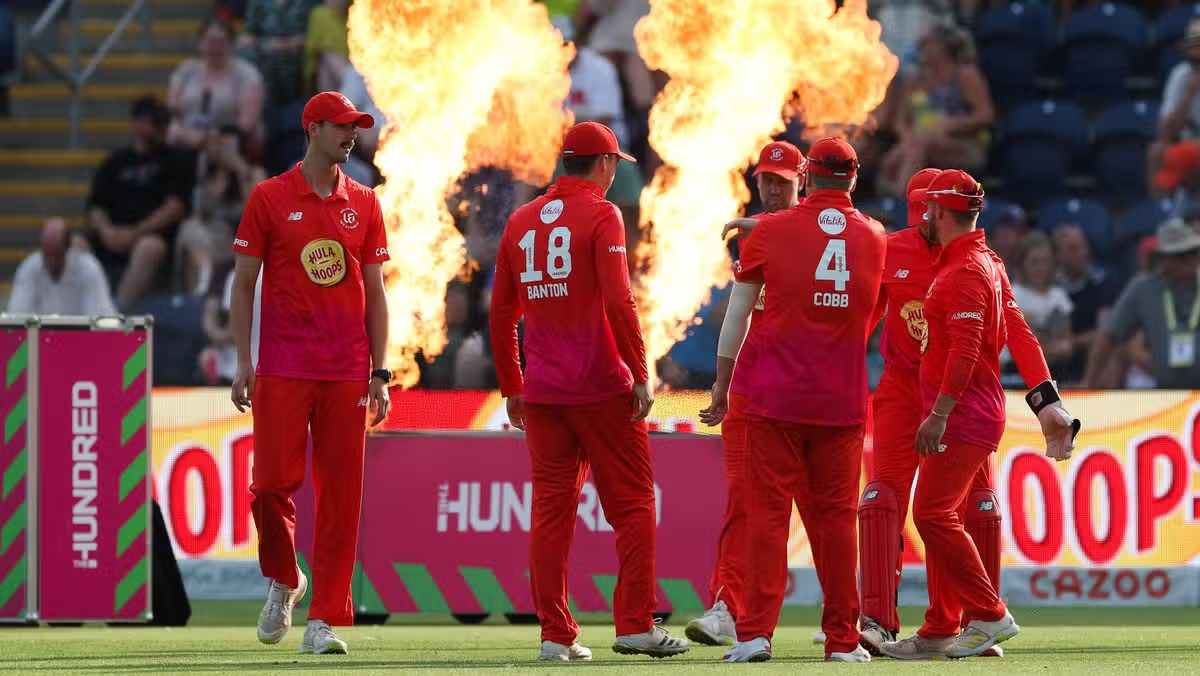
Welsh Fire.(Image: Gareth Everett/Huw Evans Agency)
After a frenetic 27 days and a gripping and sold out Finals Day last Sunday at Lord’s, the 2026 Hundred tournament has concluded.
Despite the best efforts of some to focus on a marginal decline in total attendances, this season has seen an incredibly competitive and successful tournament with many of the best men’s and women’s players in the world involved.
Many games have gone down to the last few balls and there has been a noticeable increase in intensity on all levels. Teams, owners and fans are desperate to win.
Despite a crowded and competitive sporting calendar over the summer, including a football World Cup, The Hundred has recorded its third best campaign in terms of ticket sales in the last six years, with around 550.000 sold, with three new record attendances.
Probably more significantly, given the fact that media revenues drive operating performance and valuations, the growth in the average broadcast audience on Sky Sports and the BBC was 7.5 per cent. Furthermore, this has been the most viewed and engaged season ever digitally for The Hundred with a 36 per cent rise in engagement and 55 per cent growth in views on social channels.
Objectively, this is a very creditable performance given the context of a major reset of The Hundred, the first year of co-ownership with new international investors, and a number of rebrands taking place. This year was never going to be straightforward. Taking on co-ownership or new ownership meant new teams, new brands and commercial challenges with a short pre-season lead time.
Hundred plan
The Hundred was designed from the outset to bring cricket to new audiences, especially children and families. As in previous years, the demographic of fans attending The Hundred has continued to grow strongly and is sharply differentiated to many competitor sports – 2026 saw 22 per cent of tickets go to under-16s, 40 per cent to families and 28 per cent for women.
At Welsh Fire – following the 50/50 joint venture agreement between Glamorgan County Cricket Club and Sanjay Govil – we have had record breaking attendances for both the men’s and women’s games in Wales, with ticket sales up almost 10 per cent year-on-year. Nearly half of ticket buyers were new to Sophia Gardens home, Wales’ Test-standard arena. Welsh Fire was the only Hundred franchise to increase its ticket sales in percentage terms year on year.
The Hundred achieved a valuation of just under £1bn after the franchise sale last year and provided an immediate and much needed cash injection in excess of £550m into English and Welsh cricket at all levels, with 10 per cent of proceeds earmarked for the recreational game.
The double headers have turbo-charged the growth of the women’s game and the introduction of international investors has not only brought capital but a global dimension and commercial expertise to the sport in Britain. Other sports, including rugby union, which traditionally has had a similar audience profile in size and demographic will only look on enviously.

Mark Rhydderch-Roberts
The sports asset class has seen sustained and rapid uplifts in valuations as the sector has become investment grade for many institutional investors, as well as for private equity companies and high-net-worth individuals. This trend has been confirmed with the recently announced sale of the LA Lakers for £9bn, the highest price ever paid for a sports team and £2bn more than it sold for 14 months ago. In the UK, Jeff Bezos is part of a consortium that is buying 38 per cent of Liverpool FC which values the club at £5.5bn, 18 times more than the £300m that John Henry’s Fenway Sports Group paid for the club in 2010. It would be logical to assume that The Hundred franchise valuations have already benefited from this macro trend.
International growth
Growth in cricket and international franchise valuations has, and will continue to be, driven by India which accounts for over 70 cents in every dollar generated by cricket globally. The overall business and brand valuation of the Indian Premier League is in excess of $20bn and it ranks as the second richest sports league in the world by per-match value, second only to the NFL. Media revenues also remain critically important for valuations – around 95 per cent of the ECB’s total revenues are derived from this source. Independent forecasts give global cricket media revenues around ten years of strong future growth. This is in contrast to several other sports, including Football, where they have plateaued or are in decline.
Realistically, the valuations enjoyed by the IPL, where two franchises in the Rajasthan Royals and Royal Challengers Bengaluru were recently sold for $1.65bn and $1.8bn respectively, are some way ahead of where The Hundred teams are right now. However, I believe that there is a strong case that over the next few years that The Hundred can take its place as the second most important and valuable short format global cricket league.
In a nation where sporting life has long been defined by rugby and football, Welsh Fire is an elite team and brand the nation can get behind. Demand and interest has surged not only in south Wales and along the M4 corridor but also from the south west of England.
Our chief commercial officer Ed Rice says that “Wales needed more than a franchise cricket name, it needed a team that felt Welsh, and belonged to Wales”, adding that a “deep local understanding has driven every decision, and the commercial results speak for themselves”.
A case for Cardiff
Cardiff is the UK’s premier event city after London, and this summer has seen an extraordinary array of major music and sports events. Against that backdrop, Welsh Fire cut through by offering something distinctive: elite sport combined with a genuinely entertaining day out at a competitive price point. We embraced a challenging fixture list, which included a Monday and two Wednesday fixtures, and invested in it. The iconic Welsh rock band Feeder performed in between matches on the Monday evening and we recorded a total attendance in excess of 10K.
The challenge for The Hundred and for Welsh Fire will be to build from here. A breakthrough first “Hundred reset” year does not remove the economic headwinds facing sport, nor does it make audience growth automatic. It gives us something valuable for all of us to work with; a larger database, a more engaged fan base, stronger awareness and proof that The Hundred can prosper and grow.
This is why The Hundred season should be celebrated, and we remain in the early days of something real and significant in global cricket. At Welsh Fire, we now have the opportunity to invest further in growth, technology, content, partnerships and community engagement, while maintaining a laser focus on a team built for Wales.
We also have learned much from our co-owner, and will continue to build and develop the significant operational and commercial synergies that exist between Welsh Fire and Sanjay’s Washington Freedom MLC franchise.
I wish The Hundred doubters could have been at our sold-out Saturday fixture against MI London a few weeks ago. The atmosphere at Sophia Gardens as the fans chanted “Wales, Wales” was unique, the excitement and engagement of the crowd total. There will be many more days like these to come.
- Mark Rhydderch-Roberts is co-chair of Welsh Fire and chair Glamorgan County Cricket Club.














![You’ll Make Much More Money If You Just Trade This! [Easy Switch]](https://wordupnews.com/wp-content/uploads/2026/08/1787253393_maxresdefault-80x80.jpg)


































You must be logged in to post a comment Login