Connect with us

NewsBeat

Dog and cat beaten so severely by owner they died

Published

on

Daily Record

A cat and a dog suffered blunt force trauma and died

A man who carried out fatal attacks on a dog and a cat has been jailed and permanently banned from keeping animals.

Jordan Wood, 25, pleaded guilty to three animal welfare offences following a prosecution by the RSPCA concerning a male Labrador-type dog, Chance, and a male cat, Casper.

Both animals died from severe complications caused by repeated, deliberate blunt force trauma.

Advertisement

The abuse was uncovered in April last year after a vet raised suspicions when Chance was brought in for treatment, prompting RSPCA inspectors to visit Wood’s home, reports CornwallLive.

Chance was seized by police and placed into RSPCA care. Further vet exams found Chance had sustained multiple traumatic head, throat and spinal injuries over several months. His whiskers had also been burned off.

The owner initially claimed that Chance ran into a fence, but the severity of the dog’s injuries told a different story.

There were skull fractures on both the left and right frontal bones on the skull involving the frontal sinuses, as well as a small fracture of the external sagittal crest.

Advertisement

The throat and windpipe showed injuries recognised as features of strangulation and caused an altered airway size. The windpipe also had an abnormal, flattened profile with an over-distended muscle, consistent with repeated compression from a collar, the RSPCA said.

His spinal fracture indicated a high-level blunt force applied to the lower spine and swelling, bruising, and skin abrasions around both eyes, the face, ears, and mid-neck, consistent with blunt force blows or tight ligatures.

Chance was sadly put down because of further complications from his pre-existing throat fractures while in RSPCA care.

In August 2025, Casper was found dead after suffering catastrophic injuries from at least three separate timelines of blunt force trauma to his chest, alongside skeletal and severe head trauma. Alongside the rib fractures, which were healing at different rates, showing three separate stages of injury, he also had a dislocation of the sternum and limb fractures.

Advertisement

Casper also had damage to his internal organs, with a laceration of the liver, and ruptured alveoli in the lungs and signs of head trauma with laceration of the right temporal region of the skull and right temporal muscle. Multiple cartilage fractures in both ears gave them a crinkled appearance.

Casper had also suffered severe eye trauma and blindness. At the time of his death, he had bilaterally swollen eyelids and conjunctivae, retinal detachment, lens rupture, and pus accumulation within the eyeballs. His cause of death was found to be severe blunt force trauma to the chest, resulting in extensive lung collapse and respiratory failure.

“The finding of bilateral rib fractures across multiple timelines is a powerful diagnostic indicator of physical abuse—often caused by an animal being deliberately kicked, stepped on, or thrown,” Dr Taylor noted in the vet report. “Both animals were forced to endure severe physical pain and prolonged mental torment before succumbing to their injuries”.

Wood, from Newquay, pleaded guilty to causing unnecessary suffering to a Labrador-type dog by inflicting physical abuse, causing unnecessary suffering to a cat by inflicting physical abuse, and causing unnecessary suffering to a car by failing to provide professional veterinary care and attention.

Advertisement

Wood was banned from keeping animals for life and jailed for 18 months after being sentenced at Truro on August 6. A second person is due to be sentenced for related offences on September 11.

Ellen Gibson, aged 24 and of Kilkham, Yorkshire, has also pleaded guilty to causing unnecessary suffering or permitting it to happen to Chance, who she was responsible for, and causing Casper unnecessary suffering or permitting it to happen and failing to get vet care for the cat.

In mitigation, Wood’s defence team said he experienced a difficult childhood and suffered from PTSD and depression.

RSPCA Inspector Jack Alderson, who investigated for the animal welfare charity, said: “The cruelty inflicted upon innocent animals like Chance and Casper is an unforgivable betrayal of trust. Every living creature deserves a life free from suffering and filled with compassion.”

Advertisement

Source link

Continue Reading
Click to comment

You must be logged in to post a comment Login

Leave a Reply

NewsBeat

Exercise Done At Work May Increase Dementia Risk

Published

on

Exercise Done At Work May Increase Dementia Risk

Regular exercise has long been linked to decreased dementia risk. A 2022 paper found that just 3,800 steps a day may reduce your likelihood of developing dementia by 25%, with increasing benefits up to 9,800 steps, for instance.

And strength training has been shown to help protect the parts of the brain particularly vulnerable to Alzheimer’s, too.

The NHS recommends 150 minutes of moderate-intensity activity, 75 minutes of higher-intensity exercise, or a combination of both every week to help us see the benefits of movement.

But a new paper has found that why we reach those goals might matter a lot more than we thought when it comes to dementia risk.

Advertisement

Exercise done at work may actually be linked to higher dementia risk

The paper, published in the journal The Lancet, looked at data from 74 studies, involving 4.2 million participants overall.

These participants were from 30 different countries and were aged between 45 and 93. On average, researchers tracked them for a decade.

After analysing this data, the study authors found that exercising more often was linked to a 24% lower likelihood of developing dementia.

Advertisement

But that only seemed to be the case for leisure-time activity and (maybe) housework.

Those who exercised a lot due to physically demanding jobs appeared to face a 20% higher dementia risk, while active commuting (like cycling to work) seemed associated with a moderately higher risk too.

Researcher Natan Feter, the study’s first author, said: “The findings challenge the long-held assumption that ‘every move counts’ for brain health.”

This may be part of the “activity paradox”

Advertisement

The authors of this meta-analysis suggested that this higher risk may be linked to factors common in very physical workplaces, rather than the movement itself.

These factors might include stress, uncontrolled noise (hearing loss has been associated with a greater likelihood of developing dementia), air pollution, and hazardous working conditions.

This phenomenon – sometimes called “the activity paradox” – has been seen in other research, too.

Some studies have found that work-related exercise may raise your risk of some health conditions, like heart problems, long-term sickness and related absences, and even an increased risk of death, although leisure-time activity lowers those same risks.

Advertisement

And a 2021 paper found that even the burnout-reducing potential of leisure-time activity might disappear when someone has a very physically demanding job.

Pollution could also be a factor involved in why those engaging in ‘active commuting’ might experience a heightened risk. As the Alzheimer’s Society says: “Exposure to a high level of air pollution increases a person’s risk of developing dementia.”

Professor David Raichlen, who led the research team, said that we should therefore be considerate when issuing advice telling people to “move more” without considering the context of activity.

“When it comes to protecting the brain, the context of physical activity may matter just as much as movement itself,” he said.

Advertisement

“Improving access to safe parks, walking trails and recreational facilities, ensuring people have adequate leisure time for exercise, and reducing harmful workplace exposures may ultimately prove as important as promoting physical activity itself.”

Source link

Advertisement
Continue Reading

NewsBeat

All planned paediatric surgery stopped at Scottish hospital amid safety concerns

Published

on

Daily Record

Concerns had been raised about the qualifty and safety of care.

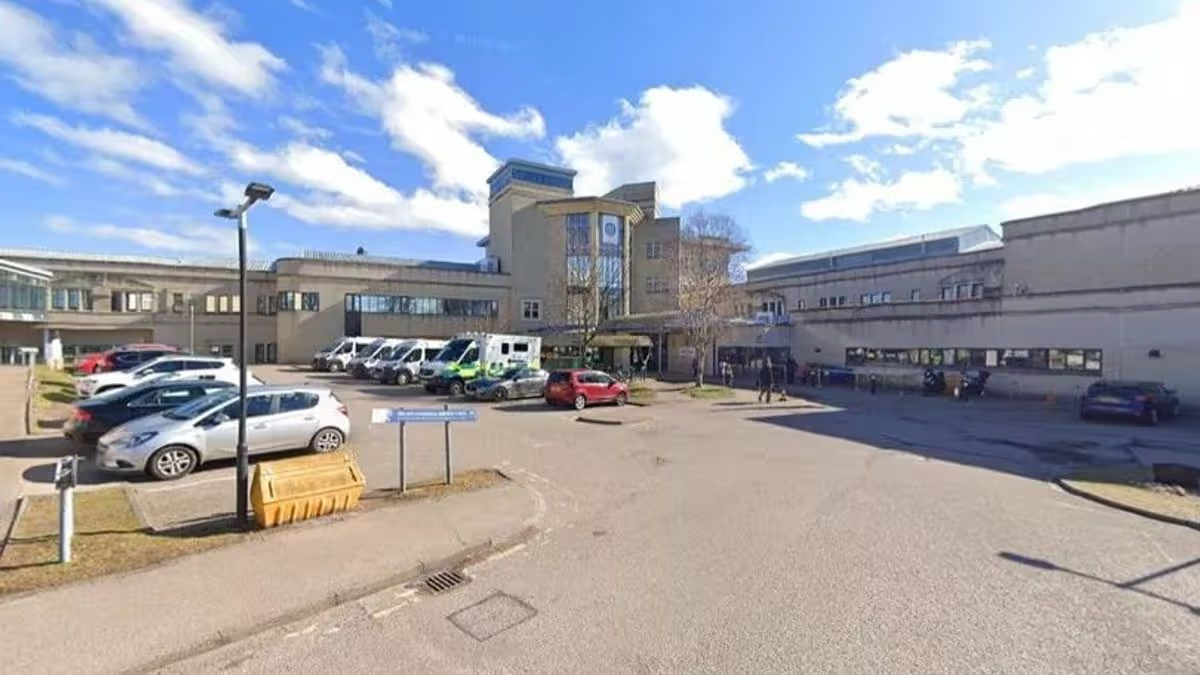
All planned paediatric surgery at a hospital in Moray has been paused after concerns were raised about the quality and safety of care.

Advertisement

NHS Grampian paused emergency paediatric surgery at Dr Gray’s Hospital in Elgin, with some exceptions, in June after concerns were identified.

It has now paused planned paediatric surgical procedures as work to address issues raised by Healthcare Improvement Scotland (HIS) continues.

The health board apologised to children and their families affected and said it is committed to offering them new dates for their procedures as soon as possible.

Dr Hugh Farrow-Bishop, NHS Grampian medical director, said: “In June 2026, we identified concerns about the quality and safety of paediatric surgical care at Dr Gray’s Hospital, which resulted in a pause of emergency paediatric surgery, with defined exceptions.

Advertisement

“Earlier this year – in April – Healthcare Improvement Scotland carried out an unannounced inspection at Dr Gray’s Hospital.

“Following this, we met with HIS to discuss their concerns about paediatric care at the hospital. In particular, HIS sought assurances around the number of available staff with appropriate advanced paediatric life support training.

“In response to their concerns, we have reviewed all rotas and current procedures and made changes to ensure staff with the appropriate training are available on-site in the event of emergencies. We have also reviewed training records and are arranging for training to be renewed where required. This is taking place as a matter of urgency.

Advertisement

“While this is underway – and with the safety of patients being our top priority – we have further paused planned paediatric surgical procedures at Dr Gray’s Hospital.

“The pause now comprises all planned, including elective dental and ear, nose, and throat procedures, and emergency surgery, with defined exceptions.”

He said after the review and renewal of required training, the health board, alongside HIS, will determine the profile of paediatric surgery that can safely be delivered at the site. It expects the process to be completed by the end of the year.

Outpatient paediatric care is not affected, and the health board said families should continue to attend those appointments as usual.

Advertisement

Dr Farrow-Bishop said: “In an emergency situation, parents or carers should continue to bring children to the emergency department. More generally, all other inpatient and outpatient care continues at Dr Gray’s Hospital as before.”

Laura Mitchell, the SNP MSP for Moray, said: “I’m deeply concerned by the safety and training issues in paediatrics that have been identified at the recent inspection at Dr Gray’s Hospital.

“Of course, the safety of children in Moray and across Grampian is paramount, so I understand NHS Grampian must take urgent action to ensure our service in Elgin is safe and delivering a high quality of care for patients.

“My constituents will be concerned by this serious situation, and NHS Grampian must assure the Moray community that these training issues will be urgently addressed, to allow surgical services to resume as soon as possible.”

Advertisement

An HIS spokesperson said: “Concerns were identified about paediatric surgery at Dr Gray’s Hospital. NHS Grampian has taken steps to address the concerns, and we continue to engage with them in the interests of patient safety.”

Highlands and Islands Scottish Conservative MSP Tim Eagle said he is seeking “urgent answers” from both NHS Grampian and the Scottish Government.

He said: “I am absolutely furious about this latest development at Dr Gray’s. This shocking situation stems from years of mismanagement by both NHS Grampian and the Scottish Government.

“These failings are completely unacceptable, putting the health and safety of children across Moray at enormous risk.”

Scotland’s Health Secretary, Angela Constance, said: “I am concerned about these changes and I am making clear to NHS Grampian my expectation that these services be resumed as soon as possible.

Advertisement

“However, patient safety must always come first and whilst NHS Grampian carries out its review of paediatric surgery at Dr Gray’s Hospital, I expect the Board to liaise with any affected patients and their families.

“The Board has sought to assure me that families with children in emergency situations should continue to bring their children into Dr Gray’s with all other inpatient and outpatient care continuing as normal.

“I will be meeting the management team of Dr Gray’s in Elgin next week to discuss this further.”

Get more Daily Record exclusives by signing up for free to Google’s preferred sources. Click HERE.

Advertisement

Source link

Continue Reading

NewsBeat

One in five GCSE entries get top marks as grades rise for second year in a row – but pass rates for English and maths fall once again to lowest level in a decade

Published

on

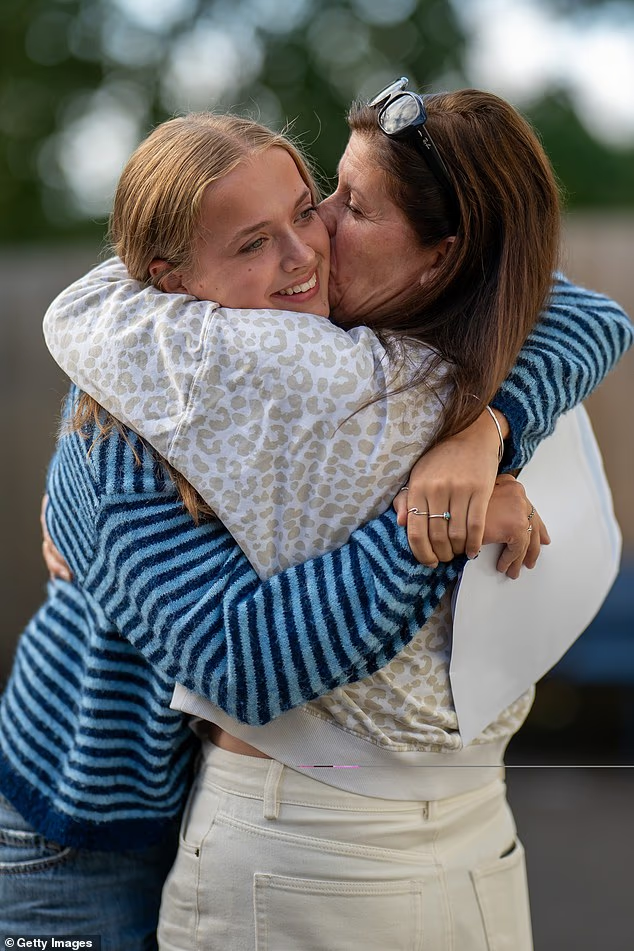
Iris Hamilton-Potter hugs her mother after receiving her GCSE results at Llanishen High School, Cardiff

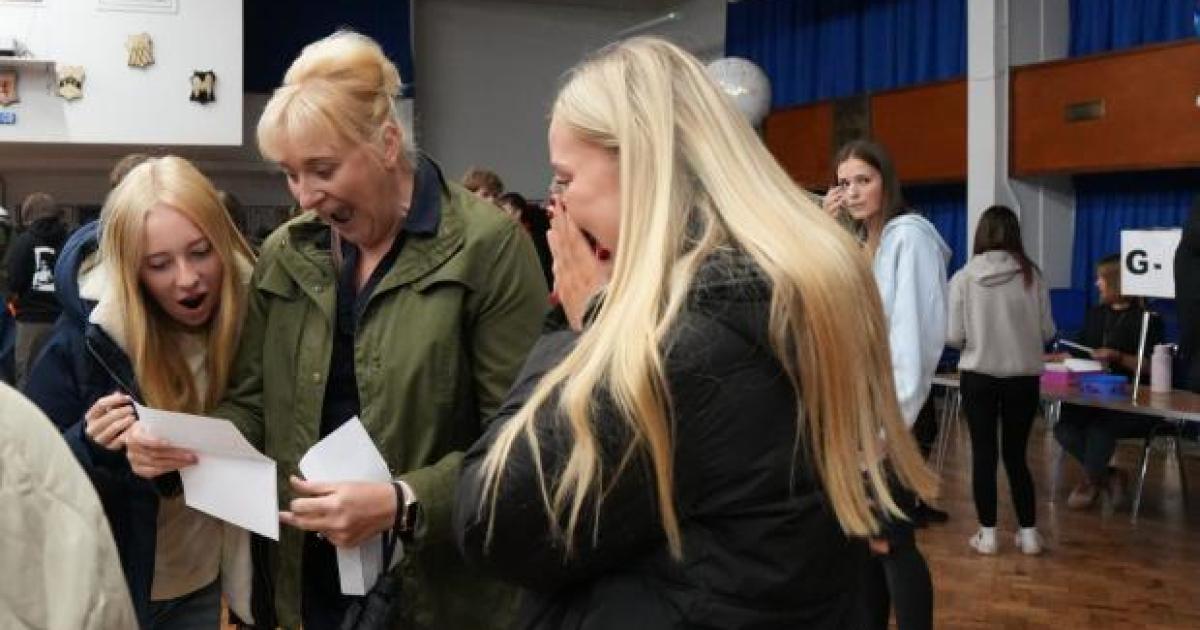
Pupils are jubilant after GCSE grades rose for a second year in a row, with top marks given to one in five entries – but pass rates for English and maths have dropped again to their lowest in a decade.

Boys are closing in on the lead that girls have had for decades, with the gap reducing again this year to its narrowest point since 2000.

As hundreds of thousands of pupils picked up their GCSE results this morning, 22 per cent were awarded at least 7 or A, up from 21.9 per cent last year.

It means GCSE grading still remains higher than pre-pandemic levels, as in 2019 the proportion was just 20.8 per cent.

Advertisement

Every UK nation apart from Scotland takes GCSEs, with England now using the grades 9 to 1, and Wales and Northern Ireland still using A* to G.

Grade 7 is roughly equivalent to A and grade 4 is broadly equivalent to C.

In 2024, 21.8 per cent of entries were at least 7/A, while in 2023 it was 22 per cent.

In England, the proportion graded 9 – considered to be a high A*, was 5 per cent, down from 5.1 last year and equal to 5 per cent in 2024.

Advertisement

Iris Hamilton-Potter hugs her mother after receiving her GCSE results at Llanishen High School, Cardiff

Coleen Rooney posted a picture of her son Kai on X with the caption: 'GCSE results day!! Super proud of you Kai. Great results especially with a busy schedule, all passed and a place in 6th form!! We love you'

Coleen Rooney posted a picture of her son Kai on X with the caption: ‘GCSE results day!! Super proud of you Kai. Great results especially with a busy schedule, all passed and a place in 6th form!! We love you’

Nasser Hamid, 20, studying at Suffolk New College after fleeing war-torn Sudan, said it was 'one of the proudest moments in my life' passing maths and English.

Nasser Hamid, 20, studying at Suffolk New College after fleeing war-torn Sudan, said it was ‘one of the proudest moments in my life’ passing maths and English. 

Advertisement
Pupils celebrate their GCSE results at Leeds Grammar School, in Leeds, Yorkshire

Pupils celebrate their GCSE results at Leeds Grammar School, in Leeds, Yorkshire

Pupils collect their GCSE results at the Ark Greenwich Free School, Woolwich, south London

Pupils collect their GCSE results at the Ark Greenwich Free School, Woolwich, south London

Freya Ter-Berg Walkom (right) collects their GCSE results at the Ark Greenwich Free School, Woolwich, south London

Freya Ter-Berg Walkom (right) collects their GCSE results at the Ark Greenwich Free School, Woolwich, south London

A student smiles with her results at Llanishen High School in Cardiff

A student smiles with her results at Llanishen High School in Cardiff

Advertisement
A pupil at Egglescliffe School, North Yorkshire

Pupils collect their GCSE results at Egglescliffe School, in Eaglescliffe, North Yorkshire

Pupils collect their GCSE results at the Ark Greenwich Free School, Woolwich, south London

Pupils collect their GCSE results at the Ark Greenwich Free School, Woolwich, south London

Students open their GCSE results at Llanishen High School in Wales

Students open their GCSE results at Llanishen High School in Wales

Pupils collect their GCSE results at the Ark Greenwich Free School, Woolwich, south London

Pupils collect their GCSE results at the Ark Greenwich Free School, Woolwich, south London

Advertisement
Students open their GCSE results at Llanishen High School, Cardiff

Students open their GCSE results at Llanishen High School, Cardiff

Florence Davies (L) looks at her results at Llanishen High School in Cardiff

Florence Davies (L) looks at her results at Llanishen High School in Cardiff

Pupils collect their GCSE results at the Ark Greenwich Free School, Woolwich, south London

Pupils collect their GCSE results at the Ark Greenwich Free School, Woolwich, south London

Iris Hamilton-Potter (L) and friend Poppy Plant pose for a photograph after receiving their GCSE results at Llanishen High School in Cardiff

Iris Hamilton-Potter (L) and friend Poppy Plant pose for a photograph after receiving their GCSE results at Llanishen High School in Cardiff

Advertisement
Poppy Plant (second to left) receives her GCSE results at Llanishen High School, Cardiff

Poppy Plant (second to left) receives her GCSE results at Llanishen High School, Cardiff

Pupils collect their GCSE results at the London Nautical School in Waterloo, London

Pupils collect their GCSE results at the London Nautical School in Waterloo, London

KEY STATISTICS

  • The proportion of entries receiving the top grades has risen for the second year in a row and remains higher than before the Covid-19 pandemic.
  • A total of 22.0% of entries were awarded grade 7/A or above, up slightly from 21.9% in 2025 and higher than the 20.8% in 2019.
  • Some 67.3% of entries received a grade 4/C or above. This is down from 67.4% last year and is the same as 2019. It is the first time the figure for 4/C has returned to pre-pandemic levels.
  • The overall rate for grades 1/G or above is 97.9%, unchanged from 2025 and below 98.3% in 2019. This is the lowest figure for entries receiving at least a grade 1/G for two decades, since 97.8% in 2005.
  • The longstanding lead enjoyed by girls over boys for the top grades has narrowed again. The proportion of total female entries awarded grade 7/A or above was 24.4%, 4.8 percentage points higher than the total for male entries (19.6%). This is the narrowest lead enjoyed by girls since at least the year 2000. Last year, girls led boys by 5.1 percentage points (24.5% girls, 19.4% boys).
  • The gap at grade 4/C has also narrowed. Some 70.2% of all female entries were awarded 4/C or higher, compared with 64.4% for boys, a lead of 5.8 points. This is the narrowest lead for girls at 4/C since at least 2000. Last year the figures were 70.5% for girls and 64.3% for boys, a lead of 6.2 points.
  • Across the regions of England, London saw the highest proportion of entries awarded grades of 7 or higher at 28.6%, up from 28.4% in 2025, while north-east England had the lowest at 17.7%, down from 17.8% last year.
  • The gap between these two regions now stands at 10.9 percentage points, up from 10.6 points in 2025 and the largest since at least 2010.
  • Some 31.7% of entries in Northern Ireland received 7/A or higher, above the equivalent figure for England (21.8%) and Wales (19.6%).
  • For entries awarded 4/C or higher, Northern Ireland again had the highest figure, at 83.6%, above England (67.0%) and Wales (62.3%).
  • The subject with the most entries this year was the science double award, as has been the case since its introduction in 2018, with a total of 1,007,628 entries, up 2% on 2025. Because this is a double award, each entry for the subject is awarded two grades.
  • Maths remains the subject with the second largest number of entries, with 912,410 this year, up 2% on last year.
  • English language ranks third, with 882,030 entries, a rise of 2%.
  • Among subjects with more than 100,000 entries, business studies had the largest percentage increase in entries this year, up 8% from 137,924 in 2025 to 148,747 in 2026.
  • Among subjects with fewer than 100,000 entries, statistics jumped by 11%, from 34,879 entries in 2025 to 38,770 this year.
  • Overall, there were 6,199,256 GCSE entries, up by 0.6% on last year’s figure of 6,160,034.

<!- – ad: https://mads.dailymail.co.uk/v8/de/news/none/article/other/mpu_factbox.html?id=mpu_factbox_1 – ->

Advertisement

The figures were published by the Joint Council for Qualifications (JCQ), which represents GCSE exam boards.

Most of the pupils receiving GCSE results this morning were in Year 5 when schools closed because of Covid-19, meaning their secondary education was not disrupted by the height of the pandemic. 

Across all nations, 67.3 per cent of pupils achieved grade 4/C or above, down from 67.4 per cent in 2025.

Grade 4/C is considered a ‘standard pass’ and is a basic requirement for many employers and universities.

Advertisement

By subject, 60 per cent passed in English language, down from 60.2 per cent last year – and 57.3 passed maths, down from 58.3 per cent last year. These pass rates are the lowest in a decade.

This is the second year pass rates have dropped in these subjects – likely caused by older pupils resitting them having previously failed to pass.

This year saw a rise in the number of 17-year-olds taking both subjects. 

In England, pupils who do not secure at least a grade 4 in English and/or maths GCSE are required to retake the subjects during post-16 education.

Advertisement

However, the Government is introducing a ‘basic skills’ alternative qualification for over-16s who fail, which in future people who score very low will be able to take instead.

This morning, the Education Secretary Lucy Powell pledged to crack down on the ‘pernicious’ system of GCSE resits which sees youngsters fail repeatedly.

She told The Times she wanted to end the resit ‘treadmill of failure’ which sees about 200,000 teenagers in England fail in both subjects repeatedly and never achieve the pass mark.

And she said more of those who receive a 2 or below are expected to be steered towards new stepping-stone qualifications called ‘Level 1s’.

Advertisement

She later added on BBC Radio 4’s Today programme: ‘I’m going to be bringing in a new stepping stone qualification, as we’re calling it, a level one… in maths and in English, so that there is an additional qualification that young people can work towards. And I want to work with employers to make sure that that qualification is credible, is respected, and that employers see that as sufficient or more than sufficient for young people to go on to do things like an apprenticeship in construction or health and social care.’ 

Meanwhile, boys are doing better than last year – while girls are doing worse.

Some 19.6 per cent of boys got 7/A, compared with 24.4 per cent of girls – a gap of 4.8 percentage points.

Last year, 19.4 per cent of boys got 7/A, compared with 24.5 per cent of girls – a 5.1 percentage point gap.

Advertisement

Ms Powell said: ‘Good luck to everyone receiving your results today, and huge thanks to the teachers and families who have helped to get you here.

‘Whatever that piece of paper says, you should be proud of the hard work and commitment you’ve put in, and excited about what comes next.

‘We will ensure every child has access to high-quality options whether that’s academic, vocational, technical, creative or a mix.

‘Everyone should have the chance to follow the path that’s right for them and build a successful career.’

Advertisement

Advertisement

The figures also revealed regional divides widening, raising concerns that some areas of the country are being left behind.

Maths GCSE for boy, 7 


Advertisement

A boy has been awarded his maths GCSE – aged seven.

Jivyan Dhruva has received a grade eight scoring 196 out of 240 in a qualification normally taken by pupils around 16.

The young academic from West London took the exam back in May and is already preparing for his A-levels next year.

His father, Dhruva Katta, 36, an AI engineer, said: ‘Jivyan is very much excited.

Advertisement
Jivyan Dhruva

Jivyan Dhruva

‘We are very proud – he’s already preparing for his A-levels in maths and further maths next year.

‘We suggested he cool down but he doesn’t want to.’

He said his son attended regular year two primary school until February this year – when he got ‘too bored’ and wanted to be homeschooled instead.

Advertisement

Despite studying mathematics far beyond his age, he said Jivyan is still a funny and energetic seven-year-old who loves chess, football and dance alongside maths.

His father added: ‘Jivyan wins all the local chess tournaments too.

‘He’s got a bright future ahead of him and always has a plan!’

<!- – ad: https://mads.dailymail.co.uk/v8/de/news/none/article/other/mpu_factbox.html?id=mpu_factbox_2 – ->

Advertisement

The gap in top grades between London – the best performing region – and the North East – the worst performing – has widened to a record high of 10.9 percentage points up from 10.6 last year.

In north-west England, 18.9 per cent of entries received grade 7 or above, up slightly from 18.8 per cent in 2025.

The gap between London and the North West has widened to 9.7 points from 9.6 in 2025, close to the recent record of 9.9 points in 2024.

Advertisement

In London 28.6 per cent of entries were graded at 7/A or above, while in the North West it was 18.9 per cent.

There has also been a widening of the gap between London and both the East and West Midlands, to the largest size since at least 2010.

In the East Midlands, 18.2 per cent of entries received grade 7 or above, 10.4 points behind London (up from 10.3 points in 2025), while in the West Midlands it was 18.3 per cent of entries, 10.3 points behind London (up from 9.9).

The regional patterns are more varied for GCSE entries awarded grade 4 or above.

Advertisement

London again has the highest rate at 71.7 per cent, up from 71.6 per cent in 2025, but here it is the West Midlands that has the lowest figure, at 62.4 per cent, down from 62.9 per cent.

South-west England saw the largest percentage-point drop, falling from 69.1 per cent to 68.3 per cent.

The gap has narrowed between the capital and north-east England, from 6.7 points to 6.5, with the North East seeing a rise in entries awarded grade 4 or above from 64.9 per cent to 65.2 per cent.

This year, JCQ is publishing results for each local authority for the first time.

Advertisement

Those figures show that although London has the highest regional rate for GCSEs awarded grade 7 or above, at 28.6 per cent, the local rates across the capital vary from a low of 19.0 per cent in Havering to a high of 43.4 per cent in Richmond upon Thames – a difference of 24.4 percentage points.

Local rates for top GCSE grades span an even greater range in north-west England, from 8.3 per cent in Knowsley to 39.7 per cent in Trafford, while eastern England has the greatest range of all, from a low of 10.2 per cent in Castle Point to a high of 53.5 per cent in Cambridge: a difference of 43.4 percentage points.

Lee Elliot Major, professor of social mobility at the University of Exeter, said: ‘It is a damning indictment of 21st-century Britain that where you happen to grow up has such a profound impact on your educational and life chances.

Pupils collect their GCSE results at Harper Green School in Farnworth, Bolton

Pupils collect their GCSE results at Harper Green School in Farnworth, Bolton

Advertisement
Pupils Hester Petransky and Isabella Bruce at St Gabriel's School in Newbury react with excitement and relief as they receive their GCSE results

Pupils Hester Petransky and Isabella Bruce at St Gabriel’s School in Newbury react with excitement and relief as they receive their GCSE results

Ukrainian refugee Vova Kravchenko, 16, who got a scholarship to go to Brighton College, got a sweep of 9, 8 and 7 grades. He said: 'It was so much to go through, with a different language. I’m just grateful for everything.'

Ukrainian refugee Vova Kravchenko, 16, who got a scholarship to go to Brighton College, got a sweep of 9, 8 and 7 grades. He said: ‘It was so much to go through, with a different language. I’m just grateful for everything.’

Pupils collect their GCSE results at the London Nautical School in Waterloo, London

Pupils collect their GCSE results at the London Nautical School in Waterloo, London

Pupil Susanna Dat at St Gabriel's School in Newbury

Pupil Susanna Dat at St Gabriel’s School in Newbury

Advertisement
Pupils celebrate their GCSE results at Leeds Grammar School, in Leeds, Yorkshire

Pupils celebrate their GCSE results at Leeds Grammar School, in Leeds, Yorkshire

Pupils Belle Bosham and Susanna Dat at St Gabriel's School in Newbury

Pupils Belle Bosham and Susanna Dat at St Gabriel’s School in Newbury

Pupils Ellie Anns, Isabella Bruce, Izzy Phillips, Belle Bosham, Susanna Dat and Luci Tedeschi at St Gabriel's School in Newbury

Pupils Ellie Anns, Isabella Bruce, Izzy Phillips, Belle Bosham, Susanna Dat and Luci Tedeschi at St Gabriel’s School in Newbury

Pupils collect their GCSE results at Harper Green School in Farnworth, Bolton

Pupils collect their GCSE results at Harper Green School in Farnworth, Bolton

Advertisement
Sophia Forshaw who received seven 9s, one 8 and two 7s in her GCSEs, at The Grammar School at Leeds in Leeds

Sophia Forshaw who received seven 9s, one 8 and two 7s in her GCSEs, at The Grammar School at Leeds in Leeds

Pupils collect their GCSE results at Harper Green School in Farnworth, Bolton

Pupils collect their GCSE results at Harper Green School in Farnworth, Bolton

Are you still deciding which university to go to?


Advertisement

I’m Alastair McCall, one of the UK’s leading data journalists and Editor of the Daily Mail University Guide.

I’ve spent years crunching the data to understand what makes a university stand out – from teaching quality and student experience to graduate salaries and career prospects. I’ve ranked every university in Britain, so whether you’re applying yourself or you’re a parent helping your child, I can show you which universities are best for your subject, where graduates earn the most, and much more.

Click here to read the full guide 

Advertisement

<!- – ad: https://mads.dailymail.co.uk/v8/de/news/none/article/other/mpu_factbox.html?id=mpu_factbox_3 – ->

‘Something is fundamentally amiss when children with the same talents and potential face such different prospects simply because of where they happen to live.

‘England’s educational divide is a story of London increasingly pulling away from much of the rest of the country.

Advertisement

‘But these broad regional divides conceal an even more troubling geography of opportunity: sometimes a few streets, or a different postcode, can make the difference between a life of opportunity and a life of overlooked talent.’

Chris Zarraga, director of Schools North East, added: ‘There is not a North-South divide in the quality of schools, nor in the talent, potential or aspirations of young people.

‘There is a structural divide in the circumstances and opportunities surrounding them. The regional results table is a map of that divide, not a map of school quality.

‘Schools in the North East are working incredibly hard to overcome those circumstances. But schools cannot independently fix poverty, stretched public services, shortages in Send (special educational needs and disabilities) support, transport barriers, unequal access to enrichment or very different local economic opportunities.

Advertisement

‘These inequalities are neither inevitable nor acceptable. The Government needs to treat them as a system challenge and address the conditions around schools as well as what happens inside them.

‘Results day should reflect young people’s potential and hard work, not the structural advantages or disadvantages of their postcode.’

At a national level, 31.7 per cent of entries in Northern Ireland received grade 7/A or higher, above the equivalent figure for England (21.8 per cent) and Wales (19.6 per cent).

Advertisement

For entries awarded 4/C or higher, Northern Ireland was ahead at 83.6 per cent, some way above England (67.0 per cent) and Wales (62.3 per cent).

Joy for Ukraine pair
Advertisement


When Zlata Byrsan and Elizabeth Horbatenko fled Kryvyi Rih in Ukraine aged just 12 years old in 2022, neither spoke a word of English. Four years on, both have received their GCSE results at Roedean, with Zlata landing 9s in both her English literature and English language and Elizabeth getting 8 in English lit and 7 in English language.

Zlata Byrsan

Zlata Byrsan

The pair, both completely fluent in English now aged 16, landed five grade 9s, three grade 8s, six grade 7s, three grade 6s and a 5 between them and will now go onto study for A levels at the East Sussex independent school. Both arrived on full scholarships along with a handful of older girls who have since left.

Advertisement

Zlata said: ‘I cannot believe I got a 9 in both English language and literature. I don’t know how I did it. I had no English when I arrived. I think the most important thing is I found good friends and pushed myself out of my comfort zone. English just came after that.’

Zlata, 16, from Horsham in Sussex, lives with her mother and brother while her father has stayed in Ukraine to work and support his family.

Elizabeth Horbatenko

Elizabeth Horbatenko

She said: ‘I was so frightened when I got here because everything was so different but it has all been worth it. I did not know two words of English and was so confused about what was happening.’ Zlata plans to study politics, psychology and economics at A level.

Advertisement

Elizabeth, who lives in Henfield in Sussex, added: ‘I felt so out of place when I arrived in England and now I am so happy with today’s results. I have gone from knowing no English words to now planning to study for A levels and go to uni here. It’s been hard work but I have had a wonderful time at school here in the UK and I am so happy it has paid off.’

Elizabeth will study drama and english literature for A level and hopes to break into the acting world.

<!- – ad: https://mads.dailymail.co.uk/v8/de/news/none/article/other/mpu_factbox.html?id=mpu_factbox_4 – ->

Advertisement

Northern Ireland’s lead is part of a long-running trend which experts have previously linked to the nation retaining the grammar school system. 

The rise in top grades overall across the UK may once again spark concerns about artificial grade inflation – although Ofqual, the regulator, insisted this has not played a part.

Grade inflation was rife during the New Labour years, when officials repeatedly insisted that pupils genuinely were getting cleverer every year.

The proportion of top grades rose every single year between 2002 and 2011.

Advertisement

However, after the Tories won the election in 2010 they instructed Ofqual to make sure the proportion getting these top grades remained roughly the same each year.

This is adjusted slightly for the ability of each cohort, which is measured by sample tests earlier in the year.

Roughly one in five have got A/7 grades over the last 15 years, but the pandemic frustrated the regulator’s efforts because exam cancellations meant teachers decided grades – leading to massive inflation.

In 2020, the year Covid struck, 26.2 per cent of entries were A/7 – rising again to 28.9 per cent in 2021.

Advertisement

In 2022, exams were laid on again, with the regulator bringing grading halfway back to normal in a stepped return.

While grades have now been brought back down, they are still higher than before the pandemic.

Meanwhile, the persistent gap between boys and girls will reignite debates over whether the nation is neglecting male pupils.

In a forecast report ahead of GCSEs this year, Professor Alan Smithers, director of the Centre for Education and Employment Research at the University of Buckingham, said he has called for many years ‘without success’ for the gender gap to be investigated. 

Advertisement

But the Centre for Policy Research on Men and Boys (CPRMB) said the disparities are not only present at GCSE level.

‘Girls are consistently outperforming boys in education,’ CPRMB research officer Martha Lucas said.

‘The gap emerges in early years education by age five.

‘It then continues into Sats and across GCSEs where a greater percentage of girls’ entries will get a grade four or above, the standard pass level.’

Advertisement

She said it then continues into the final two years of school – with tens of thousands more A-levels taken this year by girls than boys.

‘It’s a continued pattern that really spans the educational journey,’ Ms Lucas said.

She called it very concerning.

‘When around a third of boys’ entries to GCSE are consistently not meeting a grade 4 each year, which is the standard pass level, it is a massive concern,’ she said.

Advertisement

‘For a lot of employment meeting that grade 4 in maths and English is a barrier to finding that employment.

Education Secretary Lucy Powell speaks with students collecting their GCSE results at Harper Green School in Farnworth, Bolton

Education Secretary Lucy Powell speaks with students collecting their GCSE results at Harper Green School in Farnworth, Bolton

Education Secretary Lucy Powell meets students studying construction at Harper Green School in Farnworth, Bolton, on GCSE results day

Education Secretary Lucy Powell meets students studying construction at Harper Green School in Farnworth, Bolton, on GCSE results day

Education Secretary Lucy Powell lays a brick with students at Harper Green School in Farnworth, Bolton

Education Secretary Lucy Powell lays a brick with students at Harper Green School in Farnworth, Bolton

Advertisement
Education Secretary Lucy Powell speaks with students collecting their GCSE results at Harper Green School in Farnworth, Bolton

Education Secretary Lucy Powell speaks with students collecting their GCSE results at Harper Green School in Farnworth, Bolton

Wojciech Sobiecki celebrates his GCSE results with his sister Nikola Sobiecka at Hazelwood Integrated College in Newtownabbey, North Belfast

Wojciech Sobiecki celebrates his GCSE results with his sister Nikola Sobiecka at Hazelwood Integrated College in Newtownabbey, North Belfast

Roedean pupils and netball team mates Poppy Finn and Amelie Orman

Roedean pupils and netball team mates Poppy Finn and Amelie Orman

Pupils celebrate their GCSE results at Leeds Grammar School, in Leeds, Yorkshire

Pupils celebrate their GCSE results at Leeds Grammar School, in Leeds, Yorkshire

Advertisement
Olivia Dragoj (centre) celebrates at the Ark Greenwich Free School, Woolwich, south London

Olivia Dragoj (centre) celebrates at the Ark Greenwich Free School, Woolwich, south London

Sandra Young, 49, celebrates at Suffolk New College after passing her first ever GCSE

Sandra Young, 49, celebrates at Suffolk New College after passing her first ever GCSE

Singapore to success


Advertisement

A student who was raised in Singapore has celebrated picking up 11 grade nines in his GCSEs.

James Auger, 16, came to the UK two years ago and joined Year 10 of Conyers School in Yarm, Teesside.

The gifted pupil, who was born in Luxembourg, took 12 GCSEs and got top marks in 11 of them.

His learning has been boosted by taking part in the Comprehensive Oxford Mathematics and Physics Online School, joining weekly tutorials and completing extra assignments.

Advertisement
James Auger

James Auger

James, whose family came to Teesside for work, said: ‘I enjoy maths and it opens up a lot of opportunities.

‘After my A-levels, the dream would be to go to Oxford University and then become an A-level teacher or professor.

‘I’m also musical and love to sing, classical and pop, and I’d like to get involved in performing arts.’

Advertisement

Conyers head Chris Coleman said: ‘He has pursued his passion for maths and science to an exceptional level while also making the most of his interests in music and performing arts.

‘We want our students to discover what they are good at, develop their talents and leave us with the confidence and qualifications to pursue whatever comes next.’

<!- – ad: https://mads.dailymail.co.uk/v8/de/news/none/article/other/mpu_factbox.html?id=mpu_factbox_5 – ->

Advertisement

‘This year, the number of male Neets (not in education, employment or training) hit more than 500,000. 

‘So boys are consistently leaving school without the qualifications nor education necessary for them to thrive in adult life – get a job, be in employment – and quite frankly that desperately needs to change.’

In a report last year, Professor Smithers said the talents of boys are not being developed as ‘fully’ as they could be, but this year he questioned whether girls might have an ‘inherent advantage’.

‘My first thought was that this was against the vibes of the time when the emphasis is on equality for women,’ he continued.

Advertisement

‘Since men generally come out on top in the workplace, why bother.

‘More recently I have been thinking the unthinkable in these days when the cancel culture is in overdrive.

‘The sex differences in education achievement are so regular and persistent that they could be inherent differences. This should be taken on board in any inquiry.’

Professor Elliot Major said: ‘There’s no single reason why boys do less well at school.

Advertisement

‘Some of the gaps start very young, particularly around language and reading. As boys get older, things like reading habits, behaviour, engagement with school, peer pressure and attitudes about what it means to be a boy can all play a part.’

Last week, the opposite trend happened at A-level, with experts saying it is because no subject is compulsory – allowing pupils to play to their strengths.

Overall, 28.9 per cent of boys’ A-level entries scored an A* or A this summer, compared with 28 per cent of their female classmates’ entries – a gap of 0.9 percentage points.

Meanwhile, analysis of GCSE subject choices this morning prompted speculation that the rise of artificial intelligence may have led to a slump in entries for computing.

Advertisement

The subject is still relatively popular, with 85,096 entries this summer. But this is down from 91,619 in 2025 – a fall of 7.1 per cent.

Pupils at Portsmouth Grammar School collect their results

Pupils at Portsmouth Grammar School collect their results

Erik Adae-Boateng (centre) reacts to their GCSE results at the Ark Greenwich Free School, Woolwich, south London

Erik Adae-Boateng (centre) reacts to their GCSE results at the Ark Greenwich Free School, Woolwich, south London

Ethan Rillon celebrates his GCSE results with his sister Angela Rillon (left) and his mother Jan Rillon at Hazelwood Integrated College in Newtownabbey, North Belfast

Ethan Rillon celebrates his GCSE results with his sister Angela Rillon (left) and his mother Jan Rillon at Hazelwood Integrated College in Newtownabbey, North Belfast

Advertisement
Erica Coleman (right) reacts to their GCSE results at the Ark Greenwich Free School, Woolwich, south London

Erica Coleman (right) reacts to their GCSE results at the Ark Greenwich Free School, Woolwich, south London

Ruby Duff (left) celebrates her GCSE results with her mother Hayley Duff at Hazelwood Integrated College in Newtownabbey, North Belfast

Ruby Duff (left) celebrates her GCSE results with her mother Hayley Duff at Hazelwood Integrated College in Newtownabbey, North Belfast

GRADE PERCENTAGES BY REGION 

Here are the percentages of GCSE entries awarded the top grades of 7/A or higher by nation and region in 2026, with the equivalent figures for 2025 and the pre-pandemic year of 2019: 

  • North-east England 17.7% (2025: 17.8%; 2019: 16.4%)
  • North-west England 18.9% (2025: 18.8%; 2019: 18.6%)
  • Yorkshire & the Humber 19.0% (2025: 18.4%; 2019: 17.8%)
  • West Midlands 18.3% (2025: 18.5%; 2019: 18.1%)
  • East Midlands 18.2% (2025: 18.1%; 2019: 18.3%)
  • Eastern England 22.0% (2025: 22.2%; 2019: 20.5%)
  • South-west England 21.0% (2025: 21.4%; 2019: 20.4%)
  • South-east England 24.5% (2025: 24.6%; 2019: 23.5%)
  • London 28.6% (2025: 28.4%; 2019: 25.7%)
  • England 21.8% (2025: 21.8%; 2019: 20.7%)
  • Wales 19.6% (2025: 19.5%; 2019: 18.4%)
  • Northern Ireland 31.7% (2025: 31.6%; 2019: 30.5%)
  • All 22.0% (2025: 21.9%; 2019: 20.8%)

Here are the percentages of GCSE entries awarded 4/C or higher, by nation and region:

  • North-east England 65.2% (2025: 64.9%; 2019: 63.8%)
  • North-west England 63.9% (2025: 64.2%; 2019: 64.9%)
  • Yorkshire & the Humber 64.2% (2025: 63.6%; 2019: 64.1%)
  • West Midlands 62.4% (2025: 62.9%; 2019: 63.8%)
  • East Midlands 65.0% (2025: 65.0%; 2019: 65.8%)
  • Eastern England 67.6% (2025: 68.0%; 2019: 67.1%)
  • South-west England 68.3% (2025: 69.1%; 2019: 68.3%)
  • South-east England 70.0% (2025: 70.0%; 2019: 70.2%)
  • London 71.7% (2025: 71.6%; 2019: 70.6%)
  • England 67.0% (2025: 67.1%; 2019: 67.1%)
  • Wales 62.3% (2025: 62.5%; 2019: 62.8%)
  • Northern Ireland 83.6% (2025: 83.5%; 2019: 82.2%)
  • All 67.3% (2025: 67.4%; 2019: 67.3%)

<!- – ad: https://mads.dailymail.co.uk/v8/de/news/none/article/other/mpu_factbox.html?id=mpu_factbox_6 – ->

Advertisement

One exam board leader suggested AI means computing skills are still important for students to learn.

Myles McGinley, managing director of Cambridge OCR exam board, said: ‘I think despite a decline from a historic high, computer science remains a very popular GCSE. I think there could be a number of different reasons.

‘This is speculation, but I think the emergence of AI could be leading to students thinking they don’t need to learn how to code.

‘But I would say maybe that’s something that would be up for debate.

Advertisement

‘I think potentially computer science is more important than ever in the age of AI, and while vibe coding might be all the rage, I think AI won’t be able to replace a solid understanding of how software works, how technology can solve real-world problems, and how it can create a good user experience for example.’

Julia Adamson, executive director of education at BCS, The Chartered Institute for IT, said: ‘We need to bust the myth that generative AI can now do everything safely and without oversight. In fact because of trends like vibe-coding, people with computing qualifications are more important than ever.

‘Computing education has never been just about learning a programming language; it’s about developing computational thinking, problem-solving skills, and understanding how digital systems work.

‘AI is powerful but requires skilled people who can design and secure the systems behind it. If anything, the growth of AI increases the need for people with a strong grounding in computing and digital technology.’

Advertisement

Sir Ian Bauckham, the head of England’s exams regulator Ofqual, said many students receiving their results on Thursday made their choices in 2024 when AI tool ChatGPT was ‘a relatively new phenomenon’.

He added: ‘I think young people were just beginning to realise what it was and what it could do.

‘GCSE computing, as it is at the moment, is quite coding-heavy. It might have been the case that young people thought I won’t need to do this coding in quite the same way in the future, so maybe I don’t need to do computing GCSE.

‘But of course, computing GCSE is broader than just coding, and the qualification in any case is being reformed.

Advertisement

‘I think in a hi-tech world such as the one we live in now, it’s difficult to think of subjects that could be more important to young people’s future than GCSE computing.’

The data also shows GCSE business studies continues to prove popular with students.

There were almost 150,000 entries for the qualification (148,747) this summer, up 7.8 per cent on last year.

The subject has seen a 40 per cent increase in entries over the last five years, according to John Croker, the AQA exam board’s responsible officer and director of oversight, risk and compliance.

Advertisement

Mr McGinley said an interest among students in running their own businesses may be driving the rise.

He said: ‘This looks like an increasingly entrepreneurial generation, fascinated by how business works. The founders of some of the next great unicorn businesses may well be among those achieving GCSEs in business studies today.’

Among other subjects, statistics has seen a leap in popularity, with entries up 11.2 per cent on last year to 38,770.

And entries for PE have seen another year-on-year bump – with 92,191 entries compared with 89,584, in 2025 – a 2.9 per cent increase. Last year entries were up 2.0 per cent on 2024.

Advertisement

Meanwhile, it was good news for languages students, who saw top grades rise this year following changes to the exams in England.

Spanish, German and French all saw a rise in the numbers of entries achieving at least a 7/A.

New courses in each of these three languages were first taught in England in 2024, with the first grades awarded this year.

German had the highest proportion of top grades, with more than a third (35.1 per cent) of entries gaining at least a 7/A, up 0.8 percentage points from 34.3 per cent in 2025.

Advertisement

German also saw a bump in entries this year after previous falls, with 33,473 entries – up 0.2 per cent from 33,391 last year.

Nearly three in 10 Spanish entries (29.3 per cent) scored at least 7/A, up from 27.8 per cent in 2025.

The GCSE – which overtook French to become the most popular foreign language for GCSE students last year – continues to prove popular with students.

Entries are up 0.3 per cent to 137,236 from 136,871 in 2025.

Advertisement

In French – which saw a 5.4 per cent fall in entries this summer – some 30.7 per cent of entries scored at least a 7/A, up from 30.1 per cent last year.

GCSEs in the modern foreign languages were reformed in England following a proposal by the then Conservative government to make them ‘more accessible’ to students.

Vicky Gough, British Council schools adviser, said: ‘The decrease in language uptake for French and other modern languages follows a worrying trend.’

She added: ‘Language learning not only broadens horizons but deepens cultural understanding.

Advertisement

‘We must continue to bring all languages to life through exchanges, cultural programmes and real-world connections to allow students to understand why languages matter.’

Nicolas Ehler, director of the Goethe-Institut London, said: ‘The rise in GCSE German entries is welcome news and a positive sign for the future of language learning.

‘These results show what is possible when young people are given access to high-quality language education and meaningful opportunities to engage with other cultures beyond the classroom.’

Source link

Advertisement
Continue Reading

NewsBeat

Melania kicks off first public appearance in a month with tongue-in-cheek joke about her absence

Published

on

Melania kicks off first public appearance in a month with tongue-in-cheek joke about her absence

First Lady Melania Trump made her first public appearance in more than a month as she delivered remarks from the White House to tout her foster care initiative.

“I heard you missed me,” she said as she addressed a crowd at the Rose Garden on Thursday. “Here I am.”

The first lady has remained largely out of the spotlight with her husband’s return to the White House. She has made even fewer public appearances in the president’s second term than his first; her last public appearance was at the 2026 World Cup final on July 19.

Melania Trump did not join the president to attend the dignified transfer of the remains of four dead U.S. service members, nor did she sit beside the president at the White House Correspondents’ Dinner two days later on July 24.

Advertisement

She also did not attend Senator Lindsey Graham’s funeral on July 28.

This is a developing story

Source link

Advertisement
Continue Reading

NewsBeat

Jeremy Vine steps down from charity awards after backlash for ‘stoking hatred’

Published

on

Jeremy Vine steps down from charity awards after backlash for 'stoking hatred'
Jeremy Vine is facing backlash for his latest hosting gig (Picture: Channel 5)

Jeremy Vine has found himself at the centre of controversy after being booked to host a charity awards show.

The TV presenter provoked furious backlash when he was announced as the host of the Carers UK Awards, an event that seeks to ‘shine a spotlight’ on the contribution of unpaid carers.

Commenters accused Vine, 61, of ‘stoking hatred against disabled people’ on his Channel 5 show and using intentionally ‘provocative questions’ to allow guest panellists to ‘spread misinformation’.

Others said he was a poor choice because he platforms ‘lies’ about those on benefits, which go ‘unchecked’, and encourages ‘debates’ around disability and people’s lives.

Advertisement

The criticism was so strong that Vine had no choice but to issue a statement, confirming he would be stepping down from the gig.

Taking to X, the broadcaster began: ‘Because I host debates about welfare, benefits etc I see I was a controversial choice to be the (obviously unpaid) host of the prestigious @CarersUK awards so I’m very happy to stand aside and give someone else the honour of doing it.’

LONDON, ENGLAND - MARCH 12: Jeremy Vine attends the launch event for
He was announced as the Carers UK Awards presenter this week (Picture: Darren Gerrish/WireImage for 5/Paramount)

He added that he ‘originally said yes to support a friend who watched her husband die in a long and painful process’, as he ‘didn’t want to let her down’.

‘I see her as a heroine,’ he praised.

‘I’m not a campaigner, and guests on my shows know I have to be impartial, but I’m very much aware of the vital role unpaid carers play,’ Vine continued.

Advertisement

‘I believe we’ve only ever covered them sympathetically.’

He signed off by wishing the ‘excellent event’ well, saying he will ‘cheer for the winners from a distance’.

However, Vine’s statement seemed to only fuel further disapproval, as the replies alleged that he is not ‘impartial’ in his hosting.

‘I’m sure he really believes he’s impartial. Why can’t he see that having the “should we cut benefits” discussions over and over again just feeds into the negative narrative? He’s not stupid, he must know’, wrote @cfs_jo.

‘He may support carers and his friend, but he allows members of the panel on his TV show to spout absolute lies, completely unchecked about other benefits & their claimants’, wrote @kagsy_karen.

@Salliepops also vented: ‘You, on your show, debate our lives as if we’re a problem to be solved. You fuel hostility, abuse & harassment towards disabled people, while advocating for cuts to the support we rely on to live independently. Its not supporting carers. It’s harming the very community they serve’.

Meanwhile, @Grraarrgh argued that Vine was a ‘controversial’ choice for the hosting position because he ‘makes a living’ by ‘profiting off people’s pain’ when they are already ‘vulnerable’.

Advertisement

@SpinaBifidaScot urged Vine to ‘reflect’ on how, while he believes his stance is impartial on-screen, the show itself ‘is not’, adding that soundbites shared on social media only ‘create hostility’.

‘He is the last person who should be presenting these awards with his constant ragebaiting against the disabled’, echoed @CulhamAndy1, saying Vine stepping down was the ‘best news’.

Days ago, his show featured a segment debating, ‘Should benefits claimants have to work for their benefits?’ (Picture: Channel 5)
The talk show also debated Reform’s plans around PIP (Picture: Channel 5)

Some were supportive towards Vine, though, with the likes of @TiggyWalker, a Carers UK patron, declaring ‘no other media presenter has been as supportive’, which Vine responded to with: ‘This means more to me than I can say.’

The Carers charity issued its own response after Vine’s post, confirming he was ‘stepping down following discussions’.

They were originally ‘delighted’ to announce him as the host on Monday, but soon received comments calling the move ‘insulting’ and ‘disgusting’.

Advertisement

‘Jeremy has been incredibly supportive of Carers UK including through his radio show, and we’re grateful for that support,’ the organisation said.

‘But after listening carefully to our community over the past couple of days we’ve agreed with Jeremy that the focus of the evening should stay entirely on celebrating carers and the individuals and organisations that support them.’

In additional posts, Carers UK penned: ‘We recognise the strength of feeling around how disability & benefits claimants are sometimes portrayed in the media, inc on daytime television. Many of the carers we support are disabled themselves/care for someone who is and rely on a benefits system that too often fails them.

Jeremy Vine ruthlessly mocked after shocking Iran statement: 'Full-on Alan Partridge'
Vine has been accused of ‘stoking hatred’ against disabled people (Picture: Channel 5)

‘That’s exactly why we’ve campaigned consistently for reform of the benefits system, including through our #ProtectCarersBenefits campaign.’

They, too, were criticised for not directly addressing the backlash to Vine’s hiring.

Advertisement

Vine is known for chairing hard-hitting debates on his talk show. Just this week on August 16, the programme ran a segment titled: ‘Reform right to call for cuts to disability benefits?’

Then, the day after, a Facebook post from the show shared: ‘Also on the show, we’re asking if we should cut disability benefits and give people help in kind instead.

‘Half of disability benefit claimants would swap a thousand pounds of their benefits for things such as therapy, healthy meals and workplace support.

‘Would it be a good idea to make cuts here…’

Advertisement

This is far from the first time benefits have been the topic of conversation. In March last year, he was criticised for saying benefits should be ‘slashed’ when debating spending on social security and for failing to challenge false claims about the matter.

‘You’ve going to have to cut the benefits first and then expect them to get out the front door and work,’ he said, going on to claim: ‘There’s something fishy going on… we’ve had a massive increase since Covid, 25% increase, in people who are too ill to work.’

Then, in November, during a debate on whether Britain should ‘spend billions more on benefits’, he asked when income tax was brought up: ‘Why don’t you cut welfare?’

Finally, in May this year, he also did not dispute a guest’s comments that the ‘benefits bill is out of control’ and ‘spiralling’.

Advertisement

Just last month, Disability News Service (DNS) challenged BBC News, Sky News, and then Channel 5 over why presenters were not pushing back on inaccurate claims of ‘spiralling welfare’, which is actually stable.

DNS said the broadcasters did not accept their suggestions that the hosts were failing on the matter, but instead Sky issued a statement reiterating its commitment to ‘impartial, rigorous journalism’, while BBC said it covers ‘a wide range of perspectives on welfare’.

Advertisement

Source link

Continue Reading

NewsBeat

Details on the free skate lessons happening in Co Antrim over next two years

Published

on

Belfast Live

The free events will offer a programme of demonstrations and lessons tailored to different age groups, beginners and intermediate levels.

Free skate lessons for young people are set to take place in Co Antrim over the next two years.

Advertisement

Antrim and Newtownabbey Borough Council has partnered with Skateboard NI to deliver a series of free Skate Activation Events, bringing together skateboarders from across the Borough and beyond.

The events, which will launch on Saturday, August 29, will run over a period of two years. Supported through the PEACEPLUS Programme and managed by the Special EU Programmes Body, the events will take place at Skate 100, V36, Newtownabbey, and will also help promote skateboarding opportunities ahead of the development of the new skate facility planned for Antrim Forum.

The Mayor of Antrim and Newtownabbey, Councillor Henry Cushinan said, “Since opening in 2022, Skate 100 has become a popular hub for the local skating community. In partnership with Skateboard NI, these Skate Activation Events will inspire people of all ages and abilities to get involved in action sports, build confidence, develop new skills and learn from expert skateboarders through live demonstrations, as plans progress for the new skate facility at the Antrim Forum.”

Designed to celebrate skate culture, to introduce and encourage participation in action sports, the free events will offer a programme of demonstrations and lessons tailored to different age groups, beginners and intermediate levels.

Participants can register through the Council’s website to take part in the first Skate Activation Event on Saturday, August 29, from 11am to 5pm at Skate 100. The programme will feature age-specific sessions throughout the day:

  • 11am to 12.30pm: Ages 6 to 10
  • 1pm to 2.30pm: Ages 11 to 14
  • 3pm to 4.30pm: Ages 15+

Future Skate Activation Events are planned across the next two years on the following dates, which could be subject to change: Saturday 29 August 2026, 11am to 5pm, Saturday 31 October 2026, 11am to 5pm, Saturday 13 March 2027, 11am to 5pm, Saturday 24 July 2027, 11am to 5pm, Saturday 20 November 2027, 11am to 5pm, Saturday 4 March 2028, 11am to 5pm, Saturday 17 June 2028, 11am to 5pm, Saturday 16 September 2028, 11am to 5pm.

To register please visit www.antrimandnewtownabbey.gov.uk/events/2026/august/skate/

Advertisement

For all the latest news, visit the Belfast Live homepage here and sign up to our What’s On newsletter.

Advertisement

Source link

Continue Reading

NewsBeat

Gallery North East students celebrate GCSE results 2026

Published

on

Gallery North East students celebrate GCSE results 2026

From Darlington and County Durham to Teesside and North Yorkshire, pupils opened their envelopes with friends, families and teachers by their side to celebrate the grades they had worked hard for.

For many, the day marked the end of one chapter and the beginning of another as students prepare for sixth form, college, apprenticeships and start thinking about future careers.

School halls and classrooms were filled with hugs, cheers and celebrations as students opened their envelopes, with many exceeding their own expectations.

While some walked in feeling nervous about their results, many left feeling excited about their future and proud to see that their dedication had paid off.

Advertisement

Teachers and staff were on hand throughout the morning to congratulate students and share in the celebrations, posing for photographs and wishing them every success as they prepare for the next stage of their education.

Teachers spoke, praising students for their determination, resilience and commitment throughout their studies and final exams.


Across the North East, schools reported strong performances, as well as exceptional individual achievements alongside wider success and improvements on results last year.

Many students secured top grades across multiple subjects, overcame personal challenges to achieve their goals, and earned the results they needed to head off to college or onto an apprenticeship.

Advertisement

Darlington MP Lola McEvoy stopped by several schools across the town to congratulate both students and teachers for their hard work, and thank them for doing Darlington proud.

GCSE results day remains one of the most significant days for students in Britain, recognising the hard work of future generations and shining a spotlight on local and individual success.


Take a look through our gallery of some of the best moments as students across the North East celebrated GCSE results day 2026.

Staindrop Academy GCSE resultsGCSE results day 2026. (Image: Andy Drozdziak)

Staindrop Academy GCSE resultsGCSE results day 2026 (Image: Andy Drozdziak)

GCSE results Whitworth Park AcademyGCSE results day 2026. (Image: Chris Lines)

StudentsGCSE results day 2026. (Image: Supplied)

GCSE results Longfield AcademyGCSE results day 2026. (Image: Paul Fraser)

StudentsGCSE results day 2026. (Image: Supplied)

StudentsGCSE results day 2026. (Image: Supplied)

St Aidan's GCSE resultsGCSE results day 2026. (Image: Andy Drozdziak)

Carmel College GCSEsGCSE results day 2026. (Image: Peter Barron)

Carmel College GCSEsGCSE results day 2026. (Image: Peter Barron)

GCSE results Longfield AcademyGCSE results day 2026. (Image: Paul Fraser)

St Aidan's GCSE resultsGCSE results day 2026. (Image: Aja Dodd)

Students celebrate GCSE resultsGCSE results day 2026. (Image: NYC)

Portrait of studentGCSE results day 2026. (Image: Supplied)

Phoebe Addison from BoroughbridgeGCSE results day 2026. (Image: Provided)

Carmel College GCSEsGCSE results day 2026. (Image: Peter Barron)

Students celebrate GCSE resultsGCSE results day 2026. (Image: NYC)

Carmel College GCSEsGCSE results day 2026. (Image: Peter Barron)

Students at Wyvern Academy, GCSE results day 2026.GCSE results day 2026. (Image: Sarah Caldecott)

St Aidan's GCSE resultsGCSE results day 2026. (Image: Aja Dodd)

GCSE Results Day 2026 Polam Hall SchoolGCSE results day 2026. (Image: Chris Barron)

L-R: Alwin, Saskia, Olivia, Phoebe and Jasmine from Wyvern Academy.GCSE results day 2026. (Image: Sarah Caldecott)

Carmel College GCSE resultsGCSE results day 2026. (Image: Peter Barron)

St Aidan's GCSE resultsGCSE results day 2026. (Image: Aja Dodd)

Ms McEvoy celebrating GCSE success with Wyvern students.GCSE results day 2026. (Image: Sarah Caldecott)

Students at Wyvern Academy, GCSE results day 2026.GCSE results day 2026. (Image: Sarah Caldecott)

Students at Wyvern Academy, GCSE results day 2026.GCSE results day 2026. (Image: Sarah Caldecott)

Ms McEvoy celebrating GCSE success with Wyvern students.GCSE results day 2026. (Image: Sarah Caldecott)

Lola McEvoy with Olivia Bedford, who was on the Darlington MP's online safety forum last year.GCSE results day 2026. (Image: Sarah Caldecott)

Jasmine Horner, 16, from Wyvern Academy.GCSE results day 2026. (Image: Sarah Caldecott)

Phoebe Taylor, 15, from Wyvern Academy.GCSE results day 2026. (Image: Sarah Caldecott)

Celebrating GCSE resultsGCSE results day 2026. (Image: Supplied)

Olivia Bedford, 16, from Wyvern Academy.GCSE results day 2026. (Image: Sarah Caldecott)

Alwin Binu, 16, from Wyvern Academy.GCSE results day 2026. (Image: Sarah Caldecott)

Celebrating GCSE resultsGCSE results day 2026. (Image: Supplied)

Students celebrate GCSE resultsGCSE results day 2026. (Image: NYC)

Students at Wyvern Academy, GCSE results day 2026.GCSE results day 2026. (Image: Sarah Caldecott)

Students celebrate GCSE resultsGCSE results day 2026. (Image: NYC)

Celebrating GCSE resultsGCSE results day 2026. (Image: Supplied)

Celebrating GCSE resultsGCSE results day 2026. (Image: Supplied)

Darlington MP Lola McEvoy with students at Wyvern Academy celebrating GCSE success.GCSE results day 2026. (Image: Sarah Caldecott)

Saskia Yates, 16, from Wyvern Academy.GCSE results day 2026. (Image: Sarah Caldecott)

Celebrating GCSE resultsGCSE results day 2026. (Image: Supplied)

Carmel College GCSEsGCSE results day 2026. (Image: Peter Barron)

GCSE Results Day 2026.GCSE Results Day 2026. (Image: Whitworth Park)

GCSE Results Day 2026.GCSE Results Day 2026. (Image: St Aidan’s)

GCSE Results Day 2026.GCSE Results Day 2026. (Image: St Aidan’s)

GCSE Results Day 2026.GCSE Results Day 2026. (Image: Longfield)

GCSE Results Day 2026.GCSE Results Day 2026. (Image: UTC)

GCSE Results Day 2026.GCSE Results Day 2026. (Image: Longfield)

GCSE Results Day 2026.GCSE Results Day 2026. (Image: Carmel College)

GCSE Results Day 2026.GCSE Results Day 2026. (Image: Carmel College)

GCSE Results Day 2026.GCSE Results Day 2026. (Image: Ripon Grammar School)

GCSE Results Day 2026.GCSE Results Day 2026. (Image: St Aidan’s)

GCSE Results Day 2026.GCSE Results Day 2026. (Image: Whitworth Park)

GCSE Results Day 2026.GCSE Results Day 2026. (Image: Yarm School)

GCSE Results Day 2026.GCSE Results Day 2026. (Image: Longfield)

GCSE Results Day 2026.GCSE Results Day 2026. (Image: St Aidan’s)

GCSE Results Day 2026.GCSE Results Day 2026. (Image: Polam Hall School)

GCSE Results Day 2026.GCSE Results Day 2026. (Image: Polam Hall School)

GCSE Results Day 2026.GCSE Results Day 2026. (Image: Outwood Academy Redcar)

GCSE Results Day 2026.GCSE Results Day 2026. (Image: Polam Hall School)

GCSE Results Day 2026.GCSE Results Day 2026. (Image: Longfield)

GCSE Results Day 2026.GCSE Results Day 2026. (Image: Yarm School)

GCSE Results Day 2026.GCSE Results Day 2026. (Image: RGS)

GCSE Results Day 2026.GCSE Results Day 2026. (Image: Polam Hall School)

GCSE Results Day 2026.GCSE Results Day 2026. (Image: Wensleydale School)

GCSE Results Day 2026.GCSE Results Day 2026. (Image: Bedale School)

GCSE Results Day 2026.GCSE Results Day 2026. (Image: Yarm School)

GCSE Results Day 2026.GCSE Results Day 2026. (Image: Lift Unity City)

GCSE Results Day 2026.GCSE Results Day 2026. (Image: Queen Mary’s)

GCSE Results Day 2026.GCSE Results Day 2026. (Image: St Peter’s)

GCSE Results Day 2026.GCSE Results Day 2026. (Image: Yarm School)

GCSE Results Day 2026.GCSE Results Day 2026. (Image: St Peter’s)

GCSE Results Day 2026.GCSE Results Day 2026. (Image: EMS)

GCSE Results Day 2026.GCSE Results Day 2026. (Image: Lift Unity City)

GCSE Results Day 2026.GCSE Results Day 2026. (Image: St Peter’s)

GCSE Results Day 2026.GCSE Results Day 2026. (Image: RGS)

GCSE Results Day 2026.GCSE Results Day 2026. (Image: Stokesley School)

GCSE Results Day 2026.GCSE Results Day 2026. (Image: Richmond School)

GCSE Results Day 2026.GCSE Results Day 2026. (Image: Richmond School)

GCSE Results Day 2026.GCSE Results Day 2026. (Image: Richmond School)

GCSE Results Day 2026.GCSE Results Day 2026. (Image: St Peter’s)

GCSE Results Day 2026.GCSE Results Day 2026. (Image: Richmond School)

GCSE Results Day 2026.GCSE Results Day 2026. (Image: Bydales)

GCSE Results Day 2026.GCSE Results Day 2026. (Image: Richmond School)

GCSE Results Day 2026.GCSE Results Day 2026. (Image: Newcastle High School)

GCSE Results Day 2026.GCSE Results Day 2026. (Image: Consett Academy)

GCSE Results Day 2026.GCSE Results Day 2026. (Image: Cundall Manor)

GCSE Results Day 2026.GCSE Results Day 2026. (Image: Kings Academy)

GCSE Results Day 2026.GCSE Results Day 2026. (Image: Consett Academy)

GCSE Results Day 2026.GCSE Results Day 2026. (Image: Bydales)

GCSE Results Day 2026.GCSE Results Day 2026. (Image: Bydales)

GCSE Results Day 2026.GCSE Results Day 2026. (Image: Bydales)

GCSE Results Day 2026.GCSE Results Day 2026. (Image: Polam Hall School)

Source link

Advertisement
Continue Reading

NewsBeat

19 images as Gateshead skyline changes amid A167 flyover demolition

Published

on

19 images as Gateshead skyline changes amid A167 flyover demolition

The A167 flyover, closed since December 2024 due to safety issues, is being dismantled, with work still expected to finish in October.

The section of the road over the Park Lane roundabout, once a critical route into Gateshead and Newcastle, is now almost entirely gone, leaving only rubble in its place.

(Image: Joe Sheridan)

These latest images reveal the empty expanse around the Park Lane roundabout.

(Image: Joe Sheridan)

The demolition project, which began in April, now carries an estimated cost of £31 million, an increase from the original £18 million estimate.

Advertisement

The government has been repeatedly urged to fund both the demolition and regeneration of the area, but has not yet made a decision.

The Park Lane roundabout remains closed to allow the work to continue.

Source link

Advertisement
Continue Reading

NewsBeat

The Common Pasta Cooking Mistake Italians Would Never Make

Published

on

The Common Pasta Cooking Mistake Italians Would Never Make

The UK loves Italian food ― in fact the cuisine landed the top spot in the world’s flavour scoreboard in 2019.

But whether it’s while making the sauce, adding your pasta water, or even knocking up your own pesto, it seems a lot of us are missing out on some traditional steps.

The country’s national dishes often involve processes we’re not familiar with, but so long as you accept that it’s probably not quite the same as what you’d chow down on in Bologna, your homemade pasta recipe is none of my business.

Advertisement

One thing I do think we can all stand to learn from the masters themselves, though, is which pasta goes best with which sauces ― after all, l if you’ve spent hours sweating over a ragu, you’ll want to pair it with a shape that’ll make it sing most.

How can I work out which pasta shape goes with which pasta sauces?

There are over 350 different types of pasta in Italy. So how are you meant to go through each one?

It turns out that that vast array of carbs can be organised into five general categories per Italian food site Eataly:

Advertisement
  • Tubolare, or tubed shapes like rigatoni or penne, is great with hefty, meaty sauces like a ragu, cheese, or chunky veg.
  • Attorcigliaita, or twisty pasta shapes like fusilli, are great for capturing small specks of more finely chopped ingredients, like tiny sausage specks in a tomato sauce or pesto.
  • Lunga, or long pasta like spaghetti, tagliatelle, and linguini depends on its thickness. Thin angel hair pasta might do better with seafood or creamy sauces, while thicker tagliatelle can stand up to thicker veg.
  • Ripiena, or stuffed pasta like tortellini and ravioli, are likely already so flavourful and thick that they don’t need much more than a butter sauce or even a broth.
  • Pastine, or teeny-tiny pasta like orzo and stelline, fare best in soups where they can thicken up the broth and get slurped from a spoon.

Of course, some pasta (like spirali) are both tubed and twisty; others, like shell pasta or gnocchi, evade these categories.

But in general, the thickness of your sauce should correspond to the capacity of your pasta to retain its ingredients; more delicate, thin pasta should be paired with lighter fare, while thicker, more robust shapes can be better paired with meat, mushrooms, heavy cream sauces, cheeses, and other things you want to taste in every bite.

Anything else?

Pasta site Pasta Evangelista shared a helpful grid suggesting which sauces go with which shapes.

Advertisement

Source link

Continue Reading

NewsBeat

The Office vet Jenna Fischer reveals why she was put off by acting on TV after starring on show: ‘Really hard’

Published

on

The Office alum Jenna Fischer has revealed the 'intense' truth of starring on a TV series

Life as a TV star isn’t always so glamorous. 

Jenna Fischer catapulted to fame as ‘Pam Beesly’ on the beloved series The Office before landing a starring role on the sitcom Splitting Up Together. 

But the busy mother of two struggled to enjoy quality family time as a result of her leading role.

Now Fischer is revealing why the cancellation of the show turned out to be a blessing in disguise.  

Advertisement

‘It was during Splitting Up Together, which I really loved that cast so much, but the hours were so intense,’ she recalled during an appearance on the podcast, Dinner’s On Me With Jesse Tyler Ferguson.

‘It was like 65, 70 hours a week,’ she said. ‘It was really, really hard, and my kids were very small.

The Office alum Jenna Fischer has revealed the ‘intense’ truth of starring on a TV series

Advertisement
Fischer said she worked 70 hour weeks on the series Splitting Up Together

Fischer said she worked 70 hour weeks on the series Splitting Up Together

‘I just decided after that that being the lead of a television show or even a regular on a television show was not gonna be a fit for me anymore.’

Splitting Up Together ended up getting cancelled, allowing her to pursue a job that provided her with both a steady income and a flexible schedule. 

She now co-hosts the rewatch podcast Office Ladies with her former co-star Angela Kinsey.

Advertisement

‘So when that show was cancelled, that’s when I pivoted into podcasting with Angela. 

‘And that afforded me a lifestyle with both a steady income and also I was now at every school drop-off, every school pickup, every teacher conference, every concert,’ she said.  ‘I didn’t have to beg someone to go to the Halloween parade.

‘I was the agent of my own time, the architect of my own time, so to speak. And that was great.’

Funny enough, the star, who is synonymous with her role on The Office, became known as a ‘podcaster’ to her children.  

Advertisement

‘As a result, my kids – because they were so little when that change happened – they thought of me as a podcaster. Like if anybody asks them, “What does your mom do?” “Oh she’s a podcaster! She has a podcast.”

She played Pam Beesly opposite John Krasinski in the hit series

She played Pam Beesly opposite John Krasinski in the hit series  

The cancellation of Splitting Up Together ended up being a blessing in disguise for Fischer

The cancellation of Splitting Up Together ended up being a blessing in disguise for Fischer

‘They didn’t even understand what my podcast was about. “It’s called Office Ladies. It’s with her best friend, Angela.”‘ 

Advertisement

The Office aired for nine seasons from 2005 to 2013 on NBC.

The American version of The Office was based on the classic UK series of the same name created by Ricky Gervais and Stephen Merchant.

Steve Carell starred as the manager of a paper company branch in Scranton, Pennsylvania, while Rainn Wilson, John Krasinski and Mindy Kaling, Jenna, Angela and Ellie Kemper were among the branch’s employees.

When the wildly popular series ended, the former cast continued to find success on television and the big screen.

Advertisement
The mom of two is now able to spend quality time with her children in a way starring on TV didn't allow; pictured July 2026

The mom of two is now able to spend quality time with her children in a way starring on TV didn’t allow; pictured July 2026

Fischer starred opposite Oliver Hudson in Splitting Up Together, a show that ran for two seasons before its cancellation in 2019.

Later that same year, Fischer launched Office Ladies with her best friend and former co-star, Kinsey.  

In 2024, she announced she was ‘cancer free’ after she was diagnosed with Stage 1 Triple Positive breast cancer in 2023.

Advertisement

Fischer revealed her cancer diagnosis in October 2024, explaining that the cancer had been ‘aggressive but treatable.’

‘I never thought I’d be making an announcement like this but here we are,’ she posted to Instagram. ‘Last December, I was diagnosed with Stage 1 Triple Positive Breast Cancer. After completing surgery, chemotherapy and radiation I am now cancer free.’ 

Source link

Advertisement
Continue Reading

Trending

Copyright © 2025