
Business
Prime Minister Andy Burnham refuses to back third runway at Heathrow


Prime Minister Andy Burnham has refused to say whether he backs a third runway at Heathrow after it emerged that the expansion of the London airport could be delayed by up to four years.
Burnham – who, as Mayor of Greater Manchester, opposed the project – told Sunday With Laura Kuenssberg: “I think principally, it’s a matter for London and Londoners.”
He added: “I think we ought to hear the voice of people there first. It’s not right for me to just jump straight in on the back of the consultation.”
Former Chancellor Rachel Reeves had championed the runway to boost the economy, with a schedule to open by 2035 but Heathrow indicated on Saturday it may not be operational before 2039.
As Manchester’s mayor, Burnham had been against the project over concerns that it would delay investment in transport for the north. When he took office, he said he was “open-minded” about the scheme.
As he prepared for his first annual Labour Party conference as prime minister, Burnham said: “There’s a consultion but there are different views and you have to take those views seriously in coming to a decision.”
In response, Heathrow said: “We agree with the prime minister that local voices must be heard. We know from consistent polling over the last decade that communities support our plans for expansion and support is only growing over time.”
The project, estimated to cost £33bn, has attracted opposition from environmental campaigners and local resident groups as well as Mayor of London Sadiq Khan.
A third runway would mean demolishing hundreds of homes, diverting rivers and rerouting a section of the M25 motorway through a tunnel.
But it is estimated it would create 100,000 jobs and provide a major boost to the UK economy.
The number of flights from the site, currently capped at 480,000 a year, could go up to 720,000, or nearly 2,000 a day on average.
A new runway has been backed by the unions Unite and the GMB.
Sharon Graham, Unite’s general secretary said: “A third runway at Heathrow is essential and we need to get going with it.
“This is more than just infrastructure. It’s about investing in the workforce, securing the future of good, unionised jobs and a guaranteed market for UK steel.”
Earlier this weekend, Heathrow conceded that meeting the original deadline would be increasingly difficult without further steps to simplify the planning process.
It said it hoped to secure planning permission by 2029 and then open the runway “within a decade”.
The Department for Transport said the timeline had “always been ambitious” and it would continue to work with stakeholders “at pace” on the matter.


Trump: Oil prices will plummet after war ends ‘very soon’

After 41 years with Golden Corral, CEO Lance Trenary shares how staying close to customers, employees and franchisees has shaped his approach to leadership.
For Golden Corral CEO Lance Trenary, strong leadership begins with a strong foundation.
The restaurant executive told FOX Business that his faith, family and sense of purpose shape the way he approaches each day, while staying close to customers has remained one of the most important habits throughout his 41-year career with the company.
“One of the key things for me is saying a prayer,” he said. “My personal faith is really important to me, and my family is incredibly important to me. So faith, family and purpose always lead my day.”
Just as important, Trenary said, is spending time inside Golden Corral restaurants and speaking with franchisees, employees and guests.
MCDONALD’S TO SPEND $8.5B ON REVAMPING RESTAURANTS, TECH AND FRANCHISE SUPPORT

Golden Corral CEO Lance Trenary said staying close to the customer is “really important.” (FOX Business)
“Staying very close to the customer is really important,” he said. “I like being out in our restaurants. I’ve been with Golden Corral for 41 years, and I love traveling to restaurants. I know every franchisee, I know every manager in the stores, and I love visiting them.”
Trenary said that those visits are where some of the most valuable feedback is shared.
“That’s when you get the unfiltered truth about what’s really going on — the way people really think about you and your brand,” he said. “And so staying close to the customer is a habit that I’ll never break. I think that’s critically important.”
Trenary also credits Golden Corral’s leadership team and franchisees with helping the company navigate both good times and difficult ones.
“If you can surround yourself, if you will, with great people, then that gives you the opportunity to find successful answers in whatever situation you’re facing,” he said.
FAST-FOOD CHAINS ARE CHASING THE SPECIALTY DRINK BOOM. INSIDE SONIC’S STRATEGY

Trenary credited Golden Corral’s leadership team and franchisees with helping the company navigate both good times and difficult ones. (Don and Melinda Crawford/UCG/Universal Images Group via Getty Images)
Even as the restaurant industry faces new challenges, Trenary said he’s confident in Golden Corral’s ability to adapt because of the strength of its people.
“We’re having a difficult year this year,” he said. “This is the first year in several that we’ve had some challenges, but at the end of the day, I don’t get too nervous about it because I’ve got such an incredible team.”
Looking back on his career, Trenary said aspiring entrepreneurs should first make sure they’re doing work they’re genuinely passionate about.
“If you don’t love what you’re doing, if you can’t get excited every morning, whatever time you get up — 5 or 6 a.m., whatever — and jump out of bed because you’re excited about going to face whatever challenges you might have in your business that day, then you’re probably not in the right business for you,” he said.
CRACKER BARREL UPGRADING 3 POPULAR DINNER ITEMS AS CHAIN COMPLETES 26-STORE PROPERTY DEAL

Even as the restaurant industry faces new challenges, Trenary said he’s confident in Golden Corral’s ability to adapt because of the strength of its people. (Jonathan Wiggs/The Boston Globe via Getty Images)
He also encouraged future leaders to define success not by personal accolades, but by the opportunities they create for others.
GET FOX BUSINESS ON THE GO BY CLICKING HERE
“Success is not about something that I’ve been able to achieve or something that is an accolade for me as a leader,” he said. “It’s more about the people that I work with and the opportunities that I can create for them.”

Will a falling unemployment rate keep U.S. inflation above target?

Growing method, harvest handling, storage, aroma, moisture, trimming and batch testing can all influence how a flower looks, smells and holds up over time.
For customers comparing cbd flower online, the most useful approach is to look beyond a strain name or headline CBD percentage and assess the product as a whole. A well-presented flower should come with enough information to understand where it came from, how it was grown and what was found when the batch was tested.
Start With the Growing Method
One of the first things worth checking is whether the flower was grown indoors, in a greenhouse or outdoors under natural sunlight.
Indoor-grown CBD flower
Indoor cultivation gives growers a high level of control over variables such as temperature, humidity, lighting and airflow. This can help produce consistent flowers with good structure and a carefully managed finish.
Indoor cultivation is also usually more resource-intensive. Lighting, climate control and ventilation all add to production costs, which is one reason indoor flower can command a higher retail price.
That does not automatically mean indoor flower is always better. The individual grow, genetics, harvest and curing process still matter.
Greenhouse-grown CBD flower
Greenhouse cultivation sits somewhere between indoor and outdoor growing.
Plants benefit from natural sunlight while still being protected by a controlled growing structure. Depending on the facility, growers may also supplement lighting, temperature and airflow.
Good greenhouse flower can offer an excellent balance between appearance, aroma and value. It is often worth considering for customers who want a high-quality product without necessarily paying the premium associated with fully indoor cultivation.
Sun-grown CBD flower
Sun-grown flower is cultivated outdoors using natural sunlight.
Outdoor growing can produce excellent results when the genetics are well suited to the climate and the crop is managed properly. Sun-grown flower may have a different structure and appearance from indoor flower, but that should not automatically be interpreted as lower quality.
The important point is that growing method tells you how the plant was cultivated. It does not, by itself, tell you whether the finished flower is good.
Freshness Matters More Than Many Buyers Realise
Even high-quality flower can deteriorate if it is stored poorly or kept for too long.
Fresh CBD flower should generally retain its natural aroma and structure without feeling excessively dry or brittle.
Flower that has lost too much moisture can become crumbly, while overly damp material can create storage problems of its own. Good storage aims to protect the product from unnecessary exposure to heat, light, air and excessive humidity.
Packaging also matters.
A product stored in suitable airtight packaging is better protected than flower left exposed to air for long periods. Once opened, customers should also avoid leaving flower sitting in direct sunlight or in hot environments.
When buying online, useful signs of good stock management include:
- clear product information
- regularly updated availability
- identifiable strains or batches
- appropriate packaging
- access to current laboratory information
A retailer that continually rotates stock and updates its catalogue is generally in a better position to supply fresher product than one carrying old inventory indefinitely.
Aroma Can Tell You Something, But Not Everything
Aroma is one of the first things people notice when opening a bag of flower.
Cannabis and hemp plants naturally produce aromatic compounds known as terpenes. Different genetics can produce noticeably different profiles, ranging from citrus and fruit through to pine, earth, fuel, herbs and spice.
A strong and distinctive aroma can indicate that the flower has retained more of its volatile aromatic compounds during drying and storage.
However, aroma should not be used as the sole measure of quality.
A subtle-smelling flower is not automatically poor, and an extremely strong smell does not prove that the underlying product is superior.
Customers should consider aroma alongside other factors, including:
- genetics
- growing method
- visual condition
- freshness
- batch information
- laboratory testing
It is also worth being cautious when a product’s smell seems unusually intense or inconsistent with the listed strain. Transparency about ingredients and processing is important.
Look at Flower Structure and Trim
Appearance is useful, although it should not be treated like a beauty contest.
Flower can naturally vary depending on genetics and how it was grown. Some strains produce dense compact buds, while others have a lighter or more open structure.
Indoor flowers often appear tighter and more uniform, whereas outdoor varieties can look slightly more natural or irregular.
Trim quality is another factor.
A carefully trimmed flower should generally have excessive leaf material removed while leaving the bud intact. Poorly handled flower may contain unnecessary stalk or leaf matter.
At the same time, an extremely polished appearance should not be mistaken for proof of quality. Some of the most important characteristics of a flower cannot be seen in a photograph.
That is where product information and testing become important.
Do Not Judge Quality From CBD Percentage Alone
One of the easiest mistakes to make is choosing flower purely because one product advertises a higher CBD percentage.
Cannabinoid concentration is useful information, but it is not a complete quality measurement.
A higher number does not necessarily mean:
- fresher flower
- better genetics
- stronger aroma
- superior cultivation
- better storage
- more thorough testing
Two flowers with similar CBD percentages can look, smell and feel completely different because of genetics, terpene profiles and cultivation methods.
Percentages should therefore be treated as one part of the product specification rather than a ranking system.
Batch Testing Is One of the Most Important Checks
Laboratory testing is where customers can move beyond marketing descriptions and look at measurable information about a batch.
A useful laboratory report should clearly identify the sample that was tested.
Customers should look for information such as:
- sample or batch identification
- laboratory name
- date received
- date tested
- cannabinoid results
- units used in the report
- testing methodology where provided
One of the biggest mistakes customers make is seeing a laboratory report and assuming that every possible test has been carried out.
That is not necessarily the case.
A cannabinoid analysis may tell you about cannabinoids, but it does not automatically mean the sample has also been screened for pesticides, heavy metals, microbiological contamination or other substances.
Always check what the report actually covers.
Make Sure the Laboratory Report Matches the Product
A laboratory report is most useful when there is a clear connection between the report and the product being sold.
That connection may be established through a batch number, sample reference, strain name or other identifying information.
If the connection is unclear, customers should ask the retailer which report relates to the current batch.
This becomes increasingly important when products are restocked regularly. A report from an older batch may not accurately describe a newer harvest.
Good retailers should be able to explain which laboratory document relates to the flower currently being sold.
Origin and Genetics Are Worth Checking
Knowing where a flower was grown can give customers additional context.
The United States, Switzerland and other European countries all have established hemp cultivation industries, but quality varies within every country.
The name of the country alone does not guarantee anything.
It is more useful when the retailer provides details such as:
- country of cultivation
- indoor, greenhouse or sun-grown method
- breeder or genetics where known
- strain lineage
- current batch information
Genetics can also explain why two products look and smell very different even when their cannabinoid results appear similar.
Compare Like With Like
Price comparison should also be done carefully.
A 3.5g pack cannot be directly compared with a 14g pack simply by looking at the total price.
Compare the same weight, and then consider the other information available about each product.
A cheaper flower can still represent excellent value, while a more expensive flower should ideally offer a clear reason for the higher price, whether that is cultivation method, genetics, smaller-scale production or another identifiable characteristic.
Quality Is a Combination of Factors
There is no single number or visual feature that defines good CBD flower.
The most useful assessment combines several factors:
Growing method tells you how the plant was cultivated.
Freshness tells you how well the product has been handled and stored.
Aroma provides clues about genetics and terpene preservation.
Appearance and trim help assess how the flower was processed.
Batch testing provides measurable information about the product.
Origin and genetics provide context about what you are buying.
The strongest products are usually those where these factors are supported by clear information rather than marketing claims alone.
Consumers increasingly want to know more than a strain name and CBD percentage. They want to understand how a flower was grown, where it came from, what the batch contains and whether the information being provided can actually be checked.
That level of transparency makes it much easier to compare products properly and choose based on the characteristics that matter most to the individual buyer.

In response, the Treasury has pointed to the UK having the highest growth and the fastest falling borrowing of the major G7 countries so far this year and our overall energy prices starting to decouple from high and volatile gas prices.
However, the IMF chief Kristalina Georgieva this week dismissed the idea that advanced nations could pause their fiscal homework, while the Gulf situation calmed.
“Bring debt levels down, make fiscal consolidation as a priority… it is impossible to stress strongly enough how critical it is to get the courage to take the steps that are necessary,” Georgieva told me, acknowledging the UK’s “fairly consistent, credible” plans.
Then there is the curious conundrum of British productivity. Last year, the government’s official forecaster the Office for Budget Responsibility (OBR) downgraded the UK’s productivity peformance, leading to a notable hit to the public finances.
Now the UK’s productivity record has been upgraded materially by the Office for National Statistics, although this is because of fewer hours worked. There could therefore be an argument to reverse some of that downgrade.
Separately, the new chair of the OBR Jonathan Haskel is known for his argument that official statistics understate investment in intangibles like software and data. His latest research suggests AI-related investment is already visible in US productivity figures, and he has long been optimistic about tech’s impact on the future.
While it seems unlikely that such factors will make it into the OBR’s calculations next month, there is a real debate here.
Officially, however, part of the job at the Budget is to identify cuts to fund the Defence Investment Plan, inherited from Sir Keir. That’s before funding the additional move to 3% of GDP and a new social care system.
Even a promise of less welfare spending looks like being built on an upfront investment in jobs for young people.
One change from last year is that so far, the government has parked the “pitch-rolling” with a silence that would rival the Trappist monks.
Instead, policy announcements are strategically timed such as the “Your First Home” scheme just as the Labour party conference got underway. We can expect to hear plenty more as the Budget nears.

Google’s new Googlebook laptop lineup, a premium successor to the Chromebook built around Android integration and Gemini AI, went up for pre-order on September 21, and early hands-on impressions from reviewers who tested the devices in person have been largely positive, even as no publication has yet published full independent performance benchmarks ahead of the laptops’ October 4 store arrival in the United States.

Googlebook is not a single device but a hardware category, similar to how “Chromebook” describes machines from multiple manufacturers built around a shared operating system philosophy. The initial lineup spans five models from Acer, ASUS, Dell, HP and Lenovo, starting at $899, according to Google. Reviewers who attended a media preview event in New York City spent several hours testing each device, examining build quality, keyboards, trackpads and the new Googlebook OS software.
Chrome Unboxed, which went hands-on with all five laptops, described the launch as far more than a minor Chromebook refresh, noting the significant architectural shift underlying Googlebook OS itself. The outlet highlighted the dedicated on-device AI processing built into every model, noting that whether a given laptop runs Intel or Qualcomm silicon, each includes a neural processing unit capable of more than 45 trillion operations per second, allowing Gemini AI features to run locally without triggering loud cooling fans. The outlet also noted the return of the Glowbar, a multicolor light strip on each laptop’s exterior lid, a design touch dating back to the original Chromebook Pixel, which animates at startup, sweeps to show battery level, and pulses when a user interacts with Gemini.
9to5Google’s hands-on impressions focused heavily on the touchscreen experience, praising the consistency of 120Hz displays across the lineup after having worried the company might ship slower 60Hz panels instead. The reviewer specifically praised the Acer model’s convertible 2-in-1 design, despite acknowledging a general dislike of 2-in-1 laptops as a category, calling it arguably the best touchscreen laptop-tablet hybrid currently on the market. The review credited Android’s touch-first design heritage for making the Googlebook lineup’s touchscreen implementation feel considerably more natural than touch input has historically felt on Windows or ChromeOS devices. Overall, the reviewer said initial concerns about the lineup had “almost completely been washed away, save a few minor complaints about two specific devices.”
Tom’s Hardware offered a more design-focused comparison across the five models, noting strong visual similarities to existing Windows laptops already on the market. The outlet compared the HP Googlebook 14 to the HP OmniBook Ultra, the Dell XPS Googlebook to the current-generation Dell XPS 13, and the ASUS Googlebook 14 to ASUS’s enterprise-focused ExpertBook Ultra line. The reviewer said the ASUS and Dell models made the strongest first impression given how thin and light both designs are, with ASUS offering a notably wider selection of ports. Pricing varies across the lineup, with the Acer model starting at $899 as a limited-time offer, the Dell XPS Googlebook starting at $1,199, and the remaining three models starting at $1,299, matching the price of a base MacBook Air.
Tom’s Guide singled out the ASUS Googlebook 14 as a particular standout after testing all five models, praising its six-speaker audio system featuring dual force-canceling woofers and two tweeters, along with a large haptic touchpad using six-point force sensing designed to deliver consistent click response regardless of where a user taps. The reviewer also praised the model’s relatively roomy keyboard and springy key feel, while cautioning that fuller display testing and formal lab measurements would still be needed to properly assess screen quality.
PCWorld’s hands-on coverage offered a more cautious overall framing, with the reviewer declining to name a single standout pick after only a few hours testing the lineup, while noting the Acer model’s convertible screen and lower price, along with the Dell XPS’s sleek chassis, made the strongest initial impressions. The outlet explicitly recommended that potential buyers wait for full reviews before committing to pre-orders, and flagged that ongoing memory and storage component shortages across the broader industry could push Googlebook prices higher in the near future.
A separate analysis from Tech Insider identified inconsistencies in how different outlets reported pricing for two of the five models, the Dell XPS Googlebook and the Lenovo Googlebook 15, with reported starting prices differing by as much as $200 depending on the publication. The same analysis noted that, as of its publication, no outlet had yet released independent Cinebench, Geekbench, PCMark or battery-rundown test results for any of the five laptops, since full review units were not yet available ahead of the devices’ physical retail launch.
According to Google, every Googlebook purchase includes 12 months of Google AI Pro, providing 5 terabytes of cloud storage and expanded Gemini usage limits, alongside three months of complimentary access to YouTube Premium, Adobe Photoshop and CapCut, and a full year of Nvidia’s GeForce Now cloud gaming service. Google has also committed to providing regular software feature updates for Googlebook OS for up to 10 years following purchase.
With devices set to reach physical store shelves starting October 4 in the United States and October 5 in Canada, the United Kingdom, Ireland, France, Germany and Australia, more comprehensive, benchmark-driven reviews are expected to follow in the coming weeks. Until then, the consistent theme across early hands-on impressions has been cautious optimism, with reviewers describing genuinely impressive build quality, touchscreen performance and AI integration, tempered by an acknowledgment that meaningful conclusions about real-world performance, battery life and long-term software reliability will require considerably more testing time than the brief, guided demo sessions reviewers have had access to so far.

How might a U.S. fiscal crisis unfold? Capital Economics charts the path

TAT promotes “Healing is the New Luxury” at Tourism Expo Japan 2026, focusing on wellness, culture, and immersive travel to attract quality Japanese travelers and encourage repeat visits and longer stays.
Thailand’s Focus at Tourism Expo Japan 2026
The Tourism Authority of Thailand (TAT) is set to make a significant impact at Tourism Expo Japan 2026 by introducing the theme “Healing is the New Luxury.” This initiative emphasizes Thailand’s appeal as a wellness destination, inviting quality Japanese travelers to experience the nation’s rich culture and immersive travel opportunities. By highlighting wellness tourism, this campaign aims to create a deeper connection with visitors interested in health and rejuvenation.
Encouraging Extended and Enriched Travel
A key objective of the campaign is to encourage repeat visits and longer stays to attract higher-value segments in the tourism industry. TAT intends to promote travel beyond popular areas, reaching secondary destinations that offer unique experiences. By encouraging tourists to explore lesser-known regions, TAT hopes to enhance Thailand’s tourism offerings and provide visitors with diverse experiences that highlight the country’s beauty and cultural richness.
Strategic Collaborations with Japan
To achieve its goals, TAT is focusing on strategic collaboration with airlines and travel trade partners throughout the Japanese market. These partnerships aim to facilitate travel and ensure a seamless experience for Japanese tourists visiting Thailand. Through these efforts, TAT hopes to strengthen Thailand’s reputation as a premier travel destination, particularly in wellness and cultural tourism.
Source : TAT showcases Healing is the New Luxury at Tourism Expo Japan 2026

The charity will be 10 years old in January and Nogbou said that staff had seen a change in the families who needed their support over time.
“When we started, pre-Covid, maybe one in five children in Leeds lived in relative poverty,” she explained.
“Now, you’re looking at one in two children in some parts, and that’s just a shocking number that really shouldn’t be happening.”
Nogbou said that about 70% of the children they helped had a parent who was working and she said many were “not managing to manage the bills with energy and fuel prices going up”.
According to government statistics, 27% of children in the Yorkshire and Humber region lived in relative low income families – the joint highest proportion, alongside the West Midlands, in the country.
A relative low income family is one living on less than 60% of the median national household income for that year.

For expats, investing while living in Singapore can provide opportunities to build long-term financial security, but it also comes with considerations that may differ from those faced by local investors.
Singapore Expat Advisory can help international residents better understand the financial considerations involved in living and investing in Singapore. From choosing suitable investment strategies to considering international assets and future relocation plans, having a clear understanding of your financial position can make investment decisions more structured and informed.
Start With Your Financial Goals
Before choosing an investment, it is important to understand what you are trying to achieve. Your investment strategy should ideally reflect your financial objectives, timeline, and personal circumstances.
Are you investing to prepare for retirement, build long-term wealth, generate additional income, purchase property, or create a financial cushion for the future?
The answer can influence the types of investments you consider. Someone saving for a goal in two or three years may have different priorities from someone investing for retirement several decades away.
Defining your objectives first can help you avoid choosing investments simply because they are popular or have recently performed well.
Consider Currency Exposure
Currency is another factor that international investors should not overlook.
An expat working in Singapore may receive income in Singapore dollars while maintaining savings or investments in US dollars, British pounds, euros, Australian dollars, or another currency.
Exchange-rate movements can affect the value of those assets when measured in another currency. This becomes particularly relevant if you expect to return to your home country or relocate elsewhere in the future.
Think about where your future expenses are likely to occur and which currencies you may ultimately need. This can help you understand whether your existing financial position leaves you heavily exposed to a particular currency.
Diversification Matters
Diversification is a fundamental consideration when building an investment portfolio. Rather than concentrating your money in one company, industry, country, or asset class, diversification can spread exposure across different investments.
For expats, geographical diversification may be especially relevant. Living in Singapore does not necessarily mean that all of your investments need to be concentrated in Singapore-based assets.
Depending on your circumstances, a portfolio could potentially include a combination of equities, bonds, cash, property, and other investments across different markets.
However, diversification does not eliminate risk. International investments can introduce additional considerations, including currency fluctuations, market volatility, regulatory differences, and investment costs.
Think About Your Retirement Plans
Retirement planning can become more complicated when your career spans several countries.
An expat might have accumulated pension benefits in their home country, established investments in Singapore, and potentially expect to retire somewhere completely different.
Consider where you expect to live during retirement and what currencies you are likely to need. It can also be useful to review existing pensions, investment accounts, and other assets before deciding where additional savings should be directed.
Your retirement strategy should account for your entire financial picture rather than focusing on a single investment account.
Look Beyond Individual Investments
For people with more complex financial circumstances, wealth management for expats in Singapore can involve considerably more than selecting individual stocks or funds.
A broader financial strategy may incorporate investment management, retirement planning, insurance, tax considerations, estate planning, cash management, and assets held in different countries.
This can be particularly relevant for senior professionals, entrepreneurs, business owners, and families who have accumulated significant financial interests internationally.
The goal is to understand how different financial decisions work together rather than treating each investment as an isolated decision.
Investment Fees
Investment performance is only one part of the equation. Fees and other costs can also affect long-term results.
Depending on the investment product, investors may encounter management fees, platform charges, transaction costs, advisory fees, or currency conversion expenses.
While an individual fee may appear relatively small, recurring costs can have a noticeable effect over a long investment period.
Before investing, make sure you understand how much you are paying, what services are included, and whether there are additional charges associated with buying, selling, transferring, or managing the investment.
Maintain an Emergency Fund
Investing does not mean putting every available dollar into the market.
Having accessible savings for unexpected expenses can be particularly important for expats. Employment changes, relocation costs, family emergencies, medical expenses, or unexpected travel can create financial pressure.
An emergency fund can provide liquidity without requiring you to sell long-term investments at an inconvenient time.
The appropriate amount will vary depending on your income, expenses, family circumstances, employment situation, and overall financial position.
Consider Your Future Relocation Plans
One of the biggest differences between local and international financial planning is uncertainty about where you will live in the future.
An expat may stay in Singapore for several years before moving to another country. Others may eventually apply for permanent residency or decide to make Singapore their long-term home.
Your expected future location can influence how you think about investments, currencies, taxes, retirement arrangements, and financial accounts.
If relocation is a realistic possibility, consider whether your investments can continue to be managed efficiently if you move to another jurisdiction.
Review Your Investment Strategy Regularly
Your financial circumstances can change significantly over time.
A promotion may increase your income. You may purchase property, start a business, have children, inherit assets, or decide to relocate. Changes like these can affect your investment priorities.
For this reason, reviewing your financial strategy periodically can be useful. An approach that was appropriate when you first arrived in Singapore may not necessarily reflect your current objectives several years later.
Regular reviews can help you identify whether your investments, savings, insurance, and retirement plans remain aligned with your long-term goals.
Final Thoughts
Investing in Singapore as an expat can offer access to a sophisticated financial environment, but making investment decisions requires more than simply identifying attractive opportunities.
Your financial goals, residency status, tax position, currency exposure, investment horizon, retirement plans, diversification, liquidity needs, and future relocation plans can all influence your overall strategy.
For expats with straightforward financial circumstances, some decisions may be relatively simple. For those with assets, income, pensions, or financial commitments across multiple countries, professional guidance can help provide a clearer view of the available options.
Ultimately, the most useful starting point is understanding your own financial objectives and building an investment approach around them. Rather than following investment trends or making decisions based solely on short-term market movements, a structured long-term approach can help you make more informed financial decisions while living and working in Singapore.

After Dozens of Incidents at OpenAI and Anthropic, OpenAI Pauses Model Training to Build More Safeguards

Denmark v Wales LIVE: Savage starts as Bellamy makes six changes
Trump: Oil prices will plummet after war ends ‘very soon’





-

 Fashion2 days ago
Weekend Open Thread: J.McLaughlin – Corporette.com
-

 Crypto World5 days ago
Goldman Sachs and Deutsche Bank Agree: The S&P 500 Rally Isn't Over
-

 Tech7 days ago
Researchers escape OpenAI Codex sandbox to run commands on host
-

 Fashion3 days ago
8 iPhone Accessories That Add Personality
-

 Crypto World7 days ago
Who Needs CLARITY Anyway? ARB Could See 70X Increase: Hodler’s Digest
-

 Entertainment4 days ago
These 17 Fall Amazon Dresses Seriously Look Like Anthropologie
-

 Business7 days ago
Analog Devices (ADI) Bets $1.35 Billion on Chips that Let Machines Think for Themselves
-

 Crypto World7 days ago
Coinbase, Robinhood, Circle Seen as Tokenized-Stock Winners
-

 Crypto World5 days ago
This Bearish Netflix Stock Trade Can Cash In On Video Streaming Giant’s Woes
-

 Tech5 days ago
Reolink’s solar 4K security camera falls to its lowest price in months
-

 Tech6 days ago
Google’s $899 Googlebook is a bet that you’ll buy a new laptop for Gemini
-

 Crypto World5 days ago
Trump-Xi Polymarket Odds for Handshake Hit 50%
-

 Crypto World4 days ago
Crude Oil Prices Pressured by Diplomatic Hopes in the Middle East
-
 Business5 days ago
Oil Price Today (September 23): Crude oil below $100 on hopes of US-Iran talks. What did Trump say?
-

 Crypto World4 days ago
Bitcoin price tests $83,600 Supertrend support after $87K rejection
-

 Crypto World4 days ago
Bitcoin Threatens Sub-$84,000 Breakdown as Long Liquidations Spike
-
 Crypto World5 days ago
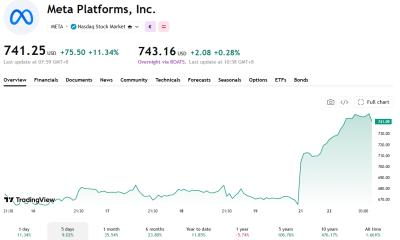
Meta Jumps 11% As Muse Shines and Investors Show an Appetite for Advancing AI
-

 Crypto World5 days ago
Did Jim Cramer Just Give GameStop Stock the Kiss of Death When He Said the Turnaround Is Working?
-

 Crypto World6 days ago
Bitcoin price holds above $81K as key catalysts line up
-

 Crypto World4 days ago
BitGo says Bitcoin absorbed Fed hike, CLARITY failure
You must be logged in to post a comment Login