Connect with us
DAPA Banner
DAPA Coin
DAPA
COIN PAYMENT ASSET
PRIVACY · BLOCKDAG · HOMOMORPHIC ENCRYPTION · RUST
ElGamal Encrypted MINE DAPA
🚫 GENESIS SOLD OUT
DAPAPAY COMING

Business

Principality Building Society boss on its branch network, commercial lending and stadium deal

Published

on

Business Live

Iain Mansfield is looking to double the mutual’s commercial lending book to support the delivery of much needed new housing stock

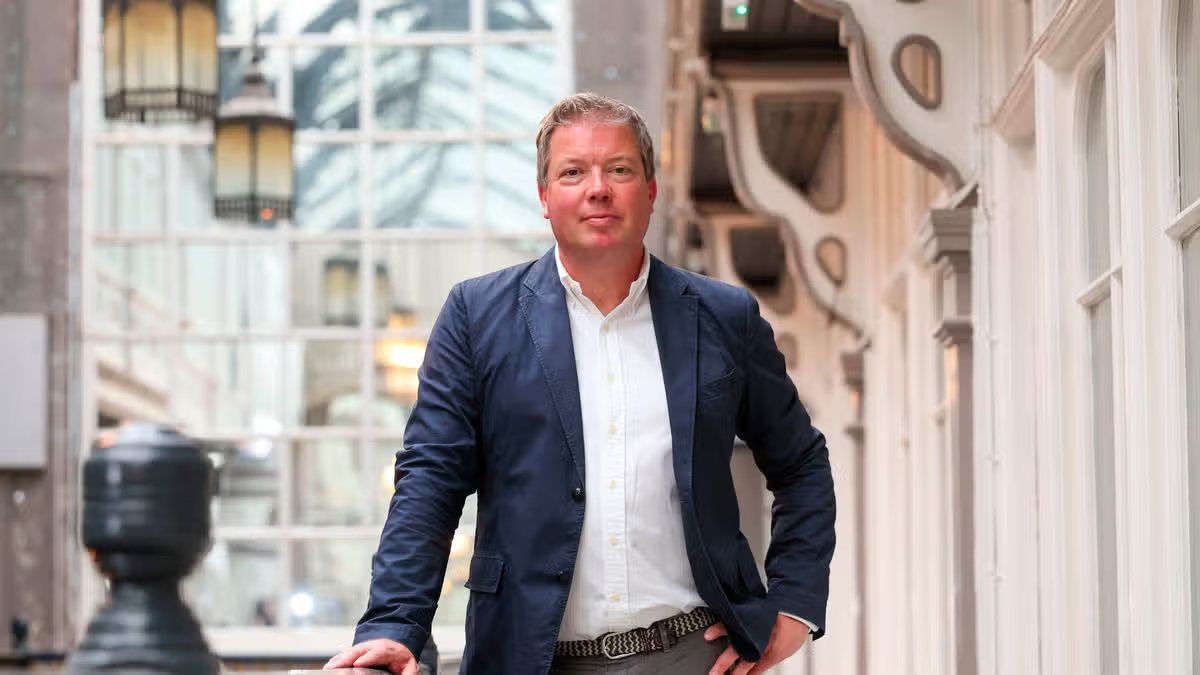
Iain Mansfield.

Chief executive of Principality Building Society Iain Mansfield has outlined plans to double its commercial lending to support much-needed new housing development to more than £2bn, while saying that despite advances in its digital offering, he cannot foresee a time when the mutual does not have a high street branch presence.

Cardiff-born Mr Mansfield, who took up his role at the UK’s sixth biggest mutual last November, succeeding Julie-Ann Haines and having previously been chief financial officer, said its three-year naming rights extension with the WRU for the Principality Stadium will further deepen brand recognition of the mutual and its products.

Mr Mansfield, 50, a chartered accountant who spent 20 years in London across retail banking, consumer financial services and private equity, as well as a two-year stint working at steelmaker Corus before its acquisition by Tata, described Principality as a “Welsh heritage business” but with plans to grow its savings customers and commercial lending clients across the UK.

Principality has assets of £14.1bn and employs 1,100 people. On his role, Mr Mansfield, who is also chairman of business membership body CBI Wales, said: “It’s about providing the services that a modern mutual should to as many people as we possibly can. The amount of people saving in the UK is relatively low and the number of people with just £100 of savings is a frightening statistic. I feel my job of getting people to save to buy their own homes is probably as challenging as it has ever been.

Advertisement

“So, it is about being open-minded and giving people a reason to save for resilience. Whether that is for a washing machine, a car or a holiday, I don’t really mind, as long as we bring that funding together to ensure that we can create home ownership, or develop new homes, so people can buy them either through a social housing relationship that we have, a mortgage property, or through buy-to-let investments.”

While more than 90% of it lending comes from savings deposits, it does rely on wholesale money markets. Last year it finalised its first covered bond, with the inaugural £500m issuance at the start of this year on a five-year floating rate secured against residential mortgages.

Principality now sees covered bonds as central to its wholesale funding plans and expects to be in the market annually under a more than £4bn programme.

Mr Mansfield, who attended Corpus Christi Catholic High School and St David’s Sixth Form College in Cardiff and first joined the mutual in 2015 as finance director of its secured lending venture Nemo Personal Finance, said: “Our model is acquiring savings through our branch network and evolving and improving our digital franchise.

Advertisement

“We want to ensure that we have got flexibility in our wholesale markets with our securitisation programme and a covered bond programme which commenced at the beginning of this year. That gives us the ability to go into the market once and get a relatively cost-effective and big chunk of funds that mature five years out. What we’re not saying is that we have to go into wholesale markets to any greater extent.

“We were created to help people save and we would like that percentage (saving deposits to fund its mortgages and commercial lending) to be as high as we possibly can. As the business grows, there is real benefit in having some wholesale funding as it gives us access relatively quickly and effectively to a big chunk of five-year money.”

The mutual holds saving deposits with a value of around £11bn. Mr Mansfield said: “The vast majority of that links to a branch. Last year we opened 175,000 new accounts and two-thirds of that was through a digital route.

“We have half a million savings accounts, but new accounts are different to members, who will have multiple numbers of accounts. We have invested heavily in our website, so the route to be able to get access to our rates has increased, and our expectation is that we will have an app by the end of the year in what will be a big digital shift.”

Advertisement

Principality has 54 branches, although one in St David’s Shopping Centre in the centre of Cardiff is due to close, and a presence at 16 agencies across Wales and the English borders. That comes with significant fixed costs of maintaining its branch presence.

Has he, the management team and the board appraised a time when it might no longer require a high street presence due to a wider take-up of digital services?

Principality Building Society branch in Bangor

A Principality Building Society branch.(Image: BBC)

Mr Mansfield said: “I think it is highly unlikely that we would be a digital-only business as we have a community and heritage in Wales. There is a broader piece here as well around alignment with what we are trying to do. Of course, more people over time will effectively save through digital routes, but what we don’t want to do is alienate people who want to come into a branch.”

He said the branch “human touch” of the mutual sector provides a point of difference to banks, where there has been a significant reduction in high street branches in recent years.

Advertisement

He added: “We have the largest branch network in the financial services sector in Wales. We are committed to our communities and I think our branch colleagues also want to bring in digital customers. Our mortgage business and savings franchise is right across the UK from a digital perspective, but longstanding members have historically opened their accounts through a branch.”

He does not like to distinguish between the mutual’s Cardiff city centre head office, Principality House, which houses around 900 hybrid working staff, and its branches and agencies with around 300 employees.

He explained: “We made some operational changes around 18 months ago and put some of the tasks of our head office into those branches. Our amazing branch colleagues have been really receptive to being able to do multiple things, which is to serve our customers who walk in, but also to do some of the work a traditional head office call centre would do. So, we are utilising our branches to do more.”

However, staff numbers remain under review. He said: “As an organisation where the world is changing as quickly as it is, we should be making sure that our model is appropriate and understanding what that looks like into the future.

Advertisement

“The strategy that we want to build for this organisation is being a highly relevant, customer-focused business fit for the future. We need to invest in our business and it is really important that we have the right mix of skills and level of investment.”

Commercial lending

Mr Mansfield is upbeat on the prospects for the mutual’s commercial lending, which is mainly centred around supporting housing development. He explained: “On commercial lending, we have a lent book of £900m and commitments of £1.1bn, where we have agreed contracts with people but they have not yet drawn down, so there is a big pipeline of opportunity.

“We would like to double the size of the business (commercial lending) to £2bn-plus. Why is this really important? Because it is bang on what we do.

Advertisement

“We lend around a third of the book, and a growing percentage, to housing associations, which aligns with our strategy and purpose. We provide finance to around 20 of the 30 housing associations in Wales and a handful in England.

“So that side is growing and we are helping housing associations develop new properties so people who are struggling with affordability can get on the housing ladder in some description.

“There is also lending for residential investment and material landlords where they have an estate which provides property into the rental market for those who don’t want to buy. A third, and again growing, is residential development. So how do we support those investors who want to grow and build homes from the ground up? “We have also worked really hard in the last two years to build relationships with councils across Wales and Welsh Government (the Plaid administration has a target of 20,000 new social homes by 2030). We are sitting here ready to work with Welsh Government, councils and whoever else to provide capital.”

In Cardiff, through a joint venture vehicle with Welsh Government, Tirion, Principality’s lending helped to derisk the Mill development, which has delivered around 800 new homes – half for the open market and the rest social housing and mixed tenure – around the former Wiggins Teape paper mill site in Ely. He sees potential for Principality to deploy more commercial lending for similar partnership approaches, which would also have the benefit of putting less strain on Welsh Government’s constrained budget to fund social housing with the option of it providing guarantees.

Advertisement

He said: “The reason that worked [the Mill], and why it is important to replicate, was getting the right group of stakeholders together for a site that would not have been able to be developed just with a commercial developer, as it was an industrial site that needed remediation. What we were able to do, by getting the right structure in place with Welsh Government, was to write initial loans to be able to do that work, which meant a developer could come in and could see a route to development.

“We would like to have more relationships with regional housing developers. That would give us the ability to work on larger projects and help the Welsh Government reach the 20,000 new homes target by the end of the decade.”

Future office requirement

The mutual looked at a number of locations for a possible smaller head office building. Last year it was close to signing a lease to occupy space at the 1 Callaghan Square office building, covering floors released by law firm Eversheds Sutherland after its decision to reduce its footprint in the building. However, that space has now been taken by British Gas.

Advertisement

There is currently a lack of grade A office space in the city. Any new speculative development, with high construction costs, would require a significant increase in the headline rent for the city and moving closer to the more than £50 per sq ft in Bristol. While no longer actively in themarket for a new head office, it remains a longer-term option for the mutual.

Mr Mansfield said: “Because this is such a great location, you have to be 100% sure it is the right place. We want just a few floors and getting people into one area and having staff working through processes seamlessly.

“My responsibility is that the balance sheet assets of this organisation are protected. So, we have been transparent with colleagues that the long-term strategy is to find an alternative home for this business, but we are not rushing into that.

“My other job is to ensure that we are looking after the assets, and one of the ways to look at this building [Principality House] is to understand the process so we can potentially get planning permission to put us into that position. If you have got that, then you have a potential business case.” Assuming it could find the right property, with a requirement of around 40,000sq ft, what redevelopment options could there be for Principality House?

Advertisement

Mr Mansfield said: “It has to be something that aligns 100% with the purpose of our business. So, if in the future we get the alchemy of finding a location and an option to do something, we would ensure that, subject to its commercial viability and protecting our members’ interests, there is a sustainability of purpose, so there would be a housing element.”

The mutual also owns a number of buildings around its head office at the Friary. The chief executive said that if Principality House is redeveloped, the mutual would not seek to be the developer, but a funder through its commercial lending arm.

Principality Stadium deal

CARDIFF, WALES – NOVEMBER 07: A view of the Principality Stadium showing the main Entrance off Westgate Street on November 07, 2023 in Cardiff, Wales. The Stadium is due to host games during the 2028 Euro Football tournament but due to Sponsorship of the Tournament the stadium will not be allowed to be called the Principality Stadium when the tournament is on. (Photo by Huw Fairclough/Getty Images)

In 2015, Principality entered into a 10-year naming rights deal with the WRU which renamed the Millennium Stadium the Principality Stadium. The value of the deal was not disclosed, but it is believed to have been around £12.5m with annual payments.

Advertisement

It was extended by a year due to the pandemic. The value of the extension, to 2030, has also not been disclosed, but provides some uplift on the 2015 deal, although it is pretty much static when accounting for inflation.

Asked if there could be a further extension – assuming there isn’t commercial interest from elsewhere – Mr Mansfield said: “It is way too early to say what the future looks like. The importance of the stadium for us is several-fold.

“Number one, our brand awareness has increased, with awareness in Wales, prompted and unprompted, continuing to be positive on the back of the stadium, which is key for us.

“We have a desire to grow our business, yes in Wales but outside too, so it is a shop window for our ambition. There are a million people a year who walk into or around it. For us, that is a massive opportunity to engage with existing members, but it also gives us visibility across the UK and beyond.”

Advertisement

On whether there is an element of confusion, as some might think it refers to an outdated and historic reference to Wales being a principality rather than a building society, he said: “We have a real ability to springboard this, and one of the focus areas through our strong relationship with the WRU, is to ensure that in all of our campaigns we get that connection between the Principality Stadium and Principality Building Society.”

On current trading he said: “From February to half year it was very challenging to price because of what has gone on in the Middle East. And that has meant the swap rates and the route through which we price our savings and mortgage business has been hugely volatile.

“Our teams have had to work very hard to continue to price practically and effectively through that period. Irrespective of that, we are not far off the plan that we expected and there is no reason to believe that we will not get to where we need to by the end of the year from a retail mortgage perspective.”


Advertisement
Continue Reading
Click to comment

You must be logged in to post a comment Login

Leave a Reply

Business

June CPI: Inflation eased following recent surge driven by Iran war

Published

on

Americans see gas price relief as costs fall annually in January 2026 CPI data

This story about the June 2026 CPI inflation report will be updated with further details.

Inflation pulled back in June after surging in prior months due to the Iran war’s impact on energy prices throughout the economy.

Advertisement

The Bureau of Labor Statistics (BLS) said on Tuesday that the consumer price index (CPI) – a broad measure of how much everyday goods like gasoline, groceries and rent cost – declined 0.4% on a monthly basis in June and was up 3.5% from a year ago. The monthly decline was the largest since a 0.8% decrease in April 2020.

Expectations vs. reality

Those figures were cooler than the estimates of economists polled by LSEG, who predicted a decline of 0.1% on a monthly basis and a 3.8% increase from a year ago. They also represent a cooling trend from the 0.5% monthly increase and the 4.2% annual rise recorded in the May edition of the report.

So-called core prices, which exclude volatile measurements of gasoline and groceries to better assess price growth trends, were unchanged from a month ago and up 2.6% from last year. Both of those figures were lower than the estimates of economists polled by LSEG, who predicted a monthly increase of 0.2% and 2.8% from a year ago.

MORE AMERICANS RELYING ON CREDIT CARDS TO BUY GROCERIES, NEW STUDY FINDS

Advertisement

The cost of living breakdown

High inflation has created severe financial pressures in recent years for most U.S. households, which are forced to pay more for everyday necessities like food and rent. Price hikes are particularly difficult for lower-income Americans, because they tend to spend more of their already-stretched paychecks on necessities and have less flexibility to save.

Energy prices fell 5.7% on a monthly basis – the energy index’s largest monthly decline since April 2020 – and are up 15.7% from a year ago. BLS noted that the energy index was the largest contributor to the decline in headline inflation, more than offsetting increases in indexes for food and housing.

Gasoline prices fell 9.7% in June and are up 26.7% from a year ago. Electricity prices were down 1% on a monthly basis and are up 4% from a year ago. Utility gas service prices rose 0.5% in June and are up 3% from last year.

Food prices rose 0.2% in June and are up 3% in the past year. The food at home index is 2.7% higher than a year ago, while the food away from home index is up 3.4% in the last year and both rose 0.2% on a monthly basis in June.

Advertisement
A man stands at a gas station.

Energy prices fell 5.7% on a monthly basis and are up 15.7% from a year ago. (Justin Sullivan/Getty Images)

The meats, poultry and fish index was 0.4% higher in June and has risen 5.7% over the past year. Beef and veal prices rose 1.2% on a monthly basis and are up 11.8% from a year ago. Egg prices increased 4.3% in June but are down 27.9% over the last year as supplies normalized after an avian flu outbreak. Prices for fruits and vegetables decreased 0.2% in June and are up 5.3% from a year ago.

Housing prices rose 0.1% on a monthly basis, which was the smallest one-month change since January 2021, and are up 3.3% from a year ago. Tenants’ and household insurance costs rose 0.2% from a month ago and are up 5.9% in the last year.

Transportation services prices declined 0.3% in June and are 3.4% higher than a year ago. Airline fares increased 0.2% on a monthly basis but are up 26.5% compared with a year ago.

A United Airlines jet takes off from Los Angeles International Airport.

Airline fares increased 0.2% on a monthly basis. (Mike Blake/Reuters)

DELTA CEO ED BASTIAN SAYS AIRLINE FARES WILL STAY ELEVATED EVEN IF JET FUEL PRICES FALL

Advertisement

What experts are saying

Ellen Zentner, chief economic strategist for Morgan Stanley Wealth Management, said that the “Fed was losing patience with high inflation, and today’s cooler-than-expected report gives them room to breathe.”

“By surprising on the downside, it relieves immediate pressure for action, allows the Fed to gather additional inflation data over the summer, and makes it considerably easier for policymakers to maintain their current wait-and-see stance through the next meeting,” Zentner added.

Jeffrey Roach, chief economist for LPL Financial, said: “After today’s benign core inflation release, it appears less likely that the FOMC will raise rates over the next few meetings. However, we may still be at an inflection point, given the risk that the energy shock could spill over into other categories of consumer prices. A positive resolution with Iran before the end of the summer is becoming increasingly important.”

What does it mean for the Fed?

The Federal Reserve has held interest rates steady at recent meetings amid concerns about elevated inflation, and with readings still coming in well above the central bank’s 2% target, policymakers are likely to leave rates unchanged at the next few meetings.

Advertisement

The CME FedWatch tool showed an 85.6% probability that the benchmark federal funds rate will remain at its current target range of 3.5% to 3.75% at the Fed’s next meeting in late July, up from 58.3% a day ago.

GET FOX BUSINESS ON THE GO BY CLICKING HERE

The tool also shows a 0% chance of a 25-basis-point rate cut by the end of the year, with just a 19.4% chance that rates remain at their current levels – with a 42.2% chance of a 25-basis-point hike and a 29.7% chance of 50-basis-points worth of hikes by the end of the year.

Advertisement
Continue Reading

Business

Crinetics Pharmaceuticals stock hits all-time high at 83.77 USD

Published

on


Crinetics Pharmaceuticals stock hits all-time high at 83.77 USD

Continue Reading

Business

Trump swaps Strait of Hormuz shipping fee for Gulf deals

Published

on

Trump swaps Strait of Hormuz shipping fee for Gulf deals

President Donald Trump on Tuesday announced that he will replace a 20% fee on commercial shipping moving through the Strait of Hormuz with “Trade and Investment Deals” that Gulf nations will be making in the United States.

Trump said the move came as the movement of oil and natural gas supplies has eased along the waterway, a vital, narrow commercial shipping point currently being contested by Washington and Tehran.

Advertisement

“Oil is flowing like never before, thanks to the awesome Power of the United States Military,” Trump wrote on Truth Social. “The Strait of Hormuz is open to ALL Ship traffic except for Iran — and that is because of their lying, violent, malicious leadership, which is taking them down the path of TOTAL DESTRUCTION.”

OIL PRICES FLUCTUATE AS TRUMP’S IRAN DEAL COULD FULLY REOPEN STRAIT OF HORMUZ

Donald Trump

President Donald Trump gestures as he participates in a bilateral meeting with Iraqi Prime Minister Ali al-Zaidi (not pictured) in the Oval Office at the White House in Washington, D.C. (Reuters / Reuters)

However, Trump said he would reinstate a blockade on Iran.

“We will therefore have a FULL Blockade, but only on Ships coming to and from Iranian ports, or carrying anything have to do with Iranian cargo,” he added. “Based on highly productive conversations with Middle East leadership, I have decided to replace the 20% United States Reimbursement Fee with Trade and Investment Deals that the various Gulf States will be making into the United States.”

Advertisement

Trump’s announcement comes amid Iran’s push to assert control over the strait. Tehran has claimed sovereign authority over the territory, despite the strait historically being considered a free-to-use international waterway.

During Tuesday’s meeting with Iraqi Prime Minister Ali al-Zaidi, Trump said he spoke with Gulf state leaders, who all said they would like to invest in the U.S. “at record amounts.”

OIL PRICES PLUNGE TO LOWEST LEVELS SINCE EARLY MARCH AFTER TRUMP SIGNS IRAN DEAL

Strait of Hormuz

Ships and tankers in the Strait of Hormuz off the coast of Musandam, Oman, April 18, 2026.  (Reuters / Reuters)

“And this way there’s no fee,” he told reporters in the Oval Office. “I don’t like the concept of a fee, but at the same time, it’s not fair that we’re protecting this strait for the entire world, for China and everyone.”

Advertisement

“I don’t mind protecting it for anybody. But it’s unfair that we’re not in somehow compensated. And we’ve been doing this for many years,” he added. “They’re investing and they’re getting a return on their money, and it’s good, but they’re going to be making massive investments into the United States and I like that much better.”

Over the weekend, U.S. and Iranian forces exchanged missile and drone attacks as Tehran again claimed to have control over the strait.

On Monday, the U.S. launched strikes against Iranian military sites. By Tuesday, Trump said Iran had been “very much destabilized.”

GET FOX BUSINESS ON THE GO BY CLICKING HERE

“I think what we’ve done to Iran is we’ve taken away almost all of their military capability.”

“I gave them a chance. I wanted to give them a chance at making a deal. You know, we had a deal two days ago. It was done. And then all of a sudden, they couldn’t do it,” he said. “They didn’t like something about the deal. They couldn’t do it. And they shot first. And that was a big mistake that they shot first because we have been knocking the hell out of them.”

Advertisement
Continue Reading

Business

Winn Group subsidiaries fuel turnover growth for Newcastle accident specialist

Published

on

Business Live

New accounts for the claims, recovery and repairs group also show a fall in operating profits

Chris Birkett, CEO of Winn Group

Chris Birkett, CEO of Winn Group(Image: Winn Group)

Turnover has increased at Newcastle accident management specialist Winn Group, which says it is well positioned to meet market challenges ahead.

The legal group – which includes replacement vehicle firm On-Hire, medico-legal reporting and rehab firm On Medical and non-fault accident specialists Winn Solicitors – saw turnover rise to £217m in the year to the end of March, 2026, from £196.1m the year before. The accounts for Winn Holding Limited show operating profit fell from £38.7m to £29.8m.

Bosses said performance had been impacted by narrowed operational losses from the group’s Scottish office which started trading in April 2023, and reduction in instructions across intervention services, along with increased salary and commission costs amid increased volumes and legal fees. Winn said it expects strong levels of profit in the future from its Scottish operation, where legal fees increased by 148% to more than £1.6m during the year.

Elsewhere, the main contributor to group revenue growth was On Hire Limited, which saw revenue increase 8% to more than £185.4m on the back of growing instructions. Winn Solicitors Limited ended the year with a 28% increase in turnover thanks to a 38% increase in non-personal injury fees and a 15% increase in fees across road traffic accident personal injury cases.

Advertisement

Meanwhile On Medical was only providing services to medical instructions not completed by April 1, with its main activity being the collection of outstanding trade debtors’ balances. Strong cash generation was noted across the group with £41m of cashflow generated from operating activities before exceptional costs. Dividends of more than £80.7m were also paid during the year.

Winn Group describes itself as a one-stop-shop for people involved in road traffic accidents. The group has become a major player in the accident management and rehabilitation market in recent years and offers an around-the-clock service to clients. It handles vehicle recovery, repairs arrangements and replacement vehicles as well as pursuing compensation and claims.

Staff levels across the year increased as headcount rose from 713 to 747. And following a refinancing in late 2025, the group negotiated a £95m loan with PGIM and Nomura to fuel growth.

Writing in the accounts, CEO Chris Birkett said: “During the year, we have not seen a major change in repair and hire markets; with the exception of inflationary increases in vehicle rental cost across all models and slightly lower lead times versus last year’s levels.”

Advertisement

He added: “Although the economic environment remains uncertain, with the wars in Ukraine, Gaza and Iran and interest rates at 3.75%, the directors remain of the opinion that the group is in a strong financial position to face the challenges ahead, including those arising from an industry where many competitors are in turmoil given recent legislative and macro changes, while keeping significant growth rates.”

Continue Reading

Business

KYN: A Raised Distribution At A 14% Discount

Published

on

TYG: This Aptly Named Fund Can Be Safely Avoided

KYN: A Raised Distribution At A 14% Discount

Continue Reading

Business

The Goldman Sachs Group, Inc. 2026 Q2 – Results – Earnings Call Presentation (NYSE:GS) 2026-07-14

Published

on

OneWater Marine Inc. (ONEW) Q1 2026 Earnings Call Transcript

This article was written by

Seeking Alpha’s transcripts team is responsible for the development of all of our transcript-related projects. We currently publish thousands of quarterly earnings calls per quarter on our site and are continuing to grow and expand our coverage. The purpose of this profile is to allow us to share with our readers new transcript-related developments. Thanks, SA Transcripts Team

Continue Reading

Business

Nexira acquires Keragum

Published

on

Nexira acquires Keragum

Keragum is a Morocco-based company specializing in carob derived ingredients.

Continue Reading

Business

Billionaire Warren Buffett stops donations to Bill Gates charity

Published

on

A woman with dark hair pulled back from her face points to a plaster on her arm

Billionaire investor Warren Buffett has stopped giving donations to Bill Gates’ charitable foundation weeks after the Microsoft co-founder detailed his links to the dead sex offender Jeffrey Epstein.

Buffett “irrevocably” committed in 2006 to donate shares in his firm, Berkshire Hathaway, each year to the Bill and Melinda Gates Foundation as it was then known “throughout my lifetime”.

But on Thursday, the Gates Foundation was left off the list of firms that will receive billions of dollars worth of stock.

The stock will instead be split between four foundations involving members of the Buffett family. The 95-year-old said he will dispose of his remaining stock over the next eight years.

Advertisement

“Of course, mortality is unpredictable,” said Buffett. “But my remaining shares will be donated to the four foundations one way or the other by 31 December, 2034.”

Gates’ association with Epstein was revealed when the US Department of Justice released files in January.

Buffett did not mention Gates or Epstein by name in his statement regarding his donations.

But in March, he told CNBC, external that he had not spoken to Gates “since the whole thing was unveiled”.

Advertisement

He added: “I don’t want to be in a position where I know things… to be called as a witness.”

The Gates Foundation has been contacted for comment.

In June, Gates appeared before the US House Oversight Committee to answer questions about his relationship with Epstein, who died in a New York prison in 2019 while awaiting trial on sex trafficking charges.

In a transcript of his testimony, Gates said that he had been introduced to Epstein in 2011 on the premise that he could raise billions of dollars for global health – a key focus of the foundation.

Advertisement

“I recall being aware that Epstein had faced prior legal issues, but I did not fully understand the extent of the crimes he committed,” Gates said.

Three years earlier, Epstein had pleaded guilty to soliciting a minor for prostitution and procuring a person under age 18 for prostitution.

Gates told the committee: “I should never have met with Epstein in the first place. Based on what I know now, I understand that even if he had delivered the donors he promised, it would not have justified associating with him.”

Buffett was an enthusiastic supporter of the Bill and Melinda Gates Foundation, stating in 2006 he “greatly” admired what it was accomplishing and promised to make yearly donations.

Advertisement

In 2010, Bill and Melinda Gates and Buffett started the Giving Pledge, which aimed to get extraordinarily wealthy people to give away the majority of their fortune during their lifetime or in their will.

Bill and Melinda Gates divorced in 2021 after 27 years of marriage.

Melinda French Gates resigned in 2024 from the foundation she co-founded and said that she would donate $1bn to help women’s rights in the US.

Advertisement
Continue Reading

Business

American States Water stock hits 52-week high at 85.63 USD

Published

on


American States Water stock hits 52-week high at 85.63 USD

Continue Reading

Business

Chipotle backs innovators transforming food systems

Published

on

Nestle backs new regenerative ag initiative

Restaurant’s Cultivate Next venture fund invests in six emerging companies.

Continue Reading

Trending

Copyright © 2025