


Connect with us
DAPA Banner
DAPA Coin
DAPA
COIN PAYMENT ASSET
PRIVACY · BLOCKDAG · HOMOMORPHIC ENCRYPTION · RUST
ElGamal Encrypted MINE DAPA
🚫 GENESIS SOLD OUT
DAPAPAY COMING

NewsBeat

British pensioner, 86, gored at wild Spanish festival which sees bulls charge through Pamplona streets | News World

Published

on

British pensioner, 86, gored at wild Spanish festival which sees bulls charge through Pamplona streets | News World
A man gored by bulls from the Jandilla ranch in Plaza Consistorial gets treatment in San Fermin festival in
(Picture: EPA)

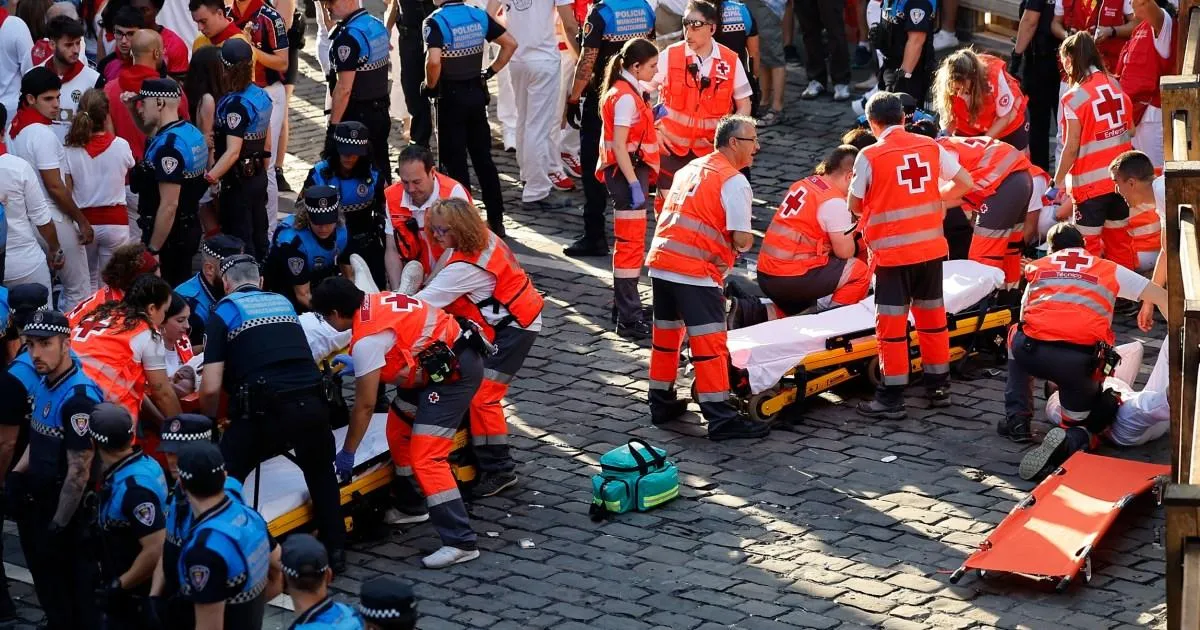
A British pensioner has become one of the oldest ever victims of the world-famous San Fermin festival which sees bulls stampede through the Spanish streets.

The pensioner, among ten taken to hospital, is from Halesowen in the West Midlands and was hurt in the bullring at the end of the half-mile course in n the picturesque city of Pamplona.

The Brit, by far the oldest of those injured, suffered wounds to his right hand, left eyebrow and left elbow.

Health chiefs said this morning they couldn’t say how his health situation would evolve after he was taken to hospital.

Advertisement

The unnamed OAP became the second Brit injured during the morning bull runs at this year’s festival.

To view this video please enable JavaScript, and consider upgrading to a web
browser that
supports HTML5
video

Advertisement

Sign up for all of the latest stories

Start your day informed with Metro’s News Updates newsletter or get Breaking News alerts the moment it happens.

It came after another British tourist was one of 11 people hurt in Saturday’s run.

Advertisement

William Mitchinson, 24, suffered an ankle injury after being knocked to the ground by one of the bulls he tried to outpace.

Speaking after his first-ever participation in this year’s fifth bull run, William told local press as he hobbled out of Navarra University Hospital after treatment: ‘I ran until the bull trampled me.

‘I’d seen the festival on social media and it looked like good fun.
‘It’s my first visit to Pamplona. I might come back another year but only for the party.’

Two people suffered gore injuries on today’s run.

Advertisement
Revelers run alongside Jandilla's fighting bull during the eigth running of the bulls at the San Ferm??n festival in Pamplona, Spain, Tuesday, July 14, 2026. (AP Photo/Miguel Oses)
Revellers run alongside Jandilla’s fighting bull during the eighth running of the bulls (Picture: AP)

One of the runners was horned in the chest near the end of the course.
Earlier by the town hall one of the six fighting bulls led by six steers broke away from the pack and charged a group of four men.

One appeared to smash his head on the ground as he was swept off his feet.

It was not immediately clear this morning if he was among the ten people taken to hospital, although health chiefs confirmed a man had suffered a gore injury to his thigh in the area where the violent knockdown occurred.

Today’s run, which lasted 2 minutes and 25 seconds, was the eighth consecutive morning revellers had taken to the streets for the traditional ‘encierros’ which are the highlight of the famous festival.

The San Fermin festival kicked off at midday last Monday with the traditional opening ceremony called the Chupinazo, with thousands of revellers dressed in the must-wear white outfits with a red bandana around their necks ending up soaked in wine and sangria.

Advertisement

It will be formally brought to an end at midnight with a traditional event known as ‘Pobre de mi’, Spanish for ‘Poor Me’ which involves thousand of participants gathering in the town hall square with lit candles to mark the end of the nine-day celebration.

epa13109842 Mozos, or runners, are chased by bulls from the Jandilla ranch during the final bull run of the San Fermin festival in Pamplona, Navarra, northern Spain, 14 July 2026. EPA/AINHOA TEJERINA
People are injured every year at the festival (Picture: EPA)

Sixteen people have been killed during the bull runs at the annual festival, which always finishes on July 14 and was made famous by 1926 Ernest Hemingway novel ‘The Sun Also Rises’, since records began in 1910.

The most recent death was in 2009 when 27-year-old Daniel Jimeno, from Madrid, was gored in the neck by a bull called Capuchino.

Several foreigners, from Australians to Americans through to Brits and Irish, are normally among the injured.

The first of the eight bull runs in 2024, known locally as encierros, took place four hours after a San Fermin reveller collapsed and died.

Advertisement

Police rushed to the scene and tried to save the 40-year-old man but were unable to resuscitate him.

In 2023 a 60-year-old man from Cardiff in Wales was among those injured.

Advertisement

Source link

Continue Reading
Click to comment

You must be logged in to post a comment Login

Leave a Reply

NewsBeat

Co Antrim Orange Hall vandalised for ‘fifth time in a year’

Published

on

Belfast Live

Police are investigating the incident as a sectarian hate crime

An Orange Hall in Co Antrim has been vandalised for the “fifth time in a year.” Graffiti was sprayed on the walls of the Rasharkin Orange Hall building, with messages including ‘up the ra’ and ‘IRA.’

Police said they are treating the incident as a sectarian hate crime. The incident took place in the early hours of Tuesday morning, July 14, at the site on Main Street.

In a statement, PSNI Inspector Armour said: “At 8am, we received a report that graffiti had been sprayed on a building in the Main Street area of the town at approximately 1.20am. This is being treated as a sectarian hate crime and enquiries are ongoing.”

Advertisement

The incident has been widely condemned, with Rasharkin Abod (Apprentice Boys of Derry) posting on social media that it was the fifth attack in a single year.

They said: “We can’t help but wonder if this was a Mosque or GAA hall what the response would be, 5 attacks in a year, simply not good enough from a society that has moved on!”

North Antrim MP Jim Allister said: “Last night’s attack on Rasharkin Orange Hall was but the latest in a long series on the building. But the truth is that Rasharkin Orange Hall is more than a building. It is symbol of the minority Protestant community in the village.

“The attack is made all the more chilling by the nature of the slogans crudely spray painted on the hall. Repeatedly they reference the IRA which waged a 30 year campaign of terror against Protestants and in so doing filled many grave.

Advertisement

“Just yesterday the self styled First Minister for all was hypocritically attacking loyalist bonfires. This is the same person who continues to defend, justify and even celebrate the wicked IRA who, as last night’s attack in Rasharkin illustrated, are still being used to intimidate Protestants.

“Her language of “no alternative” to IRA terror is the sort of rhetoric which formed the backdrop to last night’s attack. Sinn Fein need to not only condemn this cowardly attack carried out in the hours of darkness but also the murderous IRA who are celebrated in the vandalism.”

Issuing a joint statement in condemnation of the attack, DUP councillor Mervyn Storey, councillor Darryl Wilson and councillor John McAuley said: “While the majority of the residents of Rasharkin showed respect and tolerance for the 12th celebrations yesterday sadly there remains a small unrepresentative group who just want to display their sectarian intolerance of anything from a different tradition, even a building of bricks and mortar.

Advertisement

“Sadly this is the second time in weeks that the hall has been attacked and one of many over the years. Those who talk much about intolerance and demand respect for their culture and tradition seem incapable of displaying the same.

“It’s time for those in leadership in republicanism in the village to call this sectarian hatred out and condemn it for what it is, an attack on the Protestant community of the village.”

TUV Ballymoney councillor Jonathan McAuley added: “This morning we have learned of yet another sectarian attack on Rasharkin Orange Hall, carried out under the cover of darkness for no reason other than to raise tensions and, it would appear, intimidate the few remaining Protestants in the village into leaving.

“We have yet to hear any condemnation from local Sinn Féin representatives. This comes just a week after some of those same representatives were calling for the bonfire at Finvoy to be removed. That bonfire was not intended to intimidate anyone but to celebrate our loyalist culture, unlike the attack on the Orange Hall.

Advertisement

“I want to commend the young lads from Finvoy for the tremendous effort they put into this year’s bonfire. Their hard work and commitment deserve recognition.

“I have spoken with the PSNI this morning regarding the attack on Rasharkin Orange Hall, and I await to see what action, if any, will be taken. Those responsible should be identified and held accountable.”

Local councillor Alan Barr described the attack as “pathetic.”

The UUP representative for Braid and Mid and East Antrim said: “After a successful Twelfth, retrograde elements want to drag us into a dark past by glorifying PIRA terrorists by spraying their hate on Rasharkin Orange Hall.

Advertisement

“Let’s remember that not too far from Rasharkin, PIRA murdered a defenceless off duty member of the Royal Irish Regiment. It’s pathetic that they want to glorify such murderers.”

Rasharkin Orange Hall has been the target of attacks in previous years. Last year, on July 12, police investigated a sectarian hate crime at the site, when it was reported that paint had been thrown over the front of the building and graffiti daubed on the walls.

In 2024, pro-IRA graffiti at the hall was condemned as “sinister”, with the display appearing just before Orange Victims’ Day, when commemorations take place across Northern Ireland in memory of the members of the Orange Order killed during The Troubles.

For all the latest news, visit the Belfast Live homepage here and sign up to our daily newsletter here.

Advertisement

Source link

Continue Reading

NewsBeat

Cancer-stricken grandmother is ‘sent home with paracetamol’ after tumour doubled in size ‘while waiting three months for NHS treatment’

Published

on

It is said to have taken three months for the NHS to start Marie's treatment after diagnosis, by which point her tumour had doubled in size (seen centre with her husband and daughter)

A distraught daughter has accused the NHS of ‘failing’ her cancer-stricken mother after they ‘sent her home with paracetamol’.

Marie Stibbe, 79, who has retired in Tiverton, Devon, was diagnosed with liver cancer at the start of March after she experienced ‘legs so itchy she couldn’t sleep and was finding life very hard’.  

A blood test revealed she had suddenly developed diabetes – another symptom of late-stage liver cancer – and wrongly suggested she had ovarian cancer.

But it was a month later that the liver disease was confirmed with a CT scan and a further three months passed before Marie started treatment, by which point her tumour had doubled in size, her daughter has claimed. 

Advertisement

Rachael Stibbe, 44, from Kent, told the Daily Mail she was forced to seek a consultation from a private liver doctor after the NHS refused to continue her mother’s treatment, claiming her liver function had declined too significantly.

She said: ‘The doctors at Exeter Hospital were really quite bad with her. One said “I could refer you for chemotherapy, but it’ll only give you a few extra weeks. I advise you to go home and enjoy the life you have left.”

‘They literally sent her home to die. The doctor said “I give you six to 12 months” and sent her off with a packet of paracetamol. He was so insensitive, there was no patient care whatsoever.’

Rachael added: ‘She’s really depressed, she thinks her life is over.’ 

Advertisement

It is said to have taken three months for the NHS to start Marie’s treatment after diagnosis, by which point her tumour had doubled in size (seen centre with her husband and daughter)

The 79-year-old grandmother was diagnosed with liver cancer at the start of March

The 79-year-old grandmother was diagnosed with liver cancer at the start of March

Now, the family have launched a GoFundMe to help raise money for specialist treatment in India

Advertisement

After having ‘lost faith’ in the NHS, Rachael sought the opinion of a liver surgeon at King’s College Hospital, who wrote a report urging that Marie needed an MRI and PET scan, immediate combination treatment including immunotherapy and said if started right away she would have many years left. 

But after at least six weeks of chasing the oncology team at Royal Devon and Exeter Hospital, they allegedly refused to consider the report and said it would make no difference to Marie’s treatment.

When Marie was diagnosed she had a ‘compensated liver’, meaning that while the tissue is scarred it can still function relatively normally. 

However, Exeter Hospital allegedly refused to carry out an MRI scan following her diagnosis, so Rachael paid for one privately in May, which showed the tumour had grown from seven centimetres to 14.9.

Advertisement

Her liver had reached a ‘decompensated’ stage which can drastically drop life expectancy. Marie’s gall bladder had also collapsed and her spleen was enlarged. 

Rachael claimed Exeter Hospital failed to review the MRI report. 

It took three months for Marie to receive her first round of immunotherapy from Exeter Hospital – well over the NHS’s 62-day cancer pathway rule.

This is a national standard designed to ensure that patients do not face dangerous delays when they have a life-threatening illness.

Advertisement

Exeter Hospital have not met this standard for ten years since 2016 as ‘patients continued to wait too long for their treatment for cancer and remained at risk of deteriorating health because of the delay,’ according to a report by the Care Quality Commission.   

Rachael Stibbe, 44, from Kent, said she was forced to seek a consultation from a private liver doctor at King's College Hospital after the NHS refused to continue her mother's treatment

Rachael Stibbe, 44, from Kent, said she was forced to seek a consultation from a private liver doctor at King’s College Hospital after the NHS refused to continue her mother’s treatment

The mother of three pictured with her grandson, two, fears she will not get to see him grow up

The mother of three pictured with her grandson, two, fears she will not get to see him grow up

After six weeks of chasing the oncologists at Royal Devon and Exeter Hospital, they allegedly refused to consider the MRI report (Rachael and Marie pictured together with their dogs)

After six weeks of chasing the oncologists at Royal Devon and Exeter Hospital, they allegedly refused to consider the MRI report (Rachael and Marie pictured together with their dogs)

Advertisement

Rachael said: ‘The doctor was very arrogant and wasn’t interested in investigating why her liver function had dropped and if it could potentially be remedied.

‘The Exeter NHS oncologist refused to answer our questions and just told her there’s nothing further they can do.

‘Exeter Hospital has caused unacceptable delays and refused to give my family basic information. They were too slow with everything; I consider them to be negligent.’ 

Rachael added: ‘She’s not going to get to see her grandson grow up.’ 

Advertisement

She continued that her mother had cirrhosis, which is permanent scarring of the liver, but the oncology team allegedly did not work at all with the liver team, which is typically standard practice.   

Rachael said: ‘The reality is that this absolutely should have been in place throughout and I personally do not think her liver would have become so bad over the last few weeks to justify stopping treatment.

‘It might well be the case the drop in liver function is temporary but they are not interested in investigating further and of course that would have been a job for the liver team who washed their hands of the case in March.’

Marie was also suffering from extremely swollen legs, where fluid buildup was leaking into the tissue, but Exeter Hospital allegedly didn’t help manage the painful symptoms and refused to drain the excess fluid after water pills didn’t work.

Advertisement

‘She was really suffering every day and they weren’t interested. They wouldn’t help relieve her pain or take responsibility for her symptoms. They said it was a GP problem, it was terrible,’ said the distraught daughter. 

Rachael and her family have now launched a GoFundMe for private treatment abroad in India

Rachael and her family have now launched a GoFundMe for private treatment abroad in India

Marie also needed urgent treatment from a jaw and face specialist after losing a front tooth which made it difficult for her to eat.

But Rachael claims the Exeter Hospital oncologist denied receiving relevant letters, refused to contact the maxillofacial team, and her referral was downgraded from urgent to standard. 

Advertisement

‘She won’t be alive by the time they offer her a dental/maxillofacial appointment because there is such a backlog. 

‘It’s disgusting behaviour and demonstrates she’s been failed by the liver department, oncology department and maxillofacial,’ said Marie’s daughter.

The 44-year-old also complained to the NHS’s Patient Advice and Liaison Service, but says she never had any of her concerns answered.

She said: ‘I emailed PALS and I got an automated email reply saying I’ll get a response in 50 days. They’re not monitoring their emails.

Advertisement

‘The bottom line is I asked so many questions and to this day I have not got a response.’ 

Rachael and her family are now looking at private treatment abroad in India, who offer specialised treatment plans and say they may be able to save her.

But this is expected to cost more than £100,000. Rachael has started a GoFundMe pleading for donations to help her ‘lovely’ mother who is the ‘backbone’ of their family.

She wrote on the donation page: ‘Please help us save my lovely mother. She did not deserve such poor treatment from the NHS and she is the backbone of our family. 

Advertisement

‘Our family will break without her and my father will not cope. In fact, we fear he will either then end his life or die of a broken heart. After 56 years of marriage.’

She added: ‘My mother waited 40 years for a grandchild and she finally has Liam, a beautiful boy who is two years old and loves his grandma. 

‘It is heartbreaking that she paid her taxes and took such an altruistic view with child benefit and this is how the NHS repays her. Liam is now facing growing up without his grandmother but he doesn’t understand – he is only two years old.’

Royal Devon and Exeter Hospital said: ‘The concerns raised by Ms Stibbe are currently being investigated through our complaints process, and we have kept her informed of the status of those investigations. 

Advertisement

‘We will respond to her concerns directly when our investigations are completed.’

Source link

Continue Reading

NewsBeat

Dovestone wildfire enters fourth day as crews issue update

Published

on

Dovestone wildfire enters fourth day as crews issue update

Greater Manchester Fire and Rescue Service (GMFRS) said crews are continuing to tackle the blaze near Dovestone Reservoir in Greenfield, with 15 fire engines and four specialist wildfire units deployed in challenging conditions.

The latest update, issued at 7pm this evening (July 14), comes as smoke from the fire continues to affect parts of Greater Manchester.

Fire chiefs said a separate wildfire at nearby Tintwistle Moor is also contributing to a large plume of smoke across the region.

A GMFRS spokesperson said: “For the fourth consecutive day, crews from Greater Manchester Fire and Rescue Service are tackling the moorland fire near Dovestone Reservoir.

Advertisement

“More than 70 firefighters, 15 fire engines and four specialist wildfire units from across Greater Manchester are at the scene.

“Our crews are working hard in challenging conditions to contain the fire.”

Residents in affected areas are being urged to stay indoors and keep windows and doors closed if there is visible smoke.

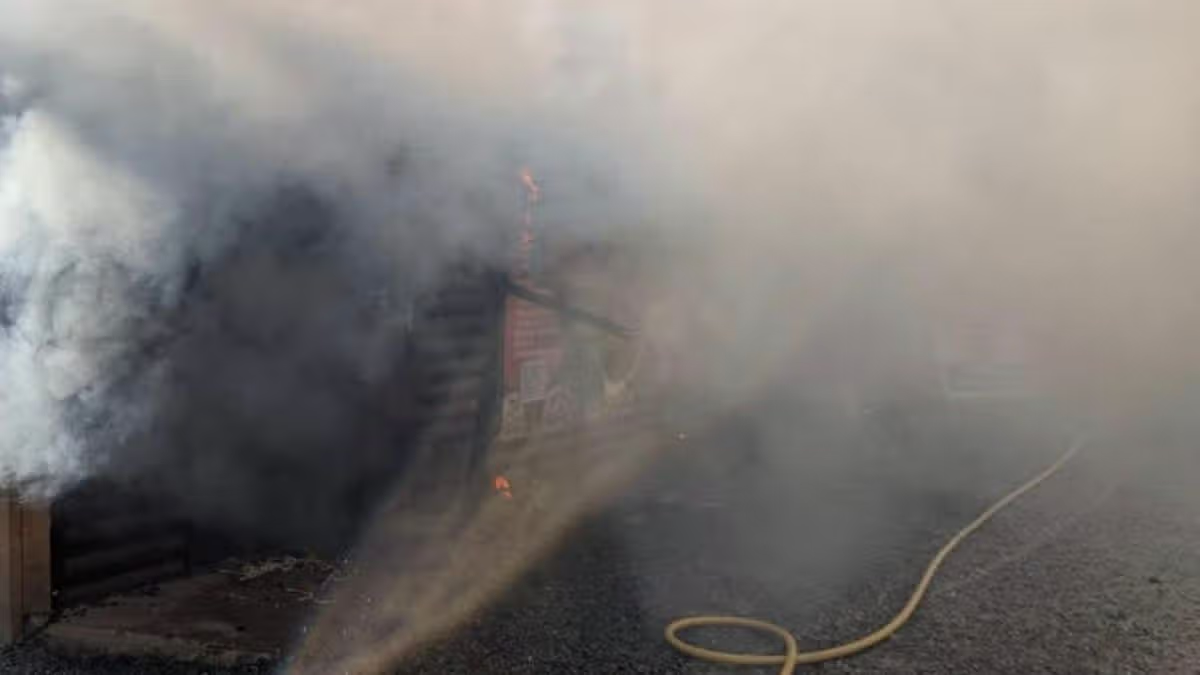
One of the fires on Marsden MoorVisible smoke has been seen across large parts of Greater Manchester (Image: Grahams Fire Page)

The spokesperson added: “People in the surrounding area may continue to experience smoke from the wildfire, with a separate wildfire at nearby Tintwistle Moor contributing to a large plume of smoke that has affected parts of Greater Manchester today.

Advertisement

“If there is visible smoke, stay indoors and keep windows and doors closed where necessary.”

Road closures remain in place around Dovestone Reservoir, and members of the public are being urged not to travel to the area while emergency services and partner agencies continue their work.

The fire first broke out shortly before 8.40pm on Saturday evening.

Since then, firefighters have been working around the clock to contain the blaze and prevent it from spreading across the moorland.

Advertisement

A major incident was declared on Sunday as the response intensified.

Specialist wildfire units, drone technology, burns teams, command support vehicles and partner agencies have all been involved in tackling the fire in difficult terrain.

Meanwhile, Greater Manchester Police have charged a woman in connection with the wildfire.

Shania Care-Slede, 20, of Market Street, Hyde, has been charged with aggravated arson, being reckless as to whether life was endangered, and dangerous driving.

Advertisement

She was due to appear at Manchester Magistrates’ Court on today (July 14).

Police said their investigation remains ongoing and officers are continuing to pursue a number of lines of enquiry to identify any other individuals who may have been involved.

Earlier today, GMFRS said the wildfire remained active but was in a steady state, with crews continuing to extinguish hotspots and monitor conditions as weather and wind direction change.

(Image: Newsquest)

The fire service also thanked local communities for their support but said firefighters have all the equipment and supplies they need.

Advertisement

A spokesperson said: “We are incredibly grateful for the kindness and support local communities have shown to firefighters and partners responding to the fire.

“However, crews have all the equipment, supplies and welfare arrangements they need to carry out their work safely.

“While we are not seeking donations, we’re thankful for the positive messages and support being shown by local people, and would encourage anyone wishing to make a donation to consider supporting a local food bank instead.”

Advertisement

Source link

Continue Reading

NewsBeat

Handing over Falkland Islands to Argentina could be Labour’s next foreign policy ‘betrayal’, Tory and Reform MPs warn, as Gibraltar effectively becomes part of EU

Published

on

London and Madrid have disputed control of Gibraltar since the tiny territory was ceded to Britain in the 1713 Treaty of Utrecht

Handing over the Falkland Islands to Argentina could be Labour’s next foreign policy ‘betrayal’, opposition MPs warned today, as Gibraltar effectively became part of the European Union more than three centuries after being declared British.

Ministers signed a post-Brexit deal at a ‘surrender’ ceremony in Brussels today which will see the border between the Rock and mainland Spain disappear.

It effectively means the peninsula – strategically important militarily because it sits at one of the world’s busiest maritime choke points – has joined the bloc’s free-movement Schengen zone.

And visiting Britons will have to show their passports to Spaniards and face being refused entry despite it being UK territory.

Advertisement

Foreign Office minister Stephen Doughty smiled for the cameras as he signed the deal today alongside Maroš Šefcovic, the bloc’s Brexit point man, and Spanish foreign minister José Manuel Albares Bueno.

But Reform MP Robert Jenrick said: ‘This Government has proven itself completely incapable of defending our national interest.

‘They fold easier than a deckchair. Why are Brits being made to show their passport to Spaniards to enter British territory?

‘Reform UK and Nigel Farage will finally put our country first.’

Advertisement

London and Madrid have disputed control of Gibraltar since the tiny territory was ceded to Britain in the 1713 Treaty of Utrecht 

With an economy based on financial services and online gaming, Gibraltar - which covers just under seven square kilometres (2.7 square miles) - has one of the highest per capita incomes in the world

With an economy based on financial services and online gaming, Gibraltar – which covers just under seven square kilometres (2.7 square miles) – has one of the highest per capita incomes in the world 

Foreign Office minister Stephen Doughty, left, smiled for the cameras as he signed the deal today alongside Maro¿ ¿efcovic

Foreign Office minister Stephen Doughty, left, smiled for the cameras as he signed the deal today alongside Maroš Šefcovic

Advertisement

Reform MP Andrew Rosindell added: ‘Having betrayed Britain’s sovereignty over the Chagos Islands, this Government has now turned its back on Gibraltar.

‘Requiring Britons to face Spanish involvement when entering British territory is an unacceptable concession.

‘Gibraltar has been British since the 1713 Treaty of Utrecht and must remain so. If ministers are prepared to compromise Gibraltar today, which British Overseas Territory will they put at risk tomorrow?’

The Tories’ Shadow Armed Forces Minister, Mark Francois, said: ‘It’s a fitting end to Starmer’s Government that it concludes with even further weakening of our sovereign borders.

Advertisement

‘Once Labour showed weakness over Chagos, other nations smelt opportunity – and we are now under pressure over the sovereign base areas in Cyprus and Argentina, which is reviving its false claim to the Falklands.’

Former Tory Brexit minister David Jones, who has defected to Reform, said: ‘It’s an outrageous, pathetic surrender by the British Government.

‘Both this government and the previous Conservative administration have been weak and spineless.

‘It is another unforced surrender and the British people will not forget it at the next general election.’

Advertisement

Former Tory Defence Secretary Sir Gavin Williamson added: ‘The government seems intent on giving everything away. First Chagos, next Gibraltar.

‘They seem to have little care for Britain’s strategic interests or the people that live there.’

The new treaty will come into force overnight and removes 118-year-old border infrastructure from the frontier with Spain and makes Gibraltar part of the EU’s free-movement zone.

It removes border infrastructure from the frontier with Spain and makes the British overseas territory effectively but not formally part of the EU Schengen zone.

Advertisement

Border checks will be introduced at Gibraltar’s airport, with Spanish guards having the final say on who can enter the Rock and by extension Schengen.

Reform MP Robert Jenrick said the Labour Govrnment had 'proven itself completely incapable of defending our national interest'

Reform MP Robert Jenrick said the Labour Govrnment had ‘proven itself completely incapable of defending our national interest’

The Tories¿ Shadow Armed Forces Minister, Mark Francois, said the deal was a 'further weakening of our sovereign borders¿

The Tories’ Shadow Armed Forces Minister, Mark Francois, said the deal was a ‘further weakening of our sovereign borders’

The fact that Britons will have to show their passports to Spaniards to enter British territory that Madrid has long claimed ownership of and deems a colony is one of the most controversial parts of the deal.

Advertisement

Before Brexit, Britain wasn’t part of the Schengen zone, meaning border checks on Spain-Gibraltar crossings have always been required.

But since Brexit, Madrid has aggressively been pushing for the border to be moved back to ports in Gibraltar and for the border to be abolished.

Fabian Picardo, Gibraltar’s chief minister, has backed the treaty and attended today’s signing ceremony.

Spanish Prime Minister Pedro Sanchez hailed the new arrangements as bringing down ‘the last wall’ inside the EU, with the peninsula reliant on about 15,500 daily cross-border workers from Spain. The removal of the border will now make it easier for local workers on either side to cross.

Advertisement

With an economy based on financial services and online gaming, Gibraltar – which covers just under seven square kilometres (2.7 square miles) – has one of the highest per capita incomes in the world.

London and Madrid have disputed control of Gibraltar since the tiny territory was ceded to Britain in the 1713 Treaty of Utrecht.

It comes after Sir Keir Starmer drew up a deal to hand control of the Chagos Islands to Mauritius.

It would have seen Britain transfer sovereignty of the islands and lease back the joint US-UK Diego Garcia air base for 99 years to the tune of around £35 billion.

Advertisement

It has been criticised by US President Donald Trump but there are fears PM-in-waiting, Andy Burnham, will try and revive the deal.

Argentina has also started flexing its muscles ahead of tomorrow’s semi-final World Cup clash with England, claiming the Falkland Islands belong to it and that it will spur them on in the match.

While Sir Keir hit back this week at comments by Argentinian foreign minister Pablo Quirno that the Falklands Islanders were an ‘artificially implanted’ population, there are fears Mr Burnham will take a softer approach to the future of the archipelago.

Source link

Advertisement
Continue Reading

NewsBeat

Red bike stolen in St Andrewgate in York city centre

Published

on

Red bike stolen in St Andrewgate in York city centre

North Yorkshire Police are investigating after a ‘distinctive vivid-red coloured pedal bike’ was stolen from St Andrewgate in York city centre last week.

They said the theft happened just before 11am last Wednesday (July 8) and the suspect was later seen cycling away towards the Granary Court, Spen Lane, and Bartle Garth area.


RECOMMENDED READING:

Advertisement

He was described as wearing a sky blue t-shirt with a large print on the back, a dark baseball cap, tracksuit bottoms, and a rucksack.

A spokesperson for the force said: “The thief takes measures to hide his face from the local cameras, and afterwards, he cycles away.”

Anyone with information is asked to email mark.burrows@northyorkshire.police.uk, call 101, or contact Crimestoppers anonymously on 0800 555 111.

The reference number is 12260129249.

Advertisement

Source link

Continue Reading

NewsBeat

Heat deaths are a public health crisis rooted in housing inequality

Published

on

Heat deaths are a public health crisis rooted in housing inequality

The heatwaves of late May and June killed an estimated 2,700 people in England and Wales, according to a recent analysis – around 550 in May, when west London hit 35.1°C, and 2,200 in June, as East Anglia reached 37°C.

Both events broke records that had stood since 1944 and 1976, and researchers estimate that 42% of the deaths were attributable to the extra heat resulting from human-induced climate change. They add to a mounting toll: more than 10,000 people died during UK heatwaves between 2020 and 2024, according to the UK Health Security Agency (UKHSA).

Public health experts call extreme heat a “silent killer” that can claim anyone, even the young and fit. That is true and worth repeating. But it obscures the pattern of what is happening: heat deaths are not scattered randomly across the population. They fall predictably and measurably on particular people in particular homes.

Around 60% of the estimated deaths in May and June were among people aged over 85. But age is only part of the story, because vulnerability to heat is socially patterned. A Government Actuary’s Department analysis, published days before the June heatwave, shows that England’s most deprived communities are concentrated in dense urban areas with the least green space – places subject to the “urban heat island” effect. This is where concrete and tarmac absorb heat by day and release it at night, depriving residents the relief of overnight cooling that allows people to recover.

Advertisement

Every English neighbourhood that ranks among both the 10% most deprived and the 10% most exposed to extreme heat is in London. During the 40°C heatwave of 2022, the urban heat island effect was itself responsible for a substantial share of London’s heat-related deaths.

The common thread is housing. An analysis by the Resolution Foundation thinktank found that 54% of the poorest fifth of English households live in homes at high risk of overheating, against 18% of the richest fifth. Two-thirds of social renters, and six out of ten households with young children, live in homes at the highest risk as the country warms.

Flats, small homes and overcrowded properties trap heat. Renters cannot fit shutters or external shading, and cooling costs money that low-income households do not have. The English Housing Survey, carried out by the UK government, found that 2.9 million households say that their homes get uncomfortably hot.

Not all homes cool at night.
Sven Hansche/Shutterstock.com

Year-round problem

The troubling part of this is that these are largely the same homes we already knew were dangerous in winter. Cold homes caused an estimated 4,950 excess winter deaths across Britain in 2022-23 – around 45 people a day through the coldest months.

Advertisement

We have treated fuel poverty as a cold-weather problem, answered with winter fuel payments and seasonal campaigns. But a badly-insulated home is thermally incompetent all year round: it leaks heat in January and traps it in July. The same outdated, inadequate housing stock kills in both seasons; only the mechanism changes. Fuel poverty is not a winter problem that pauses in spring – it is a year-round emergency.

None of this is inevitable, as last summer proved. In 2025, UKHSA recorded 1,504 heat-associated deaths in England: roughly half the 3,039 its models had predicted from temperatures alone, a pattern consistent across all five heat episodes from that year. UKHSA is careful to note that causes cannot be firmly attributed, but heat-health alerts and the system-wide response across the NHS, social care and emergency services are likely to have contributed. Adaptation, in other words, saves lives at scale.

But adaptation, too, is unequal. Private adaptation – air conditioning, well-ventilated houses, leafy suburbs – all correlate with wealth. And public health advice to “keep cool” is least effective for precisely those with the least capacity to act on it: the tenant who cannot alter her flat, the pensioner who cannot afford to run a fan. As heatwaves intensify, the gap between those who can buy their way to safety and those who cannot will widen, unless policy closes it.

Heat episodes in England are predicted to become more intense, longer and more frequent as the climate warms. The Climate Change Committee, the government’s independent climate adviser, has proposed that heat-related deaths in 2050 should be no higher than they are today. Achieving this will require treating heat as both a housing and an inequality issue. This includes retrofit programmes that prepare homes for summer as well as winter, more trees and green spaces in the most deprived neighbourhoods, and making sure the Decent Homes Standard – the government’s minimum standard for safe and suitable housing – includes protections against overheating. It also means targeted support for people who are already known to be most at risk from extreme heat.

Advertisement

What it does not mean is simply relying on more leaflets advising people to drink water and close the curtains. The deaths of May and June were tragic, but not random. Our response should not be random either. We know whose homes will be dangerous next summer – the question is whether we act before it arrives.

Source link

Advertisement
Continue Reading

NewsBeat

Meta Glasses Protest Ad

Published

on

Meta Glasses Protest Ad

!function(n){if(!window.cnx){window.cnx={},window.cnx.cmd=[];var t=n.createElement(‘iframe’);t.display=’none’,t.onload=function(){var n=t.contentWindow.document,c=n.createElement(‘script’);c.src=”//cd.connatix.com/connatix.player.js”,c.setAttribute(‘async’,’1′),c.setAttribute(‘type’,’text/javascript’),n.body.appendChild(c)},n.head.appendChild(t)}}(document);(new Image()).src=”https://capi.connatix.com/tr/si?token=19654b65-409c-4b38-90db-80cbdea02cf4″;cnx.cmd.push(function(){cnx({“playerId”:”19654b65-409c-4b38-90db-80cbdea02cf4″,”mediaId”:”5c4c9a1e-a93f-4c0f-9eb2-20f5c9845737″}).render(“6a5697b1e4b0d0cec7cdcffe”);});

Source link

Continue Reading

NewsBeat

During the Troubles, music shaped alternative identities for a generation of Northern Irish teenagers

Published

on

During the Troubles, music shaped alternative identities for a generation of Northern Irish teenagers

During the Troubles, a harrowing 30-year conflict over the constitutional status of Northern Ireland, music opened up alternative ways of understanding identity.

Along with boxing and greyhound racing, music offered a rare site of cross-community interaction. Musical identities also offered a powerful counterpoint to the media’s depiction of young people in Northern Ireland as either vulnerable victims or potential recruits to paramilitary organisations.

This spirit of resistance through culture has deep roots. In the decades preceding the Troubles, Belfast had boasted a vibrant jazz and R&B scene, with venues like the Maritime Club and Sammy Houston’s serving as cultural hubs.

However, as conflict intensified into the 1970s, international artists became increasingly reluctant to play in Northern Ireland. While traditional showbands (dance bands that played a mix of pop covers, rock and roll, country and traditional Irish music) continued to tour, they failed to appeal to the evolving youth culture.

Advertisement

Rather than disengaging, young people sought alternative ways to connect with the music they loved. They would cross territorial boundaries between Protestant and Catholic communities for band practice, house parties or underground gigs – and constructed their own subcultures through homemade clothing, DIY fanzines and scrapbooking. In doing so, they forged entirely new ways of identifying with what it meant to be from Northern Ireland.

As the decade went on, the arrival of punk and emergence of local bands such as Stiff Little Fingers and The Outcasts brought young people from both communities to venues such as The Pound and The Harp, and the Good Vibrations record shop. These spaces provided a third space as an alternative to the hostility and violence of everyday life.

Scrapbooking as sanctuary

Scrapbooking, in particular, offered an important way to construct this alternative sense of identity. Over the past year, I have studied a fantastic collection of music scrapbooks held at Belfast’s Oh Yeah! Music Centre, created by teenager Carol Clerk between 1970 and 1973. Clerk went on to become a leading journalist for the music magazine Melody Maker.

Within the pages of her scrapbooks, Clerk meticulously documented the early career of her musical hero, Irish blues-rock guitarist Rory Gallagher. She compiled hundreds of newspaper cuttings, photographs and handwritten notes.

Advertisement

In doing so, she shut out – if briefly – the everyday realities of military checkpoints, curfews and violence, creating an alternative world structured entirely around music as a space of refuge.

One of the Rory Gallagher spreads in Carol Clerk’s scrapbook.
Oh Yeah! Music Centre, Author provided (no reuse)

In the early 1970s, Gallagher was one of the few artists to continue performing in Belfast, returning every Christmas for a concert at the Ulster Hall. For fans, these concerts offered a chink of light, where young people from both communities could unite under a shared passion, rather than a political or religious identity.

Today, a statue of Gallagher sits outside the venue, serving as a permanent testament to the reconciling power of music.

Advertisement
Newspaper clippings in a scrapbook

A page from Carol Clerk’s scrapbook including Gallagher’s gum.
Oh Yeah! Music Centre, Author provided (no reuse)

Clerk’s scrapbooks preserve these fleeting moments of unity through intimate keepsakes including ticket stubs, autographs, and even a packet of chewing gum from which Gallagher had taken a piece. Most poignant, however, is her inclusion of letters to newspaper and magazine editors written by young fans in 1972 – one of the bloodiest years of the conflict.

One boy from Newtownabbey, writing to the Belfast Telegraph, vividly described the “elation” inside the Ulster Hall, and how the streets outside were temporarily filled with “dancing happy teenagers” and “excited voices”. This was “a very welcome change from the usual sounds we have come to associate with Belfast”.

Another fan recounts to Disc and Music Echo how “tears clouded [his] eyes” due to the joyous atmosphere inside the venue, while a letter in Sounds poignantly asks: “When are other artists going to realise kids still live here and are hungry for music?”

Reimagining belonging

These historical insights still have important implications for how people in Northern Ireland think about identity and belonging today.

Research has shown that younger generations are often more comfortable with complex and overlapping identities than previous generations. Many move between multiple forms of belonging, identifying as British, Irish, Northern Irish or combinations of all three. Others increasingly define themselves through interests, communities and cultural affiliations that extend beyond traditional political categories.

Advertisement

Naturally, the technologies through which musical identities occur have changed dramatically since the 1970s. Young people no longer cut up music magazines or glue newspaper clippings into scrapbooks. Instead, they curate personalised playlists, create TikTok content, participate in online fandoms and build digital communities around shared interests. Yet the underlying impulse remains remarkably similar.

Like Clerk’s scrapbooks, these practices allow young people to tell stories about who they are and where they belong. They create connections that are not necessarily determined by neighbourhood, religion, ethnicity or politics.

Ultimately, music continues to offer invaluable opportunities to imagine different forms of community – reminding us, just as it did during the darkest days of the Troubles, what unites us rather than what separates us.

Advertisement

Source link

Continue Reading

NewsBeat

Attempted murder arrest made as man seriously injured in crash

Published

on

Cambridgeshire Live

Police believe it is an ‘isolated incident’

A man has been arrested on suspicion of attempted murder after another man suffered serious injuries in a crash. Cambridgeshire Police were called to a crash in Meriton in Orton Goldhay, Peterborough just after 10pm on Monday (July 13).

Advertisement

The crash involved a man and a car. A man, who is in his 40s from Peterborough, was taken to hospital with serious injuries.

Officers arrested a 35-year-old man, also from Peterborough, on suspicion of attempted murder. The 35-year-old remains in custody and an investigation is ongoing. Officers believe this is an isolated incident.

Do you want more of the latest Cambridgeshire news as it comes in from across the county? Sign up to our dedicated newsletter to make sure you never miss a big story from Cambridge or anywhere else in the county. You can also sign up to our dedicated Traffic and Crime newsletters for the latest updates on the topics you are most interested in .

Source link

Advertisement
Continue Reading

NewsBeat

World Cup commentator was kicked off air and sacked on spot midway through match

Published

on

Wales Online

A commentator working at the World Cup was fired after he made a forbidden reference

A former World Cup commentator lost his job mid-match after uttering a forbidden name. Commentator Alper Bakircigil was suddenly fired at half-time during Morocco’s clash against Canada at World Cup 2022 after seemingly upsetting his bosses.

Turkish caller Bakircigil was overseeing the group-stage fixture at the last World Cup when Hakim Ziyech opened the scoring early on. And that encouraged Bakircigil to compare the strike with the all-time fastest World Cup strike converted by Hakan Sukur.

Advertisement

However, the comment didn’t go down well with state broadcaster TRT, whom he was working for when he made the remark. As a result, Bakircigil was informed of his sacking midway through Morocco’s 2-1 victory and sent packing that same day, leaving the public to draw the natural conclusion on those two incidents being linked.

The commentator’s social media accounts were subsequently taken down, though he was quoted in one post at the time setting out his account of events. It read: “I was cut off from the TRT institution, where I worked proudly for many years, after the event that took place today. Separation is included in love. Hope to see you again. Goodbye.”

JOIN OUR WALES FOOTBALL FB PAGE! Get latest news, analysis and more on The Dragons

Sukur, 54, still holds the record for the fastest goal in World Cup history, having netted after just 11 seconds against co-hosts South Korea at the 2002 tournament. The Galatasaray legend also remains his nation’s all-time leading scorer with 51 international goals and was once regarded as a modern icon.

Advertisement

Yet the mere mention of his name has become a cause for unease in Turkey. That’s after the former politician’s alleged involvement in the failed 2016 coup attempt to overthrow Turkish President Recep Tayyip Erdogan.

Sukur fled to the United States in 2015 and was subsequently charged with membership of the Gulen (or Hizmet) movement, which has been designated a terrorist organisation. The once-beloved football icon has worked as an Uber driver during his time in America, while also reportedly establishing a football school for boys.

After seven-and-a-half years living in California, Sukur announced in April 2023 that he and his family had been granted their green cards. This gives them the right to live and work in the country indefinitely, provided they abide by immigration laws.

Advertisement

The former Blackburn striker has also previously claimed that all of his assets and property in Turkey were seized by the government. He has consistently protested his innocence, previously telling German newspaper Welt Am Sonntag: “I have nothing left.

“[Turkey president Recep Tayyip] Erdogan took everything. My right to freedom, my right to freedom of speech and my right to work. I never did anything illegal. I am not a traitor or a terrorist.”

Sky Sports, HBO Max, Netflix and Disney+ with Ultimate TV package

This article contains affiliate links, we will receive a commission on any sales we generate from it. Learn more
Content Image

Sky has upgraded its Ultimate TV and Sky Sports bundle to now include HBO Max, Netflix, Disney+, discovery+ and Hayu, as well as 135 channels and full Sky coverage of the Premier League and EFL.

Sky broadcasts more than 1,400 live matches across the Premier League, EFL and more with at least 215 live from the top flight alongside Formula 1, darts and golf.

Advertisement

Despite his defiance, Sukur’s name remains a divisive one in Turkey. Once celebrated as the standout star of his era, the five-time Turkish Footballer of the Year is now regarded as something of a forbidden topic in public discourse, particularly on state television.

The World Cup, meanwhile, is building towards its dramatic conclusion, with the final set to take place this Sunday at 8pm UK time.

Source link

Advertisement
Continue Reading

Trending

Copyright © 2025