

Business
Safestay to exit Berlin property after landlord terminates lease


Business
Miley Cyrus Confronts Mother Tish Over Projecting Dreams in Candid Child Stardom Podcast Talk

LOS ANGELES — Miley Cyrus directly challenged her mother Tish Cyrus during a recent podcast episode, telling her “I wouldn’t project what I want onto them, mom” in a frank discussion about the pressures of child stardom and family expectations.
The conversation, which resurfaced on social media this week, offered a rare glimpse into the Cyrus family dynamics as Miley reflected on her early rise to fame and the impact it had on her personal development. The exchange highlighted both the affection and tensions that can exist in families navigating the entertainment industry from a young age.
In the podcast clip, Tish appeared to express some regret about not pursuing singing lessons as a child, prompting Miley to respond pointedly. “I wouldn’t project what I want onto them, mom,” Miley said with emphasis. “We all know that I’m living her dream!”
Tish replied lightly, “That’s true. I like that,” before adding a quip about her late mother Loretta Finley not giving her singing lessons. Miley responded, “True!”
The moment has sparked widespread discussion online, with fans praising Miley’s candor while others expressed discomfort at the directness between mother and daughter. One Reddit user commented, “Miley seems pretty well-adjusted against all odds. I’m glad she’s able to call her mom out on her B.S. and have those frank conversations about child stardom. Being able to communicate that way is probably a big part of why she’s thriving.”
Another observer noted the complexity of their relationship, writing, “This truly feels like a previously dysfunctional mother daughter relationship that has been patched up and is very tentatively working together. That’s what a lot of us go through. Sometimes I forget just how many parents make at least one big mistake in their child’s lives. But sometimes there’s a chance to rebuild a connection and hold on to the person you love.”
Miley Cyrus rose to international fame as a teenager through her role as Hannah Montana on the Disney Channel. The dual identity of ordinary teen and pop star created unique challenges that she has discussed openly in recent years. Her transition to adult artistry with albums like Bangerz and later more introspective work demonstrated a deliberate effort to establish her own identity separate from her childhood persona.
Tish Cyrus has been a constant presence in Miley’s career, serving as a manager and supporter through various phases. Their relationship has weathered public scrutiny, family changes and Miley’s evolution as an artist and individual. The podcast exchange reflects a level of honesty that both women have increasingly embraced in recent interviews.
Child stardom remains a complex topic in entertainment. Many former young stars, including Miley, have spoken about the pressures of balancing normal development with intense public expectations. The conversation between Miley and Tish touches on themes of parental ambition, personal agency and the long-term effects of early fame.
Miley has previously addressed the challenges of growing up in the spotlight. In various interviews, she has emphasized the importance of authenticity and self-discovery after years of living under a constructed public image. Her willingness to confront family dynamics publicly demonstrates growth and a desire for transparency.
The resurfaced clip comes at a time when Miley continues to evolve her career. Recent projects have shown a more mature artistic direction, moving beyond her teen idol roots to explore deeper themes in music and performance. Her openness about mental health, identity and family relationships has resonated with fans navigating similar experiences.
Tish Cyrus has also been candid about her own journey as a mother in the entertainment industry. Raising multiple children in the public eye while managing personal challenges required significant resilience. The podcast moment illustrates the ongoing negotiation of roles within their family as Miley asserts her independence.
Public reaction has been divided but largely supportive of Miley’s perspective. Many commenters appreciated her ability to address difficult topics with her mother while maintaining an underlying affection. Others viewed the exchange as uncomfortable, highlighting the fine line between honesty and oversharing in family conversations.
The discussion reflects broader societal interest in how celebrity families navigate fame’s impact on children. High-profile cases have prompted greater awareness of the need for safeguards, mental health support and balanced parenting in the entertainment world. Miley’s generation of former child stars has been vocal about these issues, contributing to industry conversations about reform.
Experts in child psychology note that open communication, as demonstrated in the Cyrus podcast, can be healthy when handled constructively. It allows adult children to process experiences and set boundaries while preserving family bonds. However, public airing of such discussions can add layers of complexity due to external judgment.
Miley’s career trajectory since Hannah Montana has been marked by deliberate reinvention. From controversial performances to critically acclaimed albums, she has consistently pushed artistic boundaries. Her willingness to discuss personal matters, including family dynamics, aligns with her broader approach to authenticity in the public eye.
Tish’s role as both mother and manager has been central to Miley’s success. Their partnership has evolved over time, with periods of close collaboration and necessary separation as Miley established independence. The podcast exchange suggests a relationship that has matured into one capable of handling difficult truths with relative ease.
As Miley continues her artistic journey, conversations like this one humanize her experience and connect with audiences who relate to family complexities. Her openness contributes to a larger cultural shift toward destigmatizing discussions about mental health, personal growth and intergenerational relationships.
The resurfaced podcast moment adds another layer to the public narrative surrounding the Cyrus family. It reinforces Miley’s image as an artist unafraid of vulnerability while highlighting the ongoing bond with her mother despite past challenges.
For fans, the exchange provides insight into the realities behind the glamour of celebrity life. It serves as a reminder that even the most successful families navigate tensions, misunderstandings and opportunities for growth. Miley’s ability to address these issues directly may inspire others to have similar conversations within their own families.
The entertainment industry continues to reckon with the long-term effects of child stardom. High-profile examples have led to greater scrutiny of management practices, education requirements and psychological support for young performers. Miley’s reflections contribute to this important dialogue.
As both women move forward in their respective paths, their relationship appears strengthened by honesty and mutual respect. The podcast moment, while sparking debate, ultimately portrays a family working through its history with transparency and love.
Miley Cyrus remains one of the most dynamic figures in popular culture. Her evolution from child star to independent artist continues to captivate audiences. The candid conversation with her mother adds depth to her public persona and reinforces her commitment to living authentically.
The full podcast episode provides additional context for their exchange. Listeners gain a more complete picture of the Cyrus family dynamic and the complexities of growing up in the spotlight. For those interested in celebrity culture and family relationships, it offers valuable perspective on navigating fame’s challenges across generations.

BofA raises Broadcom stock price target to $530 on AI growth

Jack McGinn speaks to Ella Loneragan about the state’s biggest Indigenous businesses and their growth.
Business
The Procter & Gamble Company (PG) Presents at 23rd annual dbAccess Global Consumer Conference – Slideshow

The Procter & Gamble Company (PG) Presents at 23rd annual dbAccess Global Consumer Conference – Slideshow
Business
Hero MotoCorp shares rise 3% as firm unveils India’s first 100cc flex-fuel motorcycles. Check details

The country’s largest two-wheeler manufacturer launched flex-fuel versions of its flagship Splendor+ and HF Deluxe motorcycles, making them India’s first flex-fuel motorcycles in the 100cc category. The motorcycles are compatible with ethanol-blended fuels ranging from E20 to E85 and are designed for everyday commuting without compromising on performance or affordability.
Hero MotoCorp said the new range is aimed at reducing the carbon footprint of daily transportation while aligning with India’s goal of lowering economic carbon intensity by 45% by 2030.
The motorcycles were unveiled in New Delhi ahead of World Environment Day in the presence of Union Minister for Road Transport and Highways Nitin Gadkari, Union Minister for Petroleum and Natural Gas Hardeep Singh Puri and Hero MotoCorp Chief Executive Officer Harshavardhan Chitale.
Speaking at the event, Gadkari said the introduction of flex-fuel motorcycles in the mass-market segment would support ethanol adoption, help reduce crude oil imports, strengthen farmers’ incomes and contribute to the government’s vision of Atmanirbhar Bharat and Viksit Bharat.

Puri said the launch represents another milestone in India’s efforts to build a mobility ecosystem powered by cleaner and domestically produced fuels. He added that wider adoption of such vehicles could improve energy security, lower carbon emissions and reduce dependence on imported crude oil while strengthening the country’s biofuels ecosystem.
Chitale said the flex-fuel-ready Splendor+ and HF Deluxe were developed at the company’s Centre for Innovation & Technology in Jaipur and reflect Hero MotoCorp’s focus on future-ready and locally relevant technologies. He added that the motorcycles have minimal-to-no import content and reinforce India’s manufacturing capabilities.Hero MotoCorp said the flex-fuel portfolio will be introduced in Delhi and select regions of Maharashtra in July 2026, followed by a nationwide rollout. The HF Deluxe Flex Fuel has been priced at Rs 72,792 (ex-showroom Delhi), while the Splendor+ Flex Fuel will be available at Rs 82,710 (ex-showroom Delhi).
(Disclaimer: Recommendations, suggestions, views and opinions given by the experts are their own. These do not represent the views of The Economic Times)

HPE Is Having a Dell-Like Move. But It’s Not Dell.

GitLab GTLB -2.80%decrease; red down pointing triangle is cutting 350 full-time employees, about 14% of its total workforce, as part of a restructuring it floated last month.
The maker of software-development tools said weeks ago that layoffs were coming as it looked to remove layers of management from certain parts of its business and rework its research-and-development teams.
Copyright ©2026 Dow Jones & Company, Inc. All Rights Reserved. 87990cbe856818d5eddac44c7b1cdeb8
Business
American Assets Trust, Inc. (AAT) Presents at Nareit REITweek: 2026 Investor Conference – Slideshow
American Assets Trust, Inc. (AAT) Presents at Nareit REITweek: 2026 Investor Conference – Slideshow
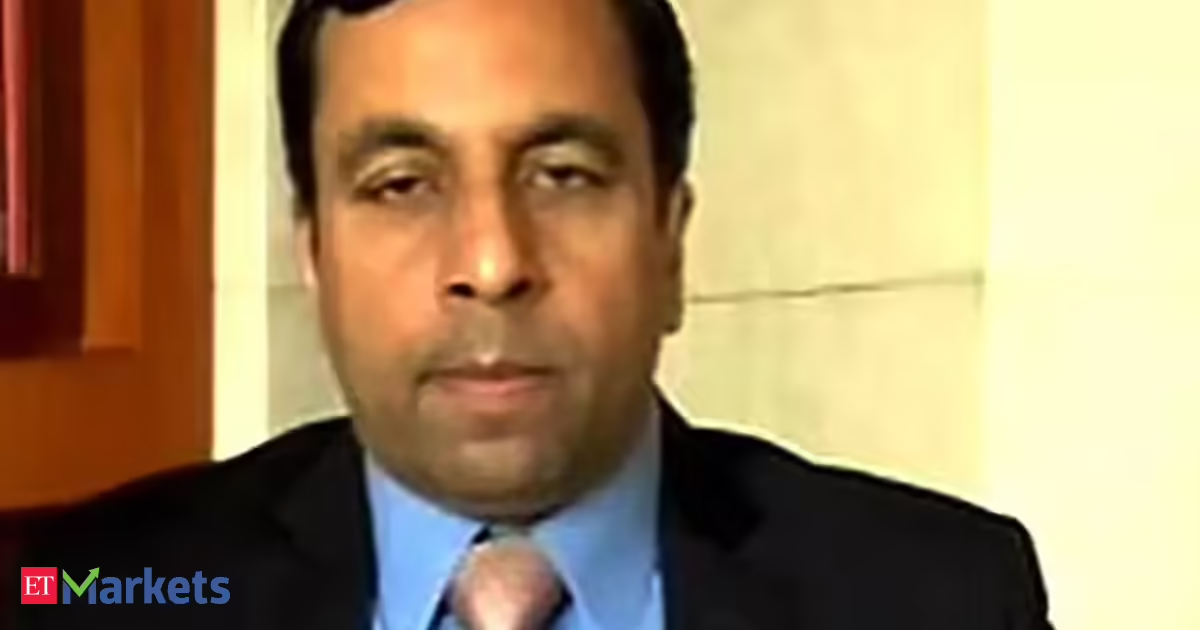
According to him, the American economy continues to perform exceptionally well, with stock markets at record highs, unemployment near historic lows, and some of the world’s largest companies continuing to create enormous wealth. He said that every country would aspire to be in the position that the U.S. currently occupies and stressed that India should focus less on judging global economies and more on addressing its own economic challenges.
Srivastava noted that despite geopolitical tensions, including the ongoing conflict in West Asia, the global economy remains resilient. He pointed out that developed nations have successfully diversified across industries such as semiconductors, technology, and advanced manufacturing, reducing their dependence on any single sector. India, he said, still has significant work to do in building similar capabilities and strengthening its economic competitiveness. He also emphasized the importance of keeping economic discussions separate from political considerations, arguing that a pragmatic approach is essential for long-term growth.
On artificial intelligence, Srivastava maintained that investors cannot afford to ignore the theme despite concerns around lofty valuations. He believes the leading AI companies enjoy strong competitive advantages and are likely to remain important wealth creators over time. While India may not be leading the development of foundational AI technologies, he sees a substantial opportunity for the country as a large-scale adopter and implementer of AI solutions. In his view, Indian businesses across sectors will increasingly rely on AI to improve productivity and efficiency, creating a significant opportunity for domestic companies involved in deployment and integration.
He also challenged the notion that the U.S. market’s strength is entirely dependent on AI-related stocks. While technology companies have undoubtedly been major contributors to market gains, he highlighted that several industrial, consumer, and defence-related businesses have also delivered strong performance. This, he argued, reflects the broader strength of the American economy rather than a narrow AI-driven rally.
Among Indian sectors, Srivastava believes banking stands to gain the most from AI adoption. He expects artificial intelligence to transform operational efficiency, reduce costs, and significantly improve profitability. From branch operations to customer service and call centres, AI has the potential to automate labour-intensive processes and enhance customer experience. As a result, he believes banks that successfully integrate AI into their business models could witness margin expansion that has not been seen in years.
While optimistic about the long-term opportunity, Srivastava remains selective on the banking sector. He reiterated concerns about large traditional lenders, arguing that some of them have struggled to deliver shareholder returns despite their dominant market positions. He also questioned the effectiveness of recent interest rate reductions in improving the sector’s outlook, noting that structural reforms and technological adoption are likely to have a greater impact on profitability than monetary policy alone. According to him, the key differentiator going forward will be how effectively banks leverage technology to reduce costs and improve efficiency.Discussing public-sector banks, Srivastava admitted that their low valuations continue to puzzle him. Although he expects certain private sector banks with strong institutional ownership to outperform, he does not believe investors should dismiss PSU banks outright. At current valuations, he suggested that downside risks appear limited, even if return potential may not be as attractive as some private-sector peers.
On the issue of expected credit loss (ECL) norms, Srivastava downplayed concerns about a significant impact on bank valuations. He believes any implementation is likely to be gradual, allowing banks sufficient time to adapt. More importantly, he argued that investors should focus on broader factors such as interest rates, economic growth, operating efficiency, and competitive dynamics rather than regulatory changes alone.
Perhaps his strongest message was directed at Indian investors’ portfolio allocation strategies. Srivastava pointed out that most Indian investors remain overwhelmingly concentrated in domestic assets and have limited exposure to global opportunities. He criticized restrictions on overseas investments by mutual funds, arguing that these constraints prevented Indian investors from participating meaningfully in the global AI boom. According to him, access to international markets is essential for long-term wealth creation, especially as many of the world’s most innovative companies continue to emerge outside India.
He believes investors should think beyond short-term market movements and focus on building diversified portfolios that include exposure to global growth themes. With new technology leaders and disruptive businesses continuing to emerge around the world, Srivastava argues that limiting investments to a market that represents only a small share of global market capitalization may not be the most effective strategy for future wealth creation. His message is clear: global markets remain strong, AI represents a transformational opportunity, and Indian investors must embrace both technological change and global diversification to fully participate in the next phase of economic growth.
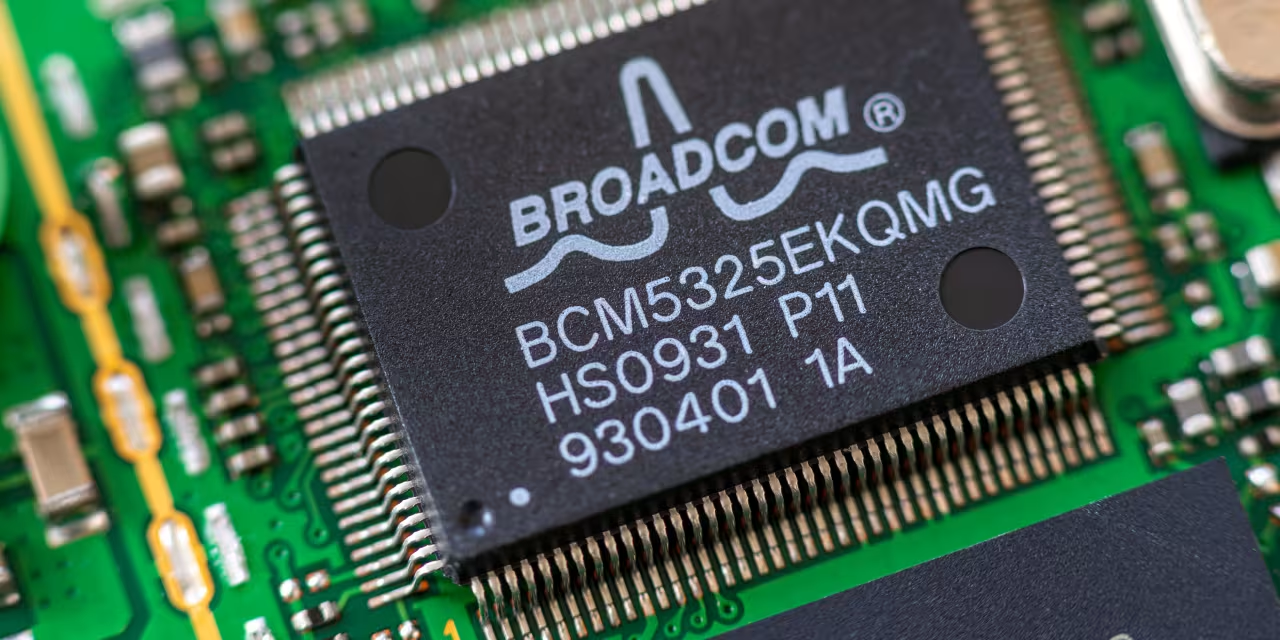
Broadcom Stock Closes at a Record. It’s Getting a Double Boost From Google and Marvell.

Nigel Farage, Rupert Lowe, and Kemi Badenoch squabble over race to the bottom

8 Habits to Practice Daily That Lead to God’s Financial Blessing

Asda to cut 1000 jobs as supermarket makes automation push



-

 Tech6 days ago
Waymo dominates autonomous vehicle registrations as Tesla trails behind
-

 News Videos6 days ago
This is BROKEN! INSANE 5x MONEY CAR WASH WEEK! The NEW GTA Online UPDATE Today! (GTA5 New Update)
-
 Tech5 days ago
SpaceX just won a second Golden Dome contract. This one is $4.16 billion.
-

 Business3 days ago
Jade Biosciences, Inc. (JBIO) Discusses Positive Interim Results From JADE101 Phase I Healthy Volunteer Study and Development Plans Transcript
-

 News Videos6 days ago
SHE IS KILLING XRP!!! WATCH URGENT AND ACT FAST
-
 NewsBeat5 days ago
FIRST NIGHT REVIEW: Take That bring the Circus back to life in spectacular sun-soaked style
-

 Business5 days ago
Is the Spurs Phenom Already Better Than Prime Diesel?
-
 Crypto World6 days ago
CFTC Has Approved the First Regulated Bitcoin Perpetual Contract in the U.S.
-

 Politics5 days ago
The House | Inside Andy Burnham’s Makerfield Campaign: “Nobody Thinks This Is In The Bag”
-

 Sports1 day ago
French Open 2026 results: Alexander Zverev beats Rafael Jodar and will play Jakub Mensik in semi-finals
-
 NewsBeat6 days ago
Novak Djokovic v Joao Fonseca LIVE: French Open latest scores and results after Jannik Sinner’s shocking collapse
-
 Entertainment5 days ago
Weak ‘Supergirl’ Box Office Tracking Amid Milly Alcock Backlash
-
 Crypto World6 days ago
Snowflake (SNOW) Stock Rallies on Strong Q1 Results and AI Product Growth
-

 Entertainment6 days ago
Maddox Jolie-Pitt Legally Requests to Drop Brad’s Surname
-

 Tech2 days ago
CryZENx Releases Fresh Playable Content Deep Inside Jabu-Jabu for His Ocarina of Time Remake
-

 Business5 days ago
Demand Conditions Improve In Chemicals Sector In April 2026
-
 Entertainment5 days ago
One of the Greatest Sitcoms of All Time Shoots Up Apple TV’s Charts 11 Years Later
-

 Crypto World6 days ago
MicroStrategy Moves $30 Million in BTC to Coinbase Prime: Is the Bitcoin Sell-Off Already Here?
-

 Tech6 days ago
This Week In Security: Ubiquiti Fixes, And FreeBSD Joins The Club You Don’t Want To Join
-
 Entertainment6 days ago
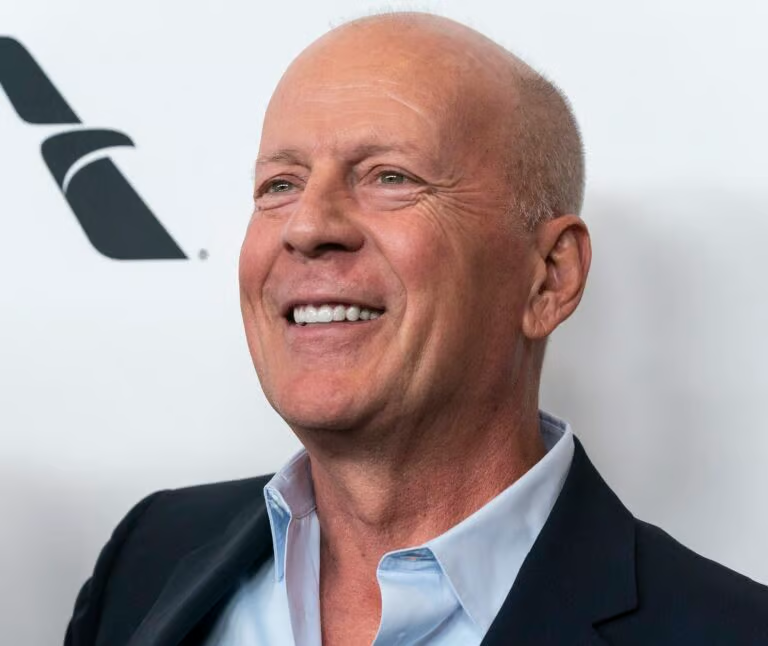
Bruce Willis’ Generosity Resurfaces Amid His Dementia
You must be logged in to post a comment Login