Connect with us
DAPA Banner
DAPA Coin
DAPA
COIN PAYMENT ASSET
PRIVACY · BLOCKDAG · HOMOMORPHIC ENCRYPTION · RUST
ElGamal Encrypted MINE DAPA
🚫 GENESIS SOLD OUT
DAPAPAY COMING

Business

Samsung’s New Portable Freestyle+ AI Projector Launches in the US for $1,200 With Smart Setup Features

Published

on

Samsung's New Portable Freestyle+ AI Projector Launches in the US

Samsung has launched its Freestyle+ projector in the United States, a compact portable device priced at $1,199.99 that leans heavily on artificial intelligence to eliminate much of the setup hassle traditionally associated with portable projectors, including manually correcting distorted images on uneven walls or surfaces.

The Freestyle+ is now available directly through Samsung’s website and select retail partners, positioning it as a premium upgrade to the company’s existing second-generation Freestyle projector, which remains available for roughly $800 through Samsung and for $798 on Amazon. The roughly $400 price premium reflects the addition of a suite of new AI-driven features Samsung first demonstrated at CES 2026 earlier this year.

The centerpiece of the new model is a feature called 3D Auto Keystone, an upgraded version of the standard keystone correction found on many projectors. According to Samsung, the technology can instantly calculate depth and perspective, allowing the device to flatten and correct image distortion even when projecting onto irregular surfaces such as room corners, wrinkled curtains, angled walls or ceilings, without requiring users to manually adjust the projection through dials or menus. That capability extends the projector’s usefulness beyond a traditional flat wall or screen, enabling users to project onto surfaces such as tent walls while camping or outdoor spaces where a flat white backdrop isn’t available.

Working alongside 3D Auto Keystone is a companion feature Samsung calls Wall Calibration, which uses sensors to detect the color and pattern of whatever surface the projector is aimed at, then automatically adjusts the projected image’s color and brightness to compensate. Samsung says the feature is designed to ensure clear viewing even when projecting onto patterned wallpaper or colored walls, conditions that would otherwise significantly distort the accuracy of colors in the projected content. The company has also added two additional automated features, called Screen Fit and Obstacle Avoidance, which allow the projector to automatically resize its image to match a defined space on a wall and reposition the projection if it detects an object blocking part of the viewing area. An ultrasonic motor built into the device continuously maintains focus in real time as the projector is moved or as its distance from the viewing surface changes.

Advertisement

On the hardware side, the Freestyle+ offers a Full HD 1080p resolution with brightness rated at up to 430 ISO lumens, nearly double the brightness of the second-generation Freestyle, a change Samsung has described as a direct response to feedback and reviews of its earlier portable projector models. The device supports PurColor and HDR10+ for improved color accuracy and contrast, and can project images up to 100 inches diagonally. Audio comes from a built-in 360-degree speaker system featuring dual passive woofers, and the projector supports Samsung’s Q-Symphony technology, allowing it to sync audio output with compatible Samsung soundbars and WiFi speakers for a more immersive sound experience.

The Freestyle+ also builds in a range of smart software features on top of its projection hardware. The device runs Samsung’s Smart Hub interface, giving users access to built-in streaming apps, cloud gaming through Samsung’s Gaming Hub, and content from Samsung TV Plus, the company’s free ad-supported streaming service. Content can also be projected directly from Galaxy smartphones and tablets, or from Apple devices via AirPlay, giving the device broad compatibility regardless of which smartphone ecosystem a user relies on. Samsung has additionally integrated a Vision AI Companion feature into the projector, allowing users to interact with both Google’s Gemini and Samsung’s own Bixby voice assistant directly through the device.

Portability remains a core focus of the Freestyle+’s design, continuing the emphasis on flexible, on-the-go use that has defined the broader Freestyle lineup since its debut. While the projector still requires a power connection during normal use, it supports external USB-C battery packs, along with Samsung’s own optional Battery Base accessory, making it usable in outdoor settings such as campsites or other locations without convenient access to a wall outlet.

Industry reviewers have offered a mixed but generally positive assessment of the new model, with much of the conversation centering on whether the added AI-driven setup features justify the substantial price increase over the standard second-generation Freestyle. One review from Gadget Review framed the Freestyle+’s value proposition around a single bet: that AI-powered surface intelligence can permanently eliminate the setup friction that has historically made portable projectors frustrating to use in imperfect spaces such as rental apartments or hotel rooms. The same review noted that despite the improved brightness and correction features, the Freestyle+ remains a 1080p device in a market where some competing portable projectors now offer 4K resolution, and cautioned that its 430-lumen brightness rating, while a significant improvement over its predecessor, still performs best in darker viewing environments and can wash out under strong ambient light.

Advertisement

The Freestyle+ enters a competitive and increasingly crowded portable projector market. Rival manufacturer Xgimi has continued expanding its own Elfin projector lineup, including a new Elfin Flip Laser model priced at $799 that offers a substantially brighter 1,600 ISO lumens using a triple laser light source, a notably higher brightness figure than Samsung’s new flagship portable model despite its lower price point.

Samsung’s launch of the Freestyle+ comes as the company continues expanding its broader ecosystem of AI-integrated home entertainment products, following earlier debuts of the technology showcased at CES 2026. For consumers weighing whether the added convenience of automated surface correction and calibration justifies the roughly $400 premium over the standard Freestyle model, the calculation is likely to come down to how often they expect to project onto imperfect or constantly changing surfaces, such as rental walls, outdoor spaces or oddly shaped rooms, versus a single, consistent flat viewing area where the second-generation Freestyle’s simpler and less expensive feature set may prove entirely sufficient.

Continue Reading
Click to comment

You must be logged in to post a comment Login

Leave a Reply

Business

Minecraft Down Now? Users Report Nationwide Outage Saturday Morning as Downdetector Complaints Begin to Climb

Published

on

'Minecraft' was first developed by one person, Markus 'Notch' Persson

Players of Minecraft, one of the world’s most popular video games, began reporting widespread access problems Saturday morning, according to outage-tracking service Downdetector, which recorded a spike in user complaints beginning at 10:48 a.m. Eastern time.

Downdetector, which aggregates real-time reports from users to identify potential service disruptions across websites, apps and games, flagged the surge in a post on its social media account, prompting the hashtag #MinecraftDown to circulate among affected players. As of Saturday afternoon, neither Mojang Studios, the game’s developer, nor its parent company, Microsoft, had issued a public statement addressing the reported disruption.

Minecraft’s core online services are managed through a combination of Mojang and Microsoft account systems, which handle player authentication, marketplace access, multiplayer server connections and the Realms subscription service that allows players to host private, always-online worlds for themselves and friends. Because these systems are interconnected, disruptions affecting authentication or login servers can cascade into broader problems across multiple parts of the game, even when a player’s local, offline single-player experience remains unaffected.

Saturday’s reported outage adds to a pattern of periodic service disruptions that have affected Minecraft over the past year, with player complaints on outage-tracking platforms ranging from login failures and marketplace slowdowns to more significant server-side authentication problems. According to data from outage-monitoring service StatusGator, Minecraft has received dozens of user-submitted outage reports within individual 24-hour windows on multiple occasions in recent months, even during stretches when the game’s official status remained listed as fully operational, reflecting how difficult it can be for automated monitoring systems to catch every localized or intermittent disruption affecting a portion of the game’s global player base.

Advertisement

Some of Minecraft’s most disruptive outages in recent memory have specifically affected Realms, the game’s subscription-based multiplayer hosting service. In one previous incident, hundreds of players reported being unable to access their Realms servers after an outage began affecting login functionality, with many users encountering error messages when attempting to open the Realms tab within the game. That disruption, tracked heavily on Downdetector at the time, left affected players unable to reach their own privately hosted worlds even though other parts of the game continued functioning normally for many users.

Frustration among the Minecraft player community over the pace and clarity of official communication during past outages has also been a recurring theme on social media. Users posting on X during previous disruptions have criticized Mojang’s support account for slow or unclear updates during extended outages, with one user asking pointedly during a past incident whether it should take more than a day for the company to acknowledge that Realms was experiencing problems, and questioning whether future disruptions would be handled with similarly limited communication.

Common symptoms reported during past Minecraft outages have included failure to log in through the game’s launcher, error messages indicating the game “couldn’t connect to the Minecraft services,” extremely slow loading times when attempting to join servers or access the in-game marketplace, and, in some cases, players being forced into offline mode despite having a stable internet connection. Third-party launchers and modified clients that rely on Minecraft’s official authentication servers, such as the popular Prism Launcher, have also been affected during past outages, with some users reporting authentication failures even when attempting to verify server connectivity directly.

Minecraft remains one of the best-selling and most actively played video games in the world, with a global player base spanning both casual single-player users and large, persistent multiplayer communities hosted through Realms, third-party server hosting services, and Microsoft’s broader Xbox and PC gaming ecosystems. Given that scale, even relatively brief or partial outages affecting login or authentication systems can generate a large volume of user reports in a short period of time, as appeared to be the case with Saturday morning’s spike in Downdetector complaints.

Advertisement

As of Saturday afternoon, it remained unclear how widespread the reported outage was, which specific services or regions were most affected, or how long the disruption might persist before service is fully restored. Given the pattern established by previous Minecraft outages, affected players may see functionality return gradually as different systems, such as authentication, marketplace access and multiplayer server connections, come back online at different times rather than all at once.

Players experiencing issues were advised to check both the official Mojang Support account on X and third-party monitoring tools such as Downdetector for updates, since the game’s own status indicators have not always reflected ongoing incidents in real time during past disruptions. In the meantime, players affected by connectivity issues were encouraged to try standard troubleshooting steps, including restarting the game launcher, verifying account credentials, and checking for any pending software updates that might be contributing to login or connectivity problems on their end before assuming a broader service-wide outage is responsible.

Minecraft’s ownership under Microsoft, which acquired the game and its developer Mojang in 2014, means the title’s backend infrastructure is at least partly tied to broader Microsoft cloud and authentication services, a connection that has occasionally meant disruptions affecting other Microsoft products, such as Xbox Live or Microsoft account services more broadly, have coincided with reported Minecraft issues in the past, even when the underlying cause originates outside the game’s own dedicated infrastructure.

For now, the scope and cause of Saturday’s reported disruption remain unconfirmed, with affected players continuing to share their experiences on social media as they wait for either the outage to resolve on its own or for an official acknowledgment from Mojang or Microsoft regarding what, if anything, is affecting the game’s services. Given the frequency of similar incidents over the past year, some players expressed hope on social media that any official response would come more quickly than during past outages, when communication from the game’s support channels was sometimes criticized as slow or unclear relative to the scale of the disruption being experienced by the community.

Advertisement
Continue Reading

Business

ICICI Bank Limited (IBN) Q1 2027 Earnings Call Transcript

Published

on

OneWater Marine Inc. (ONEW) Q1 2026 Earnings Call Transcript

Operator

Ladies and gentlemen, good day, and welcome to ICICI Bank Limited Q1 FY ’27 Earnings Conference Call.

[Operator Instructions]

Please note that this conference is being recorded. I now hand the conference over to Mr. Sandeep Bakhshi, Managing Director and Chief Executive Officer of ICICI Bank. Thank you, and over to you, sir.

Advertisement

Sandeep Bakhshi
MD, CEO & Executive Director

Thank you. Good evening to all of you, and welcome to the ICICI Bank earnings call to discuss the results for Q1 of financial year ’27. Joining us today on this call are Sandeep Batra, Rakesh, Ajay, Anindya and [ Abhinek ]. At ICICI Bank, our strategic focus continues to be on growing profit before tax, excluding treasury through the 360-degree customer-centric approach and by serving opportunities across ecosystems and micro markets.

The profit before tax, excluding treasury, grew by 20.9% year-on-year to INR 189.75 billion in this quarter. The core operating profit increased by 15.6% year-on-year to INR 202.35 billion in this quarter. The core operating profit, excluding dividend from subsidiaries increased by 18.3% year-on-year to INR 191.25 billion in this quarter. The profit after tax grew by 15.9% year-on-year to INR 148.05 billion in this quarter.

Advertisement

Total deposits grew by 14% year-on-year and 2.2% sequentially at June 30, ’26. Average deposits grew by 14% year-on-year and 6.1% sequentially and average current and savings account deposits grew by 12.1% year-on-year and 4.7% sequentially during this quarter. The bank’s average liquidity coverage ratio, LCR

Continue Reading

Business

Has Europe quietly taken the lead in the earnings race? Barclays weighs in

Published

on


Has Europe quietly taken the lead in the earnings race? Barclays weighs in

Continue Reading

Business

Earnings call transcript: Reliance Industries posts strong Q1 2026 results

Published

on


Earnings call transcript: Reliance Industries posts strong Q1 2026 results

Continue Reading

Business

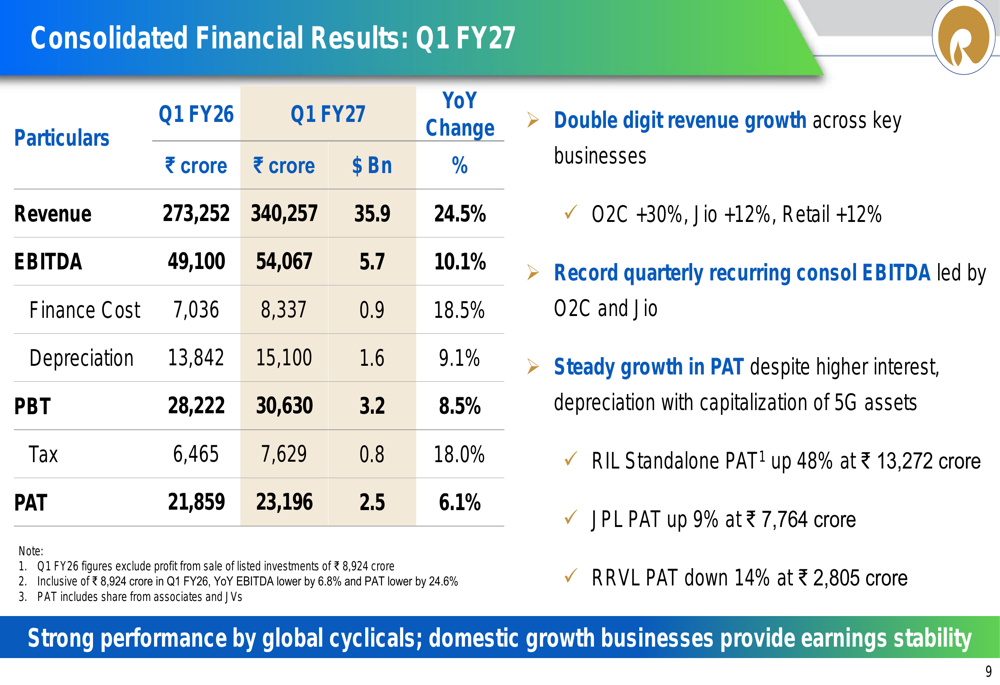
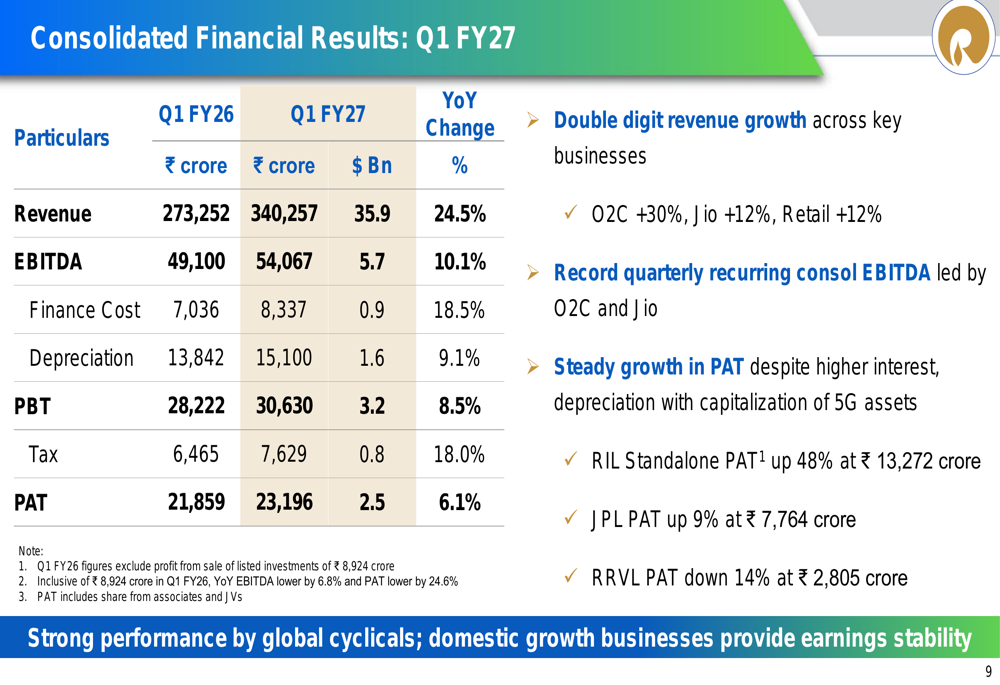
Reliance Q1 FY27 slides: record EBITDA amid energy volatility

Published

on

Reliance Q1 FY27 slides: record EBITDA amid energy volatility


Reliance Q1 FY27 slides: record EBITDA amid energy volatility

Continue Reading

Business

CDC Now Officially Confirms Cyclospora Outbreak Linked to Taco Bell Lettuce From Mexico in Five States

Published

on

Taco Bell

Federal health officials confirmed Thursday that shredded iceberg lettuce served at Taco Bell restaurants in five U.S. states is the source of a widespread outbreak of cyclosporiasis, a parasitic intestinal illness that has now sickened thousands of people across more than 30 states since the outbreak was first identified in early May.

The Centers for Disease Control and Prevention issued a warning late Thursday advising consumers not to eat shredded iceberg lettuce from Taco Bell locations in Indiana, Kentucky, Michigan, Ohio and West Virginia. According to the CDC’s most recent tally, the outbreak has sickened at least 1,644 people across 34 states, including at least 94 hospitalizations, though officials cautioned that federal numbers lag behind what individual state health departments have reported. Michigan alone reported more than 5,000 confirmed cases as of Friday, including 102 hospitalizations, according to the state’s Department of Health and Human Services, a figure far exceeding the CDC’s national count and underscoring how significantly reporting delays have affected the visibility of the outbreak’s true scale.

A Food and Drug Administration trace-back investigation identified a single supplier behind the contaminated lettuce. While the federal government’s initial public warnings did not name the company, Taylor Fresh Foods, based in Salinas, California, confirmed that FDA testing had traced the contamination to a specific independent farm affiliated with the company in central Mexico. In a statement posted to social media on July 17, Taylor Farms de Mexico said it was voluntarily removing all iceberg lettuce sourced from central Mexico and had informed the FDA that it would initiate a formal recall. The company emphasized that none of its branded salads or salad kits sold in grocery stores nationwide are connected to the outbreak, noting that those retail products do not contain iceberg lettuce in the first place.

Taco Bell confirmed Friday that it had completed the removal of the affected product from its restaurants nationwide. “As of July 17, Taco Bell has completed removal of affected Taylor Farms lettuce from our restaurants,” the company said in a statement. “Based on ongoing conversations with public health officials, and out of an abundance of caution, Taco Bell worked swiftly to voluntarily remove the product from restaurants and the affected ingredient has been removed from our supply chain nationwide. We took this action to ensure our guests can enjoy their Taco Bell favorites safely. We believe public health is a shared responsibility among restaurants, their suppliers, and authorities, and we are proud to have consistently acted quickly and proactively to protect our guests.”

Advertisement

The CDC has said it is also investigating additional cyclosporiasis illnesses and outbreak clusters nationally that are unrelated to the Taco Bell lettuce findings, meaning not every reported case tied to the broader national surge in cyclospora infections is necessarily connected to this specific source.

Cyclosporiasis is caused by Cyclospora cayetanensis, a microscopic parasite transmitted through contaminated food or water. According to the CDC, symptoms typically begin about one week after exposure, though onset can range anywhere from as soon as two days to as long as two weeks or more after consuming contaminated food. Common symptoms include watery diarrhea, loss of appetite and weight loss, with the illness sometimes persisting for weeks if left untreated. Officials noted the infection is treatable with antibiotics once properly diagnosed, though there is no routine testing for cyclospora, meaning healthcare providers typically only test for it when an outbreak has already raised awareness among clinicians. No deaths have been reported in connection with the current outbreak.

Health officials have emphasized that thorough washing alone cannot reliably remove Cyclospora from produce, since the parasite is resistant to typical rinsing methods. The CDC recommends cooking produce to an internal temperature of at least 158 degrees Fahrenheit, or 70 degrees Celsius, as the most reliable method for killing the parasite when contamination is a concern.

The outbreak has had measurable financial consequences for companies connected to the fresh produce and fast-food supply chain. Shares of Yum Brands, Taco Bell’s parent company, fell nearly 7% over the five trading days following the outbreak’s public disclosure. Other companies that sell fresh lettuce also saw their stock prices affected by the broader health scare, even without direct ties to the confirmed outbreak source. Salad chain Sweetgreen saw its shares plunge nearly 13% over the course of the week, while fast-casual chain Cava fell more than 3%. Both companies saw a partial rebound Friday, with Sweetgreen shares rising more than 17% and Cava climbing about 2%, a reaction analysts attributed to apparent relief among investors once the CDC’s investigation confirmed that neither company’s ingredients were identified as a source of the outbreak. Analysts have generally said any near-term sales or stock price impact facing Taco Bell and similarly affected companies is likely to be limited in scope and duration, particularly once headlines about the outbreak begin to fade.

Advertisement

This is not the first time Taylor Farms has been connected to a significant foodborne illness investigation involving a major fast-food chain. Last year, an E. coli outbreak was traced to onions supplied to several restaurants from a Taylor Farms facility in Colorado, a situation that briefly forced McDonald’s to stop using onions on its Quarter Pounder sandwiches at some locations while the investigation unfolded. On its website, Taylor Farms describes itself as the leading global producer of salads and healthy fresh foods, operating production facilities across the United States, Canada, Mexico and Western Europe, and industry analysts have noted that a small number of large, vertically integrated companies like Taylor Farms dominate the U.S. bagged lettuce and salad supply chain, meaning contamination at a single facility or farm can quickly ripple across numerous restaurant chains and retail products nationwide.

The FDA said it continues working with Taylor Farms to determine whether lettuce from the implicated Mexican farm was distributed to any additional locations or retailers beyond the five states currently named in the CDC’s consumer warning. Federal and state health officials said the investigation remains active, and additional updates are expected as testing and case reporting continue in the coming weeks. Consumers who believe they may have symptoms consistent with cyclosporiasis are encouraged to consult a healthcare provider and report their illness to their local health department to assist ongoing surveillance efforts tied to the outbreak.

Continue Reading

Business

Fifth Third Bancorp: Wait For A Cooldown To Buy Stock (NYSE:FITB)

Published

on

Fifth Third Bancorp: Digesting The Comerica Acquisition (NASDAQ:FITB)

This article was written by

The Investment Doctor is a financial writer, highlighting European small-caps with a 5-7 year investment horizon. He strongly believes a portfolio should consist of a mixture of dividend and growth stocks.
He is the leader of the investment group European Small Cap Ideas which offers exclusive access to actionable research on appealing Europe-focused investment opportunities not found elsewhere. The a focus is on high-quality ideas in the small-cap space, with emphasis on capital gains and dividend income for continuous cash flow. Features include: two model portfolios – the European Small Cap Ideas portfolio and the European REIT Portfolio, weekly updates, educational content to learn more about the European investing opportunities, and an active chat room to discuss the latest developments of the portfolio holdings. Learn more.

Analyst’s Disclosure: I/we have no stock, option or similar derivative position in any of the companies mentioned, and no plans to initiate any such positions within the next 72 hours. I wrote this article myself, and it expresses my own opinions. I am not receiving compensation for it (other than from Seeking Alpha). I have no business relationship with any company whose stock is mentioned in this article.

Seeking Alpha’s Disclosure: Past performance is no guarantee of future results. No recommendation or advice is being given as to whether any investment is suitable for a particular investor. Any views or opinions expressed above may not reflect those of Seeking Alpha as a whole. Seeking Alpha is not a licensed securities dealer, broker or US investment adviser or investment bank. Our analysts are third party authors that include both professional investors and individual investors who may not be licensed or certified by any institute or regulatory body.

Advertisement
Continue Reading

Business

Chinese Startup Moonshot AI Releases Kimi K3, World’s Largest Open-Source Model, Rattling Global Markets

Published

on

Chinese Startup Moonshot AI Releases Kimi K3, World's Largest Open-Source

Beijing-based artificial intelligence startup Moonshot AI released Kimi K3 this week, unveiling what the company describes as the largest open-source AI model ever made publicly available, with benchmark performance the company says rivals some of the most advanced systems built by American labs including Anthropic and OpenAI.

The model, released Thursday, contains 2.8 trillion total parameters, making it roughly 75% larger than DeepSeek’s V4 Pro, previously one of the largest Chinese open-weight models at approximately 1.6 trillion parameters, and far outpacing Zhipu AI’s GLM 5 series at 744 billion parameters. Kimi K3 is also roughly 2.8 times the size of Moonshot’s previous flagship model, K2.6, released in April. Full model weights are scheduled to be released publicly on July 27, timed to coincide with the 2026 World Artificial Intelligence Conference currently underway in Shanghai.

According to Moonshot, K3 performed “competitively” against Anthropic’s Fable 5, currently among the most capable publicly available AI models, and “substantially outperformed” Anthropic’s Opus 4.8 as well as OpenAI’s GPT 5.6 Sol and GPT 5.5 on the company’s officially released benchmarks, where K3 consistently ranked among the top three models tested. One independent benchmark from Arena.AI reportedly ranked K3 as the best-performing model currently available, ahead of offerings from both Anthropic and OpenAI, though Moonshot’s own reporting placed K3 slightly behind Fable 5 on overall performance.

In a press release announcing the model, Moonshot described K3 as its most powerful open-source coding model to date. “K3 stands as Moonshot AI’s most powerful open-source coding model to date,” the company wrote, adding that the model can “sustain long engineering sessions, navigate massive repositories, and orchestrate terminal tools” while “operating with minimal human oversight.”

Advertisement

The model introduces two architectural innovations developed internally at Moonshot: Kimi Delta Attention, a hybrid linear attention mechanism designed to reduce memory usage and improve processing speed, and Attention Residuals, which the company describes as a drop-in replacement for traditional residual connections that delivers more consistent performance gains as models scale in size. Both techniques had previously been published as open research by Moonshot’s team on GitHub. K3 also supports a 1-million-token context window, positioning it for long-horizon coding tasks and autonomous agent workloads, along with native visual understanding capabilities and an always-on reasoning mode the company calls “thinking mode.” Moonshot said the model uses 21% fewer output tokens than its predecessor on equivalent tasks, and the model’s API is compatible with the OpenAI SDK, lowering the technical barrier for developers already building on OpenAI or Anthropic’s existing toolchains.

Pricing for K3’s API access is set at $3 per million input tokens and $15 per million output tokens, the highest pricing structure of any major Chinese AI lab, though still roughly half the per-task cost of Anthropic’s Opus 4.8 and dramatically cheaper than Fable 5, which reportedly costs $50 for an equivalent volume of output tokens. Independent testers have noted that K3’s reasoning mode consumes a substantial number of tokens even on relatively simple tasks, with one test generating 13,241 reasoning tokens for a basic SVG image-generation request, costing roughly 25 cents per query.

Moonshot’s Kimi chatbot has become one of the most widely used consumer AI products in China, and the company’s annualized recurring revenue exceeded $200 million as of April, driven by a combination of paid subscriptions and API usage. The company’s investor base includes several major names in Chinese technology, including Alibaba, Tencent, Meituan, HongShan (formerly known as Sequoia China), ZhenFund and 5Y Capital, with total funding raised across four rounds standing at approximately $3.77 billion. Bloomberg reported in June that Moonshot was seeking a new funding round valuing the company at roughly $30 billion, an almost eightfold increase from its $4 billion valuation in late 2024.

Beyond its use inside China, Moonshot’s models have already gained traction among Silicon Valley developers. Cursor, the AI-assisted coding startup, has used earlier versions of Kimi to help power its Composer 2 coding agent. DoorDash chief technology officer Andy Fang said in an early July social media post that the company delegates “lower-level work to Kimi K2.6.” Thinking Machines also used Kimi K2.5 to help generate early post-training data for its Inkling model, released July 15.

Advertisement

The release of K3 coincided with, and appeared to intensify, a broader selloff already underway in global chip and technology stocks. Taiwan Semiconductor Manufacturing Company shares fell 7% Friday despite the company reporting a 77% jump in quarterly operating profit, while SoftBank, often viewed by investors as a proxy for OpenAI given its investment stake, fell 9%. Z.ai, a Chinese AI startup that has released a competing model to Kimi, plunged nearly 30% in Hong Kong trading. In the U.S., the Nasdaq 100 fell roughly 1% as of 2 p.m. Eastern time Friday, Nvidia shares dropped 1.2%, briefly ceding its position as the world’s most valuable company to Apple, and Meta shares fell more than 2.4%.

Technology analyst Patrick Moorhead pushed back on characterizing the market reaction as strictly performance-driven, attributing much of the response instead to broader political tensions surrounding Chinese AI development. In an email to CNBC, Moorhead said, “There’s a big debate in Washington DC about whether the U.S. should use Chinese open source models and if U.S. companies should enable the Chinese to use their models,” adding, “The latter is ironic as the Chinese seem to be doing fine with their models.”

K3’s release marks a notable comeback for Moonshot, whose market position had eroded significantly over the prior 18 months following the meteoric rise of rival Chinese lab DeepSeek, whose earlier open-source model releases similarly rattled global markets and intensified competitive pressure across the AI industry. With full model weights set to be published July 27 and Moonshot pursuing a substantially higher valuation in ongoing funding talks, the release is expected to keep pressure on both Chinese and American AI labs as the global race to develop increasingly capable, cost-efficient open-weight models continues to accelerate.

Advertisement
Continue Reading

Business

North East private sector stays in growth despite drop in job numbers

Published

on

Business Live

The NatWest Growth Tracker Business Activity Index pegs the region as one of the best performers in the UK

Newcastle upon Tyne skyline on the day of the local elections, May 7, 2026

A view of Newcastle(Image: Simon Greener/Newcastle Chronicle)

A survey that tracks the health of the region’s private sector companies has remained in growth despite a fallback in activity in June.

The NatWest North East Growth Tracker Business Activity Index, which measures month-on-month changes in the region’s manufacturing and service sectors, declined to 50.8 in June, having stood at 53.8 in May. Scores above 50 denote a growing economy.

The North East outperformed the UK as a whole, however, where activity fell in June. Among the 12 monitored UK regions and nations, only London and the South East recorded better trends for activity.

Within the survey, business confidence strengthened in the North East in June, with optimism regarding output over the coming year rising to a three-month high. Cost pressures receded, according to businesses responding to the survey, while the rate of input price inflation eased to its lowest since February.

Advertisement

But there were concerns at job losses, which came at the steepest levels since November last year and were sharper than the UK average.

Malcolm Buchanan, chair of the NatWest North regional board, said: “The North East saw growth momentum falter as the first half of 2026 drew to a close, according to the latest NatWest Growth Tracker. New business placed with private sector firms increased for the seventh month running, but the rate of growth slowed to a fractional pace that was the weakest over this period and contributed to a much slower rise in overall business activity.

“Nonetheless, the region remained one of only three monitored UK areas to record growth in June, alongside London and the South East. This relative resilience helped support confidence among private sector firms, with optimism about the year ahead rising to a three-month high.

“Companies also reported a further easing in cost pressures at the end of the second quarter. The rate of input cost inflation fell to its lowest since February, though it remained high by historical standards. Firms continued to raise their own charges at a marked, albeit softer, pace as they sought to protect margins from elevated cost burdens.

Advertisement

“At the same time, businesses moved to protect cashflow by controlling expenditure elsewhere. Employment fell at the sharpest pace since November last year, underlining the pressure firms continue to face even as demand remains in positive territory.”

The release of the growth tracker has come ahead of some key economic data showing the state of the regional economy. Unemployment and labour market data will be published next Tuesday, including regional data, followed by national inflation data the next day.

Continue Reading

Business

US Rep. Ralph Norman says he will run for Senate in South Carolina following Lindsey Graham’s death

Published

on


US Rep. Ralph Norman says he will run for Senate in South Carolina following Lindsey Graham’s death

Continue Reading

Trending

Copyright © 2025