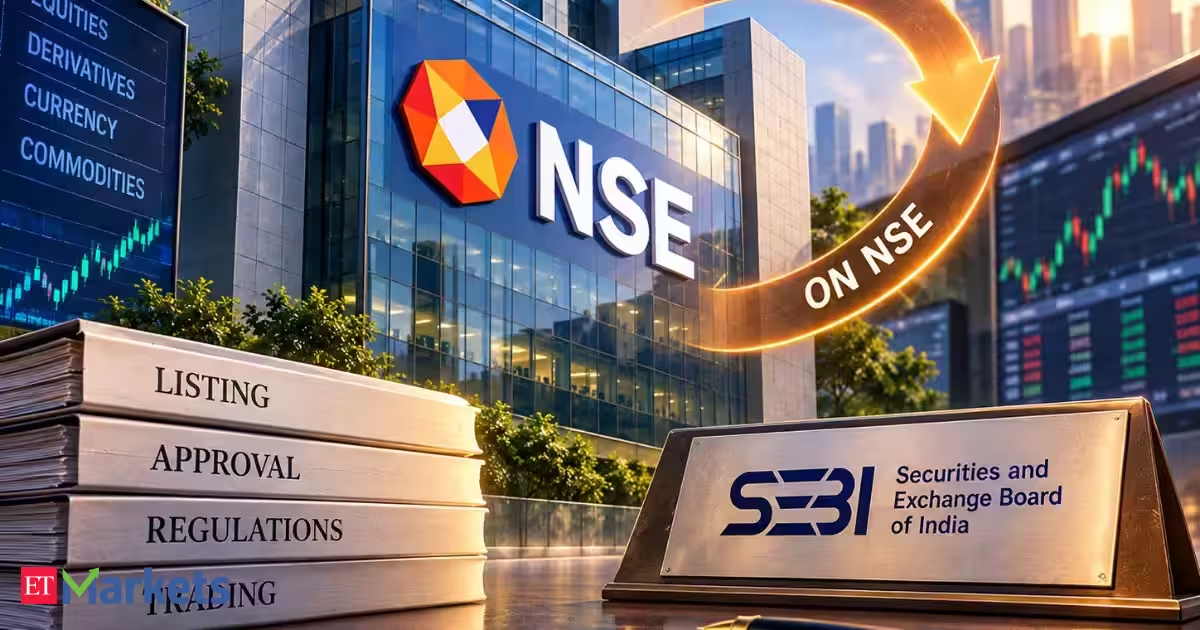
India’s largest stock exchange NSE may eventually seek Sebi’s permission to allow its shares to trade on its own platform after the exchange completes its much-anticipated IPO, though it has not yet approached the regulator.
The proposal would require NSE to explore the “permitted to trade” route, under which securities can trade on an exchange without being formally listed there. The company would continue to remain listed on its primary exchange, with its existing compliance and disclosure obligations unchanged.
NSE is getting listed only on BSE because Sebi rules currently do not allow a recognised stock exchange to list its own securities on its own platform.
Under Regulation 45(1) of the Sebi Stock Exchanges and Clearing Corporations Regulations, 2018, a recognised stock exchange can list its securities only on another recognised stock exchange. That means NSE cannot formally list on NSE after its IPO.
Also Read | NSE IPO jackpot: 10 PSUs could pocket Rs 12,802 crore from stake sale
Ashishkumar Chauhan, managing director and chief executive officer of NSE, told reporters in New Delhi the exchange could consider seeking Sebi’s approval at a later stage.
“We have not applied,” Chauhan said. “However, because we are NSE, if we want to do it, we will have to consult Sebi. We have not done that yet.”“We will consider it later but currently we are not at that stage,” he added.
The permitted-to-trade category could provide NSE’s shares access to a wider investor base through an additional trading platform, while the exchange remains formally listed on BSE.
Explaining why NSE cannot list directly on its own platform, Chauhan said the restriction was designed to prevent an exchange from regulating itself.
“There is a regulation that was created around 2016, when the first exchange (BSE) was allowed to list. The issue was that an exchange could not regulate itself. Therefore, it had to agree to be regulated by another exchange,” he said.
“That is why BSE listed on NSE, and NSE will list on BSE.”
Also Read | 70% NSE revenue under Sebi shadow: Is F&O risk a key overhang for IPO investors?
NSE is preparing for one of India’s most-awaited IPOs and has set a price band of Rs 1,700 to Rs 1,785 per share. The upper end is below the Rs 2,000-Rs 2,100 range that many investors had expected earlier and values the exchange at about Rs 4.4 lakh crore.
The lower pricing has also exposed the reluctance of existing shareholders to sell their stakes, according to Chauhan.
NSE initially proposed selling around 6.2% of its equity, but reduced the offer to 5.11% after shareholders resisted selling at the indicated price.
“When we asked shareholders to sell this time, they said the proposed price was too low,” Chauhan said. “They will sell only when they need the money. Otherwise, they will wait for a more competitive price. They believe the current pricing is below their expectations.”
He said the exchange had to repeatedly request shareholders to proceed with the sale because failing to meet the minimum offer requirement could have jeopardised the IPO.
“If we did not have the minimum number of shares, the IPO would not have happened,” Chauhan said, adding that just because somebody bought the shares 33 years ago at a certain price does not mean that price remains relevant in their books today. “Once the shares list, their value will be reflected in their net worth.”
Demand for the IPO has so far been stronger than expected, Chauhan said. The anchor book, earlier expected to be around Rs 9,000 crore, is now estimated at approximately Rs 6,000-6,500 crore, but demand remains substantially higher than the shares available for allocation.
“The demand is unexpectedly large,” he said. “A large number of investors want to acquire a large number of shares. But we have only a limited number of shares to distribute.”
The allocation framework reserves portions of the issue for different categories of investors, including local mutual funds, other domestic institutions such as pension funds, and foreign portfolio investors.
Chauhan said the exchange was comfortable with whichever framework Sebi ultimately adopts on market structure and trading arrangements.
“As far as Sebi decides, we are okay with that,” he said. “Our job is to work with Sebi and ensure that its views are properly incorporated into our operating activities.”
NSE already has more than 2 lakh shareholders and will have 100% free float after listing, Chauhan said. He added that after the first lock-in period ends, the company could attract stronger demand when it becomes eligible for inclusion in domestic and international indexes.
“Once the company starts going into various international and local indexes, the demands will be much larger,” he said.
Disclaimer: The views/recommendations mentioned in this article, wherever applicable, are those of the respective SEBI-registered Research Analyst/brokerage and have been reproduced/reported with due attribution. They should not be construed as the views or recommendations of The Economic Times Digital or the journalist. Readers are advised to consider the original research report and make their investment decisions based on their own assessment. Brokerage disclaimershere


















































You must be logged in to post a comment Login