
Business
Sebi proposes to bring all bullion trades under vault management rules


Here are the details:
The Securities and Exchange Board of India has proposed expanding its gold-backed Electronic Gold Receipts (EGR) framework to cover all physical bullion underlying SEBI-regulated products, including bullion exchange-traded funds and derivatives, according to a consultation paper.
Vault managers store physical gold that backs electronic gold receipts, which investors can trade on exchanges.
India is one of the world’s largest consumers of gold, and the electronic gold market has expanded in recent years as more investors seek alternatives to holding physical bullion.

The consultation paper also proposed a circular outlining the framework for EGRs, along with operational guidelines for vaulting services across all SEBI-specified bullion-related instruments.
SEBI has invited public comments on the consultation paper until September 1.


Earnings call transcript: Quantinuum lifts 2026 outlook as loss weighs on shares
Business
The 10 Best-Selling McDonald’s Menu Items Of All Time, Ranked From Fries To The Iconic Big Mac
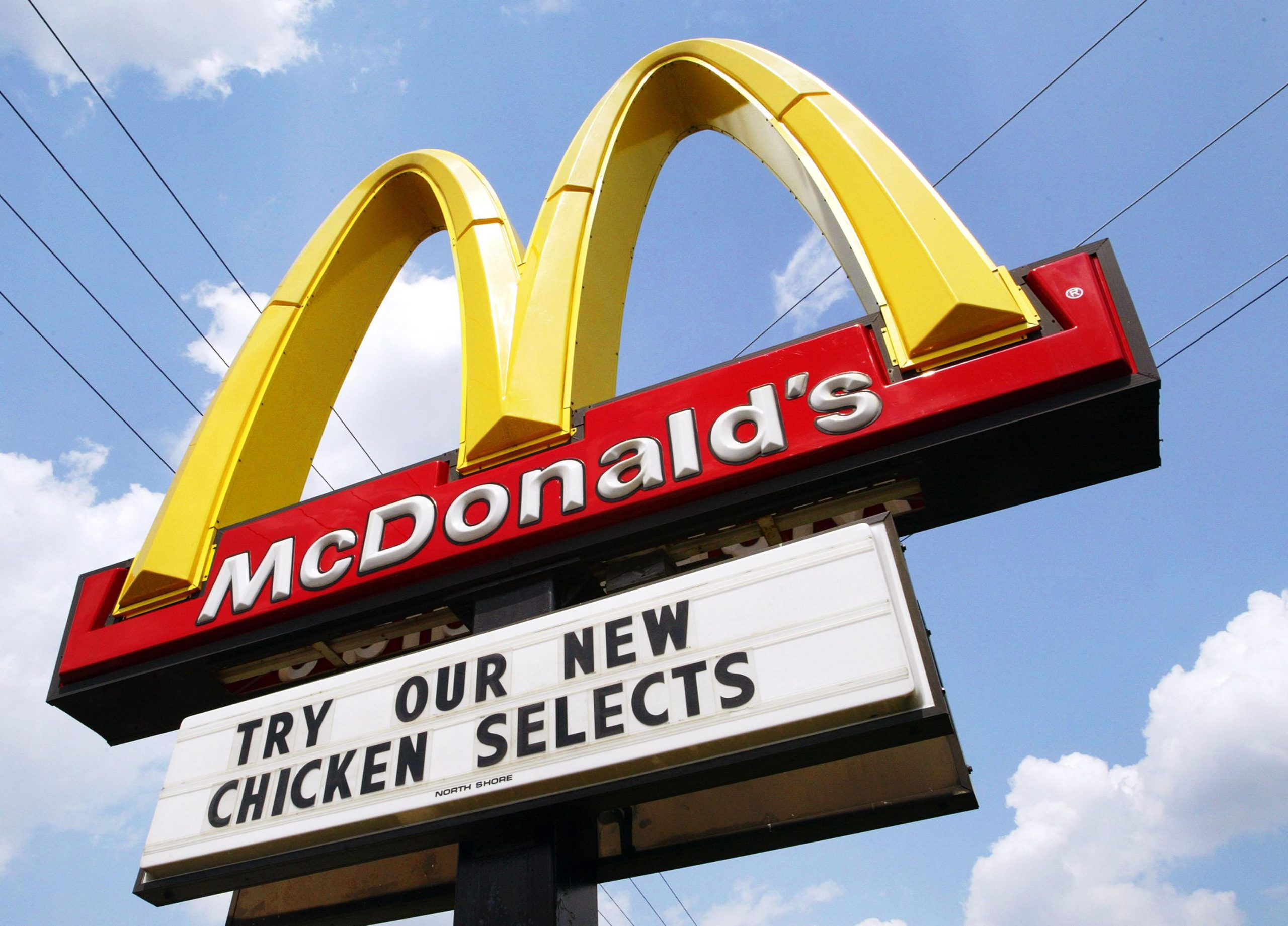
McDonald’s has served billions of customers across nearly seven decades, and while the company does not publicly disclose exact, item-by-item sales figures, a consistent picture has emerged across industry analyses, franchise data and food writers who have studied the chain’s menu over the years: a handful of items account for the overwhelming majority of what customers order.
According to a composite of rankings compiled by food and business publications, French fries sit at the top of that list as McDonald’s single best-selling item of all time. The fries are made from a small number of specific potato varieties, including Russet Burbank, Ranger Russet, Umatilla Russet and Shepody potatoes, and are widely credited with a combination of salt, fat and starch that keeps customers coming back. Reporting has pegged the profit margin on fries at somewhere between 75% and 90%, making them not just the most popular item on the menu but also one of the most profitable, and surveys of McDonald’s Rewards data have found fries rank as the top seller in all 50 U.S. states.
Just behind fries sits the Big Mac, the double-patty burger that has become nearly synonymous with the McDonald’s brand itself since its national rollout in 1968. Built around a sesame-seed bun, two beef patties, lettuce, cheese, pickles, onions and the chain’s signature special sauce, the Big Mac has remained a global fixture of the menu for more than half a century. Its enduring popularity is often credited as much to marketing as to the sandwich itself, and the item has since spawned size variations, including the larger Grand Big Mac and smaller Mac Jr., extending its reach across different appetite levels and price points.
Chicken McNuggets round out the top tier of the ranking, generating what industry estimates place at more than $10 billion annually across the broader McNuggets category, which also includes the chain’s Spicy McNuggets variety introduced in recent years. Alongside McNuggets, McDonald’s lineup of chicken sandwiches, available in grilled, crispy and buttermilk crispy varieties, has also emerged as a consistent top performer, reflecting the chain’s decades-long expansion beyond its original beef-and-fries identity into a broader protein lineup.
The Happy Meal, McDonald’s child-focused combo featuring a small portion of food alongside a toy, ranks among the top sellers as well, a reflection of both the meal’s affordability and its decades-long role as an entry point for younger customers and their families. First introduced in 1979, the Happy Meal has evolved over the years to include healthier side and drink options while maintaining its core formula of pairing food with a collectible toy.
On the breakfast side of the menu, the Egg McMuffin stands out as one of the chain’s most consistently popular items since its introduction in 1972. Though the sandwich originally launched with jam and honey as suggested condiments, a detail long since dropped from the standard recipe, it quickly became a breakfast staple. By the early 1980s, breakfast items, led by the McMuffin, accounted for roughly 18% of all McDonald’s sales, and the company has reported buying more than 2 billion eggs annually in recent years, or roughly 5% of total U.S. egg production, a figure driven in large part by sustained McMuffin demand.
Rounding out the list of McDonald’s most enduring sellers are several longtime menu staples: the Quarter Pounder with Cheese, developed by franchise owner Al Bernardin in 1973 to fill a gap for a heartier, beef-forward sandwich option; the Filet-O-Fish, which dates back to 1962 and remains one of the most recognizable fish sandwiches in fast food; the classic Apple Pie, a dessert staple since the company’s early expansion; the Double Cheeseburger, valued for its combination of affordability and portion size; and the McGriddles breakfast sandwich, which pairs a sausage, egg and cheese filling between two syrup-infused pancake buns.
Some items that have drawn outsized cultural attention over the years, including the McRib, do not consistently rank among the chain’s top sellers by volume, despite generating intense fan loyalty. First introduced in 1981 as a way to help meet demand during the early days of the Chicken McNuggets rollout, the McRib was initially pulled from the menu due to underwhelming sales before its eventual return sparked what has become one of fast food’s most famous examples of scarcity-driven marketing, with the sandwich periodically reappearing on the menu to renewed fanfare despite never becoming a permanent fixture.
McDonald’s has consistently declined to comment on updated, item-specific sales figures when asked by outlets compiling these rankings, meaning most published lists rely on a combination of franchise-level sales data, regional loyalty program breakdowns, industry analyst estimates and historical reporting rather than official company disclosures. That has occasionally led to some variation in exact ordering between different published rankings, though French fries and the Big Mac consistently appear at or near the top across nearly every version of the list.
McDonald’s overall scale underscores why even modest per-item variations in ranking still represent enormous sales volumes. The company operates more than 40,000 restaurants worldwide, and reporting has indicated that more than 85% of U.S. households visit a McDonald’s location at least once annually, a reach that has helped cement its core menu items as some of the most widely consumed food products in American history.
While new items, limited-time offerings and regional menu variations continue to rotate through McDonald’s lineup regularly, the chain’s core best sellers, led by fries, the Big Mac and Chicken McNuggets, have remained remarkably stable fixtures atop the menu for decades, a testament to the staying power of a formula McDonald’s has largely kept unchanged since establishing these items as menu mainstays generations ago.

Prime Medicine: An Initial Prognosis

“The biggest problem facing our economy right now is not the collapse of industry and the collapse of jobs; it’s that prices have been rising too fast. We got an inflation problem, and people hate inflation,” Goolsbee said in a Wired video published on Tuesday and recorded on June 22.
Citing indicators such as unemployment, hiring and layoffs, he described the labour market as “stable, without being good.”
However, it remains unclear whether he supported the rate increase sought by several colleagues last month.
The Fed kept its policy rate unchanged at 3.50%-3.75% on July 29, with three of its 12 voting policymakers dissenting in favour of an increase.Goolsbee, who does not vote on monetary policy this year, has not said whether he supported the decision. Inflation has exceeded the Fed’s 2% target for more than five years, though many policymakers expect it to resume declining later this year.
Traders scaled back bets on Fed tightening after data released on Friday showed that the US economy unexpectedly lost jobs in July. CME interest-rate futures now indicate nearly even odds of a rate increase or another pause in September.
Economists expect Wednesday’s data to show that consumer inflation accelerated again in July after easing in June.
Unlike his immediate predecessors, Fed Chair Kevin Warsh has offered little indication of where he believes interest rates should head. Goolsbee has expressed similar doubts about providing forward guidance.
In Tuesday’s video, Goolsbee did not offer specific views on the appropriate stance of monetary policy. Instead, he answered online questions about the Fed and the economy, including whether AI could destroy the job market and how to identify a counterfeit $100 bill.
“If AI takes some jobs, it will take the tasks in those jobs, but I’m still pretty hopeful and expecting that we’re going to figure out how to keep people employed,” Goolsbee said.
He added that behind the Chicago Fed’s 80,000-pound vault door were “many tens of billions” of dollars being checked for authenticity and wear.
Goolsbee advised using sight and touch to identify counterfeit bills. “Please don’t lick it,” he said.
–With inputs from agencies
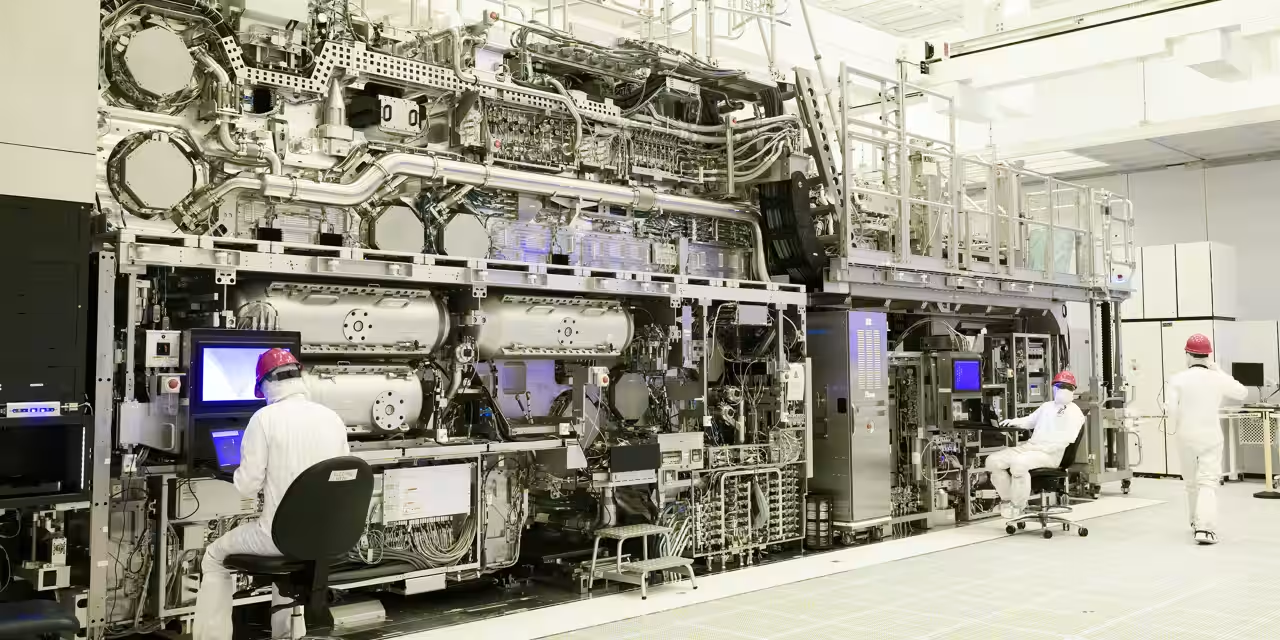
Intel Drops on $15 Billion Stock Offering. Why It’s Raising Funds Now.

Operator
Greetings, and welcome to the FutureFuel Second Quarter Results Conference Call. [Operator Instructions] As a reminder, this conference is being recorded.
It is now my pleasure to introduce Rose Sparks, Chief Financial Officer. Please go ahead.
Rose Sparks
CFO, Principal Accounting Officer & Treasurer
Thank you. Good morning, and welcome to the FutureFuel Second Quarter 2026 Results Conference Call. Leading the call today are our Chairman and CEO, Roeland Polet; and I’m Rose Sparks, the company’s Chief Financial Officer.
After the close of U.S. trading yesterday, we issued a press release detailing our second quarter operational and financial results. This release is publicly available in the Investor Relations section of our corporate website at www.futurefuelcorporation.com.
I would like to remind you that management’s commentary and responses to questions on today’s conference call may include forward-looking statements, which, by their nature, are uncertain and outside the company’s control. Although these forward-looking statements are based on management’s current expectations and beliefs, actual results could differ materially. For a discussion of some of the factors that could cause actual results to differ, please refer to the Risk Factors section of our latest reports filed with the SEC.
Additionally, please note that you can find reconciliations of all historical non-GAAP financial measures mentioned on this call in the press release issued this morning. Today’s call will begin with prepared remarks from Roeland Polet, who will provide a business update, followed by my review of our
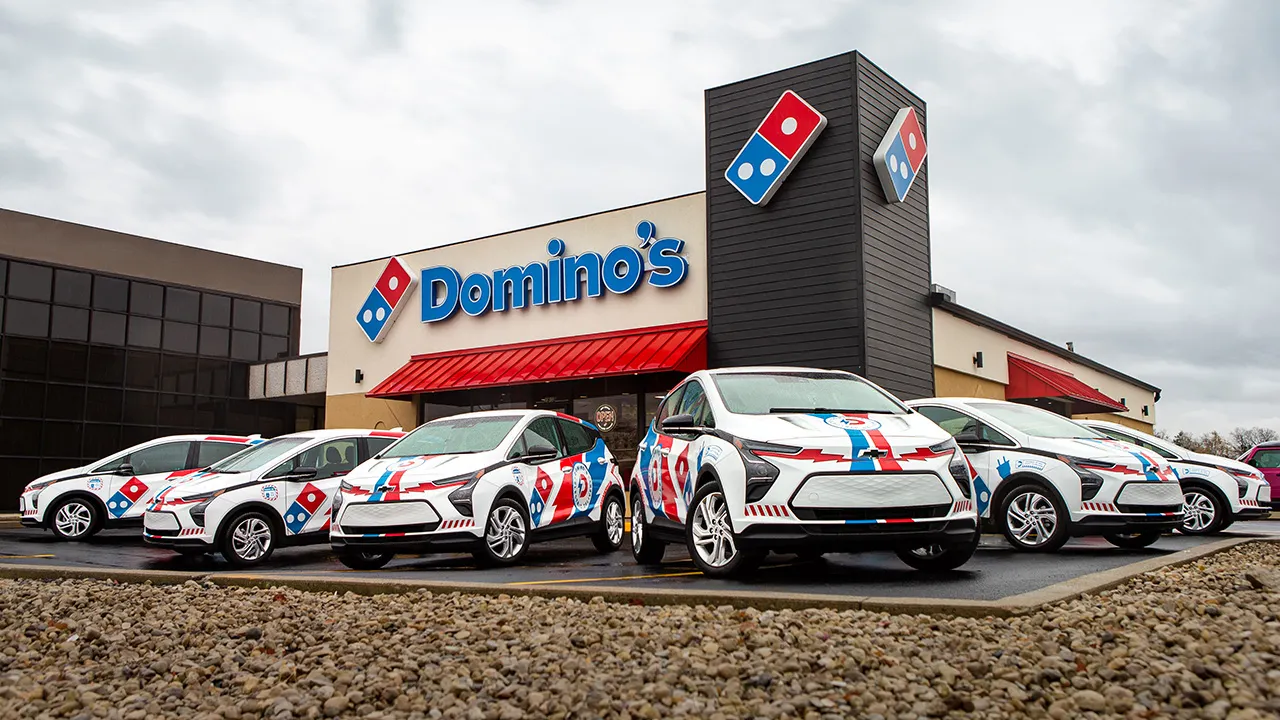
Check out what’s clicking on FoxBusiness.com.
Domino’s is putting its own name on a new pizza as the restaurant chain looks to give customers a personal-size option built for individual tastes.
The Michigan-based pizza giant said Tuesday that it will launch the Domino, a Detroit-style pizza made for one, at restaurants nationwide on Aug. 31.
Shaped like the company’s red-and-blue domino logo, the new pizza is cut into two slices and allows customers to choose their sauce and add up to three toppings.
The company is positioning the product as an alternative for customers who want different toppings when ordering pizza with family or friends, as well as for individual meals and on-the-go occasions.
HOW DOMINO’S ‘REGAINED ITS CROWN’ IN THE PIZZA INDUSTRY
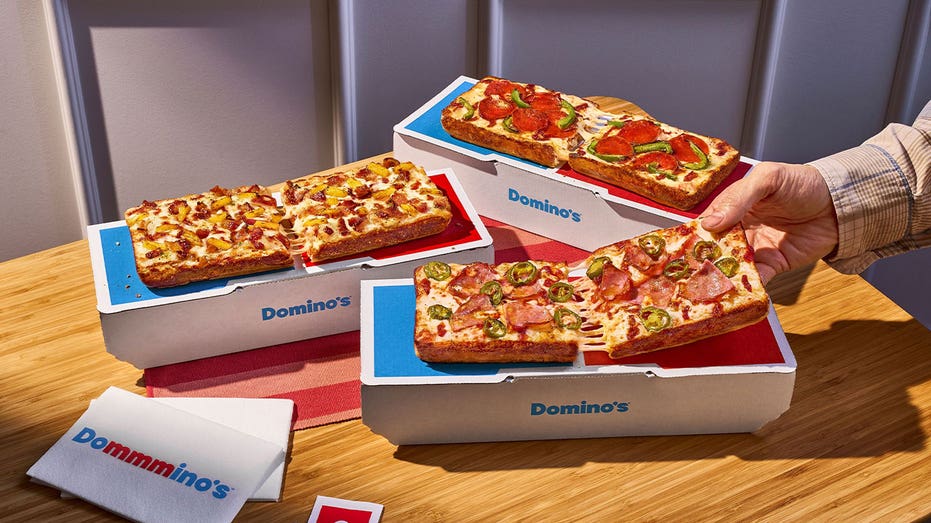
Domino’s is introducing the Domino, a Detroit-style pizza made for one, at stores nationwide on Aug. 31. (Domino’s)
“The Domino fills a gap in our portfolio,” said Joe Jordan, chief operating officer and president of Domino’s U.S., and incoming CEO. “When everyone wants something different, traditional pizza falls short. The Domino lets every person build the exact pizza they want.”
Domino’s said the pizza uses its buttery-flavored pan dough with Parmesan cheese baked into the crust. It comes with two layers of cheese and is finished with the chain’s garlic seasoning.
The company said consumers in independent testing rated the Domino as one of the most delicious products it has introduced. Domino’s did not provide additional details in its announcement about the testing methodology or sample size.
FOX Business reached out to Domino’s for additional details about the product’s development, consumer testing, pricing and potential impact on franchisees.
DOMINO’S REBRANDS FOR FIRST TIME IN OVER A DECADE
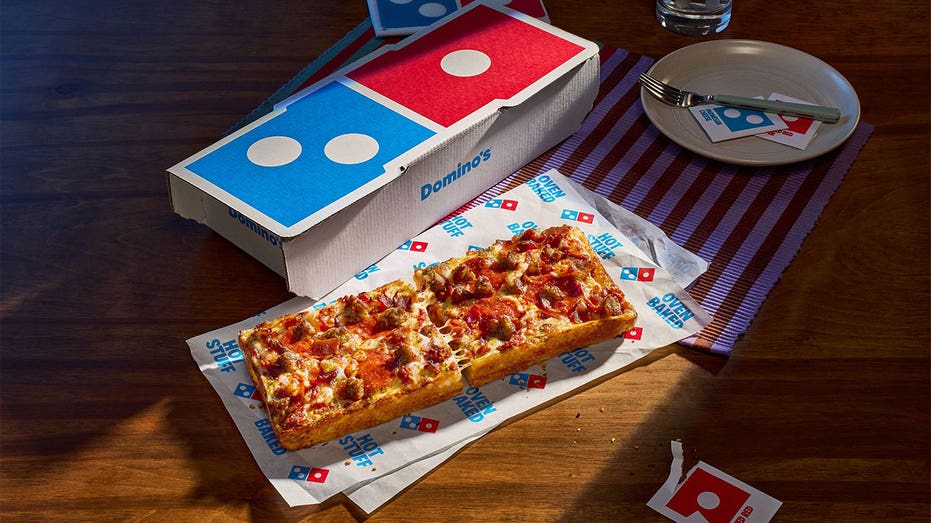
The Domino is shaped like the company’s iconic logo, cut into two slices and customizable with customers’ choice of sauce and toppings. (Domino’s)
The Domino will also be included in the chain’s Mix and Match promotion, allowing customers to select a two-topping version as one of two or more eligible menu items for $6.99 each. Prices may be higher at some locations, according to the company.
The launch comes as Domino’s operates a global network of more than 22,500 stores across more than 90 markets.
| Ticker | Security | Last | Change | Change % |
|---|---|---|---|---|
| DPZ | DOMINO’S PIZZA INC. | 357.34 | +9.49 | +2.73% |
CLICK HERE TO GET FOX BUSINESS ON THE GO
Domino’s reported more than $20.6 billion in global retail sales during the four quarters ended June 14. Independent franchise owners operated 99% of its stores at the end of the second quarter.
The company has also leaned heavily into digital ordering in its home market. More than 85% of Domino’s U.S. retail sales in 2025 came through digital channels, according to the company.

US crude oil inventories rise as fuel stocks decline
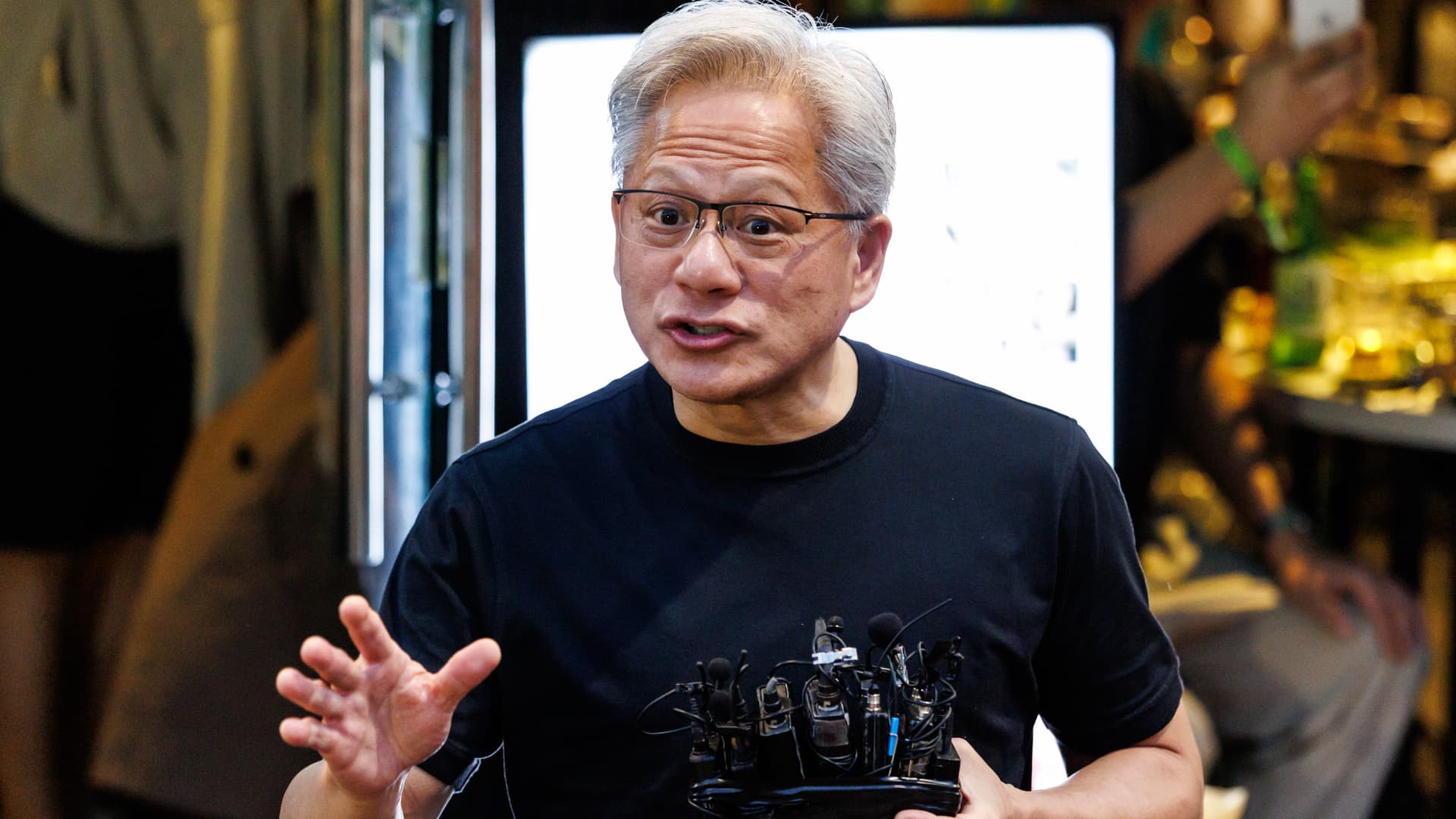
Nvidia CEO Jensen Huang speaks to members of media outside a restaurant in the Hongdae district of Seoul, South Korea, June 5, 2026.
SeongJoon Cho | Bloomberg | Getty Images
Jensen Huang built the world’s most valuable company by pioneering the specialized computer chips behind the artificial intelligence boom.
To keep his vision for the future within reach, the Nvidia founder is now attempting a different kind of engineering: convincing Wall Street investors that those chips are long-term financial assets akin to commercial real estate or toll roads.
His bet hinges on outpacing AI developments in China.
This week, Nvidia unveiled agreements with six of the world’s largest asset managers, BlackRock, Blackstone, Apollo, KKR, Brookfield and Goldman Sachs. The goal was to assemble a $500 billion pipeline to finance the construction of data centers and GPU clusters for companies that lack the credit rating or cash to buy millions of dollars of silicon outright.
Key to his plan, which Huang announced during a CNBC segment flanked by the leaders of all six Wall Street firms, is one crucial assumption: that Nvidia’s graphics processing units will hold their value over time, behaving more like traditional hard assets than fast-depreciating consumer electronics.
“Nvidia’s AI factory platform is really an investable asset, an infrastructure asset,” Huang said. “The reason for that is because it’s productive, it’s revenue generating, it is fungible, it’s used by just about every cloud service provider, it runs every AI model.”
In standard asset-backed finance, a bank lends money because if a borrower defaults, the bank can repossess the asset — like a building, a warehouse or a cargo ship — and sell it to get their money back. Those physical assets have established secondary markets and can last decades.
But the productive lifespan of cutting-edge GPUs is far from settled.
While new chips power frontier model training, after a few years they are relegated to lower-margin inference work — a shift that directly impacts their resale and collateral value.
“Depreciation is the one key risk here,” said Ben Emons, founder of FedWatch Advisors, who structured similar asset-backed loans for IndyMac before joining Pimco as a portfolio manager. Nvidia chips “could depreciate faster than expected,” he said.
High-yield rates?
In particular, Emons said he believes the single biggest threat to Nvidia’s financing model comes from China, which is rapidly ramping up domestic compute capacity and could choose to flood the market with low-cost silicon in a price war.
If Chinese production pushes hardware prices into a freefall, the collateral backing hundreds of billions in private loans could erode far faster than the terms of the debt itself, leaving investors exposed to losses, according to Emons.
To compensate at least partly for that risk, Emons estimates investors will treat GPUs as high-depreciation equipment rather than real estate, demanding high-yield returns in the 11% to 17% range depending on where they sit in the capital structure.
On top of that, the borrowers are likely to be non-investment grade firms locked out of traditional debt markets, including AI startups and neoclouds, according to a Bank of America Securities note.
If those higher-risk borrowers go under, Wall Street fund managers will be forced to repossess and resell used chips into a potentially falling market.
Whatever risks China poses wouldn’t be realized anytime soon. Huawei, the dominant provider of Chinese AI chips, has been on the U.S. Commerce Department’s Entity List since 2019. And in May, the U.S. government said Huawei’s Ascend AI chips violate U.S. export controls, preventing any American company from using the chips.
In the meantime, Nvidia remains by far the leading supplier of AI chips in the U.S., with upwards of 75% market share by most estimates.
And for now, the economics are still moving in Huang’s favor. Driven by scarcity as hyperscalers race to build out capacity, rental rates for Nvidia’s H100 chips rose from roughly $1.70 per GPU-hour in late 2025 to about $2.35 per GPU-hour this year, Huang noted.
Crucially, Nvidia argues its CUDA software layer — which enables developers to run AI workloads on its GPUs — continuously improves hardware performance after deployment, allowing older chips to stay productive and generate yield longer than traditional accounting models predict.
The future of the AI buildout, and hundreds of billions of dollars in investor money, may depend on who is right.
— CNBC’s Ari Levy contributed to this report.
Business
The Morning Download: Meta Shares Glimmer of Always-On AI Future | The Morning Download for Aug. 10

Good morning. The most interesting thing about Meta’s new Muse Glimmer model, from the enterprise point of view, is its focus on always-on AI agents. As the company emphasizes in its announcement, “Muse Glimmer is…optimized for always-on local agent workflows.”
That’s going to matter a lot in the next few years, with implications for the ways in which companies work, as I wrote in an April 2025 column called “AI Is Enabling an Always-On Economy. Companies Need to Pick Up the Pace.”
Copyright ©2026 Dow Jones & Company, Inc. All Rights Reserved. 87990cbe856818d5eddac44c7b1cdeb8

Petite Street Playtown in Meadowfield up for sale
Earnings call transcript: Quantinuum lifts 2026 outlook as loss weighs on shares

AI computing power becomes a tradable asset class as CME starts futures

Renter of Home in Anne Heche Crash Denies Settlement With Son

No Jackpot Winner as $257 Million Prize Rolls Over to $269 Million Monday Draw

Weekend Open Thread: Staud – Corporette.com

Saylor: “Everyone Has Been Sold a Lie” on Bitcoin

THEY’RE SCARED OF YOUR PROTECTION,FINANCIAL LOSSES BECAUSE U PULLED UR ENERGY BACK,DNA DRAMA & more

THIS HAS TO HAPPEN FOR A $17,500 XRP? – WILL BTC MAXI’S DITCH BTC FOR XRP?
-

 Fashion4 days ago
Weekend Open Thread: Mattifying Sunscreen
-

 Fashion4 days ago
Frugal Friday’s Workwear Report: Cap-Sleeve Pointelle Crewneck Sweater
-

 Sports6 days ago
Jordan Coyle & Cordiamo take Laya Arena Stakes at RDS
-

 News Videos3 days ago
Can Astrology Help Find Gold and Silver Trends? A Financial Astrology Guide
-
 Business6 days ago
US stocks: Dow closes at record on Mideast optimism; SpaceX, AMD drag Nasdaq
-

 Politics6 days ago
Reform UK And Greens Sink To Lowest Favourability Ratings To Date
-

 Business7 days ago
Nvidia Stock Climbs 2.5% as Chip Sector Rally Builds Ahead of AMD Earnings, Nvidia’s Own Report Looms
-

 Tech7 days ago
OpenAI, Anthropic AI agents targeted real people and systems in cyber tests
-

 Business6 days ago
Supply chain issues impact Ingredion
-

 Tech4 days ago
Rinn Pharma & Biopharma to join NordicPharmaTrain network
-

 Business3 days ago
How to Start a Cleaning Business: A Step-by-Step Guide
-
 Crypto World7 days ago
Dow and S&P 500 Hit Records on AI Earnings: When Will the Bubble Burst?
-

 Business2 days ago
Datadog: Best Of Breed For Multiple Reasons
-

 Business3 days ago
BDC Weekly Review: Private BDC Q2 Numbers Are Strong
-
 Business7 days ago
McDonald’s (MCD) Q2 2026 earnings
-
 Crypto World7 days ago
Dollar Index Trapped at 100 as Hawkish Fed Meets Official Selling
-

 Fashion7 days ago
The Bright Side of Black and White
-

 Business7 days ago
Apple UK encryption challenge filed against Home Office
-

 Fashion6 days ago
Suit of the Week: Me + Em
-
Sports6 days ago
Spider-Man: Brand New Day ending explained: Is Peter Parker alive?
You must be logged in to post a comment Login