

Connect with us
DAPA Banner
DAPA Coin
DAPA
COIN PAYMENT ASSET
PRIVACY · BLOCKDAG · HOMOMORPHIC ENCRYPTION · RUST
ElGamal Encrypted MINE DAPA
🚫 GENESIS SOLD OUT
DAPAPAY COMING

Business

Slowing rural incomes could weigh on consumer demand: Dhananjay Sinha

Published

on

Slowing rural incomes could weigh on consumer demand: Dhananjay Sinha
India’s rural economy may not be as strong as headline wage numbers suggest. While official data indicates a sharp rise in rural wages, a closer look reveals that the improvement may largely be the result of statistical changes rather than genuine income growth. According to Dhananjay Sinha from Systematix Group, the combination of weaker wage growth, rising inflation, reverse migration, and an uncertain monsoon could create fresh challenges for rural demand and consumer-focused companies.

Sinha said his team’s analysis of Labour Bureau data found that the reported 17% year-on-year increase in rural wages for March 2026 was misleading because of changes in the government’s sampling methodology.

“The underlying wage growth could be in the region of 4-4.2% instead of 17%. This 17% essentially comes on the back of additional coverage of north-eastern states, Delhi, and Goa, where the average wages are 50% higher than the earlier sample. Adjusting for that, we find a concerning trend, and the wage and income situation in rural areas might be much more modest compared to what the headlines are actually telling us,” he said.

He added that the slowdown in wage growth had emerged even before the recent geopolitical tensions in West Asia. According to him, higher living costs in cities have encouraged workers to return to rural areas, increasing dependence on agriculture, which typically offers lower productivity and income than urban employment.

Advertisement

“Because of the rise in the urban cost of living, there has been reverse migration from urban centres to rural areas. There is increased dependence on agriculture, which is less productive compared to urban occupations. This will likely impact the rural demand scenario,” he said.


Sinha warned that the improving volume growth seen by consumer companies in the previous quarter may not be sustained. He believes companies have started raising product prices as input costs increase, while slowing wage growth and rising inflation could squeeze consumers’ purchasing power.
“A combination of higher end-product prices, decelerating nominal wage growth, and inflation starting to rise might imply negative or flat real wage growth. You have rising prices and real wages actually coming down. This combination will impact the profitability and volume growth of consumer companies.”On inflation, Sinha said rising fuel prices are already pushing up the cost of living, adding that shortages of LPG have further intensified price pressures.

“Because of the LPG crisis and shortages, prices have informally gone up by almost four times. Generally, because of the increase in fuel prices, there is a generalised inflation, and we are seeing that in the numbers as well.”

He also cautioned that delayed monsoon rains and El Niño conditions could add another layer of stress to rural incomes. Lower rainfall could reduce cultivation acreage and agricultural productivity, making government support even more important.

“There has been a deficiency of almost 40% in the monsoon during the first month. Lower acreage under cultivation and higher dependence on agriculture could reduce productivity, and it will require governments to provide larger support in rural areas,” he said.

Advertisement

Discussing labour migration, Sinha noted that workers returning to villages are largely coming back from regions where wages are significantly above the national average, including Kerala, Delhi-NCR, Goa, and parts of the North-East. This, he said, could weaken household incomes and reduce remittance flows to rural families.

“The reverse migration is essentially happening from urban centres that have higher wages. This will have a significant impact on workers’ earnings and remittances. It is quite likely that, as we enter July or thereabouts, wage growth could actually come down close to zero. That is a concern that I have for the rural demand scenario,” he said.

The findings suggest that while official wage data paints a picture of robust rural recovery, underlying income trends remain fragile. If inflation continues to accelerate, rainfall remains below normal, and migration trends persist, rural consumption could face renewed pressure in the coming quarters, posing challenges for companies that rely heavily on demand from India’s villages.

Advertisement
Continue Reading
Click to comment

You must be logged in to post a comment Login

Leave a Reply

Business

Meta: Investors' AI Dilemma, Stay Or Come Back Later

Published

on

Meta: Investors' AI Dilemma, Stay Or Come Back Later

Meta: Investors' AI Dilemma, Stay Or Come Back Later

Continue Reading

Business

Care home group expands its Welsh portfolio with latest acquisition

Published

on

Business Live

Oakwood Care Group has acquired Forest Gate Healthcare

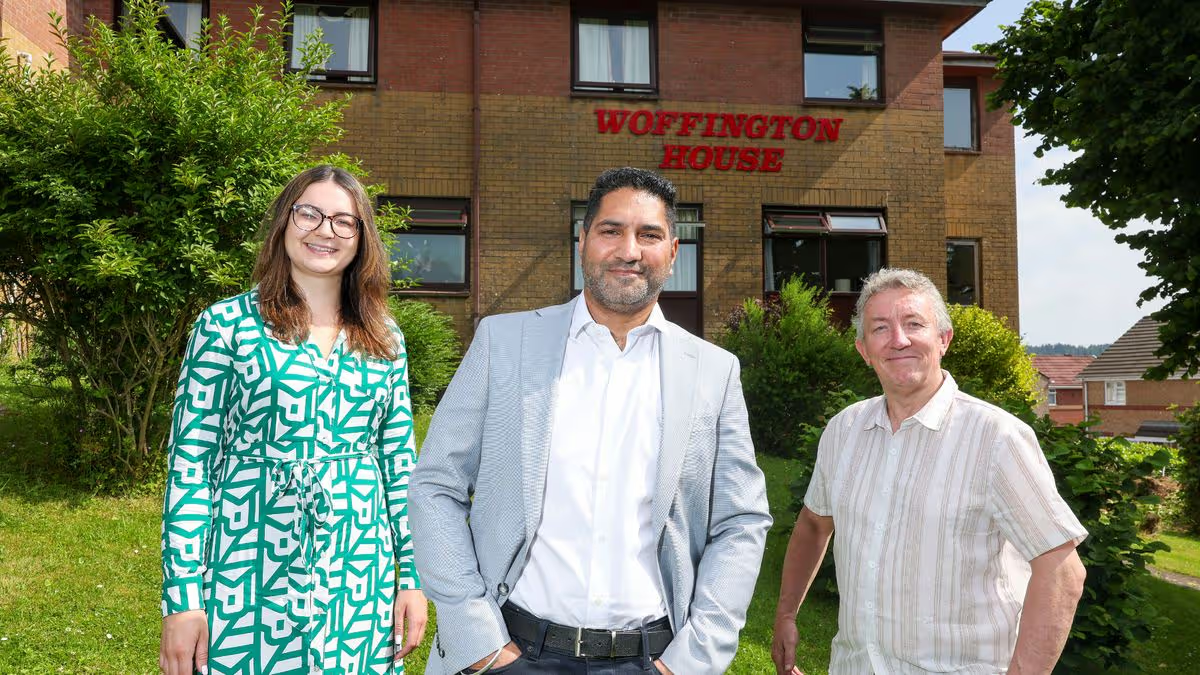
Left to right: Zoe Fletcher, corporate senior associate solicitor at JCP Solicitors; Kuljit Grewal, CEO of Oakwood Care Group; and Richard Easton, portfolio Ewecutive at the Development Bank of Wales.

Oakwood Care Group has completed the acquisition of Forest Gate Healthcare adding three care homes and 105 bedrooms to its expanding portfolio.

The acquisition, supported by a multi-million-pound debt facility from the Development Bank of Wales , sees Oakwood Care Group taking ownership of Oakdale Manor, a 31-bed care home in Blackwood; Ty Ross Care Home, a 38-bed care home in Treorchy; and Woffington House, a 36-bed care home in Tredegar.

Advertisement

The deal, the value of which has not been disclosed, significantly expands the group’s presence in Wales, increasing its workforce to approximately 200 people from around 70. It also strengthens Oakwood Care Group’s ability to provide residential care across multiple communities while safeguarding jobs and supporting future investment in care provision.

Founded by chief executive Kuljit Grewal, Oakwood Care Group’s portfolio now spans five care homes across Wales, including Bryngwy Care Home in Powys and Williamston Nursing Home in Pembrokeshire, alongside the three newly acquired homes.

The Development Bank of Wales has supported Oakwood Care Group, which is headquartered in Maidenhead, throughout its growth journey. In 2024 it provided a loan to support the purchase of Williamston Nursing Home and last year a further debt facilitate the purchase of Bryngwy Care Home.

JCP Solicitors’ Corporate and Commercial Property teams, advised Oakwood Care Group on the Forest Gate Healthcare acquisition.

Advertisement

Mr Grewal said: “This acquisition is a major milestone for Oakwood Care Group and reflects our long-term commitment to providing high-quality care across Wales.

“Our focus has always been on people first. These are not simply care facilities; they are homes for residents and important parts of their local communities. We are looking forward to working with residents, families and staff across Oakdale Manor, Ty Ross and Woffington House to build on the excellent care already being delivered.

“The support of the Development Bank of Wales has been invaluable throughout our growth journey. Strong, long-term partnerships give businesses like ours the confidence to invest, grow and continue improving services in a rapidly changing care environment. This investment places us in a strong position to continue supporting communities and strengthening care provision across Wales.”

Richard Easton, portfolio executive at the Development Bank of Wales, said:“Oakwood Care Group has established a strong track record of successfully acquiring and developing care homes while maintaining a clear focus on quality care and resident outcomes.

Advertisement

“This acquisition represents a significant step forward for the business, safeguarding employment, increasing its reach across Wales and supporting the delivery of high-quality care services to more communities. We are pleased to continue supporting the group as it builds on its success and creates a platform for future growth.

Property advisory firm Christie & Co acted for Forest Gate , which provides an exit for Richard and Ian Hutchinson. They said: “Having started the business over two decades ago, this was an important decision for our family. We are proud of what has been achieved and confident that Oakwood is the right partner to take the business forward.”

Oliver McCarthy, director, – care at Christie & Co comments, “We are pleased to have facilitated this discreet sale. Forest Gate is a well-established and highly regarded business, and this transaction demonstrates the continued demand for quality care operators. We wish both the Hutchinson family and the Oakwood Care Group every success in their respective future ventures.”

Advertisement
Continue Reading

Business

Why is Corning stock surging today?

Published

on


Why is Corning stock surging today?

Continue Reading

Business

Could Nike Get the Boot from the Dow? Why Berkshire Hathaway Might Take Its Place.

Published

on

Could Nike Get the Boot from the Dow? Why Berkshire Hathaway Might Take Its Place.

Could Nike Get the Boot from the Dow? Why Berkshire Hathaway Might Take Its Place.

Continue Reading

Business

PepsiCo’s Hoytink to become Hershey US president

Published

on

PepsiCo’s Hoytink to become Hershey US president

Veteran executive takes over role following exit of Andrew Archambault.

Continue Reading

Business

Jumex adds sparkling soda

Published

on

Jumex adds sparkling soda

The soda is available in three flavors. 

Continue Reading

Business

Hottest Day on Record? Then Double Down on Net Zero, Don’t Dumb It Down

Published

on

Hottest Day on Record? Then Double Down on Net Zero, Don't Dumb It Down

I am writing this with a damp tea towel round my neck, a fan pointed at my face like an interrogation lamp, and the distinct sense that my office has been relocated to the inside of a panini press.

Outside, the Met Office has slapped a red extreme heat warning across half the country and Britain is on course to beat its June temperature record by a margin that would embarrass a sprinter. Forty degrees. In England. In a country that historically considers a barbecue a high-risk gamble.

And do you know what our political class has decided to do about it? Reverse. Gently, apologetically, but unmistakably into the hedge.

Let me be unfashionably blunt, because that is what an oven does to a man’s patience. On the single clearest day of evidence we have ever had, every major party in this country is busy softening, fudging or flat-out binning the one policy designed to stop the thermometer doing this again. And they are all, to a man and woman, doing it because they have caught a nasty case of Faragitis.

This is the bit that genuinely astonishes me. Reform has been admirably honest about its position, which is that net zero belongs, in deputy leader Richard Tice’s words, “in the dustbin”. The party wants to axe the energy department, rip up fracking restrictions and, in a phrase imported wholesale from across the Atlantic, “drill, baby, drill”. You can read it in their own words on Business Matters, and I almost respect the clarity. At least you know where you are with a man who wants to set fire to the future to save four quid on his gas bill this winter.

Advertisement

The line, of course, runs straight back to Donald Trump, a man who has spent years insisting that wind turbines cause cancer, kill whales and personally ruin his golf views. Farage admires Trump, Reform borrows the soundbites, and now, terrifyingly, everyone else is borrowing them from Reform. The Conservatives, who once hugged a husky for a photo opportunity, last year ditched their commitment to net zero by 2050 altogether, a move even the trade press called reckless. Labour says the right things about offshore wind, then triangulates so frantically over every actual decision that you suspect Ed Miliband is the only true believer left and they keep him in a cupboard.

It is the great British political pastime: find out what the loudest man in the pub thinks, then sprint to agree with him before last orders.

Here is my problem, and it is a businessman’s problem rather than a hippie’s. The “drill, baby, drill” crowd present themselves as the hard-headed realists and everyone else as woolly idealists. They have it precisely upside down. The realism is on the other side of the argument.

The Climate Change Committee, hardly a den of placard-waving radicals, has crunched the numbers and found that the entire cost of reaching net zero by 2050 is smaller than the hit we took from one fossil fuel price shock in 2022. One. For every pound spent, the benefits come back somewhere between two and four times over. Faster electrification, heat pumps and electric cars do not bankrupt households, they put money back in people’s pockets. The expensive option, the genuinely reckless one, is staying hooked on a commodity whose price is set by despots and weather systems we do not control.

Advertisement

And this is before we get to the actual business case, which is enormous and which we keep pretending is a cost rather than the single biggest growth opportunity of our lifetimes. The UK net zero economy already generates around £105 billion in value and supports more than a million jobs, the overwhelming majority of them in small and medium-sized firms, as Business Matters laid out in its coverage of the seventh carbon budget. When politicians wobble on targets, they are not protecting business. They are kneecapping the fastest-growing part of it and handing the lead to the Chinese, the Americans and anyone else with the nerve to commit.

I have written before that British businesses must not retreat from net zero, and on the hottest day in our recorded history I will say it louder, sweat and all. Doubling down is not the brave green gesture. It is the boring, sensible, profitable thing to do, which is precisely why no politician chasing Farage’s vote will say it.

So here is my modest proposal. Turn the fans off in Westminster for a week. Let them legislate at forty degrees, like the rest of us are trying to work. They will discover their convictions remarkably quickly. Now, if you’ll excuse me, my tea towel needs wringing out.


Richard Alvin

Richard Alvin

Richard Alvin is a serial entrepreneur, a former advisor to the UK Government about small business and an Honorary Teaching Fellow on Business at Lancaster University.

A winner of the London Chamber of Commerce Business Person of the year and Freeman of the City of London for his services to business and charity. Richard is also Group MD of Capital Business Media and SME business research company Trends Research, regarded as one of the UK’s leading experts in the SME sector and an active angel investor and advisor to new start companies.

Richard is also the host of Save Our Business the U.S. based business advice television show.

Advertisement

Continue Reading

Business

CHPS: Memory Pricing Tailwinds, CPU Demand Inflection, And The 800-VDC Architecture Shift Spell Continued Growth

Published

on

CHPS: Memory Pricing Tailwinds, CPU Demand Inflection, And The 800-VDC Architecture Shift Spell Continued Growth

CHPS: Memory Pricing Tailwinds, CPU Demand Inflection, And The 800-VDC Architecture Shift Spell Continued Growth

Continue Reading

Business

Why I sold my business to my staff

Published

on

Staff at Softstar Shoes in Oregon, who now own their business

A huge number of other US entrepreneurs are in the same boat as Salcido – they are approaching retirement age, and therefore having to decide what to do with their businesses.

The “baby boomer” owners of about six million American small and medium-sized companies will retire between now and 2035, says a report this year, external from business consulting firm McKinsey. Some commentators have dubbed this a “silver tsunami”.

McKinsey adds that this mass retirement will result in “a once-in-a-generation wave of ownership transitions”.

Ethan Rouen, associate professor at Harvard Business School, says: “I don’t think a week goes by where I don’t talk to an owner who is looking to sell their business.” Their grown-up children often aren’t interested in taking on the family venture, he adds.

Advertisement

Rouen and his Harvard colleagues believe a switch to employee ownership could help many firms survive, and that such a move often appeals to owners who care deeply about their employees, and worry about what would happen following a sale to a larger company or private equity firm.

That was the case for William Stockwell, who wanted to protect the future of Stockwell Elastomerics, the Philadelphia-based manufacturer of industrial components that his great-grandfather started in 1919.

Stockwell made the decision to sell to his employees after seeing what happened to other firms that had been bought out. “The new [outside] ownership might move the business, they might shut it down, or drastically change it in other ways, and the people remaining are stuck,” he says.

There are a number of different schemes available in the US by which a workforce can buy their company. At Softstar Shoes they used an Employee Ownership Trust (EOT).

Advertisement

Under an EOT a trust is set up, which takes ownership of the business on behalf of the staff, removing the need for them to buy the business out of their own pockets.

The trust then pays the former owner the agreed sale price of the business in instalments as a share of future profits.

This means that Salcido has committed herself to a waiting game before she gets her money, with an element of risk on top – she needs the business to continue to be successful.

“I carry the risk, in that if anything happens, I don’t get paid,” she says. But she has faith in her team to deliver. They also get a share of annual profits.

Advertisement

Stockwell, who now works part-time for Stockwell Elastomerics, opted for a slightly different method of transferring ownership to the staff – an Employee Stock Ownership Plan or ESOP.

This also sees the business placed under trust ownership, but instead of staff sharing the annual profits, they get shares which they can only cash in when they leave the company.

Meanwhile, the retiring owner also must wait for his or her money. “I’m accepting payments over 10 years,” says Stockwell, who acknowledges he is making a “short-term financial sacrifice”.

Advertisement
Continue Reading

Business

AGF Management Limited 2026 Q2 – Results – Earnings Call Presentation (TSX:AGF.B:CA) 2026-06-24

Published

on

OneWater Marine Inc. (ONEW) Q1 2026 Earnings Call Transcript

This article was written by

Seeking Alpha’s transcripts team is responsible for the development of all of our transcript-related projects. We currently publish thousands of quarterly earnings calls per quarter on our site and are continuing to grow and expand our coverage. The purpose of this profile is to allow us to share with our readers new transcript-related developments. Thanks, SA Transcripts Team

Continue Reading

Trending

Copyright © 2025