SRK Fund I, LP increased 26.80% during the first half of the year. In contrast, the S&P 500 and the Russell 2000 returned 10.18% and 22.57%, respectively. Since inception, the Fund has appreciated 1551.26% compared to 222.91% for the S&P 500 and 118.90% for the Russell 2000.
SRK Fund I, LP Returns (%) as of June 30, 2026
Advertisement
2026
2025
2024
2023
2022
2021
2020
2019
SRK Fund I
26.80%
47.12%
-8.74%
17.15%
35.31%
46.71%
127.72%
77.99%
S&P 500 TR
10.18%
17.88%
25.02%
26.29%
-18.11%
28.71%
18.40%
31.48%
Russell 2000
22.57%
12.81%
11.54%
16.93%
-20.47%
14.78%
20.00%
25.52%
*Inception date of 05/01/18
In many respects, the first half of 2026 mirrored the environment of 2025, persistent macroeconomic noise, narrow market leadership, and heightened volatility. Geopolitical tensions, off and on Iran peace deals, and a partial unwinding of the AI momentum trade caused investor sentiment to fluctuate throughout the first half of the year. After an extended period in which market participants chased AI hardware bottlenecks and infrastructure buildouts, shifting sentiment triggered sharp pullbacks across many crowded positions.
Our performance during the period was achieved with zero exposure to companies tied to the AI buildout. That decision was not a refusal to evaluate the future; underwriting future earnings power is central to our investment process. The distinction is predictability, as I tend to only commit capital when a business model is proven, the economics are visible, and I believe I have a high probability of being right about what the business can generate over time. AI remains a nascent and rapidly evolving sector. At this stage, much of the easy money in the trade appears to have been made, with valuations already discounting explosive growth and earnings several years into the future. Predicting long-term customer adoption, competitive durability, and sustainable returns on invested capital now requires assumptions across a wide range of possible outcomes for which I do not believe I have an edge.
Advertisement
Instead, I prefer to focus on opportunities with asymmetric return potential and cash-flow outcomes that management can materially influence. I am allocating capital to opportunities where market neglect, cyclical weakness, or operational transitions have temporarily obscured the normalized earnings power of high-quality core assets.
Today’s portfolio consists of businesses trading at meaningful discounts to my estimate of normalized cash flows. They are led by aligned operators focused on controllable improvements, including operational efficiency, stronger cash conversion, and disciplined per-share capital allocation. By emphasizing durable cash flows and execution within management’s control, I believe the portfolio can continue compounding without depending on macro tailwinds, multiple expansion, or favorable market sentiment.
ImmuCell delivered a strong first quarter in 2026, underscoring the earnings power and cash-flow potential of its core First Defense franchise after the company’s strategic exit from Re-Tain. Product sales increased 28.4% year-over-year to $10.4 million, driven by higher volumes, price realization, and an estimated three-point gain in U.S. scours biologicals market share. Gross margin expanded to 45.0% as increased production created operating leverage, while net income rose 34% to $1.9 million. Even after the stock’s recent appreciation, ImmuCell remains a compelling opportunity. Management is refitting the former Re-Tain facility to expand First Defense capacity beyond the current 450,000 units per month, supporting a path toward $35 million to $40 million of sales over the next 12 to 24 months. With gross margins near 45%, the Re-Tain development burden permanently removed, annual EBITDA can grow towards $12 million to $14 million and convert into free cash flow with limited corporate tax leakage for several years due to substantial net operating loss carryforwards.
Outdoor Holding Company’s fourth quarter and full-year fiscal 2026 results reinforced the core turnaround thesis. Since divesting its capital-intensive ammunition manufacturing business in April 2025, the company has operated as a pure-play, asset-light marketplace through GunBroker.com. Revenue increased 3.5% year-over-year to $51.1 million, while adjusted EBITDA rose 46% to $22.3 million from $15.3 million, reflecting disciplined cost control and improved platform monetization.
Advertisement
Momentum accelerated in their fourth quarter. Net revenue grew 10.1% year-over-year to $13.9 million, supported by an 11.8% increase in gross merchandise value to approximately $229 million. Gross margin remained exceptionally high at 87.6%, and lower operating expenses helped drive adjusted EBITDA to $7.7 million, up 163% from $2.9 million in the prior-year period.
The results also highlighted GunBroker’s resilience in a subdued firearms market. Firearm unit sales on the platform grew 8.7% year-over-year during the quarter, far outpacing the 1.6% increase in adjusted NICS background checks. Adjusted EBITDA run rates over the past three quarters have also exceeded management’s $25 million target, reaching that milestone well ahead of the timetable set in August 2025. The balance sheet remains strong, with $68.1 million of cash and equivalents at fiscal year-end. They also began returning capital through a $15 million share repurchase program, buying back 513,925 shares for approximately $1.0 million at an average price of $1.95 per share.
Management is now focused on platform enhancements that can drive GMV growth and expand the take rate. During their fiscal year, the company completed its MasterFFL integration to streamline dealer verification across more than 32,000 licensed dealers and launched an AI-powered listing tool to improve product descriptions and conversion. In fiscal 2027, universal payment processing should allow individual sellers to accept credit cards through native checkout, addressing the roughly 30% of platform volume still handled through manual payment methods and creating a new high-margin revenue stream. With modest take-rate expansion, a potential cyclical recovery in firearms demand ahead of the 2028 election cycle, 85%+ gross margins, a net cash balance sheet, and aggressive buybacks, POWW has a credible path to $35 million to $40 million of EBITDA over the next 18 to 24 months and remains an attractive opportunity.
Industrial & Manufacturing Basket
Our industrial and manufacturing basket performed exceptionally well in the first half of the year, with the average holding up more than 50% year-to-date on a consolidated basis. While the market often views micro-cap industrial companies as commoditized or highly cyclical, our thesis centered on a clear inflection point. These businesses had spent two years working through severe post-pandemic inventory destocking, elevated input costs, and depressed utilization, while still retaining durable niche positions, strong balance sheets, and meaningful operating leverage.
Advertisement
The group’s fundamental results have validated that setup. As customer inventories normalized and supply chain friction eased, even modest volume recovery began flowing through to earnings. Many management teams have already used the downturn to resize cost structures, consolidate facilities, and remove legacy overhead, allowing baseline volume recovery to drive sharp improvements in gross margins and operating cash flow.
One example is a specialized synthetic fiber and materials manufacturer we accumulated at a deep discount to tangible book value. The company had been pressured by an extended destocking cycle across the global textile and apparel supply chain, which caused revenue declines and severe margin compression. Rather than waiting for demand to recover, management executed a broad operational turnaround by closing redundant plants, shifting production to lower-cost regions, and emphasizing proprietary higher-margin products. As order volumes stabilized, the company’s operating leverage became evident. The business moved from operating losses to cash generation, gross margins recovered by several hundred basis points, and the stock re-rated accordingly.
Capital allocation across the basket has also remained disciplined. Supported by net-cash or low-leverage balance sheets, several management teams have used excess cash flow to repurchase deeply discounted shares, increasing per-share value. Despite the basket’s strong year-to-date advance, these businesses still trade at modest multiples of normalized earnings and free cash flow. As core-end market demand continues to recover, I believe the group remains early in a multi-year earnings recovery.
During the first half of the year, we fully exited our position in Sanuwave Health (SNWV). Sanuwave entered 2026 as a relatively small holding. We had originally purchased shares when the business was deeply discounted trading on the OTC market and realized most of our gains at substantially higher prices, selling the bulk of the position in the $20s and $30s. After reviewing the company’s first-quarter results, I decided to sell the remaining shares and move on.
Advertisement
The exit was driven by reduced visibility into Sanuwave’s future growth. Much of the company’s recent revenue growth has come from mobile wound-care clinics using the UltraMist platform. However, the economics for those operators changed materially. Mobile clinics had previously generated very high margins from tissue-based skin grafts, while UltraMist, despite its clinical benefits, does not carry the same reimbursement profile.
As reimbursement pressure reduced margins, it became increasingly clear that many mobile wound-care operators were under significant financial strain. In my view, a meaningful portion of that customer base was and is likely to fail. Because Sanuwave’s forward growth depended heavily on a structurally challenged channel, the risk/reward profile had deteriorated. Sanuwave was ultimately a successful investment for the fund despite the recent stock price deterioration, but exiting the remaining position allows us to redeploy capital into opportunities where I have greater confidence in the predictability and durability of future cash flows.
Pro-Dex is a new holding added during the fourth quarter of last year. I have followed the company for many years and have long sought an opportunity to own shares at an attractive price. That opportunity emerged when the stock sold off on concerns that Pro-Dex’s largest customer contract would not be renewed at year-end 2025. The risk was resolved when the company secured a three-year extension through 2028, including minimum purchase commitments for 2026 and 2027. The renewal reinforces the durability of a relationship that has lasted more than fifteen years and provides a predictable, cash-generative base from which Pro-Dex can fund growth.
Pro-Dex is a specialized medical device manufacturer that designs, builds, and repairs powered surgical handpieces for large OEM customers under long-term, exclusive supply agreements. These relationships are difficult to displace because each product is tied to customer-specific regulatory clearances, designs, validated manufacturing processes, and intellectual property owned by Pro-Dex.
Advertisement
The most attractive upside to the business comes from Pro-Dex’s role as the exclusive hardware and component partner for Zimmer Biomet’s mBôs robotic surgery platform. Pro-Dex manufactures the platform’s motorized end-effector components and receives a high margin sourced products fee on third-party disposable cutting tools used in each procedure, creating a recurring, procedure linked revenue stream. The company also owns 2.2 million contingent value rights tied to Zimmer Biomet’s acquisition of Monogram Technologies. These are carried at zero on the balance sheet but could pay more than $25 million, or roughly $6.80 per share, if future mBôs milestones are achieved. In addition, the February 2026 acquisition of Advanced Precision Machining brings a key supplier in-house, expands manufacturing capacity, and adds higher margin aerospace, defense, and government customers.
At today’s price, PDEX offers asymmetric upside. We are paying primarily for the stable core business while receiving the potential mBôs economics and off-balance-sheet CVR value for little to no credit. If commercialization scales over the next 24 to 36 months, Pro-Dex has a clear path to materially higher earnings power and a substantially higher share price.
Undisclosed Holding
During the second quarter we built a position in a specialized healthcare supply business that resonates with previous investments as an overlooked turnaround trading at a significant discount to underlying business value. The company produces essential recurring consumables used daily in life-sustaining medical treatments. Despite sticky demand, a net-cash balance sheet, and improving margins, the stock trades at a low single-digit multiple of normalized cash flow.
The stock continues to be weighed down by a legacy concern tied to the loss of its largest customer. That customer represented a substantial portion of volume, and its departure created a sharp revenue gap that caused a significant decline in the share price. Rather than permanently impairing the business, however, the setback forced a broad restructuring. Management cut legacy overhead, renegotiated contract economics, improved pricing, and rebuilt the commercial strategy.
Advertisement
Today, the business is stronger and more resilient. The lost revenue has been absorbed, and the customer base is now diversified across dozens of regional providers and independent clinics, eliminating the prior customer concentration risk. Growth has also re-accelerated as the company entered a major new geographic territory, won several multi-year supply contracts, and gained share in markets where it previously had no presence. As these contracts ramp, the business will begin to benefit from operating leverage across its manufacturing and distribution footprint. Incremental volume will convert to profit at high operating margins and produce consistent positive cash flow. At a single-digit forward cash-flow multiple, the market is still valuing the company based on past challenges rather than current fundamentals. We are paying a distressed multiple for a stabilized, growing, and diversified business that should re-rate as it continues to deliver clean operational results along with the potential for one or several acquisitions to meaningfully accelerate operating leverage.
Closing Thoughts
Halfway through the year, the fund is off to a strong start, driven by solid operational execution across our core holdings. While these initial results are gratifying, I want to remind partners to temper their expectations and avoid extrapolating our first half performance forward on a permanent basis. Investment returns rarely compound in a straight line, and there will inevitably be quieter stretches or periods of noise along the way. That said, I remain deeply confident in how the portfolio is currently structured. I believe the fund is positioned to generate highly attractive returns on a go forward basis.
Right now, my pipeline of actionable ideas is abundant, I currently have more compelling opportunities than I have capital to allocate. If you know of accredited investors who share our disciplined, long-term approach to bottom-up investing, I would be deeply grateful for an introduction.
Thank you for your continued partnership, trust, and shared long-term perspective as I steward your capital alongside my own. I look forward to updating you on our progress again at year-end. Please do not hesitate to contact me with any questions regarding the matters discussed above.
Advertisement
Sincerely,
Sean Kirkwood
Advertisement
SRK Fund
S&P 500 TR
Russell 2000 TR
2018
2.90%
-4.03%
-11.72%
2019
77.99%
31.48%
25.52%
2020
127.72%
18.40%
20.00%
2021
46.71%
28.71%
14.78%
2022
35.31%
-18.11%
-20.47%
2023
17.15%
26.29%
16.93%
2024
-8.74%
25.02%
11.54%
2025
47.12%
17.88%
12.81%
YTD 2026
26.80%
10.18%
22.57%
Cumulative
1551.26%
222.91%
118.90%
Annualized
40.98%
15.44%
10.07%
The information contained herein is a reflection of the opinions of SRK Capital as of the date of publication and is subject to change without notice at any time subsequent to the date of issue. SRK Capital does not represent that any opinion or projection will be realized. All the information provided is for informational purposes only and should not be considered as investment advice or a recommendation to buy, sell, or hold any specific security. While it is believed that the information presented herein is reliable, no representation or warranty is made concerning the accuracy of any data presented. This communication is confidential and may not be reproduced without SRK Capital’s prior written consent.
Indices are provided as market indicators only. It should not be assumed that holdings, volatility, or management style of SRK Fund I, LP, or is intended to, resemble that of the mentioned indices. Index returns supplied by various sources are believed to be accurate and reliable.
Past performance is not indicative of future performance. Inherent in any investment is the possibility of loss.
This performance reporting is not an offer to sell or a solicitation of an offer to buy an interest in SRK Fund I, LP. Such an offer may only be made after you receive the Confidential Offering Memorandum and have had the opportunity to review its contents. This reporting does not include certain information that should be considered relevant to an investment in SRK Fund I, LP including, but not limited to, significant risk factors and complex tax considerations. For more information, please refer to the appropriate Memorandum and read it carefully before you invest.
Futures for the Dow Jones Industrial Average and other major stock indexes rallied Monday as oil prices and Treasury yields dropped. Meanwhile, Nvidia (NVDA) was an early winner on the stock market today. Ahead of Monday’s open, Dow futures climbed 0.9%, or around 450 points, as S&P 500 futures gained 0.7%. Nasdaq-100 futures advanced 1.1% in early morning trading. West…
Across the Broughton site, the manufacturer is creating around 480 new well paid jobs this year.
11:53, 21 Sep 2026Updated 12:02, 21 Sep 2026
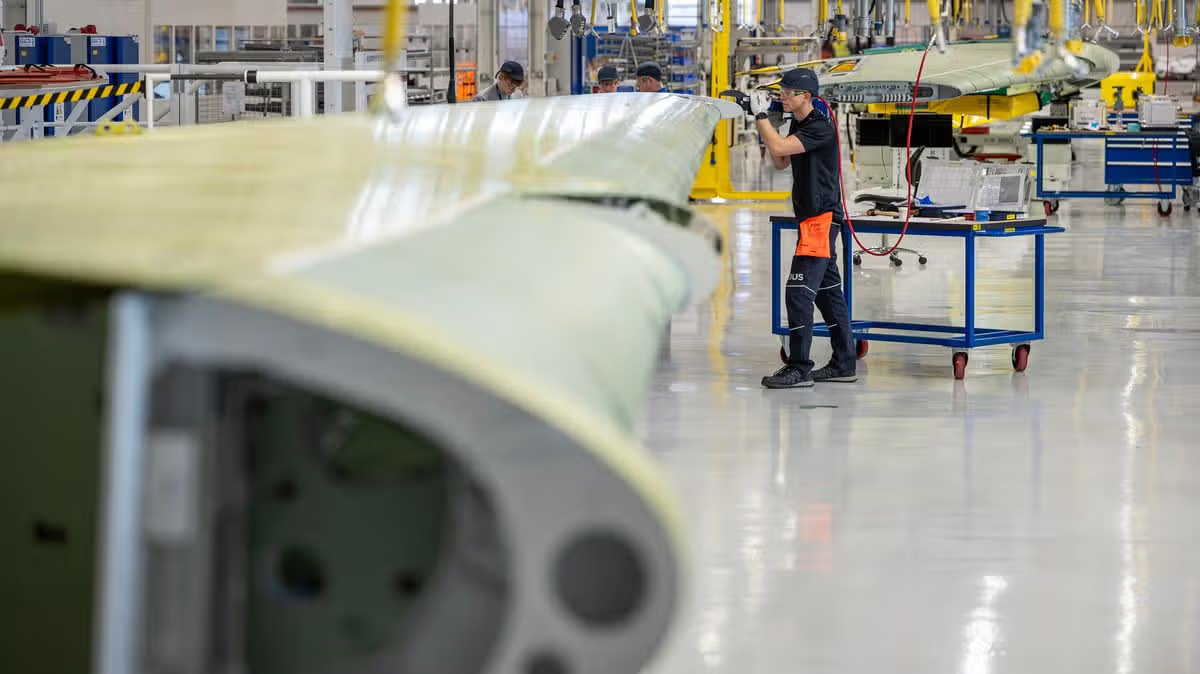
Airbus is accelerating its global industrial strategy, investing £150m into converting its former A380 wing production facility into an A321 line in Broughton
Airbus is investing £150m into converting its former A380 wing production facility into an A321 line in Broughton in North Wales.
The west factory was opened in 2003, and at the time was the largest factory built in the UK for years.
Advertisement
The Flintshire plant – with more than 1,000 workers – had been used to assemble wings for the 555 seater A380 before they were transported by barge and ship to Toulouse in France.
A decision was taken to phase out the programme and the last wing departed Broughton in February 2020.
Now it will be transformed – with work set to be completed by the end of the year .The expansion is a significant boost for the UK aerospace industry capability.
Once completed, the facility will host six wing production jigs, an equipping line and paint shop, specifically designed to feed the backlog of around 7,500 A320 Family aircraft, of which around 70% are A321s.
Advertisement
Across the Broughton site, the manufacturer is creating around 480 new well paid jobs in 2026, including 250 positions in the refurbished factory.
These roles join the 6,000 strong workforce in Broughton, signalling Airbus’ long-term commitment to Wales and reinforcing the UK’s position as a critical hub in the global aerospace industry.
At the heart of this investment is a new, advanced manufacturing environment, designed and built with direct involvement from operators across the site.
Employees fed into the ergonomics and technology integration to shape the industrial system.
Advertisement
Jerome Blandin, head of Airbus Wing, said: “We aren’t just talking about a ramp-up; we’re putting the infrastructure in place to support it.
“Around the world today, an A320 Family aircraft takes off or lands every two seconds, with wings designed and built in the UK. Investing in our capacity strengthens our industrial footprint, creates high value jobs that support the wider UK aerospace sector and ensures we remain competitive in the years to come.
“This investment is important for jobs, important for the region and important for our global ramp up towards rate 75.”
The first wing is already underway, with all jigs expected to be operational by the end of the year.
Advertisement
This latest investment builds on the recently announced multi-million pound investment in Airbus’ Belfast facility, which will expand the wing manufacturing footprint and advanced composite capabilities to support A220 ramp-up.
Monte Independent Investment Research: Michael Del Monte is a buy-side equity analyst with expertise in the technology, energy, industrials, and materials sectors. Prior to working in the investment management industry, Michael spent over a decade in professional services working across industries that include O&G, OFS, Midstream, Industrials, Information Technology, EPC Services, and consumer discretionary.
Analyst’s Disclosure: I/we have a beneficial long position in the shares of DELL either through stock ownership, options, or other derivatives. I wrote this article myself, and it expresses my own opinions. I am not receiving compensation for it (other than from Seeking Alpha). I have no business relationship with any company whose stock is mentioned in this article.
Seeking Alpha’s Disclosure: Past performance is no guarantee of future results. No recommendation or advice is being given as to whether any investment is suitable for a particular investor. Any views or opinions expressed above may not reflect those of Seeking Alpha as a whole. Seeking Alpha is not a licensed securities dealer, broker or US investment adviser or investment bank. Our analysts are third party authors that include both professional investors and individual investors who may not be licensed or certified by any institute or regulatory body.
Understanding the true cost of it is the first and best reason to take the risk seriously.
The figures are sobering, and the reality is that up to 44,000 workers per year are injured by falls from height. Behind each of those numbers sits a person, a family, and a business affected. This article looks closely at what falls really cost, where they tend to happen, and how employers can prevent them.
Why Should Businesses Care About Falls?
The human cost is the most important reason, and it should be. Falls from height are consistently among the leading causes of fatal injury at work in the UK. No target or deadline is worth that.
Free newsletters
Advertisement
The stories that matter to UK business, straight to your inbox.
Advertisement
There is a hard business case too, sitting right alongside the moral one. A serious incident brings investigation, lost productivity, and lasting damage to morale and reputation. It can also halt a project entirely. For any employer, preventing falls is both the right thing and the smart thing to do.
What Do Falls Cost a Business?
The price of a single fall extends well beyond the immediate injury. Direct and indirect costs stack up quickly, often over months. Few employers appreciate the full total until it lands.
The costs typically include:
Fines. Penalties for safety breaches can reach millions.
Downtime. Halted work and lost productivity.
Claims. Compensation and rising insurance premiums.
Reputation. Lost contracts and damaged trust.
These figures dwarf the modest cost of prevention in almost every case. Fines have topped 1 million pounds in the most serious cases, and legal costs pile on top. A single prosecution can threaten the future of a small firm. Set against that, good safety is one of the cheapest investments a business can make.
Where Do Falls Happen Most?
Falls are not confined to towering scaffolds and skyscrapers. In fact, many happen during ordinary, short tasks. Around 40 workers die from falls at work each year, and roughly 25% of worker deaths involve a fall. Recognising the real hotspots helps focus prevention.
Alt text: Workers using a secure elevated platform on a commercial site
The common hotspots are clear:
Ladders. Involved in many quick-task falls.
Fragile roofs. Often the site of fatal falls.
Edges. Unprotected edges and floor openings.
Platforms. Loading bays and mezzanine levels.
Ladders are involved in a striking number of incidents, often during quick jobs where care lapses. Roofs, especially fragile ones, are another frequent scene, and a fall through a fragile roof is often fatal. Loading bays, mezzanines, and unprotected edges all add risk in everyday workplaces. Warehouses and retail units see their share too, not just construction sites. The lesson is that no height-related task, however brief, should be treated as trivial.
How Can Employers Prevent Falls?
Prevention is well understood and thoroughly documented. It rests on planning, the right equipment, and trained people. The law also sets clear expectations.
Employers carry clear legal responsibilities for work at height. These duties are not optional, and regulators enforce them. Meeting them protects both people and the business.
The law requires employers to plan, supervise, and carry out work at height safely, using competent people and suitable equipment. That sits alongside broader duties to manage risks like Slips, trips and falls across the whole workplace. Falling short can mean prosecution, fines, and in the worst cases, corporate liability. Compliance, in truth, is simply good management.
Protecting People and the Business
Falls from height are among the costliest and most preventable risks a business can face. The toll on workers is the reason that matters most, but the financial and legal stakes reinforce the same conclusion. Assess every height task, avoid it where you can, protect workers where you cannot, and train your team well. Get that right, and you safeguard your people, your projects, and the future of the business itself.
Advertisement
Frequently Asked Questions
How Common Are Falls From Height at Work?
They are alarmingly common and consistently serious. Falls from height are among the leading causes of fatal workplace injury in the UK, and they injure tens of thousands of workers every year. Many happen during short, routine tasks rather than dramatic high-level work. This mix of frequency and severity is exactly why regulators and safety bodies treat working at height as a top priority.
What Fines Can a Business Face for a Fall?
Penalties can be severe. Under health and safety law, fines for serious breaches can run into hundreds of thousands or even millions of pounds, scaled to the offence and the company’s size. Beyond fines, businesses face legal costs, compensation claims, and higher insurance premiums. For a small firm especially, a single prosecution can be financially devastating, which makes prevention overwhelmingly worthwhile.
How Can Small Businesses Prevent Falls Affordably?
Effective prevention is usually far cheaper than most owners fear. It starts with a proper risk assessment, avoiding work at height where possible, and using suitable, well-maintained equipment. Training staff in safe methods costs little and prevents a great deal. The expense of guard rails, towers, or a short course is tiny next to the cost of a single serious incident.
Who Is Legally Responsible for Height Safety?
The primary duty rests with the employer, who must plan and manage work at height, provide the right equipment, and use competent, trained people. Workers also have a duty to follow safe systems, use equipment correctly, and report defects. Responsibility is shared, but employers hold the main legal obligation to make sure every height task is properly controlled and supervised.
Popular pub sits next to Championship side’s Racecourse Ground
Matt Hardy www.cityam.com
11:54, 21 Sep 2026Updated 11:56, 21 Sep 2026
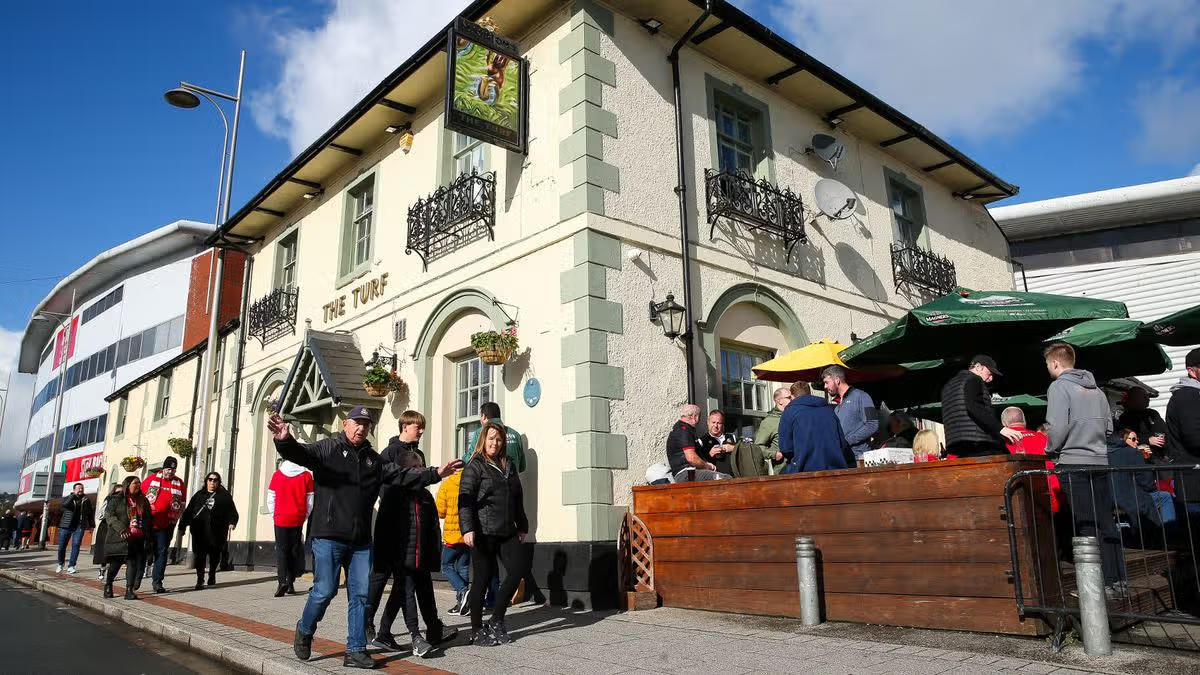
Fans at The Turf Pub, Wrexham, in 2023(Image: Barrington Coombs/PA Wire)
Ryan Reynolds, Rob McElhenney and Apollo Sports Capital have acquired a pub in a transaction that extends Wrexham AFC’s property holdings.
Advertisement
The Turf, which previously overlooked the stands with views into the Championship football stadium, has been brought into a portfolio by the club’s owners which encompasses both Wrexham and their Racecourse Ground venue.
The purchase follows weeks after the local authority instructed the club to “get their act in order” following Wrexham’s construction of a training facility without securing planning consent. An application was submitted after building work had already commenced last month, as reported by City AM.
Eric Allyn, representing minority stakeholders the Allyn family, said: “Ever since we invested in Wrexham AFC through Red Dragon Ventures in 2024, the town, the community and the Football Club have become a second home.
“And no place more so than The Turf with Wayne Jones behind the bar and filled with the locals and international fans that visit regularly – they have all become our friends and have welcomed us into the Wrexham family.
Advertisement
“By bringing The Turf into the group, we are securing the long-term future of the pub and with it preserving its history and that of the club.”
Current landlord Wayne Jones will remain in position at the establishment – which has witnessed a remarkable ascent to the second division of English football following its takeover by Reynolds and McElhenney, known as Rob Mac, in 2021.
The Hollywood duo subsequently purchased the Racecourse Ground freehold before securing government funding for a regeneration scheme. In December 2025, the club offloaded a minority stake to prominent sports investment firm Apollo Sports Capital, at a valuation of £350m.
The club’s stadium is presently undergoing a significant redevelopment, with its Kop Stand being reconstructed to accommodate a greater number of supporters.
Advertisement
Wrexham currently sit 14th in the Championship, having secured victories in just two of their opening eight fixtures, against Southampton and Millwall.
Two separate reports have revealed an appetite from businesses in the North to boost regional growth
12:01, 21 Sep 2026Updated 12:06, 21 Sep 2026
Shevaun Haviland, Director General British Chambers of Commerce
A leading business group has urged the Government to put businesses “at the heart” of any power for more devolution, saying that private firms are vital to “deliver growth, investment and higher living standards” across the UK. Chancellor John Healey has followed the direction set by his predecessor Rachel Reeves in saying that he would set out a “road map to fiscal devolution” at the Budget.
Now the British Chambers of Commerce (BCC) has said in a new report that the Budget should outline plans to put businesses at the heart of the next stage of devolution and give more local leaders power over funding to accelerate growth in their areas.
Advertisement
A survey by the business organisation of 5,000 firms found in the second quarter of 2026 that only 17% were planning to increase investment in the coming months, a post-pandemic low. The BCC said in a new report that the Budget should outline plans to put businesses at the heart of the next stage of devolution to drive growth and investment.
It urged the Government to complete its devolution plan by the end of the 2027-28 financial year, giving more local leaders power over funding to accelerate growth to improve living standards in their areas. It added that ministers should look to give local areas a direct share in the rewards of growth before the end of this Parliament.
BCC director general Shevaun Haviland added: “Devolution can be a powerful driver of economic growth, but only if businesses are at the heart of the decisions.
“As more powers are pushed out from Whitehall to regions of England, the test of success is simple. Does it make it easier for companies to invest, recruit, trade and grow?
Advertisement
“If it does, then devolution can raise living standards and spread opportunity in every postcode.”
The Chambers’ intervention has come as a separate survey suggests that greater regional decision-making will have a positive impact on business growth. The survey by accountancy group BDO found support for more fiscal powers at regional and local level was strongly backed in the North East, the North West, and Yorkshire and Humber.
The survey also found that companies wanted the Government to prioritise increased business grants (43%) and taking equity stakes in strategic businesses.
Dan Brookes, interim regional managing partner at BDO in Yorkshire and the North East, said: “The Government is making all the right noises when it comes to creating the conditions for good growth in every part of the UK.
Advertisement
“Regional business leaders clearly agree that by giving regional mayors and local authorities greater control over locally raised tax revenues it will positively impact business growth over the next three years. The key now is making those pledges a reality in a way that flows meaningfully through the regional business community.”
FTSE 100 sportswear retailer has reached an agreement with Axo as it looks to diversify beyond its struggling North American market
Felix Armstrong www.cityam.com
12:22, 21 Sep 2026
The Mexican flag flies during Mexico’s Independence Day celebration on September 15, 2026(Image: Getty Images)
JD Sports has unveiled plans to launch more than 140 stores in Mexico, as the ‘King of Trainers’ seeks to reverse declining sales and put a recent boardroom dispute behind it.
Advertisement
The FTSE 100 retailer revealed it has struck an agreement with Axo, a Mexico-based retail distributor, to run its outlets across the country.
JD Sports will be hoping the expansion can stem the sales decline it is experiencing in its vital North American market. The region currently represents 38 per cent of its worldwide revenue, but sales there dropped by 6.8 per cent in the three months to August.
Under the arrangement, Axo will manage JD’s physical stores and online operations using its brand and intellectual property, with the footwear and sportswear retailer set to deliver a “differentiated proposition” to Mexican consumers.
The FTSE 100 company sees significant opportunity in the Mexican market, informing shareholders that approximately 40 per cent of its 130 million population is under the age of 25, as reported by City AM.
Advertisement
“Mexico is a market with a large, highly engaged consumer base and a demographic profile which aligns strongly with JD’s unique position as a curator of footwear and apparel trends across sport, music and fashion,” the group stated.
The nation’s activewear sector is currently worth around $6.5 billion and is forecast to reach $10 billion by 2034, according to JD. Régis Schultz, JD’s chief executive, said: “JD’s product offering aligns closely with consumer demand in Mexico and we believe our position at the intersection of sport, music and fashion will deepen the connection we have with that consumer.”
Schultz added that Axo’s “deep market expertise, strong operational platform and proven experience with leading international brands make it uniquely placed to help deliver the JD proposition in Mexico and unlock the opportunity that exists there”.
The retailer is set to begin launching its more than 140 Mexican stores next year, with the group subsequently planning to upgrade its top-performing locations, in keeping with its “bigger and better” flagship store strategy.
Advertisement
JD’s partnership with Axo represents the latest step in the expansion of its global franchise platform. Across JD and Courir, the French trainer retailer it acquired in 2024, the group now operates 75 franchise stores spanning Europe, the Middle East, Africa and Asia.
The so-called ‘King of Trainers’ is entering the Mexican market during a turbulent period, following a profit warning and a boardroom succession dispute.
Régis Schultz, chief executive of JD Sports
Last month, JD cut its upper profit forecast by £50m to £800m, cautioning that sluggish US sales and aggressive discounting from competitors are posing a significant threat to its growth trajectory. “The market stayed highly promotional, reflecting the consumer and footwear product cycle headwinds our industry has faced in recent quarters, whilst our core consumer was impacted by incremental cost-of-living pressures,” Schultz said.
The retailer’s chief executive only narrowly survived an attempt to remove him from his position earlier this year, when JD chairman Andy Higginson stepped down from the group’s board after failing to persuade it to remove Schultz.
Advertisement
In August, JD appointed former Ikea chief executive Peter Agnefjäll to take over from Higginson.
Nissan at the New York International Auto Show in New York City on April 2, 2026.
Danielle DeVries | CNBC
Nissan Motor is looking to increase its U.S. production as it launches the 2027 Rogue crossover, including with a new hybrid model that the company views as a crucial offering for American consumers.
“We’re now maxing out the production capacity in the U.S.,” Christian Meunier, chairman of Nissan Americas, told CNBC. “The next step is going to be three shifts, and I’m pretty optimistic that with the launch of the new Rogue that is happening in the next couple months, we’ll be able to do that pretty quickly with the launch of the hybrid.”
Advertisement
The Japanese automaker currently produces the Rogue alongside other Nissan and Infiniti crossovers at a 6 million-square-foot assembly plant on two production shifts in Smyrna, Tennessee. It also has another large manufacturing plant producing the Nissan Altima sedan and Frontier midsize pickup truck in Canton, Mississippi.
Additional production at assembly plants typically means hundreds, if not thousands, of new jobs. Nissan’s moves come as the Trump administration has been focused on increasing employment and domestic production in the U.S. auto industry.
U.S. manufacturing of the hybrid is expected to start next year after the spring production launch of the 2027 Rogue with a traditional gas engine at the Tennessee plant.
2027 Nissan Rogue
Advertisement
Courtesy Nissan
In the meantime, Meunier said Nissan plans to import the vehicles from Japan as a way to get them to market more quickly to lift sales and help with an ongoing global turnaround plan for the company.
Meunier said if Nissan can add a third shift to each of its assembly plants, it would boost the automaker’s U.S. production to roughly 1 million units annually, up from nearly 487,000 in 2025.
Nissan has a target to produce 80% of the vehicles it sells in the U.S. domestically by 2030, but the company has no plans for a new plant as of now.
Advertisement
“I think we’re very well equipped to succeed without major investment and a new factory and everything else. Maybe after 2030,” he said. “Over the next four or five years, we’ll see.”
Nissan e-Power
Nissan on Monday officially revealed the 2027 Rogue with its new “e-Power” technology for the U.S., which is the first hybrid of its kind for the American market.
The “e-Power” system is called a series hybrid.
It uses the engine as a generator to power the vehicle’s electric motors that then propel the vehicle. It operates like emerging extended-range electric vehicles, or EREVs, but has a smaller battery and doesn’t require a plug. It also does not use the engine to power the wheels, just electric motors.
Advertisement
Meunier said the Rogue hybrid and resurrecting the Xterra off-road SUV were his top vehicle priorities when he rejoined Nissan in January 2025 after four and a half years with Jeep. That included pulling ahead the Rogue hybrid twice for the U.S.
The Rogue is a sales leader for the company in the U.S. It competes in the highly competitive small crossover segment against the Toyota RAV4 and Honda CR-V, which have the best-selling hybrid options in that category.
“The hybrid power that we’re launching on Rogue is going to really be the boost to our performance,” Meunier said. “It’s been quite remarkable to be able to grow without having a hybrid in the U.S. because the hybrids are obviously becoming more and more popular.”
Meunier said Nissan plans to position the Rogue e-Power squarely against the Toyota RAV4. He said that may include an unconventional sales option to allow potential customers to test drive both vehicles at Nissan dealerships, which wouldn’t typically have a Toyota available.
Advertisement
The 2026 Toyota RAV4 Plug-in Hybrid GR Sport at the Vancouver Auto Show in Vancouver, British Columbia, Canada, March 25, 2026.
James MacDonald | Bloomberg | Getty Images
The focus on the Rogue hybrid comes after Nissan and other automakers lost billions of dollars on all-electric vehicles amid a pullback in regulatory support as well as lackluster consumer demand.
Nissan has said the e-Power is a better solution than EVs or even traditional hybrids for U.S. consumers, especially amid inflated fuel prices due to the Iran war.
Advertisement
“It’s going to make people look at Nissan with different eyes,” Meunier said. “A lot of customers that didn’t even consider us until the hybrid comes to market.”
Nissan turnaround
Nissan’s renewed focus on the U.S. comes amid a global turnaround plan.
Under the strategy, the Japanese automaker intends to streamline its automobile lineup by getting rid of low-performing models and increasing its use of technologies such as artificial intelligence.
The plan includes the company targeting 1 million vehicle sales for its Nissan brand in both the U.S. and China by the 2030 financial year and growing its annual sales volume in Japan to 550,000 cars by that time.
Advertisement
For the U.S., Meunier said he is satisfied with the progress Nissan has made since he returned to the automaker last year.
After several years of struggling sales, Nissan’s U.S. sales through the first half of the year were up roughly 10% compared with Cox Automotive reporting a roughly 3% decline for the broader industry during that time.
“I think the next few months are going to be pretty good. Pretty tough, but pretty good,” Meunier said. “We’re going to have a strong close of the calendar year in December.”
With a professional background spanning multiple industries, from ecnomocis to logistics and construction to retail, I bring a diverse perspective to investing. My international education and career experiences have provided me with a global outlook and the ability to analyze market dynamics from different cultural and economic perspectives. I have been actively investing for over a decade, honing a strategy that focuses on cyclical industries while maintaining a diversified portfolio that includes bonds, commodities, and forex. My interest in cyclical sectors stems from their potential for significant returns during periods of economic recovery and growth. However, I also recognize the importance of balancing risk, which is why I incorporate fixed-income investments (long or short).
Analyst’s Disclosure: I/we have a beneficial long position in the shares of ECO either through stock ownership, options, or other derivatives. I wrote this article myself, and it expresses my own opinions. I am not receiving compensation for it (other than from Seeking Alpha). I have no business relationship with any company whose stock is mentioned in this article.
Seeking Alpha’s Disclosure: Past performance is no guarantee of future results. No recommendation or advice is being given as to whether any investment is suitable for a particular investor. Any views or opinions expressed above may not reflect those of Seeking Alpha as a whole. Seeking Alpha is not a licensed securities dealer, broker or US investment adviser or investment bank. Our analysts are third party authors that include both professional investors and individual investors who may not be licensed or certified by any institute or regulatory body.



























































You must be logged in to post a comment Login