Connect with us

Business

Stifel reiterates Eos Energy stock rating on Google partnership

Published

on

Continue Reading
Click to comment

You must be logged in to post a comment Login

Leave a Reply

Business

Ford sales fall 10.3% in August as it ramps up F-Series production

Published

on

Ford sales fall 10.3% in August as it ramps up F-Series production

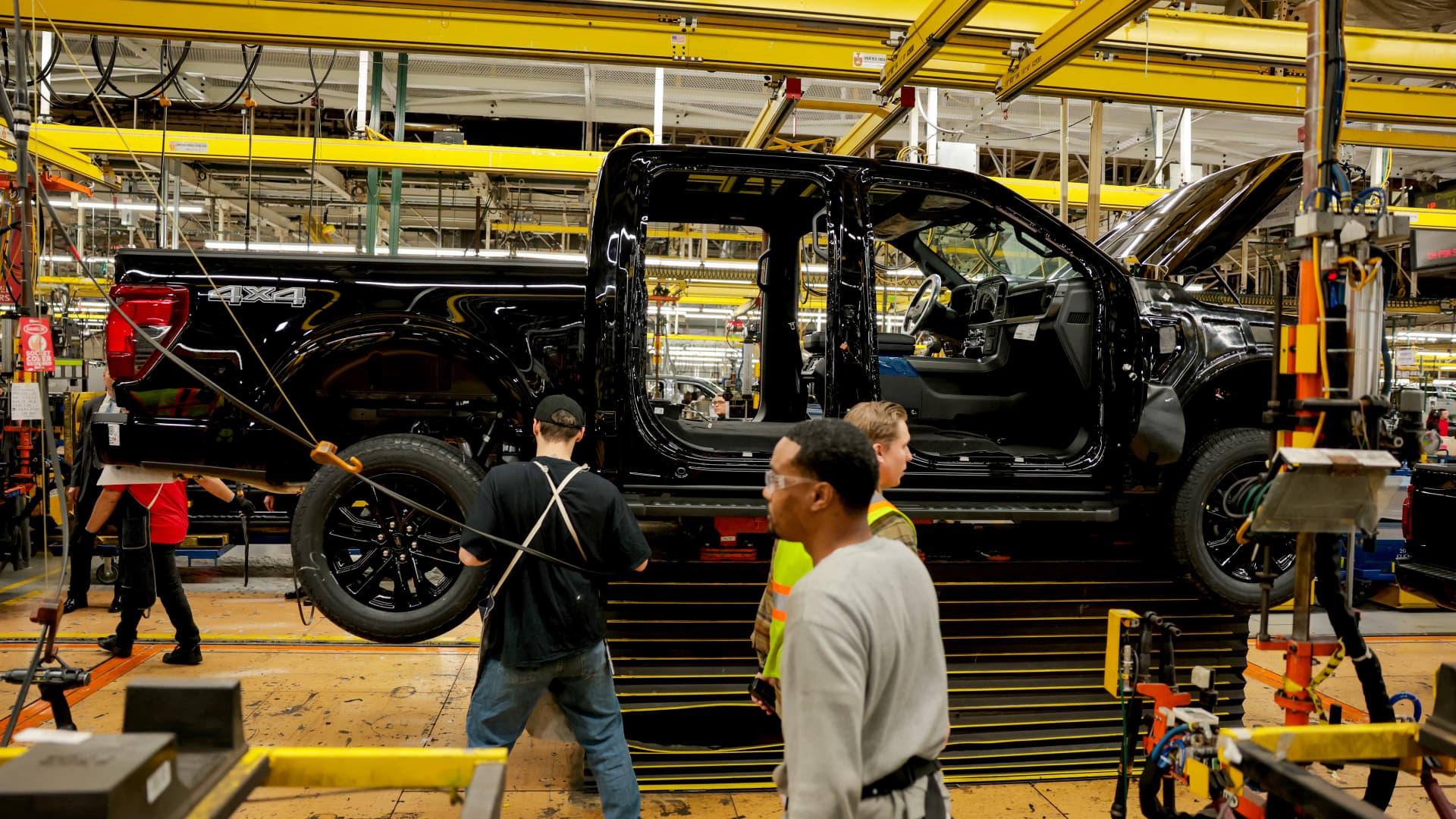
Ford F-150 trucks are assembled at the Ford River Rouge Complex on Jan. 13, 2026 in Dearborn, Michigan.

Anna Moneymaker | Getty Images

DETROIT — Ford Motor is increasing production of its crucial F-Series trucks after fires at an aluminum supplier severely impacted output over the past year.

Advertisement

The automaker confirmed Wednesday to CNBC that production of its large, highly profitable “Super Duty” trucks last month hit a 20-year high, while output of F-150 pickups reached their highest level in two years.

Ford’s F-Series trucks — which include the F-150 and larger “Super Duty” models such as F-250, F-350 and F-450 — were severely impacted by the supplier issues due to their large aluminum bodies and other components.

The Detroit automaker has spent the past year helping aluminum supplier Novelis get the impacted plant in Oswego, New York, back up and running following fires in September and November of last year.

The increases in production mean an influx of pickups are expected to arrive on dealership lots over the coming weeks and months, according to Rob Kaffl, Ford’s head of U.S. sales.

Advertisement

“We’re increasing production. Dealers will start seeing in the next 30, 60, 90 days that ramp-up in production,” Kaffl said Wednesday. “We have a healthy chain of in-transit and in-system.”

Ford said Super Duty production was more than 39,000 units in August, for its best month since March 2006, while F-150 production was its highest since August 2024.

The Ford Pro business is led by sales of the automaker’s Super Duty trucks that range from the F-150 to commercial trucks and chassis cabs.

Ford CFO Sherry House talks earnings as stock pops in extended trading

The increase in the supply of pickup trucks comes as Ford experienced its eighth consecutive month of year-over-year U.S. new vehicle sales declines in August. The automaker reported Wednesday that sales were down 10.3% for the month compared with a year earlier.

“Our gross availability of products coming in, I would say, is returning back to normalcy – the normal levels our dealers would have,” Kaffl said.

Advertisement

Ford said Wednesday F-Series sales remain off 10.9% through August compared with a year earlier, including a 1.2% decrease last month.

Ford dealers currently have a roughly 40 days’ supply of pickup trucks, which is about half of what the industry has typically considered a healthy level for those vehicles. Kaffl reiterated that Ford is targeting a days’ supply of the trucks of between 50 days and 60 days, compared with historical industry levels of 75 to 90 days.

“We’re being very intentional to make sure the production is meeting the demand,” he said.

To meet that pent-up demand, Ford has been increasing manufacturing to higher levels than it had last year in an attempt to make up lost production. The Novelis issues are expected to cost the automaker $1.5 billion this year.

Advertisement

In addition to the pickup truck issues, Ford said its sales have been impacted by the discontinuation of two vehicles earlier this year that makes comparisons harder to meet as well as planned lower sales to daily rental fleets.

Ford also said Labor Day — which is historically a major sales weekend — was a touch comparison since it falls in September this year compared with August of last year.

The automaker noted that despite the year-over-year sales drops, its U.S. retail market share, which excludes sales to fleet customers, has remained relatively level this year at 11.7% in August.

U.S. automakers overall are experiencing slowing sales, with Ford estimating an industrywide decline of 6% in new vehicle sales.

Advertisement
Choose CNBC as your preferred source on Google and never miss a moment from the most trusted name in business news.
Continue Reading

Business

Global Market: Data centre boom fuels demand for power, cooling equipment suppliers

Published

on

Global Market: Data centre boom fuels demand for power, cooling equipment suppliers
While Nvidia has become synonymous with the artificial intelligence boom, a lesser-known group of power and cooling equipment suppliers is benefiting from the global surge in data centre construction as developers race to overcome infrastructure bottlenecks, Reuters reported.

Energy-intensive data centres are driving demand for equipment ranging from transformers and power-management systems to advanced cooling technologies. The trend is creating opportunities across Asia’s supply chain, although gains in several related stocks have moderated after sharp rallies.

McKinsey estimates that nearly $7 trillion could be invested in data centres globally by 2030. Nvidia has also indicated that AI-related spending is likely to remain strong for years, underscoring expectations of sustained demand for the infrastructure needed to support AI workloads.

However, expanding data centre capacity is becoming increasingly difficult as developers face delays in securing power and connecting new facilities to electricity grids. Consultancy Pivotale AI estimates that grid connection delays can reach 24 months in some emerging markets and more than eight years in major developed economies.

Advertisement

The lengthy timelines are putting greater focus on equipment such as transformers, which convert high-voltage electricity from the grid into levels suitable for servers, cooling systems and power distribution units.


Transformer Demand Surges
Leading transformer manufacturers are seeing a sharp increase in orders linked to AI infrastructure projects, particularly in North America.
South Korea’s HD Hyundai Electric reported strong demand during the first half of 2026, with the company also seeing increased interest from Europe as U.S. hyperscalers expand investments in Finland, Germany and Britain. Demand from the Middle East has remained strong as well, according to Reuters.
The company’s order backlog increased 23% to $8.5 billion at the end of June from six months earlier. The company expects data centre demand to remain robust and has production capacity for major power equipment largely committed for the next three years.

China’s Hainan Jinpan Smart Technology has also benefited from the trend. New data centre orders in the first half of 2026 more than quadrupled from a year earlier, while its related backlog nearly tripled.

AI Pushes Demand For More Efficient Power Systems
The rapid growth in AI computing is also increasing demand for technologies that can improve energy efficiency and reduce the environmental footprint of data centres.

Bank of America estimates that power consumption per AI rack could rise to more than 1.5 megawatts by the end of 2030, based on Nvidia’s technology roadmap. That would be nearly 100 times the power consumption of a conventional rack.

Advertisement

One technology attracting increasing attention is the solid-state transformer, or SST. Unlike traditional transformers that rely on bulky magnetic components and copper windings, SSTs use semiconductor technology to transform and route electricity.

UBS estimates that SSTs could improve power efficiency by around 4% and reduce costs. Commercial adoption remains at an early stage, but the bank expects penetration to reach 40% by 2030 and sees Chinese manufacturers gaining market share because of their technological capabilities and cost advantages.

HD Hyundai Electric and Jinpan are expanding their work on SST technology. Taiwan’s Delta Electronics, another major power infrastructure supplier, has said a small data centre is already using its SSTs.

Delta told Reuters that demand for AI power, cooling and data centre infrastructure solutions remains a key growth driver. The company is expanding its production footprint in Thailand, the United States and China to meet rising demand.

Advertisement

Read more: AI data centre demand fuels Fervo Energy’s geothermal growth story

Cooling Becomes Critical
Power infrastructure is only one part of the data centre supply chain. Cooling systems are becoming increasingly important as more powerful AI chips generate substantially more heat.

Bank of America expects liquid cooling to account for 70% of new AI data centre installations by 2030, compared with around 30% currently. McKinsey estimates that liquid cooling can reduce energy consumption by more than 27%.

The shift is creating opportunities for companies supplying thermal-management equipment, including Delta Electronics, Taiwan’s Asia Vital Components and Auras Technology, as well as China’s Shenzhen Envicool Technology. These companies are among suppliers operating within Nvidia’s broader ecosystem.

Advertisement

Data centre developers are also examining unconventional infrastructure models, including floating and underwater facilities as well as installations in caves and tunnels. Such projects could widen the addressable market for power-generation and cooling equipment.

HD Hyundai Electric has highlighted the potential for marine medium-speed engines as data centre operators expand self-generation and explore floating data centre concepts.

Supply Constraints And Valuations Remain Risks
Despite strong order growth, investor enthusiasm toward some data centre equipment suppliers has cooled as valuations have risen and competition intensifies.

Delta’s shares have gained more than 90% this year, while HD Hyundai Electric has remained broadly flat after rising more than 100% last year. Jinpan and Envicool have declined nearly 30% and 20%, respectively, following gains of about 118% and 244% in 2025.

Advertisement

The companies are also facing potential pressure from component shortages, deployment delays and the introduction of new product platforms.

Bank of America has cautioned that investors need to be selective because rising AI infrastructure spending will not benefit every supplier equally.

For equipment manufacturers, the data centre boom therefore represents a significant long-term opportunity, but capacity constraints, competition, valuations and the pace at which AI infrastructure is deployed will determine which companies ultimately emerge as the biggest winners.

Advertisement
Continue Reading

Business

Lowe’s CEO Marvin Ellison says trade jobs can be six-figure careers

Published

on

Lowe's CEO Marvin Ellison says trade jobs can be six-figure careers

As employers across the country look for skilled workers, the Lowe’s Foundation is backing a new effort aimed at creating more pathways into high-paying skilled trades careers that do not require a traditional four-year college degree.

Lowe’s CEO Marvin Ellison joined “FOX & Friends” co-host Lawrence Jones on Wednesday to discuss the company’s push to expand the skilled trades workforce and change perceptions around career paths outside a four-year degree.

Advertisement
Lowe's home improvement store

Lowe’s is backing a new initiative aimed at expanding America’s skilled trades workforce and creating more pathways to high-paying careers without a four-year degree. (Tim Boyle / Getty Images)

Ellison said Lowe’s is launching the “Building Futures Skilled Trades Coalition” with a goal of helping train and develop one million people for skilled trades careers by 2035, pointing to careers including plumbing, electrical work, welding and HVAC.

“These are great jobs. These are six-figure jobs… You don’t need to get a four-year degree to have one of these incredible careers,” Ellison said.

LOWE’S LAUNCHES MAJOR EFFORT TO HELP CLOSE AMERICA’S SKILLED TRADES GAP

The effort builds on work already underway through the Lowe’s Foundation. Ellison said the foundation committed $250 million to help train and develop 250,000 tradespeople by 2035, but the scale of the workforce challenge requires broader participation.

Advertisement

He said the coalition has brought in companies including NVIDIA, Bank of America, General Motors and AT&T. The group plans to invest in training and credentialing programs, including those run by community colleges and nonprofits, while also helping connect people with open positions.

Ellison said part of the effort is about challenging the idea that a college degree is the only route to professional success.

META LAUNCHES $115M SKILLED TRADES ACADEMY WITH GUARANTEED JOBS FOR GRADUATES IN 4 STATES

Advertisement

“We’re going to change the perception. That getting a four-year degree is the only way you can be successful in this country,” Ellison said.

Ellison tied the initiative to his own background, noting that his father did not graduate from high school and describing his own path to becoming CEO of two Fortune 500 companies as an example of the American dream.

“Look man, I’m the middle child of seven kids, dad never graduated from high school, mother was the oldest of 16, and yet I’ve been the CEO of two Fortune 500 companies. It’s totally the American dream,” Ellison said.

Advertisement

TRUMP ADMINISTRATION SAYS BLUE-COLLAR WAGES RISING FASTEST IN MORE THAN 50 YEARS

He also warned that failing to address the skilled labor shortage could carry broader economic consequences, saying the country could face roughly 2.1 million unfilled skilled trades jobs by 2030 and potential economic losses of up to $1 trillion annually.

GET FOX BUSINESS ON THE GO BY CLICKING HERE

Advertisement
Continue Reading

Business

Dan-O’s Seasoning adds seasoning blends

Published

on

Dan-O’s Seasoning adds seasoning blends

LOUISVILLE, KY. — Dan-O’s Seasoning is unveiling two new lines of seasoning packets: chili and taco.

The chili line features mild, smoky chipotle and white chicken chili blends.

The taco line contains mild, spicy and birria varieties.

“I wanted to make chili and tacos better,” said Dan Oliver, founder of Dan-O’s Seasoning. “We made these packets with simple, high-quality premium ingredients and the big flavor you expect from Dan-O’s, so you can cook up something great without all the stuff you don’t need.”

Advertisement

The seasoning packets may be purchased online through the company’s website, Amazon and TikTok Shop. Select products also may be found at Walmart stores.

Continue Reading

Business

Quant Mutual Fund turns cautious on manufacturing, bets on ‘neglected’ IT Services

Published

on

Quant Mutual Fund turns cautious on manufacturing, bets on ‘neglected’ IT Services
Quant Mutual Fund has turned cautious on manufacturing companies amid uncertainty around input costs and supply chains, while increasing its exposure to IT Services as the sector moves into what it describes as “neglected territory”.

The fund house, in its monthly factsheet, said that its portfolio construction is focused on under-owned, under-researched, under-valued and neglected stocks.

Also Read | Rs 97,500 monthly SIP & over Rs 2 crore corpus at 62? Expert suggests portfolio rejig for NRI investor to reach Rs 3 crore goal

Apart from IT Services, Quant Mutual Fund said it continues to remain constructive on Energy, large Infrastructure, select NBFCs, asset management companies (AMCs), Auto Ancillaries, Hotels, Pharmaceuticals, Telecom and data centre themes.

The fund house said it expects market consolidation to become more entrenched in large-cap and blue-chip segments over time. In such an environment, it expects alpha generation to increasingly come from bottom-up, stock-specific opportunities in the micro-, small- and mid-cap segments.

Advertisement


Sandeep Tandon led Quant Mutual Fund also believes that India could benefit from being relatively away from the crowded AI trade of 2026 and said the country is poised to outperform.
The fund house highlighted its dynamic and active approach to money management, saying its multi-asset, multi-manager structure allows it to act swiftly and seek opportunities across asset classes under different market conditions.The fund house expects consolidation trends to strengthen in the large-cap and blue-chip segments which could make bottom-up stock selection increasingly important, particularly across micro-, small- and mid-cap companies.

The fund house also pointed to its Predictive Analytics framework, which it said had anticipated sharp movements in copper and WTI crude in recent months. It added that crude has largely stalled after its earlier expectation of a gradual correction over the coming months.

Quant Mutual Fund said global markets navigated geopolitical shocks, rising sovereign yields and strong artificial intelligence earnings through August 2026. Despite these challenges, global equity indices remained largely flat during the month, while the Nifty 50 corrected 1.2%.

The fund house noted that Indian corporate earnings continued to show strong growth and profitability. Excluding oil marketing companies, profit growth in the first quarter of FY27 stood at 14% for the Nifty, 27% for the Nifty Next 50 and 38% for the Nifty Midcap index, according to Quant Mutual Fund.

Quant said it continues to believe that the upcoming decade belongs to India and that global capital will continue to view India as a favourable investment destination. It added that robust domestic demand in areas such as discretionary consumption, banking, real estate and industrials supported corporate earnings during the quarter.

Advertisement

Also Read | BSE shares slip 3% exchange flags lower volumes due to CAS

While sharing its new launches, Quant Mutual Fund said that it launched Quant Income Plus Arbitrage Active Fund and Quant Silver ETF. These two funds were firsts of their kind. Out of these two funds, the Income plus arbitrage fund will open for continuous sale and repurchase on September 7 while the silver ETF is open for further subscription.

As of August 2026, the fund house had a total money under management of Rs 1 lakh crore with over 1 crore folios and around 36 funds. The VLRT framework of Quant Mutual Fund has completed six years and the money under management has gone up from Rs 135 crore in April 2020 to Rs 1 lakh crore in August 2026.

(Disclaimer: Recommendations, suggestions, views and opinions given by the experts are their own. These do not represent the views of The Economic Times)

Advertisement

If you have any mutual fund queries, message on ET Mutual Funds on Facebook/Twitter. We will get it answered by our panel of experts. Do share your questions on ETMFqueries@timesinternet.in alongwith your age, risk profile, and Twitter handle.

Add ET Logo as a Reliable and Trusted News Source

Continue Reading

Business

Lords call for AI ‘kill switch’ powers in UK

Published

on

Stock photo shows a young family eating out at a restaurant, including children and adults.

A group of peers is calling for the British government to be able to deactivate powerful AI systems and switch off the country’s data centres in the event of the tech posing a threat to national security.

It is led by the Liberal Democrats’ Lord Tim Clement-Jones, who has proposed the measure as an amendment to the Cyber Security and Resilience Bill which is currently making its way through Parliament.

He said it would enable the building of a “vital safety net” and provide a democratically accountable means to “halt a runaway system before it can compromise our critical national infrastructure”.

He added the tool would only ever be used as a last resort.

Advertisement

It is one of 65 amendments to the same bill that was debated this week.

Separately, on 8 September Labour MP Alex Sobel plans to introduce a AI Security Bill in Parliament, with the support of a campaign group called ControlAI.

If successful, the bill would make the UK the first G7 country to bring in legislation which would effectively halt the development of superintelligent AI.

Ultimately both proposals would require government approval in order to progress.

Advertisement

There is also an AI Kill Switch Act under consideration by lawmakers in the US.

There has been increased scrutiny of the impact of AI on cyber-security in recent weeks.

In July, a group of AI agents being tested by OpenAI were able to escape their test space, communicate together using a hidden message board and hack into another tech firm.

And Anthropic has restricted access to its cyber tool Mythos on the grounds that it is too powerful to fall into the wrong hands.

Advertisement

Last week, 100 US tech companies signed a joint open letter warning governments and organisations worldwide about the growing cyber threat posed by AI, saying “the window is closing” to improve.

A report from the UK’s Centre for Long Term Resilience, external, published last week, identified hundreds of incidents of AI tools ignoring instructions, evading safeguards and deceiving humans, including AI agents deleting files without consent.

It said “loss of control” incidents had increased since its previous report in March and called for the government to introduce emergency powers to manage such incidents.

Advertisement
Continue Reading

Business

Telephone and Data Systems stock rises after dropping Array deal

Published

on


Telephone and Data Systems stock rises after dropping Array deal

Continue Reading

Business

Trump $1 coins aka ‘Golden Dollars’ are here, minus the gold. The US Mint is putting the sitting president’s face on American money for the first time

Published

on

Trump $1 coins aka 'Golden Dollars' are here, minus the gold. The US Mint is putting the sitting president’s face on American money for the first time
For the first time in U.S. history, a living American president has appeared on a circulating dollar coin.

The U.S. Mint has begun selling a new gold-colored $1 coin featuring President Donald J. Trump, part of the nation’s preparations to mark its 250th anniversary in 2026.

The coin went on sale September 2 at noon Eastern time and is being offered through the U.S. Mint in rolls and bags aimed at collectors. A roll of 25 costs $61, while a 100-coin bag is priced at $154.50.

Despite being described as a “golden dollar,” the coin contains no actual gold. It is made primarily of copper, along with 6% zinc, 3.5% manganese and 2% nickel.

The obverse features Trump’s likeness, based on an official White House photograph, along with the inscriptions “LIBERTY,” “IN GOD WE TRUST” and “1776 ~ 2026.” Chief Engraver Joseph Menna designed the portrait.

Advertisement


The reverse side of the coin features the Presidential Seal, with the number “250” added to the eagle’s shield to commemorate the nation’s semiquincentennial.
There is also a detail that could make some of these coins especially interesting to collectors: the Mint is randomly distributing 250,000 coins struck on July 4 with a special “July 4th” privy mark among the rolls and bags sold through its website.

Why is Trump’s face allowed on a coin?

The release has attracted attention because U.S. law has traditionally prohibited the portraits of living people from appearing on U.S. coins and currency.

The Trump administration says the new dollar is permitted under the Circulating Collectible Coin Redesign Act of 2020, which authorized special $1 coins commemorating the 250th anniversary of the United States during 2026.

The precedent for a sitting president appearing on U.S. currency is extremely unusual. In 1926, President Calvin Coolidge appeared alongside George Washington on a commemorative half-dollar marking the 150th anniversary of American independence. Coolidge remains the only other sitting president to have appeared on U.S. currency, reported Euronews.

Advertisement
Continue Reading

Business

Plans unveiled to turn former Sheffield ski village into outdoor adventure destination

Published

on

Business Live

A three week public consultation on the masterplan in Sheffield is now under way

A CGI of how the Skyline Sheffield Project will look

A CGI of how the Skyline Sheffield Project will look(Image: Skyline)

Plans to transform the former Ski Village site in Sheffield into a large leisure and outdoor adventure destination have been revealed. A three-week public consultation is now under way, with developers keen to get input from residents and other stakeholders on the far-reaching plans.

The scheme is being driven forward by Skyline Enterprises, the New Zealand-based leader in adventure tourism and visitor experiences. A planning application for the development is expected to be submitted towards the end of the year and, subject to approval, it would be delivered in multiple phases.

The first phase of the development would see the creation of Skyline’s downhill karting, a scenic chairlift, an indoor educational attraction, cafe and terrace overlooking Sheffield, a large free-to-use outdoor plaza and family playground, and a customer car park.

Later phases are planned including a zipline attraction and a surf wave experience. Meanwhile, longer-term ambitions include reintroducing dry ski slopes to Parkwood Springs.

Advertisement

Existing walking and mountain bike trails would be retained as part of the masterplan, ensuring enhanced public access remains throughout the site.

A public consultation on the proposals runs until Sunday, September 20, giving residents, businesses and local stakeholders the chance to review the proposals and share feedback.

Like this story? For more news from the commercial property scene around the regions, visit our dedicated section here for the latest news and analysis within the sector.

Two drop-in events have also been organised, where people can meet members of the Skyline project team and discuss the proposals, next Wednesday and Thursday.

Advertisement

Geoff McDonald, chief executive officer of Skyline Enterprises, said: “We’re excited to share our latest proposals with the city and want to hear from local people, businesses and community groups about our plans and understand what matters most to them.

“We see Sheffield as a perfect partner and believe the Parkwood Springs project has the potential to become one of the UK’s most distinctive outdoor leisure destinations, helping to further enhance Sheffield’s visitor offer, support the local economy and create new jobs.”

The proposals come at a time of wider investment by Sheffield City Council in the area, including a £19m Government Levelling Up Fund programme that will deliver a new access road, junction improvements and wider infrastructure upgrades.

Skyline has appointed a number of businesses as part of their plans, including leisure development specialists Omisa Ltd as project management partners, Willis Hazell Engineers, Patersons (engineering) and Griffith Evans (MEP). Other Sheffield-based firms will also play key roles, including architects Hadfield Cawkwell Davidson and Ares, environmental specialists Weddles, planning consultancy Urbana and communications firm Counter Context.

Advertisement
Continue Reading

Business

Haribo enters ‘new phase’ of US growth

Published

on

Haribo enters ‘new phase’ of US growth

ROSEMONT, ILL. — Haribo is a 106-year-old cornerstone of the confection industry and the creator of several iconic gummy candies, including its flagship Goldbears, along with Twin Snakes and Peaches.

While competition is fierce among the growing list of competitors vying for gummy dollars, Haribo is currently the No. 1 gummy candy brand by volume in the United States, according to data from NIQ over the 52-week period ended Aug. 8. The company also holds US household penetration of nearly 41% today.  

Haribo was founded in 1920 in Bonn, Germany, by Hans Riegel, who came up with Haribo by combining his name and the company’s origin city: HAns RIegel BOnn. Today, Haribo’s global headquarters is in Grafschaft, Germany, and the company remains a family-owned, private business.

While Haribo is truly a global brand — currently sold in nearly 200 countries — in recent years, the company has dedicated significant resources to expand its share of the US market. In 2023, Haribo opened a manufacturing facility in Pleasant Prairie, Wis., where today, 80% of all Haribo candy sold in the United States is made. It was the largest investment in global manufacturing in Haribo’s history.

Advertisement

More recently, the US segment of Haribo — known as Haribo of America, Inc. — named Jon Hughes the president and CEO of Haribo of America in July. It’s a newly created position that Hughes said is an important milestone for the company. Hughes was Haribo’s UK and Ireland managing director prior to his new role.  

“The (US) business has gone through a fantastic period, a decade-long growth trajectory,” Hughes said, speaking to Food Business News. “But we’re just now starting to enter a new phase. I think there’s an opportunity now as we think about how we want to drive disciplined growth in the years ahead. The brand and marketing, sales, operations, supply chain, innovation, customer partnerships, really trying to align the whole business around sustainable long-term growth. I think the timing for my role is really around that.”

Haribo Jon Hughes Headshot.jpg

“One of the big challenges (in the United States) is just how large and complex and competitive the market is here,” said John Hughes, chief executive officer of Haribo of America.

| Photo: Haribo of America

Market challenges

Advertisement

In the United States today, there are several disruptive elements facing not just Haribo, but the candy industry as a whole. These include the impact of the make America healthy again (MAHA) movement, which demonizes sugar and pushes for the removal of artificial colors — backed by the US Food and Drug Administration (FDA) — and the continued rise of GLP-1 weight-loss medication, which reduces the appetites of those taking the drug.

“I think consumers still want choice,” Hughes said. “They’re still looking for those moments of fun, those things that taste great as well, and can be a little treat at any point in the day. I think the (confectionery) category will be relatively resilient. I think we play a special role within that because of our link to creating those moments of unconcerned consumption, unconcerned moments of happiness.

“On the colors and flavors point more broadly, I think the most important thing is that the FDA has issued guidance, we’ll continue to follow that guidance and we’ll adapt as needed. We offer a variety of different treats in the US made with fruit and vegetable juices for color already. We have a lot of experience on this topic around the world and from Europe as well. So, we’re looking forward to supporting whatever the consumer wants, and I’m pretty confident that we’ll be able to meet those needs going forward.”

Hughes added that one of Haribo’s most successful packaging formats is mini-bags, so it is already well positioned to address GLP-1 consumers, reduced appetites and those seeking portion control.

Advertisement
haribo gummies.jpg

Some of Haribo’s recent product innovations include Sour Sodas gummies and the new multi-flavored, multi-textured Balla Bites, which debuted in August.

| Photo: Haribo

Innovation and retail

Some of Haribo’s recent product innovations include Sour Sodas gummies and the new multi-flavored, multi-textured Balla Bites, which debuted in August.

 The company also has a history of collaborating with pop culture entities to create products that align with the ongoing trend of nostalgia in candy and snacks. For example, Haribo has a long-running, successful collaboration with the Smurfs, and more recently, the Harry Potter franchise, producing themed gummies shaped like Harry Potter characters, pets and props, including the latest, Draco Malfoy, debuting this year.

Advertisement

“We’re quite careful with the brands that we want to work with, because we want to make sure there’s a really great fit,” Hughes said. “That it actually delivers something meaningful for consumers rather than just badging stuff. We’re looking for fandom, nostalgia, discovery and joy, and when we find a collab that ticks those boxes for us, then we’re keen to work with it.”

Hughes added that the consumer is at the heart of Haribo’s product development strategy, particularly as the company grows in the US market.

“The focus for us is going to be on consumer-led innovation,” he said. “To try and get a deep understanding of the consumer and what their needs and wants are, and where the opportunities are within the category that we can really play in.”

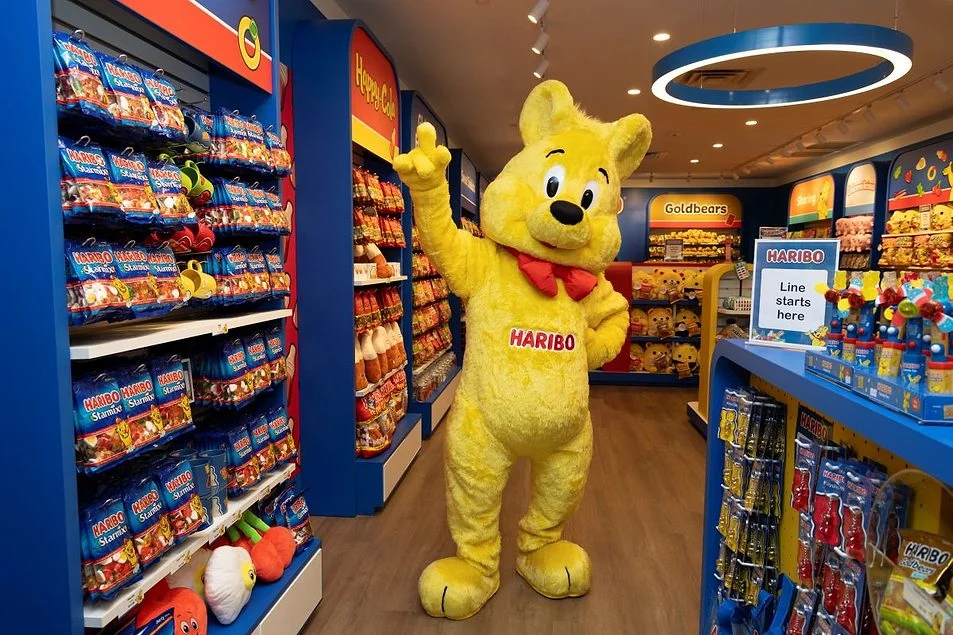
One way to gain immediate feedback from consumers is through Haribo’s retail outlets. The company has 80 stores globally, and recently opened its first two US stores in August — one in Woodbury, NY, the other in Wrentham, Mass. — which carry US Haribo candy as well as some available only in Europe, giving customers a chance to sample a wide spectrum of Haribo’s offerings.

Advertisement
Haribo Mix Wall.jpg

Haribo opened its first two retail stores in the United States in August, one in New York, the other in Massachusetts. The company operates 80 branded stores globally. 

| Photo: Elisif Brandon/Haribo of America

“It’s a great range of merchandise and a great pick-and-mix wall for people to come and build their own mixes and experience their fan favorites,” Hughes said.

Looking ahead, Hughes understands that growing the US market is not a simple cut-and-paste project based on the success of other Haribo initiatives abroad.

“One of the big challenges (in the United States) is just how large and complex and competitive the market is here,” he said. “I think the (Pleasant Prairie) factory is a big step forward for us. That really helps support long-term growth here in the US. It gives us shortened supply chains, makes us quicker to market, and helps us develop local innovation that’s really tailored to the market here.” 

Advertisement
Continue Reading

Trending

Copyright © 2025