
Business
Synopsys Crushed Earnings, But I’m Downgrading The Stock (NASDAQ:SNPS)


I’m a passionate investor from the Netherlands with 12 years of stock market experience. My articles usually contain a good overview of important investment criteria. A stock for my portfolio is of interest to me if the company has the following characteristics:1. Companies that are growing in both revenue, earnings and free cash flow.2. Companies that have excellent growth prospects.3. Stocks with favorable valuations.I prefer steadily growing companies with high free cash flow margins, dividend stocks and stocks with generous share repurchase programs.Disclaimer: My articles do not provide financial advice, they reflect my own findings and insights.
Analyst’s Disclosure: I/we have no stock, option or similar derivative position in any of the companies mentioned, and no plans to initiate any such positions within the next 72 hours. I wrote this article myself, and it expresses my own opinions. I am not receiving compensation for it (other than from Seeking Alpha). I have no business relationship with any company whose stock is mentioned in this article.
Seeking Alpha’s Disclosure: Past performance is no guarantee of future results. No recommendation or advice is being given as to whether any investment is suitable for a particular investor. Any views or opinions expressed above may not reflect those of Seeking Alpha as a whole. Seeking Alpha is not a licensed securities dealer, broker or US investment adviser or investment bank. Our analysts are third party authors that include both professional investors and individual investors who may not be licensed or certified by any institute or regulatory body.


Pigeon Forge City Manager David Wear reflects on how Dolly Parton transformed the local economy, created opportunities for locals and gave back to the community she called home.
Dolly Parton helped transform Pigeon Forge from a small mountain town into a global tourism destination, creating jobs, fueling local businesses and giving back to the East Tennessee community she called home, City Manager David Wear told FOX Business.
“Pigeon Forge and Dollywood kind of grew up together,” Wear said. “After that, it really just took off and made a huge economic impact in our area.”
The country music icon died in Nashville on Aug. 25 at age 80 following a “brief battle with cancer,” her team confirmed to Fox News Digital. Her death prompted global tributes and has deeply affected the community where the star’s influence is woven into the local economy.
Parton partnered with the operators of Silver Dollar City, an existing Pigeon Forge theme park, to open Dollywood in 1986. The attraction helped put Pigeon Forge “on a world map,” drawing visitors from across the U.S. and around the world, according to Wear.
BUSINESS LEADERS PAY TRIBUTE TO DOLLY PARTON AFTER COUNTRY ICON’S DEATH

Parton partnered with the operators of Silver Dollar City, an existing Pigeon Forge theme park, to open Dollywood in 1986. (Leon Morris/Redferns)
“[Dollywood] is a wonderful place. It has kind of put Pigeon Forge not just on the map, but on a world map where people know that Dolly is from here and that’s what they think about when they come to this area,” Wear said.
That visitor traffic has generated a ripple effect for businesses across the region. Dollywood is also Sevier County’s largest employer, according to Wear, creating jobs and paychecks for local families.
From the beginning, Parton wanted to ensure “her people” could find work and build lives in the community where she grew up, Wear said.
“She always referred to her Sevier County home as ‘my people,’” he said.
Although Pigeon Forge welcomes millions of visitors annually, Wear said it remains a tight-knit town of about 6,300 residents.
In the days following Parton’s death, locals have been sharing personal stories about the entertainment icon and her impact on their lives.
HOW DOLLY PARTON BUILT A LEGACY OF GIVING BEYOND COUNTRY MUSIC

Parton’s goal from the beginning, Wear said, was to ensure “her people” had opportunities to work and build lives in the community where she grew up. (Miller Mobley/NBC via Getty Images)
“If you’re from here, you’ve got a Dolly story,” Wear said. “Everybody is really just sharing their experiences, honoring her and, I think, probably trying to live a little better – live a little bit like Dolly.”
Wear said Parton’s philanthropy may ultimately be even more impactful than her role in building the local tourism economy.
“The economic impact is huge. However, I think the larger impact to Sevier County and to Pigeon Forge is her philanthropic work and her charity work,” Wear said.
Wear said he experienced her generosity firsthand through the Buddy Program, which the country star launched in the early 1990s to combat Sevier County’s high school dropout rate. Seventh- and eighth-grade students paired with a “buddy,” and Parton promised each student $500 upon graduating from high school, according to the website for Dolly Parton’s Imagination Library.
Wear participated in the program and later returned to his hometown to work in local government.
“That was my first experience with her,” he said. “It’s just amazing that I got to experience that charity, get to know her a little bit and then come back here to my hometown.”
DOLLY PARTON OPENS DOLLYWOOD’S 41ST SEASON, PROMISES MORE PROJECTS AHEAD: ‘I AIN’T NEAR DONE’

Wear said Parton’s philanthropy may ultimately be even more impactful than her role in building the local tourism economy. (Ron Davis/Getty Images)
Parton again came to the region’s aid after devastating wildfires swept through East Tennessee in 2016.
Through the My People Fund, Parton’s Dollywood Foundation provided financial assistance to families whose homes were destroyed or left uninhabitable.
GET FOX BUSINESS ON THE GO BY CLICKING HERE
“Dolly came in, raised a lot of money and gave it out to her people,” Wear said. “That changed the trajectory of our recovery significantly.”
Those efforts represent only a fraction of Parton’s contributions to East Tennessee, he said.
“Her impact is significant in our economy, but her impact in this community and to the people here is even more significant,” Wear said.
Fox News Digital’s Janelle Ash contributed to this report.
Business
Nifty mega caps are going nowhere. Why Samco CIO Umesh Mehta put 75% of his Flexicap fund beyond largecaps
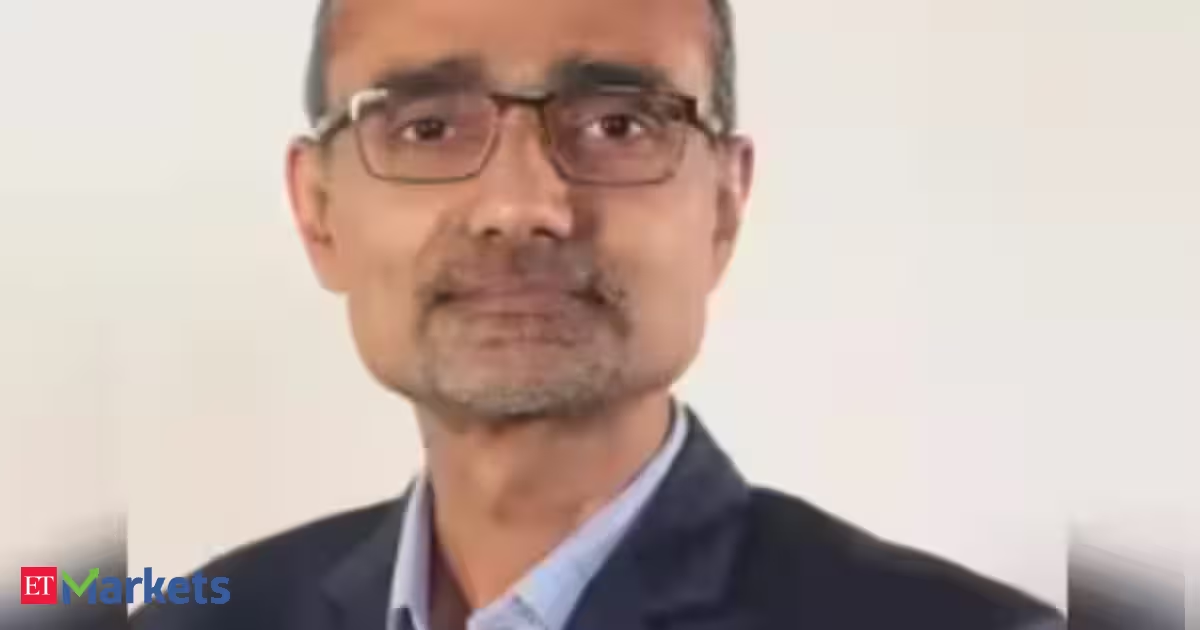
Samco has responded with an unusually aggressive positioning in its Flexicap fund, allocating around 70–75% of the portfolio to mid caps, small caps and select micro caps, while maintaining limited large-cap exposure. Although Mehta sees mega caps offering downside protection, he believes investors seeking growth must take calculated risks beyond the headline indices.
Edited excerpts from an interview.
The Nifty 50 has delivered little at the index level over the past two years, even as sector-specific activity has continued, particularly in mid- and small-cap stocks. Where do you think the market is in the current cycle?
The largest Nifty 50 companies by market capitalisation are languishing. These are mega-cap companies, and traditional businesses globally are not receiving the valuations they historically commanded.

Fortunately or unfortunately, traditional businesses account for a large part of our indices. That is why the headline indices have not generated the kind of returns investors might have expected over the past two or three years. But if you move beyond the mega caps and look at the next rung of the market—mid caps and small caps—there is considerable activity. That should continue because numerous opportunities are opening up.
The world is changing rapidly. Government spending remains supportive, while global developments sometimes provide tailwinds and sometimes create headwinds. There is considerable flux: some stocks are performing well, while others are languishing.At an aggregate level, smaller pockets of the market are moving, but a significant part of the market—large caps and mega caps—is doing very little. Even for foreign institutional investors, it can appear as though India is going nowhere.
In this environment, a bottom-up approach will help investors, traders and asset managers. They need to focus on individual stocks instead of looking only at the headline indices.
After two years of underperformance, do mega-cap stocks now offer value, or should investors continue looking beyond them?
When stocks underperform, can they become good investment opportunities? The answer is yes. But the second question is whether it makes sense to invest in a stock that is already fully owned by everyone. The answer may be no.
Everyone who wants to own these mega-cap stocks may already own them. Every fund and asset manager may have exposure to them, leaving few net new buyers. Even if incremental buyers emerge, there may also be incremental sellers. Investors therefore do not necessarily need to own all these stocks.
The other consideration is where growth is coming from. We are largely looking at growth investing. Small caps, mid caps and other growth stocks are rising, and their valuations may be high because their businesses are growing and investors are willing to pay for that growth.
The market offers a wide spectrum of risk-reward opportunities. Investors seeking safety can consider large mega caps because they may offer downside protection. Those seeking growth will need to take calculated risks and invest in growth companies.
Flexicap funds often tend to have a very strong large-cap bias. How have you positioned Samco Flexicap Fund in this market?
Flexicap funds have traditionally been managed as surrogate large-cap funds. We have instead built our portfolio around the areas where the action and momentum are.
Around 70–75% of our portfolio is tilted towards small caps, mid caps and some micro caps, with very limited exposure to large caps. That is where the market action is, and the portfolio has been designed to capture those opportunities.
The overall earnings season was very good. Mid- and small-cap companies, in particular, delivered an earnings season that broke several records.
Do the earnings delivered by mid- and small-cap companies justify their valuations and the subsequent rally?
We need to differentiate between the sources of those earnings. Did the improvement come from inventory gains, with companies liquidating stock at higher prices, or is there a genuine industry tailwind? Has geopolitics allowed a company to create a sustainable earnings and revenue stream? There are many moving parts.
At an aggregate level, the numbers were good and stock prices reflected that performance. But will the momentum sustain across the board? Obviously not. Supply-chain restrictions remain and are likely to have an impact. The same earnings numbers may not be repeated over the next three or six months.
Some companies will continue to benefit from the advantages they have captured. Refining margins are one example. Integrated companies may face difficulties, but pure refining businesses that are not also involved in retailing could have a significant opportunity. Russian refineries and some Middle Eastern capacity are moving out of the system, which could increase refining cracks and support the earnings of pure refiners. These companies have created genuine economic streams from the war.
Defence is another sector that has developed—and should continue to benefit from—a strong earnings tailwind because of geopolitics. Opportunities will continue to emerge.
Besides defence and oil and gas, which sectors look attractive?
Power, at an aggregate level, offers a significant opportunity. The challenge is that the stock market discounts developments faster than they unfold on the ground. Power projects take time and can face delays, creating a mismatch between secondary-market expectations and project execution.
Over the past three or four years, power stocks have experienced a whipsaw, moving sharply in both directions. Following the correction, the sector looks attractive again, but it remains a long-term theme requiring substantial capital expenditure before earnings follow. Demand and growth are present, but investors need a longer-term horizon to realise that potential.
AI ancillaries also present an opportunity, much like real-estate ancillaries such as cables and related products. Trillions of dollars are being spent globally on artificial intelligence, and Indian companies will participate in parts of that value chain. This could include heavy electrical cables required for power transmission, optical-fibre cables and other AI-related infrastructure.
These opportunities could remain relevant over the next one to two years. Growth investing can work in such areas, and higher valuation multiples may sustain, rewarding investors willing to take the associated risks.
Within power, do you prefer power producers or companies linked to power-sector capital expenditure?
Both. Power generators are undertaking capital expenditure and expanding across thermal, solar and wind power. However, these projects take time to deliver. The opportunity exists, but investors must be patient rather than chase stock prices.
There is also a substantial opportunity in power-sector capital expenditure. India requires investment not only in generation but also in transmission, distribution and substations. In metropolitan areas, distribution will increasingly move underground from the present overhead system. That creates a large opportunity for heavy electrical-cable manufacturers and the engineering, procurement and construction companies that install those cables.
The opportunity is sizeable, sustainable and potentially high-margin. Capacity cannot be created overnight, so heavy electrical-cable manufacturers could have a significant profit-pool opportunity for the next year or two.
Power capital expenditure is currently a very hot market theme, and valuations have risen. However, the sector will correct again because bidding up a stock is much easier than executing a project on the ground. When quarterly numbers fail to meet expectations, some liquidation will follow. Power will remain cyclical rather than move in a straight line. Several power-capex companies are also exporters.
Could exports become a bigger opportunity for power-related companies than the domestic market?
India has performed well in domestic power and solar manufacturing, and today there is overcapacity. Globally, however, solar capacity remains inadequate outside China. The US has a substantial deficit and needs additional power generation, although vested interests and lobbying are affecting the entry and impact of renewable-energy players. Politics therefore plays an important role alongside economics.
Solar is the quickest way to add power capacity, as India has demonstrated. China and Europe are also expanding, and the US will eventually have to do the same. But these opportunities will not be determined by economics alone; politics will remain an important factor.
Indian companies with solar-cell and module-manufacturing capacity currently face headwinds, although the sector retains considerable long-term potential. Nuclear power is another emerging theme, but its gestation period will be long.
Is this the right time to invest in the nuclear-power theme?
When we speak with industry participants, they indicate an eight-to-10-year time frame before the first nuclear power begins flowing and companies start earning from it. That illustrates the length of the gestation period.
The stock market can bid up share prices well before plants are established. When the narrative is driven by a theme, government support or a policy tailwind, the relevant stocks can rise. But as time passes and execution does not immediately follow, those stocks can become available at lower valuations.
That would be the more appropriate time to evaluate nuclear-power investments, rather than bidding up the stocks now, including companies catering to the broader nuclear ecosystem.
Could the high earnings base begin weighing on sectors such as automobiles and consumption from the second half of the financial year?
Automobiles are a typical sector where the base effect could become visible. The GST reduction was the opposite of a black swan—a “good swan.” That favourable window is likely to end, after which the high-base effect will begin to play out.
The auto index is already correcting. The last phase of the rally was concentrated in auto ancillaries, where considerable euphoria emerged. Eventually, reality should set in.
Maruti is near the bottom of the return table even though Maruti, Hyundai and Mahindra are among the biggest customers and value accumulators for these ancillary businesses. Auto ancillary stocks have outperformed the passenger-vehicle manufacturers they supply. The market should eventually recognise this divergence. The cyclical effect will reassert itself, leading to a correction and normalisation in prices.
Some auto-ancillary companies are increasing exports and diversifying into areas such as aerospace. Could that cushion the domestic slowdown?
Exports represent a significant opportunity, although their current contribution remains small for passenger-vehicle and commercial-vehicle manufacturers in aggregate. The impact is more visible for ancillary companies because the incremental export opportunity is substantial relative to their size.
India aspires to become a global manufacturing and automotive hub, and the government is supporting that ambition. These companies continue to generate domestic sales while also expanding exports.
If exports perform well, they could make the Indian automobile sector more secular and less cyclical from an investment perspective. For now, however, exports remain a relatively small proportion of the business. The high-base effect in the domestic market should therefore result in mean reversion, with automobile stocks likely to correct.
Over time, investors should monitor export growth. Bajaj Auto, for example, is performing very well in overseas markets, and other companies will eventually attempt to expand their export presence.
How do you assess the current IPO momentum and the quality of new listings?
IPO momentum is strong, but if it keeps accelerating, it could take momentum away from the secondary market. Liquidity is the biggest driver of stock-market performance. If liquidity is absorbed by primary issuances, that may be positive for the economy, but it can create difficulties for the secondary market.
If increasingly large IPOs continue to arrive, retail money channelled through mutual funds is absorbed by new supply, and FIIs do not return, the net liquidity equation becomes adverse. When liquidity deteriorates, markets can correct.
Either FIIs must return and provide enough liquidity to sustain the market, or IPO supply must slow. If fundraising continues at this scale, it could wreck the market. One of those two conditions needs to change for the market to sustain. We have seen this dynamic since 2024.
The supply pressure is not limited to IPOs. We are also seeing offers for sale, including LIC’s ₹32,000-crore OFS, along with numerous qualified institutional placements.
Consider the market as an investor facing a series of suppliers. If one issuer takes ₹30,000 from the investor and another subsequently seeks ₹20,000, the investor must either find additional money or sell an existing holding. At an aggregate level, a continuous stream of new supply eventually forces selling in the secondary market, creating a cascading effect on prices.
With the possibility of interest-rate cuts and renewed momentum in gold, how should investors approach asset allocation?
The past five or six years were very good for equities, but they were also very good for gold. Over the next two, three or five years, gold will remain an equally important asset class that investors should not ignore, as long as the current US administration remains in power.
Gold has historically delivered strong or comparable returns. The probability of gold generating better risk-adjusted returns is now much greater than it was two, three or five years ago.
As geopolitics intensifies and currencies are increasingly weaponised, the world is recognising that gold is money. Governments and investors cannot rely exclusively on electronic forms of money. A reserve currency gives its issuer the power to impose sanctions. If that currency is repeatedly weaponised, countries will become more inclined to diversify into gold because their savings are otherwise held in a system that can be used against them.
The reported freezing of a judge’s assets because of a decision favouring a particular country is another trigger for governments and investors to reconsider their gold exposure. Gold is currently in a strong secular bull-market trend.
Investors should allocate to gold through instruments such as exchange-traded funds or multi-asset allocation funds. It is time to consider gold alongside equities as a means of preserving wealth because markets can surprise on both the upside and downside.
For a moderately aggressive investor with a five-to-10-year horizon, should the allocation to gold exceed 10% and potentially reach 15–20%?
Easily. Whether one begins the comparison in 1979, 2000 or 2010, gold has generally delivered returns that were either better than equities or within one or two percentage points of them. Although gold’s long-term return has been slightly below the Sensex, it remains a wealth creator.
Gold cannot manipulate itself and does not generate negative or positive earnings surprises. It is a pure demand-and-supply asset: if demand rises, its price increases, and if demand falls, its price declines.
The precious-metals universe is also relatively simple, consisting primarily of gold and silver. By owning one asset, investors have historically generated returns, whereas equity investors must select from thousands of stocks while managing a much wider spread of risks to deliver a similar outcome.
Gold is therefore a valuable asset class. Over a one-year horizon, it could deliver better returns than equities. Over five to 10 years, its returns should be broadly in line with equity returns.

After having been in the investing world for more than 25 years from private banking and investment management to private and venture capital; I have pretty much “been there and done that” at one point or another. I am currently a partner at RIA Advisors in Houston, Texas. The majority of my time is spent analyzing, researching and writing commentary about investing, investor psychology and macro-views of the markets and the economy. My thoughts are not generally mainstream and are often contrarian in nature but I try an use a common sense approach, clear explanations and my “real world” experience in the process. I am a managing partner of RIA Pro, a weekly subscriber based-newsletter that is distributed to individual and professional investors nationwide. The newsletter covers economic, political and market topics as they relate to your money and life. I also write a daily blog which is read by thousands nationwide from individuals to professionals at www.realinvestmentadvice.com.

TaskUs surges 61% after InvestingPro Fair Value identified opportunity
Business
Jose Mourinho Says the Ballon dOr Should Honor Legacy Like Messi and Maradona, Not Trophies or Politics

MADRID — Real Madrid manager Jose Mourinho has renewed his long-running criticism of how the Ballon d’Or is awarded, arguing football’s most prestigious individual honor should go to players whose legacies endure for decades rather than to those who happen to win the Champions League or a World Cup in a given season.
Mourinho made the comments during a press conference Saturday ahead of Real Madrid’s La Liga match against newly promoted Malaga at the Santiago Bernabeu, with this year’s Ballon d’Or ceremony approaching next month. “It’s a very beautiful thing individually and it goes into the individual history of a player,” Mourinho said, according to comments reported by Forbes. “It’s normal that the 12 players of a very high level, of which we have three or four, have the ambition to win it.”
The Portuguese coach then laid out his central argument for what should determine the winner. “For me, the Ballon d’Or has to go to one of those players who, when they retire, we miss them for eternity,” Mourinho said, according to Fabrizio Romano and multiple outlets covering the press conference. “Maradona, Cristiano, Messi, R9, Zidane… You can’t give the Ballon d’Or to a guy just for winning the UCL or the World Cup. If you should give it to someone just for winning the UCL, then give it to Luis Enrique.”
Mourinho went on to argue that the award should be reserved for the sport’s most dominant individual talents regardless of club affiliation or nationality, a pointed remark given that this year’s leading contenders reportedly include several Real Madrid players. “No, it needs to go to the best player in the world, not necessarily a Spanish guy, or a PSG player. It needs to go to one of the 3-4 best players in the world, and those guys are HERE,” Mourinho said, according to the same reporting, though he stopped short of naming any current player directly by name in that portion of his remarks.
The Real Madrid boss also took aim at what he described as political influence shaping the voting process. “But politics come into the Ballon d’Or, so I don’t like getting into politics,” Mourinho said, according to Vanguard News’s account of the press conference. He added that he was not attempting to reinvent how the award is decided with respect to Spain’s national team or Paris Saint-Germain, saying instead that identifying the world’s best player “is something else” entirely from team-based accolades.
Mourinho’s comments come as speculation continues to build over who will win this year’s award, with outlets including Yardbarker and Fanzword noting that three Real Madrid players, Kylian Mbappe, Vinicius Junior and Jude Bellingham, are widely expected to feature prominently on the shortlist. That expectation carries some irony, given that Real Madrid have gone without a major trophy over the past two seasons, a drought that has intensified scrutiny on Mourinho’s tenure at the club even as individual members of his squad remain considered among the world’s elite talents.
This year’s ceremony carries additional significance beyond the usual debate over winners and criteria. The 70th Ballon d’Or gala is scheduled for Monday, Oct. 26, and will mark the first time in the award’s history that the ceremony will be held in London rather than Paris, according to reporting from Yardbarker. France Football, the publication that created and has organized the Ballon d’Or since 1956, has awarded the prize annually to the player judged to have had the best individual season in men’s football, with a separate award for women’s football added in more recent years.
Mourinho’s remarks echo criticism he has voiced in previous years about the award’s criteria and voting process, though this year’s comments arrive with sharper specificity about which past players he believes exemplify the standard the award should uphold. His list of examples spanned multiple eras of the sport, from Diego Maradona and Zinedine Zidane to Ronaldo Nazario, Ronaldinho and both Cristiano Ronaldo and Lionel Messi, players widely regarded among the most influential in the sport’s history regardless of how many Ballon d’Or trophies they ultimately won during their careers.
Messi holds the record with eight Ballon d’Or titles, while Ronaldo has won the award five times, and both players have previously been the subject of debate over how heavily team success, individual statistics and broader career legacy should factor into the voting. Mourinho’s comments Saturday suggest he believes the balance has tilted too far toward team achievements and away from recognizing players capable of leaving what he described as a lasting, unmistakable mark on the sport.

Jackson Hole Just Changed The Game

SpaceX set to launch NASA’s $4.3 billion Roman space telescope

Street Calls of the Week


My investing journey began at 15, sparked by a deep curiosity for markets and shaped by my father’s career in finance. What started as a fascination with Warren Buffett’s annual letters quickly evolved into a full-time passion for value investing, mental models, and understanding how great businesses create long-term value. I’ve spent years independently studying financial statements, building DCF models, and analyzing companies through both fundamental and behavioral lenses. While I’m still early in my professional path, I’ve been immersed in the world of investing for nearly a decade. From dissecting shareholder letters to reverse-engineering business strategies, I’ve developed a disciplined, fundamentals-first approach grounded in long-term thinking. I focus on identifying mispriced quality companies and understanding what makes certain business models resilient across cycles. I write on Seeking Alpha to share insights, test ideas in public, and contribute to a community of investors who value clear thinking over hype. My goal is to provide thoughtful, research-backed commentary, whether on under-the-radar compounders, Growth/GARP stocks, or misunderstood tech platforms. Above all, I invest with conviction, patience, and a relentless drive to keep learning.
Analyst’s Disclosure: I/we have a beneficial long position in the shares of ALAB, CRDO either through stock ownership, options, or other derivatives. I wrote this article myself, and it expresses my own opinions. I am not receiving compensation for it (other than from Seeking Alpha). I have no business relationship with any company whose stock is mentioned in this article.
Seeking Alpha’s Disclosure: Past performance is no guarantee of future results. No recommendation or advice is being given as to whether any investment is suitable for a particular investor. Any views or opinions expressed above may not reflect those of Seeking Alpha as a whole. Seeking Alpha is not a licensed securities dealer, broker or US investment adviser or investment bank. Our analysts are third party authors that include both professional investors and individual investors who may not be licensed or certified by any institute or regulatory body.

US Treasury’s Bessent faces G20 diplomacy test amid tariffs, Iran war, bond turmoil
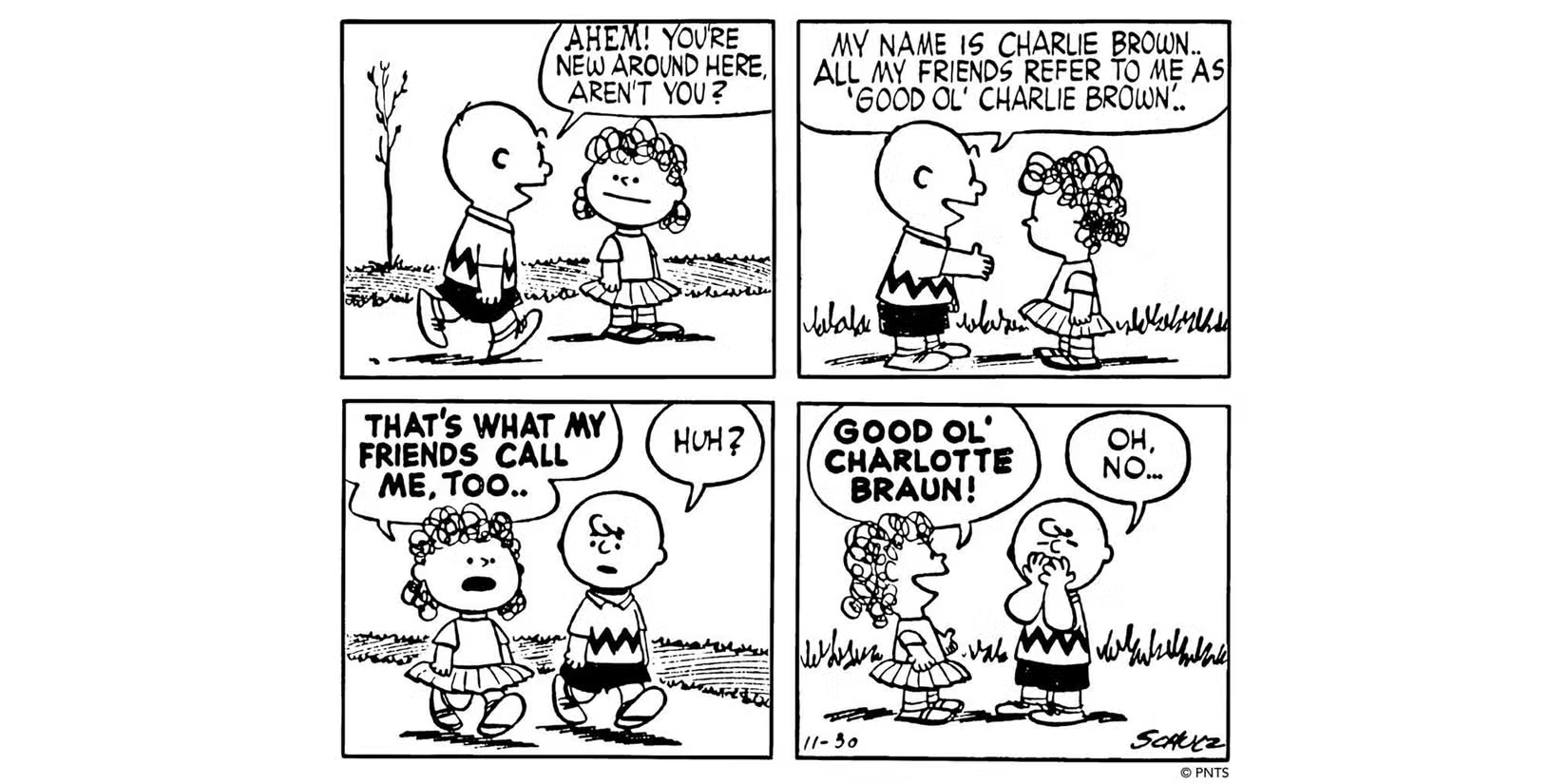
‘Peanuts’ Killed Off This Forgotten Character After Just 10 Appearances

Chelsea vs Brighton – Premier League LIVE: Blues look to end rancid recent record against the Seagulls plus updates of all other 2pm games

How Dolly Parton transformed Pigeon Forge into Tennessee tourism powerhouse





-

 Crypto World4 days ago
SpaceX stock could rise 75% to $240, JPMorgan says
-

 Fashion2 days ago
Weekend Open Thread: Maeve – Corporette.com
-

 Crypto World3 days ago
Bitcoin’s 22% rally now needs real demand to outlast Treasury liquidity boost
-

 Crypto World4 days ago
Warsh Jackson Hole keynote puts financial innovation first
-

 Crypto World5 days ago
A $30 Billion AI Fund Implodes, Now the SEC Is Investigating Wall Street’s Role
-

 Business2 days ago
Salesforce Stock Soars 19% as Blowout Earnings and Agentforce AI Growth Silence Software Skeptics
-

 Crypto World4 days ago
Did Trump Just Move SpaceX Stock With One Truth Social Post?
-

 Business4 days ago
Walmart takes aim at younger shoppers with new fashion brand
-
 NewsBeat4 days ago
Lindsay Clancy jury braces for closing arguments as judge tells court: ‘You’ve heard all the evidence’ – Live updates
-

 Crypto World4 days ago
Elon Musk Grok Bot Promise: We Will Make You Whole if AI Loses Your Money
-

 Crypto World1 day ago
Bitcoin price tests $82K resistance as Brandt stays long
-

 Business2 days ago
Apple Confirms September 9 Keynote and Reveals Its Full Pre-Order Schedule
-

 Business6 days ago
Moderna CEO warns China is pouring state money into mRNA technology
-

 Crypto World3 days ago
NVIDIA revenue hits $96.2B as AI demand doubles
-

 Business4 days ago
Thailand’s Eastern Economic Corridor Capital City (EECiti): Key Developments and Investment Opportunities
-

 Business2 days ago
iPhone 18 Pro Pre-Orders Could Shift to Saturday as Apple Reportedly Avoids September 11 Anniversary
-

 Business6 days ago
NVIDIA Stock Drops Nearly 2 Percent to $210 on Seventh Losing Day Ahead of Critical AI Earnings
-
 Crypto World6 days ago
$92 Billion Nvidia Earnings Could Make or Break the AI Trade
-
 NewsBeat4 days ago
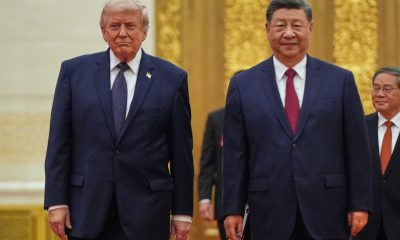
Trump’s trade truce with China faces test with Iran effort
-

 Crypto World2 days ago
Truflation calls for Fed rate cut after PCE forecast
You must be logged in to post a comment Login