As the New York Knicks clinched their first championship in 53 years and the NBA notched its highest Finals series ratings since 1998, professional basketball was inking another record.
The five-game series between the Knicks and the San Antonio Spurs generated “15 billion views and counting on social media, the most ever for an NBA Finals and nearly triple the previous record set in 2025,” according to the NBA. Game 5 alone generated more than 4 billion views on social media platforms, breaking the record set three days prior by Game 4.
It’s emblematic of an intensifying battleground in live sports as professional leagues seek to reach new and younger fans and media consumption shifts online.
TV and streaming platforms have been attracting some of the biggest audiences for live sports this year. The NBA Finals series claimed an average of 20.6 million viewers per game on Disney’s ABC and ESPN networks.
Advertisement
And yet social platforms like TikTok and Google’s YouTube are claiming a disproportionate amount of viewing time for Generations Z and Alpha — often at no cost. That’s left the sports leagues and live rights holders weighing whether to go all in on social as a funnel for future audiences or to reinforce the walled garden of subscription programming to offset rising broadcast fees.
New York Knicks fans gather outside of Madison Square Garden before Game 4 of the NBA Finals between New York Knicks and San Antonio Spurs, on June 10, 2026 in New York City.
Adam Gray | Getty Images
“It’s always a question of what the leagues are doing versus what the rights holders want to do,” said Jonathan Miller, a former Fox Corp. and NBA executive who currently serves as chief executive of Integrated Media, which specializes in digital media investments.
Advertisement
“Reaching and cultivating the youth sports base is a major priority and focus of the leagues themselves,” Miller said. “In today’s fragmented landscape, it is no longer a luxury to have a young base, it is a necessity to ensure a healthy future.”
New fans, new ways to watch
For years YouTube has snagged the biggest share of streaming viewership, according to Nielsen’s monthly report known as “The Gauge.”
Rather than watching live games in their entirety, consumers are increasingly watching sports clips, highlights, athlete-made videos and creator content on social platforms.
According to S&P Global’s 2025 “State of U.S. sports viewing” report, 68% of sports viewers reported watching live games on TV or through streaming; 38% reported watching highlights, interviews and other clips on social media, YouTube and other platforms; and 12% said they interact with social media accounts or fan forums for professional players, teams or leagues.
Advertisement
“What we’re seeing today is the evolution of consumption,” said Adam Kelly, president of global sports marketing agency IMG.
The TKO Group–owned firm packages and sells media rights and brand rights as well as providing consultancy on some of the biggest TV deals globally.
Live games that are aired exclusively on streaming consistently draw significantly younger audiences than those aired on linear TV, according to Nielsen, which recently began breaking down weekly sports viewership consumption.
If you are the broadcaster and proactively using your social and digital platforms to push out tons and tons of highlights and content … you’re kind of feeding the beast.
William Mao
Advertisement
senior vice president of media rights consulting at Octagon
The NBA Finals saw an increase in new viewers to streaming platforms like Disney’s ESPN, according to Apptopia. Even streaming-only versions of pay TV bundles like Fubo and YouTube saw similar results.
However, when broken down by age, those new viewers for the NBA postseason tended to skew older, according to Apptopia’s data.
ESPN streaming saw an increase of 38% in new users over the age of 46, while the youngest cohort between 17 and 25 was up just 8%. For Fubo and YouTube, the growth was also heavily skewed toward the over-46 audience.
Advertisement
“Our hypothesis when it comes to young fans is that they play a very important part in consuming sport and will continue to, but their consumption behavior is slightly different,” said Kelly. “People talk about fragmentation of the audience, but actually, consumption numbers have continued to increase.”
Sports highlights
Industry executives told CNBC that as sports migrate more and more onto social platforms, the content is acting as a conduit to live games, not a pure replacement.
“It’s just a continued development of the accessibility of content — a lot more platforms in the marketplace catering to short-form content,” said William Mao, senior vice president of media rights consulting at Octagon, a global sports and entertainment agency.
Mao said the rise of social content around live sports is an acknowledgment that companies need to “target and engage those younger demographics, those future consumers … where they are,” Mao said.
Advertisement
The appetite for clips is creating something of a land grab between leagues and media rights holders, according to Mao.
Both the broadcasters and the leagues have their own social media presences. If multiple accounts want use of the same footage, it could dilute the audience.
Mao said as a result, media negotiations can go so far as to determine how long a highlight or clip can be used exclusively on one platform versus another.
The hope is that a healthy highlight reel on social feeds spurs interest among younger fans in live matchups.
Advertisement
Alicia Windzio | Picture Alliance | Getty Images
Rollo Goldstaub, the global head of sport at TikTok, said 42% of users watching sports content on the short-form video platform will go on to tune into a live game on TV or streaming.
Goldstaub said his job includes making sure the platform has content from across the sports ecosystem — the leagues, athletes, media broadcasts and content creators. He said content directly from the broadcaster or the league, such as game highlights, typically has high engagement.
IMG’s Kelly said younger audiences “have been asked to fit into the existing framework when it comes to sports consumption.”
Advertisement
“Distribution has stayed very much on the traditional means of delivery because it’s what worked so well for so long,” he said. “Non-linear [TV] young fans are spending most of their time on these platforms. Their preference is to consume content where they’re already consuming other material.”
While there are ways to monetize highlights and content on social media — such as ad revenue sharing on platforms like YouTube and other sponsorship opportunities — the main source of value for these games comes from the airing of the live matches on TV and streaming.
With sports fees skyrocketing, the need to earn that investment back grows.
The NBA is in the early years of its 11-year, $77 billion deal. The NFL, which is in the midst of its own 11-year deal worth a record $111 billion, has put heavier weight on advertising to drive revenue.
Advertisement
“There’s an argument that if you are the broadcaster and proactively using your social and digital platforms to push out tons and tons of highlights and content, you’re kind of accelerating that trend even further right?” Mao said. “You’re kind of feeding the beast.”
Reaching young fans
To embrace younger fans, the major players are starting to adapt.
FIFA, the governing body over the World Cup, is allowing its global broadcasts to post more content on TikTok, whether that’s of the matches themselves or surrounding game footage.
The tournament is currently underway in the U.S., Canada and Mexico, and the first 10 minutes of every match can be shown on TikTok. When the stream ends there’s a direct link to stream the game, shown in the U.S. via networks owned by Fox and Comcast’s Telemundo.
Advertisement
Malik Tillman #17 of the United States is challenged by Miguel Almiron #10 of Paraguay during the FIFA World Cup 2026 Group D match between USA and Paraguay at Los Angeles Stadium on June 12, 2026 in Los Angeles, California.
Dean Mouhtaropoulos | Getty Images Sport | Getty Images
In February, the NBA leaned into creator content during its All-Star weekend, inviting more than 200 digital natives to the event.
Rights holders Paramount Skydance and Disney have rolled out kid-friendly simulcasts to capture the youngest fans who may be tuning in alongside their parents.
Advertisement
Paramount’s CBS has aired alternate broadcasts of live sports on its children’s TV network Nickelodeon — from Christmas Day games to the 2023 Super Bowl — complete with slime graphics and characters like SpongeBob SquarePants running on the field.
Disney has tapped into its intellectual property for ESPN’s NFL games, too, including overlays with characters from films like “Monsters Inc.” and “Toy Story.”
And leagues across sport have partnered with Gamefam, a leading Roblox game developer, to bring their team jerseys and content to the video game platform that’s popular with Gen Z and Gen Alpha.
Roblox collaborated with Paramount for its Super Bowl broadcast on Nickelodeon, which became the biggest event ever on Roblox with 70 million visits in 30 days: “It was huge,” said Gamefam CEO Ricardo Briceno.
Advertisement
Briceno noted that building fandom and converting users from Roblox to beyond the platform is “very important.” That could mean watching a game or buying a jersey or other merchandise.
“That’s the funnel. You build awareness and love for the brand, then you put your dollars into it,” said Briceno.
From TV to tech
There’s a flipside to fueling the funnel.
The tech companies and streamers acting as a bridge to younger viewers are becoming established bidders for the live games in their own right.
Advertisement
Google’s YouTube, Amazon’s Prime Video, Apple and Netflix have begun to nab more games and garner big viewership numbers.
NFL Commissioner Roger Goodell at the Netflix advertising presentation in 2025.
Courtesy of Netflix
NFL Commissioner Roger Goodell has been vocal about meeting young fans where they are on streaming services. The NBA’s latest media deal brought in Prime Video to replace Warner Bros. Discovery’s TNT Sports. YouTube aired its first-ever NFL game in September.
Advertisement
The strategy appears to be working. The NBA scored some of its highest-rated games this season, and the NFL’s “Thursday Night Football” on Prime Video has continued to capture more viewers — delivering its most-watched season in its 20-year history.
Still, IMG’s Kelly, TikTok’s Goldstaub and others said they don’t view the shift toward social media as a threat to the traditional media partners.
“We can be that partner that’s driving the value of these younger and more likely female fans, the ones that broadcasters are struggling to reach,” Goldstaub said.
“I think right now we’re really happy operating in this space of almost like part of the game,” he said. “We get to promote the full match live, we get to promote the broadcaster, but we also get to give users something really amazing and interesting to see.”
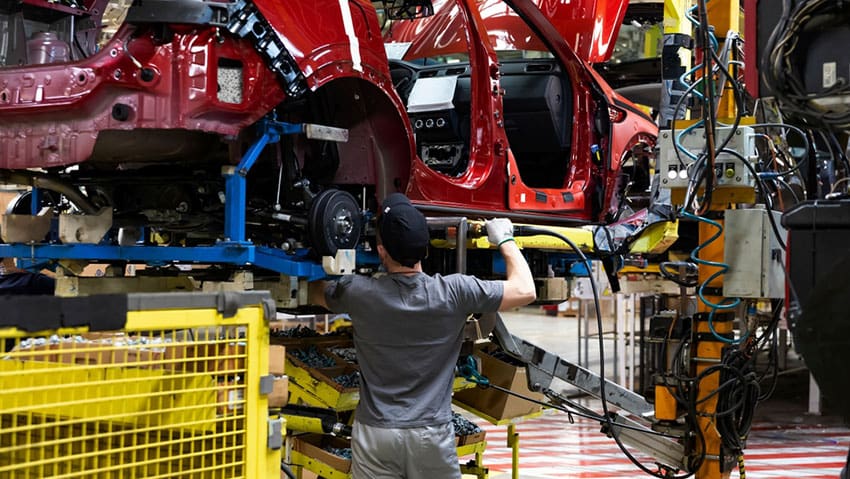
Britain’s beleaguered car industry has eked out its first monthly increase of the year, a flicker of momentum that the trade body warns could just as easily be snuffed out by stubbornly high energy costs and a fractious global trade picture.
Factories rolled 49,200 vehicles off their lines in May, up 2.3 per cent on the same month a year earlier, according to the Society of Motor Manufacturers and Traders. It is a modest figure by historical standards, but a welcome one after a run of declines that had become wearily familiar to anyone watching the sector.
The catch, and there is always a catch, is that the year-to-date numbers remain firmly in the red. UK plants have produced 306,000 cars in the first five months of 2026, down 4.1 per cent on the same period last year. May’s bounce, in other words, has trimmed the deficit rather than erased it.
Some of the month’s improvement is a quirk of the calendar. This time last year, Jaguar Land Rover, the Solihull-based maker of the Range Rover, paused shipments to the United States after President Trump slapped fresh tariffs on British exports. Set against that depressed base, almost any number was going to look better. The plants behind the figures read like a roll-call of what remains of British volume manufacturing: Nissan in Sunderland, JLR in Solihull and BMW’s Mini factory in Oxford.
It is worth holding May’s number up against the longer arc of decline. In 2016, when the country voted to leave the European Union, Britain was assembling more than 1.7 million cars a year. The current rolling 12-month average sits at 704,000, less than half that. The slump has been a long time in the making, and a single good month does not reverse it.
Advertisement
If the car numbers are sobering, the commercial vehicle figures are grim. UK factories built 11,500 vans in the year to date, a fall of 60 per cent year-on-year. On a rolling 12-month basis the total stands at 30,000, less than a quarter of what the country was turning out just two years ago.
The collapse follows Stellantis’s decision to shut its historic Luton van plant and convert Ellesmere Port into a low-volume electric van operation. The owner of Vauxhall has, in effect, taken a large slice of British van-making capacity off the board, and the data now reflects it. The country’s output recently slid to its lowest level in decades, a reminder of how quickly industrial capacity can erode once the investment case weakens.
The SMMT, which compiles the figures, is blunt about the causes: punishing energy costs, the unpredictability of international trade, particularly with the United States, and a domestic market that remains soft.
“May’s growth is welcome, and the priority must be to turn this into a sustained recovery by making the UK more competitive as a place to make and sell vehicles,” said Mike Hawes, the society’s chief executive.
Advertisement
He also pointed to a threat on the horizon. New EU trade barriers due next year could shut British automotive firms out of European supply chains if their products or components are deemed to be manufactured outside the bloc, a technicality with potentially expensive consequences for an industry that sends most of its output across the Channel. The full breakdown sits in the SMMT’s vehicle manufacturing data, and the message running through it is consistent: the firms that survived the long contraction are doing so on the finest of margins.
For now, the industry will take the win. A single month of growth is not a recovery, but after a year that has tested the sector’s resilience to the limit, it is at least a reason to look up. Whether it becomes the start of something more durable depends less on the factories themselves than on the cost of the electricity that powers them and the trade rules that govern where their cars can go, themes the government set out to address in its advanced manufacturing plan.
Jamie Young
Jamie is Senior Reporter at Business Matters, bringing over a decade of experience in UK SME business reporting.
Jamie holds a degree in Business Administration and regularly participates in industry conferences and workshops.
When not reporting on the latest business developments, Jamie is passionate about mentoring up-and-coming journalists and entrepreneurs to inspire the next generation of business leaders.
Fidelity’s mission is to strengthen the financial well-being of our customers and deliver better outcomes for the clients and businesses it serves. With assets under administration of $12.6 trillion, including discretionary assets of $4.9 trillion as of December 31, 2023, Fidelity focuses on meeting the unique needs of a broad and growing customer base. Privately held for 77 years, Fidelity employs more than 74,000 associates with its headquarters in Boston and a global presence spanning nine countries across North America, Europe, Asia and Australia. Note: This account is not managed or monitored by Fidelity, and any messages sent via Seeking Alpha will not receive a response. For inquiries or communication, please use Fidelity’s official channels.
Nissan has reportedly stopped work on a fully electric version of its bestselling Qashqai model at its Sunderland plant, as the Japanese car giant battles losses and pushes through a sweeping global restructuring plan.
Nissan’s Sunderland plant.(Image: Nissan)
Nissan has reportedly stopped development of a fully electric variant of its best-selling Qashqai model which was due to be built at its Sunderland factory.
Nissan pioneered the crossover segment when it introduced the Qashqai 16 years ago, sparking production of millions of vehicles, and in 2022 it confirmed that the Qashqai would feature its innovative e-Power technology. However, Reuters has reported that the Japanese automotive manufacturer quietly ceased work on the EV variant at its North East facility last year.
The news emerges as the company attempts to streamline its range and implement cost reductions across the organisation, having suffered a second consecutive year of losses as it recorded a net loss of approximately $3.4bn. It was in 2023 that Nissan confirmed its dedication to manufacturing new electric models at its Sunderland site, a year after unveiling plans for the Qashqai electric variant and after it committed that all of its new cars sold in Europe will be electric by 2030.
The revelations come a month after Nissan disclosed it was preparing to cut hundreds of positions across its European operations, and that it will be merging two existing product lines at its Sunderland facility into one. The Japanese car manufacturer has been grappling with difficult conditions in the global automotive industry, with the company pointing to fierce competition from Chinese competitors and obstacles during the transition to electric vehicles when it announced a significant global restructuring last year.
Advertisement
The Washington plant has, however, been spared the worst of the cut, and has recently been referred to as “central” to its operations, reports Chronicle Live.
Meanwhile, Nissan reached an agreement earlier this month with Chinese automotive manufacturer Chery, which could see it begin producing its vehicles at Nissan’s Sunderland facility following a fresh deal. The manufacturer, which owns the Omoda and Jaecoo brands, has entered into a non-binding memorandum of understanding with Nissan to assemble its vehicles at the Sunderland site.
Under the proposed arrangement, the facility would remain in Nissan’s ownership, with staff continuing to be employed by the Japanese manufacturer, while Chery would utilise the plant’s available production capacity for its passenger vehicles. Should the deal proceed, Chery vehicles could begin rolling off the Sunderland production line during the 2027 financial year.
Nissan is the largest private sector employer in the North East, with a workforce of around 6,000 people, while also sustaining a supply chain whose companies underpin tens of thousands of jobs.
Advertisement
In April, it emerged that the Jatco UK factory, 75% of which is owned by motor manufacturer Nissan, had been compelled to seek alternative work after it became clear it would no longer supply the Japanese manufacturer with the powertrains it was originally built to provide. The £50m plant – the Japanese company’s fourth overseas site – had been scheduled to commence production this year, with the bulk of its output centred on a three-in-one powertrain for Nissan.
At the time, a Nissan spokesperson said: “Under the global RE:Nissan recovery plan, Nissan, together with partners, has conducted a comprehensive review of key initiatives, introducing further measures to ensure a strong recovery. As part of this the decision has been taken not to localise production of 3-in-1 electrified powertrain to the UK.”
A Nissan spokesperson said: “In recent years, the European market has experienced significant volatility in EV consumer demand, reflected in both actual and proposed adjustments to EV targets and support programmes across the UK and EU. Nissan has monitored this closely to ensure ongoing customer demand is met with a balanced electrified offering as part of its Electrification with Choice strategy.
“Nissan has a strong EV product offensive in Europe with the recent all-EV launches of new Micra and LEAF, to be followed by an entry A-segment EV later this year and Juke EV in early 2027. This builds on an existing electrified portfolio, including Juke HEV and market leading Qashqai e POWER hybrid, providing customers with a balanced range of drivetrain options.
Advertisement
“Nissan remains committed to expanding its electrified offering – including future developments for Qashqai – to deliver genuine electrification with choice but does not have anything further to announce at this time.”
OpenTheBooks CEO John Hart joins ‘Varney & Co.’ to discuss long-term Social Security and Medicare deficits as fiscal pressures mount.
As anxiety mounts over the long-term solvency of the Social Security trust funds, a growing number of Americans are rushing to claim their benefits early out of fear that the program will run dry.
However, personal finance expert Suze Orman warns that following this viral advice will lock retirees into a permanent financial penalty that cannot be undone.
Advertisement
“There’s been some chatter on social media lately about Social Security that I think is bad advice,” Orman wrote earlier this month on her website. “The message is that you are better off claiming as early as possible — at age 62 — rather than waiting to collect a larger benefit by starting your checks later. That’s just not good advice.”
About two weeks ago, the Social Security Administration released its 2026 Trustees Report, which confirms that the federal retirement safety net is less than seven years away from reserve depletion, as the Old-Age and Survivors Insurance (OASI) Trust Fund is projected to exhaust its accumulated reserves in the fourth quarter of 2032.
Once the reserves are depleted, ongoing tax revenues will cover only 78% of scheduled retirement benefits, according to the report.
Advertisement
People wait in front of a Social Security office in Citrus Heights, California, on July 12, 2023. (Getty Images)
According to SSA data, claiming retirement benefits at age 62 remains popular among retirees, though filing early permanently locks in lower monthly benefits.
“For anyone born in 1960 or later, your Full Retirement Age is 67. That is when you are entitled to 100% of your earned Social Security benefit. If you choose to start collecting at 62, you receive just 70% of that benefit — a 30% reduction that is locked in permanently. Claiming early is basically accepting a 30% penalty,” Orman said.
“A woman in average health who reaches age 65 has a life expectancy of 88. That means a 50% probability of still being alive at 88 — still here, still paying bills, still needing income. If she reaches her break-even age of 79, there is a very real chance she has at least another decade or more ahead of her,” Orman said. “Every month past that break-even point, the person who waited is collecting meaningfully more.”
BlackRock Global Head of Retirement Solutions Nick Nefouse joins ‘Varney & Co.’ to discuss a proposed rule expanding 401(k)s to crypto and real estate.
Advertisement
The personal finance expert also pushed back on claims circulating online that filing early secures your benefits before the trust funds run low.
“Current projections suggest that if Congress does nothing, Social Security would pay out roughly 80% of scheduled benefits — a 20% reduction. That is the worst case. And as I have discussed before, Social Security has survived funding challenges before; in the early 1980s, Washington found solutions that did not require beneficiaries to absorb the full cost,” she said.
“If your benefit at 67 would be $2,000, claiming at 62 locks in a $1,400 monthly payment… Now apply the 20% worst-case cut to both. The person who waited until age 67 might see their benefit reduced from $2,000 to $1,600. The early claimer collects around $1,260.”
‘The Big Money Show’ panel discusses the alarming new analysis showing Social Security and Medicare racing toward insolvency and warns that retirees face steep benefit cuts unless Washington acts fast.
Advertisement
Orman said there are two exceptions to claiming Social Security early: health issues and the inability to work or draw from retirement savings.
And the “strongest move,” according to Orman, is waiting until age 70 to claim Social Security benefits.
“If you are married, please have the higher earner wait as long as possible — ideally until 70. The surviving spouse receives the larger of the two benefits. Making that number as large as possible is one of the most important financial gifts you can leave your partner,” Orman said.
2027 GMC Sierra 1500 AT4X (left) and Denali Ultimate models
Courtesy GMC
DETROIT – General Motors revealed its 2027 GMC Sierra 1500 pickup truck lineup on Thursday with new V-8 engine options and redesigned interior and exterior styling.
Advertisement
The new GMC trucks are crucial to the automaker’s sales and earnings, especially the highly profitable Denali luxury models and off-road AT4 models that represent roughly half of the vehicle’s current sales, according to GM. Such models feature unique parts, accessories and amenities to boost pricing and profits for the company.
GM said Thursday it’s narrowing its model lineup for the next-generation Sierra to the Pro, Elevation, AT4, AT4X, Denali and Denali Ultimate. It’s removing the mid-level SLE and SLT trims, which currently start at about $51,500 and $57,900, respectively.
GM said pricing details as well as performance specifications will be released closer to when the vehicles go on sale late this year. Starting prices for the current Sierra 1500 lineup ranges from roughly $41,000 for an entry-level Pro to more than $86,000 for a Denali Ultimate.
2027 GMC Sierra 1500 lineup
Advertisement
Courtesy GMC
“With the next-generation Sierra 1500, we’re bringing together a new generation of Small Block V8 power, precise off-road capability, and our most immersive cabin experience to date,” said Michael MacPhee, vice president of GM’s GMC and Buick brands, in a release. “The next-generation Sierra is the truck all others will be measured against.”
The new trucks come a week after the Detroit automaker unveiled updates to its Chevrolet Silverado 1500 pickup trucks, which are mechanical siblings to the GMC models.
Most noticeably the GMC pickups are styled far differently than their Chevy brethren, including taking styling cues from the brand’s all-electric Sierra pickup truck and featuring a new interior.
Advertisement
The interior cabin comes with more storage, a sliding center console and a folding table or work surface — all made possible by moving the gear shifter from the center console to behind the steering wheel. It also features new technologies and more than 60 inches of available screens, including an 11.5-inch passenger-side screen that includes media and entertainment functions.
2027 GMC Sierra 1500 Denali Ultimate
Courtesy GMC
Other significant changes are found under the hood. Like the Silverado models, the GMC pickups will include a new generation of the automaker’s small block V-8 gas engines, available in 5.7-liter and 6.6-liter options.
Advertisement
In addition to the V-8 engines, the GMC trucks will offer two V-6 engines, including a GM-exclusive diesel variant.
GM’s U.S. sales through the first half of this year are forecast to decline by roughly 7%, according to Cox Automotive. The overall market is expected to see sales fall roughly 3%, Cox said Wednesday.
GM reported first-quarter sales were down 9.7% compared with a year earlier, with its GMC brand about level. Sales of the Sierra 1500 were down about 2% to nearly 51,900 units, while larger, heavy-duty models were off about 8% to roughly 24,500 units. Sales of the electric Sierra were up 3%, but remained under 1,300 units.
The price of oil has fallen back to levels not seen since before the Iran war, handing hard-pressed UK businesses the prospect of cheaper fuel as traffic through the critical Strait of Hormuz shipping lane gradually resumes.
Brent crude, the global benchmark, briefly dipped below $72.48 (£55) a barrel, the level it sat at the day before the United States and Israel launched their attacks on Iran on 28 February, before edging back up to $73.23.
Energy markets have endured a torrid few months since Tehran retaliated by effectively closing the strait, a waterway that carries a substantial share of the world’s seaborne oil and gas. For the haulage, hospitality and agricultural firms that have watched their fuel bills balloon since the spring, the retreat in crude cannot come soon enough. Many smaller operators have spent the conflict simply trying to absorb costs they could not pass on, a squeeze Business Matters has tracked among hauliers, hotels and farms pushed into survival mode.
Crude has been falling steadily since 17 June, when Washington and Tehran signed a Memorandum of Understanding setting out a 60-day window for negotiations on Iran’s nuclear programme and other measures aimed at ending the war. Representatives from both sides met in Switzerland last weekend, talks that led the United States to partially lift sanctions on Iranian oil exports.
The number of vessels crossing the Strait of Hormuz has risen sharply since the agreement was struck, according to maritime intelligence firm Kpler. Its latest figures suggest 284 vessels made the transit from 18 June, the day after the deal was signed, although that remains well below the pre-conflict average of around 138 crossings a day. The ships passing through in recent days have included those carrying crude oil, liquefied natural gas, fertiliser and other goods, Kpler told the BBC.
Advertisement
The United States and Iran have also established a “communication line” to prevent misunderstandings “with the aim of safe passage for commercial vessels through the Strait of Hormuz”, mediators Qatar and Pakistan said in a joint statement on Monday.
Dimitris Maniatis, chief executive of maritime risk advisory firm Marisks, which is working with ships stranded in the region, described a “tremendous shift”, with far more vessels using the strait in recent days. A limited number of ships can cross a northern passageway with the permission of Iranian authorities, he said, while the US navy has set out a southern route cleared of mines and other obstacles laid during the war. Even so, traffic remains below the pre-war norm, when more than 100 ships a day used the route.
For drivers and the firms that run vans and lorries, attention has now turned to how quickly the fall in crude feeds through to the forecourt.
“On the back of the lowest oil price since before the Iran war started, drivers should see the average price of petrol fall below 150p [a litre] in the next week or so,” said Simon Williams, head of policy at the RAC. He added that diesel “ought to go back under 160p”. Petrol peaked at 159.53p a litre on 28 May, according to the motoring group, while diesel has eased from a high of 191.54p on 15 April. Drivers can track the daily averages through the RAC’s Fuel Watch data, and the longer-term trend is laid out in the House of Commons Library’s briefing on petrol and diesel prices.
Advertisement
In the United States, the average price of regular petrol has slipped to around $3.93 a gallon after touching $4 in April, its highest since 2022, though it remains well above pre-war levels.
The pace of those falls has become political. President Donald Trump on Wednesday ordered an investigation into the major energy companies, accusing Shell, ExxonMobil and others of “gouging” drivers by failing to cut pump prices even as crude costs tumbled. “Oil prices have come down so much and we are not seeing anything at the pump by comparison the way they should be,” Trump told reporters in the Oval Office. The American Petroleum Institute, which represents the US oil and gas industry, countered that fuel prices “don’t move in lockstep with crude oil”.
British energy firms have faced similar accusations of unfairly inflating petrol prices since the war began. Last month, however, the UK competition watchdog said it had found no widespread evidence of profiteering, noting that average margins were “broadly unchanged” between February and March.
For now, the direction of travel offers a measure of comfort to the millions of smaller firms for whom fuel is an unavoidable line on the balance sheet, and for whom relief has been a long time coming. Whether the easing endures will depend on whether the fragile peace holds, and on how far the broader pressure of stubbornly high energy costs on UK business continues to bite.
Advertisement
Jamie Young
Jamie is Senior Reporter at Business Matters, bringing over a decade of experience in UK SME business reporting.
Jamie holds a degree in Business Administration and regularly participates in industry conferences and workshops.
When not reporting on the latest business developments, Jamie is passionate about mentoring up-and-coming journalists and entrepreneurs to inspire the next generation of business leaders.
Edmund Ingham is a biotech consultant. He has been covering biotech, healthcare, and pharma for over 5 years, and has put together detailed reports of over 1,000 companies. He leads the investing group Haggerston BioHealth.
The group is for both novice and experienced biotech investors. It provides catalysts to look out for and buy and sell ratings. It also provides product sales and forecasts for all the Big Pharmas, forecasting, integrated financial statements, discounted cash flow analysis and market by market analysis. Learn more.
Analyst’s Disclosure: I/we have no stock, option or similar derivative position in any of the companies mentioned, and no plans to initiate any such positions within the next 72 hours. I wrote this article myself, and it expresses my own opinions. I am not receiving compensation for it (other than from Seeking Alpha). I have no business relationship with any company whose stock is mentioned in this article.
Seeking Alpha’s Disclosure: Past performance is no guarantee of future results. No recommendation or advice is being given as to whether any investment is suitable for a particular investor. Any views or opinions expressed above may not reflect those of Seeking Alpha as a whole. Seeking Alpha is not a licensed securities dealer, broker or US investment adviser or investment bank. Our analysts are third party authors that include both professional investors and individual investors who may not be licensed or certified by any institute or regulatory body.


















































You must be logged in to post a comment Login