

Business
Top 10 AI Stocks to Watch and Consider Buying in 2026 Amid Tech Boom


Investors seeking exposure to the artificial intelligence surge in 2026 are focusing on companies leading advancements in chips, cloud computing, software and data infrastructure, with Nvidia, Microsoft and Alphabet frequently cited among the strongest positioned players as capital spending on AI remains robust.
The AI sector continues to drive significant market gains, with infrastructure buildouts by hyperscalers fueling demand for semiconductors, enterprise tools and applications. While volatility persists amid high valuations and execution risks, analysts highlight a core group of stocks benefiting from secular tailwinds in data centers, generative AI and automation.
1. Nvidia (NVDA) Nvidia dominates AI accelerators with an estimated 80-90% market share in high-end GPUs. Its Blackwell platform and upcoming architectures underpin massive data center demand, with revenue growth exceeding 60% in recent periods. The company’s CUDA ecosystem creates strong competitive moats, making it a foundational pick for AI infrastructure exposure.
2. Microsoft (MSFT) Microsoft integrates AI across Azure, Copilot tools and Office suite, partnering closely with OpenAI. Cloud revenue acceleration and enterprise adoption position it for sustained growth, balancing high-margin software with infrastructure investments.
3. Alphabet (GOOGL) Google’s parent leverages Gemini models, custom TPUs and cloud services while maintaining advertising dominance. AI enhancements across search and YouTube, combined with growing cloud backlog, support optimistic outlooks for 2026 performance.
4. Broadcom (AVGO) Broadcom excels in custom AI accelerators and networking chips, supplying major hyperscalers. Strong order momentum and diversification beyond consumer markets have driven outperformance, with analysts noting its role in AI hardware ecosystems.
5. Meta Platforms (META) Meta invests heavily in AI for content recommendation, advertising efficiency and metaverse initiatives. Robust user growth and high-margin ad revenue provide funding for infrastructure, with efficiency gains from AI already visible in results.
6. Advanced Micro Devices (AMD) AMD challenges Nvidia in GPUs and leads in certain CPU segments with EPYC processors. Its Instinct accelerators gain traction as companies diversify suppliers, offering investors a growth story at relatively more accessible valuations.
7. Amazon (AMZN) Amazon Web Services leads cloud computing with extensive AI services and custom Trainium/Inferentia chips. E-commerce scale and advertising further bolster the company’s diversified AI exposure.
8. Taiwan Semiconductor Manufacturing (TSM) As the world’s leading chip foundry, TSMC manufactures advanced processors for Nvidia, Apple and others. Its process technology leadership remains critical to the AI supply chain.
9. Palantir Technologies (PLTR) Palantir delivers AI-powered data analytics platforms to governments and enterprises. Commercial momentum and platform adoption have accelerated, positioning it as a software beneficiary of AI deployment.
10. Micron Technology (MU) Micron provides high-bandwidth memory essential for AI training and inference. Strong demand for its DRAM and NAND products has driven exceptional performance, with analysts projecting continued growth as AI workloads expand.
Market Context and Investment Considerations
AI-related capital expenditures by major tech firms are projected to remain elevated in 2026, supporting the entire ecosystem from chips to applications. Morningstar and other analysts identified several of these names as undervalued or fairly priced with strong moats as of early June.
Risks include potential slowdowns in AI hype cycles, geopolitical tensions affecting supply chains, regulatory scrutiny and high valuations leaving limited room for error. Diversification across hardware, software and services mitigates single-company exposure.
Analysts emphasize long-term horizons. Companies demonstrating clear paths to monetization, strong balance sheets and technological leadership are best positioned. Quarterly results, product roadmaps and hyperscaler spending updates will provide key signals throughout the year.
Broader AI Investment Landscape
Beyond the top 10, names like Accenture, Arista Networks, Adobe and Dell also feature in many lists for their roles in implementation, networking and services. The sector’s expansion into edge AI, autonomous systems and industry-specific applications creates additional opportunities.
Investors should conduct thorough due diligence, considering individual risk tolerance and portfolio allocation. Many experts recommend a balanced approach rather than concentrating solely in a few high-profile names. Professional financial advice is essential, as past performance does not guarantee future results.
The AI transformation is reshaping industries from healthcare and finance to manufacturing and entertainment. Stocks with deep technical expertise and scalable business models are viewed as long-term winners in this shift. As 2026 unfolds, execution on massive infrastructure investments and innovation pipelines will differentiate leaders.
Market participants remain optimistic about AI’s productivity benefits, though debates continue over near-term returns on investment. The selected companies represent a cross-section of the value chain, offering investors varied ways to participate in what many consider a multi-decade opportunity.
Careful monitoring of macroeconomic conditions, interest rates and competitive dynamics will be crucial. With AI adoption accelerating, these stocks are expected to remain in focus for growth-oriented portfolios throughout 2026 and beyond.


SpaceX Launches. The Future Remains Murky.


Financial analyst by day and a seasoned investor by passion, I’ve been involved in the world of investing for over 15 years and honed my skills in analyzing lucrative opportunities within the market.I specialize in uncovering high quality dividend stocks and other assets that offer potential for long term-growth that pack a serious punch for bill-paying potential. I use myself as an example that with a solid base of classic dividend growth stocks, sprinkling in some Business Development Companies, REITs, and Closed End Funds can be a highly efficient way to boost your investment income while still capturing a total return that follows traditional index funds. I created a hybrid system between growth and income and manage to still capture a total return that is on par with the S&P.
Analyst’s Disclosure: I/we have no stock, option or similar derivative position in any of the companies mentioned, and no plans to initiate any such positions within the next 72 hours. I wrote this article myself, and it expresses my own opinions. I am not receiving compensation for it (other than from Seeking Alpha). I have no business relationship with any company whose stock is mentioned in this article.
Seeking Alpha’s Disclosure: Past performance is no guarantee of future results. No recommendation or advice is being given as to whether any investment is suitable for a particular investor. Any views or opinions expressed above may not reflect those of Seeking Alpha as a whole. Seeking Alpha is not a licensed securities dealer, broker or US investment adviser or investment bank. Our analysts are third party authors that include both professional investors and individual investors who may not be licensed or certified by any institute or regulatory body.
Why Goldman Is Cautious on Micron Stock Ahead of Earnings

Abstract
- China is structurally replacing Japan as Thailand’s dominant industrial partner, driven largely by the country’s shift toward electric vehicles. Chinese automakers including BYD and Great Wall Motor have captured over 47% of Thailand’s total car market, with Chinese brands controlling 75–80% of the battery electric vehicle segment.
- The transition extends beyond vehicle sales into supply chains and investment. China has overtaken Japan as Thailand’s top foreign investor, with capital flowing into electronics, green energy, and digital infrastructure. Rail connectivity through the Belt and Road Initiative is further integrating Chinese and Thai industrial networks.
For more than half a century, Thailand held a proud title: the “Detroit of the East.” This economic engine was built almost entirely on Japanese blueprints. Beginning in the 1960s, Japanese auto giants like Toyota, Honda, and Isuzu constructed vast industrial networks across the country, establishing a seemingly unshakeable dominance.
But a profound structural shift is rewriting the rules of Southeast Asian industry. Driven by a global transition toward electrification and high-tech supply chains, China is structurally replacing Japan as Thailand’s dominant industrial partner.
While Japanese giants like Toyota still maintain deep root networks through robust after-sales service and dominant pickup truck segments, the trajectory is clear. Decades of Japanese automotive dominance in Southeast Asia have been built on trust, reliability, and an extensive dealer infrastructure that won’t disappear overnight. Toyota’s Hilux, for instance, remains a near-ubiquitous presence on Thai roads, a symbol of the enduring loyalty that Japanese brands have cultivated across generations of consumers.
Yet even these strongholds are beginning to show cracks as Chinese automakers flood the market with competitively priced, feature-rich electric vehicles that are increasingly difficult to dismiss. The “Detroit of the East” is no longer powered by Tokyo’s engines—its future is being wired by Beijing. Chinese brands like BYD, SAIC, and Great Wall Motors are not merely competing on price; they are arriving with sophisticated technology, sleek designs, and aggressive expansion strategies that are reshaping consumer expectations across the region. Thailand’s government, eager to position itself as a regional hub for electric vehicle manufacturing, has rolled out incentive packages that have effectively accelerated this shift, drawing billions in Chinese investment and signaling a fundamental realignment of the country’s industrial identity. What was once a story of Japanese engineering excellence defining an entire nation’s automotive culture is rapidly evolving into something far more complex—and far more electric.
The EV Catalyst: Breaking the ICE Stronghold
The most visible battleground is the automotive sector. For decades, Japanese automakers controlled roughly 80% to 90% of the Thai auto market, heavily leaning on internal combustion engines (ICE). However, as Thailand aggressively pursues its “30@30” policy—aiming to make zero-emission vehicles at least 30% of total national production by 2030—Japanese manufacturers have been slow to pivot.
Chinese electric vehicle (EV) makers seized this gap with remarkable speed. Backed by Thai government subsidies (like the EV 3.0 and EV 3.5 packages), companies like BYD, Great Wall Motor (GWM), Changan, and GAC Aion poured billions into the country.
The structural crossover reached a historic turning point when Chinese brands collectively captured over 47% of Thailand’s total car market, narrowly outselling their Japanese rivals for the first time. Within the pure battery electric vehicle (BEV) segment alone, Chinese brands command over 75-80% of the market.
From Assembly Lines to “Keiretsu” Disintegration
The shift goes far deeper than vehicle sales; it is radically altering the supply chain infrastructure. Historically, Japanese auto production relied on Keiretsu—tight-knit, exclusive networks of component suppliers that kept manufacturing insular.
Today, Nikkei analysts point to a “Keiretsu disintegration.” Because Chinese EV makers build localized factories in Thailand, they are pulling their own massive ecosystems of battery, semiconductor, and electronics suppliers with them. Even legacy Japanese suppliers are facing a harsh reality: to survive in Thailand, many are actively shifting to supply Chinese EV makers or handing over their “innards” to Chinese-engineered components.
| Metric / Dimension | The Japanese Legacy | The Chinese Influx |
| Core Technology | Internal Combustion Engines (ICE) & Hybrids | Battery Electric Vehicles (BEVs) & Smart Electronics |
| Supply Chain Style | Closed Keiretsu networks | Open, modular, high-tech ecosystems |
| Investment Focus | Maintaining existing capacity | Capital-intensive factory localization & battery tech transfer |
| Market Status | Retaining traditional truck/ICE segments but losing ground | Dominating the rapidly expanding smart EV and tech sectors |
Deepening Economic Connections: Beyond Cars
This industrial realignment is cemented by massive capital flows and evolving trade dynamics:
- Foreign Direct Investment (FDI): China has overtaken Japan as Thailand’s top foreign investor. Billions of baht are flowing not just into automotive plants, but into advanced electronics, green energy solutions, and digital infrastructure.
- The Belt and Road Connection: Physical connectivity via the China-Laos-Thailand railway projects is structurally streamlining supply chains, lowering logistics costs, and allowing components to move fluidly between industrial clusters in Southern China and Thailand’s Eastern Economic Corridor (EEC).
The New Reality for Thailand
Thailand is not simply looking to swap one master for another. Its strategic goal has always been to remain a regional manufacturing powerhouse. By aggressively welcoming Chinese innovation, Thailand has successfully leveraged decades of built-up manufacturing expertise to leapfrog directly into the next-generation tech era.
While Japanese giants like Toyota still maintain deep root networks through robust after-sales service and dominant pickup truck segments, the trajectory is clear. The “Detroit of the East” is no longer powered by Tokyo’s engines—its future is being wired by Beijing.
Other People are Reading

It’s Warsh’s Fed Now. What to Expect at His First Policy-Setting Meeting.

PGP: Falling To A Discount Makes This An Attractive PIMCO Offering


I have been managing investments for over eight years in capital markets. By qualification I am a CFA Charter holder. I primarily look for discrepancies between the price and value of a security. With a focus on first-principal mindset, I try breaking down ideas into their core- most tangible parts, affecting the theses while deliberately avoiding the non-significant matter into crowding the analysis. If you like my ideas or frameworks, reach out via email/message for more granular and concentrated- portfolio level specific investment researches and ideas. I am at prakhar@shrihittruealphacapital.com.
Analyst’s Disclosure: I/we have no stock, option or similar derivative position in any of the companies mentioned, and no plans to initiate any such positions within the next 72 hours. I wrote this article myself, and it expresses my own opinions. I am not receiving compensation for it (other than from Seeking Alpha). I have no business relationship with any company whose stock is mentioned in this article.
Readers are advised to fact-check thoroughly before making any investment-related decisions; this reflects the personal views of the author and should not be pursued as formal financial or investment advice in any manner. While every effort has been made to ensure accuracy, errors may exist in the data and financial projections presented. The author is not responsible for any financial gains or losses incurred from investments made based on this content.
Seeking Alpha’s Disclosure: Past performance is no guarantee of future results. No recommendation or advice is being given as to whether any investment is suitable for a particular investor. Any views or opinions expressed above may not reflect those of Seeking Alpha as a whole. Seeking Alpha is not a licensed securities dealer, broker or US investment adviser or investment bank. Our analysts are third party authors that include both professional investors and individual investors who may not be licensed or certified by any institute or regulatory body.

Uniti Group: Growth, Debt Reduction, And A Potential Buyout Should Drive Upside

Dollar likely to find support as long as Strait remains mostly closed
It’s not all SpaceX in markets today.
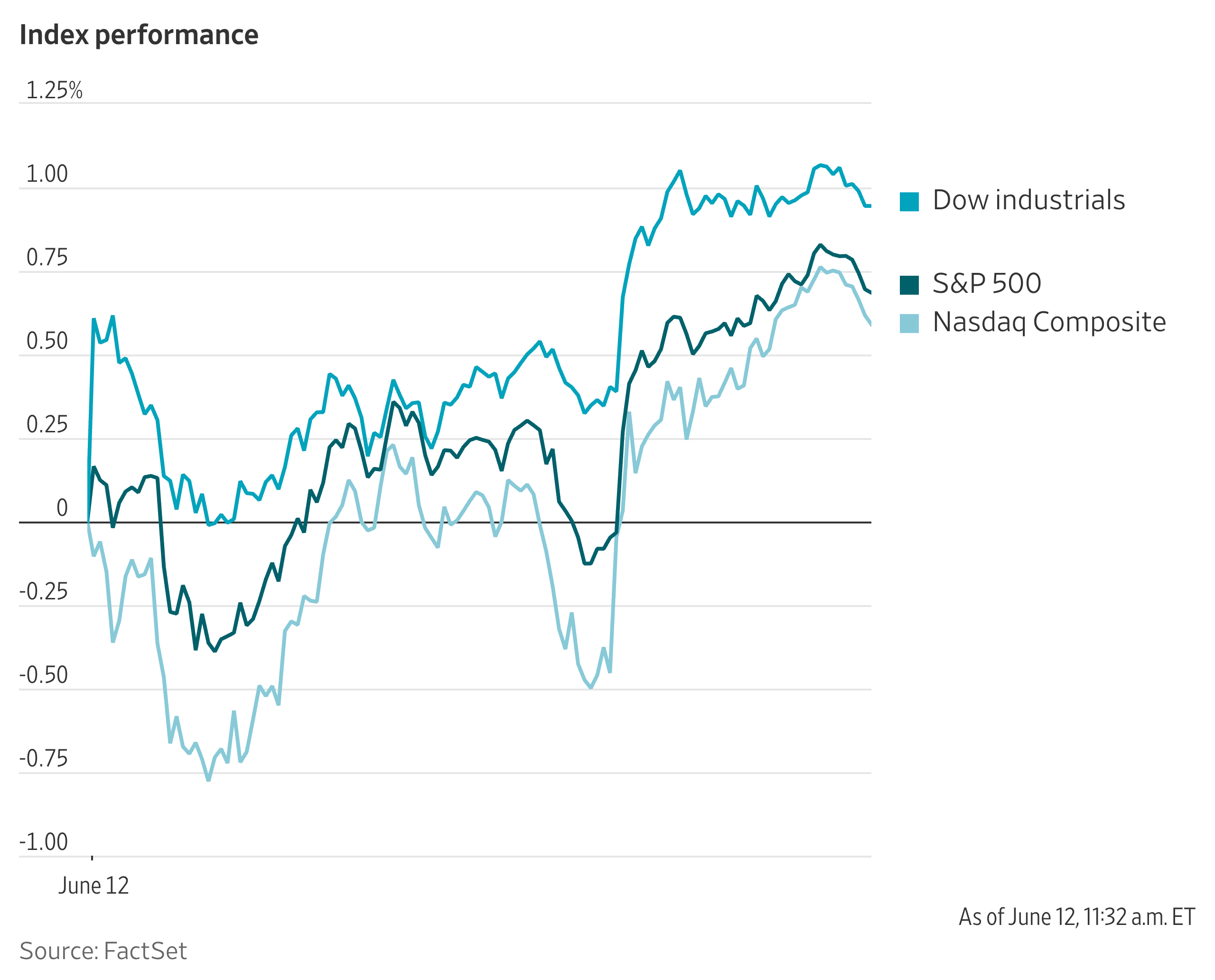
A big gain in financial stocks boosted the Dow Jones Industrial Average. The blue-chip index added around 354 points, or 0.7%. The S&P 500 rose 0.5%. The tech-heavy Nasdaq advanced about 0.3%.
The Russell 2000 index of small companies gained 0.8%, notching a fresh record.

Bestselling Bolton author Matt Cain returns home with new novel
SpaceX Launches. The Future Remains Murky.

34 Actors Who Have Appeared in Both Star Wars and the MCU


-

 NewsBeat6 days ago
Alexander Zverev wins the French Open to finally earn a 1st Grand Slam title
-

 Crypto World6 days ago
Anatomy of the June crypto crash: Fed, Iran, Saylor
-

 Crypto World2 days ago
Oppenheimer backs SpaceX as $70 billion retail frenzy builds
-
 NewsBeat6 days ago
Alexander Zverev conquers demons and outlasts Flavio Cobolli to win French Open for first major title
-

 Crypto World2 days ago
Markets Rally as SpaceX IPO Looms Amid Iran Tensions and Inflation Surge
-

 Tech7 days ago
Microsoft unveils seven homegrown AI models in new bid for ‘long term self-sufficiency’
-

 Business6 days ago
High Stakes for Wembanyama as New York Pushes for 3-0 Lead
-

 Tech6 days ago
Notion restores access to Anthropic after service disruption
-
 Crypto World6 days ago
Eli Lilly (LLY) Stock Surges 4% Following Breakthrough Sleep Apnea Trial Results
-

 Sports6 days ago
FIFA WC 2026 Group C: Morocco, Scotland challenge Brazil’s hunt for glory | FIFA World Cup 2022
-
 Business7 days ago
The investment to transform historic St Helen’s ground in Swansea
-

 Crypto World7 days ago
Trump’s AI Ownership Plan Could Benefit Anthropic at OpenAI’s Expense
-
 Sports4 days ago
Bangladesh beat Australia after 20 years in ODIs, register only their second win over six-time world champions | Cricket News
-

 Tech1 day ago
NanoClaw integrates JFrog registries to secure AI agent downloads
-

 Fashion1 day ago
Weekend Open Thread: Tuckernuck – Corporette.com
-

 Crypto World22 hours ago
Bitget enters Argentina’s regulated crypto market through PSAV registration
-

 Tech2 days ago
This Week In Security: Microsoft On Microsoft, Register Your Domains, Linux On ARM, And FreeBSD Joins The File Cache Club
-

 Politics3 days ago
Politics Home | Healey Resignation Is “Colossal Failure Of Government”, Says Former Labour Defence Secretary
-

 Sports3 days ago
First Time Since 1971: Australia Register Historic Low In ODI Cricket
-
 Entertainment2 days ago
Donnie Wahlberg & More Heat Up Las Vegas at Circa’s Barry’s Downtown Prime
You must be logged in to post a comment Login