
Business
Travelers Face Delays as Staffing Crisis Hits Peak Season

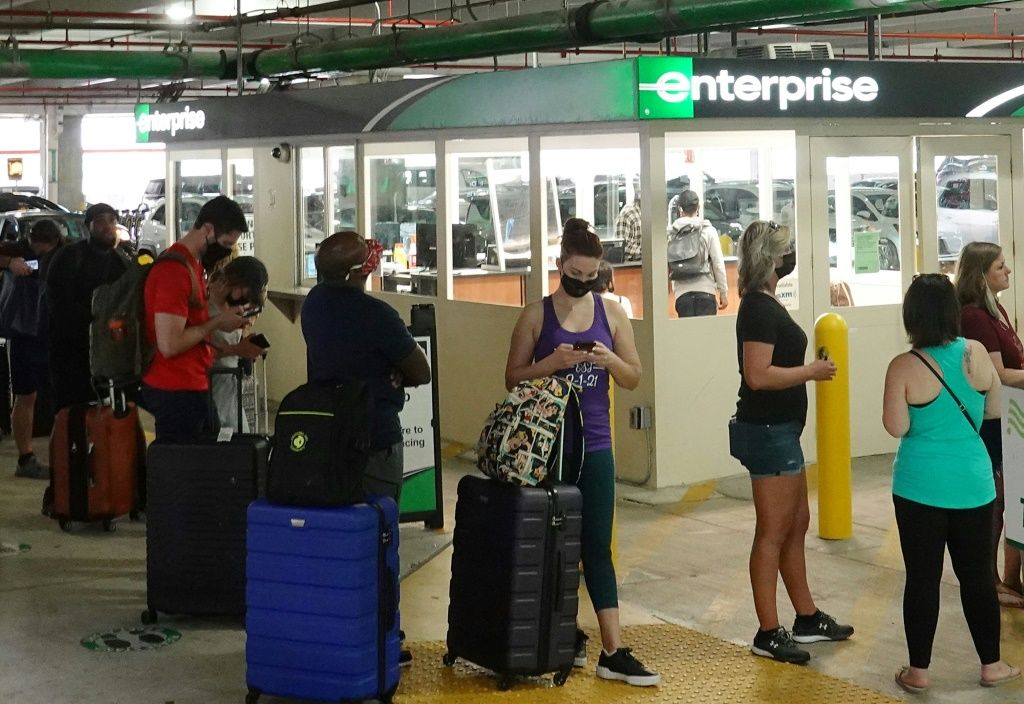
MIAMI — Travelers at Miami International Airport encountered unpredictable security lines and mounting frustration in recent weeks as a partial government shutdown strained Transportation Security Administration operations during one of the busiest travel periods of the year.

Long queues snaked through terminals at MIA and neighboring Fort Lauderdale-Hollywood International Airport in March 2026, with some passengers reporting waits of up to 35 minutes or more during morning peaks. The disruptions coincided with spring break crowds, East Coast weather delays and a federal funding impasse that left thousands of TSA workers unpaid and prompted hundreds of call-outs or resignations nationwide.
As of early April 2026, conditions at MIA have largely stabilized. Real-time data from the airport’s official website shows standard security checkpoint waits ranging from 8 to 18 minutes depending on the lane, with TSA PreCheck and CLEAR lanes often clearing in under 5 minutes. Checkpoint 1 remained closed in recent updates, while others operated with fluctuating but manageable volumes. Immigration processing, however, continued to see longer delays, sometimes exceeding 45 minutes.
The partial shutdown, which affected Department of Homeland Security funding, forced many TSA officers to work without pay since mid-February. Union leaders described the situation as “dire,” noting more than 450 officers had quit nationally since the impasse began. Absenteeism spiked, leading airports across the country — including major hubs like Atlanta and Houston — to post waits of an hour or longer on some days. South Florida airports experienced similar volatility, though MIA appeared to fare better than many peers.
Miami-Dade Aviation Department communications director Greg Chin told local media that early morning lines in mid-March occasionally stretched to 18-35 minutes due to staffing shortages. By midday, waits typically dropped significantly. Some checkpoints, such as one near dining options, stayed closed temporarily as managers shifted personnel. Airport officials urged passengers to arrive early and monitor the MyTSA app or MIA’s website for live updates.
President Donald Trump proposed deploying Immigration and Customs Enforcement agents to assist at congested airports, but MIA and FLL officials confirmed they had not been notified of any such assignments as of late March. Travelers expressed mixed reactions: some appreciated the potential backup, while others worried about added complications at an already busy international gateway.
Spring break 2026 amplified the pressure. MIA handled surges of tourists drawn to South Florida’s beaches and events, with security lines averaging around 30 minutes during peak evening hours in mid-March according to some reports. Officials implemented operational adjustments to improve passenger flow, including better lane management and encouragement of trusted traveler programs.
TSA PreCheck emerged as a key mitigator. Enrolled passengers frequently cleared screening in 1-5 minutes, even during busier periods. In February, the agency expanded TSA PreCheck Touchless ID at MIA, allowing eligible travelers to use facial recognition or mobile boarding passes for even faster processing. The technology rollout is part of a broader initiative to equip dozens more airports with biometric tools aimed at reducing document checks by up to 30%.
Despite the challenges, many recent visitors reported smoother experiences entering April. Reddit users and social media posts from early April described TSA lines at MIA as “surprisingly fast,” with some clearing from curb to concourse in as little as 13 minutes. One traveler called it “the shortest easiest line I’ve ever had at this notorious TSA checkpoint.” Real-time trackers like Flightqueue.com showed standard waits consistently under 15 minutes on multiple days, a notable improvement from March peaks.
Weather compounded problems earlier in the season. Thunderstorms and winter systems delayed or canceled hundreds of flights regionally, forcing rebookings and adding congestion. Airlines reduced schedules in some cases to ease pressure on air traffic control, which also faced unpaid staff. FlightAware data captured thousands of national disruptions during the height of the crisis.
MIA officials emphasized proactive measures. The airport’s mobile app provides real-time checkpoint wait times, interactive maps and flight status alerts. Passengers can scan boarding passes for personalized guidance. TSA recommends using the MyTSA app to check historical busyness by day and time, review the 3-1-1 liquids rule and prepare for screening to minimize delays.
Travel experts advise arriving at least two to three hours early for domestic flights and longer for international departures, especially during holidays or when staffing issues persist. Enrolling in TSA PreCheck or CLEAR can save significant time for frequent flyers. Removing liquids, electronics and outer layers in advance also speeds the process.
The funding standoff highlighted vulnerabilities in the aviation security system. TSA employs roughly 64,000 officers nationwide, many of whom felt “abandoned” during the unpaid period, according to union statements. Even after resolution, full staffing recovery could take days or weeks as agencies process back pay and rehiring.
As conditions normalize in April, MIA continues handling millions of passengers annually as South Florida’s primary international gateway. The airport serves major carriers including American Airlines, with extensive connections to Latin America and the Caribbean.
For the latest updates, travelers should check miami-airport.com/tsa-waittimes.asp or the TSA website. Officials continue monitoring operations closely and adjusting staffing as needed.
While the worst of the shutdown-related chaos appears to have eased at MIA, unpredictable variables like weather, holidays and federal budget negotiations mean vigilance remains essential. Passengers who plan ahead — using apps, trusted traveler programs and realistic arrival buffers — report the smoothest journeys through one of the nation’s busiest airports.
In the end, the recent strains at Miami International Airport’s TSA checkpoints served as a reminder of the human element behind airport security. Officers working extended hours without timely pay kept the lines moving as best they could, while millions of travelers adapted with patience and preparation. As federal talks progress, both sides hope to avoid repeating the disruptions that turned routine screenings into headline-making ordeals during spring break 2026.


Insig AI CEO gifts 6 million shares to charitable trust

Wolf Report is a senior analyst and private portfolio manager with over 10 years of generating value ideas in European and North American markets.He covers the markets of Scandinavia, Germany, France, UK, Italy, Spain, Portugal and Eastern Europe in search of reasonably valued stock ideas.
Analyst’s Disclosure: I/we have a beneficial long position in the shares of EBKDY either through stock ownership, options, or other derivatives. I wrote this article myself, and it expresses my own opinions. I am not receiving compensation for it (other than from Seeking Alpha). I have no business relationship with any company whose stock is mentioned in this article.
While this article may sound like financial advice, please observe that the author is not a CFA or in any way licensed to give financial advice. It may be structured as such, but it is not financial advice. Investors are required and expected to do their own due diligence and research prior to any investment.
Short-term trading, options trading/investment, and futures trading are potentially extremely risky investment styles. They generally are not appropriate for someone with limited capital, limited investment experience, or a lack of understanding of the necessary risk tolerance involved.
I own the European/Scandinavian tickers (not the ADRs) of all European/Scandinavian companies listed in my articles. I own the Canadian tickers of all Canadian stocks I write about.
Please note that investing in European/Non-US stocks comes with withholding tax risks specific to the company’s domicile as well as your personal situation. Investors should always consult a tax professional as to the overall impact of dividend withholding taxes and ways to mitigate these.
Seeking Alpha’s Disclosure: Past performance is no guarantee of future results. No recommendation or advice is being given as to whether any investment is suitable for a particular investor. Any views or opinions expressed above may not reflect those of Seeking Alpha as a whole. Seeking Alpha is not a licensed securities dealer, broker or US investment adviser or investment bank. Our analysts are third party authors that include both professional investors and individual investors who may not be licensed or certified by any institute or regulatory body.

Household Survey Shows A YTD Loss Of 1.4M Jobs

Westview Group has signed an agreement with Hatch to finalise the remaining engineering, approvals and construction planning required for a final investment decision on its planned steel mill.
Chalice Mining boss Alex Dorsch says the appointment of Odin Partnership as a strategic advisor for the company is a “fantastic strategic fit”.
A trial over WA controversial fishing ban continues in court, with the state claiming Sea Harvest failed to prove why the prohibition was legally unreasonable.

Speaking with ET Now, James Knightley from ING noted, “It is a really difficult one to call. There is a huge amount of uncertainty, and markets will remain on tenterhooks until the deadline is hit.”
The ripple effects of this uncertainty are being felt in the inflation outlook as well, with central banks increasingly focusing on price stability amid rising energy costs. Supply disruptions linked to the conflict have pushed oil prices higher, reviving fears of inflationary pressures at a time when growth remains uneven. However, the current situation differs from the post-pandemic surge, particularly in terms of demand dynamics. James Knightley pointed out, “The Fed does not have the tools to deal with supply shocks—they cannot print oil,” highlighting the limitations of monetary policy in such scenarios. Importantly, weaker demand conditions could act as a counterbalance, with Knightley adding, “This supply shock is more demand-destructive, so we may not see broad and persistent inflation.”
Crude oil continues to be the most sensitive asset in this environment, reacting swiftly to every geopolitical development. While a potential easing of tensions could lead to a decline in prices, the trajectory remains uncertain. The extent of any correction will largely depend on the level of damage to supply infrastructure and how quickly normalcy can be restored. As James Knightley observed, “Oil could fall if tensions ease, but the extent will depend on the damage to infrastructure,” suggesting that prices may not revert to earlier levels anytime soon.
Given these uncertainties, investors are leaning towards a defensive stance, favouring safer assets amid the lack of clarity. The risk of sudden disruptions or unexpected escalations remains a key concern, even if a temporary agreement is reached. Reflecting the cautious mood, James Knightley added, “Safe haven is still the key right now, as the backdrop remains cautious.” Until there is greater visibility on both geopolitical and economic fronts, markets are likely to stay reactive, with risk aversion shaping investment decisions.

Brightwater Care Group is set to offload one of its two commercial services to Intelife, after reporting a significant decline in the linen division’s value.

Inflation scars risk quickly lifting expectations; ECB must be ready to act: policymaker

'AI Security' Emerges As The Next Cybersecurity Theme

Rory McIlroy discovers Masters playing partner before anyone else with opponent ‘super nervous’
Insig AI CEO gifts 6 million shares to charitable trust

TRM Labs On-chain Evidence Key to Convicting 3 Terrorism Financiers

Smart energy pays enters the US market, targeting scalable financial infrastructure

Why Israel is blocking foreign journalists from entering

Bitcoin: We’re Entering The Most Dangerous Phase

How I Use Claude to Automate Financial Modeling (Full Tutorial)

The Quantum Financial System, XRP, New Currency, and Universal Basic Income!

Pak-UAE Financial Update | Debt Repayment Plan Finalized | 2 Countries Step In to Support Pakistan
-

 NewsBeat4 days ago
Steven Gerrard disagrees with Gary Neville over ‘shock’ Chelsea and Arsenal claim | Football
-

 Business4 days ago
No Jackpot Winner and $194 Million Prize Rolls Over
-

 Fashion4 days ago
Weekend Open Thread: Spanx – Corporette.com
-

 Crypto World5 days ago
Gold Price Prediction: Worst Month in 17 Years fo Save Haven Rock
-

 Business1 day ago
Three Gulf funds agree to back Paramount’s $81 billion takeover of Warner, WSJ reports
-
Crypto World7 days ago
Dems press CFTC, ethics board on prediction-market insider trades
-

 Sports2 days ago
India men’s 4x400m and mixed 4x100m relay teams register big progress | Other Sports News
-

 Business3 days ago
Expert Picks for Every Need
-

 Business5 days ago
Login and Checkout Issues Spark Merchant Frustration
-

 Tech7 days ago
EE TV is using AI to help you find something to watch
-

 Sports7 days ago
Tallest college basketball player ever, standing at 7-foot-9, entering transfer portal
-

 Tech7 days ago
How to back up your iPhone & iPad to your Mac before something goes wrong
-

 Tech7 days ago
What Are The Biggest Limitations Of Supercomputers?
-

 Crypto World6 days ago
Bitcoin enters the public bond market as Moody’s gives a first-of-its-kind crypto deal a rating
-
Crypto World6 days ago
Bitcoin stalls below key resistance as technical signals skew bearish
-

 Tech5 days ago
Commonwealth Fusion Systems leans on magnets for near-term revenue
-

 Politics7 days ago
Transform Your Space with Stunning Small Works
-

 Politics6 days ago
Starmer’s centre has collapsed, and the left was right all along
-
Business2 days ago
No Jackpot Winner, Prize to Climb to $231 Million
-

 Fashion7 days ago
Zara Turns Up the Heat With New Swimwear
You must be logged in to post a comment Login