
Business
US Fed rate hike bets soar to 57% from 30% after Warsh’s speech. What are Goldman Sachs and others saying?

The shift in expectations extends beyond the September meeting. For the meeting on October 28, traders are pricing in a 70% probability of a rate hike. By the final meeting of the year in December, traders are baking in nearly a 90% chance of a rate hike, according to official data from the US Fed.
What did US Fed Kevin Warsh say?
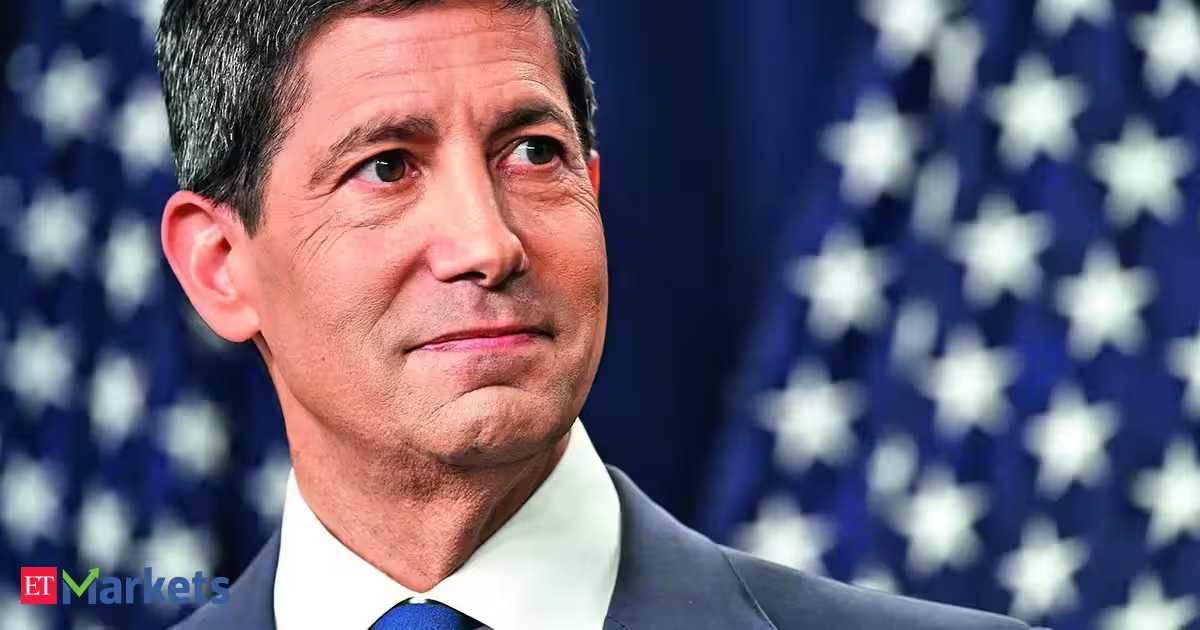
The U.S. central bank will “have work to do” if policymakers do not gain the confidence needed to see inflation heading back to 2%, Federal Reserve Chairman Kevin Warsh said on Friday. His remarks came closer than before to acknowledging that interest rate hikes may be needed to ease price pressures.
“Here is my standard: We must be confident that underlying inflation is moving to our objective, clearly and at sufficient speed. Otherwise, we have work to do. That’s our job … our mandate … and our charge to keep,” Warsh said in his keynote speech to the Fed’s Jackson Hole economic symposium in Wyoming.
With the labour market stable, inflation still too high and little in financial conditions indicating that the Fed’s policy rate is restraining it, Warsh said, “The Fed’s predominant focus right now should be on prices.”

The remarks drew applause from an audience of global central bankers looking for more than his previous vague promises to deliver price stability, while also unsettled by his refusal to say how he would achieve it. Markets responded to the change in tone by increasing bets on a rate hike next month, even as they continued to price in a healthy dose of scepticism that he will deliver one.
“We’re moving up on six years where we’ve been above target” on inflation, former Philadelphia Fed President Patrick Harker said. “You can’t keep saying this is our job” and then not act, he added. “As the old saying goes, actions speak way louder than words.”
What is Goldman Sachs saying?
Goldman Sachs continues to expect the Federal Reserve to keep interest rates unchanged in September, despite the more hawkish tone on monetary policy. The brokerage expects both core CPI and core PCE inflation to rise around 0.2% month-on-month in August, which would support its view that the FOMC will remain on hold.
However, Goldman Sachs sees a September rate hike as a possibility if upcoming inflation data comes in hotter than expected. It said a firmer-than-expected August CPI and PPI reading could prompt the Fed to raise rates, although the brokerage’s base case remains for no change in September.
Goldman also believes the recent improvement in inflation has not been enough to signal a meaningful shift in underlying price pressures. While PCE and CPI readings this summer were better than expected, the brokerage said they do not indicate that underlying inflation trends have improved significantly.
Inflation remains a concern, according to Goldman Sachs. The brokerage noted that 54% of goods and services in the PCE basket recorded price increases of more than 3% over the past 12 months. While that share is well below the post-pandemic peak of around 77%, it remains significantly above the 32% level recorded during the two decades before the pandemic. Goldman Sachs noted that tariff effects partly account for the elevated reading.
“Why the market is modestly reacting is he (Warsh) is very adamant that the 2% inflation target is going to remain. He is reiterating the hawkishness, but in a more of a consistent way than an incremental way,” said Mark Hackett, chief market strategist for Nationwide.
“There’s been somewhat misguided thoughts among investors that this would soften a little bit. Clearly, that’s not the case,” he told Reuters.
(Disclaimer: Recommendations, suggestions, views and opinions given by the experts are their own. These do not represent the views of The Economic Times)

Business
Vedanta, Wipro among 10 stocks that saw biggest jump in retail holders in Q1. See full list

Vedanta, Wipro and Bajaj Auto were among the stocks that saw the biggest additions to their retail shareholder base in Q1FY27, with several large companies witnessing strong retail participation.
Business
Reliance Jio IPO: 7 risk factors investors should know as firm gets Sebi nod for Rs 37,000-crore issue

The IPO is expected to comprise a fresh issue of up to 27 crore equity shares, with no offer-for-sale component. As a result, the funds raised will flow directly to Jio Platforms. The company plans to use the proceeds to repay part of the borrowings of its telecom subsidiary, Reliance Jio Infocomm, as well as for general corporate purposes.
Jio Platforms is among India’s largest digital platforms, with its telecom subsidiary Reliance Jio Infocomm serving more than 524 million customers as of March 2026, according to reports citing the company’s offer documents.
Here are 7 risk factors mentioned in the DRHP that investors must know about the company.
1.) Spectrum challenges
Access to adequate spectrum is critical for maintaining network quality, supporting growing data consumption and driving future growth. Jio’s network performance and expansion plans depend heavily on the quantity and quality of spectrum it holds across low, mid and high frequency bands.
However, acquiring and retaining spectrum comes with challenges. Spectrum is primarily obtained through government auctions or spectrum-sharing and trading arrangements, both of which are competitive and subject to regulatory uncertainty. High reserve prices can increase acquisition costs, while competitors may outbid Jio in auctions or strengthen their spectrum holdings through strategic arrangements. Any inability to secure sufficient spectrum at commercially viable terms could affect network quality, customer growth and financial performance.
2.) Highly regulated sector
Jio operates in a heavily regulated industry and is subject to oversight by the Telecom Regulatory Authority of India (TRAI) and the Department of Telecommunications (DoT). These regulators oversee critical aspects of the telecom sector, including licensing, spectrum allocation and management, network rollout obligations, interconnection charges, and infrastructure sharing.
The company must also comply with regulations relating to unsolicited commercial communications, subscriber verification requirements, know-your-customer norms, electromagnetic radiation standards, and network safety requirements. Any failure to comply with these regulations, or any changes in the regulatory framework, could lead to penalties, higher compliance costs, operational restrictions, or reputational damage, affecting Jio’s business and financial performance.
3.) Capex heavy
Jio’s business requires significant and ongoing investments to expand and upgrade its network infrastructure in line with evolving technology standards and customer expectations. In FY26, the company incurred cash capital expenditure of Rs 34,184 crore, equivalent to 23.3% of its revenue from operations of Rs 1.47 lakh crore. Given the scale of these investments and the fast-changing nature of the telecom and digital services industry, there is no guarantee that Jio will realise the expected returns from its capital spending, which could affect its financial performance and growth prospects.
4.) Vendor dependence risk
Jio relies on a limited number of equipment suppliers, including certain related-party vendors, creating concentration risk within its supply chain. Any disruption in these relationships, or any failure by suppliers to deliver equipment on time, in required quantities, or according to quality standards, could affect the company’s ability to maintain and expand its network infrastructure. Such disruptions may arise from capacity constraints, technical failures, production issues, labour-related challenges, or other operational factors.
While a significant portion of Jio’s equipment requirements is sourced domestically, several Indian vendors are subsidiaries of companies based in countries such as the United States, South Korea, Finland, and Sweden. This leaves the company exposed to global supply chain disruptions and geopolitical uncertainties. Any increase in import dependence could further expose Jio to currency fluctuations, trade restrictions, and supply-related challenges.
5.) Competition heating up
Jio operates in one of the world’s most competitive telecom markets, where future growth depends on attracting new subscribers, retaining existing users, and increasing engagement through value-added services. Although the company carried nearly 60% of India’s wireless data traffic in FY26, according to the DRHP, it faces strong competition from rival telecom operators that may offer better pricing, stronger customer service, or more compelling products. Any inability to keep pace with technological changes, shifting consumer preferences, or competitive pressures could hurt Jio’s market share, profitability, and overall financial performance.
6.) Infrastructure concentration risk
Jio’s network operations depend heavily on a small group of passive infrastructure providers. This includes telecom towers, shelters, fibre pairs, and ducts that form the backbone of its connectivity services. As of March 31, 2026, 1,74,451 of the 3,60,382 towers used by the company were owned by Summit Digitel Infrastructure Limited (SDIL), highlighting its reliance on a key infrastructure partner.
The dependence is even greater in fibre infrastructure. Jio Digital Fibre Private Limited (JDFPL) provides all of Jio’s optical fibre network requirements, except for the last-mile fibre network owned by Reliance Jio Infocomm. Any disruption in services, contractual disagreements, operational challenges, financial stress, or regulatory issues affecting these providers could impact network availability, service quality, and expansion plans.
7.) Cybersecurity exposure
Jio’s operations rely on complex technology systems, network infrastructure, and large volumes of customer data, making it vulnerable to a range of cybersecurity threats. These include distributed denial-of-service (DDoS) attacks, ransomware, malware, phishing attempts, credential theft, hacking, social engineering attacks and risks arising from employee errors or misconduct. Any successful cyberattack or operational disruption could affect network availability, expose sensitive information, and result in financial losses, regulatory penalties, or reputational damage.
Also read: Rs 70,000 crore IPOs in September? Jio, NSE could fuel a record month
The risk is not limited to Jio’s own systems. The company also depends on third-party vendors, cloud service providers, and both cloud-based and on-premises data centres. Any cybersecurity incident involving these partners could disrupt services, compromise data security, and affect business continuity. As cyber threats continue to evolve, Jio may have to incur significant costs to strengthen its security infrastructure and mitigate risks.
(Disclaimer: Recommendations, suggestions, views and opinions given by the experts are their own. These do not represent the views of The Economic Times)

Bitcoin price slips below $78,000 as ‘digital gold’ narrative faces fresh test
Business
Bitcoin falls below $78,000 as crypto market faces correction after Warsh’s Jackson Hole comments

Over the past 24 hours, Bitcoin was down 2.5%, while Ethereum fell 1.9% to trade at $2,430. Among major altcoins, BNB, XRP, Solana, Hyperliquid, Dogecoin and Cardano declined by up to 4.2%, while Tron gained
Also Read | Bitcoin falls 30% as Google, gold and defence stocks outperform since 2020: Report The global crypto market capitalisation edged down 2.57% to $3.07 trillion, according to CoinGecko.
Riya Sehgal, Research Analyst at Delta Exchange, said Bitcoin had fallen from above $81,000 earlier this week to around $77,700. Ethereum was trading near $2,440, while total crypto market capitalisation had declined from above $2.7 trillion.
“Leverage added to the selling. Around $488 million in crypto positions were liquidated, including more than $360 million in leveraged longs. Bitcoin’s move below $77,000 triggered further forced selling.”
Sehgal further said that Warsh said inflation remains above the Federal Reserve’s 2% target and indicated that policy could remain restrictive if price pressures persist. Treasury yields moved higher after the remarks, putting pressure on risk assets, including cryptocurrencies.Over the past week, Bitcoin and Ethereum were down 1.1% and 3%, respectively. Among major altcoins, BNB, XRP, Tron, Dogecoin and Cardano fell by up to 20.9%, while Solana and Hyperliquid gained 4.8% and 0.9%, respectively.
Nischal Shetty, Founder, WazirX, said Crypto markets navigated a volatile but increasingly constructive week, with Bitcoin retaining leadership even as leverage was flushed out and macro uncertainty capped momentum.
“Total market capitalisation fell 1.27% to $2.65 trillion on August 26, while $641.79 million in liquidations, including $489 million in long positions, highlighted the cost of crowded bullish trades.”
Also Read | Explained: Want to calculate the future value of your Rs 10,000 SIP? Here’s the formula
Crypto ETFs recorded $482.13 million in inflows on August 25, led by roughly $310 million into Bitcoin and $172 million into Ethereum. This support, alongside gains in US technology stocks, helped sustain a cautiously positive market structure, Shetty further said.
(Disclaimer: Recommendations, suggestions, views and opinions given by the experts are their own. These do not represent the views of The Economic Times)
Business
Assicurazioni Generali to Consider $10.2 Billion Banca Generali Bid, Says Assicurazioni Generali

Italy’s Assicurazioni Generali G 0.50%increase; up pointing triangle said it is willing to consider a $10.2 billion takeover offer for private bank Banca Generali BGN 0.53%increase; up pointing triangle from rival Monte dei Paschi di Siena, the latest attempt at consolidation in the country’s banking sector.
MPS, considered Europe’s oldest lender still in operation, last week launched a joint bid for Banca Generali and Banco BPM, offering 6.958 of its own shares for each Banca Generali share to value the bank at 8.72 billion euros ($10.16 billion). It said at the time the bid represented a 10% premium to Banca Generali’s share price.
Copyright ©2026 Dow Jones & Company, Inc. All Rights Reserved. 87990cbe856818d5eddac44c7b1cdeb8
Business
(VIDEO) New M&Ms Mint Crunchy Cookie Flavor Launches Exclusively at Walmart, Leaving Australian Fans Waiting

M&M’S is rolling out a new Walmart-exclusive candy flavor this fall, pairing the brand’s popular Crunchy Cookie center with mint and milk chocolate in a combination fans have already started comparing to Girl Scout Thin Mints, though Australian shoppers will have to wait to see whether the treat ever crosses the Pacific.
The new M&M’S Mint Crunchy Cookie is set to launch exclusively at Walmart stores and on Walmart.com beginning in September, according to parent company Mars, which described the release as an expansion of the Crunchy Cookie platform that first debuted in 2022. Each candy features a crisp cookie center wrapped in cool mint and milk chocolate, all encased in the brand’s signature hard candy shell. The flavor will be sold in two package sizes, a 2.83-ounce share bag and a larger 7.4-ounce sharing size, according to a company announcement reported by trade outlet Chain Drug Review.
Mars has positioned the new flavor as part of a broader push into bakery-inspired combinations, following recent additions to the M&M’S lineup including Banana Nut Bread and several flavors from what the company calls its Bakery Collection, such as Peanut Butter Cinnamon Roll, Lemon Meringue and Cherry Chocolate Cupcake. A company spokesperson told the news outlet Daily Voice that the new mint variety was designed to bring “a refreshing twist on a baked goods-inspired treat that brings a satisfying crunch to the lineup,” directly building on the commercial success of the original Crunchy Cookie release.
The mint-and-chocolate pairing has drawn immediate comparisons online to the classic Girl Scout Thin Mint cookie, a connection food reviewers and social media commenters have made repeatedly since photos and early sightings of the candy began circulating. Food content creator Snackolator, who posts under the handle Snackolator on Instagram, shared some of the earliest images of the product appearing on store shelves, writing, “I am going to DEVOUR these new Mint Crunchy Cookie M&M’s!” The same post added, “They are starting to arrive at Walmart and as a mint fan these sound incredible!”
Reaction in the comments of that post and elsewhere online has been mixed. Some social media users expressed enthusiasm for the new flavor, with one commenter writing that they wanted to “chop these up and add to cookies,” while another described the concept as reminiscent of “peppermint bark.” Other commenters were more skeptical, with one comparing the texture to a “Rice Krispie” treat, and several pointing out that the marketing language appeared to be avoiding a direct reference to Thin Mints by name.
According to Walmart’s website, a share-size bag of the new candy has been listed for 2.78 dollars, and the treat appears to already be arriving at some store locations ahead of its official rollout date. Because M&M’S Mint Crunchy Cookie is being marketed as a limited-time offering, industry watchers covering the launch have noted that interested shoppers should expect the product to disappear from shelves once its initial run sells through, consistent with how Mars has handled previous limited-edition Crunchy Cookie flavors.
The new mint variety is not the brand’s first attempt at combining chocolate and mint. M&M’S previously introduced a Crunchy Mint flavor in 2018 after fans voted for it over Crunchy Raspberry and Crunchy Espresso as part of the company’s periodic Flavor Vote campaigns, which have let consumers choose new additions to the lineup since 2016. That earlier Crunchy Mint flavor was eventually discontinued, a decision some commenters referenced with nostalgia when reacting to news of the new Mint Crunchy Cookie release.
For Australian consumers, the new flavor remains, for now, exclusively a U.S. product. Australia already produces its own version of the standard Crunchy Cookie flavor domestically, distributed through major retailers including Coles, Woolworths and independent convenience stores nationwide, suggesting the manufacturing infrastructure needed to produce a local Mint Crunchy Cookie variant could already exist. However, no announcement has been made regarding an Australian release of the new mint flavor, and it currently remains locked to Walmart’s U.S. stores and website.
Industry observers covering the U.S. launch have suggested that strong sales performance domestically could increase the odds that Mars eventually brings a similar mint cookie flavor, or a locally adapted version of it, to Australian shelves. In the meantime, Australian fans of the chocolate-mint combination have been directed toward the regular, already-available Crunchy Cookie flavor as a stand-in while they wait to see whether the new variety eventually makes its way south of the equator.
The launch also comes as Mars has continued broader changes to its confectionery lineup tied to shifting consumer preferences around ingredients. The company announced earlier this month that it would remove artificial colors and dyes from many of its products, part of a wider industry trend toward reformulating snack foods amid growing regulatory and consumer scrutiny of synthetic additives in the United States.

Globalstar: Q2 Improves The Deal Outlook, But I'm Staying On Hold

Niutech signs waste plastic pyrolysis deal with energy major


I started my career in asset management one year before the GFC. Since then, I have accumulated knowledge and extensive experience in financial analysis and portfolio management of equity, government bond, corporate bond, and money market funds. Fascinated by psychology and the way we make investment decisions. Passionate about sharing my knowledge. Please note that due to my financial institution’s compliance requirements, I mainly do not invest in any kind of single stocks but only ETFs.
Analyst’s Disclosure: I/we have no stock, option or similar derivative position in any of the companies mentioned, and no plans to initiate any such positions within the next 72 hours. I wrote this article myself, and it expresses my own opinions. I am not receiving compensation for it (other than from Seeking Alpha). I have no business relationship with any company whose stock is mentioned in this article.
Seeking Alpha’s Disclosure: Past performance is no guarantee of future results. No recommendation or advice is being given as to whether any investment is suitable for a particular investor. Any views or opinions expressed above may not reflect those of Seeking Alpha as a whole. Seeking Alpha is not a licensed securities dealer, broker or US investment adviser or investment bank. Our analysts are third party authors that include both professional investors and individual investors who may not be licensed or certified by any institute or regulatory body.

Turkey tightens hedge fund rules amid concerns over market manipulation

Piers Morgan steps in to help fly groom from Welsh wedding to play in cup final

Vedanta, Wipro among 10 stocks that saw biggest jump in retail holders in Q1. See full list

Therapy Has a Relationship Problem





-

 Crypto World3 days ago
SpaceX stock could rise 75% to $240, JPMorgan says
-

 Crypto World1 day ago
Bitcoin’s 22% rally now needs real demand to outlast Treasury liquidity boost
-

 Business7 days ago
Musk’s Tesla, SpaceX Confirm $16.8 Billion ‘Terafab’ Chip Plant as World’s Largest Building in Texas
-

 Fashion16 hours ago
Weekend Open Thread: Maeve – Corporette.com
-

 Crypto World4 days ago
A $30 Billion AI Fund Implodes, Now the SEC Is Investigating Wall Street’s Role
-

 Crypto World3 days ago
Warsh Jackson Hole keynote puts financial innovation first
-

 Business1 day ago
Salesforce Stock Soars 19% as Blowout Earnings and Agentforce AI Growth Silence Software Skeptics
-

 Politics7 days ago
6 months on, Irish renters crushed by effects of government housing bill
-

 Crypto World3 days ago
Did Trump Just Move SpaceX Stock With One Truth Social Post?
-

 Business6 days ago
Mystery AI Model ‘Ox Alpha’ Draws Developers With Free Access as Chinese Lab Origins Remain Debated
-

 Business3 days ago
Walmart takes aim at younger shoppers with new fashion brand
-
 NewsBeat3 days ago
Lindsay Clancy jury braces for closing arguments as judge tells court: ‘You’ve heard all the evidence’ – Live updates
-

 Business5 days ago
Moderna CEO warns China is pouring state money into mRNA technology
-

 Business4 days ago
NVIDIA Stock Drops Nearly 2 Percent to $210 on Seventh Losing Day Ahead of Critical AI Earnings
-

 Crypto World2 days ago
NVIDIA revenue hits $96.2B as AI demand doubles
-

 Crypto World2 days ago
Elon Musk Grok Bot Promise: We Will Make You Whole if AI Loses Your Money
-

 Business18 hours ago
iPhone 18 Pro Pre-Orders Could Shift to Saturday as Apple Reportedly Avoids September 11 Anniversary
-
 Crypto World5 days ago
$92 Billion Nvidia Earnings Could Make or Break the AI Trade
-

 Business3 days ago
Thailand’s Eastern Economic Corridor Capital City (EECiti): Key Developments and Investment Opportunities
-

 Business6 days ago
Where Will Kevin Durant Play in 2027? Rockets Hold Player Option Key to His Future With Houston via Deal
You must be logged in to post a comment Login