Connect with us

Business

(VIDEO) Amazon Cargo Jet Left a Miami Runway at 129 mph in a Crash That Killed Five; NTSB Opens Inquiry

Published

on

Amazon Cargo Jet Left a Miami Runway at 129 mph

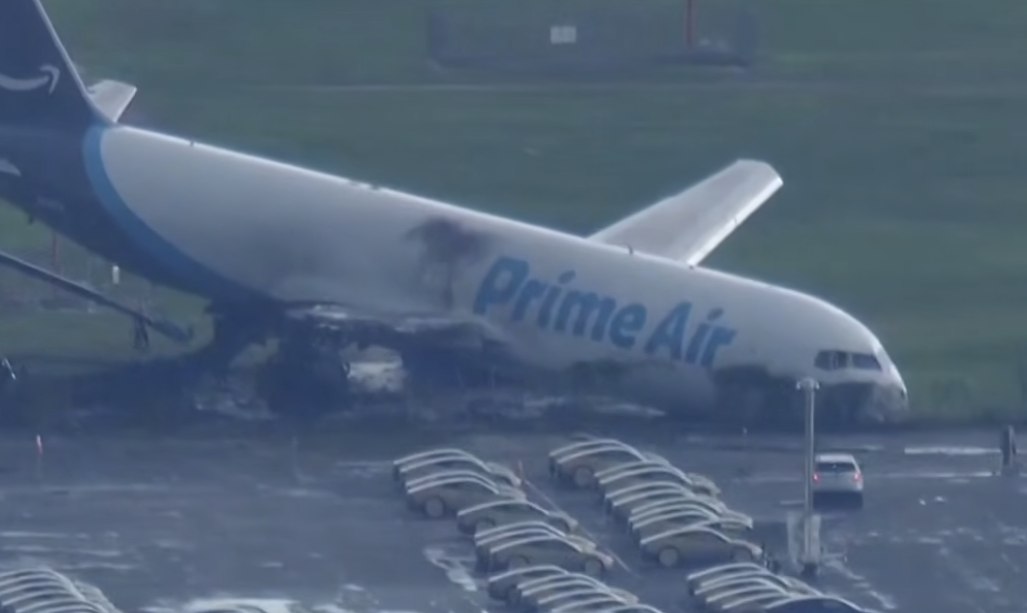
MIAMI — An Amazon Prime Air cargo jet was still moving at about 129 mph when it ran off a Miami International Airport runway, crossed a perimeter road and struck vehicles, killing five people and injuring five others on a busy Labor Day weekend afternoon.

The Boeing 767-300 freighter, Prime Air Flight 7598, arrived from San Juan, Puerto Rico, and overran Runway 30 around 2 p.m. Sunday. Tracking data compiled by Flightradar24 put the jet at 112 knots — roughly 129 mph — as it left the usable pavement. Miami-Dade Fire Rescue Chief Ray Jadallah said five people died, three were taken to a trauma center in critical condition and two others were hospitalized with less severe injuries. Officials had not said by Sunday night whether the dead were in the cockpit, in cars on the road, or both.

The National Transportation Safety Board sent a go-team led by Chair Jennifer Homendy and scheduled the agency’s first public briefing for Monday. Investigators are expected to start with a simple question captured on video and flight tracks: where the airplane touched down, and why the crew did not abandon the landing if the jet floated past the normal zone.

Advertisement

Aviation safety specialist Steve Arroyo said the typical touchdown area is within the first 3,000 feet of a runway. If the cargo jet was beyond that, he said, the pilots should have gone around. Mary Schiavo, a pilot and former inspector general of the Transportation Department, said online video showed the Amazon plane remaining airborne well down the strip without the usual flare that puts the main gear on the pavement. It was not raining, she said, but dark storm clouds were nearby and strong winds had been reported. “A tail wind would certainly add to your troubles if you’ve already given up a good chunk of the runway by not touching down and landing right away,” Schiavo said.

CNN’s review of air-traffic control audio found the crew did not declare an emergency before landing. Flightradar24 data showed the jet rose above the normal approach path to Runway 30, then dropped back toward the glide path. The runway is more than 9,000 feet long. That length did not keep the airplane on airport property.

The 767 crossed a safety area and a fence, then hit vehicles on a road used by warehouse workers and businesses that ring the field. It came to rest on its belly near two semitrucks and a parking lot that serves an Amazon warehouse. Thick black smoke rose as fire burned. Jadallah said crews trapped in the cockpit had to be reached through a window by ladder and that occupants were cut from cars. Firefighters also freed a person pinned under a vehicle. Miami-Dade Fire Rescue sent more than 60 units and about 200 people. Jadallah said crews arrived within about 30 seconds of the first call and were still dealing with a fuel leak later in the afternoon.

Miami-Dade Mayor Daniella Levine Cava said at least five people had lost their lives and five others were injured, and that rescue crews reached the scene within seconds. Sheriff Rosie Cordero-Stutz put the time near 1:58 p.m. A student pilot, Rohan Ellis, who saw the wreckage, told a reporter the vehicles “were mangled.” Names of the dead had not been released.

Advertisement

The airplane, registered N1997A, is 32 years old. It was built as a passenger 767 around 1994, flew for airlines for more than two decades and was converted to a freighter in 2015, according to Cirium and Flightradar24 records. 21 Air, a Greensboro, North Carolina, cargo carrier that also flies for DHL, operated the trip under contract. Amazon does not hold the air-operator certificate for those flights. 21 Air said it was devastated by the accident involving one of its aircraft. CEO Keith Winters said the company was cooperating with federal investigators. Boeing said it was supporting the inquiry.

Amazon spokesperson Kelly Nantel said the company was “heartbroken to learn that five people lost their lives” and extended sympathies to families and others affected. In another statement she said Amazon was “still gathering details” and would “cooperate fully with any investigation.” Schiavo said investigators will review the jet’s maintenance history, including periods of foreign ownership.

Miami International is among the busiest U.S. airports for freight. It does not have an engineered materials arresting system — the crushable bed the FAA says has been installed at more than 120 airports and credited with helping save at least 497 lives in overruns. Mike O’Donnell, the FAA’s former director of airport safety and accident investigations, said Miami appears to meet federal rules because it has a 1,000-foot safety area beyond the runway. That standard followed the 1999 American Airlines Flight 1420 overrun in Little Rock, Arkansas, which killed nine.

The crash shut the airport’s runways and taxiways on a holiday Sunday. FlightAware logged more than 160 cancellations and nearly 325 delays by late day. Some flights diverted to Orlando, more than 200 miles north. Two of four runways later reopened and flights resumed Sunday evening, but the disabled 767 remained at the northwest end of the field.

Advertisement

The accident follows last year’s UPS crash in Louisville, Kentucky, in which a jet lost an engine on takeoff and killed three people in the cockpit and 12 on the ground. Sunday’s sequence was different: a landing, not a departure; a long runway; no declared emergency on the frequency CNN reviewed; and enough leftover speed to leave the airport and hit traffic.

What investigators will pull first is mechanical and human at once. Flight data and cockpit voice recorders should show airspeed, thrust, spoiler and reverse-thrust use, brake pressure and what the pilots said in the last minutes. Weather records will show whether a tail wind was on Runway 30. Maintenance logs will show the converted 767’s recent work. Videos and ADS-B tracks already sketch a long float and a high-speed exit. They do not explain it.

Until Homendy speaks, the confirmed picture is narrow and grim. A contracted Amazon 767 from San Juan did not stop on Runway 30. It left the pavement at highway-plus speed, hit vehicles on a working road and burned. Five people are dead. Five are in hospitals. The airport is moving airplanes again. The reason the jet used up the runway is the question the NTSB came to Miami to answer.

Advertisement
Continue Reading
Click to comment

You must be logged in to post a comment Login

Leave a Reply

Business

Sebi eases compliance norms for FPIs investing only in government securities

Published

on

Sebi eases compliance norms for FPIs investing only in government securities
The Securities and Exchange Board of India (Sebi) has eased regulatory compliance requirements for foreign portfolio investors (FPIs) that invest exclusively in government securities, removing the need for them to furnish investor group details.

The move follows the Reserve Bank of India’s decision in June to withdraw concentration limits for FPIs investing in government securities through the General Route.

Sebi, in a circular issued on Monday, said the requirement to identify the investor group of an FPI investing only in government securities was no longer relevant following the RBI’s decision.

“FPIs investing only in Government Securities shall not be required to furnish investor group details,” SEBI said, modifying the relevant provision of its master circular governing FPIs, designated depository participants and eligible foreign investors.

Advertisement

Sebi had earlier, through a September 10, 2025 circular, provided a similar exemption to FPIs investing exclusively in government securities under the Fully Accessible Route. The latest amendment extends the relief to FPIs investing only in government securities more broadly.


The regulator said the move was aimed at providing greater ease of investment to FPIs.
Depositories, custodians and designated depository participants have been advised to make the necessary changes to their systems to implement the revised requirement.The changes will take effect immediately, Sebi said.

(Disclaimer: Recommendations, suggestions, views and opinions given by the experts are their own. These do not represent the views of The Economic Times)

Continue Reading

Business

American Century Ultra Fund Q2 2026 Commentary

Published

on

Invesco Quality Income Fund Q1 2026 Commentary

symbolizing increasing investment funds, financial growth, and successful fund management

Pavel Kot/iStock via Getty Images

Portfolio Review

U.S. stocks advanced sharply. U.S. equities posted double-digit quarterly gains despite volatility stemming from the Iran conflict. Robust earnings, resilient economic data and continued momentum in artificial intelligence (AI)-related stocks supported gains. However, stocks pulled back slightly in

Continue Reading

Business

Tesla Starts Paid Cybercab Rides in Austin as Regulators Probe Its Wheel-and-Pedal-Free Design

Published

on

Tesla Tells Cybercab Riders to Talk to Grok for Climate,

AUSTIN, Texas — Tesla has begun charging passengers for rides in the Cybercab, the two-seat electric car it built without a steering wheel, pedals or side mirrors, even as U.S. safety regulators opened a review of how the company certified that design as legal.

Paid trips started in Austin on Sept. 4, the day after an invitation-only launch at ACL Live. Riders hail the car through Tesla’s existing Robotaxi app, in the same geofenced area already served by driverless Model Y vehicles since June 2025. Users told reporters the Cybercab fare on identical routes was lower than the Model Y option. Tesla executives at the event described dynamic pricing and promised “a first-class experience at coach price.”

Elon Musk did not attend. In a promotional video released the same day, he called the Cybercab “the first car that is specifically built for unsupervised full self-driving.” In the days before the event he pinned a post that read, “A storm of Cybercabs.” Texas motor-vehicle records showed about 45 Cybercabs registered to Tesla’s robotaxi fleet as of late August. The company’s broader Texas robotaxi registration list stood near 420 vehicles, most of them Model Ys — fewer than half the nearly 1,000 vehicles Alphabet’s Waymo has registered in the state.

That gap between slogan and fleet size is the first fact that matters. The Cybercab is no longer a prototype on a studio lot. It is also not a mass service. Tesla held the launch without a public livestream. Presenters included lead engineer Eric Earley, vehicle-software head Silvio Brugada, designer Ian Kettle and autonomy chief Ashok Elluswamy. The talks lasted about 15 minutes. Tesla did not announce a consumer sticker price, a delivery calendar or the next Cybercab city.

Advertisement

The hardware is the second fact. The production car is a two-door liftback with scissor, or butterfly, doors, a large cabin screen and a passenger stop button. Press the button and the vehicle is designed to pull over when it is safe and connect the rider to Robotaxi Support. There is no rear window in the conventional sense and no human controls. Some test units still carried a safety monitor in the front passenger seat. The commercial pitch is that those monitors eventually disappear.

EPA certification filings published in June filled in the third set of numbers. The Cybercab uses a single front-mounted permanent-magnet motor rated at 163 kilowatts, or 219 horsepower, and a lithium-ion pack of about 48 kilowatt-hours. Curb weight is 3,113 pounds (1,412 kilograms), light for an electric car sold in the United States. Unadjusted laboratory combined range was 418.2 miles; applying the standard adjustment yields about 293 miles, in line with Tesla’s earlier “close to 300 miles” language. Energy use in the filing works out to roughly 165 watt-hours per mile. Payload is listed at 617 pounds.

Those specs explain why Tesla wants this body instead of a Model Y with the seats ripped out. A smaller pack, two seats and no driving hardware cut weight and cost if the software can actually drive. They also explain the regulatory fight. On Sept. 4 the National Highway Traffic Safety Administration opened an audit of the process and technical data Tesla used when it self-certified the wheel-free, pedal-free vehicle as meeting federal safety standards. The probe does not by itself pull cars off Austin streets. It does put a federal file on the feature that makes the Cybercab different from every other Tesla in the ride-hail mix.

Production is the fifth fact, and it is real but narrow. Tesla said the first production unit left Gigafactory Texas in February 2026. Formal production followed in April. Musk had said on X, “Cybercab, which has no pedals or steering wheel, starts production in April.” In January he warned that the start would not look like a Model Y ramp: “For Cybercab and Optimus, almost everything is new, so the early production rate will be agonizingly slow, but eventually end up being insanely fast.” Tesla’s second-quarter update in July dropped the Cybercab from the sentence that had promised volume production in 2026 for Cybercab, the Semi and Megapack 3. The factory line in Texas is described as having capacity above 125,000 vehicles a year. Capacity is not the same as cars in paid service.

Advertisement

Manufacturing method is the sixth. Tesla is using an “unboxed” process that builds large modules in parallel and joins them at the end, aiming to shrink paint-shop work and line length. Earley told the Austin audience, “We’ve unlocked a 50% reduction in line size while increasing the output of the line.” Company materials have cited a smaller factory footprint and lower labor cost versus a conventional line. The long-term cycle-time boast — a finished Cybercab every 10 seconds — remains a target, not a published factory rate.

Price is the seventh. Musk said in 2024 the vehicle would cost under $30,000 and has since answered that consumers should be able to buy one. The September launch did not confirm an MSRP. Tesla began circulating a robotaxi interest form aimed at fleet buyers and infrastructure partners. An interest form is not an order bank. Musk has still said Tesla intends to sell Cybercabs to customers, not only run them in its own fleet. That sale would require the same autonomy software — and the same regulators — that now govern the Austin rides.

Software is the eighth, and it is the constraint Musk himself has named. “This is a very important step, to put the Cybercab in production, but ultimately, it only matters if the software can allow a car to navigate safely,” he has said of the program. He has also told investors, “Really, we should be thought of as an AI robotics company,” and, “If somebody doesn’t believe Tesla is going to solve autonomy, I think they should not be an investor in the company.” Launch Cybercabs use Tesla’s camera-based system and AI4-class hardware. A later AI5 computer has been discussed for mid-2027. Competitors such as Waymo still use lidar and radar and operate in more U.S. metros.

Geography is the ninth. Austin is the Cybercab city. Tesla’s Model Y robotaxi service has also appeared in Dallas, Houston and Florida markets including Miami, Orlando and Tampa, with permits discussed for Arizona and Nevada. The company said Cybercabs would go on public display in Beijing, Shanghai and other Chinese cities from mid-September as design exhibits, not as a sales or robotaxi launch in China. Elluswamy posted, “The streets won’t be the same anymore.” Asked whether Cybercabs would “flood Austin,” Musk replied, “Yes.” Forty-five registered cars is not a flood.

Advertisement

The tenth fact is what the launch did not settle. Tesla did not say when unsupervised Cybercab rides will run without a monitor in every market, when volume production returns to the official forecast, or how NHTSA’s file will end. Morgan Stanley’s Andrew Percoco wrote before the event that a mere unveiling with few cars on the road could pressure the stock, while a rollout that materially enlarged the fleet could support it. Shares jumped ahead of Thursday’s show, then fell after the quiet debut and the regulator’s notice.

What exists today is simpler than the decade of robotaxi promises that preceded it. A purpose-built two-seater is in limited paid service in one Texas city. It has no wheel. It has a stop button. It is cheaper on some routes than Tesla’s own Model Y robotaxi. It is outnumbered by Waymo in Texas and by Tesla’s own Model Ys in the same app. The factory can make more. The software, the certifications and the next city list will decide whether “a storm of Cybercabs” is a product plan or a pinned post.

Continue Reading

Business

Tech companies look to Argentina’s windswept Patagonia to build massive data centers

Published

on


Tech companies look to Argentina’s windswept Patagonia to build massive data centers

Continue Reading

Business

Trump says Canada’s Bombardier cannot sell in US unless it builds there

Published

on


Trump says Canada’s Bombardier cannot sell in US unless it builds there

Continue Reading

Business

Airbus aircraft deliveries to end-August rose 9%

Published

on


Airbus aircraft deliveries to end-August rose 9%

Continue Reading

Business

Sebi extends deadline for angel funds to comply with accredited investor mandate

Published

on

Sebi extends deadline for angel funds to comply with accredited investor mandate
The Securities and Exchange Board of India (SEBI) has extended the deadline for angel funds registered on or before September 10, 2025, to comply with the accredited investor mandate to March 31, 2027, according to its latest circular.

The market regulator said the extension was decided based on representations from the Alternative Investment Fund (AIF) industry seeking additional time for existing angel funds to meet the mandate.

Under the revised timeline, angel funds registered with SEBI on or before September 10, 2025, will have to implement the accredited investor mandate by March 31, 2027. During the extended transition period, these funds cannot offer investment opportunities to more than 200 non-accredited investors, SEBI said.

Such angel funds will also not be allowed to accept contributions from non-accredited investors for investment in an investee company after March 31, 2027, according to the circular.

Advertisement

Existing investors in these angel funds will continue to hold their investments already made in the funds in accordance with the terms of the private placement memorandum (PPM) and/or other fund documents, SEBI said.


ALSO READ: Rs 10,000 SIP can create Rs 87.3 lakh in 20 years. Why this projection may not match your actual outcome
The revised deadline replaces the earlier timeline of September 8, 2026. Under the previous provisions, angel funds registered with SEBI on or before September 10, 2025, were required to implement the accredited investor mandate by September 8, 2026 and could not offer investment opportunities to more than 200 non-accredited investors during the transition period.SEBI had amended the AIF Regulations on September 9, 2025, to prescribe a revised regulatory framework for angel funds. It subsequently issued a circular on September 10, 2025, specifying the conditions and modalities for the revised framework. These provisions were later subsumed into Chapter 8 of SEBI’s AIF Master Circular dated June 3, 2026.

For angel funds granted registration after September 10, 2025, the existing requirement remains unchanged. Such funds are required to onboard and offer investment opportunities only to Accredited Investors, SEBI said. All other provisions under Chapter 8 of the AIF Master Circular remain unchanged. The latest circular comes into force with immediate effect.

(Disclaimer: Recommendations, suggestions, views and opinions given by the experts are their own. These do not represent the views of Economic Times)

Advertisement
Continue Reading

Business

Swiss Re AG (SSREY) Discusses Global Reinsurance Market Dynamics, Inflation Impact and Emerging Industry Opportunities Transcript

Published

on

OneWater Marine Inc. (ONEW) Q1 2026 Earnings Call Transcript