Thailand’s flagship special economic zone is entering its most concrete phase yet with the EEC Capital City, or EECiti, a planned smart city rising between Pattaya and U-Tapao airport that officials are billing as the administrative and commercial heart of the Eastern Economic Corridor. After years of master planning, 2026 has brought land compensation, a draft zoning blueprint, and the first serious test of investor appetite for the infrastructure that will underpin the city.
A new city rising in Chonburi
EECiti is being built on land in Huay Yai subdistrict, Bang Lamung district, Chonburi province, positioned within easy reach of both Pattaya and U-Tapao International Airport. The project’s Secretary-General, Chula Sukmanop, has described it as the capital of the EEC, and the numbers involved are substantial. The city is planned to cover 2,339 hectares in Huay Yai, with sports and recreational facilities envisioned under a sport and entertainment complex concept that officials say will not include a casino.
Phase one alone is significant in scale. By June 2026, the EEC Policy Committee had confirmed that compensation payments to landholders had progressed to the point where roughly 6,168 rai were ready for development, with the area designated as a special economic promotion zone and development master planning underway. An earlier draft plan put the broader development area at closer to 14,619 rai, with phase one focused on a central business district, government offices, medical centers, and residential areas.
The guiding concept, repeated consistently by EEC officials throughout the year, is a “Smart & Sustainable LIVE-WORK-PLAY City” designed to serve as a livable, tech-enabled urban centre rather than another industrial estate. Deputy Prime Minister and Transport Minister Phiphat Ratchakitprakarn has framed the project as part of a broader effort to position eastern Thailand as a global centre for business, tourism, and entertainment.
The 72-billion-baht infrastructure package
The commercial core of EECiti’s near-term story is a large public-private partnership covering the city’s basic infrastructure. The EECO’s plan calls for private co-investment across ten infrastructure and utility systems: electricity and energy, water supply, wastewater collection and recycled water, water management, waste management, digital infrastructure and telecommunications, firefighting and disaster warning, road networks supporting public transport, a common utility rail system, and central green spaces and landscaping.
Estimates of the package’s value have shifted slightly as the project has been refined, from an early figure of roughly 74.4 billion baht to the 72.04 billion baht ($2 billion-plus) figure cited by officials mid-year. Beyond the ten infrastructure systems, EECO is also studying central green spaces and landscape systems as part of the same PPP scheme.
To gauge appetite before finalising the bidding terms, EECO convened a market sounding session on July 21 at the Grand Centre Point Prestige Hotel in Bangkok. More than 100 private-sector companies attended, spanning infrastructure and real estate developers, financial institutions, and Thai and foreign investors, signalling strong interest in the future smart city development. Officials described the turnout as exceeding expectations, and the feedback gathered is now being folded into the final project documentation and private-sector selection criteria ahead of formal bidding.
Timeline: from market sounding to groundbreaking
The path from consultation to construction is now reasonably well defined, though it stretches out over several years. The EEC Policy Committee approved the launch of the PPP bidding process for early 2028, with construction expected to begin that same year. That timeline is somewhat later than the invitation date floated in late 2025, when EECO had targeted issuing an invitation for private investors to participate in early 2027, followed by proposal review, selection of the private partner, contract drafting, and construction of initial infrastructure.
For investors, that gap between now and formal bidding is where the groundwork gets laid: further refinement of risk allocation, financing structures, and investment incentives based on the market sounding feedback, followed by publication of the official call for PPP proposals.
Entertainment, sport and the theme park ambition
EECiti’s brief extends well beyond utilities and office space. Thai authorities have floated an ambitious entertainment component for the site, including discussion of a Disneyland-style theme park as part of a broader push to diversify the corridor’s economic base beyond manufacturing. The sports and entertainment centre is expected to occupy around 240 hectares within the wider development, positioned as a new landmark capable of anchoring an international-standard sports centre alongside a world-class entertainment and leisure hub.
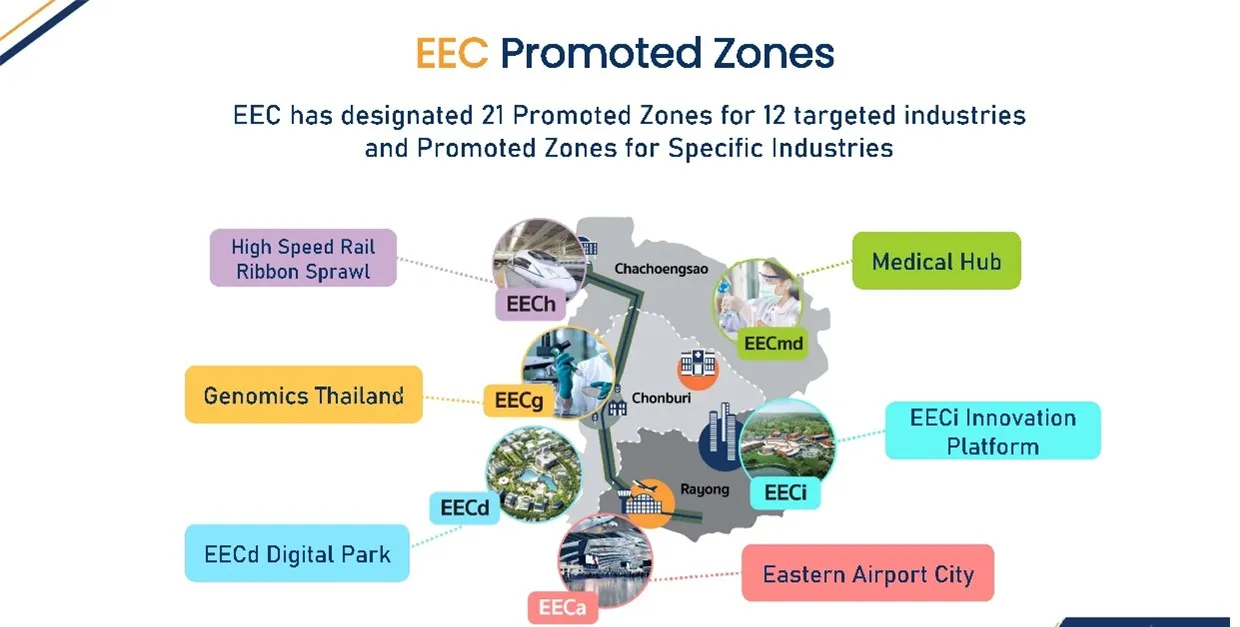
This ambition sits alongside the EEC’s existing innovation districts, including the Eastern Economic Corridor of Innovation focused on biotechnology, biofuels, petrochemicals and robotics, and complements Thailand’s broader effort to court high-value industries and foreign investment across the corridor.
Connectivity: linking EECiti to the region
Transport links are central to the EECiti pitch. The site sits within 20 kilometres of the Pattaya high-speed rail station, and a monorail system is planned to connect the new city to that station. That high-speed line is itself part of a wider scheme intended to link Don Mueang, Suvarnabhumi and U-Tapao airports, though as Thailand Business News has reported, cabinet approval for revised contract terms on that broader rail link remained pending as of early 2026. EECiti’s own success will depend in part on those regional connectivity projects landing on schedule.
What it means for investors
For infrastructure developers, financial institutions and construction groups, EECiti represents one of the larger PPP opportunities to emerge from the EEC programme since its 2017 launch. The structure favoured by EECO, a single-package investment model spanning multiple utility systems, is designed to make the project more bankable by bundling revenue streams rather than tendering each system separately, though final terms will depend on feedback from the market sounding process.
Real estate developers and hospitality groups will be watching the entertainment and residential components more closely, particularly if the theme park and sports complex plans advance from concept to formal tender. Given the 2027-2028 window for invitations and bidding, most of the near-term opportunity lies in positioning, consortium-building, and engaging with EECO’s ongoing consultation process rather than in construction contracts themselves.
More broadly, EECiti is a useful signal of where Thailand’s industrial strategy is heading: away from pure manufacturing incentives and toward the kind of integrated, livable urban infrastructure that the government hopes will help the EEC retain skilled workers and attract the service, finance and technology firms that follow industrial investment rather than lead it. Details on incentive structures and land-use rules will continue to firm up as the project moves toward its 2027 investor invitation, and Thailand Business News will continue tracking developments as EECO finalises the PPP terms.































































You must be logged in to post a comment Login