
Business
(VIDEO) Travis Kelce Reveals Wendy, His and Taylor Swifts New Dog, in Tommy Hilfiger Fashion Campaign


Travis Kelce’s new Tommy Hilfiger fashion campaign gave the world its first official look at another member of his household this week: a fluffy white Samoyed named Wendy, the dog he shares with his wife, Taylor Swift.
Kelce, the Kansas City Chiefs tight end, is one of several sports and fashion stars featured in Tommy Hilfiger’s Fall 2026 campaign, which debuted Tuesday and was filmed at the Plaza Hotel in New York City. In the roughly two-minute ad, Kelce arrives at the hotel wearing a gray hoodie and tan coat, encountering fellow campaign stars including model Gigi Hadid, tennis player Frances Tiafoe and retired NBA All-Star Carmelo Anthony before settling into a suite, where Wendy joins him on a couch for the campaign’s most talked-about moment.
Speaking with Vogue about the dog’s inclusion in the shoot, Kelce said the Hilfiger creative team had originally floated the idea of bringing a canine into the campaign, and he offered up Wendy without hesitation. “We figured, why not her? She crushed it, and actually really fit into that Tommy aesthetic, too,” Kelce told the magazine. “Those are some of my favorite shots.” Asked about the dog directly, Kelce did not hide his affection. “Are you kidding me? She lights up my day,” he said.
Wendy’s name had not been officially confirmed prior to the campaign’s release, despite months of fan speculation about a dog first spotted traveling with Kelce in July, when the Samoyed was photographed disembarking a private jet with him in Palm Beach, Florida. Forbes identified the dog’s name as Wendy in its coverage of the Tommy Hilfiger ad, according to reporting from TMZ, though the outlet briefly removed the name from its story before it was later reinstated and picked up more broadly by other outlets.
The dog’s public debut adds a fourth pet to the household Kelce and Swift have built since their wedding this summer. Swift has long been known for her trio of cats, Meredith Grey, Olivia Benson and Benjamin Button, animals that have appeared throughout her career in social media posts, music videos and professional photo shoots. Benjamin Button notably appeared alongside Swift on the cover of Time magazine after she was named the publication’s 2023 Person of the Year.
Kelce and Swift married this offseason in a ceremony held at Madison Square Garden, an event that drew a wide array of high-profile guests from both the entertainment and sports worlds. Photos from the wedding reportedly included garden-themed decor featuring a portrait of the couple holding a white dog, an image some fans have since connected to Wendy’s earlier, less formal public sightings.
Tuesday’s campaign marks the formal start of Kelce’s new partnership with Tommy Hilfiger, which the brand’s namesake designer described in a statement as a natural pairing given Kelce’s cultural reach. “Travis Kelce is one of the most magnetic figures in sport and culture today,” Tommy Hilfiger said. “He is at the forefront of a new generation of athletes expressing themselves through style.” Kelce, for his part, described a personal connection to the brand dating back to his teenage years. “Ever since high school, when I used to ask my mom to buy [Tommy Hilfiger] Sailing Gear jackets, I’ve been drawn toward the brand’s confident style,” he said.
The Fall 2026 campaign is set to be followed by a deeper collaboration between Kelce and the brand, with a dedicated design partnership planned for spring 2027. Kelce joins a lineup of past Tommy Hilfiger collaborators that has included tennis star Rafael Nadal, Formula 1 driver Lewis Hamilton, model Gigi Hadid and actress Zendaya.
The dog’s appearance comes as Kelce continues balancing his football career with an expanding roster of outside business ventures, including a prior limited-edition collaboration with American Eagle under his Tru Kolors brand. Kelce, who considered retirement following the 2025 NFL season, ultimately signed a three-year contract worth up to 57.75 million dollars with the Chiefs this offseason, a deal structured as effectively a one-year, 12 million dollar arrangement that could mark the final chapter of his playing career. Should Kelce eventually step away from football, he now has plenty of company waiting at home, with Wendy set to remain a fixture both in the Kelce-Swift household and, evidently, on brand campaigns going forward.


VFLO: Outstanding Returns And Appealing Fundamentals Lead To Buy Rating

Burnham said his government’s first moves were designed to give people ‘breathing space’.
Medtronic (MDT) stock popped Tuesday as its diabetes spinoff Minimed (MMED) rallied, reversing premarket losses, after both lifted their full-year guidance. Medtronic posted organic sales growth of 13.7%, roughly 200 basis points above the midpoint of its guidance, Evercore ISI analyst Vijay Kumar said in a report. Importantly, cardiovascular and medical-surgical sales all topped forecasts, but neuroscience coming in line.…
Copyright ©2026 Investor’s Business Daily, LLC. All rights reserved. 87990cbe856818d5eddac44c7b1cdeb8

Check out what’s clicking on FoxBusiness.com.
Dyson is expanding into oral care with a $499 smart toothbrush that uses a built-in camera and targeted liquid jet to clean between teeth.
The CameraJet, which launches on Tuesday, uses a 100,000-pixel macro camera and artificial intelligence to identify gaps between teeth and automatically directs mouthrinse toward them.
The $499 device marks Dyson’s latest expansion beyond the vacuum cleaners and hair care products for which the company is best known, adding another high-priced consumer product to its lineup.
Dyson says the camera can analyze 28 images per second. Its software can trigger the jet within 100 milliseconds of detecting a gap.
LASER-WIELDING MOSQUITO KILLER HITS MARKET PROMISING TO TRACK AND ZAP BACKYARD PESTS MIDAIR
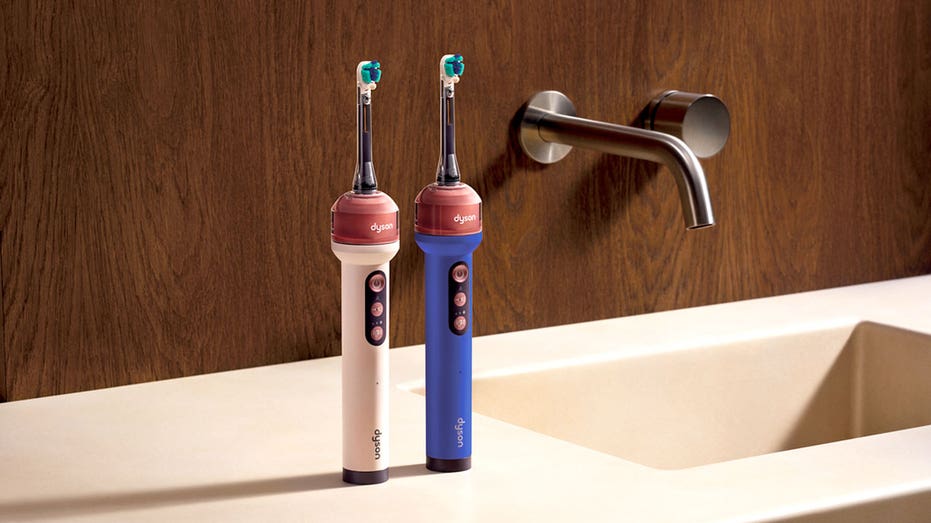
The $499 device marks Dyson’s latest expansion beyond the vacuum cleaners and hair-care products. (Dyson)
The CameraJet uses a conical liquid jet rather than the narrow stream found on traditional water flossers. Dyson says the system is designed to remove plaque between teeth while operating at lower pressure.
A 12.5-milliliter reservoir holds mouthrinse, while an included dock can refill the tank in about three seconds, according to the company.

Users can connect the device to the MyDyson app for live camera viewing. (Dyson)
Users can connect the device to the MyDyson app for live camera viewing, cleaning guidance, coverage maps and feedback on brushing technique.
Dyson says images are not stored or shared and that processing takes place on the device.
The company also says laboratory testing found the CameraJet removed nearly 70% more plaque in hard-to-reach areas than premium electric toothbrushes under certain test conditions. Dyson conducted the testing using proxy plaque developed through research with the National University of Singapore.
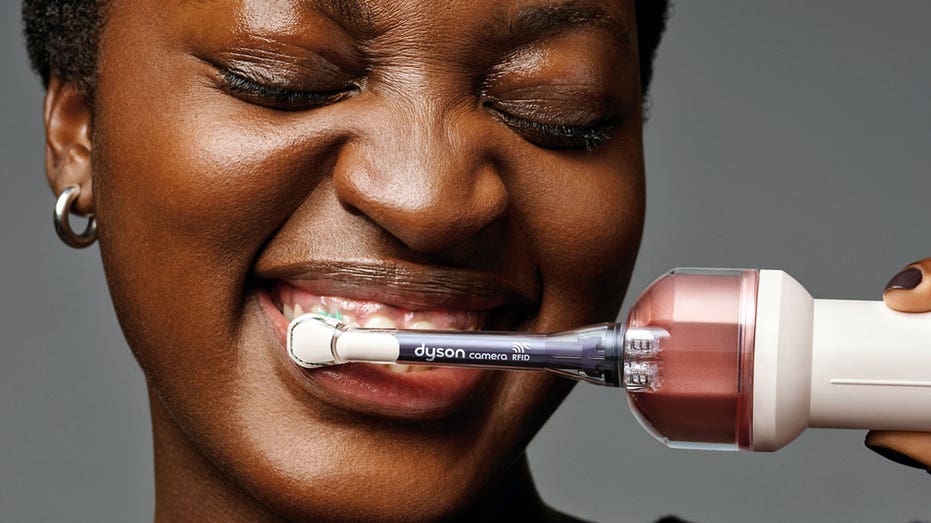
Dyson says images are not stored or shared and that processing takes place on the device. (Dyson)
Dyson is also developing low-foaming mouthrinse and SLS-free toothpaste for use with the device.
CLICK HERE TO GET FOX BUSINESS ON THE GO
The CameraJet is available through Dyson’s website and Dyson Demo Stores.

Robinhood swung higher early Tuesday after Morgan Stanley upgraded shares on the mobile broker’s growth outlook. HOOD stock rose in August, taking back the ground lost after the company posted record trading volumes in its Q2 beat in July. The gain moved shares up the right side of a base, and toward a buy point. Morgan Stanley on Tuesday upgraded…
Copyright ©2026 Investor’s Business Daily, LLC. All rights reserved. 87990cbe856818d5eddac44c7b1cdeb8

Hartford Checks And Balances Fund Q2 2026 Commentary
Business
Earnings call transcript: Bally’s Intralot posts strong H1 2026 growth as U.K. tax bite bites

Earnings call transcript: Bally’s Intralot posts strong H1 2026 growth as U.K. tax bite bites

For decades, a fixed office landline was simply part of running a business.
That’s changing fast. Across the UK, sole traders and small firms are dropping traditional lines in favour of a virtual phone number — a business number that works on the mobile they already carry. Here’s what’s driving the shift.
The old network is being switched off
The timing isn’t a coincidence. The UK’s traditional copper phone network (the PSTN) is being retired, and analogue landlines are being phased out in favour of digital alternatives. For a small business, that looming deadline is a natural prompt to ask a bigger question: do we need a physical line at all?
For many, the answer is no. If your team already works from mobiles, laptops and the odd coffee shop, a desk-bound line starts to look like a cost without a purpose.
What a virtual number actually does
A virtual phone number isn’t tied to a single handset or location. Calls to your business number are simply diverted to whatever device you’re using — usually your mobile. You keep a professional presence, without the hardware.
The practical wins add up quickly:
- Work and personal calls stay separate. You hand out a business number, not your personal mobile.
- You’re reachable anywhere. Calls follow you, whether you’re on site, at home or travelling.
- No engineer, no installation. Setup takes minutes, not weeks, and there’s nothing to wire in.
Crucially, a virtual number still looks the part. You can choose a UK phone number with a local area code — an 0161 for Manchester, an 020 for London — so customers see a familiar, credible number rather than a mobile.
Professional features without the phone system
The other draw is control. Modern virtual services bundle in the kind of features that used to require an expensive on-premise phone system: call forwarding, business hours, voicemail, custom greetings and call menus, all managed from an app.
For a growing business, that means you can route calls to the right person, switch off cleanly after hours, and add numbers or users as the team expands — without a contract renegotiation or a visit from an installer.
A lower-risk way to look bigger
Cost plays a part too. Virtual numbers typically run on a straightforward monthly subscription, with no lengthy contracts and no hardware to buy. Providers like Rinkel start from a few pounds per user per month, which makes a professional setup accessible even for a one-person business.
The bigger picture is simple: as the old network winds down and work becomes more mobile, the fixed landline is quietly becoming optional. For many small UK businesses, a virtual number offers the same professional front — with a lot more freedom behind it.
Business
(VIDEO) North Carolina Boy Faces Six Rabies Shots After Mobile Petting Zoo Goats Test Positive for the Virus

MOCKSVILLE, N.C. — A North Carolina family is racing through a series of rabies vaccinations for their 4-year-old son after learning that baby goats he petted at a mobile petting zoo tested positive for the virus, part of a broader public health response now underway across the state.
Rebecca Lanning, 30, of Marion, said she received a call from her son’s aunt last Friday informing her that her son had been exposed to rabies. The family had visited a dinosaur-themed exhibit in Mocksville 13 days earlier, on Aug. 15, an event that also featured food trucks, carnival games and a petting zoo where the boy fed baby goats by hand. “I didn’t think anything of it until Friday, when his aunt called me and was like, ‘Hey, we have a situation,’” Lanning said.
The North Carolina Department of Health and Human Services announced Friday that three baby goats from the petting zoo had tested positive for rabies. Those animals, along with a fourth goat suspected of carrying the virus, have since been euthanized.
Lanning immediately took her son to the doctor, where he received the first two of six required doses of the rabies vaccine, a regimen known as post-exposure prophylaxis. The shots are administered after a possible exposure in an effort to stop the virus before it can take hold in the body. Once symptoms of a rabies infection begin, the disease, which attacks the brain and spinal cord, is almost always fatal. The vaccine is nearly 100% effective at preventing the disease, but only when it is administered before symptoms appear.
People can become infected with rabies through contact with the saliva of an infected animal, or through a bite or scratch. Lanning said the uncertainty of her son’s specific interactions with the goats has weighed on her heavily in the days since learning of the exposure. “My fear is that if he was feeding the goats, and he’s 4, who’s to say that he didn’t touch his mouth or eyes?” Lanning said. “I don’t want to bury my child.”
Rabies symptoms typically take weeks to months to appear after exposure, and can initially resemble the flu, including weakness, fatigue, fever and headaches. According to the North Carolina health department, people may also experience a prickling or itching sensation at the site where they were touched or bitten by an infected animal.
As of Monday, the state health department said it did not have an estimate of how many people may have been exposed to the infected goats. The animals were part of a North Carolina-based mobile petting zoo operation called Farm Adventures, which had appeared at events across the state between July 28 and Aug. 23. Beyond the Mocksville dinosaur exhibit, the goats were also brought to private gatherings, including birthday parties and a back-to-school celebration, as well as a visit to an assisted living center.
A representative for Farm Adventures did not respond to a request for comment. The company addressed the situation in a post on its Facebook page, stating that its goats, which were too young to have been vaccinated against rabies themselves, appeared to have contracted the virus after a skunk got into their enclosure. Skunks are among the animals most commonly known to carry and transmit rabies, along with bats, raccoons and foxes.
In a statement, the North Carolina health department said it is “working with local health departments and healthcare systems to make sure rabies post-exposure prophylaxis is available to anyone who needs it,” as officials work to identify and reach others who may have come into contact with the infected animals during their weeks on the road.
The incident comes amid what public health officials say is a broader increase in rabies exposures nationally in recent years. According to the Centers for Disease Control and Prevention, roughly 1.4 million Americans are evaluated annually for possible rabies exposure, with about 100,000 people ultimately receiving post-exposure prophylaxis shots each year. Health officials continue to urge caution around wild and unfamiliar animals, along with prompt medical attention following any bite, scratch or direct contact with an animal’s saliva, given how critical early treatment is to preventing the disease from becoming fatal.

For years, Britain had an uncomfortable problem with its broadband infrastructure. While countries including Spain, Japan and South Korea pushed fibre deeper into their fixed networks, millions of UK homes continued to rely on copper for the final stretch of their connection.
That gap has not disappeared. But it is closing remarkably quickly.
Full-fibre broadband was available to 82% of UK homes by January 2026, according to Ofcom, up from less than a quarter just five years earlier. Gigabit-capable broadband, which also includes technologies other than full fibre, had reached 89% of homes.
The figures represent one of the fastest infrastructure transformations Britain has undertaken in recent years. They also complicate the familiar argument that the UK is simply falling behind the rest of the world.
Britain was late to the fibre race. Increasingly, however, it is becoming one of its fastest runners.
The countries Britain is still chasing
There remains a group of countries where fibre is considerably more mature.
Ofcom’s international comparison for the first quarter of 2025 put full-fibre coverage at 100% in Singapore, Japan and Spain, followed by South Korea at 99% and France at 95%. The UK stood at 77% at the time, ranking sixth among the countries compared.
Other measures tell a similar story. Across the OECD, fibre accounted for 44.6% of fixed broadband subscriptions by mid-2024, but the proportion was dramatically higher in some markets. Iceland, South Korea and Spain were among the countries where fibre represented more than 80% of fixed broadband connections.
These countries did not necessarily arrive there in the same way.
South Korea and Japan benefited from dense urban populations and began investing heavily in fibre infrastructure much earlier. Spain combined favourable deployment economics in its cities with sustained investment by competing operators. France pursued an aggressive nationwide programme that extended fibre well beyond its largest urban centres.
Britain, by contrast, spent years extracting more performance from its existing copper and cable infrastructure.
That approach was economically rational. Fibre-to-the-cabinet could provide much faster broadband without replacing the final copper connection into every property, while cable networks provided another route to higher speeds.
But it also delayed the point at which fibre would need to be built all the way to millions of individual premises.
Britain is now building at extraordinary speed
The result is an unusual position: Britain remains behind the world’s most mature fibre markets while simultaneously carrying out one of Europe’s largest fibre deployments.
Ofcom says the UK has gone from full fibre reaching less than one in four homes five years ago to more than eight in ten today. In the six months to January 2026 alone, another 1.2 million homes gained access.
Much of that acceleration has come from competition.
Openreach remains the country’s largest fixed network operator, but it is no longer building in isolation. Virgin Media O2, CityFibre and a collection of smaller alternative networks have invested heavily in their own infrastructure, sometimes building competing fibre networks in the same towns and cities.
That competition has not been painless. Some alternative network operators have struggled to convert homes passed into paying customers, while consolidation across the sector has become increasingly likely as investors scrutinise the returns generated by duplicated infrastructure.
For consumers, however, the investment boom has helped turn Britain’s fibre deficit into a rapidly shrinking one.
Geography changes the economics
International broadband rankings can obscure just how different the challenge is from one country to another.
Countries such as South Korea and Japan combine highly urbanised populations with relatively high population density, making it possible for networks to reach large numbers of households efficiently. Spain has also benefited from dense cities and extensive fibre investment, helping it become one of Europe’s most mature fibre markets.
The challenge looks different in larger and more sparsely populated countries. Canada and Australia, for example, must connect populations spread across enormous geographic areas, while the United States combines dense metropolitan markets with vast rural regions where the economics of fixed infrastructure can be considerably more difficult.
“Fibre coverage is difficult to compare between countries without considering the geography behind the numbers,” says Tomas Novosad of Home Internet Plans. “Population density, the distance between communities and the infrastructure already in place can dramatically change the economics of a fibre rollout. Reaching another million premises in one country may require a very different level of investment than reaching the same number somewhere else.”
Britain sits in a comparatively favourable position. Its relatively high population density and compact geography allow network operators to reach large numbers of premises without covering the distances required in countries such as Canada or Australia.
That advantage becomes less significant, however, as coverage approaches universality. The homes left behind tend to be precisely those that are most difficult and expensive to connect.
The last homes are the hardest
This is where Britain’s fibre story enters its next and potentially more difficult stage.
Ofcom forecasts that full-fibre networks could reach 96% of UK premises by 2027 if operators complete their planned deployments.
Reaching the remaining premises is another matter.
Commercial networks naturally prioritise areas where the cost of construction can be justified by the number of potential customers. Remote homes, isolated communities and difficult terrain can produce precisely the opposite equation: substantial construction costs for relatively few connections.
That is why public programmes such as Project Gigabit remain important even as commercial fibre coverage approaches nationwide levels. The challenge is increasingly not bringing faster broadband to Britain’s major population centres, but preventing the final pockets of the country from being left behind as networks move away from copper.
It also means the definition of success is changing.
Five years ago, the central question was how quickly Britain could build fibre. As coverage approaches maturity, the questions increasingly concern who remains unconnected, how much it costs to reach them and whether consumers actually migrate onto the new networks once they arrive.
From catching up to finishing the job
So, is Britain falling behind?
Against the world’s fibre leaders, the UK still has ground to make up. Countries such as Spain, Japan and South Korea reached near-universal fibre coverage earlier, while Britain spent longer relying on technologies that incorporated its existing copper and cable infrastructure.
But describing Britain today simply as a broadband laggard misses what has happened over the past five years.
The country has moved from less than a quarter of homes having access to full fibre to more than four in five. It now ranks ahead of several comparable developed economies on full-fibre availability, and network operators are approaching the expensive final stage of nationwide deployment.
Britain entered the full-fibre era late.
The more relevant question now is whether it can finish the rollout as strongly as it has caught up.

VFLO: Outstanding Returns And Appealing Fundamentals Lead To Buy Rating

Robinhood's new crypto network is printing cash, and it's sending Arbitrum's token soaring

Forget Freddy Krueger, Horror’s New Slasher Villain Is Coming for Your Dreams [Exclusive]





-

 Crypto World7 days ago
SpaceX stock could rise 75% to $240, JPMorgan says
-

 Fashion4 days ago
Weekend Open Thread: Maeve – Corporette.com
-

 Crypto World5 days ago
Bitcoin’s 22% rally now needs real demand to outlast Treasury liquidity boost
-

 Crypto World6 days ago
Warsh Jackson Hole keynote puts financial innovation first
-

 Business5 days ago
Salesforce Stock Soars 19% as Blowout Earnings and Agentforce AI Growth Silence Software Skeptics
-

 Business5 days ago
Apple Confirms September 9 Keynote and Reveals Its Full Pre-Order Schedule
-

 Crypto World6 days ago
Elon Musk Grok Bot Promise: We Will Make You Whole if AI Loses Your Money
-

 Crypto World7 days ago
Did Trump Just Move SpaceX Stock With One Truth Social Post?
-

 Business4 days ago
Onto Innovation Stock: AI’s Next Bottleneck Is Yield (NYSE:ONTO)
-
 NewsBeat6 days ago
Lindsay Clancy jury braces for closing arguments as judge tells court: ‘You’ve heard all the evidence’ – Live updates
-

 Business6 days ago
Walmart takes aim at younger shoppers with new fashion brand
-

 Crypto World4 days ago
Bitcoin price tests $82K resistance as Brandt stays long
-

 Crypto World5 days ago
NVIDIA revenue hits $96.2B as AI demand doubles
-

 Business7 days ago
Thailand’s Eastern Economic Corridor Capital City (EECiti): Key Developments and Investment Opportunities
-

 Business4 days ago
iPhone 18 Pro Pre-Orders Could Shift to Saturday as Apple Reportedly Avoids September 11 Anniversary
-

 NewsBeat7 days ago
Trump’s trade truce with China faces test with Iran effort
-
 Crypto World6 days ago
Nvidia Q2 Earnings Reveal $96.2 Billion Beat, So Why Is NVDA Falling?
-
 Tech3 days ago
Hugging Face built a $4.5 billion empire on free AI models. Now Nvidia is buying it for $12.9 billion
-

 Tech6 days ago
Claude Cowork gets its own browser that doesn’t touch your tabs, bookmarks, or saved passwords
-

 Crypto World5 days ago
Truflation calls for Fed rate cut after PCE forecast
You must be logged in to post a comment Login