

Business
VIX ‘Fear Gauge’ Jumps Above 19 as Wall Street’s Tech Stock Selloff Deepens Once Again, Rattling Investors


NEW YORK — Wall Street’s most closely watched measure of investor anxiety ticked higher Friday, as renewed selling in the technology sector pushed traders to pay up for protection against further market swings.
The CBOE Volatility Index, widely known as the VIX or “fear gauge,” was trading at 19.34, up 0.45 points, or 2.38%, extending a climb that began the previous session as megacap technology stocks came under fresh pressure.
A modest but telling move
The VIX’s rise on Friday builds on an increase that was already underway Thursday. The index closed Thursday at 18.89, up 1.40% on the day, even as the broader S&P 500 finished essentially flat. That divergence — a rising fear gauge alongside a steady headline index — is often a signal that investors are growing more cautious beneath the surface of the market, even when the major averages aren’t moving dramatically.
Understanding what these moves actually mean requires looking at what the VIX measures in the first place. The VIX measures expected S&P 500 volatility over the next 30 days, derived from S&P 500 index option prices across a wide range of strike prices, reflecting how much movement traders are paying to hedge against rather than predicting a specific market direction. A high VIX reading means traders are bidding up insurance — when stocks drop sharply, investors rush to buy put protection, and that demand for hedges lifts option premiums and, in turn, the VIX itself.
Where Friday’s reading falls historically
At just above 19, Friday’s level remains within what market professionals consider a normal trading range, even as it ticks higher. Readings of 15 to 25 reflect a normal market with two-way flow, while readings of 25 to 30 mark rising stress often associated with earnings or policy surprises, and readings above 30 indicate the kind of high stress typically seen during sharp risk-off episodes.
That context matters for putting Friday’s move in perspective: the VIX remains well below levels associated with genuine panic, even as it rises from the unusually placid readings the market saw earlier in the year. The index’s 52-week low of 13.38 was set on December 24, 2025, while its 52-week high came on March 9, 2026.
What’s driving the renewed caution
The uptick in volatility tracks closely with a broader retreat in technology shares that has rattled markets over the past several sessions. Megacap names that have powered much of this year’s market gains have come under renewed selling pressure, driven in part by concerns over rising costs tied to the artificial intelligence buildout. Apple, Nvidia, Microsoft, Amazon and Meta Platforms all posted losses this week as megacap technology shares remained under pressure.
That weakness has stood in contrast to strength in a different corner of the tech sector. Micron surged after reporting strong earnings and issuing a robust revenue outlook, lifting other chip-related stocks including Sandisk, Applied Materials and Western Digital. The split between companies benefiting from surging memory demand and those facing higher costs because of it has left investors trying to sort winners from losers within the same broad sector — exactly the kind of uncertainty that tends to push hedging demand, and the VIX, higher.
A global dimension to the unease
The volatility hasn’t been confined to U.S. markets. Trading overseas showed even sharper swings tied to the same underlying worries about technology valuations. Trading in South Korea was temporarily halted after an 8% decline in the benchmark Kospi index triggered a circuit breaker designed to curb panic selling, with the index ultimately closing down 5.8%.
A market strategist pointed to a broader shift in how investors are approaching the AI trade after a long rally in related shares. “The long-term investment case for AI remains compelling, but investors are becoming far more selective about which companies can justify the valuations the market has assigned to them,” said David Makaryan, a senior partner at Alpha Pacific Group.
A pattern of swings rather than a single event
This year’s volatility readings have themselves been something of a rollercoaster, reflecting how quickly sentiment has shifted on Wall Street in recent months. Headlines from earlier in June captured that whiplash directly: the “fear gauge” tumbled as traders bid up SpaceX shares in mid-June, only to “punch back” days later as a “crash up” in chip stocks reversed. Other recent commentary noted that the volatility index was signaling calm on Wall Street even though “that’s not how traders feel,” underscoring a gap between the VIX’s headline number and the underlying nervousness many investors describe.
How to think about a VIX in the high teens
For everyday investors trying to make sense of the number, market commentary generally treats VIX readings in the high teens as unremarkable on their own, but worth watching if they continue to climb. Volatility tends to cluster and then fade — once a specific catalyst passes, option demand typically cools and the VIX drifts back toward its long-run average, generally cited as somewhere between 18 and 20. That would put Friday’s reading right around the historical norm, even as the short-term trend has been upward.
With megacap technology names continuing to face scrutiny over AI-related spending and valuations, and with memory chip stocks pulling in the opposite direction on strong earnings, traders are likely to keep a close eye on the VIX in the sessions ahead as a barometer of how much further the current bout of sector rotation has to run. A sustained move higher from current levels would suggest the unease rippling through tech stocks is spreading more broadly across the market; a pullback back toward the high teens would suggest Friday’s bump was simply another short-lived spike in what has already been a volatile year for Wall Street’s fear gauge.



I have a strong inclination towards high-growth companies, often treading in sectors poised for exponential expansion. My expertise lies in understanding and investing in disruptive technologies and forward-thinking enterprises. My approach is a mix of fundamental analysis and future trend prediction. I believe in the power of innovation to yield substantial returns and aim to provide insightful analysis on such companies here on SeekingAlpha.
Analyst’s Disclosure: I/we have no stock, option or similar derivative position in any of the companies mentioned, and no plans to initiate any such positions within the next 72 hours. I wrote this article myself, and it expresses my own opinions. I am not receiving compensation for it (other than from Seeking Alpha). I have no business relationship with any company whose stock is mentioned in this article.
Seeking Alpha’s Disclosure: Past performance is no guarantee of future results. No recommendation or advice is being given as to whether any investment is suitable for a particular investor. Any views or opinions expressed above may not reflect those of Seeking Alpha as a whole. Seeking Alpha is not a licensed securities dealer, broker or US investment adviser or investment bank. Our analysts are third party authors that include both professional investors and individual investors who may not be licensed or certified by any institute or regulatory body.


US safety agency ends power steering probe into 376,000 Tesla EVs

No downward dog jokes, please: Yoga tights pioneer Lululemon Athletica is one of the stock market’s worst performers. It has fallen 45% year to date and 60% over the past five years, good for ninth and 12th worst, respectively, among S&P 500 companies.
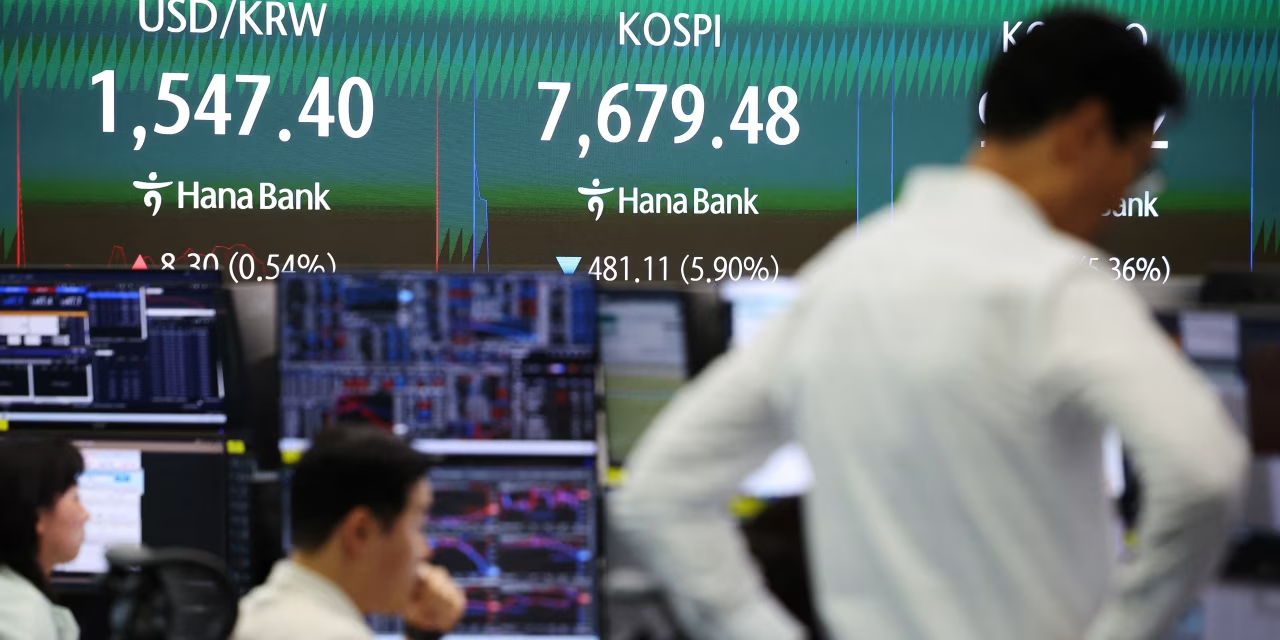
South Korean shares slumped more than 8%, prompting regulators to halt trading for the second time this week as jitters over the valuations of companies riding the artificial-intelligence boom rattled the world’s best-performing market this year.
The benchmark Kospi tumbled 8.1% Friday afternoon, erasing Thursday’s gains as investors grew concerned that the rapid growth in profits of chip manufacturers that supply the AI industry could top out. Reflecting how volatile trading of South Korean stocks has become, regulators briefly suspended trading again in an effort to steady the market.
Copyright ©2026 Dow Jones & Company, Inc. All Rights Reserved. 87990cbe856818d5eddac44c7b1cdeb8

Salesforce: Why The Bears Are Getting Ahead Of Themselves

Catching A Falling Calf: A Contrarian Case For America's Beef Packers

The Strait Is Open. What's Next For Markets?

I’m at about 30 years persevering as a “professional bear.” My lucky break came in late-1989, when I was hired by Gordon Ringoen to be the trader for his short-biased hedge fund in San Francisco. Working as a short-side trader, analyst and portfolio manager during the great nineties bull market – for one of the most brilliant individuals I’ve met – was an exciting, demanding and, in the end, a grueling and absolutely invaluable learning experience. Later in the nineties, I had stints at Fleckenstein Capital and East Shore Partners. In January 1999, I began my 16 year run with PrudentBear (that concluded at the end of 2014), working as strategist and portfolio manager with David Tice in Dallas until the bear funds were sold in December 2008. In the early-nineties, I became an impassioned reader of The Richebacher Letter. The great Dr. Richebacher opened my eyes to Austrian economics and solidified my lifetime passion for economics and macro analysis. I had the good fortune to assist Dr. Richebacher with his publication from 1996 through 2001. Prior to my work in investments, I worked as a treasury analyst at Toyota’s U.S. headquarters. It was working at Toyota during the Japanese Bubble period and the 1987 stock market crash where I first recognized my love for macro analysis. Fresh out of college I worked as a Price Waterhouse CPA. I graduated summa cum laude from the University of Oregon (Accounting and Finance majors, 1984) and later received an MBA from Indiana University (1989). By late in the nineties, I was convinced that momentous developments were unfolding in finance, the markets and policymaking that were going unrecognized by conventional analysis and the media. I was inspired to start my blog, which became the Credit Bubble Bulletin, by the desire to shed light on these developments. I believe there is great value in contemporaneous analysis, and I’ll point to Benjamin Anderson’s brilliant writings in the “Chase Economic Bulletin” during the Roaring Twenties and Great Depression era. Ben Bernanke has referred to understanding the forces leading up to the Great Depression as the “Holy Grail of Economics.” I believe “The Grail” will instead be discovered through knowledge and understanding of the current extraordinary global Bubble period.


With over three years of finance and consulting experience, Nikola is laser focused on finding value in North American public equities and ETF’s. His professional experience includes corporate credit risk analysis, consulting for government entities, and venture capital analysis in the med-tech space. More recently, Nikola has helped investors narrow down better options for ETF’s – every asset manager seems to have similar offerings these days. Nikola is not a licensed financial advisor and nothing in his commentary here on Seeking Alpha should be regarded as advice. All of his opinions are his own, and not on behalf of any other entities.
Analyst’s Disclosure: I/we have a beneficial long position in the shares of HMAX:CA either through stock ownership, options, or other derivatives. I wrote this article myself, and it expresses my own opinions. I am not receiving compensation for it (other than from Seeking Alpha). I have no business relationship with any company whose stock is mentioned in this article.
Seeking Alpha’s Disclosure: Past performance is no guarantee of future results. No recommendation or advice is being given as to whether any investment is suitable for a particular investor. Any views or opinions expressed above may not reflect those of Seeking Alpha as a whole. Seeking Alpha is not a licensed securities dealer, broker or US investment adviser or investment bank. Our analysts are third party authors that include both professional investors and individual investors who may not be licensed or certified by any institute or regulatory body.

Gulf Coast Express Expansion Live As Waha Basis Tightens And Permian Bottleneck Eases

Updated Local Plan for Stockton set to take shape

SELLAS Life Sciences: The AML Platform Is More Interesting Than Binary Event (NASDAQ:SLS)

EU Lawmakers Call for Clear DeFi, Staking, NFT Rules Under MiCA


-

 Entertainment6 days ago
Renter of Home in Anne Heche Crash Denies Settlement With Son
-
 Sports4 days ago
Two goals and an assist by sheer aura: Cristiano Ronaldo just entered the World Cup chat
-

 Tech5 days ago
Microsoft accidentally kills epic Outlook email threads
-

 Fashion16 hours ago
Weekend Open Thread: Staud – Corporette.com
-

 Business6 days ago
Soccer-U.S. defends Iran World Cup travel restrictions, says discussions ongoing
-

 Politics1 day ago
The House | Manchesterism won’t survive the painful trade-offs unless it gets citizens on board
-

 Politics1 day ago
Potential 2028er World Cup attendee leaderboard
-

 Business1 day ago
Asia stock markets slide as tech shares slump
-

 Tech2 days ago
A Look At A Gaggle Of Transputer Boards
-
Crypto World3 days ago
Bitcoin (BTC) Dips Below $62K, Ethereum (ETH) Plunges 6% Daily: Market Watch
-

 Crypto World3 days ago
Securitize Wraps Roubini's SEC-Registered ETF as Dubai VARA Digital Security
-
 Crypto World2 days ago
Dell (DELL) Shares Tumble Over 5% Following Analyst Downgrade to Hold
-
Business3 days ago
Entergy settles forward sale agreements, raises $672 million in cash proceeds
-
 Crypto World7 days ago
Can Charles Hoskinson Really Rescue Cardano?
-

 Sports13 hours ago
FIH Pro League: India defeat Pakistan 7-1, register biggest win of campaign | Other Sports News
-

 Crypto World4 hours ago
Kraken's xStocks Opens Bending Spoons IPO Registration to EEA Retail
-

 Crypto World16 hours ago
RTX holders must register wallets before token distribution begins
-
 Crypto World19 hours ago
Hyperliquid Named on Singapore MAS Investor Alert Register
-

 Crypto World7 days ago
Jake Chervinsky accuses CME of protecting derivatives monopoly
-

 Sports2 days ago
India vs Bangladesh LIVE Score, Women’s T20 World Cup: Bangladesh Opt To Bat; India Enter ‘Do-Or-Die’ Stage As Semi-Final Race Heats Up
You must be logged in to post a comment Login