
Business
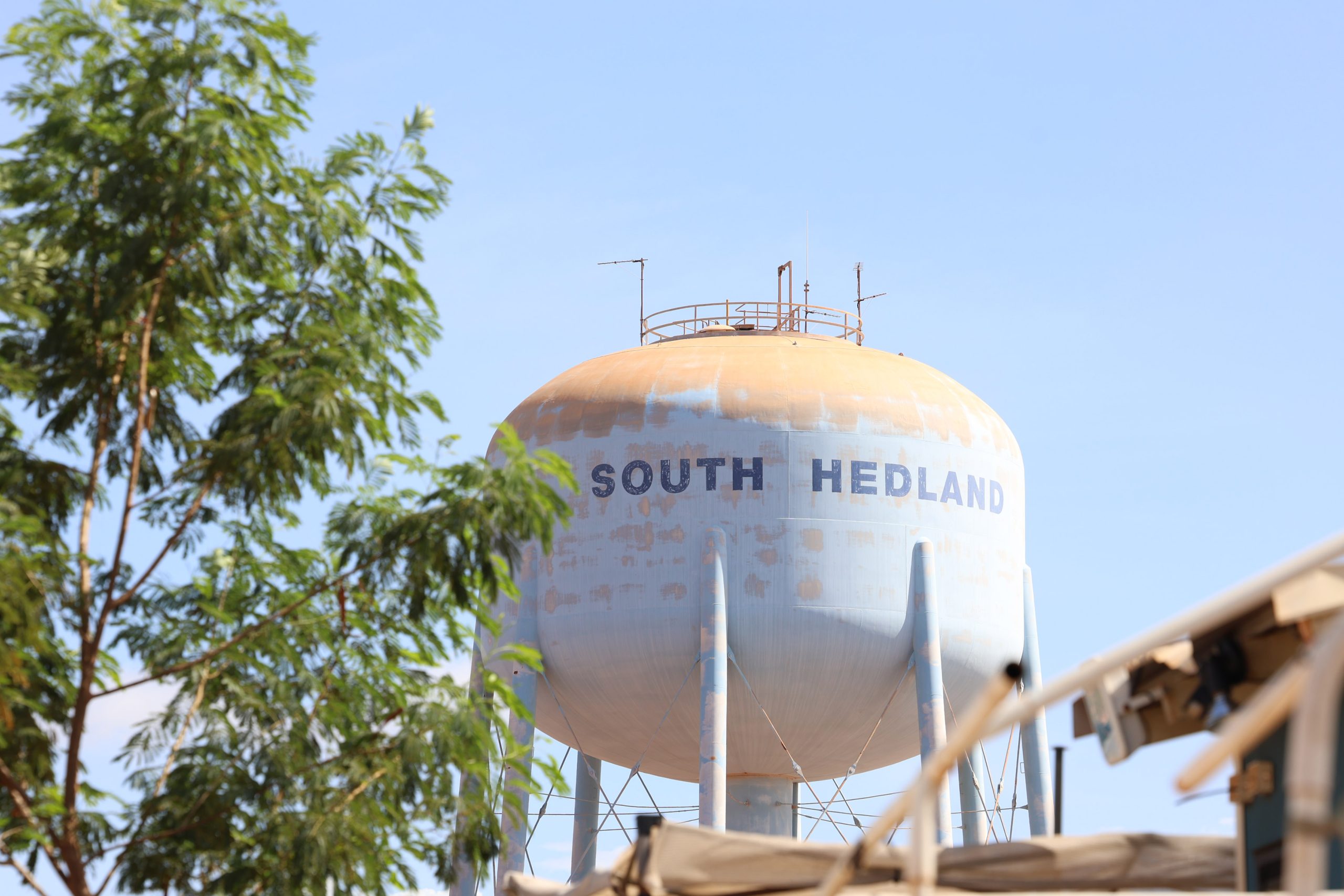
Vysarn to open Kariyarra Water Scheme order book for Pilbara industrial clients


Business
Looking for top-performing equity mutual funds? Here are the best performers across categories in the last 1 year

Returns from mutual fund schemes over the past year show a wide gap between the best- and worst-performing funds across categories, underscoring the importance of scheme selection for investors. Here are the top performers across categories against their benchmark and category average, as reported by ET Bureau.

In an exchange filing, GSM Foils said the firing incident took place in the Naikpada area in Vasai-Virar, located near Mumbai. After getting injured in the incident, the company said that Parmar received prompt medical attention and is presently under proper medical care. His health condition was reported to be stable and improving.
Sagar Bhanushali, a whole time director of the company, was then taken into police custody in relation to the ongoing investigation into the firing case. The company said it is extending full cooperation to the investing authorities.
The senior management team has taken the necessary steps to ensure continuity of the company’s operations. At present, the company’s manufacturing facilities at Vasai and Ahmedabad, Plant continue to function normally,’ it added.
Also read | Peter Lynch does not like the AI trade; here’s why he says ‘Know what you own’
GSM Foils share price
GSM Foils shares crashed 20% to close at Rs 192 apiece on NSE. Notably, the exchange filing came in the post market hours of Friday.

GSM Foils manufactures blister foils and aluminium pharma foils for the pharma industry. The sharp fall in the share price came prior to that as media reports around the incident surfaced.
US stock market losses behind murder plot?
Bhanushali plotted the attack to evade repaying Parmar Rs 32 crore and gain complete control over the company, Times of India reported. According to police officials cited by the report, Bhanusali suffered massive financial losses during a sharp selloff in the US stock market, leaving him burdened with debts running into crores.
The report quoted investigators as saying that Bhanusali had persuaded Parmar to purchase his stake in the company and took nearly Rs 32 crore. Instead of repaying the said amount, he allegedly conspired to kill Parmar, thinking this death would wipe out the liability and enable him to take complete control of the company.The attack took place on July 24 at the company’s premises when two motorcycle-borne hitmen opened fire at the 46-year old Parmar, who was hit in the shoulder by the first bullet.
(Disclaimer: Recommendations, suggestions, views and opinions given by the experts are their own. These do not represent the views of The Economic Times)
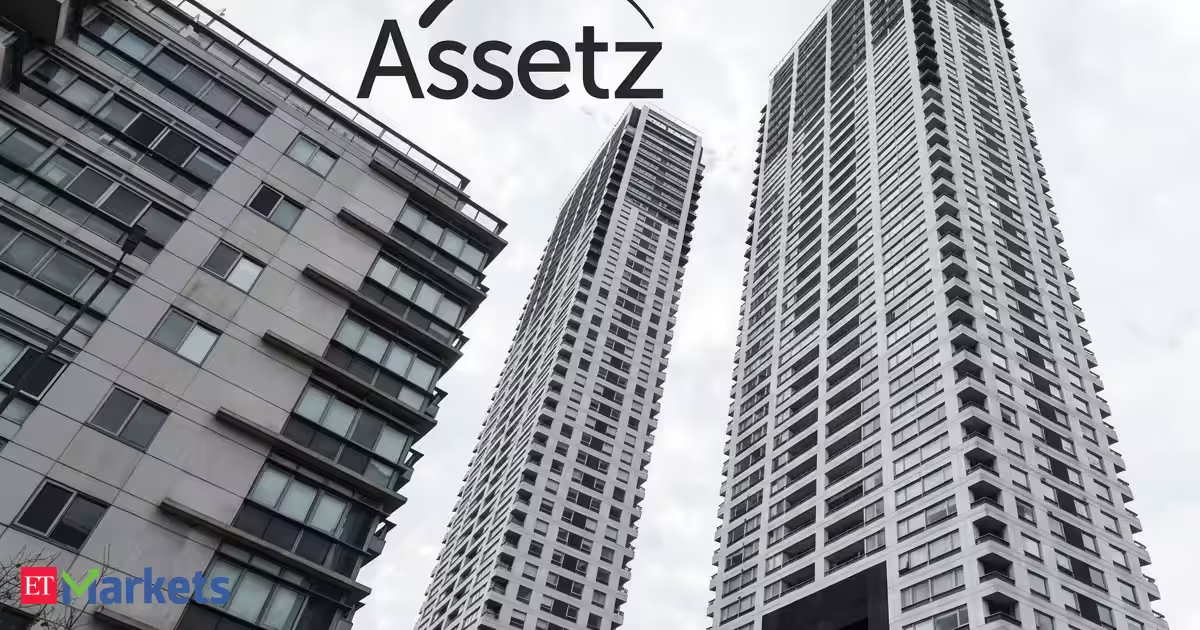
The proposed IPO is likely to be a combination of a fresh equity issuance and an offer for sale (OFS) by existing shareholders.
JM Financial, BofA Securities India and Motilal Oswal Investment Advisors are the book-running lead managers to the issue.
Email queries to the company and the bankers went unanswered.
In the confidential IPO filing route, issuers are allowed to keep their initial draft prospectus confidential from the public domain until the regulatory review process reaches an advanced stage.
J.P. Morgan, Aditya Birla Capital, Motilal Oswal Alternates and HDFC Ltd have been investors in projects of Assetz, founded by Ben Salmon and Rajpal Singh Chaudhary in 2006.
Bengaluru’s residential property market has remained one of the strongest in the country, driven by sustained demand from technology professionals, Global Capability Centres (GCCs), startups and a steadily expanding white-collar workforce. Robust employment generation, rising incomes and continued infrastructure development have supported healthy home sales despite higher property prices.Developers have remained focused on premium housing and large integrated townships, while the city’s deep end-user demand and improving connectivity have encouraged continued land acquisitions, new project launches and institutional investments.

Operator
Good afternoon, ladies and gentlemen, and welcome to the Coveo First Quarter Fiscal 2027 Financial Results Conference Call. [Operator Instructions] This call is being recorded on Thursday, July 30, 2026. I would like to turn the conference over to Adhir Kadve. Please go ahead.
Adhir Kadve
Head of Investor Relations
Good afternoon, everyone, and thank you for joining us. With me to discuss Coveo’s first quarter fiscal 2027 results are Laurent Simoneau, Coveo’s co-founder and Chief Executive Officer, Louis Têtu, Coveo’s Executive Chairman, and Karine Hamel, Coveo’s Chief Financial Officer. A reminder that some remarks made today will be forward-looking statements within the meaning of applicable securities laws, including those regarding our planned objectives, expected performance, and our outlook for the second fiscal quarter and full year fiscal 2027. These are forward-looking statements given as of July 30, 2026, and while we believe any statements we make are reasonable, they are based on current expectations and assumptions which are subject to risks and uncertainties.
Actual results could differ materially from those expressed or implied. Coveo disclaims any intent or obligation to update our forward-looking statements, whether as a result of new information, future events, or otherwise. Further information on factors that could affect the company’s financial results is included in the filings we make with Canadian Securities Regulators, including the Risk Factors section of the company’s

AlexSecret/iStock via Getty Images
Technology rallied 5.24% on Thursday for its best day since April 9, 2025, when the sector surged 14.15% after the Tariff Tantrum. Tech had fallen 5.41% over the prior four trading days, and the rebound recovered more than 90% of that decline. By comparison, the
Kip Meintzer
Head of Global Investor Relations
Greetings, and welcome to the Check Point Software’s 2026 Second Quarter Financial Results Video Conference. I’m Kip E. Meintzer, Global Head of Investor Relations. And joining me today are Chief Executive Officer, Nadav Zafrir; and our Chief Financial Officer, Roei Golan.
Before we begin, I’d like to remind everyone that this conference is being recorded and will be available for replay on our website at checkpoint.com. [Operator Instructions] During the presentation, Check Point’s representatives may make forward-looking statements.
Forward-looking statements can relate to future events or future financial and/or operating performance. These statements involve risks and uncertainties that could cause actual results to differ materially from those projected in the forward-looking statements. Any forward-looking statements made only as of the date hereof, Check Point Software undertakes no obligation to update publicly any forward-looking statements except where required by law.
In our press release, which has been posted on our website, we present GAAP and non-GAAP results, along with the reconciliation of such results, as well as

The e-commerce and cloud titan posted its strongest cloud growth in over four years, indicating a fresh wave of demand that justifies its 10% increase in planned capital spending for 2026 to $220 billion.
Amazon’s results come as a resounding sign to Wall Street that some of Big Tech’s AI investments are already generating measurable returns.
If gains hold, the stock could add more than $340 billion in market value on the back of a 37% jump in second-quarter cloud revenue. Earlier this week, Microsoft surged more than 15% after its cloud unit beat estimates with a 43% revenue jump.
However, there’s a growing divide in investors’ tolerance for the ever-increasing AI spend by Big Tech, set to exceed $730 billion this year.
“The market is no longer questioning whether AI demand is real. The new dividing line is whether unprecedented spending is producing visible, near-term revenue and margin expansion,” said Bill Birmingham, managing director at REX Financial.
“The market penalizes spending when monetization is delayed, indirect or difficult to measure.” Meta and Google-parent Alphabet both slumped 7%, despite strong growth in revenues, after the companies raised their capital spending forecasts while free cash flows cratered.
“Amazon is earning the right to keep spending. Where others are asking investors to trust that the payoff will come, Amazon showed it this quarter,” said Thomas Monteiro, senior analyst at Investing.com.
“As long as AWS keeps accelerating and margins hold, the market looks willing to fund the build-out, even with free cash flow in the red.”
Amazon’s free cash flow swung sharply negative in the quarter, with the company burning $7.6 billion on a trailing 12-month basis, versus $18.2 billion in positive free cash flow a year earlier.
Still, CEO Andy Jassy reassured investors that Amazon is only pouring money into serving demand that already exists. He said a majority of available Amazon cloud capacity for 2027 and some capacity for 2028 had already been reserved by customers.
Chris Ballard, managing partner at Check Capital, said Amazon’s approach to spending was “methodical and responsible.”
“This level of capital deployment is all very new, so Amazon showing immediate results is a really good sign.”
At least 15 brokerages raised their price targets on the stock following results.
Amazon trades at a price-to-earnings ratio of 24.67, compared with Microsoft’s 22.94 and Alphabet’s 19.35.
Business
Aluminium signals recovery after correction; supply risks and energy concerns may drive the next leg higher

The recent rebound has been supported by tightening global inventories, concerns over energy availability in key producing regions, geopolitical tensions in the Middle East, and expectations of robust demand from the power, transportation, renewable energy, and electric vehicle sectors. Additionally, China’s production constraints and growing global emphasis on electrification continue to reinforce the long-term bullish outlook for aluminium, a metal increasingly regarded as one of the most strategic industrial commodities alongside copper.
Factors Currently Supporting Aluminium Prices
Several factors have tilted market sentiment in favour of aluminium. The foremost among them is the growing expectation of a tighter global supply balance. There are estimation that the global aluminium market has moved from surplus conditions seen in previous years towards a marginal deficit as demand growth continues to outpace supply expansion. Electrification trends, including electric vehicles, solar installations, battery infrastructure, and grid modernization projects, are generating sustained demand growth across major economies. At the same time, aluminium smelting remains one of the most energy-intensive industrial activities, making production vulnerable to fluctuations in power costs and energy availability. China’s production restrictions and limited capacity additions elsewhere have further strengthened market fundamentals.
Impact of US-Iran Tensions
The recent escalation in tensions involving the US and Iran has emerged as a significant driver for aluminium prices. While Iran is not among the world’s largest aluminium exporters, any conflict affecting the Persian Gulf region raises concerns about the continuity of raw material shipments and finished metal exports. The Strait of Hormuz remains one of the world’s most critical maritime chokepoints. Disruptions to shipping routes can delay alumina supplies and increase freight and insurance costs, thereby affecting aluminium production economics.
Furthermore, gulf producers including Bahrain, Qatar and the UAE are major aluminium suppliers to international markets. Any prolonged geopolitical instability in the region could trigger a renewed supply squeeze and exert upward pressure on prices.
Global Supply-Demand Scenario
The global aluminium market is witnessing a gradual transition from comfortable supply conditions to tightening availability. China remains the world’s largest producer, accounting for nearly 60% of global output. Demand continues to be driven by transportation, construction, packaging, electrical infrastructure and renewable energy sectors. The rapid expansion of electric vehicle manufacturing and investments in power transmission infrastructure have emerged as the primary demand drivers. With inventories remaining relatively tight and new capacity additions lagging demand growth, the market is becoming increasingly sensitive to any supply disruptions.
China’s Dominant Role in the Market
China remains the single most important variable for aluminium prices. The country produces approximately 58-60% of global aluminium output and is also its largest consumer. However, Beijing’s production cap of around 45 million tonnes has prevented unrestricted expansion of smelting capacity. Environmental regulations, carbon-emission targets and energy consumption limits have restricted production growth in several provinces.
Despite weakness in the property sector, demand from automobiles, solar energy, power grids and energy storage projects has remained robust. As long as Chinese production growth remains constrained while domestic demand continues to expand, global aluminium prices are likely to remain well supported.
India’s Position and Deficit Concerns
India is among the world’s leading aluminium producers, with companies such as Hindalco and Vedanta playing important roles in the global market. While the country is not expected to face a severe aluminium shortage in the near term, domestic demand is rising rapidly. If global prices continue to rise and imports become costlier because of logistics disruptions, Indian consumers may face higher procurement costs. This could eventually increase production costs across various sectors. Although a sharp physical deficit is unlikely immediately, tighter market conditions could translate into higher prices for aluminium-intensive goods.
Price Outlook for the Rest of the Year
Looking ahead, the outlook remains constructive. The combination of geopolitical uncertainty, energy market volatility, constrained Chinese supply growth, and structurally rising demand from electrification trends continues to favour higher prices. For MCX aluminium, while intermittent corrections cannot be ruled out, the broader trend remains positive as long as supply-side risks persist. If Middle East tensions escalate further or energy prices witness another sharp spike, aluminium could witness a stronger-than-expected rally in the second half of the year. Conversely, a significant increase in Chinese production or a slowdown in global industrial demand may cap gains.
(The author is Head of Commodity Research, Geojit Investments Limited)

Why did the Japanese yen collapse in 2026?

Form 144 Meta Platforms For: 1 August
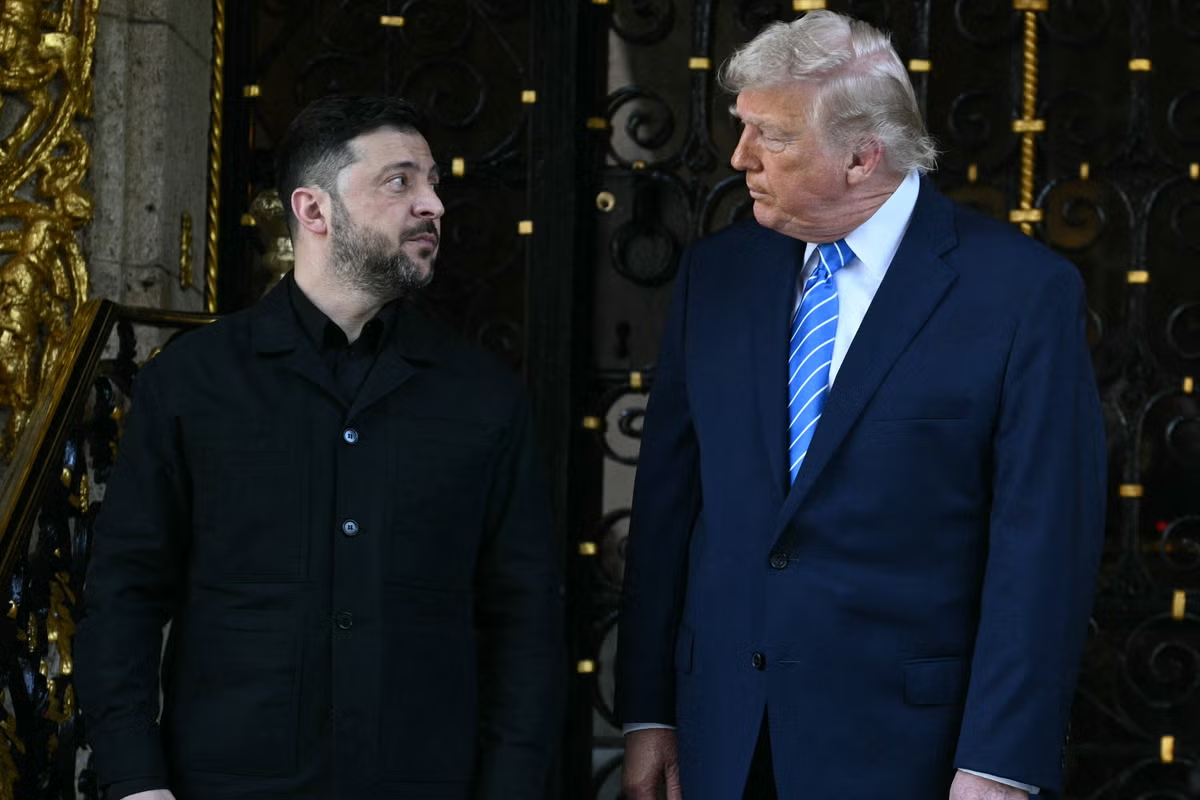
Ukraine-Russia war latest: Trump says he’s ‘not sure’ about allowing Kyiv to build Patriot missiles

Looking for top-performing equity mutual funds? Here are the best performers across categories in the last 1 year
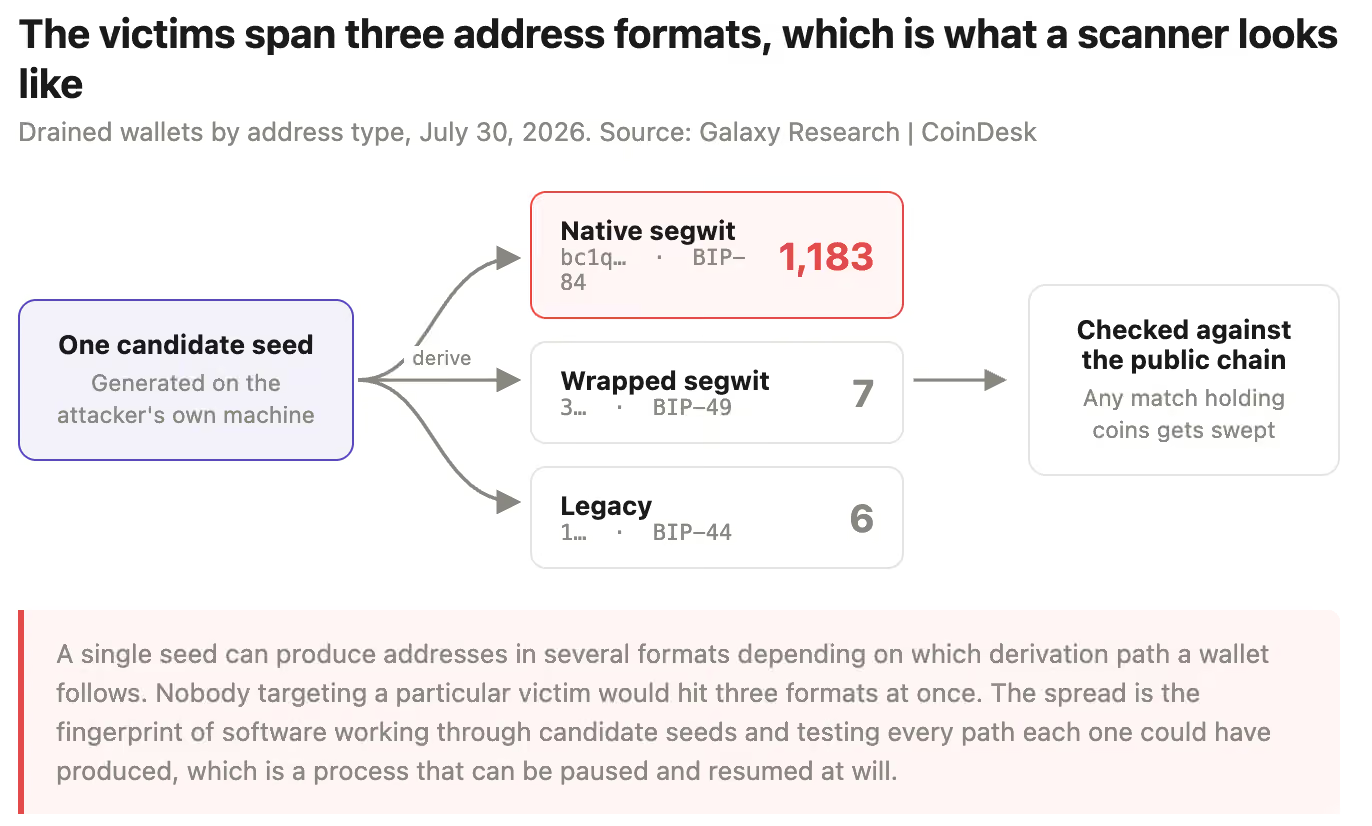
How bitcoin cold wallets lost $70 million in an attack that never touched the devices


-
 Sports5 days ago
Commonwealth Games boxing: Jadumani Singh seals dominant 5-0 win over Pakistan’s Sumama Rehman to enter quarter-finals | Commonwealth Games News
-

 Business2 days ago
Why Trees Belong on the Risk Register
-

 Fashion12 hours ago
Weekend Open Thread: Wit & Wisdom
-

 Politics9 hours ago
Meta enters AI-training agreement with far-right ‘propaganda rag’ Newsmax
-

 Tech5 days ago
Intel is reversing course and bringing hyper-threading back to its server chips
-

 Crypto World6 days ago
Ripple bought a bank in pieces. The $4 billion audit
-

 Politics5 days ago
Luke Littler dismantles Gerwyn Price to retain title in Blackpool
-

 Politics4 days ago
The Part of the Electric Transition Nobody Wants to Discuss
-

 News Videos5 days ago
BITCOIN JUST ENTERED THIS CRITICAL ZONE…
-

 Crypto World6 days ago
XRP Ledger adds $2.6B as RWA inflows rank second
-
 Entertainment3 days ago
‘Stargate’ Creator’s New Sci-Fi Series Returns for Season 3 Tomorrow
-

 Business3 days ago
Major shareholder moves on Canyon
-

 Politics6 days ago
Spain sweeps the board at 2026 World Cup with individual awards
-

 News Videos2 days ago
Bitcoin Enters the 3rd Stage of the Bear Market
-

 Entertainment6 days ago
Sara Gilson Killed By Husband After Viral “Pedophile” TikTok Video
-

 Crypto World3 days ago
Kraken Enables Retail Access to Jersey Mike’s IPO via Tokenized Shares
-

 Tech4 days ago
New macOS Sequoia & Sonoma security updates for older Macs
-

 News Videos3 days ago
Claude: Build Financial Dashboards in Minutes (2026)
-

 Politics2 days ago
Luke Littler’s dominance sparks GOAT debate
-

 Crypto World6 days ago
Upbit expands KRW market with two major DeFi token listings
You must be logged in to post a comment Login