
Business
Wall St dips as investors monitor Iran talks, earnings


US stocks have finished the trading session lower, pausing after a strong start to the week, as investors digested the latest round of corporate earnings and looked for signs of progress toward a peace deal between the US and Iran.
A robust earnings season, which has tempered some concerns about the massive spending by AI-related companies, and growing optimism over the potential end of hostilities in the Iran war helped propel both the Dow Industrials and S&P 500 to record highs earlier this week.
Oil prices rose, with US crude settling up 2.75 per cent at $US77.29 a barrel and Brent settling at $US82.49 per barrel, up 3.83 per cent.
Iranian news agency Fars reported that a parliamentary committee in Iran is reviewing a preliminary bill that would bar US, Israeli and other “hostile” vessels from transiting the Strait of Hormuz.
“You’re seeing perhaps more muted response to macro news than you would otherwise see, probably due to the fact of the summer and a little bit of fatigue, there’s a little bit of headline fatigue, specifically around Iran,” said Robert Bernstone, head of trading at SummitTX Capital in New York.
“Iran is having less of an impact right now, to be clear, I’m not saying it has no impact … tweets are something, headlines are something, but we really want to see the devil is in the details.”
The Dow Jones Industrial Average fell 464.02 points, or 0.85 per cent, to 53,885.10, the S&P 500 lost 13.52 points, or 0.18 per cent, to 7,710.03 and the Nasdaq Composite lost 15.09 points, or 0.06 per cent, to 26,348.35.
The recent indications of movement toward a peace deal helped push crude prices lower earlier in the week and, in turn, eased inflation worries and expectations for a rate hike from the Federal Reserve, which also served to push US Treasury yields lower.
Data storage company Western Digital tumbled 13 per cent and memory chip maker Sandisk dropped 6.8 per cent following their quarterly results.
Both companies have surged this year, however, with Sandisk up more than 400 per cent and Western Digital up about 160 per cent.
AppLovin plunged 19.7 per cent after the marketing platform missed Wall Street estimates for quarterly revenue while Datadog plummeted 19 per cent after the cloud security firm said it expects revenue growth to slow in the third quarter.
Both stocks were among the biggest drags on the benchmark S&P index.
Of the 382 companies in the S&P 500 that have reported earnings through Wednesday morning, 84.8 per cent have topped analyst expectations, according to LSEG data, well above the 68 per cent average beat rate since 1994.
SpaceX shares erased losses from earlier in the session and closed 6.1 per cent higher, defying expectations that they would be pressured by insider selling, as the lockup period for early investors holding the stock expired.
On the data front, the number of people in the US filing claims for unemployment benefits increased slightly last week.
The report came ahead of closely watched non-farm payrolls figures for July due on Friday, which will shape expectations for the Fed’s path for interest rates at a time when chairman Kevin Warsh has scaled back on forward guidance from the central bank.
Declining issues outnumbered advancers by a 1.57-to-1 ratio on the NYSE and by a 1.38-to-1 ratio on the Nasdaq.
The S&P 500 posted 29 new 52-week highs and four new lows while the Nasdaq Composite recorded 131 new highs and 82 new lows.
Volume on US exchanges was 17.09 billion shares, compared with the 17.42 billion average for the full session over the last 20 trading days.


For many years, financial literacy was often associated with investors, traders, and finance professionals. Today, that view is changing. In an increasingly connected global economy, understanding financial concepts has become one of the most valuable business skills for entrepreneurs, executives, managers, and SME owners.
Business decisions are no longer made in isolation. Inflation, interest rates, currency movements, geopolitical events, and changes in consumer confidence can all influence profitability. Even businesses that operate only in domestic markets are affected by global economic developments through higher costs, changing customer demand, or supply chain disruptions.
Financial literacy allows business leaders to understand these external forces rather than simply reacting to them. It provides the confidence to make informed choices based on evidence instead of uncertainty. As economic conditions become more complex, financial education is increasingly viewed as a practical business necessity rather than an optional area of knowledge.
Why Economic Awareness Shapes Better Business Strategy
Every business operates within a wider economic environment. When inflation rises, operating expenses often increase. Energy costs, wages, transport, and raw materials may all become more expensive within a relatively short period.
Business leaders who understand inflation trends can prepare earlier by reviewing supplier contracts, adjusting pricing strategies, or improving operational efficiency before costs become difficult to manage.
Interest rates provide another clear example. When central banks raise borrowing costs, businesses may reconsider expansion plans, equipment purchases, or refinancing decisions. Companies with strong financial planning are generally better positioned to adapt because they understand how monetary policy affects both financing costs and customer spending.
These examples show that financial literacy is closely linked with effective business strategy. Leaders who understand the broader economic picture can make more balanced decisions during periods of uncertainty.
Financial Literacy Supports Everyday Decision Making
Many people assume financial knowledge is only relevant for annual budgets or investment portfolios. In reality, it influences everyday operational decisions.
Cash flow management is one of the clearest examples. Even profitable companies can experience difficulties if income and expenses are poorly managed. Understanding financial reports, forecasting future cash requirements, and identifying potential funding gaps allows businesses to remain stable during challenging periods.
Currency fluctuations also affect many SMEs. A local manufacturer importing materials from overseas may suddenly face higher production costs when exchange rates move unfavourably. Likewise, exporters may benefit from currency changes but still need to manage pricing and contracts carefully.
Commodity prices can create similar challenges. Businesses that rely on fuel, metals, agricultural products, or construction materials often experience changing costs driven by global market conditions. Financial literacy helps decision makers recognise these trends and plan accordingly instead of being caught by surprise.
Reading Economic News With Confidence
Modern business leaders receive a constant flow of economic information. Headlines about inflation, GDP growth, employment figures, trade policies, or central bank decisions appear almost daily.
Without financial education, this information can seem confusing or disconnected from everyday business operations. However, leaders who understand the basic economic principles behind these reports can identify which developments genuinely require attention.
Rather than reacting emotionally to every headline, financially literate professionals learn to evaluate information within a broader context. They recognise that short-term market volatility does not always require immediate business changes, while some long-term economic trends deserve careful strategic planning.
As businesses increasingly recognise the importance of financial literacy, many professionals also follow educational resources and daily market insights published by ScoreCM to better understand economic developments, central bank decisions, inflation trends, and broader market conditions that may influence business planning.
This habit of continuous learning enables better financial decision making and supports more confident leadership during periods of economic uncertainty.
Supply Chains, Geopolitics, and Business Resilience
Recent years have demonstrated how quickly global events can affect local businesses. Political tensions, conflicts, trade restrictions, shipping disruptions, and natural disasters have all influenced supply chains across multiple industries.
A delayed shipment on another continent can increase production costs for a manufacturer in the UK. New trade regulations can affect delivery schedules, while rising energy prices may influence transportation expenses worldwide.
Financial literacy helps business leaders understand how these external events influence operational performance. More importantly, it encourages proactive planning rather than reactive decision making.
Businesses with stronger financial awareness often develop contingency plans, diversify suppliers, maintain healthier cash reserves, and review long-term contracts more carefully. These actions improve resilience without relying on predictions about future market movements.
Financial Education Creates Competitive Advantage
The pace of economic change continues to accelerate. Artificial intelligence, digital transformation, changing consumer behaviour, and global economic shifts require leaders to make increasingly complex decisions.
Continuous financial education equips professionals with the knowledge needed to adapt. It encourages better conversations with accountants, lenders, investors, suppliers, and customers because leaders understand the financial implications behind strategic choices.
Entrepreneurship today involves far more than creating a product or delivering a service. Successful founders also need to understand financing options, budgeting, risk management, pricing, taxation, and market conditions. These capabilities strengthen long-term planning and improve organisational confidence.
For SMEs in particular, where owners often perform multiple leadership roles, financial literacy can provide a meaningful competitive advantage. Better-informed decisions often lead to stronger financial planning, more sustainable growth, and greater resilience during uncertain economic cycles.
The most successful businesses are rarely those that simply react to changing conditions. They are the organisations that understand the financial environment around them and prepare accordingly.
Financial literacy is therefore no longer just an investor skill. It has become an essential capability for modern business leaders who want to navigate uncertainty, build stronger organisations, and make informed strategic decisions in an increasingly interconnected economy.


Equity Research Analyst with a broad career in the financial market, covered both Brazilian and global stocks. As a value investor, my analysis is primarily fundamental, focusing on identifying undervalued stocks with growth potential. Feel free to reach out for collaborations or to connect!
Analyst’s Disclosure: I/we have no stock, option or similar derivative position in any of the companies mentioned, and no plans to initiate any such positions within the next 72 hours. I wrote this article myself, and it expresses my own opinions. I am not receiving compensation for it (other than from Seeking Alpha). I have no business relationship with any company whose stock is mentioned in this article.
Seeking Alpha’s Disclosure: Past performance is no guarantee of future results. No recommendation or advice is being given as to whether any investment is suitable for a particular investor. Any views or opinions expressed above may not reflect those of Seeking Alpha as a whole. Seeking Alpha is not a licensed securities dealer, broker or US investment adviser or investment bank. Our analysts are third party authors that include both professional investors and individual investors who may not be licensed or certified by any institute or regulatory body.

Perth drone company Innovaero is accelerating plans for its IPO, with brokers pricing the raise at $40 million at five cents per share, giving the business an expected market capitalisation of $158 million.

Alibaba plans revenue-sharing for commercial users of next Qwen AI model – Reuters

US President Donald Trump signed an executive order on Thursday that imposes a 15% tariff on imported products made from polysilicon, a crucial material used in semiconductors and solar panels.
The order also set minimum import prices on polysilicon and related products. It comes after a national security investigation into the production of the material overseas.
The move is intended to help protect US manufacturers as they face increasing competition from China’s chip industry – a key source of friction between the world’s two largest economies.
The Chinese embassy in Washington said the move “seriously disrupts” trade between the two countries and Beijing will act to protect its companies.
Washington is “abusing state power to go after Chinese businesses,” the embassy said, adding that protectionism will not make the US more competitive.
Trump said in the order, external that he had accepted recommendations by Secretary of Commerce Howard Lutnick to set minimum import prices as well as a 15% tariff on polysilicon and related imports.
The measures are due to take effect in December.
The US will also offer incentives to boost domestic production, it added.
For decades, the US has allowed “foreign firms to weaken United States producers in the polysilicon sector,” said Trump, who has long advocated for the use of tariffs to protect American jobs and boost the economy.
The material is critical in military equipment and electronics, yet imports have led to the US’ share of global polysilicon production to fall from 50% in 2005 to less than 2% in 2024, Trump said.
China holds a near monopoly on the production of polysilicon.
The order is likely to benefit Hemlock Semiconductor and Wacker Chemie, which are the main producers of the material in the US.
The production of computer chips is central to the race between the US and China to develop artificial intelligence (AI). Washington and Beijing have also been locked in a tit-for-tat tariffs war, which has been on hold since May 2025.
Analysts quoted by Chinese state media outlet Global Times said the new tariff marks the latest escalation in Washington’s efforts to limit China’s role in critical technology supply chains.
The move follows other US restrictions on the imports of drones, humanoid robots and other tech products from China.
China announced a range of countermeasures this week, including tighter export controls on drones. Beijing also launched a national security review into imported printers and copiers.

At a meeting with Securities & Exchange Board of India (Sebi) and officials of Department of Economic Affairs here on Wednesday, the high-frequency trading firms said that Reserve Bank of India‘s stern regulations on leverage would force them to shift exposures from entities here to FPIs.
Read more: Most active funds beat benchmark indices last year: Motilal Oswal StudyThe meeting -attended by senior advisors and two European custodian banks representing FPIs and a few MNC trading subsidiaries- comes two months after India eliminated taxes on government securities (G-Secs) for FPIs.

 Agencies
Since April RBI prohibited banks from funding brokers for proprietary trade or investment, and, more significantly, stipulated that credit to brokers must be backed by 100% collateral.
“No such leverage restriction exists offshore. And since traders here can’t take guarantees from banks overseas, some trades would be routed through FPIs. No one gains from this. The government gets less tax and the market sees less market-making and liquidity-providing trades. And the trading entities can’t cut deals through or as FPIs which they can as a domestic entity,” a person familiar with the discussions told ET.Despite higher tax on Indian subsidiaries — compared with zero tax on derivative profits for FPIs in treaty-friendly jurisdictions like Mauritius and Singapore — several foreign traders have set up shop here to overcome restrictions applicable to FPIs. These include strict position limits for futures and options trades, and the conditions under for short-selling.
“The DEA officials didn’t say anything but were willing to listen – probably after the increase in inflows following tax cuts on G-Secs, though the delay in inclusion of G-secs in Bloomberg index may disappointment many,” said another person.
India scrapped taxes on G-Secs for FPIs through a June ordinance with effect from April 1, 2026. With this, interest withholding tax, along with short-term and long-term capital gains taxes were removed.
“It’s widely felt that rationalisation of STT along with other charges and levies would make transaction charge more competitive. There’s also demand to reduce capital gains tax which has risen over the years, but I don’t know to what extent the government is open to this,” said an industry official who attended the meeting.
STT, applying on stocks, derivatives, and equity-oriented mutual funds, is collected by exchanges directly at the time of transaction. Introduced in 2004 as a small turnover tax after abolishing the long-term capital gains tax, STT continued even after long-term capital gains tax was brought back and tax on equity profits was raised. STT on equity derivatives was hiked in 2026 but it may not have led to a fall in retail losses in F&O.
“Through there was no one from CBDT (Central Board of Direct Taxes), the new uncertainty post Tiger Global was mentioned,” said a source. The Supreme Court verdict on the US investment firm has unsettled foreign investors, changing the way they interpret treaties and indirect transfers.

View over the clear turquoise waters of the harbor from verdant hilltop viewpoint above the village, Marigot Bay, Castries, St. Lucia.
David C Tomlinson | The Image Bank | Getty Images
A version of this article first appeared in CNBC’s Inside Wealth newsletter with Robert Frank, a weekly guide to the high-net-worth investor and consumer. Sign up to receive future editions, straight to your inbox.
The European Union has given five Caribbean nations notice that they need to end their citizenship-by-investment programs or risk losing visa-free access to Europe’s Schengen area by 2028.
The ability to enter the 29 countries in the Schengen area can be a substantial selling point for these golden passport programs. While some immigration attorneys told CNBC that the ultimatum will likely end in a compromise, it is possible the EU will stand its ground.
Currently, foreigners can obtain citizenship in one of the countries by making a qualified investment in its economy, such as buying real estate or contributing to a government fund. Passports from one of these nations allow visa-free travel to some 140 countries and territories. With costs starting around $200,000, these citizenship-by-investment, or CBI, programs provide vital revenue to the Caribbean nations.
The EU in late June sent letters to the governments of Antigua and Barbuda, Dominica, Grenada, St. Lucia and St. Kitts and Nevis. The countries are planning a coordinated response, including a mission to Brussels, according to a statement.
“Our citizenship-by-investment programs are critical pillars of our non-tax revenue base. They cannot simply be abandoned without viable, credible and sustainable replacement sources of revenue,” said Antigua and Barbuda Prime Minister Gaston Browne in a subsequent statement.
The EU has cracked down on CBI programs in other nations before, including Malta. However, this request is unusual because it doesn’t cite specific security concerns or propose remedies to address them, according to Ron Klasko, immigration attorney and co-founder of advisory Exodus Migration. He said he does not expect the EU to back down.
“There’s always been pressure from the EU on on the Caribbean countries, mostly related to security issues, and all of them have bolstered their security issues in response to EU requests in recent years. The new thing is different,” Klasko said. “They’re saying we are opposed to the concept of a commercial transaction resulting in you getting a passport. That goes to the very core of their program, unlike if they’re saying we want you to bolster your security, which is where they can do something.”
Klasko said he is advising one of the five affected nations, which he declined to name, on possible changes to the program that may satisfy the EU.
Reaz Jafri, senior counsel at Charles Russell Speechlys, said he views the EU request as a starting point for negotiations rather than a firm ultimatum. Jafri, who also leads Dasein Advisors, a citizenship and residency consultancy, said a few clients have reached out, but they are still going through with their applications.
“This conversation has been going on as long as I can remember,” said the immigration attorney of 30 years. “I think the EU is looking to maybe get more diligence or better handle on certain things with regards to who gets in and who doesn’t come in, and I think they’ll comply because they’re not looking to skirt any rules.”
In late 2024, the EU revoked visa-free travel to the Schengen region for citizens of Vanuatu, an island nation in the South Pacific, due to security and migration concerns. In 2025, the European Court of Justice struck down Malta’s “golden passport” program as illegal. Malta has since implemented a merit-based program with residency requirements.
Even if a compromise can’t be reached, Jafri said the Caribbean nations rely too much on revenue from CBI programs to phase them out. More than half of his clients are Americans, who don’t need a visa-free perk, he added.
“I’ve had clients take these passports because they don’t want to travel with their American or Israeli or Chinese passport. It’s a security issue for them,” he said. “I work with very wealthy clientele around the world, and having alternate citizenships and residencies is part of the global planning they do. They’re managing different risks: political, personal, commercial, financial and so forth.
“My clients are not doing this for easy access to the EU,” he added.

Tony Righetti
Good afternoon and welcome to Five9’s Second Quarter 2026 Earnings Conference Call. I am Tony Righetti, Senior Vice President of Investor Relations. With me today are Amit Mathradas, Chief Executive Officer; and Bryan Lee, Chief Financial Officer.
During today’s conference call, certain statements will be made that are not historical facts and are considered forward-looking statements within the meaning of the Private Securities Litigation Reform Act of 1995. These forward-looking statements include but are not limited to, statements regarding our quarterly and full year 2026 guidance, expected improvements in operating and financial metrics, industry trends, including with respect to AI, our strategy, priorities and execution, our product road map and technology investment, our markets, customer demand trends, our market position and opportunity, our capital allocation strategy and other future events or results. Such statements are simply beliefs and predictions that should not be unduly relied upon by investors. Actual events or results may differ materially, and the company undertakes no obligation to update the information in such statements.
These statements are subject to substantial risks and uncertainty that could adversely affect Five9’s future results and cause these forward-looking statements to be

NAVER Q2 2026 slides: revenue climbs 16% as AI investments pressure margins

The logo of car manufacturer Ford is pictured in Inwood, New York, on Feb. 5, 2024.
Charly Triballeau | AFP | Getty Images
Ford Motor announced Thursday that its new midsize electric truck will have a starting price of $28,350 and be called the “Fathom,” as the automaker looks to offer an affordable option in the pricey EV truck market.
Destination and delivery charges of $1,595 will bring the price to $29,945, coming in at the $30,000 mark the automaker had long promised in touting its upcoming electric vehicles.
Ford said preorders for the five-passenger truck will begin in early 2027. Customer deliveries are expected to begin later in 2027. The company has yet to reveal what the new truck will look like.
The Fathom is the first vehicle to be built on Ford’s new “Universal Electric Vehicle,” or UEV, platform, which the company has said is key to bring its Model e business unit from billions of dollars in annual losses to breakeven by 2029.
“We are confident that we have the best cost platform and are focused on the right market,” a Ford spokesperson said in an email. “We believe the UEV platform will be a strategic advantage — and we have the best chance to make it work.”
Ford has said the goal for the UEV platform is for each vehicle built on the system to be profitable within a year of launching and cost-competitive with global EV leaders from China and Tesla. Ford has had a secret unit working on the platform to make the vehicles comparable in price to gas-powered models through new technologies and efficiencies.
Ford’s push with the UEV platform comes despite a massive slowdown in EV adoption and the elimination of U.S. consumer incentives to buy EVs. The company last year reported $19.5 billion in restructuring charges related to its electric vehicles.
The Ford Fathom will be built using the company’s new assembly tree manufacturing process at its Louisville Assembly Plant in Kentucky.

NHS probe allegations ‘murdered’ schoolgirl’s health records ‘accessed by staff’

Why Financial Literacy Is Becoming a Business Skill, Not Just an Investor Skill

CFTC chief backs innovation in $1.2 quadrillion derivatives market


-

 Fashion6 days ago
Weekend Open Thread: Wit & Wisdom
-

 Politics6 days ago
Meta enters AI-training agreement with far-right ‘propaganda rag’ Newsmax
-

 Politics4 days ago
Zack Polanski: an incitement to murder Nigel Farage?
-

 Crypto World5 days ago
MicroStrategy Post-Earnings CLARITY Act Push Could Add New Catalyst for Its Stock
-

 Crypto World6 days ago
XRP Ledger v3.3.0 brings five institutional features
-

 Crypto World6 days ago
New York sues Kalshi over prediction market gambling
-

 Crypto World5 days ago
Crypto PAC spending tops $2M in Michigan House race
-

 Business4 days ago
DTCR: Deleveraging And A Hedge Fund Collapse Point To A Possible AI Bottom
-

 Business7 days ago
Trump Announces Hamas Disarmament Agreement as Iran Strikes Kuwait Air Base and US Attacks Pause Overnight
-
 Crypto World6 days ago
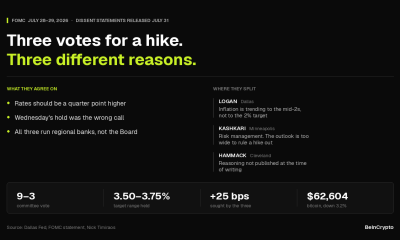
3 Fed Officials Just Explained Their Rate Hike Vote: Is Inflation Winning?
-

 Tech5 days ago
ESET tracks rise in malicious AI skills and adaptable malware
-
Crypto World4 days ago
XRP Ledger urges node upgrade after manifest flood
-

 Tech7 days ago
Gemini Spark can now use Chrome logins and saved passwords to run errands on your behalf
-

 Tech7 days ago
Building A Reproduction PlayStation Motherboard
-

 Sports6 days ago
France Cricket implodes: letters hidden in a drawer and a board at war
-

 Crypto World6 days ago
Moneyflip CEO charged in $40K murder-for-hire plot
-
 Sports6 days ago
Bruno Fernandes decision made as Man United ‘discuss’ striker transfer option
-

 News Videos5 days ago
Financial Crash Expert: The 90-Day Collapse Timeline They Are Desperately Hiding.
-

 NewsBeat7 days ago
Spain sending troops as thousands enter enclave of Ceuta from Morocco
-

 Sports6 days ago
Commonwealth Games 2026 Live Updates | Day 9 CWG 2026: Lovlina Borgohain, Sachin Siwach Enter Final After Indian Judokas Script History
You must be logged in to post a comment Login