

Business
Wall Street Saturday: Shorting Consumer Stocks With George Noble


Agita Zeltkovska/iStock via Getty Images

Listen below or on the go on Apple Podcasts and Spotify

Legendary investor George Noble talks income investing (0:20) Energy, drillers, gold, miners, and consumer stock shorts (5:30)
Transcript
Rena Sherbill: The man, the myth, the legend. It’s George Noble. We’re so happy to have him. Thanks for coming on.
George Noble: Thanks, Rena. Thanks for putting up with me.
Rena Sherbill: Put up with you very happily. We’re happy to have you on talking markets and analysis, but we also have something very special to share with our audience and with investors in general, you are putting on the absolute best conference that’s ever been seen to man and machine.
What is the conference? It’s May 20th. We have Steve Cress and some other familiar names from Seeking Alpha, but also some big hitters from outside the Seeking Alpha world.
Talk to us about this conference that’s coming next week. Share with us some of the main insights that will be gleaned and given and some of the biggest hitters that are going to be speaking, please.
George Noble: Thank you, Rena. So we’ve had three conferences so far, stock picking ideas. This conference is going to be dedicated to income investing, which I know is a topic that’s near and dear to many Seeking Alpha subscribers.
In a world of runaway fiscal deficits, irresponsible policy, bond markets, which are in disarray, think we’ve had four consecutive down years in bonds, and we’re looking at a fifth one now, what are you supposed to do with your income portfolio?
You take the traditional 60-40 portfolio. What are you supposed to do? And so, bonds historically, look at the 60-40 portfolio. Their inclusion has really been designed to hedge your equity exposure i.e. if we had a recession, profits went down, and markets went down, the bonds, the appreciation in bonds would offset that.
Historically, that’s worked. Stocks and bonds have been negatively correlated. Now they’re positively correlated. And the real risk is not one of recession and depression, but inflation. We have fiscal dominance running. Budget deficit is 7 to 8 % of GDP as far as the eye can see. We’re not, the dollar’s not the safe haven it once was.
And so bonds are, and we talked about this in our last time we were together, Rena, bonds are a very dangerous place to be. So what’s an investor supposed to do?
And so we’re trying to answer that question. There are other ways to generate income. We have on the one hand from Seeking Alpha, Steve Cress, who I understand is coming out with an income product next month. Steve’s going to speak about that and what he sees in the way of income.
And then we have a very nice array of other well-known Seeking Alpha group leaders. I can’t recall all of them, but people like Hoya Capital, Alex Pettee.
Leo Nelissen, Kirk Spano, Sam Kovacs, you go down the list. It’s some of the most popular and best SA authors. They’re going to come with a lot of great individual ideas in conjunction with an array of speakers who are coming from outside SA.
These are some of the best thought leaders out there. People like Michael Howell, who’s the world’s leading expert in liquidity. Luke Groman, who needs no introduction. He’s been in the Vanguard advocating gold and Bitcoin as a replacement for bonds. David Hay of Evergreen Gavekal. Jay Pelosky, formerly head of emerging markets at Morgan Stanley. And then finally, John Roque, who is my favorite technician on the street, is going to talk about the technical outlook for interest rates, bonds.
So you’re have a combination of macro and micro thinkers to try to make sense of the very challenged income environment that we’re in. All in one day on Wednesday, May 20 for only $99. This is crazy. You take someone like Michael Howell, he charges tens of thousands of dollars a year for institutional clients. You can get all of this in one place for $99. This is unprecedented.
I hate the term democratization of finance, but we really are democratizing finance. We are bringing the best intellectual capital we know to investors and it’s only $99. I couldn’t be more excited about this. Hopefully many of your viewers will attend.
Rena Sherbill: We’ll leave a link to sign up for that in the show notes. And it also runs from 10 a.m. to 6 p.m. Eastern. It’ll also have access to a full replay.
George Noble: Correct, replays should be available immediately. I don’t expect anyone to sit through 10 hours, 8 hours except me because I have to interview everybody but the replays will be available so you can listen to them in bite sized portions.
Rena Sherbill: J. Mintzmyer, by the way, one of the friends of the podcast, will also be in the conference.
George Noble: I forgot J. I just was emailing with J this morning. We’re trying to figure out when he’s going to talk. J’s one of my favorites and he talks shipping, which is related to energy. It’s one of the most topical things right now. So, I’m really excited to have J.
And I should also mention Michael Boyd, who works with J. Energy Investing Authority, it’s called. He’s going to be appearing.
So, in the show notes, in the flyer for the program, you’ll see everyone. I think we have eight people. I think we have 14 speakers and I believe eight or nine of them are from SA. It’s kind of like the SA All-Star team in combination with the best minds that I know, guys I’ve known for decades coming from the outside. I think it’s fantastic, but I know advice is worth what you pay for it, which is nothing.
Rena Sherbill: It sounds like an embarrassment of riches. That’s what it sounds like.
Last time you were on, you were talking about avoiding the S&P, avoiding bonds, as you mentioned, buying gold. Where are you at these days?
George Noble: Prices have fluctuated, to put it mildly. You look smart, you look stupid. I think all those trades worked until they didn’t work. I think they’re about to work again.
So people like to result on performance and there’s lies, more lies, and statistics. You always can adjust your starting point from wherever you want. Into May, I looked like a genius. The last five, six weeks, not so much.
But I think the big trends are still in play.
So, let’s talk about where we are, but I will reference where we were, this context where we’re going. We made a call on energy in December. We got, I just looked at it, I was like, you know what? If I’m wrong, we’re not going to lose much money. The sector was forgotten. If I’m right, you can kill it. It has nothing to with the Strait of Hormuz.
We killed it. The energy sector was on fire before the extra-curricular activities of February 28. Now that crude’s gone crazy, energy’s up, energy’s down.
My crystal ball isn’t any better than anybody else’s in terms of how high oil prices are gonna go, how long this is gonna continue.
My own personal view though for what it’s worth is I think this is rather take longer instead of sooner. It’s gonna be later rather than sooner in terms of when this gets resolved.
Each side is dug in. The Iranians have never had more leverage than they have now. And each side is asking of the other set of demands which I don’t think the other sides will want to accept.
So, in the for what it’s worth category, I think this is going to take quite a while to resolve.
However, even if we were to wave a magic wand today, and the whole thing was resolved, it’s going to take months for this to get resolved, and it’ll be until 2027 until the situation gets back to normal.
But what I want to point out to people is normal, again, think about what the energy patch looked like prior to February 28. Prices were going up.
Demand was inflecting. Consumption was at record highs. So use that as a baseline. But then on top of it, consider the over a billion barrels of crude by which global inventories have come down and all things being equal, which they never are, oil prices inversely correlate the level of inventory.
So whatever you thought was going to be the baseline for oil prices previously, it’s that much higher now. And so I look at the stocks.
They don’t in any way, or form reflect current oil prices. More importantly, you should look at deferred prices. Looking at the longer term contracts, December crude or whatever. Those have gone up a mere fraction of what the front has gone up. And I think the day this thing gets resolved and I hope it gets resolved, I have no idea when it’s going to get resolved. I’d fully expect oil prices to go down.
That’s Captain Obvious 101 thinking. That’s not what’s important. What’s important is what comes afterwards.
And I think we’re in a world where, you go back and you look at consumption at record highs and growing. We’ve got 5 % depletion roundabout, give or take. We’re not drilling for enough oil. I think the outlook for the energy patch is terrific.
Over time, I was trained in Fidelity. Back in the day, you want to invest in industries where you’ve had underinvestment and avoid industries that are over investment. Tech investors, please call your office.
I did a great interview last week with one fellow, points out to me that, you look at for instance, the drilling sector, you look at rigs, day rates, you look at the replacement cost of rigs, like 50 million bucks, you can buy them through publicly traded companies at like 10 or 20 million bucks.
Prices have to go up a lot in order to for drilling activity to increase and I think we are entering a period of drill baby drill.
So I like the energy sector a lot, in particular the drillers. We had a couple great calls in the offshore guys, energy guys early turn of the year, had Valaris (VAL), had Cenovus (CVE). Ensign (ESVIF) looks interesting. All the land drillers look really interesting. So I like the energy stocks a lot.
I’d stay away from the ETFs, from Exxon (XOM) and Chevron (CVX). They’re great companies, but they’re pretty expensive. They can do a lot better. So I like energy.
Gold. Gold was doing fantastically until the Mideast situation erupted. A lot of theories as to why gold sold off. Some people say, well, the Mideast nations are having to sell some of their gold. Who the heck knows? I mean, just to review the go to the videotape, gold and silver were doing great until the fall.
Momentum Bro and Tech Bro discovered (GLD) and (SLV) as their new favorite meme stocks and the thing went totally crazy. So it got to be a zillion percent or above the moving averages. We had a correction. That’s fine. That was in January, February, and then along came the Mideast. So gold and silver kind of got sideways for a while.
I think they’re now starting to go again. Silver’s poked its head up. More importantly, and I’m going to give a big shout out to SA alum, Zachary Marx, is now managing money. He’s been a champ, everyone should go look at some of the stuff Zach’s put out of hand on the podcast a couple times. He’s no most notably been recommending (SSRM), which is a stock we’ve written up. Stocks are in 35, I think it’s to give or take. It’s like six or seven times earnings. I didn’t say cash flow. I said earnings. I think the stock should double.
Just to start the conversation, then we can debate what happens from there. In other words, and Zach made the point, I totally agree, the gold miners, the (GDX) is the ETF for the gold miners, and (GDXJ), the gold miners and the silver miners are going to do incredibly well even if the metals prices just stay where they are.
So, and God forbid if gold goes up the way I think it’s going to go up, then no price is too high. So I really like the gold miners. If you’re too lazy to pick stocks, just buy the GDX or GDXJ.
I think inflation, generally speaking, and this gets back to the conference, is sticky and rising. The 10-year, I think we’re at 440, 445 today. I think we discussed this last time, but if I came to you and I said, Rena, I have income of $5 trillion, and I’m spending $7 trillion, I’m running a $2 trillion deficit and by the way, I owe the bank already $40 trillion. And by the way, there’s $125 trillion of off balance sheet liabilities. Rena, would you please lend me money for 10 years at 4.4%? I don’t think you would do that, right?
That’s the bond market today. So, I would run, not walk from the bond market.
And you’re starting to see bond yields in the US drift up. And again, don’t just look at the US, you have to look at the context.
Look at what’s happening on a global basis. US yields are relatively, remarkably quiescent. You have Japanese bond yields at 30-year highs and breaking higher. You have European bond yields at 20-year highs and breaking higher.
And so I think the direction of yields is up. I don’t know at what point we’ll get to the market now. At what point rising bond yields and rising oil prices finally pressure the stock market? That’s a simple question and I’m on a roll, so let me keep going as long as I’m making sense.
If you told me two months ago when this stuff, you told most people when these extra-curricular activities broke out that the S&P (SP500) would go straight up and the semis would go up 100% whatever in three weeks, whatever it was, I certainly didn’t predict that, most people didn’t.
But to be fair, people like to point out that earnings estimates have continued to rise. They’re at a very healthy clip the last couple of months, and that’s really the reason why the market’s been going up despite all the negative news.
I’m fearful that we’re approaching a point that once it all gets to a certain level or bond yields break through a certain level, I think it’s going to really hit the economy and hit the market. What that number is, I don’t know.
Many times people say it’s not the level, it’s the rate of change. But I think the equity market writ large is in a very dangerous place right now.
I don’t want to be hyperbolic, but I’m sure you follow all these things. The market breadth has been terrible. There’s been an increasingly smaller number of stocks that driving the indices, most notably technology, the semis.
I’m very negative on the AI trade. I’m not negative on AI itself. I think AI will be adopted. But, right now, show me the money. I mean, they’re spending hundreds of billions, about trillions of dollars on AI and hyperscalers. And I don’t see a path to monetization or one that’s going to justify the current valuations.
And then you look at the cash flow profile for the hyperscalers. This is disaster. I mean, look, these stocks, why they do so well over a long period of time? It’s deservedly so. Rising earnings, rising sales, rising earnings, strong cash flows, pristine balance sheets, buying back stock, moats, all good.
What’s changed? What’s changed is these companies have now become very capital intensive and their free cash flow is going out the window. They are spending money on data centers at such a prodigious pace the cash flow profile is a freaking disaster and that has big implications for what the valuations should be and one of the trades I think we talked about last time.
It worked and it didn’t work but it’s going to work again, you want to own the equal weighted S&P. Keep in mind tech is 40% broadly defined tech is 40 % of the S&P. So it’s a very tech-centric index and I think that’s a big risk that maybe investors don’t realize. So, it’s all come down to tech. It’s all tech all the time, right?
And the market has an inability to focus on more than one thing at a time. And it’s been focusing on tech, focusing on the horror moves. We put out a list of stocks late March, March 25th I believe. I put out like eight buys and eight sells. 8 shorts and 8 longs. Wasn’t making a market call. I just said, here are the stocks that are to outperform and here are the stocks that are going to underperform.
If you look at the spread between the longs and the shorts, the buys are up 14, the market’s up 13. It outperformed even though it had no tech stocks, which is freaking amazing. But the really interesting thing is the shorts are only up 4.
So you look at the spread between the longs and the shorts, it’s like 9-10%. Which gets to, as I mentioned earlier, the market can only focus on one thing at a time.
You look at our shorts, there a lot of consumer stocks in there. In fairness to my paying subscribers, I don’t want to give away all the secrets, but I’ll just mention one that we have been public on, Freshpet (FRPT), which by the way, was mentioned as an idea at our last conference by Tom Chanos, brother of Jim Chanos.
Everyone knows Freshpet. Those are the guys with the refrigerated dog food in the coolers in Costco (COST), in Walmart (WMT). Freshpet has been a great growth stock.
They pretty much have exhausted all their white space. Growth is slowing. Stock is still egregiously expensive and here comes the good part. The week after Tom recommended it as a short at 80, the stock’s down, I don’t know, 30%, 40%, whatever, since he recommended it.
Costco came out and said they’re coming out with their own competing product. Costco, by the way, is 10 % of revenues. And Walmart also made a similar announcement, they’re 35 % of revenues.
Not to mention the fact that General Mills (GIS) is also a big competitor. So earnings estimates have been collapsing for Freshpet. The stock is still extremely competitive, really expensive.
And you have two huge competitors entering their space. So even though it’s gone from 80 to 52, that’s what, down 35 %? I expect it’s gonna go down another 35%.
This is an investment short, all right? This is pure alpha. This is collapsed down 35%. I guess the backdrop of a market is up 10%. This is pure alpha.
So it’s longs and shorts. I mean, so this list, as I said, the longs are up 14, the shorts are only up 4. What’s really interesting, the shorts, largely I’m concentrating on the consumer area. I didn’t put any tech names in the shorts. Consumer names in. So it’s stocks like Freshpet.
I’ll give away one other name which I made public before. But Cava (CAVA), the salad guys everybody knows. I think it’s done alright so far, but it’s staring at a stupid valuation.
And you’re starting to see with the K-shaped economy, we all know this, low end consumers starting to get pressured. And I suspect like a lot of other consumer companies, they’re going to get hit as well.
And by the way, it’s not just the low end consumer that’s getting hit, you’re starting to see even the high end starting to get hit.
So I think consumer stocks, again, it’s a market of stocks. Everyone always asks, so what do think of the market? I don’t know.
It’s a market of stocks. I could find a lot of things I like in the sectors I mentioned, broadly speaking, resources, commodities, metals, gold, energy, all that kind of stuff. Things that Dennis Gartman would describe as if you drop them on your foot, it would hurt.
And the flip side is there a lot of things I would short. A lot of consumer names.
I think Tesla (TSLA), you might want to ask you about Tesla. I went into jihad the other day against Elon Musk and SpaceX (SPACE), which I think is going to be an epic disaster.
And I think the semis are totally overcooked. I think data centers are overcooked. And so there’s a lot to do here. So I don’t even know what the question was. I know I answered it and then some, but that’s my story and I’m sticking to it.
And if you’re serious about investing, and I’m not shilling for you. Learn some investor education. Take a finance class. Watch your favorite YouTube guys. Subscribe to Seeking Alpha. Learn what Steve Cress has to say.
Steve Cress has run rings around 99.99% of investors in the world. Alpha Picks is like nothing. It’s like $400 bucks, it’s like nothing. So swallow your pride, just say no to SpaceX and Elon Musk, and just invest in Steve Cress’s Alpha Picks. And no, to all the haters, oh George, no, I’m not being paid to say that.
I’m saying that because I’ve been taking his product for three years and I know what the man does and the process is systematic, repeatable and transparent. That is investing.
Don’t miss the Best Income Ideas Online Summit on Wednesday, May 20. Hosted by legendary investor George Noble in collaboration with Seeking Alpha, the summit will feature today’s top investing minds sharing their #1 highest-conviction income idea for 2026. Actionable names and frameworks for putting capital to work in this market, all for just $99.
Editor’s Note: This article discusses one or more securities that do not trade on a major U.S. exchange. Please be aware of the risks associated with these stocks.



Dhierin-Perkash Bechai is an aerospace, defense and airline analyst.
Dhierin runs the investing group The Aerospace Forum, whose goal is to discover investment opportunities in the aerospace, defense and airline industry. With a background in aerospace engineering, he provides analysis of a complex industry with significant growth prospects, and offers context to developments as they occur, describing how they might affect investment theses. His investing ideas are driven by data informed analysis. The investing group also provides direct access to data analytics monitors.
Learn more.
Analyst’s Disclosure: I/we have no stock, option or similar derivative position in any of the companies mentioned, and no plans to initiate any such positions within the next 72 hours. I wrote this article myself, and it expresses my own opinions. I am not receiving compensation for it (other than from Seeking Alpha). I have no business relationship with any company whose stock is mentioned in this article.
Seeking Alpha’s Disclosure: Past performance is no guarantee of future results. No recommendation or advice is being given as to whether any investment is suitable for a particular investor. Any views or opinions expressed above may not reflect those of Seeking Alpha as a whole. Seeking Alpha is not a licensed securities dealer, broker or US investment adviser or investment bank. Our analysts are third party authors that include both professional investors and individual investors who may not be licensed or certified by any institute or regulatory body.
SlateStone Wealth chief market strategist Kenny Polcari discusses whether investors are too dependent on AI, Space X’s IPO and his outlook for the markets on ‘Varney & Co.’
An American favorite pizza chain is quietly disappearing from communities across the country.
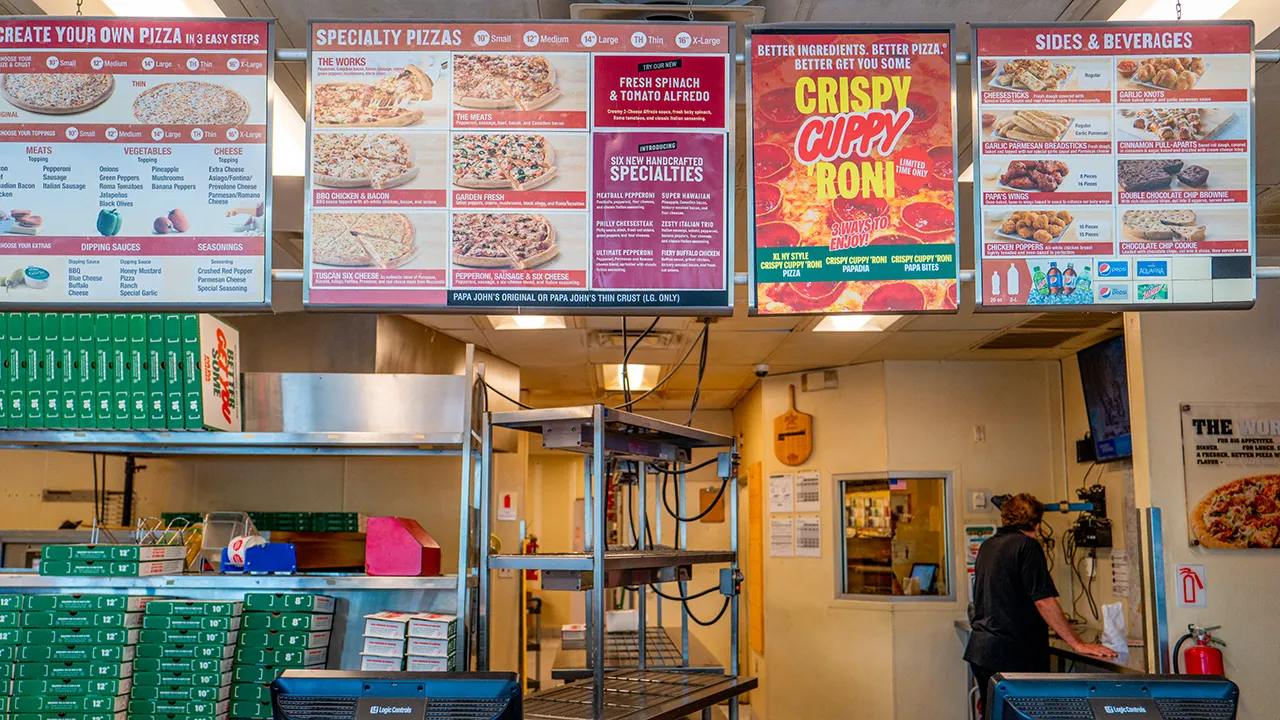
Papa Johns is following through on its plan to close about 300 North American stores, with dozens of locations shuttering in the first quarter – primarily in core Sun Belt states.
A recent analysis of Papa Johns financial filings by Fast Company found that 44 stores closed across 17 states, with the highest concentration of closures in Texas, California, Florida and Arizona.
Multiple location closures have also been identified in Michigan, North Carolina and Virginia.
CHICK-FIL-A EXPANDS ITS ‘GHOST KITCHEN’ MODEL WITH NEW DELIVERY-ONLY STORE IN FLORIDA
The pizza brand first announced in February that hundreds of underperforming restaurants would cease operations by the end of 2027, describing the locations as being primarily franchise-owned, more than a decade old and generating less than $600,000 in annual sales volumes (AUVs).
The interior of a Papa Johns Pizza is seen on May 9, 2024, in Austin, Texas. (Brandon Bell/Getty Images / Getty Images)
“We believe these closures will further strengthen the system, increasing AUVs by at least 3% and improve franchisee health by allowing franchisees to reallocate resources towards operational excellence in their remaining restaurants and open units in priority markets,” Papa Johns CFO Ravi Thanawala previously said.
He also said that the majority of the company’s restaurants worldwide have “performed well over the years and delivered strong returns for both corporate and franchise owners,” and that the strategic closure of underperforming restaurants is “among the most impactful actions we can take to improve restaurant profitability and fleet health.”
FOX Business co-host Taylor Riggs and Fox News contributor Marcus Lemonis see small business success up close at Rocky’s Pizza Bar on ‘FOX Business In Depth.’
However, shares of Papa Johns International were down roughly 21% year to date through Wednesday’s close. Over the past five years, shares of Papa Johns International have fallen more than 69%.
In addition to the Q1 store closures, filings showed that Papa Johns laid off 7% of its corporate workforce.
GET FOX BUSINESS ON THE GO BY CLICKING HERE
Cava CEO Brett Schulman explains the restaurant chain’s no-discount strategy.
Not only are franchisees across the fast-food industry facing severe headwinds from inflation, supply chain expenses and labor costs, but pizzerias nationwide are facing stiff competition. A recent Wall Street Journal report found that pizza restaurants are now outnumbered by Mexican restaurants and coffee shops.
Other pizza chain competitors have made strategic moves amid weakening demand, including rival Pizza Hut closing hundreds of locations and its parent company, Yum! Brands, reportedly looking into a potential sale of the chain.
FOX Business’ Matthew Kazin contributed to this report.

NEW YORK — The Dow Jones Industrial Average rose more than 246 points on Thursday, closing at 50,165.69 as investors welcomed resilient corporate earnings and signs that inflation pressures may be moderating despite ongoing geopolitical risks.
The blue-chip index gained 246.91 points, or 0.49%, in a session that saw broad participation across sectors. The S&P 500 and Nasdaq Composite also posted gains, reflecting improved sentiment after recent volatility tied to energy costs and global tensions.
Market Drivers and Sentiment Shift
The rebound followed a string of solid earnings reports that demonstrated corporate resilience amid higher costs. Several major Dow constituents beat expectations, providing reassurance about consumer demand and operational efficiency. Traders appeared to price in the possibility of a soft economic landing, with some relief that the latest inflation data may not force more aggressive Federal Reserve tightening.
Energy stocks provided support as oil prices stabilized, while technology and consumer discretionary names recovered ground after recent weakness. Financials benefited from a more constructive outlook on interest rates, and industrial names gained on expectations of steady economic activity.
Inflation Data and Fed Outlook
The latest Consumer Price Index report showed headline inflation at 4.2% year-over-year in May, the highest reading since 2023, largely driven by energy. However, core measures remained closer to the Fed’s 2% target, giving policymakers room to assess incoming data without immediate pressure for rate hikes.
The Producer Price Index due later Thursday will offer additional insight into wholesale trends. Markets continue to price in a high probability of rates remaining steady at the June Fed meeting, with potential cuts later in the year depending on subsequent readings.
Corporate Earnings Momentum
Earnings season has provided a mixed but generally positive narrative. Companies across sectors have demonstrated pricing power and cost control, helping alleviate concerns about margin compression. Forward guidance in key areas has been constructive, with many executives citing stable demand despite higher borrowing costs.
This corporate strength has helped support equity valuations even as macroeconomic uncertainties persist. The Dow’s ability to climb back above the 50,000 psychological level earlier this year remains a significant milestone, with analysts viewing current levels as supported by fundamentals.
Sector Rotation and Leadership
Technology and communication services led gains as investors rotated back into growth names. Financials showed strength on improving net interest margin outlooks, while energy names benefited from stable oil prices. Defensive sectors such as consumer staples and healthcare provided steady support.
The session’s breadth, with more advancing than declining issues on the New York Stock Exchange, indicated healthy participation rather than concentrated buying in a few names.
Technical and Sentiment Indicators
The Dow’s move reflected improving momentum after a period of consolidation. Technical indicators suggest the index is neither strongly bullish nor bearish in the short term, with support levels holding firm.
Options activity showed reduced hedging demand, suggesting traders are becoming more comfortable with current valuations. Institutional flows appeared balanced, with selective buying in quality companies.
Global Market Influence
International markets showed mixed performance overnight, with European indexes posting modest gains and Asian markets closing mixed. The U.S. dollar traded in a tight range, reflecting balanced global risk perceptions.
Commodity prices, particularly oil, stabilized after recent volatility tied to Middle East developments. Gold prices eased slightly as risk appetite improved.
Investor Outlook and Strategy
Strategists maintain a generally constructive view for equities, citing resilient corporate profits and the potential for monetary easing later in the year. However, they caution that volatility around data releases and geopolitical events is likely to continue.
Diversified portfolios with exposure to both growth and value sectors are recommended. Focus on companies with strong balance sheets, clear growth strategies and pricing power remains key in the current environment.
Broader Economic Picture
The U.S. economy continues to demonstrate resilience despite higher interest rates and external shocks. Consumer spending has held up better than many feared, supported by a still-solid labor market and wage growth in certain sectors.
Challenges remain, including elevated housing costs and uneven recovery across income groups. The Federal Reserve’s careful approach to policy has helped maintain stability, though the path forward depends on incoming data.
Looking Ahead
Markets will continue monitoring upcoming economic releases, including retail sales and further inflation metrics. Corporate earnings season remains in focus, with additional reports expected to shape sentiment in the days ahead.
The Dow’s performance serves as a key barometer for investor confidence. Thursday’s gain reflects measured optimism as traders balance positive corporate trends with ongoing macroeconomic uncertainties.
As the trading week progresses, focus will shift to any fresh signals from policymakers and corporate boardrooms. The blue-chip index’s ability to hold recent gains will be an important technical test in the near term.
Overall, the session’s advance underscores the market’s capacity to absorb news and find buying opportunities amid a complex backdrop. Investors remain attentive to both risks and opportunities as 2026 unfolds.
The modest rebound leaves the Dow well-positioned after recent consolidation, with many analysts viewing current levels as attractive for long-term accumulation in quality names. Continued corporate resilience and potential policy support could drive further upside if inflation trends moderate as hoped.

Bank of America declares preferred stock dividends
VO: Mid Caps Now Look Attractive, But Vanguard's $103 Billion ETF Misses The Mark

India, like many developing economies, “remains largely peripheral to both the origination and propagation of global imbalances; yet, we continue to face their spill-over effects”, the minister said.
Sitharaman made the statements while representing India at a virtual meeting on the Global Convergence for Growth Summit, presided over by French President Emmanuel Macron, the finance ministry said in a post on microblogging site X.
“In today’s interconnected world, prosperity and challenges are shared, but the consequences of conflicts and uncertainty fall disproportionately on developing countries and the Global South. The situation demands coordinated global action,” the minister said during her intervention at the summit.
“We must strengthen multilateral cooperation to build resilient economies, accelerate sustainable development and ensure inclusive growth that benefits all,” she added.

The summit was held to bring together leaders of advanced and emerging economies to deliberate on ways to support a balanced and efficient global framework. The senior leadership of all the G7 nations and India, Brazil, China, Kenya, South Korea and the International Monetary Fund participated in the summit.
Making her observations on global imbalances, the minister said: “Not all imbalances are alike, some reflect differences in demographics, development stages, resource endowments, or economic structures.””Our focus should, therefore, remain on excessive and persistent imbalances while recognising that the scale of domestic needs varies significantly across countries,” she said.
Medium-term growth, MDB reforms
India’s growth is projected to remain strong at about 7% over the medium term, the minister said, stressing that the country remains the world’s fastest-expanding major economy.
The country’s growth is primarily led by domestic demand, with a largely market-determined exchange rate, she added.
Sitharaman called for better, bigger, more effective and more representative multilateral development banks (MDBs) that can deliver greater financing to developing countries and emerging economies. Bolstering their financing capacity, operational agility and responsiveness will be critical, she said.

Alphabet: Now Is The Time To Raise Equity, Agentic AI Is Here (Rating Upgrade)


Trump cancels US strikes on Iran, citing progress in talks


Hasemilk helps manufacturers replicate the taste of milk without using dairy ingredients.

Form 4 Caterpillar For: 11 June

BANK OF AMERICA JUST LAUNCHED XRP???!!! (WHAT.)

The ticket price fiasco for the men’s Fifa World Cup has been a spectacular own goal

Melrose Industries: The Market Is Pricing In An Aerospace Growth Failure (OTCMKTS:MLSPF)



-

 Fashion6 days ago
Weekend Open Thread: Evereve – Corporette.com
-
 Crypto World6 days ago
Jensen Huang Approves Samsung, SK Hynix, and Micron for NVIDIA (NVDA) HBM4 Memory Supply
-

 Crypto World4 days ago
Anatomy of the June crypto crash: Fed, Iran, Saylor
-
 Entertainment5 days ago
The Best Mystery Series of All Time Is Surging on Streaming 30 Years After It Ended
-

 NewsBeat4 days ago
Alexander Zverev wins the French Open to finally earn a 1st Grand Slam title
-

 Tech6 days ago
Suspicious Polyfill login prompts pop up on Toshiba, Muji websites
-
 Crypto World5 days ago
Senator Cynthia Lummis Calls CLARITY Act the Most Consequential Financial Legislation of This Generation
-

 Tech4 days ago
Microsoft unveils seven homegrown AI models in new bid for ‘long term self-sufficiency’
-

 Tech6 days ago
Microsoft launches MXC, an OS-level sandbox for AI agents, with OpenAI and Nvidia already on board
-

 Business6 days ago
(VIDEO) Justin Bieber Delivers Surprise Happy Birthday Serenade to Diners at Los Angeles Mexican Restaurant
-
 Business5 days ago
The Pain Points Taking a Fragile Tech Rally Down a Notch
-

 Business4 days ago
High Stakes for Wembanyama as New York Pushes for 3-0 Lead
-
 Crypto World3 days ago
Eli Lilly (LLY) Stock Surges 4% Following Breakthrough Sleep Apnea Trial Results
-

 Tech6 days ago
Von der Leyen’s AI envoy pick draws conflict-of-interest fire
-

 Tech6 days ago
Meta steals a tactic from Tesla and builds data centers in tents
-
 NewsBeat4 days ago
Alexander Zverev conquers demons and outlasts Flavio Cobolli to win French Open for first major title
-
Crypto World6 days ago
LBank Surpasses 25 Million Users Worldwide as AFA Partnership Continues to Drive Global Growth
-

 Tech6 days ago
Hackers now exploit SolarWinds Serv-U flaw to crash servers
-

 Crypto World4 days ago
Trump’s AI Ownership Plan Could Benefit Anthropic at OpenAI’s Expense
-
 Sports2 days ago
Bangladesh beat Australia after 20 years in ODIs, register only their second win over six-time world champions | Cricket News
You must be logged in to post a comment Login