
Business
What Happened to F1’s Lost Sponsors? Rothmans, Sega, Compaq & More

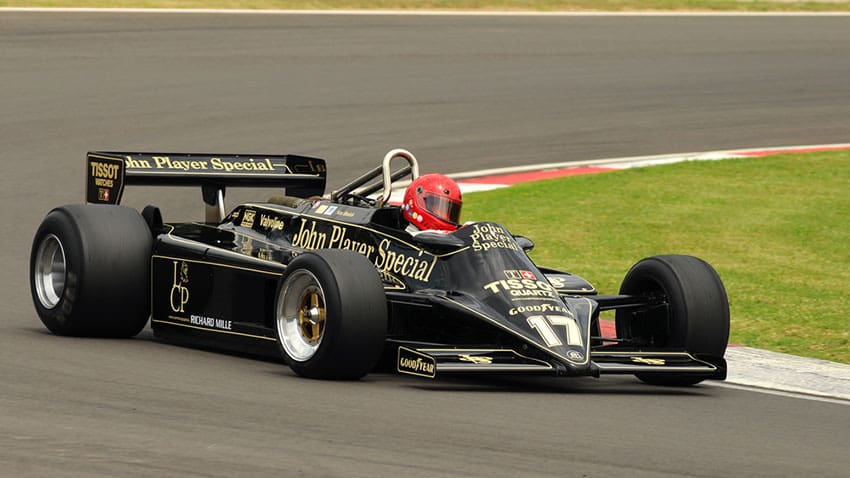
Stand at Becketts this weekend as the historic demonstration runs howl past and you could be forgiven for thinking the calendar has slipped.
The blue-and-gold of a Rothmans Williams, the screaming yellow of a Benson & Hedges Jordan, a Tyrrell in Elf colours, a McLaren still wearing its day-glo Marlboro chevrons: to a certain generation these liveries are as evocative as the engine notes. Yet look closely at those sidepods and you are not looking at a paddock. You are looking at a corporate graveyard.
The British Grand Prix that surrounds them could not be more different. A record crowd of well over half a million, a sprint format, a global streaming audience raised on Drive to Survive, and a sport that, as Business Matters reported this week, is now worth £12bn a year to the UK economy. But in the 1980s and 1990s Formula One was a very different commercial proposition: a rolling billboard held together by tobacco money, corporate vanity and the occasional fraudster. The teams, Williams, McLaren, Jordan, Tyrrell, survived, evolved or were absorbed. Many of the companies whose logos paid the bills did not. Their fates read like a potted history of three decades of business upheaval.
The tobacco giants: regulated out, swallowed up
No sector defined the era like tobacco. By 1995, nine of the top ten drivers in the world championship carried a cigarette brand on their overalls, and the sport’s aesthetic was effectively designed in the marketing departments of London and Winston-Salem.
Rothmans is the most instructive case. The brand arrived at Williams in 1994 and turned the FW16 into what one Italian commentator called “a cigarette packet on four wheels”, white, blue and gold, and utterly unmistakable throughout the seasons that carried Damon Hill and Jacques Villeneuve to their world titles. Yet within two years of leaving the sport’s front line, Rothmans International plc ceased to exist as an independent business. In 1999 it was swallowed by British American Tobacco in a merger waved through by the European Commission, and the Rothmans, Dunhill and Player’s brands disappeared into BAT’s portfolio, where they remain. The company that once wrote some of the biggest cheques in world sport is now a line item in someone else’s annual report.
Benson & Hedges followed a similar arc. Eddie Jordan’s masterstroke in 1996 was persuading Gallaher to paint his cars gold, then yellow, spawning the Buzzin’ Hornets and Bitten & Hisses workarounds when national advertising bans began to bite. B&H stayed with Jordan until 2005, by which time the FIA had already decreed that tobacco branding would be gone by the end of 2006. Gallaher, the last great independent British tobacco house, did not long outlive the ban that ended its motor racing adventure: in April 2007 it was acquired by Japan Tobacco for around £7.5bn, then the largest ever foreign takeover by a Japanese company.
Camel, which had splashed its yellow across Lotus, Benetton and Williams, read the regulatory runes earlier than most. When France banned tobacco advertising in motorsport in 1992, R.J. Reynolds began its retreat, and by the end of 1993 the desert dromedary had largely vanished from the grid. The lesson for any business built on a single, regulation-exposed revenue stream is timeless: the writing appears on the wall long before the wall falls on you.
Only Marlboro defied gravity. Philip Morris outlasted every rival, moved its money quietly to Ferrari, and kept paying long after its name could legally appear on the cars, proof that in sponsorship, as in business, the deepest relationships survive even when the logo cannot.
The technology names: disrupted at full speed
If tobacco was regulated out of existence, the technology sponsors of the era were simply out-innovated, an irony for brands that attached themselves to the fastest-moving sport on earth.
Consider the Williams FW15C of 1993, arguably the most technologically sophisticated F1 car ever built, with its active suspension and traction control. On its flanks sat Sega, then the swaggering champion of the console wars, which even had Sonic the Hedgehog’s feet painted below the cockpit and supplied a Sonic-shaped winner’s trophy, famously lifted not by a Williams driver but by Ayrton Senna at Donington, after which McLaren mischievously painted a squashed hedgehog on his car. Sega was at its absolute commercial peak. Within eight years it was gone from the hardware business entirely: bruised by the 32X and Saturn missteps and unable to sustain the Dreamcast against Sony and Nintendo, it exited consoles in 2001 to become a software publisher. The company survives, indeed, in a pleasing footnote, Sega returned to the grid last year as a gaming partner of McLaren, the very team that once taunted its Williams deal with a squashed-hedgehog sticker, but the colossus that sponsored world champions does not.
Compaq tells the same story at corporate scale. The Texan PC maker became a principal sponsor of the BMW Williams team in 2000, its logo carried by Ralf Schumacher and a young Juan Pablo Montoya. In May 2002, mid-season, Compaq was consumed by Hewlett-Packard in one of the most contentious mergers in tech history, and, in a neat piece of symbolism, the branding on the Williams cars was changed from Compaq to HP at that year’s British Grand Prix at Silverstone. A brand that had been one of the world’s biggest computer companies was reduced to a mid-race livery swap, and eventually retired altogether.
The telecoms adventure: two crashes for the price of one
The dot-com era brought a new breed of sponsor, and no partnership captured its giddiness better than Orange and Arrows. The mobile operator’s papaya livery made the 2000 Arrows A21 one of the best-looking cars on the grid, but the relationship delivered a double collapse. Arrows, run by the flamboyant Tom Walkinshaw, ran out of money and folded during 2002, its cars famously failing to appear at races while lawyers argued. Orange declined to renew and retreated from the sport. The sponsor fared better than the team, but not as an independent company: it had already been bought by France Télécom in 2000 at the very top of the telecoms bubble. The twist is that the brand ultimately devoured its owner, France Télécom judged the Orange name so much stronger than its own that in 2013 it renamed the entire group Orange S.A. Sometimes the sponsorship asset outlives the balance sheet that acquired it.
The cautionary tale: when the money was never real
And then there were the sponsors who were not what they seemed. Leyton House, the Japanese property and leisure group whose turquoise March cars very nearly won the 1990 French Grand Prix with Ivan Capelli, collapsed in scandal when founder Akira Akagi was arrested in 1991 over a fraud involving Fuji Bank. The team died with him, and F1 learned, not for the last time, as anyone who remembers more recent crypto logos will attest, that due diligence on a sponsor’s money matters as much as the size of the cheque.
What the survivors teach us
It would be wrong to paint the whole era as a graveyard. Canon, which backed Williams through its Mansell-Piquet pomp, remains a global imaging power. Elf, the French fuel brand on every Tyrrell and Renault of the period, lives on inside TotalEnergies, still in the sport today. And the teams themselves proved remarkably durable assets: Tyrrell’s entry was sold to BAT and became BAR, then Honda, then Brawn, and is today Mercedes-AMG F1; Jordan’s Silverstone factory now houses Aston Martin’s title challengers. In Formula One, as sponsorship strategist and author Jackie Fast, whose best-selling book PINPOINT chronicles what actually works in sponsorship, might observe, the platform has consistently outlived the brands that paid for it.
That, perhaps, is the real business story hiding in this weekend’s nostalgia. A grid livery is a leading indicator: it tells you which sectors have cash, confidence and something to prove. In 1986 that meant cigarettes; in 1993, video games; in 2000, PC makers and telecoms; today it is crypto exchanges, cloud computing and logistics giants, sectors whose own thirty-year survival is anything but guaranteed. The sport’s £12bn UK footprint suggests Formula One itself has never been healthier. History suggests the same cannot be assumed of the names painted on its cars.
So when the old Rothmans Williams crackles past the pits this afternoon, spare a thought not just for the drivers who wrestled it, but for the marketing directors who signed the deals, men and women who believed, entirely reasonably, that their brands were as permanent as the sport they adorned. Formula One is still here. Rothmans, Gallaher, Compaq, Leyton House and Sega’s console empire are not. In business, as at Becketts, nothing stays flat-out forever.

Paul Jones
Harvard alumni and former New York Times journalist. Editor of Business Matters for over 15 years, the UKs largest business magazine. I am also head of Capital Business Media’s automotive division working for clients such as Red Bull Racing, Honda, Aston Martin and Infiniti.


WA’s transport industry has warned consumers to brace for higher prices as rising fuel costs get passed on to businesses.The federal government’s fuel excise introduced three months ago to ease price hikes caused by conflict in the Arab Gulf comes to an end on Monday.
Business
Industrial Logistics Properties Trust 2026 Q2 – Results – Earnings Call Presentation (NASDAQ:ILPT) 2026-08-02


Seeking Alpha’s transcripts team is responsible for the development of all of our transcript-related projects. We currently publish thousands of quarterly earnings calls per quarter on our site and are continuing to grow and expand our coverage. The purpose of this profile is to allow us to share with our readers new transcript-related developments. Thanks, SA Transcripts Team

Micron: High Risk, High Reward
UK hiring falls but demand for AI skills jumps, job site Indeed says

Toyota expected to post fifth straight profit drop, investors weigh Japan quake fallout
Business
St. James’s Place plc 2026 Q2 – Results – Earnings Call Presentation (OTCMKTS:STJPF) 2026-08-02
Seeking Alpha’s transcripts team is responsible for the development of all of our transcript-related projects. We currently publish thousands of quarterly earnings calls per quarter on our site and are continuing to grow and expand our coverage. The purpose of this profile is to allow us to share with our readers new transcript-related developments. Thanks, SA Transcripts Team

Japan confirms joint FX intervention with U.S., says won’t hesitate for more

Stock Futures Rise, Oil Drops to Begin a New Month

Reckless mortgage lending was blamed for the financial crisis of 2008, which brought some banks to their knees and saw people lose their homes.
In 2014, the business secretary of the time, Vince Cable, said he was appalled that some mortgage providers were lending five times a mortgage applicant’s income, suggesting a stable level was up to 3.5 times.
But house prices have risen significantly since, outstripping wage rises most of the time. So a bigger loan has become the only option for many potential buyers.
Regulation limited how much lenders were able to lend – technically, only 15% of their new mortgages could be at higher than 4.5 times loan-to-income. Many of the big lenders played it very safe meaning they didn’t get close to the limit.
Business
Oki Electric Industry Co., Ltd. 2027 Q1 – Results – Earnings Call Presentation (OTCMKTS:OKIEY) 2026-08-02
Seeking Alpha’s transcripts team is responsible for the development of all of our transcript-related projects. We currently publish thousands of quarterly earnings calls per quarter on our site and are continuing to grow and expand our coverage. The purpose of this profile is to allow us to share with our readers new transcript-related developments. Thanks, SA Transcripts Team

Straw bale fire stopped from spreading in Grimston Tadcaster

Consumer goods prices to rise as fuel costs hit transport

Lioness Stars Hint Scheduling Issues Caused Season 3 Change

Renter of Home in Anne Heche Crash Denies Settlement With Son

No Jackpot Winner as $257 Million Prize Rolls Over to $269 Million Monday Draw

Weekend Open Thread: Staud – Corporette.com

What Is Crypto Mining? How Bitcoin Miners Earn Money | Bitcoin Mining Explained for Beginners

#inversiones #innovacionfinanciera #motivacion #dinero #exito

The Biggest Bitcoin Myth Everyone Believes #crypto #btcsapp #cryptocurrency
-

 Business4 days ago
Why Trees Belong on the Risk Register
-

 Fashion2 days ago
Weekend Open Thread: Wit & Wisdom
-

 Tech7 days ago
Intel is reversing course and bringing hyper-threading back to its server chips
-

 Politics2 days ago
Meta enters AI-training agreement with far-right ‘propaganda rag’ Newsmax
-

 Politics7 days ago
Luke Littler dismantles Gerwyn Price to retain title in Blackpool
-

 Crypto World1 day ago
MicroStrategy Post-Earnings CLARITY Act Push Could Add New Catalyst for Its Stock
-

 Politics6 days ago
The Part of the Electric Transition Nobody Wants to Discuss
-
 Entertainment5 days ago
‘Stargate’ Creator’s New Sci-Fi Series Returns for Season 3 Tomorrow
-

 Business5 days ago
Major shareholder moves on Canyon
-

 News Videos4 days ago
Bitcoin Enters the 3rd Stage of the Bear Market
-

 Crypto World2 days ago
XRP Ledger v3.3.0 brings five institutional features
-

 Crypto World5 days ago
Kraken Enables Retail Access to Jersey Mike’s IPO via Tokenized Shares
-

 Tech6 days ago
New macOS Sequoia & Sonoma security updates for older Macs
-

 News Videos5 days ago
Claude: Build Financial Dashboards in Minutes (2026)
-

 Politics3 days ago
Luke Littler’s dominance sparks GOAT debate
-

 Business5 days ago
Johnson & Johnson agrees to $5.5B settlement over talc cancer claims
-

 Sports3 days ago
Seema Kaliramna Wins Discus Throw Bronze, Takes India’s CWG Medals Tally To 17
-

 Crypto World14 hours ago
Crypto PAC spending tops $2M in Michigan House race
-

 Business2 days ago
Trump Announces Hamas Disarmament Agreement as Iran Strikes Kuwait Air Base and US Attacks Pause Overnight
-

 Tech4 days ago
Gemini can now summarize the messiest comment threads in Google Docs
You must be logged in to post a comment Login