Connect with us
DAPA Banner
DAPA Coin
DAPA
COIN PAYMENT ASSET
PRIVACY · BLOCKDAG · HOMOMORPHIC ENCRYPTION · RUST
ElGamal Encrypted MINE DAPA
🚫 GENESIS SOLD OUT
DAPAPAY COMING

Business

What It Means for UK Small Businesses, Business Rates & Late Payments

Published

on

What It Means for UK Small Businesses, Business Rates & Late Payments

Britain’s small and medium-sized businesses have given the King’s Speech a decidedly lukewarm reception, with industry leaders accusing ministers of squandering a “critical opportunity” to ease the mounting cost pressures threatening to choke off growth across the economy.

While the legislative programme offered some genuine wins, most notably a long-awaited crackdown on late payments and a meaningful overhaul of City regulation, there was a conspicuous silence on the three issues that dominate the in-tray of every SME owner in the country: business rates, soaring energy bills and the rising cost of employing staff.

Coming as the deepening conflict in the Middle East drives up energy and shipping costs, the omissions felt particularly raw to firms already navigating what the CBI’s chief executive, Rain Newton-Smith, described as “strong global headwinds”.

A missed moment on rates and energy

Shevaun Haviland, director-general of the British Chambers of Commerce, did not mince her words. “With the Middle East conflict ratcheting up cost pressures, this was a critical opportunity to deliver meaningful change and give companies the certainty they urgently need,” she said. “Businesses will be disappointed to see no clear progress on reforming business rates, which remain a major cost burden for firms across the UK.”

Haviland was equally pointed on what she called the speech’s failure to grapple with supply-chain resilience, urging ministers to accelerate work on infrastructure, planning reform and the chronic backlog of grid connections that has become a binding constraint on industrial investment. Businesses, she said, wanted “a relentless focus on reducing costs, boosting investment and improving competitiveness”.

Advertisement

Newton-Smith struck a similar note. Firms, she argued, “want to go for growth, but they need strong leadership from government to reform an unfair business rates system, lower business energy bills and find appropriate landing zones on the Employment Rights Act”.

The British Retail Consortium went further, warning that ministers risked allowing an “inflationary storm” to take hold. Helen Dickinson, its chief executive, said: “Government cannot raise living standards without reducing the costs of doing business. Every moment of indecision will deepen the damage done to the British economy and extend the pain felt by households everywhere.”

Late payments: a long-overdue win for SMEs

For all the grumbling, one measure was greeted with something close to euphoria in the SME community. The Small Business Protections (Late Payments) Bill will impose maximum payment terms of 60 days, mandate interest on overdue invoices and arm the Small Business Commissioner with powers to investigate serial offenders and issue fines.

The economic case is stark. Late payments drain an estimated £11 billion from the UK economy every year and, according to government figures, contribute to the closure of 38 businesses every day.

Advertisement

Tina McKenzie, policy chair at the Federation of Small Businesses, called the bill “an historic moment for small firms”, adding: “Late payment destroys thousands of viable small firms a year. For too long, large businesses have used small suppliers as a free overdraft.”

Emma Jones, the Small Business Commissioner, described the package as “excellent news for UK businesses”. Steve Thomas, insolvency partner at Excello Law, said the measures could finally arrest the “domino effect” of large companies pushing smaller suppliers towards insolvency, though he argued the 60-day deadline should ultimately be tightened to 28.

The City cheers a regulatory reset

In the Square Mile, the mood was markedly brighter. The Enhancing Financial Services Bill promises a significant pruning of the post-crisis regulatory thicket, including an overhaul of the Financial Ombudsman Service, the absorption of the Payment Systems Regulator into the Financial Conduct Authority, and a streamlining of the Senior Managers and Certification Regime.

Miles Celic, chief executive of TheCityUK, said the package “signals a clear commitment to strengthening the UK’s position as a leading international financial centre”. Hannah Gurga, director-general of the Association of British Insurers, hailed it as “a significant step towards strengthening the UK’s competitiveness and long-term economic stability”.

Advertisement

Chris Hayward, policy chairman at the City of London Corporation, struck a note of cautious optimism. “Delivery will be key,” he said. “We must now maintain momentum and ensure reforms translate into tangible improvements in how regulation operates in practice.”

The accompanying Competition Reform Bill, which aims to speed up merger investigations and bake a growth duty into regulators’ decision-making, was similarly well received. Michael Moore, chief executive of UK Private Capital, said quicker, more focused investigations would provide “increased clarity” for private capital firms weighing UK investments.

Hospitality braced for a holiday tax

If the City had cause to smile, the hospitality sector did not. Proposals for local tourist levies have alarmed an industry already grappling with the highest employment and energy costs in its recent history.

Allen Simpson, chief executive of UK Hospitality, was blunt: a holiday tax, he said, would be “wildly unpopular, as well as economically destructive. A holiday tax will increase the cost of a staycation for Brits, it will hit lower income families hardest, it will lose the Treasury money and it will cost 33,000 jobs.”

Advertisement

Matthew Price, chief executive of Awaze, the holiday rentals group behind cottages.com and Hoseasons, warned that any levy on overnight stays “risks placing further pressure on consumers with already tight budgets, and by extension the communities and businesses that rely on holidaymakers for their living”. If a levy is unavoidable, he urged, it must be applied through “a standardised national framework that minimises the impact on guests, owners and the wider visitor economy in Britain”.

Steel, Europe and a leasehold flashpoint

Elsewhere, the Steel Industry (Nationalisation) Bill gives ministers the powers to take British Steel into full public ownership, subject to a public interest test. The CBI cautiously described nationalisation as “an expensive option of last resort”, while conceding that preserving sovereign steelmaking capability mattered for economic security.

The European Partnership Bill, which would fast-track future UK-EU agreements, was warmly welcomed by exporters and retailers. The BRC called it a “golden opportunity” to cut red tape for food businesses, manufacturers and suppliers trading across the Channel, though it pressed for clear guidance on the sanitary and phytosanitary arrangements that will follow.

The Commonhold and Leasehold Reform Bill, which will ban leasehold for new flats in England and Wales and cap ground rents at £250 a year, drew predictable battle lines. Matthew Pennycook, the housing minister, said the legislation “marks the beginning of the end for the leasehold system that has tainted the dream of home ownership for so many”. The Residential Freehold Association countered that the proposals were “a wholly unjustified interference with existing property rights” that risked damaging investor confidence in the housing market.

Advertisement

Regulatory sandboxes for the innovators

Finally, the Regulating for Growth Bill empowers regulators to establish “sandbox” schemes allowing firms to trial emerging technologies — from defence innovations to AI-controlled ships — under lighter-touch oversight. It was warmly received by investors, with Moore suggesting the powers would help founders and backers “grow, innovate and support jobs” in sectors often dependent on private capital.

 The verdict

Across 37 bills, the King’s Speech offered something for almost every business constituency, and, in the eyes of many SMEs, not nearly enough. The late payments crackdown will rightly be celebrated as a structural reform a generation overdue. The City has its long-promised regulatory reset. Exporters have a route to a closer European relationship.

But for the corner-shop retailer staring at a quadrupled rates bill, the manufacturer absorbing yet another energy price spike, or the publican counting the cost of the Employment Rights Act, the speech will feel like a missed opportunity. The political theatre may have moved on; the economic anxiety on Britain’s high streets has not.


Paul Jones

Harvard alumni and former New York Times journalist. Editor of Business Matters for over 15 years, the UKs largest business magazine. I am also head of Capital Business Media’s automotive division working for clients such as Red Bull Racing, Honda, Aston Martin and Infiniti.

Advertisement

Continue Reading
Click to comment

You must be logged in to post a comment Login

Leave a Reply

Business

World Cup travel boost hasn’t materialized for U.S. businesses, yet

Published

on

World Cup travel boost hasn't materialized for U.S. businesses, yet
World Cup betting boom could outweigh early travel concerns

The 2026 World Cup is expected to bring a wave of global soccer fans to North America. But the travel boom is shaping up to look less like one uniform surge and more like a city-by-city, match-by-match test of pricing power.

“Demand is real and positive, but it’s not evenly distributed across host cities,” said Jay Wardle, president of travel data intelligence company Sojern.

New flight-booking data from Sojern shows most U.S. and Canadian host cities are seeing year-over-year gains for the tournament window, led by Houston and Dallas. But Seattle and all three Mexican host cities are trailing last year’s pace.

The tournament kicks off Thursday in Mexico City and runs through mid-July, ending with the final at New York New Jersey Stadium — better known as MetLife Stadium — in East Rutherford, New Jersey. It is the biggest World Cup ever, with 48 teams, 104 matches and games across the United States, Canada and Mexico.

Advertisement

For hotels, restaurants, airlines, ride-sharing companies and host cities, the pitch has been straightforward: more teams, more games, more fans and more spending.

FIFA has projected the event could contribute up to $17.2 billion to U.S. GDP.

But Deutsche Bank said even if it brings 1.2 million international fans to North America, the overall economic impact will likely be limited in a U.S. economy of this size — amounting to a short-term GDP lift of roughly 0.05% if FIFA’s estimate is reached.

Hotels and Airbnb

Businesses along Roosevelt Avenue prepare for the World Cup by displaying flags, soccer jerseys, and banners on June 09, 2026, in the Queens borough of New York City.

Advertisement

Spencer Platt | Getty Images

The financial bonanza is likely to be split unevenly among cities, hotels, restaurants and other tourism-dependent businesses.

Airbnb said it is expecting its best event ever, surpassing the  2024 Paris Olympics. The company expects to benefit from families and groups looking for larger accommodations or lower per-person costs.

It could also benefit from how long travelers are staying. Sojern’s data shows more than three-quarters of World Cup travelers plan to spend six to 12 nights at their destination.

Advertisement

“We’re pretty enthusiastic about the impact of FIFA as we look at booking patterns coming into the summer,” Marriott CEO Tony Capuano told CNBC. “We’re seeing really strong demand patterns in both FIFA and non-FIFA cities in the U.S.”

Capuano said Marriott expects the World Cup to lift U.S. revenue per available room by about 40 basis points.

Marriott, the world’s largest hotel chain, said it’s particularly well-positioned because of its brand recognition and rewards ecosystem.

“Because of the breadth of our global footprint, we have deep experience, whether it’s FIFA, whether it’s the Olympics, Super Bowl,” Capuano said. “The booking patterns we’re seeing are tracking pretty closely with our expectations.”

Advertisement

Capuano said some release of FIFA room blocks had been anticipated and that current bookings are “right on track” with Marriott’s forecast. The bigger variable, he said, will be the later rounds, when travel demand could shift depending on which national teams advance.

Jim Allen, chairman of Hard Rock International and CEO of Seminole Gaming, said South Florida is already seeing World Cup-related momentum. Allen said more than half of tickets for games in the Miami area are being purchased by locals, while the rest are coming from tourists.

He said Miami’s deep ties to Central and South America are helping drive demand, along with the region’s existing tourism infrastructure and soccer culture.

For Hard Rock, Allen said the World Cup is already producing high-end international traffic. He said the company is seeing guests from multiple continents, including some staying at Hard Rock properties for the first time.

Advertisement

He also said casino play tied to the event is exceeding normal levels and rivaling the kind of activity Hard Rock sees around major events such as the Super Bowl and Formula One.

‘Still finalizing plans’

Businesses along Roosevelt Avenue prepare for the World Cup by displaying flags, soccer jerseys, and banners on June 09, 2026, in the Queens borough of New York City.

Spencer Platt | Getty Images

Sojern’s flight booking data shows nearly an 8% increase in Miami, with New York showing nearly the same boost. Dallas-Fort Worth is seeing a roughly 10% jump and nearly 13% increase in Houston.

Advertisement

But not all cities are seeing the same lift. For instance, Seattle’s flight bookings are nearly 21% lower than this time last year.

The expanded World Cup format means more inventory and more tickets to sell across more matches. Marquee games, host-nation matches and the final are still expected to command premium demand. But lower-profile group-stage matches in large NFL stadiums have been harder to fill, especially with ticket prices remaining high, on par with Super Bowl-level scarcity.

That creates a pricing challenge. Host cities and hotel owners prepared for a once-in-a-generation event. But fans are making practical decisions: which match is worth the trip, how far they are willing to travel, whether to stay in a hotel or short-term rental, and whether prices still make sense.

Rosanna Maietta, president and CEO of the American Hotel & Lodging Association, said hotel demand in host cities has “evolved differently than many initially anticipated,” driven in part by lower-than-expected international visitation.

Advertisement

A survey by the industry group in April showed 80% of respondents reported reservations weren’t meeting expectations. Some were furious that FIFA had canceled large room blocks it had previously booked.

But she said AHLA members are now seeing demand pick up, consistent with shorter booking windows for major events.

“Unlike typical leisure travel, many visitors are still finalizing plans and securing tickets,” Maietta said. “The industry expects some acceleration of late bookings in the lead-up to individual games and we believe stadium attendance will be strong.”

Sojern said 35% of hotel bookings in World Cup host cities historically occur in the final seven days before travel.

Advertisement

FIFA President Gianni Infantino downplayed any concerns about disappointing results in travel. He told CNBC’s Sara Eisen on Tuesday, “We should make the analysis after the end of the World Cup. We have never seen so many ticket requests. “

FIFA pres. on ticket prices: The World Cup being in America is a 'once-in-a-lifetime opportunity'

Deutsche Bank said hotel real estate investment trusts with greater exposure to full-service hotels could benefit from World Cup demand as team delegations, sponsors and business groups use not just rooms, but meeting spaces and food-and-beverage outlets. The firm has generally baked a 50- to 75-basis-point revenue per available room lift into its hotel REIT models tied to the tournament. It also expects luxury hotels to benefit more than economy properties.

Restaurants may be better positioned to benefit broadly. Deutsche Bank said foodservice companies should get a lift from both tourism and watch parties, especially restaurants near stadiums and host cities, delivery-heavy concepts such as pizza and wings, and sports bars showing games during North American time zones.

Derek Evans, CEO of the Marcus Samuelsson Group, told CNBC that in the restaurant business, it’s too early to count his chickens.

“You haven’t seen fandom really kick in yet,” he said. “When your country’s team starts winning that’s when travel budgets go out the window.”

Advertisement

Rideshare companies such as Uber and Lyft could also see increased demand around matches.

The key question for host cities is whether even the biggest sporting event in the world has a price ceiling.

Disclosure: CNBC parent Versant carries NBC Sports-produced Olympic coverage on its networks, including USA Network and CNBC.

Choose CNBC as your preferred source on Google and never miss a moment from the most trusted name in business news.
Advertisement
Continue Reading

Business

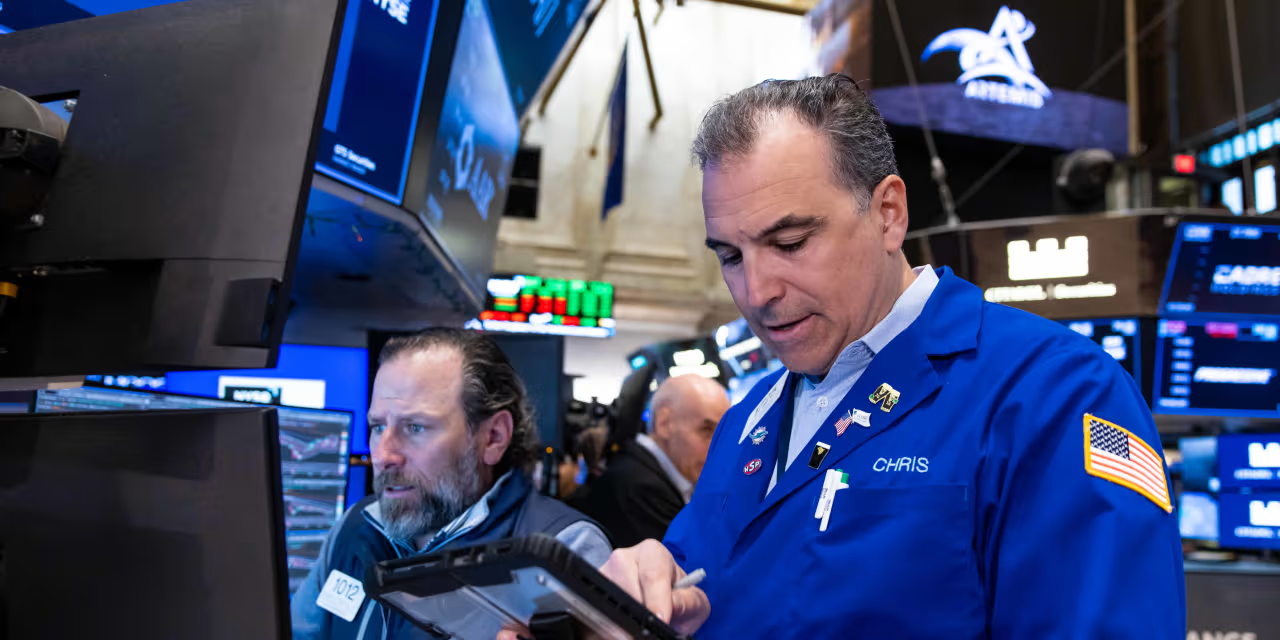
Micron, Super Micro, Newmont, Robinhood, Casey’s, and More Stocks That Explain Today’s Market

Published

on

The First $6 Trillion Company May Not Be Nvidia

Micron, Super Micro, Newmont, Robinhood, Casey’s, and More Stocks That Explain Today’s Market

Continue Reading

Business

Crisp Power building US presence

Published

on

Crisp Power building US presence

Company opens first US manufacturing hub.

Continue Reading

Business

Donald Trump: ‘I love the inflation’

Published

on

Donald Trump: 'I love the inflation'

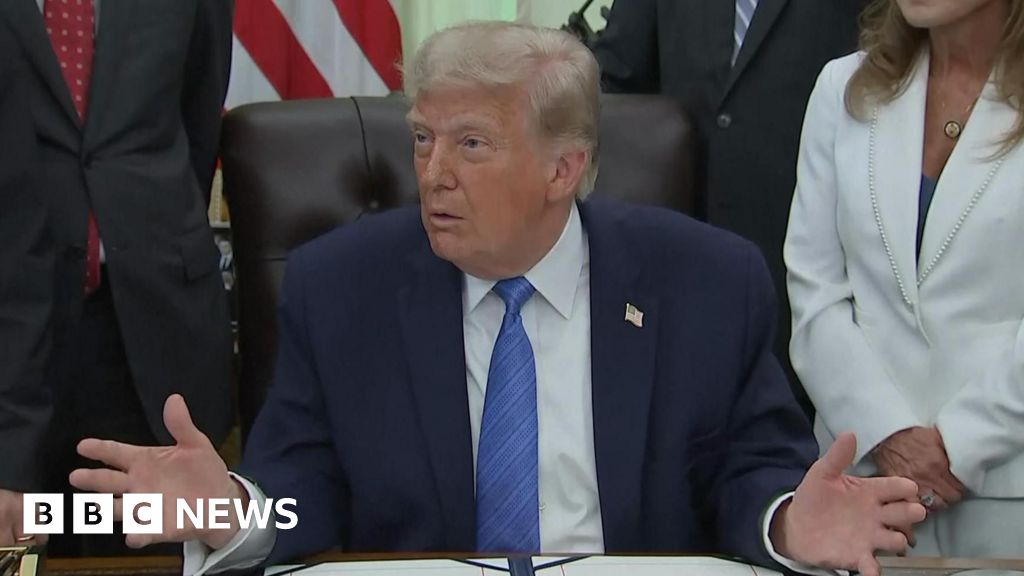
During an Oval Office signing event, President Donald Trump said, “I love the inflation” in response to a reporter’s question about news that it had surged to a three-year high of 4.2%.

The president also revealed that the US has been “taking out millions of barrels of oil” from Iran, saying Tehran didn’t know about it “until right now”.

Despite its recent climb, Trump insisted that inflation will “come down like a rock” after the war is over.

Read more here.

Advertisement
Continue Reading

Business

Goldman Sachs buys CMR Green Technologies shares on listing day after strong debut

Published

on

Goldman Sachs buys CMR Green Technologies shares on listing day after strong debut
Shares of CMR Green Technologies attracted institutional interest on their market debut, with a Goldman Sachs-managed fund picking up shares worth nearly Rs 50 crore through a bulk deal on Wednesday. According to NSE bulk deal data, Goldman Sachs India Equity Portfolio purchased 19.41 lakh shares of CMR Green Technologies at an average price of Rs 256.64 per share. The transaction was valued at about Rs 49.82 crore.

The purchase came on the same day the stock made a strong stock market debut, listing at a premium of around 43% over its issue price of Rs 192.

CMR Green Technologies had launched a Rs 630.88 crore initial public offering, which was entirely an offer-for-sale (OFS) by existing shareholders. The issue received an overwhelming response from investors, getting subscribed 127.07 times overall.

Institutional investors led the demand, with the qualified institutional buyer (QIB) portion subscribed 270.46 times, while the non-institutional investor (NII) category was booked 172.35 times. The retail portion attracted bids worth 27.08 times the shares on offer.

Advertisement

The strong subscription and listing performance reflect investor optimism around the company’s position in India’s growing recycled metals and aluminium recycling industry.


Brokerages had highlighted the company’s market leadership and growth prospects ahead of the IPO. Arihant Capital noted that CMR Green’s aluminium recycling capacity is more than four times that of its nearest domestic competitor and pointed to its estimated 42-45% market share in the automotive cast alloy segment.
SBI Securities had also maintained a “Subscribe” rating, citing the company’s installed capacity of 4.7 lakh tonnes per annum and opportunities arising from increasing demand for recycled metals and expansion into wrought aluminium products.Deven Choksey Research said the company is well placed to benefit from long-term themes such as electric vehicle adoption, rising aluminium usage in automobiles, decarbonisation initiatives and India’s push towards a circular economy.

However, analysts have advised caution after the sharp listing gains.

Shivani Nyati, Head of Wealth at Swastika Investmart, said investors should remember that the IPO was entirely an OFS and did not bring fresh capital into the company. She said investors who received allotment could consider booking partial profits while retaining some exposure for the medium term, given the company’s industry positioning. New investors, meanwhile, should wait for a correction or consolidation rather than chase the stock at elevated levels, she added.

Founded in 2006, CMR Green Technologies is among India’s largest non-ferrous metal recyclers. The company manufactures recycled aluminium alloys, zinc alloy ingots, aluminium billets and other recycled metal products used across automotive and industrial applications.

Advertisement

For FY25, the company reported revenue of Rs 6,697 crore and net profit of Rs 155 crore. In the first nine months of FY26 ended December 2025, it posted revenue of Rs 6,291 crore and profit after tax of Rs 162.4 crore, indicating continued operational momentum.

Continue Reading

Business

It’s Time To Sell The Energy Sector (Commodity:CO1:COM)

Published

on

Occidental Petroleum: Why This Warren Buffett Stock Has A Lot More Upside (NYSE:OXY)

This article was written by

As a detail-oriented investor with a strong foundation in finance and business writing, I focus on analyzing undervalued and disliked companies or industries that have strong fundamentals and good cash flows. I have a particular interest in sectors such as Oil&Gas and consumer goods. Basically, anything that has been unloved for unjustified reasons that could offer substantial returns. Energy Transfer is one of those companies that I came across when no one wanted to touch it and now I can’t resolve myself to sell it. I will always focus more on long-term value investing but I can sometimes lose myself in possible deal arbitrage such as with Microsoft/ Activision Blizzard, Spirit Airlines/Jetblue (that one still hurts), and Nippon/U.S. Steel (perfect exit at $50.19). I tend to shun businesses that I can’t understand either high-tech or certain consumer goods such as fashion (give me a Levi’s jeans). I don’t understand why anyone would invest in cryptocurrencies as well. Through Seeking Alpha, I aim to connect with like-minded investors, share insights, and build a collaborative community of individuals seeking superior returns and informed decision-making, currently on a quest to review every public company.

Analyst’s Disclosure: I/we have a beneficial long position in the shares of ET either through stock ownership, options, or other derivatives. I wrote this article myself, and it expresses my own opinions. I am not receiving compensation for it (other than from Seeking Alpha). I have no business relationship with any company whose stock is mentioned in this article.

Seeking Alpha’s Disclosure: Past performance is no guarantee of future results. No recommendation or advice is being given as to whether any investment is suitable for a particular investor. Any views or opinions expressed above may not reflect those of Seeking Alpha as a whole. Seeking Alpha is not a licensed securities dealer, broker or US investment adviser or investment bank. Our analysts are third party authors that include both professional investors and individual investors who may not be licensed or certified by any institute or regulatory body.

Advertisement
Continue Reading

Business

Jefferies upgrades Aegis Vopak shares to Buy, says correction overdone. Here’s why

Published

on

Jefferies upgrades Aegis Vopak shares to Buy, says correction overdone. Here’s why
Shares of Aegis Vopak Terminals rallied as much as 6% to their day’s high of Rs 203 on the BSE on Wednesday after international brokerage firm Jefferies upgraded the stock to Buy and assigned a fresh target price of Rs 240, implying an upside of 25% from current market levels.

While the brokerage has cut its target price from Rs 255, it believes the recent correction in Aegis Vopak Terminals (AVTL) has been excessive. The stock has fallen 16% since Middle East tensions escalated, compared with an 8% decline in the Nifty. While near-term risks persist, the brokerage expects LPG import volumes to normalise once geopolitical tensions ease.

Jefferies said Aegis remains on track with its expansion plans, with management reiterating an aggregate capex target of $5 billion by FY30 and $1.2 billion by FY27. The company currently operates 1.7 million cubic metres of liquid storage capacity and 225,800 MT of LPG capacity across six ports and aims to expand its presence to 12 ports by 2030.

Capacity additions at JNPT and Kandla ports are progressing as planned and are expected to increase liquid storage capacity by 25% and LPG capacity by 34%, respectively. Management said capacity expansion is being aligned with demand growth. The company is also expanding into ammonia storage, with a 36,000 MT facility under development at Pipavav port. Additionally, the Kandla-Gorakhpur pipeline is expected to be commissioned by September 2026, which could support higher LPG terminal throughput.

Advertisement

“We estimate 4.7% CAGR in LPG demand over FY26-30E, driving 5.3% CAGR in imports. We believe AVTL is also well-placed to capture storage-led growth as the government plans to build an LPG storage reserve to cover 30 days of demand,” the brokerage said in a note.


Jefferies has lowered its FY27 EBITDA estimate for Aegis Vopak Terminals (AVTL) by 22% to factor in the March 2026 quarter miss and the impact of Middle East tensions. However, it has largely retained its FY28 estimates, assuming geopolitical tensions ease over time.
The brokerage has cut its target price to Rs 240 from Rs 255 earlier. The valuation is based on 22x March 2028 estimated EV/EBITDA, compared with 18x for JSW Infrastructure. Jefferies expects AVTL to deliver a 33% EBITDA CAGR between FY28 and FY30, versus 21% for JSW Infrastructure, while achieving broadly similar return ratios by FY28.Key downside risks highlighted by the brokerage include delays in the Kandla-Gorakhpur pipeline project, weaker-than-expected LPG imports or market share gains, and value-dilutive capacity expansion plans.

Aegis Vopak shares are down 20% since the beginning of the year.

(Disclaimer: Recommendations, suggestions, views and opinions given by the experts are their own. These do not represent the views of The Economic Times)

Advertisement
Continue Reading

Business

Plans to transform the port of Port Talbot

Published

on

Business Live

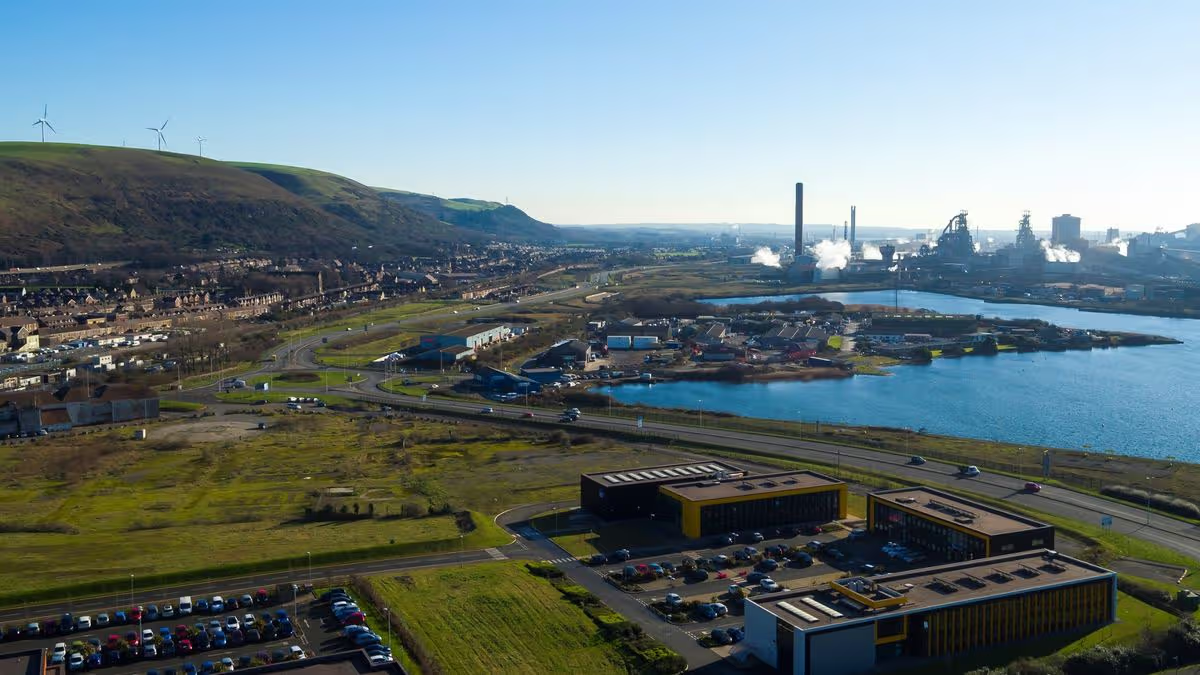
The investment will support the delivery of floating offshore wind projects in the Celtic Sea

The port of Port Talbot.(Image: Dave Powell Ltd.)

Plans for a “transformative programme” of works to redevelop the port of Port Talbot have taken a step forward after an early stage application to the local council.

Advertisement

The project known as the “Future Port Talbot” programme will look to construct new marine and land-side infrastructure at the south Wales port in order to facilitate the creation of huge floating offshore wind-farms in the Celtic Sea.

The work could eventually see the creation of assembly and manufacturing facilities for the offshore wind industry along with a new quay wall, land-side material and equipment storage if taken forward.

It comes after The UK Government announced a £64m investment into the port of Port Talbot in March to enable Associated British Ports, (ABP) to complete the essential design and engineering work needed.

Additionally, in 2025 the Crown Estate struck a leasing agreement with developers to build three floating offshore wind-farms in the Celtic Sea, one in English waters, one in Welsh waters and a third straddling both.

Advertisement

As a result it is hoped that the port could support thousands of new jobs once completed, potentially unlocking over £500m of investment for the town and wider area.

The latest submission to Neath Port Talbot Council was revealed as part of officers delegated decisions made between March 13 and May 14.

It confirmed the intention of ABP to submit a Harbour Revision Order for the works in Port Talbot. A scoping direction also confirmed the full plans would need to include an environmental impact assessment as well as an application for a Marine Licence from Natural Resources Wales.

A section of the Associated British Ports website which discusses the Future Port Talbot Programme said: “Port Talbot has been at the forefront of industrial change before, and ABP’s vision is to lead that change again. Port Talbot has a natural sheltered deep-water harbour and large land that can be developed.

Advertisement

“It is close to floating offshore wind in the Celtic Sea and has strong export potential. The port sits within communities with a rich industrial heritage and a strong base of relevant skills and experience.

“These plans support growth in Wales and the UK and can help drive wider economic regeneration across South Wales.”

Continue Reading

Business

Beverages dominate in Circana’s 2025 Pacesetters

Published

on

Beverages dominate in Circana’s 2025 Pacesetters

Carbonated, sports and energy drinks generated the largest dollar contribution in the annual report. 

Continue Reading

Business

Alphabet Shares Decline 1.6% to $356.62 as Tech Stocks Face Profit-Taking

Published

on

Google May Avoid Harsh Penalties as Judge Eyes Softer Antitrust

Alphabet Inc. shares fell modestly in midday trading Wednesday, dropping 1.57% to $356.62 as investors engaged in selective profit-taking across major technology names amid ongoing earnings season and persistent macroeconomic uncertainty.

The decline in Google’s parent company came on moderate volume with no major company-specific news immediately triggering the move. Alphabet has delivered strong performance year-to-date, driven by robust growth in its cloud business, continued dominance in search and accelerating artificial intelligence initiatives. However, the stock remains sensitive to broader rotation out of high-valuation tech names and shifting expectations around Federal Reserve policy.

Market Context and Sector Dynamics

Wednesday’s trading reflected a cautious tone across major indexes, with the Nasdaq Composite also showing modest weakness. Technology stocks, which have led market gains in 2026 on AI enthusiasm, encountered some resistance as traders locked in profits following recent rallies. Defensive sectors provided relative stability, limiting broader market downside.

Advertisement

Analysts noted that Alphabet’s valuation, while supported by strong fundamentals, leaves limited room for error in a market increasingly focused on near-term execution and capital returns. The company’s diversified revenue streams across search, YouTube, cloud computing and other bets continue to underpin investor confidence despite periodic volatility.

AI Investments and Cloud Momentum

Alphabet has aggressively invested in artificial intelligence infrastructure and model development, with Gemini powering enhancements across Search, Workspace and consumer products. Google Cloud has posted accelerating growth, benefiting from enterprise demand for AI tools and infrastructure services.

Recent quarterly results highlighted double-digit revenue increases in cloud, with AI-related bookings contributing meaningfully. The company’s integration of generative AI features into core products has been well-received, though competition from Microsoft, Amazon and specialized AI players remains intense.

Advertisement

Search and Advertising Performance

Search advertising, Alphabet’s core profit engine, continues to generate substantial cash flow. YouTube advertising and subscription services provide additional diversification. While regulatory scrutiny on digital advertising practices persists, Alphabet has maintained strong market share and innovation in ad formats.

Analysts expect advertising revenue to remain resilient, supported by digital transformation trends across industries. However, any slowdown in consumer spending or shifts in advertiser budgets could influence near-term results.

Regulatory and Antitrust Landscape

Advertisement

Alphabet continues navigating significant regulatory challenges globally. Ongoing antitrust cases in the United States and Europe focus on search dominance, app store policies and advertising practices. Resolutions could impact future business models and financial performance.

The company has maintained a proactive approach, engaging with regulators while defending its practices in court. Long-term investors view these issues as manageable risks given Alphabet’s financial strength and adaptability.

Financial Strength and Capital Allocation

Alphabet maintains a robust balance sheet with significant cash reserves, enabling continued investment in AI, cloud and other growth areas. Share repurchases and dividend growth provide returns to shareholders while supporting stock price stability.

Advertisement

Management has emphasized disciplined capital allocation, balancing innovation with shareholder returns. Recent increases in capital expenditures reflect confidence in long-term AI and cloud opportunities.

Analyst Perspectives

Wall Street consensus remains largely positive on Alphabet. Several firms maintain Buy ratings, citing the company’s competitive advantages in search, cloud momentum and AI positioning. Price targets reflect optimism around sustained growth, though some analysts note valuation discipline is warranted given current multiples.

The stock’s performance has been resilient, though periodic pullbacks like Wednesday’s highlight sensitivity to macro factors and sector rotation. Longer-term outlooks emphasize Alphabet’s ability to monetize AI investments and maintain leadership in core businesses.

Advertisement

Broader Technology Sector Trends

The technology sector has been a primary driver of market gains, fueled by AI infrastructure spending and digital transformation. While large-cap names like Alphabet, Microsoft and Nvidia have captured much attention, selectivity has increased as investors differentiate between sustainable growth stories and more speculative plays.

Geopolitical risks, supply chain considerations and interest rate sensitivity continue influencing sector dynamics. Alphabet’s global footprint provides diversification but also exposes it to currency fluctuations and regulatory variations across regions.

Investor Considerations

Advertisement

For investors, Alphabet represents a high-quality technology franchise with strong cash generation and growth potential. The company’s scale, brand strength and innovation track record provide a defensive growth profile in an uncertain economic environment.

Risks include regulatory outcomes, competitive pressures in AI and potential slowdowns in advertising markets. However, the balance sheet strength and diversified revenue streams offer meaningful downside protection.

Outlook and Key Catalysts

Upcoming quarterly results and updates on AI progress will be closely watched. Management commentary on cloud bookings, AI monetization and capital spending plans could influence sentiment significantly.

Advertisement

Longer-term, Alphabet’s position at the intersection of search, cloud and artificial intelligence positions it favorably for continued growth. Successful execution on current initiatives could drive further upside, while disciplined capital management supports shareholder value.

Wednesday’s modest decline represents normal market fluctuations rather than a fundamental shift. The stock’s performance continues to reflect investor confidence in Alphabet’s strategic direction amid a complex operating environment.

As the trading session progressed, focus remained on broader market dynamics and upcoming economic data. Alphabet shares, while lower on the day, maintain a constructive longer-term trajectory supported by strong fundamentals and leadership in key technology areas.

The company’s evolution continues to attract investor interest, with AI and cloud growth serving as primary drivers. Market participants will monitor developments closely in coming weeks for additional clarity on execution and strategic priorities.

Advertisement
Continue Reading

Trending

Copyright © 2025