
Business
Worst of market uncertainty likely behind us: Trideep Bhattacharya

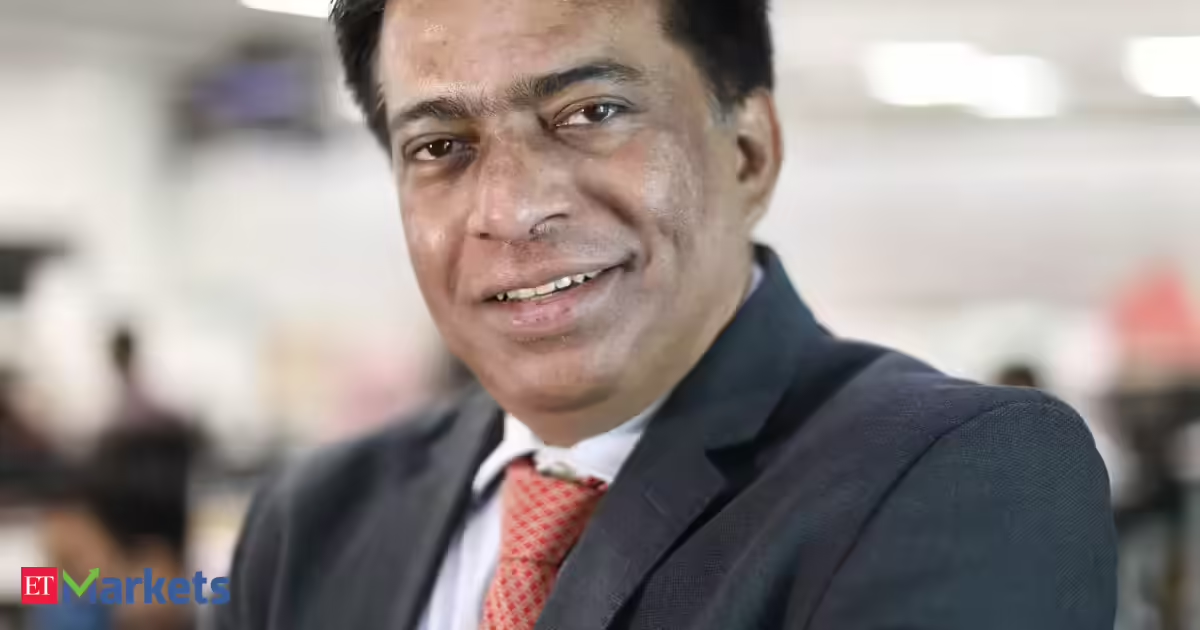
When asked about the current trajectory, Trideep Bhattacharya from Edelweiss AMC offered a measured outlook, suggesting that the worst phase of uncertainty may already be behind us.
“So, in my opinion, in most logical circumstances we have probably seen the worst of the war in the sense of worst of the uncertainty. While the exact deal, the nature of it is still pending and will take time to evolve over time, we have seen the worst of it and that is our base case,” he said.
He emphasized that the base case scenario points toward a gradual normalization by the end of April. “The base case is that by the end of April most of war-related uncertainty is resolved and we gradually live back to normalcy because some of the energy infrastructure will take a bit of time to normalise but the market will discount once it knows that the worst point of the event is over.”
However, he cautioned that risks remain if key developments fail to materialize. “The reason why it is vacillating around the higher level of the mark that you are talking about is we do not seem to find yet a common ground of understanding between the warring parties and that is necessary, by the way, before we end April. If it does not happen… the way to keep track of this is if oil price stays above 100 for a period of three months, which means March, April and May put together, then the negative scenario starts playing out on the economic front which will be global in nature. India will also go through its impact.”

Bhattacharya summarized the outlook succinctly: “The base case is the majority of the event ends in April. The earnings impact is manageable and we go back to where we started the warlike scenario. But if it were not to happen, oil stays above $100 for three months… then economic circumstances is something that we need to be prepared for.”
Midcaps and Smallcaps Regain Investor Interest
Recent weeks have seen renewed buying in midcap and smallcap stocks, a trend Bhattacharya views positively.
“We have been positive. We have been positive on this space because on a relative basis we find the valuations during this correction for both mid and smallcaps have actually reached a five-year low versus broader markets,” he noted.
He added that valuation excesses have normalized, making these segments attractive again. “Structurally we feel that this end of the market, particularly the midcap end of the market, is that part of the market where we have relatively stronger business models that are gaining market share and… have better earnings growth.”
With valuations now at more reasonable levels, he believes gradual allocation into these segments makes sense.
Energy Theme Gains Prominence
Energy, particularly the power sector, has emerged as a dominant theme in recent months. Bhattacharya highlighted that this trend predates current geopolitical tensions.
“Power overall is a segment where we have been positive on… because as a growing economy the energy needs of the economy kind of grows multi-fold more than just the GDP,” he explained.
India’s economic ambitions will require significant expansion in power generation, transmission, and distribution. He also pointed out that the ongoing conflict has underscored the importance of energy diversification.
“This war… has put this issue right in the forefront that we need to look at how do we have multiple sources of energy so that we are not too much dependent on the Strait of Hormuz or any particular channel.”
Sector Rotation: Financials, Power, and Capital Goods Lead
Looking ahead, Bhattacharya identified three key sectors where his outlook remains positive.
“We are overweight on three areas where we think demand is relatively insulated,” he said.
First, financial services stand out as credit growth shows signs of recovery. “We think that clearly credit growth has bottomed out and over the next three, six, nine months we will see credit growth move up to somewhere between 14% to 16% and as a play on the same financial services is a good place to be.”
Second is the power sector, which continues to benefit from structural demand trends.
Third, capital goods—particularly short-cycle segments—are expected to gain from post-conflict rebuilding activity. “As we come out of this conflict and as the rebuild phase starts to happen, you will see some of the capital goods companies benefit from the same.”
On the flip side, he remains underweight on telecom, utilities, and parts of the oil and gas sector following their recent rally.
Financials: Moving Down the Market Cap Curve
Within financials, Bhattacharya suggests taking a broader approach.
“So given that it is a rising tide right now within financials where liquidity is decent, where credit growth is bottoming out, it makes sense to take a bit of risk within financials,” he said.
This includes exploring opportunities beyond large private banks. “Which means going down the market cap chain in the context of private sector banks, also maybe PSU banks and some NBFCs. And finally I would say capital markets is another place where we have been structurally positive.”
IT Sector in Transition
On the technology front, Bhattacharya struck a cautious tone, describing the sector as being in the midst of a structural shift driven by artificial intelligence.
“So, strong is not the view that I have… We think that AI is like any other technology cycle which will reorient, which will create some newer avenues for growth and will take away some of the old ones,” he said.
He noted that the transition phase may weigh on performance in the near term. “At the moment you are looking at a sector which is IT sector in the transition… During these periods generally the sector derates.”
Despite this, he remains watchful rather than outright negative. “We are marginally underweight and watching the data points carefully to see when the growth rates start to go better maybe in three to four quarters.”
A Market at an Inflection Point
As markets balance recovery with uncertainty, the coming months will be critical. While the base case suggests stabilization, key variables—particularly oil prices and geopolitical developments—will determine whether optimism holds or gives way to renewed volatility.
For now, investors appear to be positioning selectively, focusing on sectors with structural strength while keeping a close eye on evolving risks.



– Building a consistent, low-risk passive income portfolio—no gambling, no hype, just fundamentals. I aim to generate ~12% average annual returns with minimal downside risk, prioritizing capital preservation and stable value compounding over short-term momentum. – With over a decade of professional experience in equity research, I specialize in analyzing cash-generative businesses, special situations, and corporate restructurings across developed markets. My investment strategy emphasizes risk assessment over speculative growth, aligning with contrarian and value-driven principles. – Influenced by legendary investors like Warren Buffett and Howard Marks, I rely on deep fundamental analysis, macroeconomic context, and rigorous valuation discipline. I hold a First-Class Honors degree in Economics from the University of London and am passionate about translating complex financial insights into actionable long-term investment ideas.
Analyst’s Disclosure: I/we have a beneficial long position in the shares of BRK.B either through stock ownership, options, or other derivatives. I wrote this article myself, and it expresses my own opinions. I am not receiving compensation for it (other than from Seeking Alpha). I have no business relationship with any company whose stock is mentioned in this article.
Seeking Alpha’s Disclosure: Past performance is no guarantee of future results. No recommendation or advice is being given as to whether any investment is suitable for a particular investor. Any views or opinions expressed above may not reflect those of Seeking Alpha as a whole. Seeking Alpha is not a licensed securities dealer, broker or US investment adviser or investment bank. Our analysts are third party authors that include both professional investors and individual investors who may not be licensed or certified by any institute or regulatory body.
Business
WSFS Financial Corporation 2026 Q1 – Results – Earnings Call Presentation (NASDAQ:WSFS) 2026-04-25

Q1: 2026-04-23 Earnings Summary
EPS of $1.68 beats by $0.18
| Revenue of $275.30M (7.49% Y/Y) beats by $7.09M

Seeking Alpha’s transcripts team is responsible for the development of all of our transcript-related projects. We currently publish thousands of quarterly earnings calls per quarter on our site and are continuing to grow and expand our coverage. The purpose of this profile is to allow us to share with our readers new transcript-related developments. Thanks, SA Transcripts Team

What a transition towards an AI-driven company may or may not mean for SAP

On a sequential basis, net profit rose 6 per cent.
Its core net interest increased to Rs 4,424.03 crore in the reporting quarter from Rs 4,240.07 crore a quarter ago and Rs 3.749.88 crore in the year-ago period.
“Through the course of the year, we remained steadfast in our approach, tightening credit and risk administration frameworks, strengthening collections infrastructure, accelerating our AI-led technology transformation and continuously focusing on growth across all our business lines,” Sudipta Roy, Managing Director and Chief Executive Officer at L&T Finance, said.
In the microfinance business, the focus was on navigating the cycle with prudence and the efforts have yielded results, Roy said, adding that business parameters across disbursements and collection efficiencies are now reverting to near pre-crisis levels.
The company is confident that FY27 will be a stable and productive year for this segment.
The total revenue from operations increased to Rs 4,771.03 crore in Q4 FY26 compared to Rs 4,578.27 crore in Q3 FY26 and Rs 4,022.92 crore in Q4 FY25, according to its financial results.In the reporting quarter, retail disbursements grew 62 per cent to Rs 24,107 crore in Q4 FY26 from Rs 14,899 crore in Q4 FY25.
The growth in secured disbursements led by two-wheeler finance at Rs 2,930 crore, a rise of 58 per cent year-on-year.
Personal loan disbursements rose 98 per cent to Rs 3,786 crore, rural business finance disbursements increased 41 per cent to Rs 7,208 crore, investor presentation showed.
Its retail book rose 26 per cent year-on-year to Rs 1,19,508 crore, and consolidated stood at was Rs 1,21,728 crore.
The wholesale book of the company declined 14 per cent to Rs 2,220 crore as of March 31, 2026, from Rs 2,582 crore a year back.
The company has seen an improvement of 0.06 per cent in net interest margins (NIM) plus fees. It stood at 10.47 per cent in Q4 FY26 compared to 10.41 per cent in Q3 FY26.
Credit costs improved in the reporting quarter at 2.64 per cent from 2.83 per cent in the preceding December quarter.
The L&T Finance scrip closed 0.56 per cent down at Rs 290.45 a piece on the BSE against a 1.29 per cent correction on the benchmark.

AI in Travel: Threat or opportunity?

As markets swing between optimism and caution in 2026, the ability to identify exceptional CEOs has become a critical edge for long-term investors. While short-term trades may be driven by sentiment, long-term wealth creation still depends on leadership quality and capital allocation discipline.
The Core Principle: Measure What Truly Matters
According to the insights of renowned author and investor William Thorndike, evaluating a CEO does not require overly complex metrics. Instead, it boils down to a simple but powerful framework:Shareholder returns during the CEO’s tenure
Comparison with peer companies
Performance relative to the broader marketThis relative performance approach is crucial in today’s environment. With benchmark indices experiencing cycles of rapid rallies and corrections, outperformance—not just absolute returns—is the real signal of leadership strength.
Capital Allocation: The Defining Skill
Modern investing increasingly recognises that a CEO’s most important role is not just running operations—but allocating capital wisely.
Research and market commentary consistently show that CEOs who think like investors—deploying cash into high-return opportunities, avoiding wasteful expansion, and maintaining financial discipline—tend to outperform over time.
In fact, so-called “outsider CEOs” often stand out because they:
Focus on cash flows rather than accounting profits
Practice frugality and disciplined spending
Decentralise operations while retaining capital control
In a market like today’s—where liquidity conditions are tightening and capital is no longer cheap—these traits are not optional; they are essential.
Why This Matters More in 2026
Recent market trends reinforce the importance of leadership quality:
Investors are shifting toward “quality investing”, favouring companies with strong fundamentals and resilient management.
Market behaviour is increasingly influenced by uncertainty and macro shocks, making leadership decisions more impactful than ever.
Long-term compounders—companies that steadily grow over the years—are being preferred over speculative, short-term plays.
In such an environment, a mediocre CEO can destroy value quickly, while a great one can navigate turbulence and emerge stronger.
The Long-Term Lens: Thinking Beyond Market Noise
One of the biggest mistakes investors make is focusing too much on quarterly earnings or short-term stock movements. Great CEOs, by contrast, think in decades—not quarters.
Evidence shows that companies with long-term orientation tend to deliver:
Higher revenue growth
Better profitability
Stronger shareholder returns over time
This aligns closely with the philosophy of legendary investors, who emphasize understanding businesses deeply and trusting capable management over reacting to price fluctuations.
Key Traits of Great CEOs for Investors to Watch
1. Deliver Consistent Outperformance
Not just growth—but growth that beats peers and markets.
2. Excel at Capital Allocation
They treat company cash like an investor would.
3. Focus on Cash Flow Over Optics
Avoiding accounting illusions and prioritising real value creation.
4. Maintain Discipline in Tough Times
Especially critical in volatile cycles like today.
5. Think Long-Term
Resisting pressure for short-term gains at the cost of future value.
Leadership Is the Ultimate Moat
In a world where information is abundant, and markets are increasingly efficient, edge comes from judgment—not data. Identifying great CEOs offers that edge.
As the 2026 market continues to evolve, investors who focus on leadership quality—rather than chasing trends—are more likely to build sustainable wealth. Because in the end, stocks are not just numbers on a screen—they are businesses led by people. And the right people make all the difference.
(Disclaimer: Recommendations, suggestions, views and opinions given by the experts are their own. These do not represent the views of The Economic Times)
Business
Sebi to expedite rule simplification, boost tech-led oversight: Chairman Tuhin Kanta Pandey on 38th anniversary
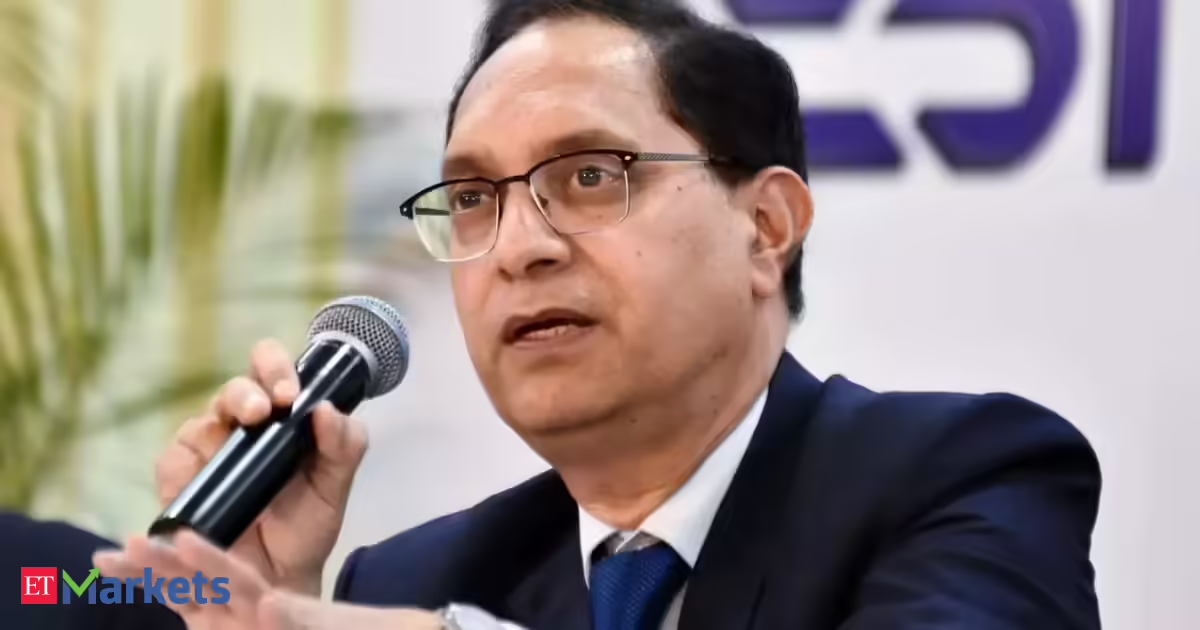
“Today is an important day to ask- what is our way forward? Our collective resolve is unambiguous. We will collaborate to bring innovations for market development such that capital formation contributes to faster economic growth. We will continue to invest in technology-led supervision,” Pandey said.
The event was also attended by Finance Minister Nirmala Sitharaman.
Pandey said that Sebi will work towards strengthening governance and risk management frameworks and capabilities while emphasising the role of other market stakeholders.
“At this point, it is also important to recognise that markets are not built by regulators alone. Industry participants must move beyond compliance to a deeper commitment to fairness, integrity and innovation. Intermediaries must recognise that they are often the first point of trust for
investors. Investors themselves must remain aware and responsible in their participation,” the Sebi chief said.
Pandey said Indian markets have demonstrated strong resilience despite global uncertainties such as geopolitical tensions and rapid technological shifts, reflecting years of institution-building and robust regulation. Marking 38 years of Securities and Exchange Board of India, he highlighted Sebi’s evolution from an open outcry system to a technology-driven, transparent and globally integrated market through reforms like dematerialisation, screen-based trading and improved risk management.
He noted that India’s markets today are defined not just by scale — with over 5,900 listed companies, 140 million investors, and steady growth in market cap and mutual funds — but also by rising retail participation and digital adoption. Pandey emphasised that this growth brings added responsibility to balance innovation with investor protection and sustainable development.
Also read: Sebi plans risk-based calculation for brokers’ variable net worth
He added that recent reforms have focused on easing business, strengthening investor safeguards, and improving efficiency, while Sebi is also enhancing internal capabilities through technology, data analytics, and governance improvements to meet the evolving demands of modern financial markets.
(Disclaimer: The recommendations, suggestions, views, and opinions given by the experts are their own. These do not represent the views of The Economic Times.)


Trump hosts crypto contest winners at Mar-a-Lago as his coin languishes


Dhierin-Perkash Bechai is an aerospace, defense and airline analyst.
Dhierin runs the investing group The Aerospace Forum, whose goal is to discover investment opportunities in the aerospace, defense and airline industry. With a background in aerospace engineering, he provides analysis of a complex industry with significant growth prospects, and offers context to developments as they occur, describing how they might affect investment theses. His investing ideas are driven by data informed analysis. The investing group also provides direct access to data analytics monitors.
Learn more.
Analyst’s Disclosure: I/we have no stock, option or similar derivative position in any of the companies mentioned, and no plans to initiate any such positions within the next 72 hours. I wrote this article myself, and it expresses my own opinions. I am not receiving compensation for it (other than from Seeking Alpha). I have no business relationship with any company whose stock is mentioned in this article.
Seeking Alpha’s Disclosure: Past performance is no guarantee of future results. No recommendation or advice is being given as to whether any investment is suitable for a particular investor. Any views or opinions expressed above may not reflect those of Seeking Alpha as a whole. Seeking Alpha is not a licensed securities dealer, broker or US investment adviser or investment bank. Our analysts are third party authors that include both professional investors and individual investors who may not be licensed or certified by any institute or regulatory body.
Two Key Factors Driving The Economy, Neither Is Sustainable

Berkshire Hathaway Stock: Selling At A 20% Discount To Asset Value (NYSE:BRK.B)

5 Pollinator-Friendly Flowers To Bring Wildlife To Your Garden
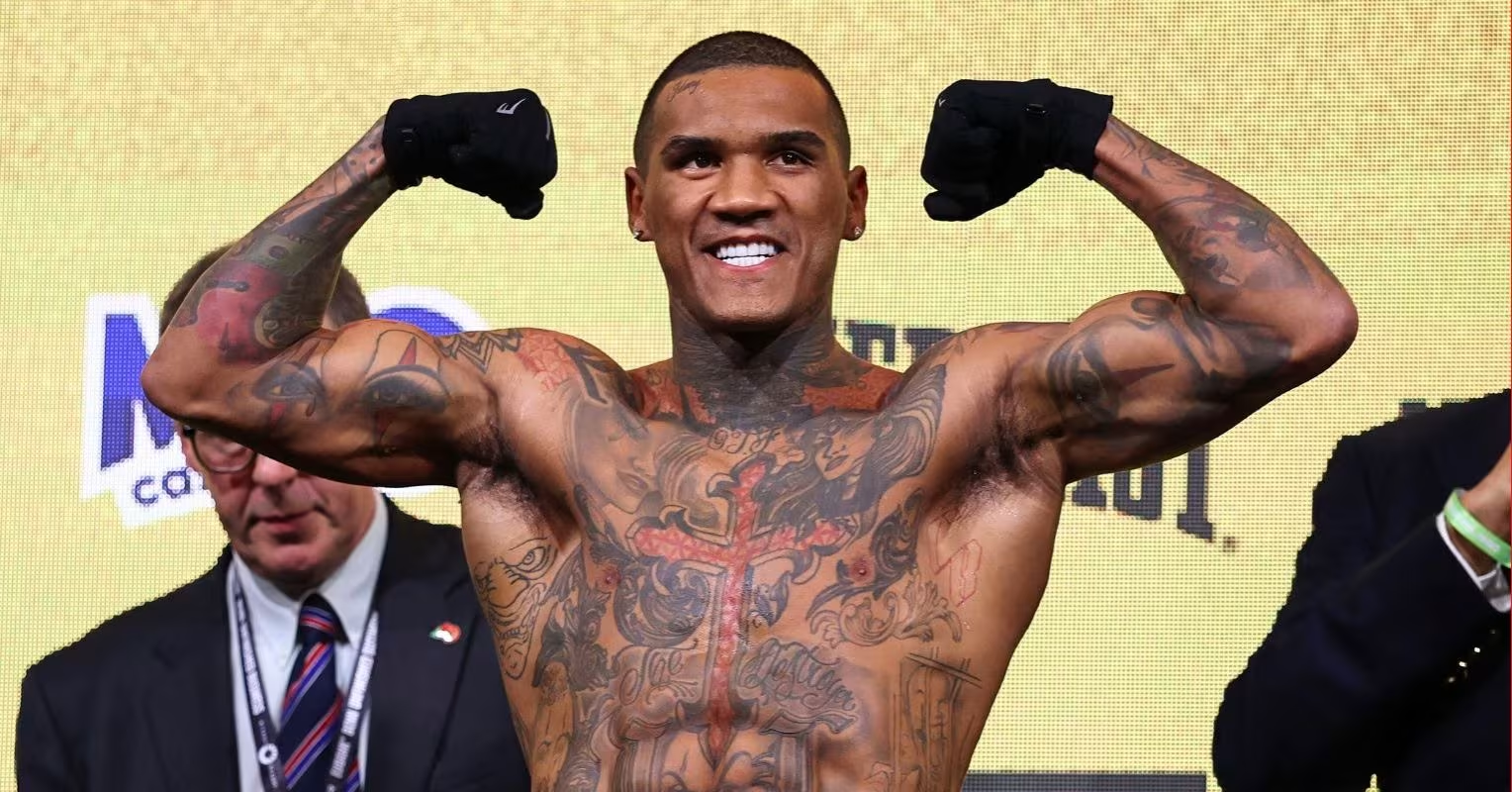
World champion says Conor Benn pulled out of fight after the ‘whole deal was set up’

Manchester United reach agreement with Casemiro over contract clause amid transfer speculation

US brings back mandatory military draft registration

Steven Gerrard disagrees with Gary Neville over ‘shock’ Chelsea and Arsenal claim | Football

What is CryptoCurrency? | Everything About Bitcoin & Cryptocurrencies Explained for Beginners

These Illegal Immigrants Are F*cked | Financial Audit

L&T Finance Share q4 result 2026 i L&T Finance share dividend I L&T Finance SHARE LATEST NEWS I LTF
-

 Business6 days ago
Powerball Result April 18, 2026: No Jackpot Winner in Powerball Draw: $75 Million Rolls Over
-

 Politics6 days ago
Zack Polanski demands ‘council homes not luxury flats for foreign investors’
-

 Fashion16 hours ago
Weekend Open Thread – Corporette.com
-
Entertainment5 days ago
NBA Analyst Charles Barkley Chimes in on Ice Spice McDonald’s Fiasco
-

 Tech6 days ago
Auto Enthusiast Scores Running Tesla Model 3 for Two Grand and Turns It Into Bare-Bones Go-Kart
-

 Politics5 days ago
Gary Stevenson delivers timely reminder to register to vote as deadline TODAY
-

 Politics3 days ago
Making troops accountable for war crimes threatens US alliance, ex-SAS colonel warns
-

 Business3 days ago
Rolls-Royce Voted UK’s Most Iconic Trade Mark as IPO Register Hits 150
-

 Politics3 days ago
Disabled people challenge government SEND proposals over segregation concerns
-
 Crypto World5 days ago
Bank of Hawai’i (BOH) Q1 2026: Net Income Drops to $57.4M as Net Interest Margin Expands
-

 Politics3 days ago
Zack Polanski responds to home secretary’s taser threat
-
Politics3 days ago
Wings Over Scotland | How To Get Away With Crimes
-

 Politics3 days ago
Starmer handler McSweeney to be dragged from shadows by Foreign Affairs Committee
-
Crypto World6 days ago
Kelp DAO rsETH Bridge Hack Drains $292M as DeFi Losses Top $600M in Two Weeks
-

 Politics3 days ago
‘Iran is still a nuclear threat’
-
 Crypto World4 days ago
Five Value Stocks with Recovery Potential in 2026: PayPal (PYPL), Nike (NKE), and More
-

 Crypto World3 days ago
New York sues Coinbase, Gemini over prediction market offerings
-

 Business3 days ago
The Job Benefits Most Men Don’t Know to Negotiate
-

 Crypto World24 hours ago
Michael Saylor says BTC winter is over. Market analyst disagrees, says bitcoin was in a pullback
-

 Politics6 days ago
Reform investigating candidate who ‘hates’ the NHS
You must be logged in to post a comment Login