Crime
Tennessee’s Botched Execution Leaves Christa Pike on Ventilator, Prompts Resignation and Investigation

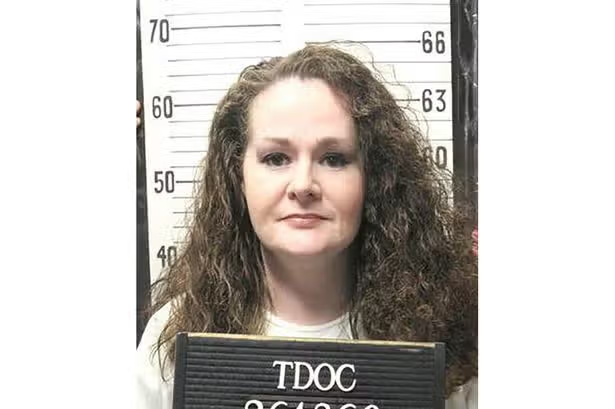
A botched execution in Tennessee has left death row inmate Christa Pike unconscious and on a ventilator four days after prison officials attempted to put her to death, raising fresh questions about the state’s lethal injection protocols and the broader machinery of American capital punishment.
Pike, 50, has not regained consciousness since Wednesday night, according to her lawyer, assistant federal defender Stephen Ferrell. She remains under guard in hospital as doctors try to clear a massive dose of the barbiturate pentobarbital from her system. “We don’t know right now, and we may never know what sort of torture she endured during that process, where her consciousness was, what physical pain there was, what mental torture she went through,” Ferrell said.
Tennessee prison officials administered two doses of the lethal injection drug, but the pentobarbital did not kill her. Her legal team says her arms were burned and blistered by the caustic chemicals during the attempt. Pike has reportedly given someone medical power of attorney, though her lawyers say they have not been told who that person is or what instructions they may have received.

How the Botched Execution Unfolded
Pike’s execution had already been thrown into chaos hours before the lethal injection began. A federal appeals court halted the process so it could more thoroughly examine whether the jury that originally sentenced her to death had properly considered claims of childhood sexual abuse. The US Supreme Court intervened, overturning that stay after an eight-hour delay, clearing the way for the execution to proceed that night.
Pike was 18 when she and her boyfriend tortured and killed her classmate, Colleen Slemmer, in 1995, a crime that made her one of the youngest women ever sentenced to death in the United States. Her case had already drawn scrutiny over the years because of her age at the time of the offense and her history of alleged abuse.
Her lawyers have since asked a court to compel Tennessee prison officials to preserve all written records, communications, images and video connected to the execution, anticipating a lengthy legal fight over exactly what happened inside the death chamber.
A Pattern of Failures Inside Tennessee’s Death Chamber
This is not the first time this year that Tennessee has failed to carry out a scheduled execution. In May, officials were unable to complete the execution of Tony Carruthers after staff successfully placed an IV line in one arm but could not establish a required secondary line. Taken together, the two incidents have intensified criticism that the state’s capital punishment system is poorly managed and dangerously opaque.
Ferrell has been blunt in his criticism of how little the public is told about the process. “The state of Tennessee has got to start telling its people exactly what it is doing so that in the democratic process, the people of Tennessee can decide if that’s what they want to be done in their name,” he told CNN. Like many death penalty states, Tennessee keeps closely guarded secrets around how its lethal injection drugs are manufactured, sourced and tested for quality before use.
The fallout from the botched execution has already reached the top of the state’s correctional leadership. Frank Strada, commissioner of the Tennessee Department of Correction, announced his resignation on Saturday, just days after the failed procedure. Governor Bill Lee has since ordered an independent investigation into the state’s execution protocols, to be led by former US attorney Ed Stanton.
Notably, this is not Stanton’s first time scrutinizing Tennessee’s capital punishment procedures. He previously reviewed the system in 2022 after Governor Lee halted an execution at the last minute, a review that found the state had failed to follow its own lethal injection protocol at the time. Critics say the recurrence of serious procedural breakdowns, years after that earlier warning, suggests deeper systemic problems that have gone unaddressed.
Questions That Remain Unanswered
For now, Pike’s medical fate remains uncertain. Her defense team says it could be days before anyone knows whether she will recover from the effects of the failed lethal injection, and a spokeswoman for her legal team has asked for respect of her privacy during the ordeal. Meanwhile, the investigation ordered by Governor Lee is expected to examine not just what went wrong on the night of the botched execution, but whether Tennessee’s entire approach to capital punishment needs to be overhauled.
The case has reignited a long-running national debate over lethal injection as a method of execution, with critics arguing that repeated failures, secrecy around drug sourcing, and inconsistent staff training point to a system ill-equipped to carry out executions reliably or humanely. Supporters of capital punishment, meanwhile, maintain that isolated procedural errors should not be used to challenge the legitimacy of death sentences handed down by juries.
As Pike remains hospitalized and unresponsive, her case has become a flashpoint in that debate, a stark illustration of how a single botched execution can ripple outward into resignations, investigations and renewed scrutiny of how states carry out their most severe punishment.
Explore more on this topic with Vexel Search.
You must be logged in to post a comment Login