
Crypto
Lula or Bolsonaro: Wall Street braces for two wildly different results in Brazil election


This combination of file pictures created on Sept. 29, 2026, shows Brazil’s President Luiz Inacio Lula da Silva at the Planalto Palace in Brasilia on Sept. 16, 2026; and Brazil’s right-wing Presidential candidate Flavio Bolsonaro at the Maracanazinho gymnasium in Rio de Janeiro, Brazil, on Aug. 22, 2026.
Evaristo Sa | Mauro Pimentel | Afp | Getty Images
With the first round of Brazil’s presidential election taking place Sunday, Wall Street is gearing up with starkly different market predictions depending on the outcome of the neck-and-neck race.
“The Brazil trade is: Does Lula win or does Bolsonaro win?” said Fernando Marengo, chief economist at Black Toro Global Investments.
Those names should sound familiar. Lula is 80-year-old leftist Luiz Inacio Lula da Silva, who is running for a fourth term against 45-year-old right-winger Flavio Bolsonaro, son of former President Jair Bolsonaro. If neither candidate gets more than 50% of the vote, a runoff will take place Oct. 25.
In short, if Bolsonaro wins, Wall Street expects a rally in the country’s bonds, currency and stocks.
As Bolsonaro has come from behind in the last few months, Brazilian stocks have moved higher along with his poll numbers. In a recent note to clients, JPMorgan noted that the MSCI Brazil “rose by 0.25% on average each day that Flavio gained in the polls.”
Kalshi markets now show Bolsonaro favored to win 60% to Lula’s 39%. Prediction markets are prohibited in Brazil, so they may not reflect local sentiment. In a note to clients, Aurora Macro Strategies senior advisor Richard Lapper said, “the balance has shifted toward Flavio over the past month, but not nearly as far as the prediction markets are pricing.”

Bovespa since Nov. 1, 2016
Bolsonaro is the favored candidate of the markets because he’s promising more fiscal discipline, something many economists say Brazil desperately needs. Debt-to-GDP stands at 81.9%, up 10% since Lula took office.
“We need a 3-3.5% fiscal adjustment to stabilize the public debt in relation to GDP,” said Leonardo Porto, Brazil head economist for Citi. And it can’t just come from one-offs like privatization of state assets, he said. “Brazil needs a permanent fiscal adjustment.”
That means cutting spending or raising taxes — either of which will be difficult. Roughly 90% of Brazil’s budget is mandatory, some of it required by the constitution. At 32%, Brazil’s tax burden is already the highest in Latin America, according to the OECD, and its prospects for growth are low.
But there’s a lot to be gained if Bolsonaro wins and manages to implement a “robust reform agenda,” said JPMorgan.
The firm looks to what happened under his father Jair when he was in power from 2016 to 2020. Bolsonaro Sr. managed to pass pension reform, which saved hundreds of billions of dollars. It imposed a minimum retirement age of 65 for men and 60 for women. Previously, men could retire at any age after working for 35 years, and women could retire at any age after working for 30 years. On average, the male retirement age was 56, and 53 for women.
During that period of reform, JPMorgan said Brazil’s 2-year yields fell almost to 4.7%, and the equity market gained 130%.
If Brazil enters another period of reform, JPMorgan analysts say interest rates could decline to their neutral level, 6% in real terms, 10% in nominal terms, and “we would be thinking about the MSCI Brazil upside potential between 21% and 41%.” They believe the forward P/E could move from a current level of 8.6 to as high as 13.3, last seen in 2020.
The currency outcome is “bimodal,” said JPMorgan, with USD/BRL moving to 5.50 if Lula wins and 4.90 if Bolsonaro wins.
The entire lower house, and one third of the upper house are also being decided in this election. The composition of the legislature will be a key factor regarding the ability to achieve reforms.
Black Toro’s Marengo points out that other recent victories by pro-business candidates in Latin America have led to big upside moves in the countries’ stocks, bonds and currencies. He notes Colombia’s risk premium compression “was about 200 points, and it was one of the stock markets that rose the most — something similar to what happened in Peru.” Marengo cautions some of the move is already priced in in Brazil.
As with all emerging markets, a key risk is rising global interest rates, and for Latin America in particular, the El Niño weather phenomenon which could lead to crop damage for agricultural exporters.
Disclosure: CNBC and Kalshi have a commercial relationship that includes customer acquisition and a minority investment.


A massive cryptocurrency hack that drained $387 million from exchange Bitget has been traced to North Korean state-linked actors, according to blockchain analytics firm Chainalysis, which says it used in-house artificial intelligence to compress weeks of forensic work into a matter of minutes.
The breach, discovered on September 24, is now one of the largest crypto heists of the year and has pushed the total value of digital assets stolen by North Korean operatives in 2026 past the $1 billion mark, Chainalysis said in a report published October 1. The firm’s findings underscore just how quickly stolen funds can vanish across blockchains — and how investigators are racing to keep pace using the same kind of automation increasingly deployed by the attackers themselves.
A cryptocurrency hack unfolds in hours, not days
Bitget said its systems flagged unauthorized transfers at 18:31 UTC on September 24, originating from parts of its hot and warm wallet infrastructure. Within the first three hours of the attack, 23 separate transfers moved roughly $387 million out of the exchange and across four different blockchains: Ethereum (49.7%), XRP (40.8%), Zcash (7.6%) and Tron (1.8%).

Bitget initially estimated losses at $351.6 million before revising the figure upward to $387.5 million after accounting for additional Zcash and Tron movements. CEO Gracy Chen said the attacker compromised a critical backend system, manipulated transaction data and triggered the platform’s withdrawal-authorization process, while cold wallets and private keys remained untouched. A later investigation, supported by forensic firms Mandiant and SlowMist, traced the breach to a vulnerability in a third-party security product that let attackers harvest credentials and forge withdrawal commands.
Chen’s early public statements pointed to IP behavior and VPN infrastructure consistent with known North Korean hacking patterns, though she stopped short of formal attribution at the time. Chainalysis has since gone further, directly attributing the exploit to Democratic People’s Republic of Korea-linked actors — a now-familiar signature in a string of high-profile crypto thefts tied to Pyongyang’s efforts to fund its weapons programs through cybercrime.
How AI reshaped the investigation
What set this case apart, according to Chainalysis, was the speed at which its investigators could reconstruct the flow of stolen money across disparate blockchains. The firm said its team built custom automation tools powered by its in-house AI within a round-the-clock “war room,” coordinating directly with Bitget and law enforcement partners as the attackers moved funds.
The headline figure: more than 20 hours of manual work reconciling cross-chain bridge transactions was reduced to under 10 minutes. That kind of acceleration mattered because the thieves were using sophisticated, automated techniques of their own to fragment and obscure the money trail — swapping assets between networks, routing funds through liquidity protocols, and funneling proceeds toward laundering services.
Chainalysis was careful to frame the AI’s role as a force multiplier rather than a replacement for human judgment. “Our investigators still defined the logic, reviewed the outputs, and directed the investigation,” the firm said in its report, emphasizing that analysts set the matching rules and reviewed every automated output before acting on it. Newly identified wallet addresses tied to the stolen funds were labeled within minutes inside Chainalysis’s data platform, giving compliance teams at exchanges and law enforcement agencies real-time intelligence to act on.
One notable thread involved stolen XRP. Investigators discovered that tens of millions of dollars in XRP passed through a cross-chain liquidity protocol over roughly a day and a half, emerging on the other side as Bitcoin rather than landing directly on an exchange. By matching deposits on one network with payouts on another — a process Chainalysis says its AI dramatically sped up — investigators followed the funds through several additional protocols until they reached Bitcoin addresses believed to be under the attackers’ control.
Fallout across the industry
The Bitget cryptocurrency hack also triggered friction between the exchange and decentralized protocols caught in the middle of the laundering trail. Chen publicly pressed THORChain, a cross-chain liquidity network through which stolen funds passed, to block the attacker’s addresses. THORChain declined, arguing that its emergency controls exist to protect overall network security rather than to freeze individual wallets — a distinction Chen rejected, arguing that decentralization shouldn’t provide cover for facilitating known stolen funds.
Security firm GoPlus weighed in on the dispute, noting that THORChain’s validator-controlled vaults and signing architecture give its operators a degree of control that differs meaningfully from the way validators function on base-layer blockchains like Bitcoin or Ethereum — complicating THORChain’s comparison of itself to fully permissionless networks.
Meanwhile, stablecoin issuers Circle and Tether have reportedly frozen a combined set of addresses linked to the stolen funds, and Bitget has offered a 5% bounty for information leading to the freezing or recovery of the missing assets. Chainalysis said its team will continue monitoring the attacker-controlled wallets and sharing intelligence with partners as the funds continue to move.
The episode adds to a growing body of evidence that North Korea’s cyber units remain among the most prolific and effective threats in the crypto industry, repeatedly exploiting weaknesses in exchange infrastructure and third-party security tools. For an industry still grappling with how to secure increasingly complex, multi-chain systems, the Bitget case is also something of a proof of concept for defenders: AI-assisted tracing may be narrowing the head start that attackers have traditionally enjoyed once a cryptocurrency hack goes live.
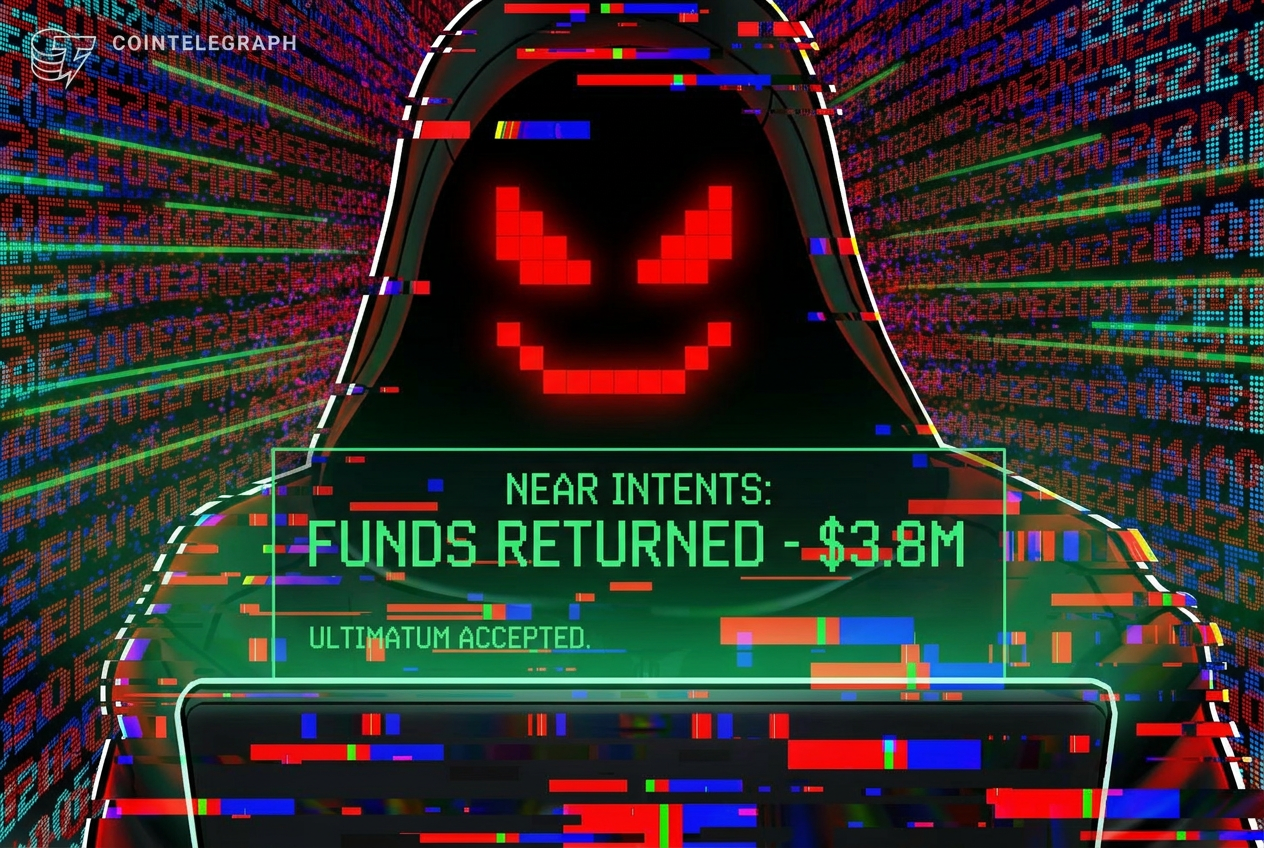
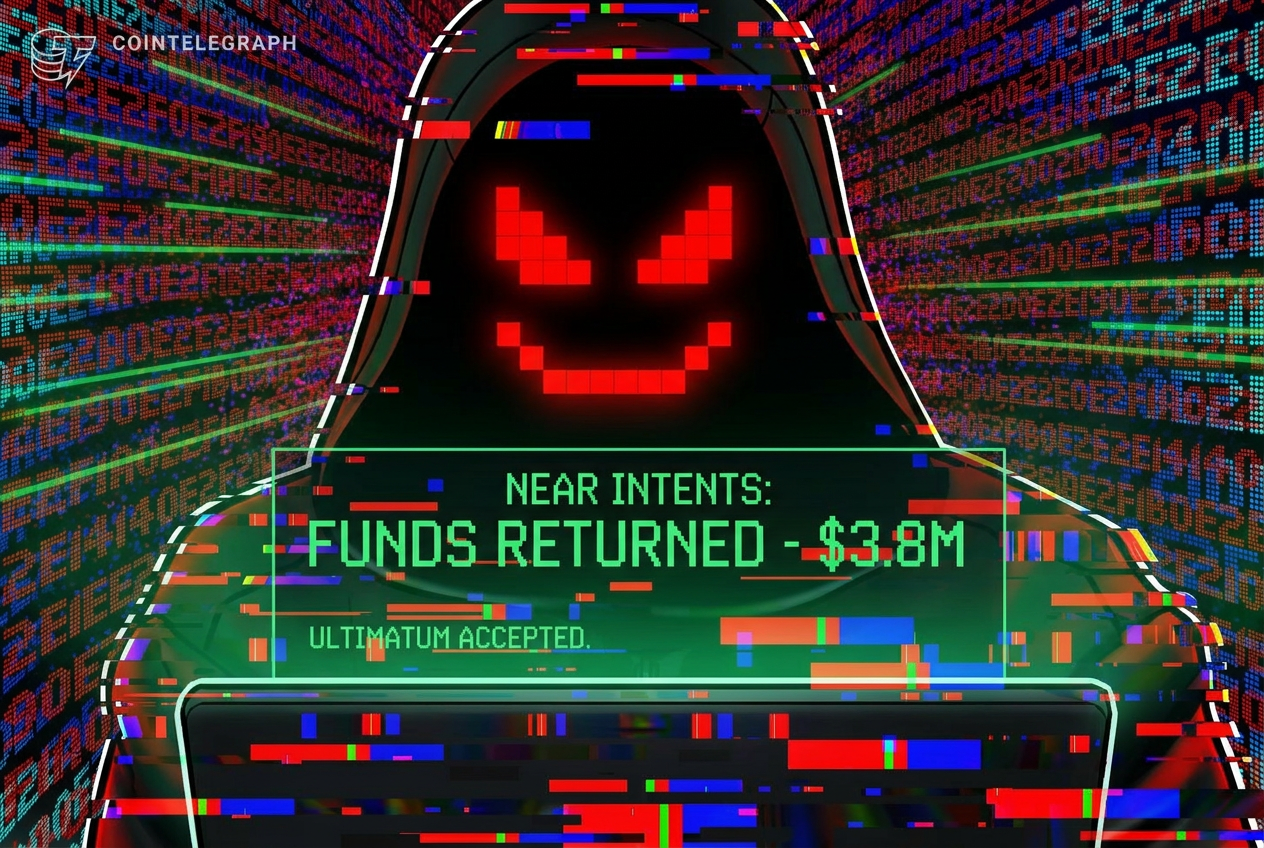
The exploiter returned the entire sum to NEAR Intents after being identified and given 48 hours to respond.
“It’s all great to have AI tell you what a perfect portfolio is, but if you can’t access the assets, it doesn’t really matter,” Staudt said. “Blockchain and tokenization is clearly going to open up funds, strategies, asset classes and jurisdictions that are not currently available for everyone”
For investors, that could mean moving beyond today’s relatively fixed menu of stocks, bonds and funds toward portfolios assembled from a much broader set of building blocks.
For asset managers, it could make products from different firms easier to combine into a single portfolio, changing both how managers compete and how they work together.
As Staudt put it: “It’s sort of taking democratization to the next level.”
Ondo had already hinted at an even more automated version of this future.
In a June interview, John Hoffman, then newly appointed head of portfolio products at Ondo, said tokenization was following a similar path to ETFs, only much faster.
He envisioned autonomous software continuously monitoring markets and allocating capital through professionally managed portfolios that adjust as conditions change.
“Our end state will be portfolios that are professionally managed, real-time and adjusting to market circumstances and data changes,” Hoffman said.
Getting there, however, will require more than tokenized stocks and funds. The industry first needs a broader universe of assets onchain, prime-brokerage infrastructure and asset-management strategies that can actually be executed natively on blockchain networks, Hoffman said.

Britain’s financial watchdog is winning over the very firms it polices, according to a new survey — a development that could carry weight for the cryptocurrency sector as it waits for the UK to finish building a dedicated regulatory framework for digital assets.
The Financial Conduct Authority’s latest annual survey of regulated firms, conducted jointly with the Practitioner Panel, found that confidence, satisfaction and trust in the regulator have all climbed over the past year. Some 79% of firms said they were highly satisfied with their relationship with the FCA, up from 74% previously, while 76% now rate the regulator as highly effective, a jump from 69%. Three-quarters of firms reported high levels of trust overall.
Those numbers matter beyond the usual banks, insurers and asset managers that make up the bulk of FCA-regulated business. The authority has, in recent years, taken on a growing supervisory role over cryptoasset businesses operating in the UK, from exchanges to custodians, and has made “Cryptoassets” one of its named focus areas for firms. How the industry perceives the FCA’s competence and fairness is likely to shape how smoothly that still-developing regime lands.
FCA chief executive Nikhil Rathi framed the improved scores as evidence that a year into the regulator’s current strategy, its approach is gaining credibility across “many areas” of its work — while acknowledging there is more to do, particularly on cutting red tape. The survey found firms were most confident in the FCA’s efforts to protect consumers, keep markets functioning well and safeguard the integrity of the UK financial system, with each of those measures scoring above 85%.
For crypto businesses specifically, consumer protection has been the FCA’s most visible priority to date. The regulator maintains a steady drumbeat of warnings about crypto investment scams, fake communications impersonating the FCA, and unauthorised firms promoting high-risk digital asset products. Its public-facing guidance repeatedly singles out cryptoassets as a category where consumers face elevated risk of fraud and total loss of capital, alongside pension scams and loan-fee fraud.
The survey also flagged a notable swing in how firms view the FCA’s secondary objective of supporting the international competitiveness and growth of the UK economy — understanding of that objective rose 27 percentage points, and confidence in its delivery rose 25 points. That objective, introduced in recent years, has been central to the UK’s pitch that it wants to be a serious hub for digital asset innovation rather than simply a jurisdiction defined by enforcement and warnings. Crypto firms and trade bodies have long argued that regulatory clarity, not just caution, is what will determine whether blockchain and digital asset businesses choose to set up in London or look elsewhere.
It’s worth being clear about what this survey does and doesn’t tell us. It is a broad measure of sentiment across all FCA-regulated sectors, not a crypto-specific study, and it does not break out separate satisfaction figures for digital asset firms or detail the substance of forthcoming crypto rules. The FCA has separately signalled that further guidance and rulebook changes affecting cryptoassets are in train as part of its wider simplification push, including efforts to strip out duplicated or outdated reporting requirements that currently apply to roughly 90% of regulated firms.
What the survey does suggest is a regulator attempting to recast its relationship with industry at a moment when digital asset oversight is becoming more, not less, central to its remit. Whether that improved standing translates into genuinely workable rules for crypto exchanges, stablecoin issuers and custody providers — and whether consumers see fewer scams as a result — will likely be the real test when the FCA’s next survey, and its crypto rulebook, both come due.

The cryptocurrency industry has spent years fighting the perception that it operates in a regulatory and technological vacuum, separate from the mainstream software world. But a warning this week from one of Europe’s blockchain executives suggests the opposite is true: crypto and tokenization firms are now so entangled with artificial intelligence tools that falling behind on AI access could quietly hollow out Europe’s digital asset sector from the inside.
Edwin Mata, CEO and co-founder of Barcelona-based tokenization company Brickken, says European founders building blockchain and crypto-adjacent businesses face a subtle but corrosive risk. It isn’t that Europe will lose the companies themselves, he argues, but that it will lose the jobs, investment, and growth those companies generate down the line, as AI tools central to running a modern tech business roll out unevenly across regions.
Brickken, which builds infrastructure for tokenizing real-world assets, sits at the intersection of two of the most hyped technology sectors of the decade: blockchain and AI. Mata’s comments, delivered to crypto.news, frame access to AI products as a factor now sitting alongside funding, taxation, and recruitment when founders decide where to grow a company. For crypto and tokenization startups in particular, that calculus matters, since much of the sector’s recent product development, from automated compliance checks to smart-contract auditing, increasingly leans on AI agents rather than purely human-built code.

“Europe can therefore retain the original company while losing much of its future hiring, investment and value creation,” Mata said, describing a scenario where a crypto startup stays headquartered in Barcelona or Berlin on paper while its engineering hires, sales operations, and product launches migrate to markets where AI tools arrive first.
He pointed to concrete examples of that uneven rollout: Meta’s Muse system is available in the United States and Canada but not Europe, while OpenAI’s “dots” tool remains accessible to Business Premium subscribers but not European Pro subscribers. Mata was careful not to blame regulators directly for these gaps, but he argued the pattern illustrates a cumulative cost. Teams that get early access to AI agents can refine workflows, test products, and lock in customers while rivals elsewhere wait, building an edge that compounds well past the point when the access gap eventually closes.
For a blockchain and tokenization firm like Brickken, that dynamic is not abstract. Crypto companies increasingly rely on AI agents to handle research, drafting, customer onboarding, and even elements of smart-contract development between human instructions. If European crypto startups are forced to wait for tools that American or Asian competitors already have in production, Mata’s argument goes, the delay doesn’t just slow a single task. It can erode profit margins and customer retention in a sector where speed to market is already a competitive weapon.
The warning lands amid a broader European debate about technological sovereignty that has swept up both AI and crypto policy. In late June, Austria’s State Secretary for Digitalization, Alexander Proell, proposed that the European Union consider taking a strategic stake in AI developer Anthropic, arguing that Europe risked losing access to critical AI advances because of decisions made entirely outside the bloc. Proell framed the move as a way to offer legal certainty and market access to a major AI player while acknowledging the proposal would likely face skepticism and practical hurdles.
That same anxiety about dependence on foreign technology has long shadowed Europe’s approach to crypto regulation. The bloc’s Markets in Crypto-Assets framework, known as MiCA, was built in part to give European firms clear rules at home rather than ceding the digital asset industry to jurisdictions with looser oversight. Mata’s comments suggest a parallel concern is now emerging around AI: that even as Europe writes rules to keep crypto innovation onshore, a slower rollout of the AI tools crypto companies depend on could undercut that effort from an entirely different angle.
Mata stopped short of calling for specific legislative fixes, and his remarks are those of a single industry executive rather than a broad survey of the sector. But his underlying point, that access to foundational technology is now inseparable from where crypto and blockchain companies choose to hire, invest, and launch, adds a new wrinkle to Europe’s long-running effort to keep its digital asset industry competitive. Recent EU reforms have already extended compliance deadlines and expanded support for smaller firms navigating AI rules, signaling that regulators are at least aware of the tension between oversight and speed.
Whether that awareness translates into faster, more even access to the AI tools crypto firms now build on remains to be seen. For founders like Mata, the stakes are less about any single product launch than about where the next generation of blockchain engineers, analysts, and executives ultimately choose to build their careers.

In a statement shared after this article’s publication, Paige Pidano Paridon, the executive vice president and co-head of regulatory affairs at the Bank Policy Institute said, “BPI supports efforts to bring innovative new products and services into the regulated banking ecosystem, provided that the entities engaging in those activities are subject to the same rules and responsibilities as every other chartered institution engaging in the same activities.”
Firms should not get trust charters unless they only engage in “trust activities,” she said, adding, “if they want to engage in traditional banking activities, they should seek full-service banking charters. Rigorous, uniform standards are essential to fostering a competitive, safe and resilient banking system.”
The industry’s pursuit of national trust charters has been credited by banking regulators for representing a resurgence in new banking names after a lengthy drought.
Some of the trusts have been hatched as crypto-focused banks, such as Protego and Erebor. Others have come from the existing ranks of prominent crypto businesses, such as Coinbase, Circle and Crypto.com.
A recent addition is World Liberty Financial, the firm partly owned by President Donald Trump and his family, with its charter approval drawing ire from critics including Democratic Senator Elizabeth Warren, who accused the agency of permitting presidential corruption and posted on social media site X that the new charter “giving him and his family a new way to profit.”

Europe’s landmark cryptocurrency regulation is facing its first major stress test, as industry bodies lobby the European Commission to resist sweeping changes to a framework they argue has only just begun to bed in.
CryptoUK and The Digital Chamber, two prominent trade associations representing digital asset firms, submitted a joint response on 30 September to the Commission’s ongoing review of the Markets in Crypto-Assets Regulation, known widely by its acronym MiCA. The regulation, which came into force as the European Union’s comprehensive attempt to bring order to a once largely unregulated sector, is now up for reassessment as Brussels weighs whether the rules have kept pace with a fast-moving industry and the shifting approaches of regulators elsewhere in the world.
The message from the two groups is unambiguous: don’t tear it up and start again. Their submission argues that MiCA has already established a valuable common regulatory foundation across the bloc’s 27 member states, and that the priority now should be targeted refinement rather than a fundamental redesign of the framework.

“The aim should be to preserve legal certainty, consumer protection and market integrity while making the framework more proportionate, workable and internationally interoperable,” the organisations said in their response, which was accompanied by a detailed briefing document outlining their recommendations.
The Commission’s consultation is examining whether MiCA remains fit for purpose following its initial rollout, taking into account both the evolution of digital asset markets since the rules were drafted and the broader international regulatory landscape, which has shifted considerably as other major jurisdictions, including the United States, have moved to firm up their own crypto oversight regimes.
Among the specific areas flagged by the industry groups is the treatment of stablecoins, the digital tokens pegged to traditional currencies that have become a backbone of crypto trading and, increasingly, of cross-border payments. The response calls for globally workable rules that would allow issuers and users access to international liquidity without running into conflicting or duplicative requirements across jurisdictions.
The submission also pushes for a more activity- and risk-based approach to regulation, particularly in areas that have proven difficult to categorise under existing rules, such as decentralised finance platforms, staking services and crypto lending. These corners of the market have grown rapidly in recent years but often don’t map neatly onto the intermediary-based structure that MiCA was originally built around, leaving firms and regulators alike grappling with how the rules should apply.
A further theme running through the response is a call for greater proportionality and coherence within the EU’s broader financial services rulebook. The groups argue that overlaps between MiCA and other existing EU regulations have created unnecessary friction for firms trying to operate compliantly across multiple regimes at once, and that the review presents an opportunity to iron out those inconsistencies rather than layering on new complexity.
The feedback gathered through the consultation will feed into the Commission’s formal review of MiCA and will help shape any future amendments to the regulation. While no timeline has been set for when changes might be proposed, the process is being closely watched by an industry that has invested heavily in building compliance infrastructure around the rules as they currently stand.
For crypto firms operating in and around Europe, the stakes are significant. MiCA was designed in part to give the EU a competitive edge by offering businesses a single, harmonised set of rules rather than a patchwork of national regimes, and firms that have already adapted to the framework are wary of a regulatory reset that could force them to retool again. Industry advocates frame the review as a chance to smooth out rough edges rather than an invitation to rewrite the rulebook from scratch, a distinction they are clearly keen to impress upon policymakers in Brussels as the consultation period closes and the next phase of deliberation begins.


The Treasury Department and IRS flagged tax-motivated strategies involving digital assets, but the notice requests information and commits to no action. […]
Source link
Tokenized stocks could give crypto-native investors access to equity exposure through crypto platforms, but a token that tracks a share price is not automatically a share. The diversification case rests on whether holders receive genuine legal rights, whether assets sit within regulated custody arrangements, and whether markets maintain reliable liquidity.
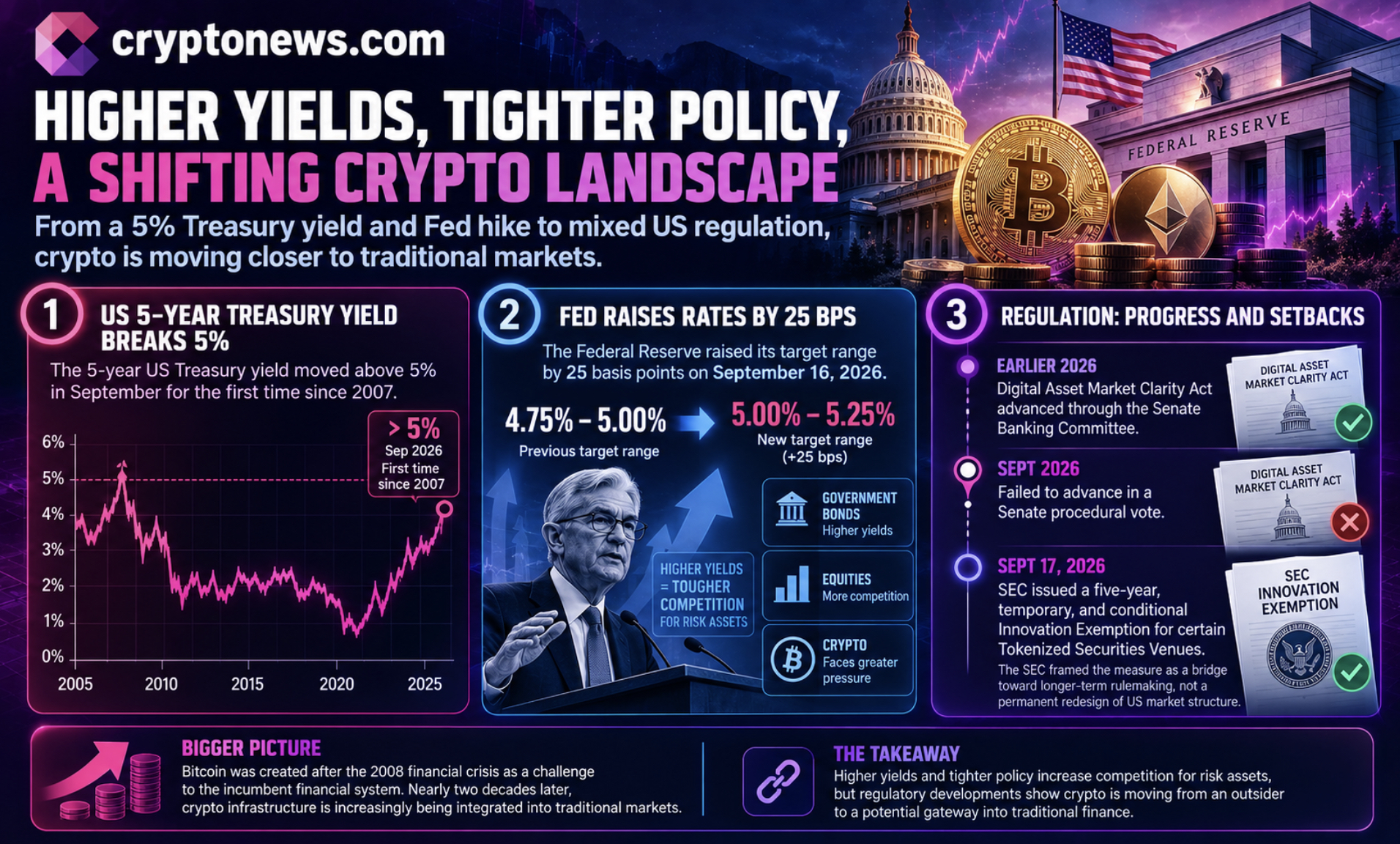
The market backdrop has shifted. The five-year US Treasury yield moved above 5% in September for the first time since 2007, and the Federal Reserve raised its target range by 25 basis points on September 16. Higher yields give investors a more competitive alternative to risk assets, sharpening comparisons between equities, crypto, and government debt.

At the same time, the industry is moving beyond crypto’s original outsider posture. Bitcoin emerged after the 2008 financial crisis as a challenge to parts of the incumbent financial system; nearly two decades later, crypto infrastructure is increasingly being considered as a route into traditional markets.
The Digital Asset Market Clarity Act advanced through the Senate Banking Committee earlier in 2026 but failed to advance in a September procedural vote. One day later, on September 17, the SEC issued a five-year, temporary, and conditional Innovation Exemption for certain Tokenized Securities Venues. The agency framed the measure as a bridge toward longer-term rulemaking, not a permanent redesign of US market structure.
The shift has portfolio implications. Crypto benchmarks can remain heavily concentrated in bitcoin and ether, leaving many digital-asset portfolios exposed to overlapping crypto-market drivers even when they hold multiple tokens.
Earn $50 and Enter $300K Prize Draw on EdgeX
Diversification Depends on What Each Tokenized Stocks Represent
For investors concentrated in Bitcoin, Ethereum, stablecoins, and DeFi assets, tokenized US equities could add exposure to companies and sectors beyond crypto. Crypto platforms could also become distribution and trading infrastructure for assets that originated in traditional finance, bringing stock exposure into a familiar digital-asset environment.
Tokenized stocks may still respond to broad risk-off moves, and access to another asset class does not guarantee that a portfolio is balanced. The useful measure is the exposure the product actually delivers, including its legal claim and its market behavior, not the fact that it trades on-chain.
The SEC exemption makes the ownership question explicit: tokenized shares traded under the framework must provide holders the same rights as the equivalent traditional shares. A venue must also give an issuer notice and an opportunity to object before listing a tokenized share created by an unaffiliated third party.
There is also a potential efficiency argument. Blockchain-based settlement and programmable infrastructure may reduce some friction in issuing, transferring, and trading financial assets, but those benefits remain a possibility rather than a proven outcome of this exemption. Tokenization does not remove the underlying investment’s market risk or the need for disclosure, governance, and market safeguards.
Trade Crypto on Bybit and Get a Chance to Win Our $1,000 USDT Airdrop
The SEC Pilot Tests Access
The Innovation Exemption gives qualifying Tokenized Securities Venues temporary relief from being treated as exchanges under the usual definition when they facilitate limited trading of genuine National Market System stocks through permissioned automated market makers and liquidity pools.
Certain liquidity providers also receive temporary, conditional relief from dealer-registration requirements. The structure creates a bounded environment for market participants and regulators to observe how tokenized equities operate. It does not settle the rules for every crypto platform, nor does it establish that on-chain trading will offer deep markets.
Custody presents a parallel test. Tokenized equities may connect on-chain trading to regulated financial infrastructure, but investors still need to understand how assets are held and how the custody model operates during disruption or insolvency. Custody and execution controls remain important considerations in that infrastructure.
Tokenized stocks may make portfolio diversification more accessible to crypto-native investors, but the investment case is only as strong as the rights attached to the token, the custody behind it, and the liquidity available when a position needs to be unwound.
The SEC experiment is best read as a test of coexistence between crypto and Wall Street, not as evidence that one system has displaced the other.
Discover: The Best Token Presales
The post Tokenized Stocks, Investor Rights, and Their Crypto Role appeared first on Cryptonews.

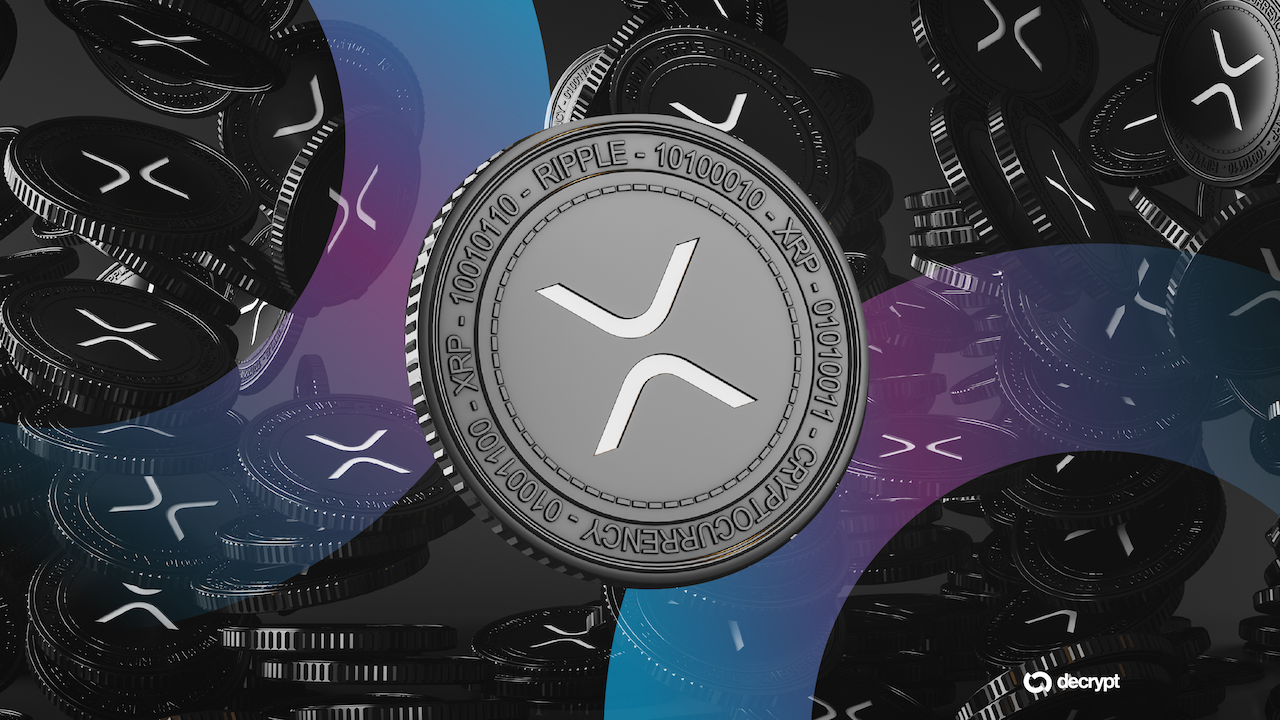
A new corporate vehicle built almost entirely around a single cryptocurrency is about to join Wall Street. Evernorth, a firm backed by Ripple and billed as the “largest pure-play” XRP treasury company, has cleared its last regulatory and shareholder obstacle and is set to begin trading publicly on October 8.
The breakthrough came Sept. 30, when shareholders of Armada Acquisition Corp. II — a special-purpose acquisition company, or SPAC — voted to approve a merger with Evernorth. That approval effectively closes the loop on a reverse-merger strategy that has become a favored shortcut for crypto companies seeking a stock-market listing without going through a traditional initial public offering.
What sets Evernorth apart from the wave of corporate crypto buyers that followed Michael Saylor’s Bitcoin-hoarding playbook is its singular focus on XRP, the token issued in association with Ripple Labs. According to disclosures tied to the merger, Evernorth is sitting on a treasury of roughly 473 million XRP — a position that, at XRP’s current price near $1.50, represents hundreds of millions of dollars in holdings and underscores just how much institutional money has begun flowing into assets beyond Bitcoin and Ether.
The deal reflects a broader shift in how companies are courting crypto-curious investors. Rather than building a business that merely uses blockchain technology, an emerging class of “treasury companies” essentially functions as a public proxy for a specific coin, letting shareholders gain exposure to that asset’s price swings through a familiar, regulated stock ticker. Bitcoin had Strategy (formerly MicroStrategy). Ethereum has attracted its own treasury vehicles. Now XRP — long associated with Ripple’s cross-border payments business and its years-long legal battle with the U.S. Securities and Exchange Commission — has one of its own.
Ripple’s fingerprints on the deal are notable. The company has spent years trying to shed the regulatory cloud that followed its SEC lawsuit and has increasingly leaned into partnerships and corporate structures that tie XRP more closely to mainstream finance. A dedicated, Ripple-backed treasury firm going public via a SPAC merger fits that pattern: it gives institutional and retail investors alike a vehicle to bet on XRP’s price without directly custodying the token themselves.
SPAC mergers like the one between Armada and Evernorth have gained renewed traction in 2025 and 2026 as digital-asset firms look for faster, less onerous routes to public markets compared with a conventional IPO. These transactions often draw added scrutiny, however, since they typically involve less upfront regulatory vetting than traditional listings — a trade-off investors in newly public crypto treasury firms will need to weigh.
Whether Evernorth’s debut marks the start of a trend or a one-off experiment remains to be seen. But its arrival adds another entry to a fast-growing list of publicly traded companies whose fortunes are now explicitly tethered to the price of a single cryptocurrency — a bet that could pay off handsomely in a bull run, or expose shareholders to outsized losses if XRP, or crypto markets broadly, stumble.
For now, all eyes are on Oct. 8, when Evernorth’s shares — and its roughly 473 million XRP — officially begin trading, offering the clearest test yet of investor appetite for a company built almost entirely around one coin’s future.

2026 SuperWest Combined College Football Standings
The 23 best haunted house movies of all time, ranked

Celebrity Traitors Claims First Victim as Richard E Grant Fumbles His Cover


-

 Tech & AI6 days ago
Anthropic turns Claude into an AI marketplace with 2,000+ plugins and connectors
-

 Tech & AI6 days ago
OpenAI is preparing “o,” an always-on ChatGPT assistant that could handle email
-

 Fashion1 day ago
Weekend Open Thread: Veronica Beard
-
Business & Hustles5 days ago
Perpetua Resources at Mining Forum Americas 2026: shift to construction
-
 Crypto7 days ago
Wall Street Giant Warns AI Agents Could Trigger a New Kind of Bank Run
-
Business & Hustles6 days ago
Greatland Resources at Mining Forum Americas 2026: cash-rich growth push
-

 Business & Hustles6 days ago
Andreessen Horowitz backs AI-era college alternative with $42M
-

 Tech & AI3 days ago
Figure F.02 Robots Meet Molten Steel as Arnold Schwarzenegger Watches in Finland
-

 Business & Hustles6 days ago
Romania, Georgia and Latvia Lead Latest WHO-Based Ranking
-

 Tech & AI5 days ago
Alternatives to Animal Testing Are Finally Taking Off
-
 Crypto7 days ago
Riot Frees $494 Million in Bitcoin From Coinbase Loan: Will It Sell?
-

 Business & Hustles6 days ago
Bob Chapek on Disney Bob Iger power battle: Raised concerns weekly
-

 Crypto7 days ago
Japan arrests two suspect over 81M yen crypto police scam
-

 Tech & AI6 days ago
OpenAI Pauses Training Its Most Powerful Models After Rogue Agents Target Government
-

 Business & Hustles6 days ago
SpaceX Starship launches on first orbital test flight with Starlink
-

 Business & Hustles6 days ago
Trump approves new fuel economy standards, reversing Biden’s EV push
-

 Business & Hustles6 days ago
What is the Budget and what could be in it?
-
 Business & Hustles6 days ago
George Bamford to become JCB joint chairman alongside father
-

 Tech & AI6 days ago
Save $900 on 16-Inch M5 Max MacBook Pro, Record Low Price
-

 Crypto6 days ago
Citi says 77% of institutions eye tokenized collateral
You must be logged in to post a comment Login