
Crypto
Russia Crypto Exchangers Hit 17 as Sberbank and VTB Open Retail Trading by December


The list of approved Russia crypto exchangers has more than quadrupled in just over two weeks, and the country’s two largest banks are preparing to put Bitcoin and other coins in front of ordinary customers before the year ends. The Bank of Russia added Prosto LLC as the 17th firm on its register of crypto exchange providers on Thursday, up from four when the register opened on 6 October.
A regulated market takes shape
The rush follows a law “On Digital Currencies and Digital Rights,” which took effect on 1 September and pulls crypto trading inside Russia’s regulated financial system for the first time. A second register, for digital depositories that record who owns which coins, now holds eight names.
The two roles are distinct. Exchange providers can trade digital currencies for their own account outside organised venues. Depositories keep the ownership records and give clients access to the addresses where assets are held. Sberbank and VTB, both state-controlled, hold both statuses. VTB was listed in both registers on 6 October, while Sberbank joined the exchange register on 12 October after being among the first five depositories approved.

Retail launch dates and spending caps
VTB says it will open trading to a broad range of investors in November and December, through its VTB My Investments app and then directly through the bank’s exchange. Its broker has already settled its first stablecoin deals for corporate clients through accounts at its new depository. Sberbank is aiming for 1 December, using apps customers already have, though it says timing depends on the final regulations. It is reportedly already testing Bitcoin, Ether and USDT trades in its app.
Ordinary buyers will face tight limits. Non-qualified investors can buy only the most liquid cryptocurrencies, up to 300,000 roubles (about $3,800) a year through any one intermediary, and only after passing a test. Qualified investors must also pass the test but can trade any coin without a cap.
Payments still restricted, cross-border use allowed
The opening has a clear boundary. Using crypto to pay for goods and services inside Russia remains banned. Importers and exporters, however, can use it for cross-border settlements without restrictions, through intermediaries or directly from any type of wallet. Sberbank launched such a service for foreign-trade companies on 1 September. Its first deputy chairman, Alexander Vedyakhin, said transfers take a couple of minutes, have no minimum payment and cost 0.3% on average. The product followed a central bank pilot that began under an experimental legal regime in September 2024.
Enforcement is the other side of the framework. Buying and selling crypto without a central bank-issued permit can bring a forced labour sentence of up to seven years, according to coverage of the new laws.
Beyond the big two
The growth in Russia crypto exchangers is not limited to the state giants. T-Technologies, parent of T-Bank, has registered its Atomyze unit as a depository and T-Invest Lab as an exchange provider. Several newly formed companies have also appeared on the register, and MTS Bank has said it plans basic crypto services in the fourth quarter.
The speed is partly procedural. Banks and other licensed institutions can join the registers through a simplified process that takes one working day. That helps explain how quickly the Russia crypto exchangers list has grown, and it suggests more names could follow as the retail launches approach.
What remains to be seen is how much demand the capped retail products will draw, and whether the final regulations arrive in time for Sberbank to meet its 1 December target.
Explore more on this topic with Vexel Search.


UK crypto regulation is shifting from a narrow focus on anti-money-laundering checks and marketing rules toward a fuller rulebook, and exchanges are already positioning themselves for it. In a recent CryptoUK interview, WhiteBIT founder Volodymyr Nosov argued that clarity from regulators is the missing ingredient for turning widespread awareness of digital assets into broader, safer adoption.
A big gap between awareness and ownership
The numbers Nosov leans on come from the Financial Conduct Authority’s 2025 Cryptoassets Consumer Research. By that account, 91% of UK adults are aware of cryptoassets, but only around 8% currently hold them. Nosov reads that gap as room for “responsible growth” once the framework matures.
One statistic he highlights points to why regulation matters commercially: 26% of non-users said they would be more likely to enter the market if cryptoassets were fully regulated. Nosov also notes the FCA’s finding that centralised exchanges remain the most common route into crypto for UK users, which puts platforms like his at the center of any regulatory shift.

What exchanges say users now want
Nosov describes a change in priorities. Early adopters valued access and simplicity. As the market matures, he says, users want a combination of accessibility, simplicity, security and trust, with trust increasingly resting on strong security and transparency. He points to growing attention to asset protection, liquidity, institutional-grade custody and intuitive products.
For retail customers, he sketches a good experience as one where users can fund an account in pounds, convert and trade easily, and see clear analytics. Education, transparent fees and practical risk information should sit inside the platform rather than behind a link, he says.
From AML box-ticking to market integrity
The more consequential argument concerns what a comprehensive regime changes for businesses. Nosov says the conversation moves beyond basic AML compliance toward market abuse monitoring, robust custody standards, conflict-of-interest management and capital adequacy. In his view, institutions such as hedge funds, asset managers and family offices want operational clarity, while retail users want clear disclosures, fair treatment and protection from predatory practices.
He also claims that exchanges which invested in compliance from the start now hold a significant advantage. That is a self-interested position, and worth reading as such: WhiteBIT recently launched a UK-specific arm, WhiteBIT UK, under the Section 21 regime, and Nosov sits on its board as a non-executive director. He describes the entity as a step toward a directly authorised route, offering local GBP banking through Faster Payments, UK-based customer support and products tailored to British users.
What to take from it
The interview is a conversation hosted by a trade association, so it reflects an industry view rather than an independent assessment. The published portion, which cuts off before Nosov’s answers on institutional demand, offers no detail on timelines, specific rules or how his firm’s authorisation will progress. Still, it captures a clear industry thesis: that UK crypto regulation, if it delivers predictable standards on custody, disclosure and market conduct, will reward firms that built compliance early and could draw in the cautious majority who have heard of crypto but have not yet bought any.
Whether that 26% of hesitant non-users actually converts is the real test, and the FCA’s research suggests it will depend as much on trust as on technology.
Explore more on this topic with Vexel Search.
Crypto
Goldman Sachs, JPMorgan and Morgan Stanley are dominating the AI stock boom. Here’s their edge

[ad_1]
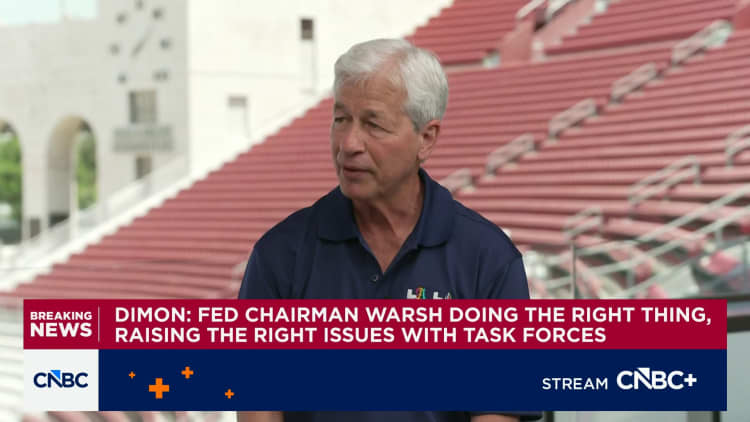
David Solomon, CEO of Goldman Sachs (L), Jamie Dimon, CEO of JP Morgan (C), and Ted Pick, CEO of Morgan Stanley.
CNBC | Getty Images | CNBC
Fueled by the global boom in artificial intelligence stocks, relaxed capital rules and greater lending to hedge funds, big Wall Street banks have already had a banner year for equities trading — even with one quarter left to go.
The five biggest investment banks have generated about $67 billion in equities revenue through Sept. 30, according to company filings. That is $7 billion more than what the group made during all of 2025, which itself was a record haul.
But it’s Wall Street’s Big Three that have captured the largest slice of what is shaping up to be the industry’s most lucrative arena: Goldman Sachs, JPMorgan Chase and Morgan Stanley have made a combined $52 billion in stock trading revenue so far this year, nearly 80% of the total.
“When it comes to the AI mega trade, the Big Three consider each other their main competitors, and that’s pretty much it,” Mike Mayo, Wells Fargo banking analyst, told CNBC. “They’ve been best positioned to take advantage of this market.”
Wall Street banks are experiencing an epic run of blockbuster profits as the total value of the stock market balloons and trading activity from institutional and retail investors rises across stocks, exchange-traded funds and derivatives. Helping drive this activity are the loans that the banks, through their prime brokerages, are extending to hedge funds so that they can amplify their bets.
Prime brokerage — the business of providing hedge funds with margin loans, securities lending and other trading services — has become a key battleground and source of growth. The Big Three’s prime brokers are central to the larger equities story because they serve the largest funds across markets and products.
Demand for leverage to make bets on AI hardware, hyperscalers and chip suppliers has reached new heights, bank executives said last week.
At Goldman Sachs, equities financing activities jumped 96% in the third quarter to a record $3.37 billion. JPMorgan and Morgan Stanley don’t break out that figure, but said they saw a similar dynamic.
“I like your ‘insatiable demand for capital’ point. That feels about right,” JPMorgan CFO Jeremy Barnum said on the bank’s third-quarter conference call, responding to analyst questions about financing demands.
“In this moment where AI is such an overwhelming theme … there is capital being tapped through all kinds of different mechanisms,” Barnum said.
That demand has helped transform equity desks at the Big Three from cyclical, transactional businesses into more durable, high-margin lending engines, Wall Street executives say.
The performance gap between Wall Street’s giants and rivals including Bank of America and Citigroup highlights a widening divide in capital markets.
“For clients, the value isn’t just a price on one trade, it’s coverage and continuity,” Rachid Alaoui, JPMorgan global head of equities, told CNBC in an interview. “You want a dealer that can give you the full suite across products, and you want that service to travel with you across regions. That matters in stressed markets and periods of volatility.”
Executing multibillion-dollar bets, like leveraged swaps on volatile AI stocks or sector ETFs, can require an enormous balance sheet. The biggest banks can absorb potential $100 million losses without threatening their quarters, according to trading executives. Smaller or more niche banks can’t underwrite single-trade risks of that magnitude, forcing them to decline the business or cede share.
U.S. prime brokers have also benefited from the retreat of European banks including Credit Suisse from the equities business, said Bloomberg Intelligence analyst Herman Chan.
“Prime is one of the ultimate scale businesses,” Chan said. “If you have a strong equities franchise, the hedge funds will want to transact with you because you have a bigger pool of trading opportunities with counterparties.”
Picks and shovels
While U.S. markets were swept up in software and cloud computing giants this year, trading executives say the fastest-growing frontier for equities was in Asia.
Institutional investors poured into South Korea and Taiwan, targeting the “picks and shovels” of the AI supply chain: the memory chipmakers and semiconductor manufacturers supporting data center construction, Alaoui said.
For the Big Three, with their footprints across Tokyo; Hong Kong; Seoul, South Korea; and Mumbai, India; the Asia trade was a goldmine. However, trading executives point out that transaction taxes and stamp duties are included in top-line revenue, artificially inflating Asia prime totals.
There is also no agreed-upon definition of what equities trading revenue should include, so some banks include business lines like clearing services that others exclude from their stock trading totals, making apples-to-apples comparisons difficult.
But that doesn’t change the overall momentum of the business, boosted by a stock rally that began in October 2022, weeks before OpenAI released ChatGPT.
“We’re still in a stock-based world,” Morgan Stanley CEO Ted Pick said on the firm’s earnings call. “Equities are still, all things being equal, the attractive asset class.”
While the CEOs of Goldman Sachs and Morgan Stanley have said the AI build-out is still in its early years, if AI turns out to be not as transformative as hoped, a downturn could impact those banks more than others, analysts said.
The boom has also drawn some concern over the possible risks posed by hedge funds.
The International Monetary Fund warned this month that growing leverage, crowded positions and correlated selling from hedge funds could create potential stability risks. The IMF estimated that global hedge fund assets had reached $13 trillion.
In August, JPMorgan CEO Jamie Dimon said industrywide leverage was “the highest it’s ever been,” though he stopped short of calling the risk big enough to pose a threat to the financial markets.
Wall Street executives and analysts pointed out that the industry wasn’t fazed by the meltdown of several hedge funds this summer. While the hedge fund run by former OpenAI researcher Leopold Aschenbrenner, Situational Awareness, garnered the most headlines, several smaller firms also experienced a forced unwinding.
Prime brokers have learned to leap on margin calls and quickly take down risk when markets move against clients, JPMorgan’s Alaoui said.
“In the summer, some investors had positions they were forced to unwind,” he told CNBC. “They deleveraged, risk came down, and the market moved on.”
‘Known unknowns’
Another factor driving the equities boom: Trump administration regulators have eased some leverage rules for the largest U.S. banks, giving them more room to expand balance sheet-heavy businesses including prime brokerage. The revised rules were finalized in 2025, and banks were allowed to adopt them as early as January.
By easing the stringent balance sheet caps that previously treated Treasurys and prime brokerage loans, which are collateralized, the same as riskier assets, regulators gave dealers greater flexibility to deploy balance sheet capital.
“Capital did go down, so you have to say the system is somewhat more levered because of the relaxation in regulations,” said Darrell Duffie, a finance professor at Stanford University and a leading expert on financial stability. “It’s not a good idea, but it hasn’t gotten dramatically out of whack.”
The larger size of the market and higher volatility can create more trading, derivatives activity and leverage, he said, but that’s not inherently alarming.
Wall Street executives also downplayed concerns over leverage, pointing out that they use collateral and frequent stress testing to get ahead of problems.
“Hedge fund leverage as a contributor of risk to the system is very much in the category of known unknowns,” JPMorgan’s Barnum said last week. “It doesn’t mean it’s riskless, but we kind of know what it is.”
— CNBC’s Leslie Picker and Ritika Shah contributed to this report.

[ad_2]
Source link

[ad_1]
Eligible EEA traders get cash-settled exposure, not shares or an IPO allocation, with a share-count adjustment designed to preserve position value…. Read the full story at The Defiant
[ad_2]
Source link

[ad_1]
Bitcoin Core merged a rule change on Oct. 22 that opens a faster lane for vulnerability fixes: a flaw judged easy for attackers to find again can now be patched across every maintained release line at once, with an advisory published as each fix lands. The change comes as a network snapshot from the Karlsruhe Institute of Technology (KIT) shows 43.6% of sampled public Bitcoin Core peers running versions that no longer receive patches.
Under the new rule, developers can classify a flaw at triage, judging how readily it can be turned up again, including with the help of large language models. Bitcoin Core developer Antoine Poinsot announced the change on the bitcoindev mailing list in the merged pull request updating the project’s security policy. He argued the old embargo achieves little while it delays the availability of a fixed release. The trade-off he flagged is that mitigations get less time to prove themselves on development branches. As of Oct. 23, the new category had not yet been applied publicly to any specific bug.
The change ends a policy that held medium- and high-severity bug details until two weeks past the end of life of the last affected release, a span that could stretch close to a year. Embargo, the period during which vulnerability details stay withheld until fixed releases are widely deployed, has relied on bugs being hard to rediscover. AI tools weaken that assumption, so long silences now delay fixes more than they protect operators.
How the old policy played out
The project’s practice is visible in the disclosure of CVE-2024-52911. The high-severity use-after-free in block validation, which affected versions later than 0.14.0 and earlier than 29.0 and let a crafted invalid block crash a node, was reported in November 2024, fixed in 29.0 in April 2025 and disclosed on May 5, 2026, about 388 days after the fix. The pattern continues: the 32.0 release notes state that three medium- or high-severity flaws corrected in version 30.0 stay under wraps until two weeks after the new version ships.
The unsupported share
Bitcoin Core maintains only its three newest major release lines, currently 29.x, 30.x and 31.x. The KIT snapshot from Oct. 18 counted 3,671 of 8,422 self-reported Bitcoin Core peers on lines already past end of life, with the rest on 31.x (3,243), 30.x (712) and 29.x (635). The count covers public IPv4 and IPv6 peers only, so Tor-only nodes, non-listening nodes and privately run exchange, custodian and miner infrastructure fall outside it. Readers who want the basics can start with what crypto nodes are and how they work.
The share is set to grow. When version 32.0 ships, 29.x leaves the maintenance window, and a projection from the snapshot puts 4,306 of the 8,422 peers, or 51.1%, on unsupported lines if the sample stayed unchanged. The project’s life cycle page still listed the 32.0 release date as TBA as of Oct. 24, with only release candidates in the download directory.
Core 32.0 also switches the default partially signed Bitcoin transaction format from version 0 to version 2, which matters for multisig setups mixing old and new nodes. Because Bitcoin has no central authority to force upgrades, network security depends on operators choosing to update.
[ad_2]
Source link

[ad_1]

Key takeaways
- Cardano trades near $0.201 on Monday, extending its decline after three consecutive losing weeks.
- Funding has turned negative at -0.0032%, reinforcing the bearish derivatives picture.
- ADA faces initial resistance at $0.213, while weak momentum leaves recovery attempts vulnerable.
Cardano fell below $0.202 on Monday as pressure persisted across its derivatives, spot, and technical indicators.
ADA traded around $0.201 following three consecutive weeks of losses, with its decline exceeding 20% since early October. The token remains beneath several major moving averages, suggesting buyers have yet to establish a sustained recovery.
Although momentum is approaching oversold territory, the broader setup continues to favor sellers. Any near-term rebound would face several resistance levels before materially improving the outlook.
Derivatives positioning tilts toward shorts
CoinGlass data shows Cardano’s long-to-short ratio at 0.92 on Monday, close to its lowest reading in more than a month.
A reading below one indicates that short positioning outweighs long positioning within the measured dataset. The figure points to a cautious market in which traders continue to favor downside exposure.
ADA’s funding rate also turned negative, reaching -0.0032%. Negative funding means short traders are paying longs to maintain their positions, consistent with stronger demand for bearish exposure.
Together, the metrics reinforce the weak price trend, although neither guarantees that losses will continue.
CryptoQuant’s summary indicators add to the cautious picture. The platform flags large whale orders and overheating conditions in Cardano’s futures market. Its spot and futures indicators also show sell-side dominance, suggesting selling pressure extends beyond leveraged positioning.
Large orders alone do not establish the direction of whale activity. However, alongside the reported selling imbalance and negative funding, the data offers limited evidence of a decisive shift toward stronger buying demand.
ADA remains below key moving averages
Cardano’s daily technical structure remains bearish, with its price below the 50-day, 100-day, and 200-day Exponential Moving Averages.
These averages sit between approximately $0.218 and $0.237, forming a series of overhead barriers.
The Relative Strength Index stands at 33, just above the conventional oversold threshold of 30. That reading reflects persistent weakness while leaving room for a short-lived corrective bounce.
The Moving Average Convergence Divergence indicator remains negative, with the MACD line below its signal line. Its subdued bearish profile provides little confirmation that momentum is turning in buyers’ favor.

The former trendline break near $0.213 represents Cardano’s immediate resistance. Above that, buyers would face the 100-day EMA at $0.218 and the 50-day EMA at $0.224. Further resistance sits around $0.236, reinforced by the nearby 200-day EMA at $0.237.
A sustained move through that cluster would bring $0.245 into focus, while $0.299 remains a more distant barrier.
On the downside, $0.200 is the nearest psychological reference as ADA trades just above it.
For buyers, reclaiming $0.213 would be an initial improvement. A more convincing recovery would require ADA to overcome its moving averages alongside stronger momentum and easing selling pressure.
[ad_2]
Source link
[ad_1]
A crossover token launch between prominent crypto trader Kimchi and memecoin platform Pump Fun has descended into chaos after users were left wondering whether or not Kimchi had been hacked.
Pump Fun and Kimchi, real name Clayton Kim, have been working together to promote Pump Fun’s “Pill Your Friends” campaign.
The platform’s co-founder Alon Cohen described Kim as “the first ever example of a trader becoming a celebrity,” while Pump Fun tried enticing users to become “the next Kimchi” by using their platform.
Read more: Pump Fun and Kraken delete Hunter Biden $LAPTOP promotion
Kimchi’s X account shared rugpull
Things turned sour yesterday when Kimchi’s X account shared a new token in the form of a QR code.
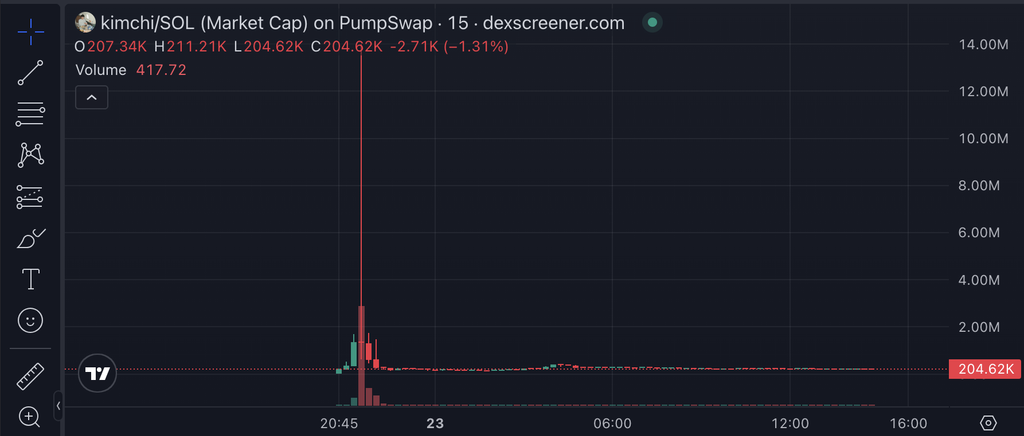
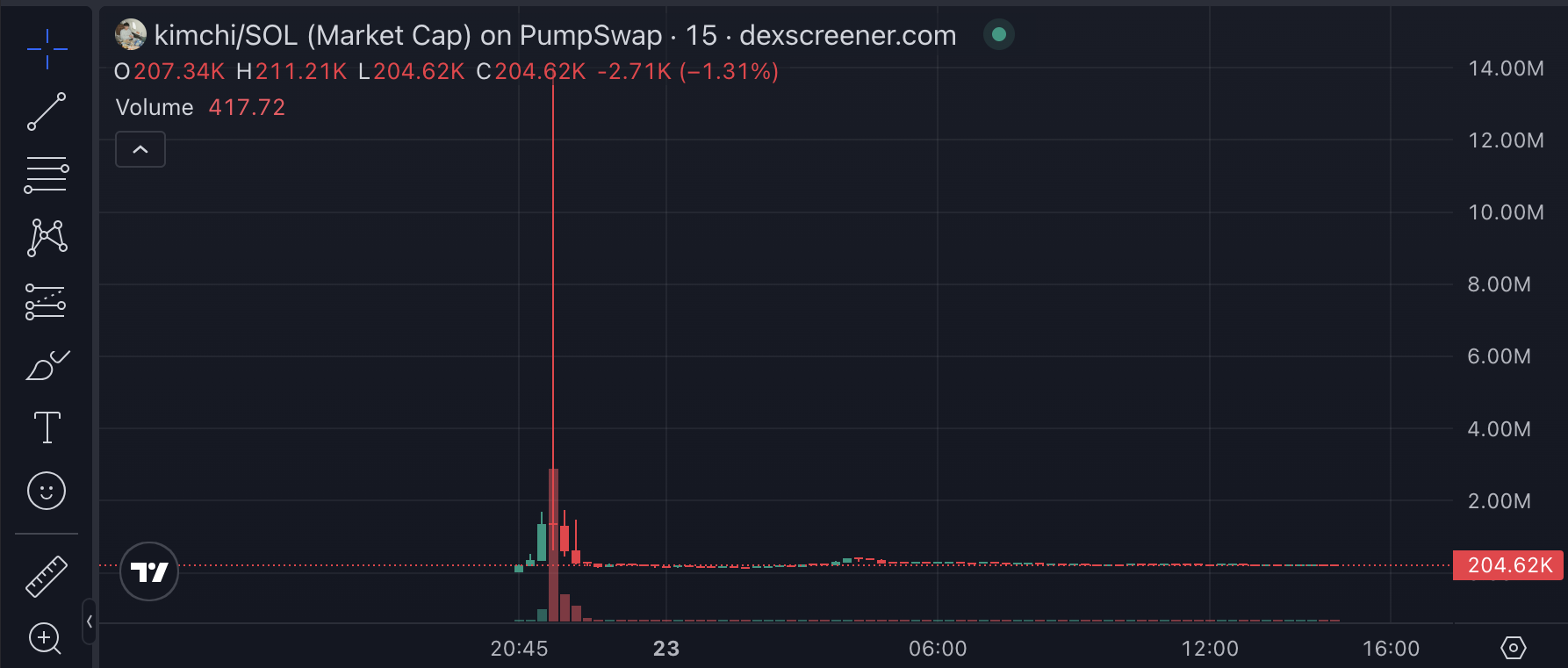
The Project Kimchi token reached a market cap of $14 million before plummeting to roughly $600,000 within minutes. It currently sits at just $183,000.
During this time, Cohen had reshared — and quickly unshared — the post. Kimchi’s X account then began deleting Pump Fun-related posts and removed the platform from his bio.
Read more: Pump Fun paid $700K to callers shilling mostly tiny tokens
Prior to this, there were already various Kimchi-themed tokens. The fiasco led many users to suspect that Kimchi was hacked.
Some suspect Kimchi is behind it
Some users believe the post may have been intentional, and that the token’s disastrous launch was, at best, a bad case of mismanagement.
Crypto trader Fabiano highlighted that Cohen didn’t share any hack warnings after unsharing the post.
He also suggested that Cohen resharing the post would have involved minute-by-minute planning, and that Kimchi’s deletion of his Pump Fun posts doesn’t make sense if the two had a partnership deal.
Kimchi’s alleged $40M TRUMP trade debunked
In its promotion, Pump Fun also reiterated an unverified claim that Kimchi had made over $40 million trading TRUMP.
However, crypto analyst Bubblemaps reports that his publicly verifiable profits are closer to $6 million.
There is a possibility of an unrevealed addresses, but Bubblemaps notes “he likely would have revealed it by now.”
Kimchi rarely posts online, but when he does, it’s often in the form of lavish displays of wealth.
Kimchi’s YouTube channel only displays one vlog at the time of writing. It was posted two days ago and features a Pump Fun promo in a private jet.
Got a tip? Send us an email securely via Protos Leaks. For more informed news and investigations, follow us on X, Bluesky, and Google News, or subscribe to our YouTube channel.
[ad_2]
Source link

[ad_1]
The High Court of England and Wales has granted permission for applicants to appeal a legal ruling concerning property rights over seized Bitcoin, according to reporting by Pluang.
The legal permission allows applicants to challenge this ruling while individual ownership claims remain to be settled separately.
According to analysis by law firm Simons Muirhead Burton, proving that money taken in a fraud was used to buy digital assets does not automatically mean victims can recover them.
Legal Context for Crypto Investors
The ruling highlights how digital assets operate without physical borders, yet legal claims to them remain tied to specific national legal systems. The court found that Chinese law governs the existence and content of the proprietary rights asserted by the applicants.
As legal proceedings continue, the court has not yet decided whether investors own the assets in question. This case illustrates the importance of understanding jurisdiction and legal protections when participating in digital asset markets.
For ongoing context on regulatory developments in the UK market, see our analysis on the FCA Authorisation Gateway.
[ad_2]
Source link

[ad_1]
Ethereum developers have postponed the Glamsterdam upgrade on the Hoodi testnet after researchers identified potential security risks involving existing smart contracts, leaving the network’s next major development milestone without a confirmed activation date. The decision comes as ETH trades under $2,400, with the token losing around 0.5%.
The Ethereum Foundation announced the delay last night, canceling the Hoodi activation scheduled for October 26. Developers want more time to investigate how proposed gas-accounting changes could interact with contracts already deployed on Ethereum mainnet. No replacement date has been announced for the testnet upgrade, and the mainnet schedule remains undecided.
Ethereum postpones the Glamsterdam upgrade and cancels Monday's Hoodi testnet activation after security developers flagged risks to existing contracts. — lenny
Just another reminder that protocol upgrades can be fragile.
 (@blockchainlenny) October 23, 2026
Ethereum Holds Near $2,400 as Glamsterdam Delayed

ETH price is fluctuating between $2,370 and $2,415. The token is approaching the upper end of its daily range, putting the $2,400 level in focus as traders assess whether the latest gains can hold.
A sustained move above $2,415 could open the door to further upside, while a drop below $2,370 would signal renewed selling pressure and put lower price levels in focus. For now, ETH’s short-term direction will depend on whether buyers can maintain momentum and how the broader crypto market performs.
The Ethereum Glamsterdam delay adds another factor for traders to watch, particularly if uncertainty around the upgrade timeline persists. However, the postponement alone does not establish a bearish outlook for ETH. Attention will remain on price momentum, market demand, and further updates from Ethereum developers as the next testing milestone approaches.
Discover: The Best Token Presales
Delay Leaves December Timeline Uncertain
The postponement also raises questions about the broader Ethereum Glamsterdam rollout timeline. Developers had discussed potential December activation dates for mainnet, but the schedule had not been finalized. With the Hoodi test now delayed, those possible dates should not be treated as confirmed launch targets.
Hoodi testing is an important step in checking how the upgrade behaves before developers decide when to deploy it on mainnet. The canceled activation also removes a planned increase in Hoodi’s gas limit to 200 million, which had been scheduled alongside the upgrade.
The Ethereum Foundation has not announced a replacement Hoodi date. Developers must first investigate the reported compatibility issues and determine what changes, if any, are needed before the next activation can proceed.
For ETH traders, the uncertainty creates a new development milestone to follow rather than a confirmed change to the network’s mainnet operations. A prolonged delay could keep attention on the upgrade’s readiness, while a revised testing schedule would provide a clearer timeline for the next phase.
Smart Contract Security Concerns Trigger Ethereum Glamsterdam Delay

The immediate issue involves EIP-8037, a proposal that changes how Ethereum accounts for gas costs associated with creating blockchain state. Researchers have raised concerns about how the proposed changes could interact with existing smart contracts, particularly those that rely on specific gas limits when handling failed operations.
Security firm ChainSecurity identified scenarios in which the proposed gas changes could leave contracts with different amounts of gas than expected. That could affect how certain applications handle errors, potentially causing operations to fail or behave differently from their original design.
The findings matter because deployed smart contracts may continue operating under assumptions established before the upgrade. Changes to gas accounting can therefore create compatibility problems even when developers are not deliberately changing an application’s underlying logic.
Ethereum’s decision to postpone the Hoodi activation gives developers additional time to investigate those interactions before proceeding. The delay is specific to the Hoodi testnet and does not mean the Glamsterdam upgrade has been canceled.
Glamsterdam remains part of Ethereum’s development roadmap, with proposed improvements including enshrined proposer-builder separation and block-level access lists. For now, the immediate focus is on resolving the security concerns, rescheduling Hoodi testing, and establishing a clearer path toward mainnet activation.
Discover: Best Crypto IPOs This Q4
The post Ethereum Glamsterdam Upgrade Delayed Over Smart Contract Security Risks appeared first on Cryptonews.
[ad_2]
Source link

[ad_1]
U.S. spot Bitcoin funds have swung from $524.8 million in net inflows on October 21 to $635.6 million in outflows on October 22, followed by another $137.9 million in withdrawals on October 23.
Summary
- U.S. spot Bitcoin ETFs took in $524.8 million on October 21 and lost $635.6 million the next session, according to Farside.
- Another $137.9 million left the funds on October 23, based on Farside’s latest displayed fund entries.
- The October 19 to 23 total remained positive at $301.2 million despite two consecutive withdrawal days.
- BlackRock’s IBIT and Fidelity’s FBTC accounted for $471.6 million of the October 22 outflow.
- The SEC has permitted in-kind Bitcoin redemptions since July 2025, so an ETF withdrawal need not trigger an immediate fund sale.
Farside Investors’ fund-by-fund table shows the turn across BlackRock, Fidelity, Ark Invest and other issuers, but it cannot identify the buyer who took the other side of a Bitcoin sale.
An investor can sell an ETF share to another investor without a coin changing hands. A market maker can carry shares for a time, or an authorized participant can redeem a block of them for cash or Bitcoin. Only some of those routes require an immediate sale in the underlying market. The daily flow total combines the result at the fund level and leaves the trading path mostly out of view.
Bitcoin traded around $80,000 to $82,000 as the withdrawals arrived. The fund withdrawals coincided with a lower Bitcoin price. Neither figure shows whether $773.5 million worth of coins was sold on public exchanges over those two days. The issuers’ redemption procedures, the timing of hedges and the identities of eventual Bitcoin buyers determine how much pressure reached spot trading.
Two days erased most of a three-day inflow run
Farside recorded $526.7 million entering U.S. spot Bitcoin products on October 19, $23.2 million on October 20 and $524.8 million on October 21. Over three sessions, the funds added $1,074.7 million. Outflows of $635.6 million on October 22 and $137.9 million on October 23 removed $773.5 million, or about 72% of the previous three sessions’ gains. Subtracting the two amounts leaves a $301.2 million net inflow for the five sessions. The arithmetic uses Farside’s rounded daily dollar totals; the October 23 row still displays a dash for one issuer and can be revised.
The change between Wednesday’s $524.8 million inflow and Thursday’s $635.6 million withdrawal was a $1,160.4 million swing in the daily net flow. It was not a $1.16 billion redemption. SoSoValue put October 22 outflows at $635.49 million and October 21 inflows at about $528.4 million in crypto.news coverage of the price decline. Farside’s figures differ slightly, so the five-session calculation here uses Farside throughout.
BlackRock’s IBIT posted a $254.1 million outflow on October 22 and Fidelity’s FBTC lost $217.5 million, Farside’s table shows. Their combined $471.6 million made up about 74% of the day’s net withdrawal. Ark Invest and 21Shares’ ARKB lost $109.4 million, Bitwise’s BITB lost $27.4 million and Grayscale’s GBTC lost $29.5 million. Morgan Stanley’s MSBT had a $2.3 million inflow. A net figure can therefore conceal simultaneous inflows at one fund and redemptions elsewhere.
IBIT lost another $110.3 million on October 23, while FBTC lost $31.8 million. Morgan Stanley’s fund added $4.2 million. A negative daily total tells readers which fund shares were removed after creations and redemptions were netted; it says nothing on its own about the identity or motive of an investor selling shares in the open market. Institutional portfolios, retail accounts, arbitrage desks and market makers can all trade the same shares.
Bitcoin failed to hold a move toward $85,000 during the three-day run of ETF inflows. Lookonchain and Farside then published different daily tallies for the period. Lookonchain’s graphic labeled its figures October 22 without identifying a completed U.S. session, while Farside’s October 21 row listed $524.8 million. The two figures refer to differently labeled reporting snapshots.
An ETF share can change hands without a Bitcoin trade
An ordinary investor sells ETF shares through a broker. A buyer acquires those shares on the stock exchange, and the fund’s Bitcoin balance does not change simply because the trade occurred. The secondary market can process heavy selling if another investor, a dealer or a market maker is willing to hold the shares at an acceptable price.
The next question is what the buyer does with them. A market maker may sell its inventory to someone else, hedge Bitcoin price exposure with derivatives or assemble enough shares to redeem a basket. Authorized participants, the financial firms that deal directly with the trust, can submit those baskets and receive the specified redemption proceeds. Several participants may serve a fund, and a single participant can act for multiple clients. The route from an investor’s sell order to a redemption is therefore neither automatic nor visible in a daily ETF flow table.
BlackRock’s IBIT prospectus filed with the SEC says only authorized participants can redeem baskets. Its trust can make redemptions using partial cash, all cash or, at the sponsor’s discretion, Bitcoin in kind. The document says the choice can depend on participant capabilities and preferences as well as tax considerations. A shareholder who is not an authorized participant cannot demand Bitcoin from the trust directly.
A $100 million IBIT share sale to another investor would raise trading volume without changing the trust’s Bitcoin holdings. No basket needs to be redeemed in that exchange transaction. Shares outstanding can fall if an authorized participant later gathers a basket and returns it to the trust for redemption proceeds. Even then, the proceeds may be Bitcoin or cash, and the counterparty’s next trade is not disclosed by the daily flow number.
Existing ETF shares represent a claim on a trust that already holds Bitcoin. A trade in those shares does not require the trust to buy another coin. Creations and redemptions change the number of shares and the corresponding assets. Secondary trading transfers exposure between owners. Confusing these layers turns an observation about who held the security at the close into an unsupported claim about a simultaneous order in a crypto exchange’s spot book.
The redemption route determines where selling occurs
Cash redemptions and in-kind redemptions can produce different immediate trades. With an all-cash redemption, a trust needs cash to pay the authorized participant and may instruct an execution agent to sell Bitcoin. The execution, its venue and its timing are separate from the public tally of share redemptions. With an in-kind redemption, the trust can transfer Bitcoin to the authorized participant or its designated agent. The trust’s wallet balance falls, but the recipient decides whether to hold, sell, hedge or deliver the coins to another customer.
The Securities and Exchange Commission approved in-kind creations and redemptions for spot crypto exchange-traded products in July 2025. Its decision ended the cash-only requirement imposed when spot Bitcoin products first launched in January 2024. The commission described in-kind processing as a way to reduce costs and improve efficiency. Permission to use it does not establish that every fund, on every day, used that route.
Commissioner Mark Uyeda said the former cash-only structure could force issuers to sell Bitcoin to raise redemption cash. In-kind settlement removes that specific forced sale at the trust, though a recipient of the Bitcoin remains free to sell later. Daily flow dashboards do not report how many of the October 22 redemptions were paid in cash, partial cash or Bitcoin.
BlackRock’s prospectus sets an in-kind redemption order cutoff at 2 p.m. Eastern on the trade date. Its other cash and partial-cash orders follow their stated deadlines, and proceeds are generally expected on the next business day after an accepted redemption request. Market makers may begin managing exposure before a basket is submitted or settle positions later. Matching every October 22 withdrawal dollar to a Bitcoin sale during the same New York trading session would ignore those timing differences.
Some funds have revised their procedures since the SEC’s 2025 decision. An in-kind transfer can separate a fund outflow from a same-day Bitcoin sale by the trust. Each fund’s prospectus describes the options it offers, but public daily flow figures do not say which option it used for a particular October 22 basket.
Who could take the other side?
Every executed Bitcoin sale has a buyer, but a public flow number does not label that buyer. If a trust sells coins for a cash redemption, the direct counterparty may be a trading firm, an exchange customer or a dealer filling an institutional order. A dealer can subsequently sell the position to several customers. If the trust delivers Bitcoin in kind, the authorized participant receives the coins first and can keep them as inventory, use them to cover a hedge, pass them to another client or sell them. The eventual buyers may not transact at the same hour as the ETF redemption.
Price is part of how those counterparties meet. At a quoted price, bids may be insufficient for a seller’s desired size; the next available bids sit lower. A trade clears when a buyer accepts the offered amount and the seller accepts the price. A $635.6 million fund outflow does not tell us how many coins, if any, were offered through public order books, or how deep those books were at each moment. It cannot by itself assign the whole Bitcoin price move to one class of seller.
Glassnode’s October 21 market study described buying around $80,000 to $81,500 after an October 15 dip. Its analysts placed the estimated cost basis of U.S. spot ETF holdings and corporate treasury holdings in that region, with potential selling and liquidation clusters between about $85,000 and $87,500. A cost basis is an average calculated for a cohort, not a standing bid from every member of the cohort. The research showed where buyers had previously appeared; it did not identify who bought the October 22 or 23 redemptions.
The same study cited an October 19 ETF inflow of $653 million on thin volume, a different number from Farside’s $526.7 million for that day’s fund table. The discrepancy appears in published datasets and should not be smoothed away. Provider coverage, preliminary timestamps or methodology may differ; neither source offers transaction-level identities for the buyers on the other side. The five-session calculation in this article consistently uses Farside.
Direct spot demand can come from private clients, exchange users, corporate treasuries or trading firms arbitraging prices across venues. Their motives cannot be reconstructed from the aggregate ETF totals. The ledger shows transfers between addresses, yet exchange and custodian wallets often pool many customers’ coins. An address receiving Bitcoin is not necessarily a newly bullish investor, and an exchange inflow is not automatically a market sell order.
The case for treating outflows as real selling pressure
Redemptions do remove shares and assets from a fund, and the process can still create selling pressure. Someone who takes Bitcoin in kind might sell it to raise dollars, while a fund paying cash might sell the coins itself. Market makers buying ETF shares from departing investors may hedge by selling Bitcoin futures or spot. Selling and hedging can press on price even when the trades do not line up neatly with a single daily fund-flow print.
Bitcoin’s decline and ETF withdrawals occurred together during October 22 and 23. Bitfinex analysts had warned of liquidation risk as futures open interest grew despite falling prices. The October 23 price report put BTC near $81,450 after a retreat from the $84,000 to $85,000 area and recorded more than $400 million in broader crypto liquidations from CoinGlass. Liquidations can add forced sales or buybacks independently of fund redemptions. Weak technology stocks and other risk assets were moving at the same time, according to contemporary market coverage. The available data do not show how much of Bitcoin’s drop came from ETF redemptions.
Farside recorded $773.5 million in net withdrawals over two sessions. Dealers or other investors had to take on the shares or the resulting Bitcoin inventory as the funds shrank. Demand for fund shares weakened, although the public figures do not show how much Bitcoin funds or market makers sold in response.
An authorized participant can sometimes warehouse coins while seeking another counterparty, but inventory has a cost and risk. A rapidly moving Bitcoin price makes that risk larger. If spreads widen or dealers step back, a sale that might have been absorbed quietly in a calmer market can move through available bids more visibly. The size and capacity of those intermediaries on October 22 are not reported in the fund flow table. Price movement is consistent with pressure, though it does not reveal the identity of its source.
Glassnode recorded buyers near $80,000 after the October 15 dip. Their orders on that day say little about how much they would buy during another selloff. Macro news, liquidations and further redemptions can change the price buyers are willing to pay. The estimated ETF cost basis around that level offers no guarantee that it will hold.
The fund totals hide a mixed week
Thursday’s $635.6 million withdrawal was bigger than Wednesday’s $524.8 million gain, but the preceding Monday added $526.7 million. Friday’s $137.9 million loss then reduced, without erasing, the weekly net inflow. The last two sessions therefore show net withdrawals, while the five-session total shows a net inflow. The choice of window changes the description of ETF demand without telling us how much Bitcoin traded outside the funds.
Farside lists a cumulative $57.251 billion in net inflows to the covered funds in its October 23 table. This historical total is not their current Bitcoin holdings or the amount investors would receive if every share were sold. Asset values move with BTC’s price, and Grayscale’s GBTC alone carries roughly $28 billion in cumulative net outflows in the provider’s series. Cumulative dollars flowing into and out of shares answer a different question from coins held at the custodian or current market value of the shares.
The issuer breakdown complicates any claim that all institutions sold in unison. On Thursday, IBIT and FBTC dominated withdrawals while MSBT gained $2.3 million. On Friday, MSBT gained $4.2 million as the larger funds remained negative. Simultaneous directions can reflect different clients, mandates, fees or execution choices; the table cannot say which explanation applies. It shows enough to rule out a single, uniform trade across all funds.
An ETF share’s discount or premium to its net asset value can signal whether the exchange price and underlying holdings have moved apart. Authorized participants may be motivated to create or redeem baskets when the gap covers their costs, helping align the two markets. A small discount alone does not prove a completed redemption, and a large one may persist if trading or settlement becomes difficult. Issuer price and NAV disclosures are useful alongside fund flows, but they are still not a tape of the authorized participant’s Bitcoin trades.
The 2025 SEC approval gave market participants another way to close those gaps. BlackRock’s current prospectus nonetheless leaves the redemption form to the sponsor’s discretion, and authorized participants have no obligation to submit orders. The daily fund table records the outcome but does not disclose each basket’s settlement method or the authorized participant’s trades.
What price and on-chain data can establish
Market data offer fragments of the answer. Exchange trade records identify the time, price and size of transactions, and some venues report whether aggressive buyers or sellers crossed the spread. Order books show posted bids and offers that can disappear or change before they execute. Neither dataset labels a Bitcoin trade as an IBIT redemption or tells readers whether a market maker is closing an earlier hedge.
On-chain transfers can show coins leaving a known custodian address, subject to the quality of address identification and the custodial settlement timetable. A wallet transfer between a custodian and an authorized participant may represent an in-kind redemption, an internal reorganization or another operational movement. Transfers through omnibus addresses require particular care. Without transaction-level confirmation from the fund or a participant, a matching dollar amount and timestamp are suggestive but not proof.
The ETF’s own holdings, shares outstanding and NAV can provide a more reliable fund-level cross-check. A decline in shares outstanding accompanied by lower Bitcoin holdings is consistent with a net redemption. Comparing consecutive reports needs adjustment for the fund’s fee accrual, pricing timestamp and any other assets or liabilities. The count of coins moved is more informative about trust inventory than a chart of share trading volume, but it still stops short of identifying whoever ultimately bought the coins.
Glassnode’s October study adds the holders’ estimated cost basis, the distribution of on-chain coin ages and areas where leveraged positions may be forced out. Such models describe investor positioning, not individual identities. Its observation that bids refilled near the October 15 low is evidence of buying at that point. It does not prove that those same buyers remained there when October 22’s ETF outflow was announced.
At a hypothetical fixed Bitcoin price of $81,000, Farside’s $773.5 million two-day outflow is equivalent to about 9,549 BTC. The calculation divides $773.5 million by $81,000 and measures scale only. Fund share valuations, fees, cash balances and redemption methods vary, so 9,549 BTC is not an observed count of coins sold.
A buyer’s identity remains private even when the flow is public
Public disclosures can show that Bitcoin left a trust; they generally cannot reveal the names behind every share order and subsequent coin trade. Broker records identify customers to their intermediaries, but those records do not appear in Farside’s aggregate table. Market makers can offset positions across several venues or derivatives contracts. A dealer who receives coins in a redemption may already have a customer order for them, avoiding any visible exchange sale at the point of delivery.
The publicly available October 22 and 23 fund data do not name the buyers. Another investor or a dealer may have bought the ETF shares. If a basket was redeemed, an authorized participant could have received Bitcoin and either held it or sold it to a client or on an exchange. Naming a final buyer would require transaction records or a disclosed trade, neither of which is available in the fund table.
Holding an ETF share and buying a coin are different forms of exposure. One person buying shares from a seller can keep the fund’s Bitcoin where it is. Another can receive Bitcoin in kind from the trust and transfer it without touching a public exchange. Direct buyers at a lower price can absorb a later spot sale. Each route can contribute to the same observed combination of ETF outflows and a falling Bitcoin price, which is why a price chart cannot reconstruct the transaction chain by itself.
Farside’s table will show whether net redemptions continue after the next trading close, subject to corrections. Fund holdings and share counts can show which trusts shed assets. Exchange volume, spreads and the direction of active trades can show how Bitcoin markets responded. Keeping those readings separate preserves the distinction between money leaving an investment product and coins changing owners in the market underneath it.
What to watch
- The next completed fund rows: Check Farside’s issuer entries and any revisions to October 23 before treating the $301.2 million five-session net inflow as final.
- Shares and holdings: Compare each issuer’s shares outstanding, Bitcoin holdings and NAV at consistent timestamps to see whether redemptions changed trust inventory.
- Redemption disclosures: Check current prospectuses and any issuer updates for the cash, partial cash or in-kind methods used; permission to redeem in kind does not establish daily usage.
- Spot liquidity: Watch executed volume and bid depth near $80,000 to $81,500, the area where Glassnode recorded buying on October 15, without treating it as a guaranteed floor.
- Price versus fund demand: Compare completed ETF flows with Bitcoin’s trading range and liquidation data, while keeping other market drivers in view.
FAQ
Did Bitcoin ETFs sell $635.6 million of Bitcoin on October 22?
Farside reported $635.6 million in net fund outflows, not an audited total of Bitcoin sold on exchanges. Cash and in-kind redemptions can send the resulting inventory through different hands and on different schedules.
How much left Bitcoin ETFs over October 22 and 23?
Farside’s displayed totals were $635.6 million and $137.9 million, respectively, or $773.5 million combined. One October 23 issuer entry was displayed as a dash when the figures were reviewed, so the later day’s total could change.
Were Bitcoin ETF flows negative for the whole week?
Using Farside’s October 19 to 23 entries, the three inflow days totaled $1,074.7 million and the two outflow days $773.5 million. The difference was a $301.2 million net inflow across five sessions, subject to any revised fund entries.
Who buys an ETF share when an investor sells it?
Another investor or a market intermediary takes the other side of the stock exchange trade. Only authorized participants can later create or redeem shares directly with a trust in baskets.
What is an in-kind Bitcoin redemption?
An authorized participant returns a basket of ETF shares and receives Bitcoin, subject to a fund’s procedures. The SEC permitted that structure for spot crypto products in July 2025; the participant’s later decision to hold or sell the coins is separate.
Can ETF outflows push Bitcoin’s price down?
They can contribute to selling or hedging pressure when funds or intermediaries dispose of Bitcoin exposure. A daily outflow total alone cannot measure that pressure or separate it from other selling, including derivatives liquidations.
Does the $80,000 cost basis guarantee support?
No. Glassnode estimated that ETF and treasury holders’ average costs sat around the $80,000 to $81,500 area and observed bids after an October 15 dip. An average historical cost and a past episode of buying do not guarantee future demand.
Can public data identify who bought the redeemed Bitcoin?
Public ETF tables, issuer disclosures and on-chain records can narrow the route and measure changes in fund holdings, but they do not generally name the final buyer. A direct answer requires transaction-level information from the relevant fund or intermediary. This is educational analysis, not investment advice.
Disclaimer: This article is for information and educational purposes only and does not constitute financial or investment advice. Figures reflect regulatory filings and reporting available at the time of writing and change with each disclosure. Nothing here is a recommendation to buy, sell, or hold any security or asset. Always do your own research. Information is accurate as of October 25, 2026.
[ad_2]
Source link
[ad_1]
The AI boom is creating huge demand for training data and the expensive computers that power it. Grayscale has identified three cryptocurrencies targeting these growing needs. Their prices, however, tell very different stories.
In an October 23 research note, Grayscale Head of Research Zach Pandl highlighted DATA Network (DATA), USD.AI (CHIP), and Pearl (PEARL).
Each addresses a different part of AI infrastructure, from supplying training data to financing computer chips and earning revenue from computing power.
1. DATA Network (DATA): Selling the Data AI Needs
AI models learn from images, videos, and voice recordings. DATA aims to collect this material with permission, license it to AI developers, and reward contributors.
On October 12, the Sui Foundation announced a $30 million investment in the network. DATA also plans to migrate to Sui, transferring existing tokens one-for-one.
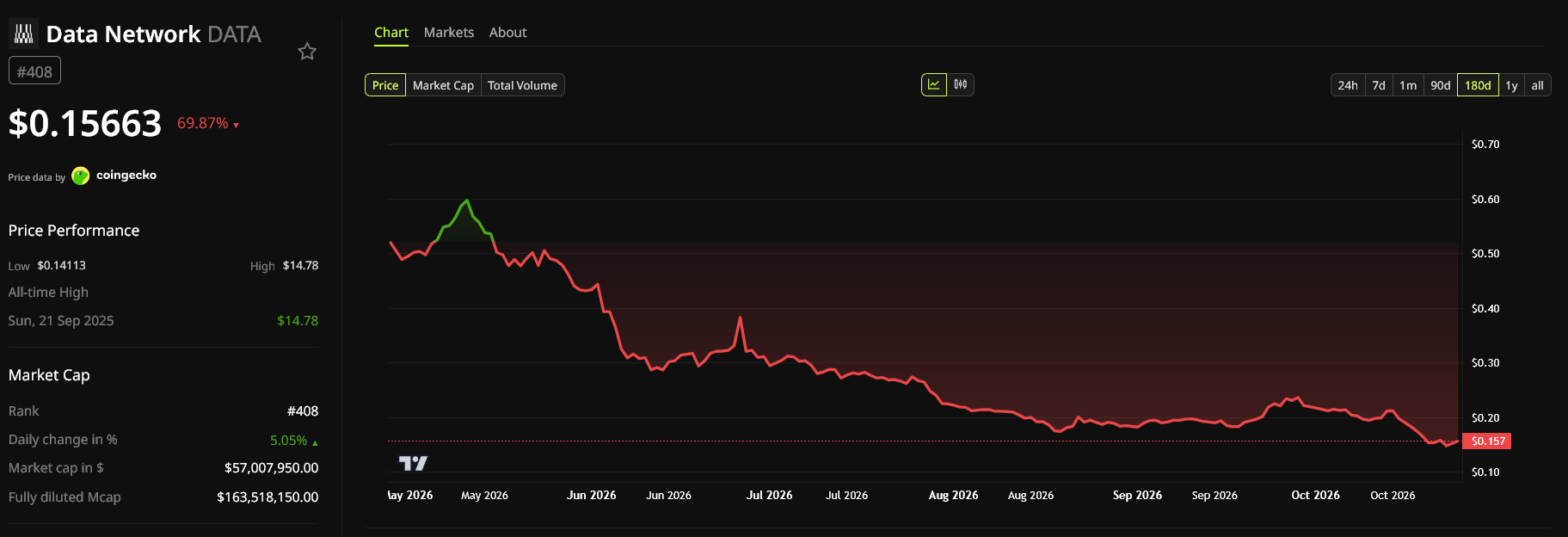
Yet investors have seen little relief. DATA has fallen 42.07% over 90 days to $0.15243, including a 34.65% decline over the past month.

2. USD.AI (CHIP): Financing Expensive AI Chips
AI requires powerful graphics processors, or GPUs. USD.AI helps computing companies borrow money against this hardware and its future income, using blockchain-based lending pools.
In August, Bullish announced a $100 million financing facility supporting USD.AI’s GPU loans.
CHIP has gained 47.98% over 90 days to $0.04386, although it remains roughly 69% below its April peak.
3. Pearl (PEARL): Making GPUs Earn Twice
Pearl proposes using the same computing capacity for AI workloads and blockchain mining. Providers could earn AI revenue while collecting tokens for securing the network.
PEARL is the standout performer, surging 528.24% in 90 days to $2.00. However, it has retreated about 19% from its October 21 record of $2.46.
Supply also poses a risk. Around 1.2 million new tokens are estimated to enter circulation daily, while its $4.2 billion fully diluted valuation far exceeds its $713 million market cap.

Grayscale sees potential in all three projects, although their success remains uncertain.
“Their long-term relevance will depend on adoption and competitive economics. We are keeping an eye on them,” Pandl said.
The post Grayscale Names 3 Cryptocurrencies That Could Benefit From AI Growth appeared first on BeInCrypto.
[ad_2]
Source link

91% Know Crypto, Only 8% Own It: Why UK Crypto Regulation Could Be the Next Growth Lever

GameMaker Commercial Use Goes Free on PC From January 1, 2027, but Console Still Costs

Walter Koenig, Star Trek’s Chekov, Dies at 90: George Takei Says He Was “More Than Chekov”


-

 Fashion4 days ago
Weekend Open Thread: Anine Bing
-

 Tech & AI2 days ago
New conversion kit lets builders fit ATX motherboards and standard PC GPUs inside Apple Mac Pro case
-
 Tech & AI7 days ago
Google Support Pages Start Defaulting to AI Chatbots
-

 Tech & AI7 days ago
Stolen UpdraftCentral keys used to backdoor WordPress sites
-

 Crypto6 days ago
UK Banks Restricting Crypto Transfers: Complaints Rise
-

 Fashion4 days ago
Coffee Break: Elodie-R Coat – Corporette.com
-

 Sports6 days ago
Team News, Stats and Odds
-

 Tech & AI7 days ago
Mozilla, Google, Apple block compromised eMudhra CA certificates
-
Tech & AI6 days ago
Tesla-SpaceX Merger Being Considered
-

 Fashion7 days ago
The 10 Best Dressed Stars at the 2026 Academy Museum Gala: Jessica Biel in Tamara Ralph, Teyana Taylor in Schiaparelli, Kim Kardashian in Vintage Balenciaga, And More!
-
Entertainment7 days ago
The 20 best “Bluey” episodes of all time
-
Sports7 days ago
Stolen Vikings Pass Rusher is a Free Agent Yet Again
-
Tech & AI6 days ago
Can It Be Both Cheap And Cheerful?
-

 Business & Hustles7 days ago
Google Cloud outage hits Revolut, Lloyds and DPD
-

 Business & Hustles6 days ago
(VIDEO) Ongoing North Toledo Chemical Release Forces School Closures Evacuations and Shelter-in-Place Orders
-

 Fashion7 days ago
Coffee Break: Wally Boot – Corporette.com
-

 Entertainment7 days ago
Young and Restless 2-Week Spoilers Oct 19-30: Sally in LABOR & Victor QUESTIONS!
-

 Sports4 days ago
Will Bayern Munich star Harry Kane win the Ballon d’Or?
-

 Tech & AI6 days ago
Bose Acquires Skullcandy: The Real Prize Is an Audience Bose Couldn’t Reach
-

 Crypto7 days ago
NEAR slips below $5 despite $5.42m ETF inflow – CoinJournal
You must be logged in to post a comment Login