
Crypto World
15 Habits Infectious Disease Experts Swear By to Avoid Getting Sick



Dr. Daniel Griffin doesn’t like to get sick. The first reason why is obvious—the congestion, the aching, the cough that overstays its welcome, the unpleasant stomach symptoms.
The second is a matter of professional dignity. “It’s almost like a gardener with dead plants,” says Griffin, chief of the division of infectious disease at Island Infectious Disease Medical in Long Island, N.Y. and president of Parasites Without Borders. “I really don’t want to be sick—because then the infectious disease doctor got sick.”
So what do infectious disease doctors and experts like him do differently than the rest of us when it comes to preventing illness? Not as much as you’d think. Infectious disease specialists aren’t disinfecting every surface or hiding from the outside world. Instead, they’ve built a collection of practical habits into their daily lives—simple routines that reduce risk without making life less enjoyable.
We asked six infectious disease experts which habits they never skip.
Set up your kitchen so cross-contamination can’t happen
Jill Roberts tries to take the guesswork out of food safety. “One of the major causes of foodborne illness is cross-contamination,” says Roberts, a molecular epidemiologist and professor at the University of South Florida College of Public Health. “It’s when you have something that’s raw and you get microbes from the raw thing into the ready-to-eat thing.”
Her favorite solution: color-coded cutting boards. Meat always goes on the red one; vegetables never do. “If your meat is always on the red cutting board, you’re never gonna have your salad stuff on your red cutting board,” she says.
Order matters just as much. She makes the salad first, puts it in the refrigerator, and only then brings out the red boards and raw meat. Once she starts handling meat, she’s vigilant about sanitizing any surfaces she may have contaminated—from the counters and sink to the faucet handles and refrigerator door.
Wash your produce under running water—not in a bowl
Some people think rinsing produce means filling a bowl with water and letting everything soak. But that’s not the best approach. “What you actually need is that little bit of friction to break the surface,” says Dr. Heidi Torres, an infectious disease physician and assistant professor of clinical medicine at Weill Cornell Medicine. About 30 seconds under running water, while gently rubbing the produce with your hands, does far more than a passive soak.
The problem with a bowl is that you’re washing everything in the same water. “If you have one piece that’s contaminated, that water could contaminate the other vegetables,” Torres says. Running water washes germs away instead of moving them from one piece of produce to another. It won’t remove everything—Cyclospora, for example, doesn’t simply rinse off—but it does reduce bacteria, viruses, and even some pesticide residue.
Microwave your kitchen sponge
A sponge is a nearly perfect habitat for germs: damp, warm, and studded with food particles, sitting next to the counter where you just set down raw chicken. “Sponges and wet dishcloths are really good at growing bacteria,” says Kelley Steury, a clinical associate professor in the school of public health at the University of Nevada, Reno, who specializes in veterinary preventive medicine. Her routine: Rinse her sponge until no food particles come out, then microwave it for 20 seconds. Just make sure it’s wet. “If you did it when it was pretty dry, you could start a fire,” she says.
Brush your teeth like it’s infection control
Most people brush their teeth to prevent cavities. Torres brushes hers to prevent infections.
“At least 25% of infections that I see are related to dental disease,” she says. Here’s why: Every day, small amounts of bacteria slip into your bloodstream, and a healthy immune system clears them without you ever noticing. Cavities and gum disease change the equation. They allow more bacteria—and more aggressive bacteria—to leak into the blood, which Torres describes as “a highway to all your organs.” In some cases, she says, doctors can trace an infection back to the mouth because the bacteria involved simply don’t live anywhere else.
That makes brushing about much more than fresh breath. “Rinsing alone wouldn’t replace it, because you really need that mechanical brushing to break down that film of bacteria,” Torres says. Hospitals have even started treating basic oral care as a form of infection prevention, she says—which is a pretty compelling reason to take it seriously at home, too.
Rethink the rug in your bathroom
Your bath mat outside the tub should be washable, hung to dry between uses, and tossed in the laundry about once a week. “We don’t leave the wet stuff on the floor, because that’s gross,” Roberts says. A damp bath mat can also spread athlete’s foot from one person to another.
As for the old-fashioned rug wrapped around the base of the toilet? Roberts would get rid of it altogether. Rubber backings don’t often hold up well in the wash, which means it probably doesn’t get cleaned as thoroughly as it should. “Especially if you have kids, they don’t aim well,” she says. “You have splash-overs.” In other words: Nothing around the toilet should be soaking anything up.
Leave your shoes at the door
Shoes pick up a lot more than dirt. Every sidewalk has been shared with other people, their pets, and whatever else has passed through. Dr. Cesar J. Figueroa Ortiz, an infectious diseases specialist at Memorial Sloan Kettering Cancer Center in New York, would rather not track any of that across the floors where his family walks and spends time—so shoes come off at the door.
His job reinforces the habit. Hospitals are meticulously cleaned, but there’s always “the risk of bringing pathogens with you on your shoes,” he says.
Open a window before company comes over
Before guests arrive, most people wipe down the counters. Dr. Peter Chin-Hong, an infectious-disease specialist at the University of California, San Francisco, thinks they should be paying more attention to the air. “I respect air more than surfaces,” he says. “You’re probably going to have a bigger bang for your buck when you think about ventilation.”
His solution is simple: crack a window. If the air conditioning is running, make sure it’s bringing in fresh outdoor air rather than recirculating the same indoor air all evening, he adds.
Wash your hands like you’re not in a hurry
Even infectious disease doctors don’t always practice perfect hand hygiene. Griffin has watched colleagues race out of a public restroom because they were about to miss a lecture at a conference. “They’re so anxious to get back out because they’re missing whatever the lecture is, and they’re not really doing proper hand hygiene,” he says. “Even the people that should know better are rushing back out.”
And when people do wash their hands, they’re often rushing through that, too. “Nobody’s singing ‘Twinkle, Twinkle, Little Star’ to time themselves,” Griffin says (besides him).
His other rule is knowing when soap and water beat sanitizer. (Basically always.) Alcohol-based hand sanitizer doesn’t kill everything: Norovirus—the highly contagious stomach bug behind many cruise ship outbreaks—is particularly resistant. Soap and water keep you safe, though, so if someone around you is vomiting or has diarrhea, Griffin says, head for the sink.
Use your shirt tail
Steury will happily look a little strange to save herself a bout with a germ. “Someone might look at me and think I’m crazy, but I’ll use the bottom of a shirt, like my shirt tails,” she says—or the hem of a cardigan, whatever’s handy—around her hand when she has to touch certain surfaces.
She’s selective about when she does it. What worries her are high-touch surfaces that are indoors and out of the sun: elevator buttons, soda fountain dispensers, and the door handle to a medical clinic, for instance. And if she does touch one of those surfaces directly, she waits until she can wash her hands before touching her eyes, nose, or mouth.
Decline the grocery-store sample
Before you accept that free cube of cheese, think about the cart you’re pushing.
“I always think about what happened to the grocery cart before you got there,” Roberts says. “Somebody picked up raw chicken. Somebody picked up raw seafood. And all of that is on the cart. It’s on the handle.”
Then someone offers you a toothpick with a sample. “I’m supposed to take my hand off this dirty cart and then take that food and put it in my mouth?” she says. “There’s no way.”
Wear sandals in every locker-room shower
At the gym, Torres worries less about the person coughing on the treadmill than the surfaces her bare skin touches. Benches, mats, and other shared equipment can harbor MRSA and fungi like ringworm—even at the nicest gyms. She wipes equipment down before using it, not just afterward, and if there aren’t disinfecting wipes available, she puts a towel between herself and the bench.
The locker-room shower gets its own rule. “It’s this wet, damp floor, walking around the locker room, walking around the joint showers,” she says. “I always recommend bringing a pair of sandals.” Foot fungus is the biggest concern, and some infections can be surprisingly difficult to get rid of.
Wash any cuts before reaching for the antiseptic
Most of us instinctively reach for the antiseptic after nicking a finger. Chin-Hong heads for the sink instead. “The more important thing is to rinse it well with running water and soap, which is more important than the aggressive disinfectant,” he says. Disinfectants don’t kill everything, but running water can physically flush away germs before they have a chance to cause trouble.
His reasoning comes down to one simple idea. “Running things are better than stagnant things,” Chin-Hong says. “We get infections when things are in stasis rather than in movement.” It’s the same reason standing water becomes a mosquito breeding ground.
Pack a pair of tweezers
Torres never leaves for a weekend in tick country without packing a pair of tweezers. It might sound excessive, she admits, but after years of treating tickborne illnesses, it’s become second nature. “This is a little unusual—maybe my colleagues don’t do this,” she says, “but whenever I go away for a weekend, I always pack a pair of tweezers.”
These days, that means much of the country: the Northeast, the Midwest, the South, and parts of the West Coast. After spending time in tall grass or wooded areas, do a full-body tick check, paying special attention to places they like to hide, like under the arms and behind the knees.
It matters more than you might think. “Most people that develop Lyme disease or tickborne illness have no recollection of ever being bitten by a tick or ever seeing a tick,” Torres says. She’s also vigilant against ticks to try to prevent alpha-gal syndrome—the tick-triggered allergy to red meat that has become increasingly common.
Reapply bug spray like it’s sunscreen
Bug spray is a permanent fixture in Chin-Hong’s travel bag. “I respect mosquitoes,” he says. “They actually kill more people than any other animal.” It’s West Nile season, and dengue keeps extending its reach into new parts of the U.S., so he travels with insect repellent as a matter of course.
The biggest mistake people make, he says, is treating bug spray like a one-and-done product. “It’s like sunscreen. You don’t get away with just applying it once.” If you’re outdoors all day, reapply at least every six hours. He also recommends choosing a repellent with about 20% to 50% DEET—or 20% picaridin if you prefer to avoid DEET—and remembering that the mosquitoes most likely to spread disease are busiest from dusk to dawn.
Rinse your toothbrush with bottled water when traveling abroad
Most travelers remember to avoid the tap water in destinations with questionable water supplies. Griffin worries about the toothbrush. “We tell people to be careful of ice cubes and tap water and all the rest,” he says. “But then people brush their teeth with the tap water.”
He calls what often follows “third-day sickness.” By then, your toothbrush has been rinsed repeatedly in tap water and left to sit in a warm, humid bathroom—giving any lingering microbes plenty of time to multiply before the brush goes right back into your mouth. His solution takes just a few seconds: rinse your mouth and toothbrush with bottled water, too.



The crypto industry’s most important regulatory bill is stuck because of the president’s own memecoin. Senators Elizabeth Warren and Richard Blumenthal just asked the SEC to investigate while the Clarity Act’s ethics provision remains the last unresolved section blocking a vote. The irony is precise: the bill that would bring regulatory clarity to crypto cannot advance because the most powerful person in the country launched a token that embodies exactly the regulatory ambiguity the bill was designed to resolve.
Summary
- Senators Elizabeth Warren and Richard Blumenthal sent a letter to SEC Chairman Paul Atkins on August 4 requesting an investigation into $TRUMP, citing $3.8 billion in estimated investor losses and $636 million in reported profits for the president from the token.
- The Digital Asset Market Clarity Act, the crypto industry’s best prospect for comprehensive US market structure legislation, remains stalled because Democrats and Republicans cannot agree on an ethics provision governing government officials’ involvement in crypto projects.
- The SEC has already declared that memecoins are “generally outside its sphere of influence” and do not qualify as securities under existing law, making enforcement action on $TRUMP unlikely under the current commission.
- President Trump agreed to narrow restrictions on his crypto involvement, but Democrats rejected the proposal as insufficient, and bipartisan negotiators Thom Tillis and Ruben Gallego are attempting to draft compromise language that both parties can accept.
- The $TRUMP token peaked at approximately $46 in January 2025 and currently trades near $1.47, with the vast majority of the nearly one million buyers sitting on losses while the president’s entity collected revenue from transaction fees and initial allocation sales.
The letter arrived on the same day that crypto lobbyists in Washington were counting votes for the Clarity Act, the legislation that would for the first time define which digital assets fall under SEC jurisdiction and which belong to the CFTC. The bill has bipartisan support in principle. It passed committee with votes from both parties. The industry has spent millions pushing it toward a floor vote. And it is stuck, not on a technical question about token classification or a policy disagreement about decentralized exchange regulation, but on the question of whether the president of the United States should be allowed to profit from a memecoin while his appointees regulate the industry.
What the Clarity Act would actually do
The Digital Asset Market Clarity Act is designed to solve the jurisdictional ambiguity that has defined US crypto regulation since the industry’s inception. Currently, there is no clear statutory framework determining whether a given token is a security (regulated by the SEC), a commodity (regulated by the CFTC), or something else entirely.
The bill creates a functional test for determining a token’s regulatory classification. Tokens that are sufficiently decentralized, meaning no single entity controls them, would be classified as digital commodities and regulated by the CFTC. Tokens that function as investment contracts, where buyers depend on the efforts of a centralized team for returns, would remain securities under SEC jurisdiction.
The legislation also creates registration pathways for crypto exchanges, sets disclosure requirements for token issuers, and provides a framework for stablecoin oversight that complements the separate GENIUS Act focused specifically on stablecoins.
For the crypto industry, the Clarity Act represents the difference between operating in regulatory limbo and having a defined set of rules. Projects that have delayed US launches because of enforcement risk would have a path forward. Exchanges that have restricted token listings because of securities law uncertainty would have clearer criteria. Investors would have standardized disclosures that currently do not exist for most crypto assets.
The bill’s journey through Congress has been broadly supported by both parties. The political dynamic that historically divided crypto along partisan lines, with Republicans favoring lighter regulation and Democrats favoring stricter oversight, had begun to shift as both parties recognized the electoral weight of crypto-interested voters. The White House said in April that a deal was “very close.”
Then the ethics provision became the obstacle.
The ethics fight that froze everything
The core dispute is narrow but politically explosive: should the Clarity Act include provisions that restrict senior government officials, including the president, from directly profiting from crypto projects while in office?
Democrats argue that any comprehensive crypto regulation bill must address the conflict of interest created when the president launches a token, profits from it, and simultaneously appoints the regulators who oversee the industry. Without an ethics provision, they contend, the bill effectively legalizes a regulatory framework while leaving the most prominent conflict of interest in the industry unaddressed.
Republicans counter that the ethics provision is scope creep, that the bill’s purpose is market structure regulation, not ethics reform, and that adding restrictions targeted at a specific individual risks turning a bipartisan bill into a partisan weapon. The president agreed to accept limited restrictions, but the proposed language was so narrow that Democrats described it as meaningless in practice.
The negotiation is now in the hands of Senators Thom Tillis, a North Carolina Republican, and Ruben Gallego, an Arizona Democrat, who are drafting compromise language. The White House has been involved in the discussions but has not publicly committed to signing a bill with meaningful ethics restrictions. Every day the bill remains stalled, the industry operates without the regulatory clarity it was designed to provide.
The $TRUMP token: $636 million in, $3.8 billion out
The numbers around $TRUMP are what give the ethics debate its weight. The token launched on January 17, 2025, three days before the presidential inauguration. It peaked at approximately $46 within days and has since declined to roughly $1.47, a 97 percent drop from its all-time high.
According to blockchain data analyzed by The New York Times and confirmed by the president’s 2025 financial disclosure, Trump-linked entities earned approximately $636 million from the token through a combination of initial allocation sales and ongoing transaction fees collected by the protocol.
On the other side of the ledger, nearly one million buyers collectively lost an estimated $3.8 billion. The asymmetry is stark: for every dollar the president’s side earned, buyers lost approximately six dollars. This ratio is not unusual for memecoins, but the involvement of a sitting president in the profit-taking entity is unprecedented.
The token saw brief price spikes around two Mar-a-Lago gala events where top token holders were invited to dine with the president. These events temporarily reversed the price decline but did not sustain any recovery. The galas themselves highlighted the conflict: the president was simultaneously the most powerful figure in crypto regulation and the host of an event that rewarded the largest holders of his personal memecoin.
What Warren’s letter asks and why it probably will not work
The Warren-Blumenthal letter to SEC Chairman Paul Atkins requests a formal investigation into whether $TRUMP involves “potentially fraudulent enrichment schemes with implications for market integrity and stability.” The letter cites the $3.8 billion in estimated buyer losses and the $636 million in presidential profits as evidence of an asymmetry that warrants regulatory scrutiny.
The request faces several obstacles. First, the SEC under Chairman Atkins has taken a materially different approach to crypto enforcement than the Gensler-era commission. The current SEC has paused or dropped numerous crypto enforcement actions and adopted a policy of regulation through rulemaking rather than enforcement.
Second, the SEC issued a staff statement in February 2025 explicitly declaring that memecoins are “generally outside its sphere of influence.” The statement said memecoins have “limited or no use or functionality” and do not qualify as securities under the Howey test because buyers are not investing based on the expectation of profits from the efforts of others. By the SEC’s own published position, $TRUMP is not a security and therefore falls outside the agency’s enforcement jurisdiction.
Third, Atkins was appointed by President Trump. Asking a presidential appointee to investigate the president’s personal financial interests is a political act more than a regulatory one. Warren and Blumenthal know this. The letter’s primary function is political: it creates a public record of the conflict of interest and forces a response (or conspicuous non-response) from the SEC that can be cited in the Clarity Act debate.
The letter is a negotiating tool dressed as a regulatory request. Its real audience is not the SEC. It is the handful of senators whose votes will determine whether the Clarity Act passes with or without meaningful ethics restrictions.
The SEC’s memecoin blind spot
The SEC’s February 2025 memecoin statement created a regulatory gap that the $TRUMP situation has exposed. By declaring memecoins outside its jurisdiction, the SEC effectively created a category of financial product that no federal regulator oversees.
The CFTC regulates commodities and derivatives but has not asserted jurisdiction over memecoins. The FTC regulates consumer fraud but has not acted on memecoin losses. State securities regulators have limited resources and jurisdictional reach for tokens that trade globally.
This gap means that a sitting president can launch a token, collect hundreds of millions of dollars in revenue, watch nearly a million buyers lose billions, and no federal agency has clear authority to investigate or act. The Clarity Act was supposed to fill gaps like this by creating a comprehensive framework for token classification. Instead, the most prominent example of the gap’s consequences is the reason the bill cannot pass.
The irony compounds. If the Clarity Act passes without an ethics provision, it would create a legal framework that implicitly permits government officials to profit from token launches. If it passes with a strong ethics provision, it would retroactively create restrictions that apply to the president’s existing token. If it does not pass at all, the entire industry continues operating without the regulatory clarity that would attract institutional capital, encourage responsible innovation, and protect retail investors from exactly the kind of losses that $TRUMP buyers experienced.
The crypto industry’s impossible position
The crypto industry’s Washington lobby has spent years and hundreds of millions of dollars building bipartisan support for regulatory legislation. The Clarity Act is the culmination of that effort. And it is being held hostage by a conflict of interest that the industry cannot publicly criticize without alienating the president whose administration has been broadly favorable to crypto.
Major industry trade groups have carefully avoided commenting on $TRUMP specifically. Their public statements focus on the importance of passing the Clarity Act and avoid any reference to the ethics provision. Privately, industry leaders acknowledge that the president’s memecoin has complicated their legislative strategy. The token’s existence makes it harder for Democrats to vote for the bill without ethics restrictions, and harder for the industry to argue that ethics restrictions are unnecessary without appearing to endorse a presidential conflict of interest.
Some industry participants have taken a different approach, arguing that the $TRUMP situation is precisely why clear rules are needed. Under a comprehensive regulatory framework, the argument goes, a presidential memecoin would either be subject to disclosure requirements and trading restrictions or it would be clearly categorized as outside the regulated perimeter. Either outcome would be better than the current ambiguity, where no one knows which rules apply and no agency claims jurisdiction.
The problem with this argument is timing. The industry wants the bill passed now, and the ethics provision is the obstacle to passing it now. Any delay risks losing the political window entirely. If the bill carries over into a new Congress, it must restart the committee process, and the bipartisan coalition that brought it this far may not reassemble.
What happens if the bill dies
If the Clarity Act fails to pass this session, the consequences extend beyond the crypto industry’s policy wishlist.
The SEC would continue operating under the enforcement-first approach of previous years or the current hands-off approach, depending on which administration is in power. Neither approach provides the predictable, statute-based framework that institutional capital requires. Major financial institutions that have waited for regulatory clarity before offering crypto products would continue waiting or would structure their offerings under existing securities law, which adds compliance costs that make many crypto products uneconomical.
Token projects would continue launching in offshore jurisdictions and restricting US access, as they have for years. The US share of global crypto innovation and trading volume would continue declining relative to jurisdictions like the EU, which implemented its MiCA framework in 2024 and is already attracting projects that want regulatory certainty.
Retail investors would remain in the current environment where memecoins exist in a regulatory vacuum, where disclosure requirements are absent, and where losses like the $3.8 billion from $TRUMP buyers have no regulatory pathway for investigation or remedy. The Clarity Act does not specifically address memecoins, but its classification framework would at minimum force a determination about whether specific tokens fall under SEC or CFTC jurisdiction, ending the current situation where no agency claims responsibility.
The deepest irony is that the $TRUMP token is the strongest argument for why the Clarity Act is necessary, and simultaneously the reason the Clarity Act cannot pass.
What to watch
The Tillis-Gallego compromise language. The bipartisan pair negotiating the ethics provision will determine whether the bill lives or dies in this Congress. Watch for a draft that restricts government officials from launching new tokens while grandfathering existing ones, a structure that addresses Democratic concerns without requiring the president to divest from $TRUMP.
The SEC’s response to Warren’s letter. A formal investigation is unlikely, but the SEC must respond in some form. The nature of the response, whether a brief dismissal or a detailed explanation of jurisdictional limitations, will signal how the current commission views its role in the memecoin space.
The September legislative calendar. Congress returns from recess with a narrow window before the midterm election cycle consumes legislative bandwidth. If the Clarity Act does not advance in September and October, its chances of passing this session diminish sharply.
$TRUMP token price action. Any significant price movement in $TRUMP, up or down, will reignite media attention on the ethics question. A rally would raise questions about insider trading. A further decline would increase the estimated buyer losses and strengthen the case for an investigation.
Other government official tokens. If $TRUMP’s existence normalizes the practice, other elected officials may launch their own tokens. Each new launch would add pressure to the ethics provision debate and make the Clarity Act’s passage without restrictions increasingly untenable.
What is the Clarity Act?
The Digital Asset Market Clarity Act is proposed US legislation that would create a comprehensive framework for classifying crypto assets as either securities (regulated by the SEC) or digital commodities (regulated by the CFTC). It would also create registration pathways for crypto exchanges and set disclosure requirements for token issuers, providing the regulatory clarity the industry has sought for years.
Why is the Clarity Act stalled?
The bill is stalled because Democrats and Republicans cannot agree on an ethics provision that would restrict senior government officials, including the president, from directly profiting from crypto projects while in office. President Trump’s $TRUMP memecoin has made this provision the central point of contention, with Democrats refusing to support the bill without meaningful restrictions.
What did Warren and Blumenthal ask the SEC to do?
On August 4, 2026, Senators Elizabeth Warren and Richard Blumenthal sent a letter to SEC Chairman Paul Atkins requesting a formal investigation into the $TRUMP memecoin. They cited $3.8 billion in estimated investor losses and $636 million in presidential profits, arguing the asymmetry raises questions about potentially fraudulent enrichment.
Will the SEC investigate $TRUMP?
A formal SEC investigation is unlikely under the current commission. The SEC under Chairman Paul Atkins (appointed by President Trump) has scaled back crypto enforcement, and the agency issued a February 2025 staff statement declaring memecoins generally outside its jurisdiction. The Warren-Blumenthal letter functions more as a political pressure tool in the Clarity Act negotiations than as a realistic enforcement request.
How much did Trump make from $TRUMP?
According to the president’s 2025 financial disclosure and blockchain data analysis, Trump-linked entities earned approximately $636 million from the $TRUMP token through initial allocation sales and ongoing transaction fees. Nearly one million buyers collectively lost an estimated $3.8 billion over the same period.
Is $TRUMP a security?
The SEC’s February 2025 staff statement declared that memecoins generally do not qualify as securities because they have limited or no use or functionality and buyers are not investing based on the expectation of profits from the efforts of others (the Howey test standard). By the SEC’s own published position, $TRUMP falls outside securities law, though critics argue the token’s connection to a sitting president creates unique circumstances not contemplated by the staff statement.
What happens if the Clarity Act does not pass?
If the bill fails, the US crypto industry continues operating without a comprehensive regulatory framework. The SEC and CFTC would continue disputing jurisdiction over various tokens. Projects would continue launching offshore to avoid US regulatory ambiguity. Institutional investors would continue waiting for clarity before entering the market at scale. And memecoins would remain in a regulatory vacuum where no federal agency claims oversight authority.
What is the ethics provision compromise being negotiated?
Senators Thom Tillis (R-NC) and Ruben Gallego (D-AZ) are drafting compromise language for the Clarity Act’s ethics section. The expected approach would restrict government officials from launching new tokens while potentially grandfathering existing positions. The White House has been involved but has not committed to signing a bill with meaningful restrictions on the president’s existing crypto interests.
Disclaimer: This article is for informational purposes only and does not constitute financial, investment, or legal advice. Cryptocurrency investments carry significant risks. Always conduct your own research before making any financial decisions. The information in this article is current as of August 4, 2026.

Just a few days after admitting to a key vulnerability that left millions and millions worth of BTC in jeopardy, the team behind the self-proclaimed ‘best bitcoin hardware wallet’ published a key message urging users to migrate their funds.
Coldcard’s official X account informed customers that they should “treat this as urgent” and move their funds. The posts added that they have to follow the advisory of their models, upgrade their devices, generate a new seed, and “carefully” move their funds.
Please treat this as urgent. Migrate your funds. Follow the advisory for your model, upgrade your device, generate a new seed, and carefully move your funds.
Help spread the word, especially to people who are less online and may not see this update.
The threat is still ongoing. https://t.co/cbJxJles8x
— COLDCARD (@COLDCARDwallet) August 4, 2026
The Coldcard saga unraveled at the end of July. Some users first issued warnings online that their funds, stored on the hard wallet, had disappeared before the team admitted to a critical vulnerability in the code.
According to the latest estimations by Galaxy Research, the confirmed amount stolen is over $100 million. Some reports noted that the actual number could be around $130 million.
Market commentator Joe Consorti argued earlier that the attacker may struggle to spend a large portion of the swiped BTC since every BTC is being tracked on the public blockchain.
The post Coldcard Urges Users to ‘Carefully Move Funds’ as Exploit Losses Mount appeared first on CryptoPotato.





Every once in a while, my good friend Thelma Golden will meet someone who is shocked to learn this tiny, energetic, and dynamic woman is a paradigm-shifting curator. Some would find this disheartening. But not Thelma. She sees it as her chance to show the world exactly what she can do.
As one of the most influential people in art, Thelma knows the power of flipping an assumption on its head. Her exhibits at the Studio Museum in Harlem and, previously, the Whitney not only stop you in your tracks, they also show you so much more about the depth of the Black experience. Her steadfast dedication has given voice to a new generation of artists and curators who are ready to stir our souls too—folks who may have otherwise gone unnoticed had it not been for Thelma’s eye for talent and potential. She has broadened the world of art to better reflect the sum of us, rather than just a few. That’s power. And that’s why, while some folks might go on underestimating her, I’ll never be one of them.




Not only are people unable to tell the difference between stories written by humans or artificial intelligence, they actually prefer it when the stories are created by AI. And that’s especially true when they are told that the stories had human authors, according to a new study from Villanova University.
The study consisted of multiple experiments, all of which indicated a preference for AI. In the first, 1,682 participants were told to rate both the quality of six short stories they were given and how “engaging” they were. They were told, either correctly or incorrectly, who or what had authored each one.
Read More: Is AI Making Our Brains Weaker?
Not only were AI-generated stories found to be higher-quality (by 6%) and more engaging (by 8%), they were rated “even more highly,” researchers concluded, when participants believed that they were written by humans (by an additional 3%).
Deena Weisberg, the senior author of the study and an associate professor from Villanova’s Department of Psychological & Brain Sciences, said in a press release that the finding “reveals a bias towards narratives written by real people.”
That may be because “we assume creative writing requires uniquely human qualities, such as emotional understanding and lived experience,” she said, explaining that it shows how “public assumptions about AI’s capabilities are increasingly out of date.”
Furthermore, people were only able to identify AI-generated content roughly 40% and 52% of the time in two subsequent experiments, each with over 400 participants. People who said they were AI-literate had more success, while people who claimed to have a background in literature were less accurate in their guesses.
“Familiarity with AI systems appeared to help people recognize the patterns typical of AI-generated writing, such as em dashes and sentence structures such as ‘it’s not just X, it’s Y,’” Weisberg said. “That suggests that improving AI literacy would be one way to help people to navigate the new AI-enabled world that we’re living in.”
Cameron Jones, assistant professor of psychology at Stony Brook University tells TIME that the study’s findings are not necessarily surprising, considering the history of research going back years that shows people’s diminishing ability to tell between artificial intelligence and humans.
He also points to the trajectory of his own studies, which look at whether people can differentiate between them in conversation. In those scenarios, he says, “The person actually gets to quiz the model and ask follow-up questions.”
Even then, they had trouble distinguishing between human and generative content partners.
Jones says that this is because the large language models driving the content responses are trained to appeal to users.
“We basically get the model to generate little bits of text, and then we get people to read them, and they give a thumbs up if they like what the model’s saying and they give a thumbs down if they don’t like what the model’s saying,” he says.
It’s no surprise that people prefer the results, he explains, when “we’re optimizing these models’ outputs against our preferences.”
It can oversimplify output, but it leads to writing with higher overall appeal—whereas humans might write something truly exceptional that only caters to select tastes.
“Real humans are weird and idiosyncratic, and they’re very different from one another,” Jones says. “But models can kind of learn to be this kind of milquetoast everyman who appeals to everybody.”
While the findings align with rising exposure to artificial intelligence, along with algorithmic reward systems for broadly approachable content on platforms like TikTok, Weisberg does not think that the current digital landscape is to blame for the results. She says, “Technologies amplify existing tendencies, rather than creating them.”
Plus, she adds, the human-authored content might have simply challenged readers more.
“AI writing tends to be clearer, more direct and easier to process,” she said. And it’s reasonable for participants to find themselves more deeply engaged with content that offers greater predictability and less friction.
In other words, Weisberg says, “Difficult or subtle material requires more brainpower.”

A former FBI supervisory agent, Patrick Steven Yaroch, has been charged with abusing internal access to obtain credentials for cryptocurrency wallets tied to an adversarial country and then using those funds to transfer value to his own crypto accounts. Prosecutors say Yaroch used the access to conduct unauthorized transfers totaling roughly $1 million in digital assets across late 2024 and early 2025.
According to a Saturday court filing in the U.S. District Court for the Eastern District of Virginia, Yaroch later admitted to 10 unauthorized transfers involving an estimated total of about $1 million. Prosecutors also allege that some of the stolen crypto was deposited into Suilend to earn yield.
Key takeaways
- Patrick Steven Yaroch allegedly used FBI internal systems to access credentials for cryptocurrency wallets linked to an adversarial country.
- The admitted unauthorized activity included 10 transfers between late 2024 and early 2025, with an estimated total value of around $1 million.
- After self-reporting, Yaroch was placed on administrative leave, then terminated and arrested within days.
- Investigators reportedly recovered devices, seed phrases, and a Trezor wallet from Yaroch’s Virginia home to access accounts on Suilend and on crypto exchange Kraken.
- Earlier federal cases in the Silk Road investigation involved agent theft of large Bitcoin amounts, underscoring a recurring pattern.
What prosecutors allege Yaroch did
The filing states that Yaroch admitted to making unauthorized transfers between late 2024 and early 2025. Prosecutors describe the conduct as credential misuse: he allegedly used internal FBI systems to obtain access for wallets associated with an adversarial country. Those credentials were then used to move funds to wallets under his control.
Yaroch’s admission included 10 transfers, with prosecutors estimating the total digital assets involved at approximately $1 million. The filing further alleges that he deposited some of the assets into Suilend, a platform where users can earn yield by supplying crypto.
How the investigation proceeded
After Yaroch self-reported the incident, he was placed on administrative leave last Wednesday. He was terminated and then arrested on Friday, according to the filing.
Agents also obtained materials from Yaroch’s Virginia residence. The filing says investigators retrieved devices, seed phrases, and a Trezor hardware wallet to access Yaroch’s accounts on Suilend and on crypto exchange Kraken.
With Yaroch’s cooperation, investigators report transferring roughly $925,000 in funds to government-controlled wallets. That figure represents the majority share of the estimated value admitted in the case, but the filing’s description indicates that some assets may not have been fully captured in the returned amount.
AI use raised further questions
In May, the court filing says Yaroch used ChatGPT for advice about investing money for maximum profit and return. The prompt included a hypothetical: “If I had a million dollars, how would you suggest investing it/spending it to maximize profit and return.”
According to the filing, the AI response recommended “building a slower-living vineyard/agricultural lifestyle” in places such as Cilento or Portugal’s Dão region. The filing does not indicate that the advice was acted on as written, but it places Yaroch’s mindset and planning alongside the period during which the alleged unauthorized transfers were conducted.
A pattern of agent-linked crypto theft
Yaroch’s case follows several other U.S. federal prosecutions involving law enforcement personnel accused of stealing cryptocurrency connected to major investigations.
In 2015, former DEA special agent Carl M. Force diverted about $700,000 in Bitcoin. The Department of Justice later announced that Force pleaded guilty and was sentenced to six and a half years in prison; the DOJ described the case as involving extortion and money laundering connected to the Silk Road investigation. Earlier coverage of the Silk Road investigations also notes the role that seized or handled crypto played in facilitating improper transfers.
In a separate case, former U.S. Secret Service special agent Shaun W. Bridges was charged with stealing about $350,000 in Bitcoin in 2015. According to DOJ records, Bridges pleaded guilty and received a six-year prison sentence tied to a scheme associated with the Silk Road investigation.
Both of those matters—Force and Bridges—were linked to the broader Silk Road dark web marketplace investigation, demonstrating how cryptocurrency handling in high-profile cases can become a target for insider wrongdoing. Yaroch’s situation is different in details—focused on wallet credential access and transfers tied to an adversarial country—but it similarly involves a trusted role, crypto access, and unauthorized movement of funds.
A broader takeaway for the crypto sector is that enforcement and investigative work increasingly intersects with on-chain systems and credentialed wallet access. When insiders control operational keys, seed phrases, or database-like credentials—whether intentionally or through misuse—the risk is not limited to centralized platforms; it can directly translate into irreversible on-chain transfers. That reality is what makes these cases a recurring concern for regulators and compliance teams, even beyond any single exchange or protocol.
What to watch next
Readers should watch how the court evaluates the scope of the alleged transfers, what portion of the estimated value remains unaccounted for after the reported ~$925,000 transfer to government wallets, and whether the case expands beyond credential access into additional charges or additional wallet targets.
Ripple announced yet another expansion of its institutional digital asset strategy. In fact, the past seven days were rather packed with ecosystem updates.
All of it happened as XRP traded near $1.07 following a few unsuccessful recovery attempts, but more on that later. Now, let’s dive into the most important and recent Ripple news.
Ripple Invests in ZILO and Licuido
Undoubtedly the week’s largest ecosystem development was Ripple’s investment in ZILO and Licuido – two companies building infrastructure for digital investment funds and trading of institutional assets. Ripple did not disclose the size of either of those investments.
ZILO provides transfer agency and fund administration technology for tokenized share classes. It sounds fancy and tech, but the important part is that it fits well into Ripple’s plans to become the preferred international settlement layer for both retail and institutions. Conversely, Licuido operates a platform that supports the issuance, distribution, trading, and use of traditional assets as digital collateral. The important bit here is that it’s regulated in the United Kingdom.
Ripple plans to connect those services with its existing XRP Ledger infrastructure. The goal is to let institutions issue tokenized assets, transfer them between investors, hold them in custody, and use them as collateral. RLUSD could provide the settlement side of the transactions, allowing assets and payments to settle together and instantly.
Mastercard Completes Acquisition of Ripple Partner BVNK
Mastercard completed its acquisition of BVNK – a stablecoin infrastructure company that also supports XRP deposits and outgoing payments through its multichain infrastructure.
The company itself has worked with Ripple since 2024, even before RLUSD was officially launched. Both firms also participate in Mastercard’s Crypto Partner Program and have contributed to its multi-token network initiative.
Mastercard mentioned that this deal would help connect traditional and digital forms of money.
FXRP Enters $280 Million RLUSD Lending Vault
Another important development is that Flare’s wrapped XRP (FXRP) received approval to be used as collateral in an RLUSD lending pool that’s managed by Sentora.
The vault, worth $280 million, operates through an isolated market on Morpho Blue. Users can deposit FXRP and borrow RLUSD, essentially without losing their exposure to XRP.
Around 155 million FXRP had been minted by the time of the announcement. There are some relative complications, though. Users have to mint FXRP on Flare, bridge to Ethereum, deposit on Morpho, and then borrow RLUSD.
XRP ETFs Stay Positive, but Demand Slows Down
XRP exchange-traded funds kept on attracting capital in July. However, the demand has weakened significantly.
These products recorded around $27 million in net inflows throughout the month. That was considerably less than the $60 million (approximately) registered in June, and a far cry from the $132 million in May.
However, the positive results are indicative of the fact that investors continue to add XRP exposure. On the other hand, the declining monthly totals suggest that institutional momentum might be cooling.
XRP Price Tests Long-Term Support
Last but not least, let’s look at the price action. XRP is currently found at around $1.07, after spending some time defending the area around $1.05 – $1.06. It remained below its 20-day exponential moving average near $1.08 and the 50-day average around $1.12.

That said, popular analyst ChartNerd described the current structure as a falling wedge that’s forming near a six-year support area. He argued that the next several months could prepare XRP for a broader repricing, although a temporary break below the critical $1 level could still take place.
On the other hand, a sustained move above $1.08 and $1.12 would improve the short-term picture and provide for a more reliable rally.
The post Important Ripple News and XRP Price Update: August 4th appeared first on CryptoPotato.
The US Dollar Index (DXY) trades near 100.02 on Tuesday after last week’s sharp rejection from 101.50. The greenback is battling to reclaim the psychological 100 mark, according to Trading Economics data.
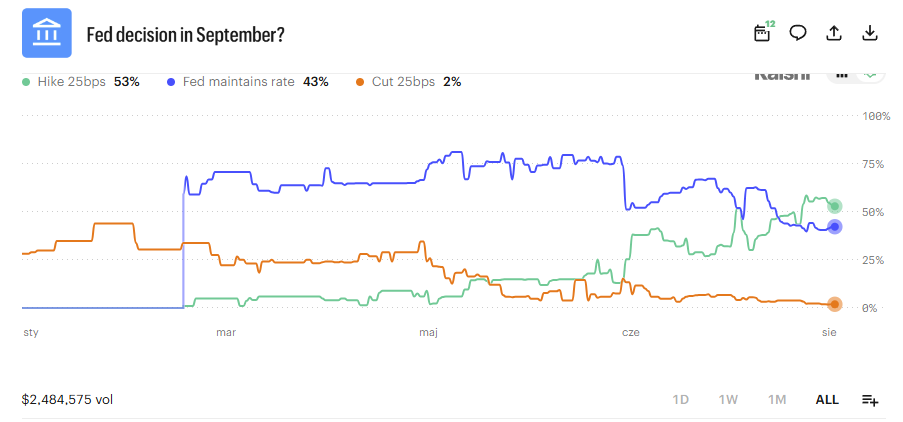
Markets price roughly 55% odds of a September Federal Reserve rate hike. At the same time, coordinated currency intervention and falling oil prices pull the index in the opposite direction.
Fed Hike Bets Collide With Yen Intervention
Fundamentals have turned dollar-friendly on the monetary policy side. July’s ISM Manufacturing Purchasing Managers Index (PMI) jumped to 55.6, its strongest reading since May 2022.
Three Federal Open Market Committee (FOMC) members also dissented in favor of a hike in July, when rates held at 3.50% to 3.75%. Prediction market Kalshi prices a 25-basis-point September hike at 53%, with CME FedWatch showing similar odds.

However, official pressure works against the dollar. The US and Japan confirmed coordinated yen intervention after USD/JPY weakened to 40-year lows near 164.
Falling energy prices add to the bearish side. Oil dropped around 5% on Monday after Washington and Tehran agreed to restart talks, easing inflation pressure.
Dollar direction also matters beyond forex. A firmer greenback has repeatedly pressured gold and Bitcoin (BTC) in 2026.
US Dollar Index Weekly Chart Shows the Rally Stalling Below 102
The weekly chart frames the move within a wide macro range. DXY topped at 110.176 in January 2025 and bottomed at 95.551 on January 27, 2026.
The recovery from that low stalled in July near 101.50. That area holds the 0.382 Fibonacci retracement at 101.14, just below the May 2025 swing high at 101.977.

Last week, sellers pushed the index back below the 100.30 to 100.60 resistance zone. The drop ended at an ascending trendline that connects to the January low.
Meanwhile, the weekly Relative Strength Index (RSI) sits near 50. The reading offers neither bulls nor bears a clear momentum edge.
Level
Significance
101.98
May 2025 swing high, main upside target
101.14
0.382 Fibonacci retracement
100.30 to 100.60
Resistance zone that needs to flip into support
99.49
Trendline and June swing low confluence
99.00
0.236 Fibonacci retracement
DXY Price Prediction Rests on the 99.49 Support Confluence
The daily chart strengthens the bullish structure argument. An ascending trendline from the February low has now held twice, on May 6 and again on August 3.
The latest bounce also coincided with the June 17 swing low at 99.491. That confluence makes 99.49 the most important support on the chart.
Momentum tells a different story. Daily RSI reads 38, below the neutral zone but not yet oversold. The reading suggests sellers still control short-term momentum despite the intact trend.

A daily close above 100.60 could open the path to 101.14 and then 101.977, roughly 2% above the current price. In contrast, losing 99.49 would expose the 0.236 Fibonacci level at 99.008, about 1% lower.
The calendar could decide the fight. ISM Services PMI lands on Wednesday, and the July jobs report follows on Friday, August 7. The Fed’s data-dependent stance adds weight to each release after last week’s GDP and PCE inflation data.
Until either side wins the battle for 100, DXY remains trapped between hawkish Fed pricing and official selling pressure.
The post Dollar Index Trapped at 100 as Hawkish Fed Meets Official Selling appeared first on BeInCrypto.

Apple UK encryption challenge filed against Home Office

The Clarity Act, Trump’s memecoin, and the SEC investigation Warren just requested

Young and the Restless: Sally Issues Ultimatum to Billy After His Dirty Play – Breaking Point?


-

 Business6 days ago
Why Trees Belong on the Risk Register
-

 Fashion4 days ago
Weekend Open Thread: Wit & Wisdom
-

 Politics4 days ago
Meta enters AI-training agreement with far-right ‘propaganda rag’ Newsmax
-

 Politics6 days ago
Reform UK betrays West Mids residents by running from party pledges
-

 Crypto World3 days ago
MicroStrategy Post-Earnings CLARITY Act Push Could Add New Catalyst for Its Stock
-

 Business7 days ago
Major shareholder moves on Canyon
-

 Politics2 days ago
Zack Polanski: an incitement to murder Nigel Farage?
-

 Crypto World4 days ago
XRP Ledger v3.3.0 brings five institutional features
-

 News Videos6 days ago
Bitcoin Enters the 3rd Stage of the Bear Market
-

 Politics5 days ago
Luke Littler’s dominance sparks GOAT debate
-

 Sports5 days ago
Seema Kaliramna Wins Discus Throw Bronze, Takes India’s CWG Medals Tally To 17
-

 Crypto World4 days ago
New York sues Kalshi over prediction market gambling
-

 Crypto World3 days ago
Crypto PAC spending tops $2M in Michigan House race
-

 Business4 days ago
Trump Announces Hamas Disarmament Agreement as Iran Strikes Kuwait Air Base and US Attacks Pause Overnight
-

 Tech6 days ago
Gemini can now summarize the messiest comment threads in Google Docs
-

 Tech3 days ago
ESET tracks rise in malicious AI skills and adaptable malware
-

 Business2 days ago
DTCR: Deleveraging And A Hedge Fund Collapse Point To A Possible AI Bottom
-

 NewsBeat6 days ago
Four people die trying to cross Channel in small boats
-

 Tech5 days ago
Gemini Spark can now use Chrome logins and saved passwords to run errands on your behalf
-

 Sports6 days ago
Sakshi, Arundhati Enter Boxing Semi-Finals. India Assured Of 18 Medals At CWG 2026
You must be logged in to post a comment Login