







Connect with us

Crypto World

3 Altcoins to Watch for the Second Week of August 2026

Published

on

ARB Whale Holdings Slip

A packed week of catalysts is about to test three altcoins. Between now and Aug 16, one faces a large token unlock, another must prove its earnings can hold, and a third races toward a mandatory network upgrade.

That makes this a ‘three altcoins to watch’ list, each pulling a different way.

Token Outlook Main Catalyst
Arbitrum (ARB) Bearish 92.65M ARB unlock on August 15; whales reducing holdings ahead of added supply
Hyperliquid (HYPE) Neutral / Mixed Trading fees and perp volume; stronger activity would support HYPE buybacks and price recovery
TRON (TRX) Bullish GreatVoyage v4.8.2 upgrade by Aug. 16, rising network fees, and strong USDT activity
Disclaimer: This table reflects technical and market analysis for informational purposes only and should not be considered investment advice.

Arbitrum (ARB) Heads Into a Big Unlock as Whales Trim

Arbitrum starts the week under supply pressure. On August 15, about 92.65 million ARB unlocks, worth roughly $7.37 million.

That equals about 1.4% of the circulating supply, and most of it goes to the team, contributors, and investors.

Advertisement

ARB Aug 15 Unlock
ARB Aug 15 Unlock: DefiLlama

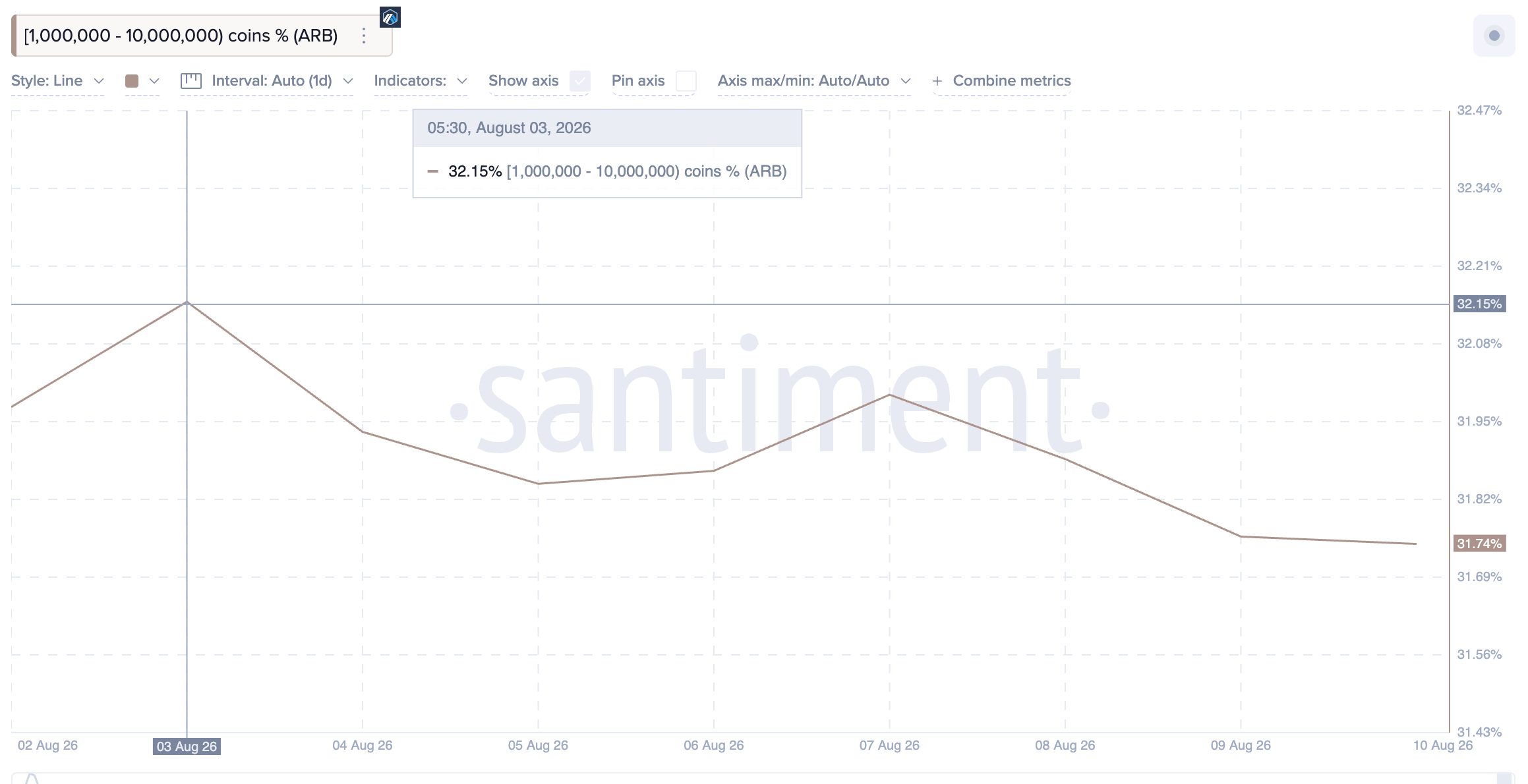
Large holders are already easing off considering the supposed supply pressure. Wallets holding 1 million to 10 million ARB slipped from 32.15% of supply on Aug 3 to 31.74% by Aug 10. This quiet whale distribution lines up with the coming token unlock.

ARB Whale Holdings Slip
ARB Whale Holdings Slip: Santiment

However, the ecosystem has a longer-term boost. Robinhood built its new chain, which trades tokenized stocks, on Arbitrum technology.

It routes 8% of its net revenue to the Arbitrum treasury. For now, the token unlocks to watch tilt ARB bearish. The real risk is whether recipients move coins to exchanges.

Hyperliquid (HYPE) Earns Big, but Its Fees are Cooling

Hyperliquid is the mixed signal among the altcoins to watch. Its token has steadied this week, up almost 5%. Yet it still trades well below where it sat a month ago, down almost 18%. The question is whether the business supports that recent weekly bounce.

Want more token insights like this? Sign up for Editor Harsh Notariya’s Daily Crypto Newsletter here.

The protocol remains one of the highest earners in crypto. It booked about $9.37 million in fees and $6.44 million in protocol revenue over seven days.

Advertisement

That came on $38.9 billion in perpetual-futures volume, the value of leveraged bets on price. Annualized fees run near $1 billion.


Hyperliquid Fees and Revenue
Hyperliquid Fees and Revenue: DefiLlama

However, weekly fees have cooled from the 30-day pace, and that is the crack to watch. Hyperliquid sends most of its trading revenue to a fund that buys back HYPE and burns it. That steady buying supports the price.

So those HYPE buybacks only hold up while trading activity stays high. If fees and volume climb again, the recovery has real backing. If they keep falling, the price is simply rising faster than the business behind it.

Perpetual Volume
Hyperliquid Perpetual Volume: DefiLlama

Hyperliquid’s case rests on trading activity that is now cooling. The next token, TRON, runs on network activity that keeps growing.

TRON (TRX) Guards a $90 Billion Base Before a Deadline

TRON closes the week with a hard deadline and the firmest setup. Node operators must install the mandatory GreatVoyage v4.8.2 “Pyrrho” network upgrade by Aug 16. It improves Ethereum compatibility and node reliability.

This matters because TRON is the leading stablecoin settlement rail for Tether’s USDT, the most-used stablecoin. It hosts about $91.7 billion, close to half of all USDT in circulation.

A clean upgrade lowers the risk of disruption for wallets, exchanges, and USDT transfers, which protects that base. Rising USDT on TRON already shows the demand.

Stablecoin Supply Makes It One Of The Key Altcoins to Watch
TRON Stablecoin Supply Makes It One Of The Key Altcoins to Watch: DefiLlama

The fundamentals support that view. Chain fees rose about 4.5% over the past week, and roughly four million accounts stay active each day.

TRON Chain Fees Rise
TRON Chain Fees Rise: DefiLlama

TRX has also held near $0.33, keeping the token steady as the deadline nears.

TRON Network Vitals
TRON Network Vitals: TRON

That lead in stablecoin payments makes TRX the group’s bullish anchor.

Still, DeFi value locked slipped about 0.6% on the week, so settlement is strong even as broader DeFi growth stays unproven.

The post 3 Altcoins to Watch for the Second Week of August 2026 appeared first on BeInCrypto.

Advertisement

Source link

Continue Reading
Click to comment

You must be logged in to post a comment Login

Leave a Reply

Crypto World

Circle is mispriced as stablecoins head toward trillions

Published

on

Circle is mispriced as stablecoins head toward trillions

The big picture: In an interview on CoinDesk’s Public Keys, Bitwise Head of Research Ryan Rasmussen said investors are underestimating Circle’s opportunity as stablecoins move toward a multi-trillion-dollar market.

  • Rasmussen expects the stablecoin market to grow from roughly $300 billion to between $3 trillion and $5 trillion.
  • He said Circle is particularly well positioned as U.S. stablecoin regulation takes shape, with its existing market share giving it a head start.
  • “I think we’ll look back five years from now and Circle will be not only a stablecoin giant, but a payment giant,” Rasmussen said.

Closer look: Rasmussen’s thesis isn’t just that more stablecoins mean more reserve revenue for Circle — he sees payments infrastructure becoming a major second business.

  • Circle is building infrastructure designed to facilitate payments in a stablecoin-driven financial system.
  • Rasmussen said that expansion is being “very mispriced by the market,” as investors remain focused on Circle’s reserve-based business.
  • He compared Circle’s potential trajectory to global payments giants including Visa and Mastercard.

The competition: Banks, consumer companies and other incumbents are preparing their own stablecoins, but Rasmussen doesn’t see that as a major threat to Circle.

Source link

Continue Reading

Crypto World

TRON USDT Supply Reaches $87.9B as Q2 Transfers Hit $2.1T: Messari

Published

on

Crypto Breaking News

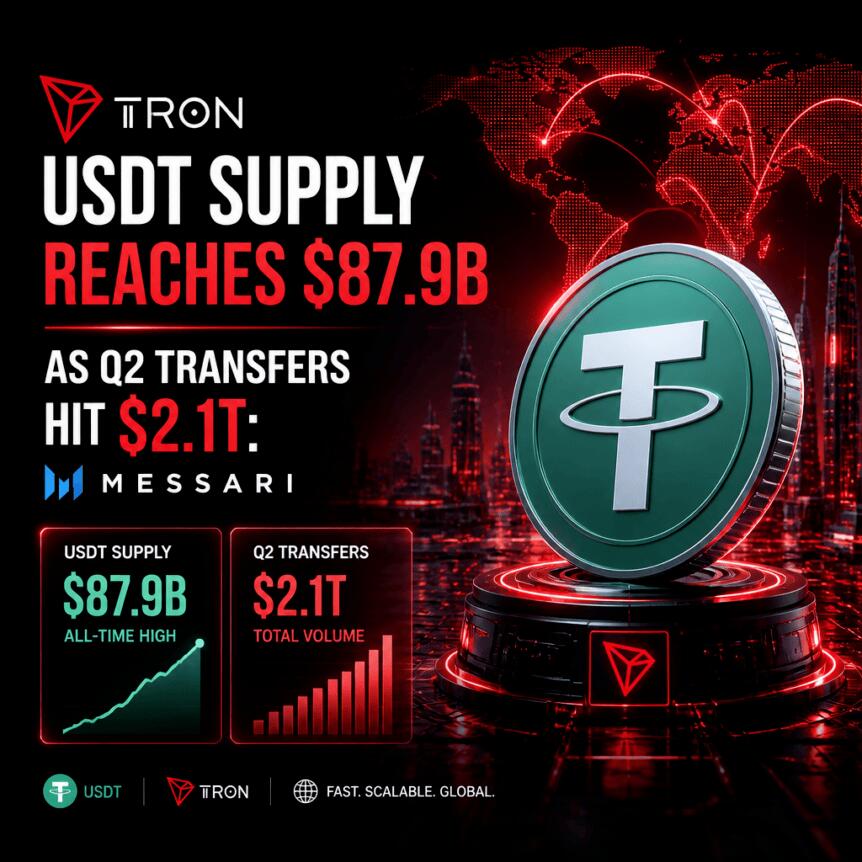
TRON closed its second quarter with a sharp rebound in stablecoin activity, ending the period holding $87.9 billion in circulating USDT—a level that, according to a Messari report, pushed TRON ahead of Ethereum in USDT circulation. The network also handled $2.1 trillion in USDT transfers across the quarter, underscoring how central stablecoin throughput remains to TRON’s growth story.

Messari’s “State of TRON Q2 2026” report attributes much of the expansion to stablecoin market concentration and renewed transfer momentum. It found that USDT made up 98.5% of TRON’s stablecoin market, while the overall stablecoin base grew 4.1% quarter-over-quarter to a record $89.2 billion. Average daily USDT transfer volume also returned to growth, rising 4.3% to $22.8 billion after it had declined in the first quarter.

Key takeaways

  • USDT circulation on TRON hit $87.9 billion in Q2, with Messari noting TRON surpassed Ethereum on circulating USDT.
  • USDT transfers increased meaningfully, with average daily transfer volume up 4.3% to $22.8 billion.
  • Network usage hit new highs: 11.8 million average daily transactions (+8.7%) and 3.6 million active addresses (+11.7%).
  • Fees reversed a two-quarter decline, rising 15.9% to $699.4 million as network fees climbed for the first time since an August 2025 governance change.
  • DeFi activity weakened, with DeFi TVL down 1.9% to $4.4 billion and DEX volume falling for a fourth straight quarter.

Stablecoin momentum returns, and activity follows

The quarter’s headline numbers point to a clear relationship: higher stablecoin transfer flow translated into stronger on-chain usage. Messari reports that TRON averaged 11.8 million daily transactions during Q2, up 8.7% quarter-over-quarter. Daily active addresses also increased, climbing 11.7% to 3.6 million.

On peak days, usage reached even more visible milestones. The report says TRON processed a record 14.6 million transactions on June 15. For investors and traders tracking TRON’s health, this kind of throughput matters because it often correlates with broader stablecoin utility—especially when USDT dominates the stablecoin mix.

Messari’s breakdown reinforces that dominance. With USDT at 98.5% of TRON’s stablecoin market, the network’s stablecoin growth is effectively synonymous with USDT growth. That can create outsized upside when transfers accelerate, but it also concentrates risk if stablecoin demand shifts across chains.

Advertisement

Network fees improve after an earlier policy shift

Beyond volume, Q2 also marked a change in revenue dynamics. Messari notes that higher activity helped reverse a two-quarter decline in TRON network fees. Fees increased 15.9% to $699.4 million, their first quarterly increase since an August 2025 governance change reduced the price of TRON’s “energy unit,” a key metric that influences transaction costs.

From an economic perspective, this is an important nuance. Lower energy unit prices can reduce per-transaction costs, which may improve user experience but can also compress fee totals—at least until activity ramps enough to offset the unit price effect. Messari’s finding that the fee decline has now been reversed suggests Q2’s throughput was strong enough to compensate for the earlier pricing change.

DeFi fades while fundamentals for stablecoins strengthen

Not all parts of TRON’s ecosystem followed the same direction. Messari reports that DeFi TVL fell 1.9% to $4.4 billion. The report also shows that average daily DEX volume dropped 21.7% to $49.3 million, continuing a trend of contraction: it was the fourth consecutive quarterly decline.

For market participants, this divergence between stablecoin rails and DeFi activity is worth monitoring. Stablecoins can remain highly active even when trading and on-chain lending demand soften, particularly if users primarily use the chain for payments or settlement rather than DeFi strategies.

Advertisement

TRON’s token supply dynamics also remained a mixed signal. Despite the higher activity levels, the report states that TRX supply stayed inflationary. Circulating supply increased by 87 million tokens during the quarter, with issuance continuing to outpace burns. That means network usage growth in Q2 did not translate into immediate deflationary pressure on supply.

Institutional access expands across trading, tokenization, and staking

Alongside the on-chain activity metrics, Messari highlights a separate thread: growing institutional access to TRON products during Q2. Securitize reportedly launched Hamilton Lane’s tokenized Senior Credit Opportunities Fund on TRON, described as the network’s first TRON-issued asset. The fund began with about $4.3 million under management.

Grayscale also expanded the conversation around institutional custody and exposure by adding TRX to its list of assets under consideration. Separately, a proposed staked TRX exchange-traded product from Canary Capital remained in registration, according to the report.

Broader market access reflected similar momentum. Bitnomial launched spot TRX trading in the United States, OKX Europe introduced MiFID-regulated TRX expiry perpetuals, and Binance.US restored trading in the token during the quarter.

Advertisement

The push for institutional infrastructure did not stop after Q2. Earlier coverage noted that Anchorage Digital added native TRX staking and custody for TRC-20 assets in July, enabling institutional clients to stake TRX directly from its custody platform.

Taken together, these developments suggest TRON’s narrative is broadening beyond consumer usage and stablecoin transfers toward more regulated, institutional-friendly access paths. For investors, that can matter because improved access often reduces friction—both operational and regulatory—when firms decide how to allocate capital across crypto assets.

Looking ahead, readers should watch whether TRON’s stablecoin-driven strength can pull more DeFi liquidity back in, given that DEX volumes and DeFi TVL fell for multiple quarters. At the same time, the sustainability of higher fees after the earlier energy unit change will likely be tested by the next round of network usage—especially on peak days like the June 15 transaction record.

Risk & affiliate notice: Crypto assets are volatile and capital is at risk. This article may contain affiliate links. Read full disclosure

Advertisement

Source link

Continue Reading

Crypto World

CLARITY Act delay draws backlash before September vote

Published

on

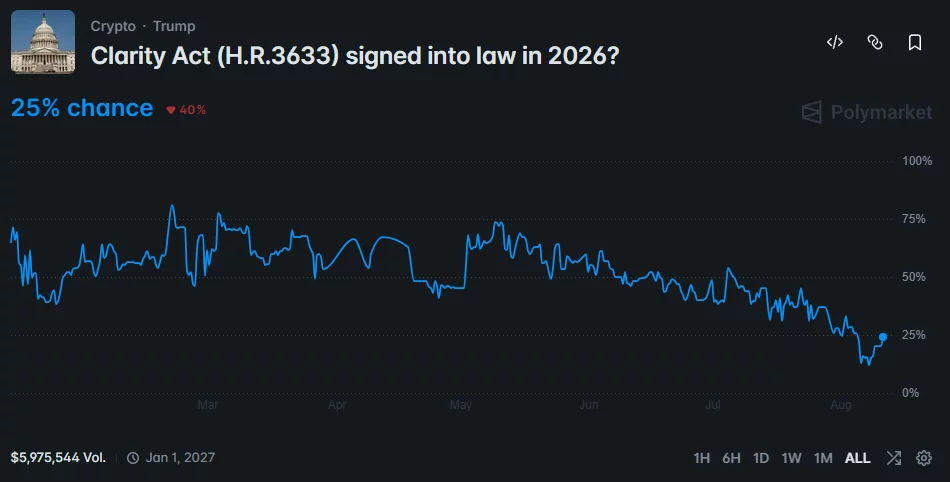
Polymarket chart shows the CLARITY Act’s 2026 passage odds falling to 25%, with nearly $6 million in trading volume.

Crypto industry leaders are voicing frustration after the U.S. Senate failed to advance the CLARITY Act before its August recess, leaving the market structure bill facing a crucial procedural vote weeks before the 2026 midterm elections.

Summary

  • Senate leaders filed cloture, setting up a Sept. 15 procedural vote on the CLARITY Act.
  • Coinbase executives and Sen. Cynthia Lummis called the pre-recess failure disappointing and frustrating.
  • Ethics restrictions and stablecoin rewards remain unresolved as the bill seeks 60 Senate votes.
  • Polymarket traders give CLARITY a 25% chance of becoming law during 2026.

CLARITY Act faces a Sept. 15 procedural vote

Senate Majority Leader John Thune filed cloture on the motion to proceed to the Digital Asset Market Clarity Act shortly before the Senate began its month-long recess, according to the Senate Daily Press.

The filing positions the legislation for an initial procedural test after senators return to Washington on Sept. 14. The cloture motion is scheduled to ripen on Sept. 15, according to previous crypto.news coverage.

Advertisement

The vote would determine whether the Senate begins formally considering the bill. It would not amount to final passage.

CLARITY would still need to move through debate and possible amendments before receiving a separate approval vote. Any Senate-approved version that differs from the measure passed by the House would also need to return to the lower chamber before reaching President Donald Trump’s desk.

The legislation needs at least 60 votes to clear the Senate’s cloture threshold. Republicans cannot reach that number without Democratic support, making the remaining bipartisan negotiations central to its prospects.

Advertisement

The House approved the CLARITY Act by a 294–134 vote on July 17, 2025, with 78 Democrats supporting the legislation. The Senate Banking Committee advanced its portion of the legislation by a 15–9 vote in May 2026, with Democratic Sens. Ruben Gallego and Angela Alsobrooks joining Republicans.

Crypto leaders criticize the Senate delay

Industry executives and advocates reacted negatively after lawmakers left Washington without holding a procedural vote.

“You can imagine how frustrated I am,” Sen. Cynthia Lummis said after the chamber failed to schedule the legislation for consideration before the recess.

Lummis added that she would continue working with other senators and described the effort as “far from over.” She had previously pushed for a CLARITY Act vote before the August recess, saying negotiators had spent months working through the bill’s CFTC provisions and other disputes.

Advertisement

Coinbase CEO Brian Armstrong also called the delay disappointing but argued that broader crypto adoption would continue regardless of Congress’ schedule.

Armstrong pointed to stablecoin adoption, tokenization, and expanding digital asset markets as sources of continued momentum. Coinbase Chief Policy Officer Faryar Shirzad similarly said September would offer lawmakers another opportunity to “finish the job.”

As crypto.news previously reported, the delay has not produced an immediate decline in Coinbase shares. COIN closed Friday at $153.60, gaining about 5.7% during the session.

BitMine Chair Tom Lee offered a similar market assessment in the company’s weekly report. Lee said investors appeared more focused on softer inflation and employment data than on the immediate consequences of CLARITY failing to advance before the recess.

Advertisement

Ethics and stablecoin rewards divide senators

The September timetable gives lawmakers more time to negotiate but also pushes the vote closer to the Nov. 3 midterm elections. The Senate will have roughly seven weeks between its return and Election Day, narrowing the available floor time for a complex bill.

Democratic demands for stronger ethics restrictions remain one of the main obstacles. Several lawmakers want the bill to address crypto investments and business interests held by senior federal officials and their families.

Those concerns have centered on Trump’s association with World Liberty Financial and the Official Trump memecoin launched shortly before he returned to office. Sen. Elizabeth Warren supports creating a federal crypto framework but has rejected the current CLARITY Act over corruption, consumer protection, national security, and financial stability concerns.

Banking groups are pressing senators from another direction. They argue that the legislation could still allow crypto companies to provide stablecoin rewards under certain conditions, potentially drawing deposits away from community banks.

Advertisement

The current framework distinguishes between interest paid simply for holding a stablecoin and rewards connected to activities such as trading, payments, or loyalty programs. That distinction has placed companies such as Coinbase at the center of the dispute.

Banking associations have urged the Senate to close what they describe as stablecoin-yield loopholes. Crypto advocates counter that the legislation already prevents stablecoin issuers from paying deposit-like interest and that broader restrictions would protect banks from competition.

Prediction markets remain split on passage

Prediction markets show traders expect the Senate to vote on CLARITY in September, but they remain doubtful that the legislation will become law before the end of 2026.

A Kalshi contract with approximately $1.23 million in trading volume placed the probability of a Senate vote before Oct. 1 at 88%. That closely aligns with the Sept. 15 procedural schedule created by Thune’s filing.

Advertisement

However, a separate Polymarket contract assigned only a 25% probability that CLARITY would be signed into law during 2026. More than $5.79 million had been traded on that market.

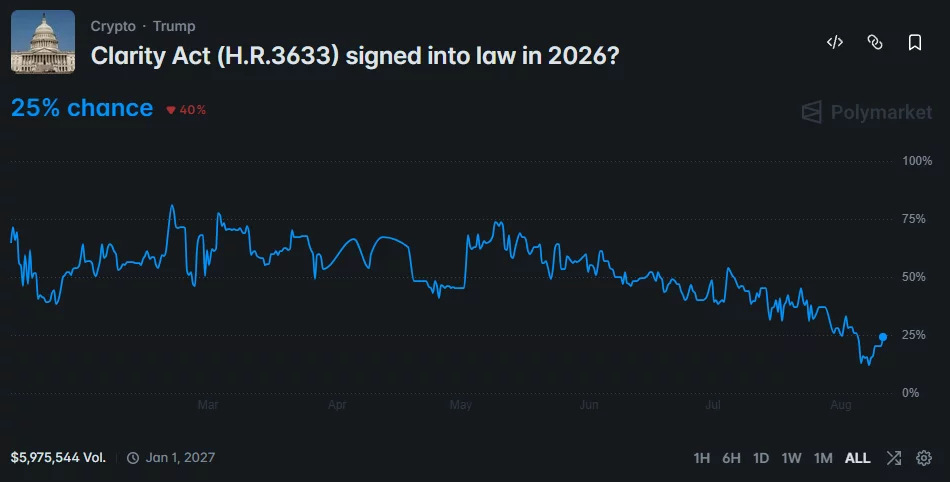
Polymarket chart shows the CLARITY Act’s 2026 passage odds falling to 25%, with nearly $6 million in trading volume.
Source: Polymarket

The difference reflects the additional steps required after the first Senate vote. Lawmakers must clear the 60-vote threshold, settle disagreements over ethics and stablecoin rewards, approve a final Senate text, and reconcile it with the House version.

Longer-term contracts have increasingly shifted expectations into 2027. Kalshi traders recently placed the probability of the legislation taking effect before July 1, 2027, at 41%, while assigning higher odds to passage under later deadlines, according to crypto.news reporting.

The Sept. 15 vote will provide the next concrete test. Clearing cloture would allow senators to begin considering the bill, but its final passage would still depend on whether negotiators can convert procedural support into a durable bipartisan agreement.

Advertisement

Source link

Continue Reading

Crypto World

SpaceX Stock Finally Breaks Out of a 30-Day Price Dump, Will It Last?

Published

on

SpaceX (SPCX) Stock Performance

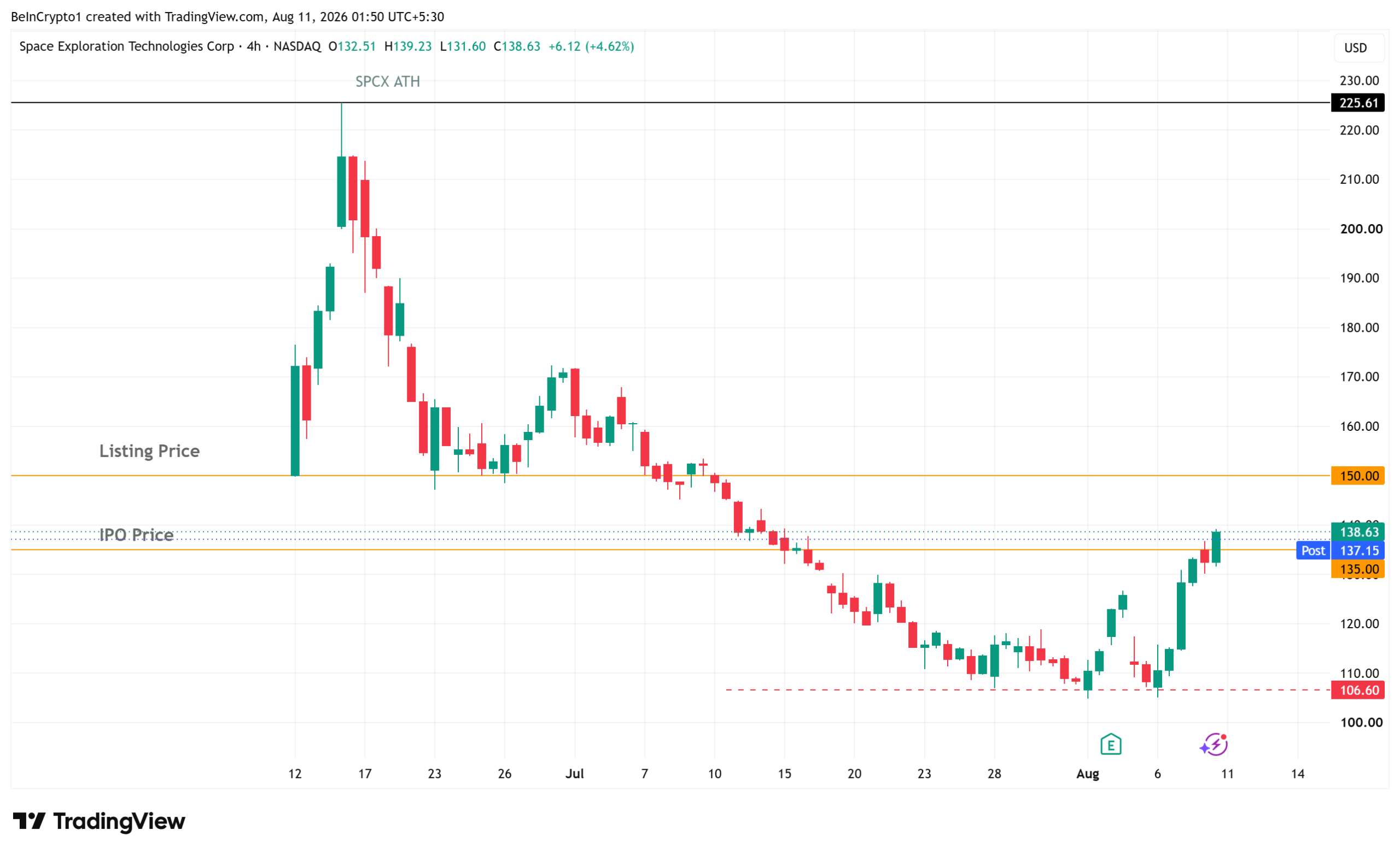
SpaceX (SPCX) stock traded back above its $135 IPO price on Monday for the first time in nearly a month. Shares changed hands near $138, up more than 4%, according to TradingView data.

Two forces collided to get it there. Deutsche Bank doubled down on the company’s boldest revenue promise, just as small investors quietly began cashing out.

SpaceX (SPCX) Stock Performance
SpaceX (SPCX) Stock Performance. Source: TradingView

Follow us on X to get the latest news as it happens

Deutsche Bank Maps the Road to $100 Billion

SpaceX wants to reach $100 billion in annual recurring revenue (ARR) by December. ARR projects the latest repeat sales over a full year.

The target sounds extreme. Deutsche Bank analyst Edison Yu argues it can happen.

Advertisement

“As a baseline, 2Q’s [ARR] run-rate was just $31 billion, meaning management is aiming to more than triple that in just six months. We see this target as likely very achievable, driven mainly by neocloud and Cursor contribution,” Yu made the case in a Monday note, alongside a Buy rating and $235 price target.

The engine is neocloud, SpaceX’s business of renting AI computing power to outside customers. One client, the AI developer Anthropic, paid $1.6 billion last quarter. Yu expects that to jump to $3.75 billion this quarter.

Google’s deal reaches $920 million per month by October. A new $6.7 billion contract, possibly with the US government, ramps at the same time. Yu sees these deals producing $45 billion to $50 billion in ARR by December. Cursor, the AI coding startup, drives another leg.

Elon Musk already holds a trillion-dollar revenue target for 2030.

Advertisement

However, cost is the catch. SpaceX spent $18.4 billion on capital projects last quarter, per its first quarterly earnings report. Wall Street had expected about $6 billion, with similar outlays signaled through year-end.

Retail Sells SpaceX Stock While Wall Street Stays Bullish

Small investors picked this rally to step back. They sold a net $4.5 million of SPCX on Friday, Vanda Research told Reuters. It marked their first net selling since the June 12 listing.

The signal outweighs the size. Retail buyers took at least 30% of the shares offered at the IPO. Their best single buying day hit $144.6 million in June. Friday’s trickle still ended a two-month streak.

Advertisement

Sam North, market analyst at trading platform eToro, reads it as discipline rather than fear.

“Friday is particularly interesting because retail turned net sellers while the shares were rebounding strongly and trading back around the IPO price. That looks more like investors using strength to take some money off the table than panic selling.”

The math supports him. Retail’s average entry sits near $147, Vanda estimates, so selling near $135 trims losses into strength. The same crowd bought heavily during the post-earnings stock slide on August 5, when shares sank 13.6%.

The stock has earned that caution. It peaked at $225.61 in June, 67% above the IPO price, then hit $104.83 on August 3. Roughly 911.5 million insider shares became tradable last week as the lockup overhang lifted. The float more than doubled, yet the rally held.

Wall Street keeps buying the story regardless. SPCX holds a Moderate Buy consensus from 31 analysts, per TipRanks. The average target of $229.33 implies roughly 66% upside. Yet targets span $75 to $800, showing deep disagreement over what SpaceX is worth.

Advertisement
SpaceX (SPCX) Stock Forecast & Price Target
SpaceX (SPCX) Stock Forecast & Price Target. Source: TipRanks

Third-quarter results will settle the argument. They will show whether the Anthropic and Google deals grow as fast as Yu’s math requires. Until then, cautious retail money and bold analyst targets will keep pulling the stock in opposite directions.

The post SpaceX Stock Finally Breaks Out of a 30-Day Price Dump, Will It Last? appeared first on BeInCrypto.

Source link

Continue Reading

Crypto World

Breaking Down the Euphoric Ending of ‘Teenage Sex and Death at Camp Miasma’

Published

on

Breaking Down the Euphoric Ending of 'Teenage Sex and Death at Camp Miasma'

Kris bursts into Bunk 5 gasping. You made it, Billy soothes, adding that it’s just play. “It doesn’t feel like play, Billy,” Kris says. “I know,” Billy answers. “But it is.” Everything the film taught them converges on the bed. Billy lies over her, tells her she’s almost there, almost dead, and asks her to do what Billy did on that mattress decades ago: watch herself through his eyes. Kris does. Billy once left her body to survive a scene; Kris leaves hers to arrive in one.
We enter Little Death’s perspective, taking in the blue door, the candles on the railing, the slow approach down the hallway, while Kris narrates her own stalking in a mounting gasp: He’s walking inside, he’s coming closer, she can see herself now. Terror is no longer distinguishable from arousal. “Billy, I don’t want to die,” she pleads, and then, in the same breath, “Billy, please don’t leave me.” Billy stays. The spear comes down through them both, and Einbinder plays the instant of it with astonishing precision: Kris’s face moving from something like surprise into unmistakable release, her eyes fluttering as the blood arrives.

Source link

Continue Reading

Crypto World

Robinhood's Head of Product Reveals How Robinhood Chain Hit 200M Transactions in 30 Days

Published

on

Robinhood's Head of Product Reveals How Robinhood Chain Hit 200M Transactions in 30 Days


🎧 Listen to Interview 💻 Watch Video… Read the full story at The Defiant

Source link

Continue Reading

Crypto World

North Korea’s Kimsuky Turns to AI as Crypto Firms Face New Threats

Published

on

Kimsuky has been setting up local AI environments as it looks for ways to bring artificial intelligence into its cyberattack operations. The North Korea-linked threat actor, which has frequently targeted the cryptocurrency and financial sectors, was found to have established local LLM environments using Ollama, GPT4All, and Msty.

Genians said the local approach prevents conversation data from being transmitted to external AI services, thereby reducing the risk of external exposure.

AI Added to Crypto Attack Playbook

According to the report, the activity showed the group was building capabilities to integrate artificial intelligence into its attacks. In GPT4All, investigators detected a database linked to its LocalDocs feature. The cybersecurity firm said the evidence indicates that the threat actor may have attempted to connect documents in its possession to an AI system and use them as a knowledge source.

The group also collected libraries and frameworks that can integrate artificial intelligence into software. These included LLaMaSharp, Microsoft Semantic Kernel and Microsoft Agents AI. The components covered local AI execution, document retrieval, automated agents and integration with external AI services.

Advertisement

The investigation also found files related to Whisper and faster-whisper, speech-to-text tools. Genians said such tools could be abused to process and analyze material stolen or collected from compromised systems.

The company further added,

“This provides concrete evidence that the Kimsuky-affiliated threat actor is moving beyond one-off experimentation with AI and is continuously preparing to integrate the technology into actual attack capabilities, including malware development, data analysis, and the advancement of attack techniques.”

North Korea, Hackers and the Crypto Industry

Zooming out, North Korea-linked attackers were responsible for more than half of the cryptocurrency stolen in the first half of 2026, according to Blockaid’s recent findings. The firm said DPRK-linked attackers stole about $609 million during the period, making up roughly 55% of the $1.1 billion lost across 212 incidents.

The KelpDAO and Drift Protocol attacks were linked to TraderTraitor, a North Korean state-sponsored group associated with Lazarus. The two attacks accounted for most of the DPRK-linked losses. Humanity Protocol also lost $32 million in an attack tied to the same group. The findings highlight North Korea’s continued role in some of the biggest crypto thefts of 2026.

Advertisement

These operatives have also sought access from inside the industry. Prominent blockchain investigator ZachXBT had previously reported that North Korean IT workers generated more than $3.5 million in crypto through fake developer identities and a coordinated payment system. The operation came to light after a hacker compromised one worker’s device and exposed records tied to nearly 390 accounts.

The leaked data showed that the operation was bringing in about $1 million a month. Workers used fake identities and forged documents to secure jobs on different projects. Their payments were tracked through an internal platform, where workers reported their income and administrators managed transfers. Records from the compromised device also showed the use of VPNs and multiple fabricated personas. Chat logs revealed that dozens of workers were active in the same system.

The post North Korea’s Kimsuky Turns to AI as Crypto Firms Face New Threats appeared first on CryptoPotato.

Source link

Advertisement
Continue Reading

Crypto World

What to Know About the Earthquake in Colombia

Published

on

What to Know About the Earthquake in Colombia

A 7.4-magnitude earthquake rattled western Colombia on Monday, causing widespread destruction and leaving at least 111 people dead.

Colombian President Abelardo De La Espriella, who was sworn into office just days before the disaster struck the nation, said in a post on X on Monday morning that he had “directly assumed leadership of the emergency response.” In another post that morning, he said that he was traveling to the nation’s capital, Bogotá, “to focus on addressing the emergency facing our country.”

“To the Colombians who are going through difficult times today, I want to say: you are not alone,” he said. “You have a President who cares deeply for his people and who will do everything necessary to protect you, support you, and move forward together in rebuilding the affected regions.”

Here’s what to know about the earthquake.

Advertisement

When and where did the earthquake happen?

The epicenter of the earthquake was near San José del Palmar, which is a community west of the country’s capital that has a population of 5,000 and is located in the Chocó region. Other cities nearby, including Pereira, Manizales, and Cali, were impacted, too.

Neighboring countries, including Venezuela, Ecuador, and Panama, also felt the quake.

The damage sustained by the Manizales Cathedral are pictured after the earthquake in Manizales, Colombia, on Aug. 10, 2026. Andres Valencia—AFP/Getty Images

How strong was the earthquake?

Advertisement

USGS reported that the earthquake that struck Colombia had a 7.4 magnitude. “Magnitude” indicates the size of a quake—one with a 5.3 magnitude, for instance, is a “moderate” quake, whereas one with a 6.3 is considered “strong,” according to USGS. The back-to-back quakes that shook Venezuela in June and left more than 6,000 people dead each had a magnitude above 7.

The Colombian Geological Service reported that the quake had a depth of about 103 km, in addition to its 7.4 magnitude, “making it the strongest earthquake recorded in Colombia in the last decade.” The agency also said that two aftershocks—with magnitudes of 2.8 and 4.8—have been recorded so far on Monday

What is the death toll?

The disaster in Colombia left at least 111 people dead, according to the AP. The majority of the deaths reported so far occurred in the region of Risaralda—the capital of which is Pereira—where at least 40 people were killed, the AP reported. Authorities said that at least 27 more people were killed in the nearby region of Valle del Cauca.

Advertisement

De La Espriella said on Monday that at least 87 people were wounded by the quake, the AP reported.

A police officer walks amid the debris of a damaged commercial store after the earthquake in Manizales, Colombia, on Aug. 10, 2026. Jonh Bonilla—AFP/Getty Images

What damage has been reported?

The total extent of the damage caused by the earthquake is not yet clear hours after it hit, but videos and photos shared by news outlets showed buildings in multiple cities collapsing and being destroyed by the disaster. 

Local officials said that they had received reports of many people trapped under buildings that had collapsed.

Advertisement

The International Rescue Committee (IRC) said that its teams are monitoring the situation.

“Our teams near the epicenter in Chocó are reporting damages to infrastructure, including to hospitals and clinics,” Nicole Kast, IRC’s Country Director for Colombia, Venezuela and Ecuador, said in a statement. “Impacted communities were already facing armed conflict and high levels of poverty before the ground began to shake. The IRC is monitoring the situation and stands ready to scale up its response as the full extent of the destruction becomes clear.”

Colombia’s civil aviation authority said in a post on X on Monday morning that it had received reports of damage at airports in Pereira, Manizales, Quibdó, Armenia, Cartago, and Buenaventura, and that operations there were being suspended “for safety reasons” until the damage had been assessed.

An elderly woman is carried on furniture near a collapsed building after an earthquake in Cali, Colombia, on Aug. 10, 2026. Joaquin Sarmiento—AFP/Getty Images

Is there a tsunami threat after the earthquake?

Advertisement

While earthquakes can sometimes trigger tsunamis, the U.S. Tsunami Warning System said on Monday that there was no warning, advisory, watch, or threat for a tsunami after the earthquake in Colombia.


Source link

Continue Reading

Crypto World

Two Prediction Markets Shut Down Hours Apart as Kalshi and Polymarket Take 93% of Volume

Published

on

Two Prediction Markets Shut Down Hours Apart as Kalshi and Polymarket Take 93% of Volume


Two crypto prediction market startups announced they were winding down within 90 minutes of each other on Monday morning, both giving users until Sept. 30 to pull their money out. The venues that closed sat at opposite ends of the market. Trepa built its own mechanism on Solana, paying users by how… Read the full story at The Defiant

Source link

Continue Reading

Crypto World

Trump Media (DJT) BTC holdings shrink as crypto losses hit $361 million

Published

on

Trump Media’s Q1 loss widens to $406 million on bitcoin, CRO markdowns

Trump Media and Technology Group’s (DJT) bitcoin holdings shrank during the second quarter of the year as falling crypto prices saddled the Truth Social parent with $360.6 million in losses in the first half of the year.

The company held 9,477.16 bitcoin with a fair value of $557.1 million as of June 30, according to its quarterly filing Monday. That’s down from 9,542.16 BTC at the end of March, translating to a 65 BTC decline in holdings through the quarter.

Trump Media’s Crypto.com-linked cronos holdings remained unchanged at roughly 756.1 million tokens, but their fair value fell to $40.6 million from $68 million at the end of 2025.

A significant chunk of the company’s bitcoin was also tied up as collateral. Trump Media, which is majority owned by the Donald J. Trump Revocable Trust, had 4,260.73 BTC pledged against convertible notes and another 2,077.34 BTC pledged for its bitcoin options strategy as of June 30.

Advertisement

U.S. President Donald Trump owns a significant stake in the trust, which is controlled by Donald Trump, Jr., one of the president’s children.

The results landed only days after Trump Media pared back parts of its crypto ambitions.

Source link

Advertisement
Continue Reading

Trending

Copyright © 2025