
Crypto World
329T SAND minted, $675K stolen

A bridge configuration flaw on Base and BNB Smart Chain let attackers hijack LayerZero delegate permissions, mint trillions of phantom SAND tokens, and drain roughly $675,000 from the Ethereum vault before the team shut everything down. The $49 billion face value headline masked the real story: structural constraints meant the attacker could never have cashed out more than a fraction of what was created.
Summary
- An attacker exploited the `approveAndCall` function on The Sandbox’s SAND omnichain fungible token contract on Base, hijacking LayerZero delegate permissions and minting 329.24 trillion unbacked SAND across 703 events over five hours on Aug. 21 and 22, 2026.
- The face value of minted tokens reached approximately $49 billion according to security firm Blockaid, but the actual extraction totaled roughly 14.75 million SAND (about 80 ETH, or $675,000) drained from the Ethereum OFT Adapter in under 60 seconds.
- The Sandbox disabled bridging on Base and BNB Smart Chain, removed LayerZero peer settings via multisig governance, and confirmed that SAND on Ethereum and Polygon remained untouched throughout the incident.
- The project announced a 1:1 reimbursement plan from its treasury for eligible holders, with no new SAND tokens to be minted and a claims portal expected within two weeks of the Aug. 27 post-mortem.
- The exploit marked the third major LayerZero-related bridge failure in five months, accelerating a $15 billion migration wave from LayerZero to Chainlink CCIP led by BitGo, Mantle, and Lombard.
On the night of Aug. 21, 2026, an address that had been dormant for 313 days routed a crafted payload through The Sandbox’s SAND token contract on Base. Within five hours, blockchain explorers showed trillions of freshly minted SAND tokens spreading across 173 wallets. Security firm PeckShield flagged the activity first, and by the time The Sandbox team responded, the attacker had already extracted what they could and moved on. The headline numbers were staggering, but the actual financial damage told a very different story.
The gap between the face value of minted tokens and the real amount stolen reveals something important about how bridge exploits actually work. It also exposes a recurring pattern in cross-chain infrastructure: the same design choices that make bridges useful also make them fragile, and a single misconfiguration can open a door that costs millions to close.
How the approveAndCall exploit worked
The technical root of the attack sat inside a function called `approveAndCall` on The Sandbox’s SAND omnichain fungible token contract deployed on Base. In a standard OFT setup built on LayerZero, a delegate address on the destination chain holds administrative rights over the endpoint configuration. Those rights include the ability to set trusted peers, update security stacks, and authorize privileged calls into the token contract.
The attacker discovered that the `approveAndCall` function could be weaponized to hijack those delegate permissions. By routing a crafted payload through the SAND token contract, the attacker manipulated the delegation mechanism and assumed control over the minting process on Base. Once the delegate was compromised, the OFT no longer required a legitimate burn on the source chain to authorize a mint on the destination chain. The attacker essentially became the sole verifier for incoming bridge messages, gaining the ability to approve fraudulent messages without the authorization normally required by the bridge.
The Sandbox’s post-mortem stressed that no private keys were compromised and no unauthorized access to wallets took place. The vulnerability stemmed entirely from design flaws in the operational contract structure itself. That distinction matters because it means the flaw was not a case of stolen credentials or social engineering. It was a configuration problem baked into the bridge architecture from deployment.
The attacker minted 329.24 trillion SAND across 703 separate events over approximately five hours on Aug. 21 and 22. The minting happened on Base first, with secondary exposure on BNB Smart Chain. Ethereum and Polygon, where the vast majority of SAND’s legitimate supply resides, were never affected.
The $49 billion illusion versus $675,000 reality
The most misleading number in the entire incident was the $49 billion face value that Blockaid attached to the minted tokens. That figure came from multiplying the number of minted tokens by SAND’s market price at the time, a calculation that ignored every practical constraint on actually selling those tokens.
The reality was far smaller. The attacker drained approximately 14.75 million SAND from the Ethereum OFT Adapter in under 60 seconds. That extraction generated about 80 ETH, worth roughly $675,000 at the time of the transactions. The attacker sold tokens across 26 separate transactions, each sized to extract approximately 90 percent of available ether from the liquidity pool before it could recover.
One detail from the EGamers post-mortem stood out: the attacker minted exactly 14,743,364.21 SAND, which was precisely 100 tokens below the vault’s holdings at that moment. The precision suggested careful reconnaissance of the vault balance before execution. However, an unforeseen arbitrage bot disrupted the plan, leaving the attacker with 14,095,483.66 SAND instead of the intended amount.
The trillions of additional tokens minted on Base were essentially worthless. They could not be redeemed through the official bridge because The Sandbox disabled bridging before any meaningful redemption could occur. They could not be sold on decentralized exchanges because liquidity pools on Base did not hold anywhere near enough paired assets to absorb even a tiny fraction of the supply. The tokens existed on chain but had no path to value extraction.
This dynamic is important for understanding bridge exploits more broadly. The “total tokens minted” headline dramatically overstates the actual damage. The constraint is always liquidity, not the number on screen. An attacker can print any number of tokens on a destination chain, but the tokens are only worth what someone will pay for them, and in a bridge exploit scenario, the available liquidity evaporates almost instantly.
The Sandbox response and bridge shutdown
The Sandbox team moved relatively quickly once the exploit was identified. Hours after PeckShield’s initial alert, the team disabled all bridging to and from Base and BNB Smart Chain. The shutdown was executed at the contract level on both chains, and the team removed LayerZero peer settings via multisig governance to prevent any further cross-chain messages from being processed.
The project issued a statement confirming that SAND tokens on Ethereum and Polygon were not affected. No user wallets were compromised. The SAND locked on Ethereum, which backs all legitimately bridged SAND, remained fully intact throughout the incident. The team estimated the impact at less than 0.01 percent of the total SAND token supply when measured against the 3 billion maximum supply.
Korean exchanges Upbit and Bithumb suspended SAND deposits and withdrawals on Aug. 22, citing a suspected security incident and South Korea’s Virtual Asset User Protection Act. Upbit went further and froze SAND transfers on Ethereum, the chain The Sandbox said was not affected, suggesting the exchange was taking a cautious approach regardless of the project’s assurances. Coinbase separately delisted SAND perpetual futures contracts.
SAND’s price saw a near 10 percent intraday plunge after the incident was disclosed but recovered most of the loss within 24 hours, trading down just 0.8 percent over the full day. The muted price impact reflected the market’s relatively quick understanding that the actual financial damage was small and that the inflated token count could not be converted to real value.
Bridge security remains the weakest link
The Sandbox exploit did not happen in isolation. It was the third major LayerZero-related bridge failure in five months, following the $292 million Kelp DAO attack in April and the Stake DAO breach in May. Each exploit targeted different aspects of LayerZero’s architecture, but all three shared a common thread: insufficient verification redundancy.
The Kelp DAO attack was the most damaging. On April 18, 2026, attackers linked to North Korea’s Lazarus Group drained 116,500 rsETH, worth approximately $292 million, from KelpDAO’s LayerZero-powered bridge. The attack began six weeks earlier when an attacker socially engineered a LayerZero Labs developer, harvesting session keys and pivoting into LayerZero’s internal RPC environment. The attackers then poisoned internal RPC nodes and launched a DDoS attack against external providers, feeding false data to a single verifier that was the only checkpoint standing between the attacker and $292 million.
The KelpDAO hack wiped $13 billion from DeFi within 48 hours as users rushed to exit protocols they perceived as vulnerable. Curve Finance halted LayerZero infrastructure as a precaution after the attack, affecting CRV bridging on multiple chains.
LayerZero’s Decentralized Verifier Network allows applications to select as few as one verifier to validate cross-chain messages. Chainlink CCIP, by contrast, requires a minimum of 16 independent node operators per lane plus a separate Risk Management Network. That architectural difference explains why the industry response to these exploits has been a massive migration away from LayerZero.
By August 2026, publicly announced migrations from LayerZero to Chainlink CCIP totaled approximately $15 billion in secured value. BitGo led the wave by moving $7.4 billion in WBTC. Mantle shifted its $2.5 billion Super Portal. Lombard transferred over $1 billion in bitcoin-backed assets. Solv Protocol moved $700 million in tokenized bitcoin reserves. Kraken replaced LayerZero with Chainlink CCIP for its kBTC wrapped asset. Even Wyoming’s Stable Token Commission selected Chainlink CCIP for its Frontier Stable Token.
LayerZero’s ZRO token fell to approximately $302 million in market capitalization from an all-time high near $7.47. Nethermind, a former LayerZero verifier operator, exited to join Chainlink as a node operator.
The reimbursement plan
The Sandbox announced on Aug. 27 that it would reimburse affected SAND holders at a 1:1 ratio from its treasury. The total loss stood at 14.7 million SAND tokens, worth approximately $700,000. No new tokens would be minted for the compensation, meaning the reimbursement would not increase SAND’s circulating or maximum supply.
Eligible users were those who legitimately held bridged SAND on Base or BNB Smart Chain before the Aug. 21 attack. The project planned a snapshot-based compensation system using pre-attack balances. The two largest centralized exchanges holding over 72 percent of affected balances agreed to distribute replacement tokens directly to their customers without requiring individual claims. Other holders would need to submit claims through a dedicated portal expected to open within two weeks of the post-mortem.
The treasury-funded approach was a relatively clean resolution. Unlike some exploit responses that involve emergency token mints, governance votes on inflation, or protracted recovery processes, The Sandbox had sufficient reserves to absorb the loss directly. The $700,000 price tag, while not trivial, was manageable for a project with a treasury of its size.
The history of bridge exploits in numbers
Cross-chain bridges have consistently been the most attacked category of smart contracts since the technology emerged. The cumulative damage tells a sobering story about the structural risks of moving assets between blockchains.
Bridges have leaked more than $4 billion to hackers since 2021, according to data compiled across Chainalysis, DeFiLlama, and independent security researchers. The list of individual disasters includes the $624 million Ronin exploit in March 2022, the $326 million Wormhole theft in February 2022, the $190 million Nomad hack in August 2022, and the $292 million Kelp DAO breach in April 2026.
In 2024, bridges and cross-chain messaging protocols accounted for $1.19 billion of total crypto losses despite representing fewer than 5 percent of monitored protocols by count. That disproportionate figure reflects the concentrated risk that bridges carry: they hold or control large pools of assets across chains, and a small flaw can drain a fortune in minutes.
The year 2025 was worse. Over $3 billion was stolen across 119 hacks in just the first half of the year, a 50 percent jump over all of 2024’s losses. More than $1.5 billion of that total funneled through cross-chain bridges. The $1.5 billion Bybit compromise drove much of the annual total.
In 2026, bridge exploits have already accounted for $329 million from eight separate attacks through August. April 2026 was identified as the single worst month in DeFi’s history by number of attacks, with more than 30 separate incidents netting attackers almost $635 million in total. Q2 2026 saw 99 exploits draining $746 million, with cumulative DeFi losses for the year exceeding $840 million by the end of May.
The pattern is clear: despite years of audits, bug bounties, and architectural improvements, bridges remain the soft underbelly of cross-chain infrastructure. Each year brings new attack vectors and new headlines, but the fundamental vulnerability persists because bridges must hold concentrated pools of value and rely on verification mechanisms that can be compromised.
The OFT architecture problem
The Sandbox exploit raised uncomfortable questions about the omnichain fungible token standard itself. OFTs are designed to allow tokens to move freely across multiple blockchains by burning on one chain and minting on another, with a locked pool on the home chain serving as the ultimate backing. The architecture is elegant in theory, but each destination chain introduces a new attack surface.
In The Sandbox’s case, the SAND contract on Base inherited the `approveAndCall` function from earlier ERC-20 implementations. That function was designed for a different era of token standards, one where tokens lived on a single chain and delegate permissions carried less weight. When combined with LayerZero’s OFT framework, the function became a vector for hijacking cross-chain minting authority. The interaction between legacy token functions and modern cross-chain messaging created a vulnerability that neither system would have had in isolation.
The problem extends beyond The Sandbox. Any OFT deployment that includes `approveAndCall` or similar callback functions on destination chains could be vulnerable to the same class of attack. The Sandbox’s post-mortem did not disclose how many other OFT deployments share this pattern, but security researchers have noted that the function is common in older token contracts that were later wrapped in OFT adapters.
The broader lesson is that cross-chain token standards must account for the full surface area of the underlying token contracts they wrap. An audit that examines only the bridge logic without scrutinizing legacy functions on the token itself can miss exactly the kind of flaw that enabled the SAND exploit. Projects that deployed OFT bridges on top of existing token contracts face a particular risk because the original contracts were designed without cross-chain minting authority in mind.
This architectural concern is separate from the LayerZero verifier discussion. Even with multiple verifiers, a delegate hijack through `approveAndCall` could bypass the verification layer entirely because the attacker would already hold the keys to the minting function. The fix requires changes at the token contract level, not just the messaging protocol level.
Lessons from the phantom mint
The Sandbox incident crystallized several lessons that apply far beyond a single gaming token.
First, face-value calculations are misleading and potentially dangerous for market participants. When Blockaid reported $49 billion in minted tokens, that number traveled through headlines and social media without context. Traders who sold SAND based on a $49 billion figure were reacting to a phantom number. The actual extraction was $675,000. The gap between those two numbers is the difference between a catastrophic failure and a manageable incident. Media outlets that reported the $49 billion number without qualifying it as a notional figure contributed to unnecessary panic selling and distorted the market’s initial reaction to the incident.
Second, the approveAndCall vulnerability was a configuration flaw, not a novel zero-day exploit. The function existed in the deployed contract from the beginning. The delegate permissions structure was part of the standard OFT architecture. The attacker did not need to discover a previously unknown cryptographic weakness or break any encryption. They needed to understand how the pieces fit together and find the point where a crafted payload could hijack existing permissions. That kind of composability risk, where two individually safe systems become dangerous when combined, is one of the hardest categories of vulnerability to catch in standard security audits.
Third, the dormant wallet pattern is worth watching. The attacker’s address had been inactive for 313 days before the exploit. That kind of operational patience suggests either a sophisticated actor who prepared the exploit well in advance or someone who acquired access to a previously funded wallet specifically for this purpose. Either way, the long dormancy period meant the address would not have triggered activity-based monitoring until it was too late. On-chain surveillance systems that rely on recent activity patterns would have classified the wallet as inactive and deprioritized it from alerting systems.
Fourth, the arbitrage bot interference highlighted an underappreciated dynamic in DeFi exploits. The attacker planned their extraction with precision, minting exactly 100 tokens below the vault’s holdings. An automated trading bot disrupted that plan, reducing the attacker’s take by roughly 650,000 SAND. The interaction between exploit execution and automated market activity is a growing factor in how these incidents play out. In some cases, bots can accelerate an exploit by front-running the attacker’s swaps. In this case, the bot accidentally served as an unintentional defense mechanism by consuming liquidity the attacker needed.
Fifth, the speed of the actual extraction deserves attention. The attacker drained 14.75 million SAND from the Ethereum OFT Adapter in under 60 seconds. The five-hour minting spree on Base was essentially noise. The real damage happened in a single minute on Ethereum. That timeline underscores why bridge monitoring systems need to focus on vault drain velocity rather than destination-chain minting volume. A system that alerted on unusual minting activity on Base would have fired hours before the actual theft, but the theft itself was over before any human could have intervened.
What to watch
Bridge audit disclosures: Whether The Sandbox publishes a full technical post-mortem with contract-level details, or limits disclosure to high-level summaries, will signal how transparent the project intends to be about the root cause
LayerZero configuration changes: LayerZero said it will stop signing messages for applications using single-DVN configurations; watch whether existing integrators upgrade or migrate to alternatives
Reimbursement portal launch: The claims portal for non-exchange holders is expected within two weeks of the Aug. 27 post-mortem; delays or complications could erode holder confidence
Korean exchange relisting: Upbit and Bithumb suspended SAND trading; their timeline for restoring deposits and withdrawals will indicate how regulators view the incident severity
CCIP migration pace: The $15 billion migration from LayerZero to Chainlink CCIP is accelerating; further bridge incidents could push total migration volume past $20 billion by year-end
How many SAND tokens were actually minted in the exploit?
The attacker minted 329.24 trillion unbacked SAND tokens across 703 separate events over approximately five hours on Aug. 21 and 22, 2026. Security firm PeckShield initially flagged roughly 14.9 billion SAND created across two wallet addresses, while Blockaid put the face value near $49 billion across more than 400 transactions.
How much money was actually stolen from The Sandbox?
The actual financial extraction was approximately 14.75 million SAND drained from the Ethereum OFT Adapter in under 60 seconds. The attacker converted those tokens into roughly 80 ETH, worth about $675,000 at the time. The EGamers post-mortem estimated total economic damage at approximately $1.5 million when including broader market impact and slippage losses across affected liquidity pools.
What was the approveAndCall vulnerability?
The `approveAndCall` function on The Sandbox’s SAND omnichain fungible token contract on Base allowed the attacker to route a crafted payload that hijacked LayerZero delegate permissions. Once the attacker controlled the delegate, they could authorize minting on the destination chain without a corresponding burn or deposit on the source chain. No private keys were compromised; the vulnerability was a design flaw in the contract structure.
Will The Sandbox reimburse affected holders?
Yes. The Sandbox announced a 1:1 reimbursement plan funded from its treasury. No new SAND tokens will be minted. The two largest exchanges holding over 72 percent of affected balances will distribute replacement tokens directly to customers. Other holders must submit claims through a portal expected within two weeks of the Aug. 27 post-mortem.
Were SAND tokens on Ethereum and Polygon affected?
No. The exploit targeted only the bridge contracts on Base and BNB Smart Chain. SAND on Ethereum and Polygon was not affected. The SAND locked on Ethereum that backs all legitimately bridged SAND remained fully secure throughout the incident. No user wallets on any chain were compromised.
Why did Korean exchanges suspend SAND trading?
Upbit and Bithumb suspended SAND deposits and withdrawals on Aug. 22 under South Korea’s Virtual Asset User Protection Act after detecting abnormal on-chain activity. Upbit froze SAND transfers on Ethereum despite The Sandbox confirming that chain was unaffected, suggesting the exchange adopted a cautious approach. Coinbase also delisted SAND perpetual futures contracts.
What is the connection between this exploit and the Kelp DAO hack?
Both exploits targeted LayerZero-powered bridge infrastructure. The Kelp DAO hack in April 2026 drained $292 million through a compromised single-verifier configuration. The Sandbox exploit in August used a different attack vector (approveAndCall function hijacking) but exploited a similar weakness: insufficient verification redundancy in LayerZero’s architecture. Together with the Stake DAO breach in May, these three incidents accelerated a $15 billion migration from LayerZero to Chainlink CCIP.
How do phantom token mints differ from real theft in bridge exploits?
A phantom mint creates tokens on a destination chain without a corresponding deposit or burn on the source chain. While the face value can reach astronomical numbers, the tokens are only worth what available liquidity allows them to be sold for. In The Sandbox case, 329 trillion tokens were minted with a notional value of $49 billion, but the attacker could only extract $675,000 because that was the extent of reachable liquidity. The distinction between minted face value and extractable value is critical for accurately assessing bridge exploit severity.
Disclaimer: This article is for informational purposes only and does not constitute financial, investment, or legal advice. Cryptocurrency investments carry significant risk, and readers should conduct their own research and consult with qualified professionals before making any investment decisions. Published Aug. 29, 2026.

Ripple has named Academy Award winner and Water.org co-founder Matt Damon as a keynote speaker for Swell 2026, scheduled for Oct. 27–29 at The Shed in New York City.
Summary
- Matt Damon will deliver a keynote at Ripple Swell 2026, scheduled October 27–29 in Manhattan.
- Ripple will combine Swell and XRPL Apex for the first time across three stages together.
- Organizers expect more than 1,500 attendees, 75-plus speakers and over 50 sessions in total overall.
- New speakers include executives from Aviva, Susquehanna Crypto, Water.org and PEAK6 across finance sectors globally.
- Ripple supports Water.org’s Get Blue campaign, using RLUSD to transfer funding toward microfinance partners worldwide.
The official Swell website lists Damon among the keynote speakers alongside Bullish Chairman and CEO Tom Farley. Ripple has not yet published the topic, timing or format of Damon’s appearance.
Swell’s latest announcement also added four speakers: Aviva Senior Investment Director Alastair Sewell, Susquehanna Crypto CEO Chase Lax, Water.org CEO and co-founder Gary White, and PEAK6 co-founder Jenny Just.
Ripple Swell 2026 adds finance and nonprofit leaders
The expanded lineup places executives from investment management, crypto trading, financial technology and nonprofit finance within the same program. Ripple describes Swell as a conference examining connections between traditional finance and the onchain economy.
Other listed speakers include Ripple CEO Brad Garlinghouse, President Monica Long and CTO Emeritus David Schwartz. External participants include Robinhood crypto executive Johann Kerbrat, BNY Global Head of Markets Laide Majiyagbe and Intercontinental Exchange Vice President Michael Blaugrund.
Former Reserve Bank of India Governor Raghuram Rajan is also listed. The lineup extends beyond crypto-native companies to include banks, asset managers, exchange operators, academics and development organizations.
Ripple has not released the complete session schedule. More speakers are expected to be announced, but the event website does not provide a deadline for completing the lineup.
Matt Damon’s appearance connects to Water.org
Damon co-founded Water.org with Gary White. The nonprofit works with local financial institutions to provide affordable financing for household water and sanitation systems.
Ripple joined Water.org’s Get Blue campaign in June as its exclusive digital asset and payments partner. As crypto.news reported, RLUSD is being used to move funding to microfinance partners serving communities across emerging markets.
That existing relationship gives Damon’s participation a direct connection to Ripple’s humanitarian payments work. However, neither Ripple nor Water.org has confirmed that his keynote will focus on RLUSD, charitable payments or the Get Blue initiative.
Ripple previously said Water.org and other nonprofits were testing its payments infrastructure and stablecoin. The company described the technology as a way to improve the speed and transparency of cross-border aid transfers. Those performance claims come from Ripple and participating organizations rather than an independent assessment of every transfer.
Swell and XRPL Apex become one conference
Ripple will combine Swell and XRPL Apex into one event for the first time in 2026. Swell has traditionally focused on institutional finance, payments and policy, while Apex has served developers and researchers working on the XRP Ledger.
The combined conference is planned around more than 50 sessions across three stages. Ripple expects over 75 speakers and more than 1,500 attendees, according to the event website. These are organizer projections and may change before October.
Program topics include payments, stablecoins, tokenization, crypto markets, exchange-traded funds, decentralized finance, artificial intelligence, privacy, quantum computing and XRP utility.
In related coverage, the combined Swell and XRPL Apex conference was identified as a major October event for the wider Ripple and XRP Ledger ecosystem. Conference announcements alone do not establish future demand for XRP or other Ripple-related products.
Registration closes before the October event
Swell 2026 will take place at The Shed, a cultural center at 545 West 30th Street in Manhattan’s Hudson Yards. Standard registration is listed at $1,200 through Oct. 5.
The final registration period runs from Oct. 6 through Oct. 20, with tickets priced at $1,500. Ripple has separate application routes for journalists, speakers, partners and hackathon participants.
The organizers are also planning an institutional summit and a hackathon within the wider conference program. Detailed schedules for those components remain pending.
The next confirmed steps are additional speaker announcements and publication of the complete agenda. Damon’s precise keynote subject and the sessions assigned to the four newly announced speakers have not yet been disclosed.
Coinbase will suspend trading for Badger DAO and Storj on Sept. 28, 2026, following its latest review of assets listed on the U.S. cryptocurrency exchange.
Summary
- Coinbase will suspend BADGER and STORJ trading on September 28, 2026, around 2:00 p.m. ET.
- Suspension covers Coinbase.com Simple and Advanced Trade, Coinbase Exchange, and Coinbase Prime services for customers.
- Both order books now operate in limit-only mode, allowing orders and possible trade matches temporarily.
- Customers will retain access to BADGER and STORJ balances and withdrawals after trading ends completely.
- Coinbase cited routine listing reviews but did not identify specific deficiencies involving either token publicly.
Trading will end at approximately 2 p.m. ET across Coinbase.com Simple and Advanced Trade, Coinbase Exchange and Coinbase Prime, according to the exchange’s Aug. 28 announcement.
Coinbase said it regularly reviews supported assets to determine whether they continue meeting its listing standards. The exchange did not disclose which technical, legal, compliance or market criteria prompted its decision concerning BADGER and STORJ.
Coinbase puts BADGER and STORJ in limit-only mode
Coinbase has moved the BADGER and STORJ order books into limit-only mode ahead of the suspension. Customers can place and cancel limit orders, while transactions may still execute when matching orders become available.
Limit-only mode prevents traders from submitting market orders. It gives customers more control over their requested prices during the transition, although an order may remain unfilled when sufficient liquidity is unavailable.
The restrictions apply to Coinbase’s retail, professional and institutional trading services. After the Sept. 28 deadline, customers will no longer be able to buy or sell either token through the affected Coinbase platforms.
Coinbase did not announce any automatic conversion program for remaining balances. This differs from its earlier handling of DAI, when eligible customer balances were scheduled for conversion into USDS after trading ended.
Withdrawals remain available after trading ends
Customers will retain access to their BADGER and STORJ balances. Coinbase said users will continue to have the ability to withdraw both assets, and it did not announce a withdrawal deadline.
A trading suspension therefore does not mean that Coinbase has frozen the tokens. Customers can leave supported balances on the platform or transfer them to compatible external wallets. Anyone transferring funds must verify the receiving address and supported blockchain before approving an irreversible transaction.
BADGER is the governance token associated with Badger DAO, a decentralized finance project focused on bringing Bitcoin-linked assets into DeFi. STORJ serves as a payment token within the Storj decentralized cloud-storage ecosystem.
The loss of Coinbase trading could reduce access to both tokens for customers who rely on the exchange. Other centralized and decentralized markets may continue supporting them, subject to regional restrictions and the platforms’ own listing decisions.
BADGER falls as Coinbase prepares trading suspension
BADGER traded near $0.37 on Aug. 30, down approximately 4% over 24 hours. The token moved within an intraday range of about $0.365 to $0.385. The timing followed Coinbase’s announcement, but the price change cannot be attributed solely to the suspension without further evidence.
STORJ traded near $0.074 during the same reporting period. Available market data did not show a comparably clear announcement-linked move, making a direct market-reaction conclusion difficult.
Delistings can reduce liquidity and widen spreads when a large exchange accounts for a material share of trading. However, Coinbase did not publish volume or liquidity figures showing its share of the global BADGER and STORJ markets.
The exchange says its monitoring process considers onchain and offchain signals. Material changes to a project or Coinbase’s understanding of an asset can trigger further review, according to the company’s listing policy.
September brings three Coinbase token suspensions
BADGER and STORJ are not Coinbase’s only scheduled September suspensions. The exchange previously announced that IoTeX trading would end on Sept. 23 at approximately 2 p.m. ET.
Coinbase also suspended five tokens earlier in August. As crypto.news reported, withdrawals remained open after trading ended for IDEX, LRC, OMNI, PIRATE and FIS.
Customers holding BADGER or STORJ now have until Sept. 28 to complete trades through Coinbase, subject to the limit-only restrictions. The exchange has not announced an appeal process, reconsideration period or further review deadline.
The next confirmed step is the suspension across all named Coinbase trading services. Withdrawals are expected to continue afterward unless Coinbase publishes a separate update.
Real Trump Coins denied launching or authorizing the Solana-based Trump Digital GOLD token on Aug. 29 after promotional posts appeared on its X account and associated website.
Summary
- Real Trump Coins denied authorizing GOLD and attributed its promotion to unidentified third-party bad actors.
- GOLD lost approximately 99% after connected wallets sold 82.45% of the Solana token’s total supply.
- Onchain analysts estimated clustered wallets received 9,784.6 SOL, worth about $1.01 million during sales combined.
- Promotional posts appeared on the merchandise account and related website before the denial was issued.
- No U.S. regulator or law enforcement agency has publicly identified GOLD’s developers or wallet operators.
The Trump-linked merchandise business blamed “third-party bad actors” for the promotion. It also said it was working with authorities to investigate the incident. No named law enforcement agency has publicly confirmed an investigation.
“Trump Coins has not authorized and will not launch, promote, or authorize any digital token,” the company said on X.
The denial followed a rapid token collapse and large sales from a concentrated group of wallets. However, neither blockchain analysts nor authorities have publicly identified the people who created GOLD or controlled the wallets.
GOLD token appeared across linked online channels
The @realtrumpcoins1 X account posted GOLD’s Solana contract address shortly after the token was created on Aug. 29. The post directed traders to RealTrumpCoins.com, where the token also appeared.
The involvement of both channels created confusion over whether the launch was authorized. The promotional X posts were later deleted, while the account began directing users to TrumpCoins.com.
Earlier posts from the same account had directed merchandise customers to RealTrumpCoins.com as recently as Aug. 25. The older domain reportedly continued showing the GOLD promotion after the company issued its denial.
The account is associated with licensed Trump-themed physical merchandise, including commemorative coins. That connection does not establish that GOLD was approved by Donald Trump, his family or the Trump Organization.
Trump’s verified accounts did not publicly promote GOLD. The token is also separate from Official Trump, the Solana memecoin Trump promoted through his verified social media profiles in January 2025.
GOLD loses 99% after concentrated wallet sales
GOLD briefly reached an estimated market capitalization of $66 million following the promotional post. It later fell to approximately $700,000, representing a decline of almost 99%.
Onchain researcher EmberCN reported that connected wallets sold 824.54 million GOLD tokens, equal to 82.45% of the supply. The wallets received approximately 9,784.6 SOL, worth about $1.01 million at the time.
The token’s market value reportedly fell from roughly $55 million to $1 million within 30 seconds as the wallets sold. The concentration left the market with limited capacity to absorb the available supply.
A separate Lookonchain analysis identified 15 wallets described as team-linked. It estimated that those wallets sold tokens for about $330,000 and earned approximately $312,000.
The two estimates appear to cover different wallet groups or transaction periods. Neither researcher identified the real-world owners behind the addresses. Blockchain activity can connect funding and trading patterns, but it cannot establish identity or criminal responsibility by itself.
As crypto.news reported before the denial, some wallets acquired GOLD before the account published its contract address. That timing raised questions about whether traders had advance knowledge of the promotion.
Denial leaves control of the account unexplained
Real Trump Coins said “bad actors” were responsible but did not explain how they gained access to both the X account and website. It also did not state when it detected the activity or when it regained control.
The business has not disclosed whether the incident involved stolen credentials, compromised administrators or unauthorized access to domain infrastructure. It has also not identified the organization handling its reported investigation.
Therefore, the denial confirms the company’s position but does not resolve who controlled the promotional channels. It also does not establish whether the token developers coordinated with anyone who had access to those channels.
No regulator has publicly accused Real Trump Coins, Donald Trump or the Trump Organization of participating in the GOLD launch. Likewise, no official finding has classified the incident as fraud or a rug pull.
Authorities could examine promotion and wallet activity
The SEC’s February 2025 staff statement said transactions involving meme coins fitting its description generally do not constitute securities transactions. That staff position is not legally binding.
The statement also said fraudulent conduct involving meme coins can still lead to action under other federal or state laws. Authorities could examine false promotion, unauthorized account access, wire fraud or other conduct depending on the evidence.
The SEC’s investor guidance warns that promoters may create culture-themed tokens, generate demand through social media and sell before the attention ends.
What happens next depends on whether Real Trump Coins identifies the authorities it contacted and provides technical evidence of a compromise. Investigators would also need records from the website, X account, token deployer and exchanges that received the sold SOL.


Stablecoins do not yet credibly function as a payment method at scale, Bank for International Settlements General Manager Pablo Hernández de Cos said on Aug. 28 at the Federal Reserve’s Jackson Hole symposium.
Summary
- BIS chief Pablo Hernández de Cos said stablecoins cannot credibly support payments at scale today.
- Tokenized deposits preserve settlement in central bank money, making them preferable for payments, de Cos.
- Five major jurisdictions differ over which entities may issue stablecoins and conduct additional financial activities.
- U.S. rules require payment stablecoins to maintain one-for-one reserves using cash and eligible short-term assets.
- Stablecoin issuers’ Treasury purchases could lower government borrowing costs while increasing banks’ marginal funding expenses.
In his official BIS speech, de Cos argued that tokenized bank deposits provide a stronger route to programmable payments. They remain within the existing banking system and settle through central bank money.
“Tokenised deposits offer a more direct path to harness tokenisation while preserving the monetary system’s foundations,” de Cos said.
However, he did not call for a complete ban on stablecoins. He said stablecoins and tokenized deposits could coexist if regulators defined their roles and imposed appropriate safeguards. Under his preferred model, tokenized deposits would handle most daily and wholesale payments. Stablecoins would serve narrower functions, including decentralized lending.
The speech came one day after the BIS-linked Financial Stability Institute published a study comparing stablecoin regulations in the United States, European Union, United Kingdom, Hong Kong and Singapore. The report found wide differences in which entities may issue stablecoins and which additional activities they may conduct.
Stablecoins struggle to meet three features of money
De Cos assessed stablecoins against three characteristics he considers central to a functioning monetary system: singleness, interoperability and financial integrity.Singleness means different forms of money denominated in the same currency remain redeemable at equal value. A dollar held in one regulated bank should have the same value as a dollar held in another bank.
Stablecoins do not always meet this condition in secondary markets. A user holding USDT may need to sell it before buying USDC when a recipient accepts only the latter. Either token can trade above or below one dollar during stress, meaning the exchange may not occur at par.
By contrast, tokenized deposits remain liabilities of regulated commercial banks. Transfers can debit one customer’s bank balance and credit another while the banks settle through central bank accounts. De Cos argued that this arrangement preserves the connection to central bank money.
Interoperability presents another challenge. Stablecoins operate across several blockchains and scaling networks. Moving the same token between chains often requires bridges, centralized intermediaries or wrapped assets. Each method introduces operational, custody or smart-contract risks.
Tokenized deposits also face interoperability problems. Most current projects operate through permissioned networks that do not communicate freely with other platforms. De Cos acknowledged that no multi-bank, cross-border tokenized deposit system currently operates at full commercial scale.
Financial integrity formed his third concern. Public blockchains allow users to hold and transfer assets without relying on a regulated custodian. This structure can make anti-money laundering and counterterrorist financing controls harder to apply consistently.
That concern does not mean every self-custody transaction is illicit. It means regulators cannot always identify the parties as easily as they can within a bank account system. De Cos said policymakers still need to determine how AML rules should apply to peer-to-peer transfers while protecting privacy.
The BIS chief had already warned that dollar-backed tokens could create financial stability risks if they grow without traditional banking safeguards.
Stablecoin growth creates opposing economic effects
Stablecoin adoption could increase demand for short-term government debt. Issuers commonly hold Treasury bills and other liquid assets to back their circulating tokens.
The U.S. Treasury Department has noted that the GENIUS Act requires permitted payment stablecoins to maintain one-for-one reserves. Eligible assets include cash, deposits, repurchase agreements and Treasury securities with remaining maturities of 93 days or less.
Treasury Secretary Scott Bessent has argued that stablecoin growth could strengthen international demand for dollars and U.S. government debt. When the GENIUS Act became law in July 2025, Bessent called stablecoins “a revolution in digital finance” that could generate additional Treasury demand.
De Cos accepted that stablecoins could lower government borrowing costs, particularly when demand comes from outside the United States. Foreign stablecoin users can create additional demand for Treasury bills rather than merely replacing existing domestic buyers.
However, he said the effect could work against private borrowers. If households move money from bank deposits into stablecoins, banks may lose a relatively stable and inexpensive source of funding.
Issuers could return part of that money to banks as wholesale deposits. Yet wholesale funding tends to be more concentrated and sensitive to interest rates. Banks could respond by raising loan prices or holding more liquid assets.Smaller lenders could face greater pressure because they rely more heavily on customer deposits. Higher funding costs could then reach households and small businesses through more expensive credit.
The reserve structure also creates possible contagion channels. A wave of stablecoin redemptions could force an issuer to sell Treasury bills or withdraw large bank deposits. Such movements could place pressure on short-term funding markets during periods of stress.
These outcomes remain scenarios rather than confirmed forecasts. De Cos cited BIS modeling that found a modest overall economic effect, with the result depending on reserve composition, government debt and whether stablecoin demand originates domestically or abroad.
Five markets apply different stablecoin rules
The Financial Stability Institute study examined regulatory frameworks in five major markets. It found that all five generally limit issuers to functions such as issuance, redemption and reserve management.
The frameworks differ over lending, staking, proprietary trading and custody. The United States and Singapore take relatively restrictive approaches toward specialized non-bank issuers.
Under the U.S. GENIUS Act, activities such as lending, staking, proprietary trading and custody of third-party crypto assets generally fall outside a payment stablecoin issuer’s core permissions. Separate entities or regulatory approvals may still support some related services.
The European Union, United Kingdom and Hong Kong allow certain additional activities when issuers obtain separate authorization, regulatory consent or other required permissions. Banks may also operate under broader prudential frameworks than specialized issuers.
The study identified a potential group-level gap. Restrictions generally apply to the legal entity issuing the stablecoin, not every company within its corporate group.
A related affiliate could therefore conduct activities that the issuer cannot perform directly. Banks already face consolidated supervision designed to capture risks across their groups. Non-bank stablecoin businesses may not face an equivalent system in every jurisdiction.
The FSI authors said regulators may need to extend group-level oversight to larger non-bank issuers. The publication states that its conclusions represent the authors’ views and do not necessarily reflect the position of the BIS or its member central banks.
Meanwhile, the U.S. Treasury continues implementing the GENIUS Act. In April, it proposed AML and sanctions rules that would treat permitted payment stablecoin issuers as financial institutions under the Bank Secrecy Act.
The proposal would require issuers to maintain systems for blocking, freezing or rejecting transactions when legally required.
Tokenized deposits still face practical barriers
Tokenized deposits are digital representations of commercial bank deposits recorded on programmable infrastructure. They remain claims against banks rather than claims against separate stablecoin issuers.
Their main advantage is institutional. Banks already operate within capital, liquidity, resolution, supervision and customer-protection frameworks. Settlement through central bank money can also preserve equal value between deposits at different institutions.
Still, tokenized deposits have not solved every technical problem. Separate bank networks can become closed systems with trapped liquidity. Smaller institutions may struggle with implementation costs and network effects that favor larger banks.
Continuous operation also brings risk. Round-the-clock transfers could accelerate deposit withdrawals during a crisis. Banks and central banks may need new liquidity arrangements capable of responding outside traditional operating hours.
Legal questions remain around settlement finality, smart-contract enforcement and correcting mistaken transactions. Tokenized systems must also operate alongside existing banking infrastructure during any long transition.
The BIS is testing these ideas through Project Agorá, which brings together seven central banks and more than 40 private financial institutions. The project has tested cross-border settlement using tokenized commercial bank money and central bank reserves.
As crypto.news reported, the project moved from prototype work toward real-value testing in 2026. However, those trials do not establish that tokenized deposits are ready to replace existing payment networks.
De Cos’s position therefore presents tokenized deposits as the stronger institutional model, not a finished global product. Stablecoins already have wider public-blockchain distribution, while tokenized deposits retain a closer connection to regulated money.
What happens next?
Regulators must now turn broad principles into detailed operational requirements. In the United States, agencies are continuing to implement reserve, licensing, sanctions and AML provisions under the GENIUS Act.
Other jurisdictions will continue applying their own frameworks. Differences between the five markets could encourage issuers to choose structures or locations with broader permissions.
The FSI study suggests that regulators will pay closer attention to entire corporate groups, especially when non-bank affiliates provide lending, staking, trading or custody services around an issuer.
For central banks, the next step involves expanding tokenized settlement experiments while developing common technical and legal standards. Stablecoins are unlikely to disappear from this process. De Cos instead expects them to occupy specialized roles under rules that support redemption, transparency and financial integrity.
FAQs
Why does the BIS question stablecoins as everyday money?
The BIS says stablecoins can trade away from par, operate across fragmented blockchains and complicate consistent AML enforcement. These limitations make universal acceptance and final settlement harder to guarantee.
What is the difference between a stablecoin and a tokenized deposit?
A stablecoin is generally a liability of a private issuer backed by reserve assets. A tokenized deposit remains a commercial bank liability and settles through the regulated banking system.
Could stablecoins lower U.S. borrowing costs?
They could increase demand for short-term Treasury securities, especially when foreign users drive adoption. The size of any borrowing-cost reduction remains uncertain.
Is the BIS calling for stablecoins to be banned?
No. De Cos said stablecoins and tokenized deposits could coexist. He proposed using stablecoins for specialized activities under transparent and robust regulatory regimes.
Are tokenized deposits currently available at global scale?
No. Banks and central banks are running pilots, but no fully interoperable multi-bank and cross-border tokenized deposit network currently operates at global scale.


Sberbank plans to expand its crypto-backed lending business by accepting Bitcoin, Ethereum and Tether’s USDT as collateral, Deputy Chairman Anatoly Popov told TASS on Aug. 28.
Summary
- Sberbank plans to accept Bitcoin, Ethereum and USDT as collateral after required regulatory approval arrives.
- Russia’s new crypto market framework takes effect September 1, 2026, under formal central bank supervision.
- Non-qualified investors may purchase 300,000 rubles annually through each intermediary after passing mandatory knowledge tests.
- Sberbank completed a Bitcoin-backed loan pilot with Russian mining company Intelion Data during December 2025.
- Cryptocurrency payments for goods and services remain prohibited within Russia despite the expanded regulatory framework.
However, the proposal remains conditional. Popov said the Russian bank would only add ETH and USDT after the Bank of Russia permits their public circulation. Sberbank has not announced a launch date, loan terms or eligible customer groups.
“We plan to accept not only Bitcoin but also Ethereum and the stablecoin Tether as collateral,” Popov said. He added that the expansion would begin only “after the Central Bank, of course, allows them for public circulation.”
Sberbank will adapt loans to Russia’s crypto rules
Popov said Sberbank had prepared for the regulatory change and already had practical experience handling cryptocurrency. The bank intends to modify its existing products once every part of the new framework becomes effective.
The statement expands Sberbank’s previous interest in issuing ruble-denominated loans secured by cryptocurrency. Popov said in December 2025 that the bank was assessing crypto-backed lending and working with regulators on the required infrastructure.
Sberbank later completed a pilot Bitcoin-backed loan involving Russian mining company Intelion Data. The borrower pledged mined cryptocurrency as collateral. That transaction gave the bank experience in custody, collateral monitoring and enforcement procedures.
The new statement does not mean customers can immediately pledge ETH or USDT. Sberbank must wait for the Bank of Russia to determine which assets can circulate through regulated intermediaries and qualify for use in banking products.
Russia’s crypto framework starts September 1
Russia’s wider cryptocurrency framework takes effect on Sept. 1, 2026. According to the Bank of Russia, the rules create a regulated market involving banks, brokers, asset managers, crypto exchanges and digital depositories.
Both qualified and non-qualified investors will be able to conduct crypto transactions through approved intermediaries. However, retail access will remain restricted.
Non-qualified investors must pass a knowledge test. They may then purchase up to 300,000 rubles in eligible cryptocurrencies annually through each intermediary. Qualified investors must also pass testing but can access a wider group of assets without the same monetary limit.
Foreign stablecoins will generally face the same requirements as other cryptocurrencies. This provision could cover USDT, although the central bank must still determine which assets satisfy its circulation standards.
The framework does not legalize cryptocurrency as a domestic payment method. Payments for goods and services in Russia remain prohibited. Exporters and importers may use cryptocurrency for cross-border settlements under the applicable rules.
Sberbank builds trading and custody infrastructure
Sberbank is also preparing infrastructure for regulated cryptocurrency trading and custody. The bank aims to launch a digital depository by Dec. 1, 2026, as crypto.news reported.
The planned system would record customer ownership, manage wallets and support deposits, withdrawals and settlements. Sberbank has not yet confirmed which cryptocurrencies the platform will support or disclosed its fees and withdrawal limits.
The bank already operates within Russia’s digital financial asset market. It joined the Bank of Russia’s register of approved information system operators in 2022 and has since issued tokenized financial products through its platform.
Sberbank’s plans also remain separate from public blockchain lending protocols. The bank would issue conventional loans and hold cryptocurrency as collateral within a regulated custody structure. It has not announced any integration with decentralized lending platforms.
Regulatory approval will determine the launch
The Bank of Russia must now complete supporting standards covering eligible assets, custody, accounting and customer protection. These rules will determine whether Sberbank can use ETH and USDT as loan collateral.
Market participants have until July 1, 2027, to obtain the necessary licenses and align their operations with the framework. Sberbank’s Dec. 1 infrastructure target falls within that transition period.
Until the regulator approves the assets and Sberbank publishes commercial terms, the expanded collateral offering remains a plan rather than an available product. The bank must also explain how it will value volatile collateral, handle margin requirements and respond when asset prices fall.

Tokenized stock transfer volume climbed more than 415% over the 30 days ending Aug. 29, reaching $29.5 billion as Coinbase brought four equity tokens to Base.
Summary
- Tokenized stock transfer volume increased 415% over 30 days, reaching $29.5 billion, RWA.xyz data showed.
- Monthly active addresses rose 209% to 1.3 million as onchain equity activity accelerated sharply globally.
- Coinbase launched four initial tokenized stocks on Base, each backed one-for-one by an underlying share.
- Coinbase currently restricts Base stock tokens to eligible non-U.S. users under Regulation S offering rules.
- Onchain tokenized stock value reached $2.54 billion, rising about 637% from one year earlier overall.
Data from RWA.xyz also showed that monthly active addresses increased more than 209% to approximately 1.3 million. The number of holders rose 167% to 2.36 million during the same period.
The total distributed value of tokenized stocks increased at a much slower rate. It rose 1.45% over 30 days to $2.54 billion. However, that figure was about 637% above the $344 million recorded one year earlier.
Transfer volume measures the value moved between blockchain addresses. It does not necessarily represent purchases and sales by separate investors. Automated transfers, collateral movements and repeated activity between decentralized applications can also raise the figure.
Tokenized stock activity outpaces market value growth
The difference between transfer volume and distributed value shows that existing stock tokens are circulating more frequently. The $29.5 billion monthly figure was more than 11 times the sector’s $2.54 billion onchain value.
RWA.xyz ranked Securitize Corp. as the largest individual tokenized stock at approximately $163 million. Strategy PP Variable xStock followed at $136 million, while an Ondo-tokenized Circle Internet Group product held about $109 million.
Ondo led the platform rankings with $842.8 million in distributed value. Kraken’s xStocks followed with $609.3 million, while Binance’s bStocks held $599.9 million. Together, the three platforms represented roughly 81% of the tracked market.
The address and holder figures indicate broader onchain participation. Still, blockchain addresses do not always equal individual investors. One person or institution can control several wallets, while custodial platforms may use one address for many customers.
Coinbase tokenized stocks go live on Base
Coinbase launched tokenized versions of Nvidia, Meta, Apple and Alphabet shares on Base on Aug. 24. The products trade under the NVDAc, METAc, AAPLc and GOOGLc tickers using Coinbase’s B20 token standard.
According to the official Base announcement, the products can trade continuously through onchain markets and sit inside self-custody wallets. Supported decentralized applications can also integrate them into exchanges, lending markets and other financial products.
Coinbase Onchain SPV Ltd., a company incorporated in Abu Dhabi Global Market, issues the securities. Each token initially represents a beneficial interest in one underlying share held through a segregated custody account.
Alpaca Securities acts as the broker and custodian responsible for purchasing and holding the underlying stocks. Alpaca is registered with the U.S. Securities and Exchange Commission and belongs to FINRA and the Securities Investor Protection Corporation.
Base describes the products as “real shares” held one-for-one by a regulated custodian. However, the product prospectus distinguishes beneficial ownership from direct registration on the listed company’s shareholder records.
As crypto.news reported after the launch, verified holders may submit voting instructions. The issuer’s ability to act on those instructions remains subject to legal, operational and timing restrictions.
Base integrations expand beyond continuous trading
The B20 tokens can interact with supported Base applications. Aerodrome provides decentralized liquidity, while protocols including Aave, Morpho and Euler support or plan lending functions.
Chainlink also launched price feeds for the four assets. The feeds combine the underlying stock price with a Coinbase-provided multiplier that accounts for changes in the amount of equity represented by each token.
The data can help lending protocols calculate borrowing limits, collateral health and liquidations. As crypto.news reported in related coverage, each protocol remains responsible for setting its risk parameters.
Continuous trading creates additional risks. Token prices may move during weekends and outside regular Nasdaq or New York Stock Exchange sessions, when the underlying shares are not trading. Lower liquidity during those periods could produce wider price differences.
Corporate distributions also work differently from a conventional brokerage account. The issuer generally reinvests dividends into additional underlying shares after fees and applicable U.S. withholding taxes. This process changes the deposit ratio rather than delivering cash directly to tokenholders.
U.S. investors remain excluded from the offering
Coinbase limits the Base products to eligible non-U.S. users. The tokenized securities have not been registered under the U.S. Securities Act or approved for sale to U.S. persons.
The offering relies on Regulation S, which covers certain securities transactions outside the United States. Users who acquire tokens through decentralized markets must still complete the issuer’s compliance process before accessing redemption and voting functions.
Unverified holders cannot redeem tokens for shares, U.S. dollars or accepted stablecoins. Verified redemptions carry a 0.05% fee and remain subject to identity, sanctions and anti-money laundering checks.
Coinbase said “more stocks are coming,” but it has not published a complete launch schedule. Any additional products will remain subject to regulatory approval and separate prospectus disclosures.
Meanwhile, Bitwise has introduced three automated models using Coinbase tokenized stocks. The portfolios cover large technology companies, robotics and artificial intelligence. Crypto.news previously reported that the products charge a 0.15% methodology fee and remain unavailable to U.S. persons.
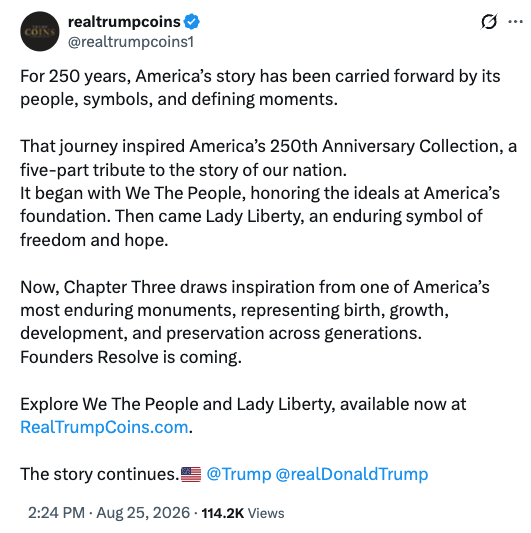
Real Trump Coins has denied launching, promoting or authorizing the Trump Digital GOLD token that briefly appeared across its online presence before collapsing, blaming the promotion on “third-party bad actors.”
The denial came after the Real Trump Coins X account promoted the Solana-based token on Saturday and directed users to RealTrumpCoins.com, where GOLD was also advertised. The X posts were later deleted, while the account now links to a separate domain, TrumpCoins.com.
“Trump Coins has not authorized and will not launch, promote, or authorize any digital token,” Real Trump Coins said in an X post on Saturday, adding that it was working with authorities to investigate the matter.
The statement follows a highly concentrated GOLD launch, with Lookonchain reporting that the developer and newly created wallets controlled 82.45% of its supply. According to the blockchain analytics platform, 15 wallets linked to the team sold their holdings for about $330,000, making an estimated $312,000 profit.
The involvement of both the X account and RealTrumpCoins.com confused crypto observers, with X user Rune questioning how both the account and the domain could have been compromised.
While the Real Trump Coins X account bio linked to TrumpCoins.com, the account was still directing customers to RealTrumpCoins.com as recently as Aug. 25 in a post that remained online at the time of publication.
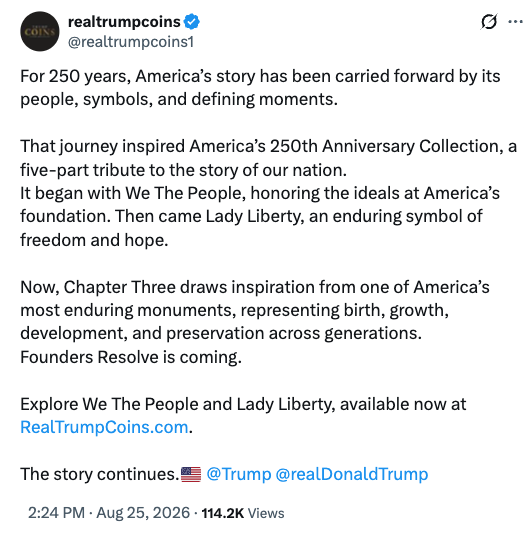
The Real Trump Coins X account directed customers to RealTrumpCoins.com on Aug. 25. Source: Real Trump Coins
At the time of publication, RealTrumpCoins.com still displayed the GOLD promotion. Trump also continued to follow the Real Trump Coins X account, one of 53 accounts he followed on the platform.
Related: Trump cost investors $4.7B through crypto ‘schemes’: Public Citizen
Crypto World
From Record Short Squeezes to Massive ETF Inflows: Everything Driving Bitcoin Right Now
Bitcoin (BTC) has risen about 26% from its mid-August low after a short-liquidation event accelerated the rebound. Glassnode said the August 19 move produced the largest one-day liquidation event since 2019.
Short positions accounted for most of the liquidations across the major centralized exchanges. The actual total was likely higher because the dataset excludes Hyperliquid.
ETF Demand and Large Holders Add Support
The squeeze cleared much of the liquidation liquidity around Bitcoin. Glassnode now sees short-liquidation levels above the market and a smaller pool of long-liquidation levels below.
The rebound was not driven only by forced closures, as spot demand also supported the move. US spot Bitcoin ETFs recorded $2.23 billion of net inflows over seven days, with no outflow days and their strongest weekly intake of 2026. The period included the largest ETF creation session since mid-January.
Meanwhile, Bitcoin continued moving away from exchanges as wallet groups changed their holdings. Entities holding between 1,000 and 10,000 BTC reduced their balances by 50,500 BTC since June 30.
In contrast, entities holding more than 100,000 BTC added 59,100 BTC. This group includes exchanges, custodians and ETF-related wallets.
During the squeeze week, the custody group added 31,500 BTC. Glassnode said the amount was similar in scale to weekly ETF creations, but the data does not show that the same coins moved directly into ETFs.
Every wallet-size cohort also moved into net accumulation on Glassnode’s 30-day trend score. The firm called it the most persistent all-cohort buying since late 2024.
Bitcoin Now Faces a Tougher Test
Leverage has not returned at the same pace as Bitcoin’s price, with futures open interest falling 11% in BTC terms. Perpetual funding remained near neutral and later turned negative, suggesting limited pressure from new leveraged long positions.
Beyond accumulation and leverage, on-chain data places recent buyers beneath price, while long-term holders provide the main supply zone above it. Bitcoin is now trading between these groups, creating a key market test for demand.
Several indicators point to a similar supply area overhead, including cost-basis levels, ask liquidity, options positioning and remaining liquidation clusters. A sustained move through that zone would show whether buyers can absorb the available supply.
The post From Record Short Squeezes to Massive ETF Inflows: Everything Driving Bitcoin Right Now appeared first on CryptoPotato.
Bitcoin’s advance from approximately $63,500 to above $80,000 received substantial support from spot buying rather than new leveraged positions, QCP Capital said on Aug. 28.
Summary
- Bitcoin rose from $63,500 as spot ETFs drew $2.8 billion across eight consecutive sessions overall.
- Futures open interest fell from 646,000 BTC to 588,000 BTC while Bitcoin prices moved higher.
- U.S. spot Bitcoin ETFs ended nine inflow sessions with $201.9 million in August 28 outflows.
- July headline PCE rose 3.7% annually, while core PCE remained at 3.3%, official data showed.
- Treasury will double long-end buybacks to at least $4 billion per operation beginning September 9.
The trading firm estimated that U.S. spot Bitcoin exchange-traded funds attracted roughly $2.8 billion across eight consecutive sessions during the rally. Meanwhile, BTC-denominated futures open interest declined from about 646,000 BTC in mid-August to 588,000 BTC.
That combination suggests spot purchases and short covering drove much of the move. It differs from a rally led by traders opening aggressive leveraged long positions. However, the latest verified figures show that institutional demand has begun to cool after Bitcoin failed to hold above $80,000.
Bitcoin rally gained support as leverage declined
Bitcoin briefly traded above $81,000 after climbing from roughly $63,500 within little more than a week. QCP said funding rates remained contained during the advance, despite the sharp increase in price.
Falling open interest means traders closed futures positions on a net basis. Some bearish traders likely bought Bitcoin or futures to cover short positions as prices rose. At the same time, ETF inflows provided identifiable demand through regulated U.S. investment products.
QCP said the combination “suggests that short covering and spot demand have played a larger role than fresh leveraged longs chasing the move.” That assessment represents the firm’s interpretation of the market data, rather than proof that every ETF purchase translated directly into immediate Bitcoin buying.
The structure initially appeared healthier than an advance accompanied by rapidly rising open interest and expensive funding. Excess leverage can increase liquidation risk when prices reverse. Still, falling leverage does not guarantee that Bitcoin will maintain its gains.
As crypto.news reported in its coverage of Bitcoin’s $80,000 breakout, U.S. spot funds attracted about $1.92 billion during the week ending Aug. 21. That marked their strongest weekly intake since October 2025.
Bitcoin ETF outflows test the spot-demand argument
The latest ETF data introduced the first clear test of QCP’s spot-support thesis. U.S. spot Bitcoin ETFs recorded $201.9 million in net withdrawals on Aug. 28, ending nine consecutive inflow sessions.
ARK 21Shares’ ARKB posted $114.9 million in outflows. Bitwise’s BITB lost $49.7 million, while BlackRock’s IBIT recorded $33.4 million in withdrawals. VanEck’s HODL also lost $13.2 million, according to data cited by crypto.news.
The reversal represented a $444.2 million change from the previous session’s $242.3 million inflow. However, the funds still collected approximately $924.5 million over the Aug. 24–28 trading week.
However, Bitcoin subsequently traded near $77,500 on Aug. 29 after falling about 2.9% over 24 hours, as crypto.news reported. The decline followed a failed attempt to maintain the move above $80,000.
One outflow session does not establish a sustained institutional exit. Continued withdrawals would provide stronger evidence that ETF demand is weakening. Renewed inflows, by contrast, would support QCP’s view that spot participation remains an important foundation for the rally.
Inflation keeps the Federal Reserve constrained
The U.S. inflation backdrop remains less supportive. Bureau of Economic Analysis data showed that headline personal consumption expenditures inflation reached 3.7% year over year in July. Core PCE, which excludes food and energy, remained at 3.3%.
Both indexes rose 0.2% from June. The annual figures remained above the Federal Reserve’s 2% objective, limiting policymakers’ ability to loosen monetary conditions.
Federal Reserve Chair Kevin Warsh reinforced that concern during his Aug. 28 Jackson Hole address. He said the Fed’s “predominant focus right now should be on prices” and noted that broad financial conditions were difficult to describe as restrictive.
Markets had assigned an estimated 35% probability to a 25-basis-point September rate increase before the speech, according to QCP. That probability was a market estimate, not a Federal Reserve forecast or commitment.
The next policy decision will depend on incoming inflation, labor-market and activity data. Higher rate expectations could pressure Bitcoin by strengthening the dollar and raising yields on lower-risk assets.
Treasury buybacks provide liquidity but are not QE
A separate liquidity factor will arrive on Sept. 9. The U.S. Treasury Department will increase its long-end liquidity-support buybacks from a maximum of $2 billion to at least $4 billion per operation.
The change covers nominal securities in the 10-to-20-year and 20-to-30-year sectors. It will remain in place through Nov. 4, when the Treasury plans to provide more information during its next quarterly refunding.
The program aims to improve trading liquidity in older Treasury securities. It does not create central-bank reserves and does not constitute Federal Reserve quantitative easing. No official agency has established that the program caused Bitcoin’s rally.
For Bitcoin, the next test is whether ETF demand returns while funding remains contained. A gradual recovery in open interest would point to measured positioning. Rapid leverage growth alongside rising prices would make the advance more vulnerable to liquidations.


Sheikh Tahnoon bin Zayed al Nahyan, the UAE’s national security advisor and brother of its president, holds the single largest stake in WLTC Holdings through StringZ Holding RSC. The Trump family owns 38%. On August 14, the OCC granted this entity preliminary conditional approval for a federally regulated national trust bank to issue and redeem USD1, a stablecoin with more than $4 billion in circulation. In the same administration that loosened AI chip export caps to the UAE, $263 million from the original deal has already flowed to Trump family entities.
Summary
- StringZ Holding RSC, backed by Sheikh Tahnoon bin Zayed al Nahyan and co-investors, owns 49% of WLTC Holdings, the holding company behind the proposed World Liberty Trust Company. An entity affiliated with the Trump family owns 38%.
- The Office of the Comptroller of the Currency granted preliminary conditional approval on August 14, 2026 for a national trust bank that will issue, redeem, and hold reserves for the USD1 stablecoin, currently the fourth largest stablecoin with more than $4 billion in circulation.
- Trump’s 2025 financial disclosure, released in July 2026, showed $1.4 billion in crypto-related income, including $263 million directed to Trump family entities from the original January 2025 World Liberty Financial deal with Tahnoon’s group.
- The same administration upgraded the UAE to Country Group A:5 in July 2026, its highest export control tier, clearing the way for unlimited AI chip sales from Nvidia and AMD to Emirati firms including G42, which Tahnoon controls.
- Senators Elizabeth Warren and Andy Kim have requested a CFIUS national security review of the arrangement, while Democrats have called the OCC approval a “brazen act of self-dealing.”
A sitting president’s family has never before held a financial stake in a company that received a federal banking charter from regulators appointed by that same president. That is no longer a hypothetical. It happened on August 14, 2026, when the Office of the Comptroller of the Currency conditionally approved World Liberty Trust Company, National Association, to organize as a federally regulated national trust bank.
The approval capped a 221-day review process. The application was filed in January 2026, the same month the Trump administration began rolling back Biden-era restrictions on advanced chip exports to Gulf states. By the time the OCC signed off, the largest single shareholder in the holding company behind the bank was not Donald Trump or any member of his family. It was an entity controlled by Sheikh Tahnoon bin Zayed al Nahyan, the UAE’s national security advisor, brother of President Mohamed bin Zayed, and one of the most powerful figures in Middle Eastern finance.
The details, first reported by the Wall Street Journal on August 27, have reignited a debate about where personal enrichment ends and foreign policy begins in the Trump administration’s approach to digital assets.
The ownership structure behind WLTC Holdings
WLTC Holdings LLC is the holding company for the proposed bank. According to OCC filings and the Wall Street Journal’s reporting, the ownership breaks down as follows.
StringZ Holding RSC, an entity backed by Tahnoon and co-investors, holds 49% of WLTC Holdings. An entity affiliated with President Donald Trump and certain family members owns 38%. The remaining shares belong to associates of Zak Folkman and Chase Herro, co-founders of World Liberty Financial.
StringZ’s OCC commitment letter was signed by Hamad Khlfan Ali Matar Alshamsi, a former director of G42, the Abu Dhabi artificial intelligence holding company that Tahnoon also controls. That connection matters because G42 has been a primary beneficiary of the Trump administration’s decisions to ease technology export restrictions to the UAE.
The ownership arrangement means that Tahnoon’s group, not the Trump family, is the single largest shareholder in the entity that will control a federally regulated bank issuing a dollar-pegged stablecoin on American soil.
What the OCC actually approved
The OCC’s preliminary conditional approval, dated August 14, 2026, authorizes World Liberty Trust Company to organize as a national trust bank with a specific and narrow mandate. The bank will issue and redeem USD1, maintain reserve assets backing the stablecoin, provide fiduciary custody services to institutional clients, and offer conversion services between approved stablecoins and USD1.
The bank will be based in Bay Harbor Islands, Florida, and will be led by Zach Witkoff as president and chairman. Witkoff co-founded World Liberty Financial alongside Trump’s three sons: Eric Trump, Donald Trump Jr., and Barron Trump. Zach Witkoff is the son of Steve Witkoff, the longtime Trump friend who serves as U.S. special envoy.
Other named officers include Mack McCain as chief trust officer, Daniel Dietzel as chief financial officer (formerly at Hidden Road institutional prime broker), and board members Scott Alper, Robert Witkoff, Jeffrey Weiner (formerly of Marcum accounting firm), and Erin Baskett, who sits on the FINRA Board of Governors.
The approval carries several conditions. World Liberty Trust must maintain at least $20 million in eligible capital at opening. The chief financial officer must receive separate regulator approval. A qualified internal audit manager must be appointed. The company must apply for Federal Reserve Bank stock. And it must comply with the GENIUS Act, the stablecoin law that Trump signed on July 18, 2025.
Crucially, the approval specifies what the bank will not do. It will not accept customer deposits. It will not issue conventional loans. It will not carry FDIC insurance. It will not seek a Federal Reserve master account. And it will not issue, custody, or deal in WLFI governance tokens.
Final authorization to commence business will not be granted until all preopening requirements are met.
The $500 million deal that started it all
The roots of Tahnoon’s involvement in World Liberty Financial trace back to January 2025, just four days before Trump’s inauguration. Tahnoon and fellow investors committed $500 million to World Liberty Financial in exchange for a 49% ownership stake in the crypto venture. Eric Trump signed the investment documents on the Trump family’s side.
Trump’s 2025 financial disclosure, a 927-page document released by the Office of Government Ethics between July 1 and July 3, 2026, reveals the scale of the financial returns. The president reported more than $1.4 billion in crypto-related income for 2025, making it the largest single category in his approximately $2.2 billion total reported income.
The crypto earnings broke down as follows. WLFI token sales generated more than $550 million, roughly nine times the $57 million reported in 2024. Sales of equity in the World Liberty Financial holding company produced $260 million. A separate stablecoin holdco equity sale brought in more than $196 million. And CIC Digital, the entity behind Trump’s memecoin ventures, contributed more than $635 million, largely from royalties tied to what the filing calls “Celebration Coins.”
Of the original $500 million investment from Tahnoon’s group, $263 million flowed directly to Trump family entities. That figure was confirmed through Trump’s financial disclosure and has been cited by congressional investigators and ethics watchdog groups.
USD1: from quiet launch to fourth-largest stablecoin
World Liberty Financial quietly launched USD1 in March 2025 on Ethereum and Binance Smart Chain, initially without a formal announcement. The token achieved more than $140 million in trading volume within its first 24 hours.
Each USD1 token is designed to maintain a 1:1 peg with the U.S. dollar and is backed by a reserve of cash, U.S. Treasury securities, and government money market funds. BitGo Trust Company has served as the reserve custodian and exclusive issuer since launch. If the OCC grants final authorization, World Liberty Trust Company will assume those responsibilities, bringing stablecoin issuance and custody entirely in-house.
USD1 has grown to more than $4 billion in circulation, making it the fourth-largest stablecoin by market capitalization. A significant portion of that growth came from a single transaction: in May 2025, Abu Dhabi state-backed investment firm MGX used USD1 to settle a $2 billion transaction with Binance. MGX’s ties to the Abu Dhabi sovereign wealth ecosystem and Tahnoon’s broader financial network have raised questions about whether early adoption was organic or strategically coordinated.
As of February 2026, Binance held approximately 87% of USD1’s total supply, a concentration level that exceeds any other major stablecoin at a single exchange. That same month, USD1 briefly lost its dollar peg, falling to $0.994 during what World Liberty Financial described as a “coordinated attack” against the protocol. The peg was restored within hours.
The stablecoin has since expanded to Canton Network and added listings on Coinbase, Kraken, Crypto.com, OKX, Bybit, Uniswap, and PancakeSwap. In June 2026, USD1 was used to pay $250,000 in fighter performance bonuses at UFC Freedom 250, an event held on the White House lawn.
World Liberty Financial CEO Zach Witkoff has pushed back against accusations of political favoritism, stating in late August 2026 that “USD1 grew because institutions trust how it operates, and confidence at enterprise scale deserves the backing of federal supervision.”
The AI chip connection
The conflict-of-interest concerns extend well beyond banking. Sheikh Tahnoon controls G42, the Abu Dhabi artificial intelligence holding company that has been one of the largest beneficiaries of the Trump administration’s decision to loosen restrictions on advanced chip exports to the UAE.
In November 2025, the Commerce Department authorized the export of 35,000 Nvidia Blackwell processors to G42 and Saudi Arabia’s Humain. In January 2026, the administration codified a broader policy shift, moving the licensing posture for chip exports from a presumption of denial to case-by-case review.
Then, on July 14, 2026, exactly one month before the OCC approved the World Liberty banking charter, the Commerce Department’s Bureau of Industry and Security upgraded the UAE to Country Group A:5, its highest export control tier. The designation, which cited the UAE’s status as a “Major Defense Partner,” allows the UAE government and approved firms, including G42, to import advanced AI chips and servers without individual export licenses.
The chips now cleared for export include Nvidia’s H200 and AMD’s Instinct MI325X, which were previously restricted, as well as Nvidia’s even more powerful Blackwell-class processors. The upgrade essentially removes the ceiling on how much advanced AI compute the UAE can import from American manufacturers.
Senator Elizabeth Warren has drawn a direct line between these policy decisions and the Trump family’s financial relationship with Tahnoon. In an August 2026 letter to Commerce Secretary Howard Lutnick, Warren pressed for answers about whether the UAE’s access to sensitive U.S. technology was influenced by Tahnoon’s crypto investments with the Trump family. Warren and Senator Andy Kim had previously requested a CFIUS national security review of the World Liberty Financial arrangement as early as February 2026.
U.S. national security officials have separately voiced concerns that Emirati access to these chips could serve as a conduit for sensitive AI technology to reach China, compromising America’s strategic advantage in artificial intelligence development.
World Liberty Financial spokesman David Wachsman responded to the conflict-of-interest allegations by stating: “No one at World Liberty works for the U.S. government and there are no conflicts of interest.”
A regulatory framework built for this moment
The timing of the World Liberty Trust charter approval is inseparable from the regulatory environment that the Trump administration has actively shaped.
Trump signed the GENIUS Act on July 18, 2025, creating the first federal framework specifically for payment stablecoins. The law requires issuers to back stablecoins with 100% reserves in Treasury bills or insured deposits, report weekly to regulators, and publish monthly disclosures. It takes effect on either January 18, 2027, or 120 days after final rules are issued, whichever comes first.
The OCC expects to finalize its GENIUS Act implementation rules by November 2026 after reviewing industry feedback on stablecoin reserves, custody, and licensing. World Liberty Trust’s charter application explicitly commits to operating under GENIUS Act compliance, a framework that the president signed into law and that his family’s company is now among the first to operate within.
The Clarity Act, which passed the House with a 294-134 bipartisan vote and Trump’s backing, extends the regulatory framework beyond stablecoins to broader digital asset markets. Together, the GENIUS Act and the Clarity Act represent the most significant crypto legislation in U.S. history, and together they create the precise regulatory environment in which World Liberty Trust will operate.
Critics, including CNN, which called the OCC approval a “brazen act of self-dealing,” argue that the president cannot sign laws, appoint regulators, and then profit through a family business that those regulators approve. Defenders counter that the charter application went through a standard 221-day review process and that the OCC’s conditions, including capital requirements and compliance mandates, prove the approval was rigorous.
What the WLFI token tells us
While the banking charter applies exclusively to USD1, World Liberty Financial also operates the WLFI governance token, which tells its own story about investor returns.
The Trump family takes 75% of net revenue from WLFI token sales. Those sales generated more than $550 million in 2025 income according to Trump’s financial disclosure. Yet the token itself has been a different story for outside investors. WLFI traded between $0.061 and $0.067 in late May 2026, representing a decline of more than 81% from its $0.2577 high in late 2024. It remains down more than 60% year-over-year.
The OCC’s approval letter specifically states that the bank “will not issue, custody, or deal in WLFI tokens,” a deliberate separation between the stablecoin banking operation and the governance token that has generated massive revenue for the Trump family while delivering steep losses for retail investors.
Congressional and ethics response
The political reaction has been sharply divided along partisan lines, though the scale of the financial entanglement has prompted some bipartisan concern.
Democrats, led by Senators Warren and Kim, have focused on three overlapping issues. First, they argue that the CFIUS review process should apply to any foreign investment that gives a non-U.S. entity significant ownership in a federally chartered financial institution. Second, they contend that the simultaneous loosening of AI chip export restrictions to the UAE, where Tahnoon wields significant influence, creates an appearance of quid pro quo that undermines public trust. Third, they question whether OCC Acting Comptroller Rodney Hood, a Trump appointee, should have recused himself from the charter decision given the president’s direct financial interest.
The Senate Banking Committee’s minority staff issued a 14-page letter in February 2026 requesting that the OCC delay the charter review pending a national security assessment. The OCC did not comply, and the 221-day review proceeded on its original timeline.
Ethics watchdog groups have pointed to the unprecedented nature of the arrangement. No previous president has held a financial stake in a company that received a banking charter from regulators appointed by that president while simultaneously signing the legislation under which that bank would operate.
Republican lawmakers have largely defended the approval, arguing that the OCC’s conditions prove the process was merit-based and that blocking the charter would amount to political discrimination against a legitimate business. Senator Tim Scott, the Banking Committee chairman, has said that crypto companies should be evaluated on their compliance posture, not on who their investors happen to be, and that the GENIUS Act framework already provides the guardrails that critics claim are missing.
Follow the money: a timeline
The financial thread connecting the Trump family, Sheikh Tahnoon, and the proposed bank follows a clear chronological path.
In September 2024, World Liberty Financial launched during the presidential campaign, co-founded by Trump and his three sons. In January 2025, four days before inauguration, Tahnoon’s group committed $500 million for a 49% stake, with $263 million directed to Trump family entities. In March 2025, USD1 launched on Ethereum and Binance Smart Chain. In May 2025, MGX used USD1 to settle a $2 billion Binance transaction. In November 2025, the Commerce Department authorized 35,000 Nvidia Blackwell chips for G42 and Humain. In January 2026, the administration moved chip export licensing from presumption of denial to case-by-case review, and WLTC Holdings filed the bank charter application with the OCC. In July 2026, the Commerce Department upgraded the UAE to Country Group A:5, and Trump’s financial disclosure revealed $1.4 billion in crypto income. On August 14, 2026, the OCC granted preliminary conditional approval for the bank. On August 27, the Wall Street Journal reported Tahnoon’s 49% stake in WLTC Holdings.
Each step is individually defensible. Taken together, they form a pattern that critics describe as the interweaving of presidential financial interests, foreign policy decisions, and regulatory approvals on a scale without precedent in modern American governance. Whether that pattern reflects corruption or simply the natural consequences of a business-minded president operating in a deregulatory environment is the central question that will define the legacy of this chapter in American crypto policy.
What to watch
OCC final authorization timeline: The preliminary approval requires World Liberty Trust to meet multiple preopening conditions, including the $20 million capital requirement and CFO approval. Watch for the final authorization date, which will signal when the bank can actually begin operations.
CFIUS review outcome: Warren and Kim’s request for a Committee on Foreign Investment review remains pending. A formal CFIUS investigation could delay or block the bank from operating even after OCC final authorization.
GENIUS Act rulemaking by November: The OCC expects to finalize GENIUS Act implementation rules by November 2026. Those rules will determine reserve requirements, reporting standards, and compliance obligations that directly affect how World Liberty Trust operates.
Binance USD1 concentration changes: With Binance holding roughly 87% of all USD1 supply, any significant redistribution or withdrawal by the exchange would have outsized effects on the stablecoin’s market stability and perceived independence.
UAE chip export volumes post-upgrade: Now that the UAE holds Country Group A:5 status, tracking the actual volume and value of AI chip shipments to Emirati firms, especially G42, will reveal whether the export liberalization translates into material technology transfers at scale.
What is WLTC Holdings?
WLTC Holdings LLC is the holding company for World Liberty Trust Company, National Association, the proposed federally regulated national trust bank. It was organized to file the bank charter application with the OCC in January 2026. StringZ Holding RSC, backed by Sheikh Tahnoon bin Zayed al Nahyan, owns 49% of WLTC Holdings. An entity affiliated with the Trump family owns 38%.
Who is Sheikh Tahnoon bin Zayed al Nahyan?
Sheikh Tahnoon is the national security advisor of the United Arab Emirates and the brother of UAE President Mohamed bin Zayed al Nahyan. He controls G42, the Abu Dhabi artificial intelligence holding company, and oversees several sovereign wealth and investment vehicles. His group committed $500 million to World Liberty Financial in January 2025, and his associated entity StringZ Holding RSC holds the largest single ownership stake in the company behind the proposed crypto bank.
What does USD1 do and how large is it?
USD1 is a dollar-pegged stablecoin issued by World Liberty Financial. Each token is backed 1:1 by reserves of U.S. Treasury securities, cash, and government money market funds. It launched in March 2025 and has grown to more than $4 billion in circulation, making it the fourth-largest stablecoin by market capitalization. It trades on Binance, Coinbase, Kraken, and several other major exchanges.
What did the OCC actually approve?
The OCC granted preliminary conditional approval on August 14, 2026, for World Liberty Trust Company to organize as a national trust bank. The bank will issue and redeem USD1, maintain reserve assets, and provide digital asset custody to institutional clients. It will not accept deposits, issue loans, carry FDIC insurance, or deal in WLFI tokens. Final authorization requires meeting additional conditions including a $20 million capital floor.
How much money has flowed to the Trump family from World Liberty Financial?
Trump’s 2025 financial disclosure shows more than $1.4 billion in crypto-related income. This includes $550 million from WLFI token sales, $260 million from equity sales, $196 million from stablecoin holdco equity sales, and $263 million from the original January 2025 deal with Tahnoon’s group. Separately, CIC Digital, the memecoin entity, generated more than $635 million.
What is the connection between the crypto bank and AI chip exports to the UAE?
Sheikh Tahnoon controls G42, the Emirati AI firm that has been a primary beneficiary of the Trump administration’s decisions to loosen advanced chip export restrictions. The Commerce Department upgraded the UAE to its highest export tier on July 14, 2026, exactly one month before approving the World Liberty bank charter. Senator Warren has publicly questioned whether these policy decisions were influenced by Tahnoon’s $500 million crypto investment with the Trump family.
What is the GENIUS Act and how does it relate to this bank?
The GENIUS Act, signed by Trump on July 18, 2025, is the first federal law specifically governing payment stablecoins. It requires 100% reserves, weekly regulatory reporting, and monthly public disclosures. The OCC’s approval of World Liberty Trust is conditioned on compliance with the GENIUS Act. Critics note that the president signed the law under which his family’s company will operate, creating an unusual overlap between legislative and commercial interests.
Could the bank still be blocked?
Yes. The OCC’s approval is preliminary and conditional. Final authorization requires meeting preopening conditions including capital requirements and regulatory approvals for key officers. Separately, Senators Warren and Kim have requested a CFIUS national security review of the foreign ownership structure. If CFIUS opens a formal investigation, it could recommend that the president block the arrangement, creating the extraordinary scenario of Trump being asked to block his own family’s business deal. —
Disclaimer: This article is for informational purposes only and does not constitute financial, legal, or investment advice. Cryptocurrency investments carry significant risk. Always conduct your own research before making any financial decisions. Published August 29, 2026.

Manchester Airport flights delayed by more than an hour today

Income-Covered Closed-End Fund Report, August 2026

Ripple Swell 2026 names Matt Damon as keynote speaker





-

 Crypto World4 days ago
SpaceX stock could rise 75% to $240, JPMorgan says
-

 Fashion2 days ago
Weekend Open Thread: Maeve – Corporette.com
-

 Crypto World2 days ago
Bitcoin’s 22% rally now needs real demand to outlast Treasury liquidity boost
-

 Crypto World4 days ago
Warsh Jackson Hole keynote puts financial innovation first
-

 Crypto World5 days ago
A $30 Billion AI Fund Implodes, Now the SEC Is Investigating Wall Street’s Role
-

 Business2 days ago
Salesforce Stock Soars 19% as Blowout Earnings and Agentforce AI Growth Silence Software Skeptics
-

 Crypto World4 days ago
Did Trump Just Move SpaceX Stock With One Truth Social Post?
-

 Business7 days ago
Mystery AI Model ‘Ox Alpha’ Draws Developers With Free Access as Chinese Lab Origins Remain Debated
-

 Business4 days ago
Walmart takes aim at younger shoppers with new fashion brand
-
 NewsBeat4 days ago
Lindsay Clancy jury braces for closing arguments as judge tells court: ‘You’ve heard all the evidence’ – Live updates
-

 Crypto World3 days ago
Elon Musk Grok Bot Promise: We Will Make You Whole if AI Loses Your Money
-

 Crypto World1 day ago
Bitcoin price tests $82K resistance as Brandt stays long
-

 Business6 days ago
Moderna CEO warns China is pouring state money into mRNA technology
-

 Crypto World3 days ago
NVIDIA revenue hits $96.2B as AI demand doubles
-

 Business4 days ago
Thailand’s Eastern Economic Corridor Capital City (EECiti): Key Developments and Investment Opportunities
-

 Business2 days ago
Apple Confirms September 9 Keynote and Reveals Its Full Pre-Order Schedule
-

 Business2 days ago
iPhone 18 Pro Pre-Orders Could Shift to Saturday as Apple Reportedly Avoids September 11 Anniversary
-

 Business5 days ago
NVIDIA Stock Drops Nearly 2 Percent to $210 on Seventh Losing Day Ahead of Critical AI Earnings
-
 Crypto World6 days ago
$92 Billion Nvidia Earnings Could Make or Break the AI Trade
-

 NewsBeat4 days ago
Trump’s trade truce with China faces test with Iran effort
You must be logged in to post a comment Login