
Crypto World
A Cryptocurrency Trap: How New Russian Laws Will Support EU Sanctions



The 20th EU sanctions package imposed a sectoral ban on all Russian crypto services. From May 24, 2026, any transactions with Russian-registered crypto providers and exchange platforms will become illegal for market participants under EU jurisdiction.
The new sanctions coincide with Russian authorities’ plans to centralize the domestic crypto market: the bill ” On Digital Currency and Digital Rights ” proposes mandatory storage of cryptocurrencies in depositories and a ban on personal wallets. The combination of these two developments creates serious risks for Russian crypto investors.
BeInCrypto’s editorial team discussed the implications of the new restrictions with experts. Here’s how our interviewees believe the 20th sanctions package will impact Russia’s crypto industry.
Will all crypto that touches the Russian circuit now become “dirty”?
Mikhail Uspensky, a member of the State Duma’s expert council on legislative regulation of cryptocurrencies , believes that it is already considered de facto as such: large platforms, primarily European ones, refuse to accept cryptocurrency with a Russian connection.
However, not all experts share such a categorical assessment. Daria Mitrokhina, a leading lawyer for international projects at Right Side , clarifies that cryptocurrency used solely by Russian citizens or unsanctioned platforms will not carry the same risk of blocking as assets used through sanctioned platforms. According to her, such cryptocurrency is not considered “dirty,” as it is defined as assets linked to criminal activity. However, it carries increased risk and is subject to sanctions, which, in her opinion, will make foreign platforms and countries even more cautious when dealing with Russians.
As a reminder, the 20th package also imposes sanctions on those who support and facilitate the circulation of Russian cryptocurrency on the international stage.
Olga Ocheretyanaya, a senior associate in the cryptocurrency regulation and mining practice at Right Side , takes a similar position . She believes that the EU sanctions’ focus on Russian platforms and exchanges, specific tokens linked to the Russian financial system, and sanctions-evasion infrastructure does not automatically render any asset that was once held by a Russian resident or passed through a Russian wallet “dirty.” However, she warns that if the new regulations in Russia are implemented as currently formulated, it will inevitably result in all officially registered crypto platforms in Russia being sanctioned, and the wallets and cryptocurrency passing through them will be labeled .
Is it possible to comply with Russian laws and still avoid labeling?
Working with Russian sanctioned platforms with the subsequent goal of bringing cryptocurrencies to international markets is futile—it will likely result in blocking , warns Daria Mitrokhina. However, individuals still have the option to choose other platforms within the framework of legal compliance, excluding sanctioned services.
Will the authorities abandon plans to centralize the crypto market?
The idea of introducing digital depositories is causing confusion and bewilderment among a large number of market participants , notes Mikhail Uspensky. According to him, closing the internal loop with mandatory licensed custodians is a Russian innovation, born out of the habit of imposing securities regulations on the distributed ledger. The EU’s position should further alarm the bill’s authors:
“Transactions by centralized custodians will inevitably sooner or later create clusters/hubs in the blockchain that are easily tracked and marked with a ‘red Russian trace.’ A hack, leak, simple oversight, or other leak of data linking address identifiers to a Russian digital depository will cause problems for dozens, if not hundreds, of legitimate Russian residents seeking to buy crypto from a legitimate exchange,” warns Mikhail Uspensky.
However, lawyers believe the sanctions will have the opposite effect. The Russian Federation’s primary goals are to restrict the market from external influence, strengthen the ruble, develop its own payment systems, and increase independence from the international market, notes Daria Mitrokhina:
“Strengthening sanctions is more likely to accelerate than slow them down, based on the ‘they tighten them, we leave’ approach. We should now expect a focus on settlements with friendly countries and increased domestic oversight.”
Olga Ocheretyanaya agrees with this assessment: sanctions, on the contrary, are pushing Russian authorities to build their own closed circuit, leaving open the possibility of completely isolating external services. Meanwhile, the question of how cryptocurrency within this circuit will be “cleaned” and how liquidity will be replenished remains open.
She also emphasizes that EU sanctions only affect those within their perimeter: European providers and users. In fact, Russia has long since established channels through Asia, the Middle East, and other friendly jurisdictions, and key flows will simply extend further into areas where EU regulations don’t apply.
Plans for cross-border settlements using the digital ruble
The creation of the digital ruble was initially not intended to circumvent sanctions, but rather to create its own payment system, recalls Daria Mitrokhina. The initiative was aimed at working with neutral and friendly countries, as EU sanctions have long exposed Russia as an undesirable participant in their market. The new sanctions package will likely not affect the plans for the digital ruble’s rollout, but will impact its geography and operational procedures. Plans will have to be adjusted rather than scrapped.
According to Olga Ocheretyanaya, the issue is not so much about EU sanctions prohibiting participation in the development of the necessary infrastructure for the digital ruble, but rather about reaching a fundamental agreement among BRICS members to use this instrument in settlements among themselves.
Want access to expert insights? Subscribe to our
Telegram channel to receive trading signals and market news, and chat with our analyst. Stay one step ahead of the market every day!
The post A Cryptocurrency Trap: How New Russian Laws Will Support EU Sanctions appeared first on BeInCrypto.

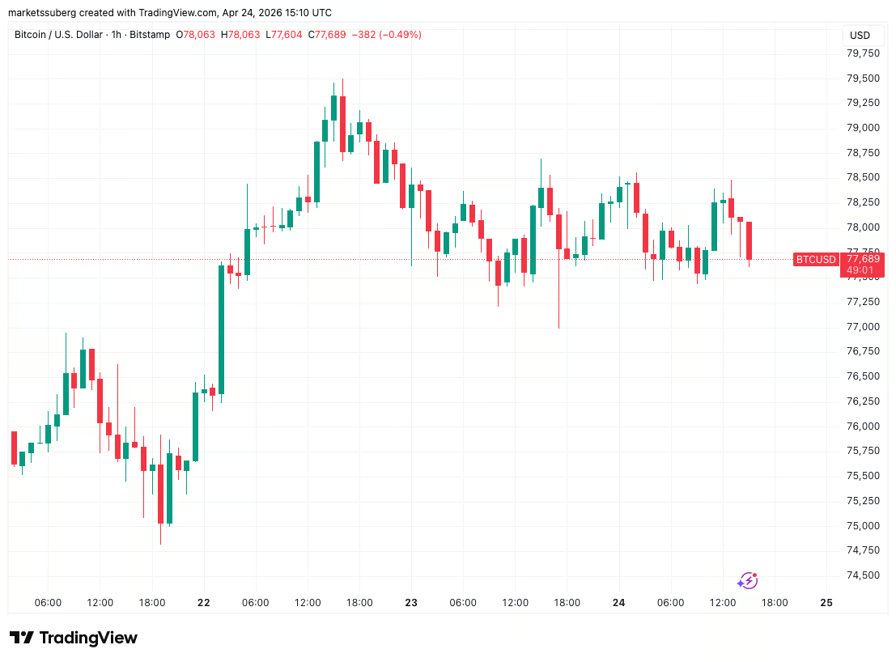
Bitcoin (BTC) stayed glued to $78,000 on Friday with markets “awaiting clarity” from the US-Iran war.
Key points:
- Bitcoin stalls in its bid to recapture $80,000, as US stocks tread water.
- Strong earnings are needed to sustain the equities push, says analysis.
- BTC price support is at risk of giving way next.
Bitcoin joins risk assets “chopping sideways”
Data from TradingView tracked flat BTC price action into the week’s last Wall Street trading session.
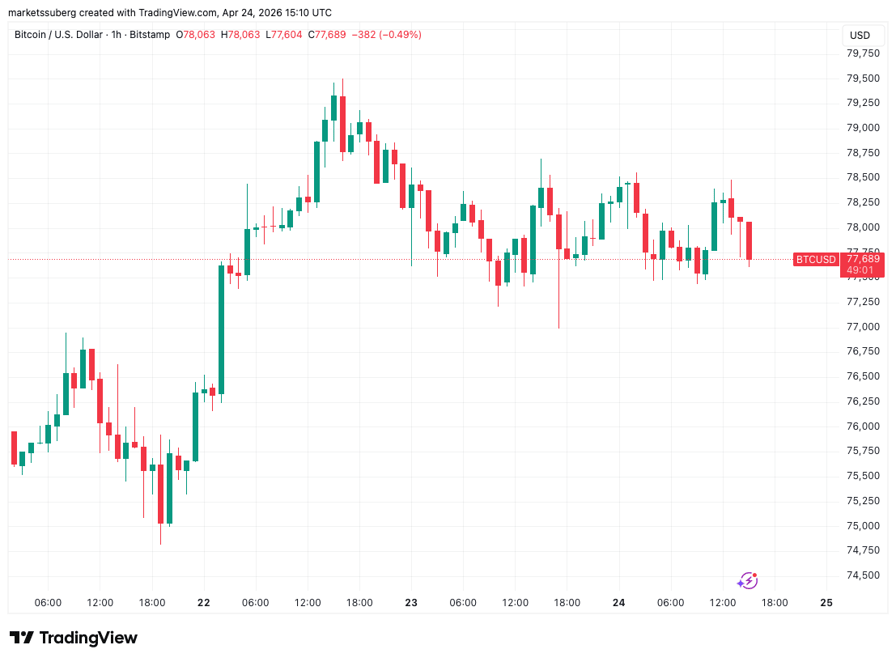
BTC/USD one-hour chart. Source: Cointelegraph/TradingView
Amid a lack of fresh geopolitical cues, risk-asset catalysts presented a mixed picture, leading to sideways movements for US stocks. WTI crude oil, after nearing a rematch with the $100 mark, cooled to $95.
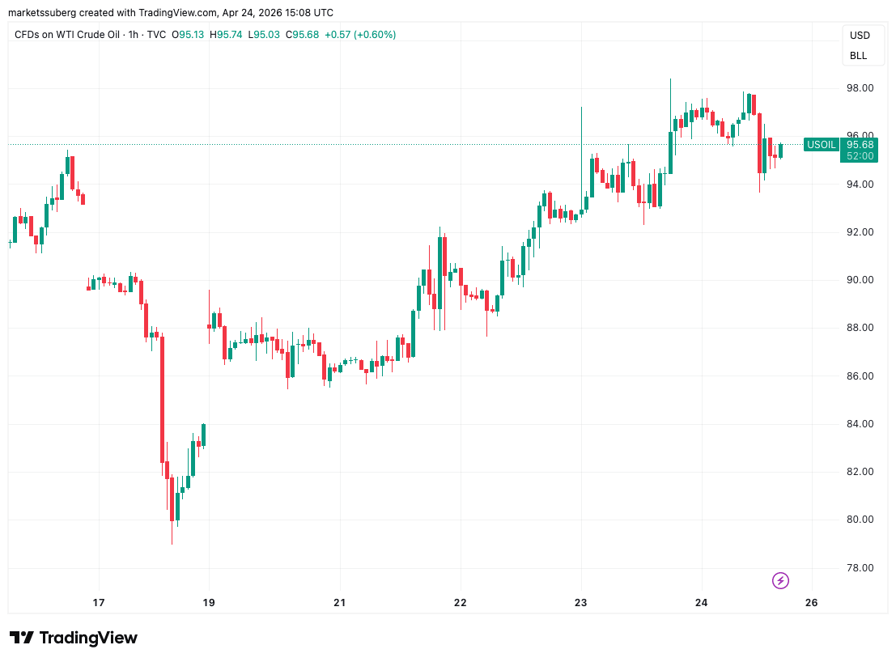
CFDs on WTI crude oil one-hour chart. Source: Cointelegraph/TradingView
“$BTC & Stocks started the week off strong as metals have sold off. But as $OIL has been starting to move again the past few days, risk assets have stalled and are now chopping sideways,” trader Daan Crypto Trades responded in a post on X.
“Market is eagerly awaiting clarity from the conflict in the middle east. The longer it drags on and oil keeps moving higher, the more pressure will be put on these.”
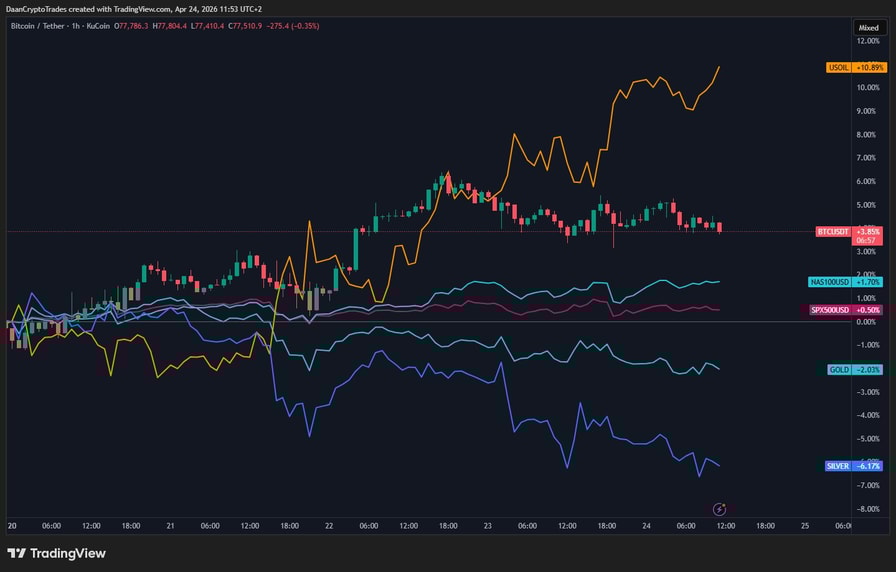
Macro asset price comparison. Source: Daan Crypto Trades/X
The day prior, trading resource Mosaic Asset Company said that positive earnings figures would be essential to sustain continued upside for stocks, with the S&P 500 already hitting new record highs.
“With the first quarter reporting season about to pick up, it will be crucial to monitor forward earnings estimates for any changes in trend since the start of the year,” it wrote in its latest analysis.
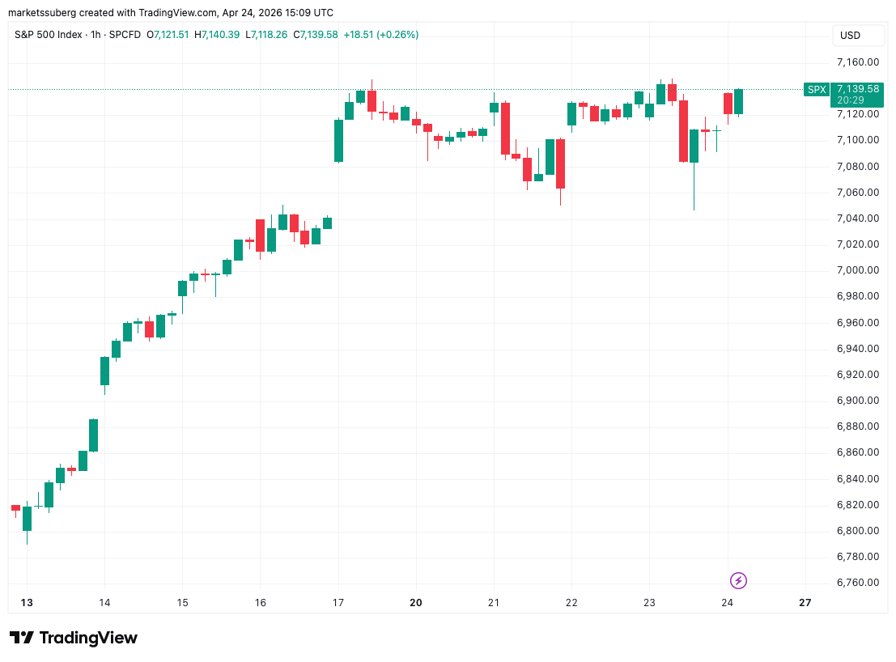
S&P 500 one-hour chart. Source: Cointelegraph/TradingView
Analyst “surprised” that BTC price support holding
Focusing on BTC/USD, trading resource Material Indicators hinted at early signs of a deeper retracement next.
Related: Bitcoin price set for best gains since Q4 2024 with $77.5K monthly close
“Bid liquidity at $76.5k already rugged, as predicted yesterday, and LTF order flow is trending down,” it wrote on X, referring to data from one of its proprietary trading tools.
Material Indicators added that it was “surprised” that bid liquidity below spot price had not been pulled.
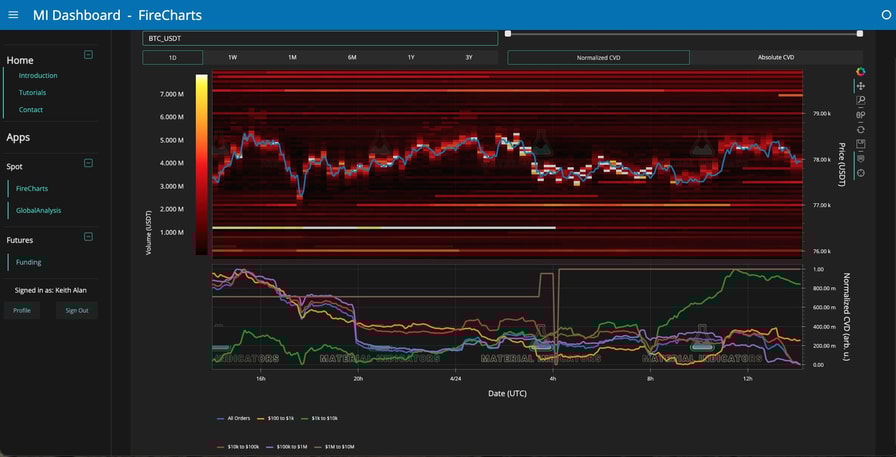
BTC/USDT order-book liquidity data with whale orders. Source: Material Indicators/X
Trading account JDK Analysis referenced a “news-driven pump” as further evidence that the low-time frame rally was overextended.
“The profile shows $BTC at the upper value extreme of the past two days,” an X thread read, analyzing exchange order-book data.
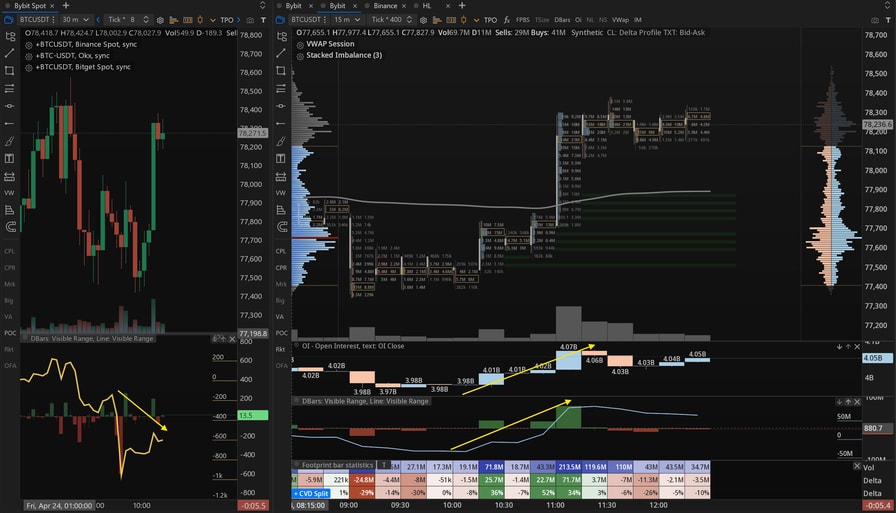
BTC/USDT order-book data (Bybit). Source: JDK Analysis/X

The European Central Bank has taken a concrete step to reduce the technical barriers surrounding a potential digital euro by signing agreements with three European standards bodies to reuse existing open payment standards for euro-area transactions. The move is intended to ease integration for banks, merchants and payment service providers as the bloc contemplates a broad roll-out of central bank digital money.
According to the ECB, the deals with the European Card Payment Cooperation, Nexo standards and the Berlin Group will enable the reuse of established open standards for several core capabilities. These include contactless tap-to-pay payments, merchant-to-payment-provider interfaces and alias-based payments—such as transactions initiated with a phone number rather than a bank account. The intention is to leverage widely adopted, interoperable specifications rather than rely on bespoke, bank- or vendor-specific solutions.
The ECB underscored that using open standards would help minimize adoption costs and support a uniform digital euro user experience across the euro area. However, it stressed that the agreements are a cost-mitigation step rather than a guarantee of a low-cost rollout, noting that broader implementation costs remain a central policy and practical consideration for banks and payment players.
In parallel with the standards push, Reuters reported an ECB analysis estimating that the digital euro could cost EU banks between €4 billion and €6 billion over four years. The ECB has previously signaled that the total cost of implementation is a complex mix of technical upgrades, staffing, compliance processes and ongoing operational considerations. The new agreements address only one leg of that broader cost equation—the choice and harmonization of technical interfaces.
The actions signal the ECB’s intent to reduce one of the primary technical hurdles to mass adoption: achieving interoperable, open-standards-based infrastructure across a fragmented payments landscape that is currently dominated by proprietary protocols and card schemes. By aligning standards now, the central bank aims to smooth the path for banks, merchants and PSPs should a digital euro be launched in the future.
The standards collaboration is part of a broader effort to prepare Europe’s payments infrastructure for the digital euro’s potential deployment. The ECB has indicated that a universal open standard ecosystem remains lacking in Europe, with much of the current ecosystem still tied to proprietary technologies owned by international card schemes and global digital wallet operators. The ECB’s initiative seeks to establish a common technical layer ahead of any pilot or launch, reducing the risk of later fragmentation.
Key takeaways
- The ECB has formalized cooperation with three European standards bodies to reuse open payment standards for the digital euro, targeting key capabilities like contactless payments, merchant-to-provider connectivity and alias-based transactions.
- The move is framed as a cost-mitigation measure intended to lower integration costs for banks, merchants and PSPs, though it does not guarantee low overall implementation costs.
- Regulatory and cost considerations remain central, with ongoing assessments of the total financial burden on EU banks and the broader compliance ecosystem required for any potential issuance.
- A digital euro pilot is planned, with a 12-month duration starting in the second half of 2027, involving a limited set of payment service providers and merchants, under Eurosystem oversight.
- Technical standards are expected to be announced by summer, reflecting the ECB’s emphasis on early coordination among market participants and standardization bodies to support a coherent rollout if pursued.
Operational scope and regulatory context: harmonizing the digital euro toolkit
The agreements with the European Card Payment Cooperation, Nexo standards and the Berlin Group focus on reusing familiar, cross-market specifications to govern essential digital euro functions. In practice, this means enabling a smoother experience for end users—whether they pay at a merchant, tap a card or mobile device, or initiate a payment from alias-based identifiers like phone numbers—without forcing banks to rebuild disparate systems from scratch. For policymakers, the emphasis on interoperable standards aligns with regulatory objectives to maintain financial stability, support cross-border payments and ensure robust AML/KYC controls as new forms of central bank money enter the ecosystem.
Despite the optimism around open standards, the ECB’s stance remains cautious. While harmonization can reduce upfront capital expenditure and ongoing integration challenges, the total cost of a potential digital euro program extends well beyond interfaces. Banks would still need to update core processing systems, risk controls, fraud prevention measures, settlement capabilities, data protection protocols and compliance workflows to accommodate a central bank digital currency at scale. The interplay between technical interoperability and regulatory compliance—especially around privacy, data residency and cross-border flows—will shape the ultimate feasibility and timeline of any market rollout.
Regulatory and cost implications for banks and payment ecosystems
From a regulatory perspective, the push to standardize interfaces interacts with broader EU policy frameworks governing payments, digital finance and market infrastructure. The digital euro’s design and governance sit at the intersection of Eurosystem oversight and EU financial services law, with potential implications for licensing, supervision and cross-border settlement arrangements. While MiCA covers crypto assets and related activities, the digital euro itself remains national sovereign money, and its deployment would be subject to the Eurosystem’s governance. Nonetheless, the surrounding regulatory architecture will influence how payment institutions plan, procure and operate if a digital euro moves from concept to a defined program.
The cost dimension remains a central point of attention for banks and PSPs. Reuters’ reporting of an €4–6 billion potential hitting banks over four years illustrates the scale of investment anticipated in systems, processes and talent. Even with a shared standards approach, institutions will face ongoing costs associated with regulatory compliance, operational resilience, cybersecurity, third-party risk management and customer due diligence. The ECB has repeatedly described the expected pilot as a learning phase to validate interoperability, security and user experience, rather than a foregone conclusion of a wholesale market launch.
For lenders and payment firms, the cost and regulatory calculus will influence decisions about timing, participation and the depth of integration with existing networks. Institutions will need to weigh the benefits of a more seamless, open-standard digital euro against the resource commitments required to modernize infrastructure, ensure compatibility with existing payment rails and maintain strict compliance controls. The EU’s ongoing emphasis on openness, transparency and supervision will shape not only technology choices but also licensing and operating models as banks navigate cross-border operations and potential future harmonization efforts across member states.
Pilot planning, governance and timeline: preparing for a measured test of the architecture
Beyond standardization, the ECB is actively laying the groundwork for a controlled digital euro pilot. The central bank has begun recruiting payment service providers to participate in a 12-month trial slated to start in the second half of 2027. The pilot will involve a limited cohort of PSPs, a restricted set of merchants and Eurosystem staff, with PSPs playing a central role in digital euro distribution. The goal is to test the operational viability of the chosen technical framework, assess the readiness of payment rails and ensure that risk, fraud prevention and privacy controls are robust before any broader deployment.
ECB officials have signaled that the technical standards that will govern the pilot are expected to be announced by the summer. This timeline underscores a deliberate approach: coordinate with standards bodies early, align market participants’ capabilities, and create a governance environment in which lessons from the pilot can inform any potential scaling. The effort is not only about technology but also about regulatory alignment, governance, data stewardship and the creation of clear lines of accountability for participating institutions.
For observers and participants, the pilot represents a critical inflection point. It provides a structured setting to evaluate interoperability across payment terminals, digital wallets, and merchant interfaces while exploring how alias-based and contactless flows perform under real-world conditions. From a compliance perspective, the pilot will offer a laboratory to refine AML/KYC controls, data protection measures and cross-border settlement arrangements within a controlled Eurosystem framework.
Closing perspective
As Europe advances its preparations for a potential digital euro, the emphasis on reusable open standards marks a meaningful shift toward interoperability-driven implementation. While the cost picture remains uncertain and contingent on the scale of adoption and regulatory requirements, the current path aims to reduce one of the clearest technical barriers to a future rollout. The coming months will be pivotal as the ECB outlines key technical standards, confirms pilot participation, and clarifies how these standards will translate into a coherent, supervised payments ecosystem across the euro area.

Familiar players ramp up Bitcoin and Ether bets as markets hint at a rebound, while institutions test blockchain rails and US lawmakers stall on crypto rules this week.

Key Highlights
-
Treasury bill introduces comprehensive framework for digital asset oversight
-
Mandatory declaration requirements for cryptocurrency holders above threshold
-
Border enforcement powers expanded to include digital asset searches
-
Penalties reach one million rand and five-year imprisonment for violations
-
Capital flow framework extended to encompass cryptocurrency transactions
The National Treasury of South Africa has released draft legislation designed to bring cryptocurrency under comprehensive regulatory oversight. The proposed bill establishes mandatory reporting requirements and introduces enhanced enforcement mechanisms for digital assets. This legislative move represents a fundamental transformation in the country’s approach to cryptocurrency governance and financial monitoring.
Treasury Bill Integrates Digital Assets Into Capital Controls
The National Treasury has unveiled draft regulations that position cryptocurrency within South Africa’s existing capital flow management system. Under these proposed rules, individuals holding digital assets exceeding specified limits must formally declare their holdings to authorities. The framework also requires specific transactions to be processed through approved intermediaries or obtain regulatory clearance beforehand.
According to the draft provisions, asset holders will have a 30-day period to comply with declaration obligations once the threshold is met. The legislation further stipulates that digital assets purchased for designated purposes must be liquidated if those objectives are not fulfilled. This mechanism creates a direct connection between cryptocurrency ownership and stated financial objectives.
The legislative initiative seeks to modernize regulations by replacing the Exchange Control Regulations established in 1961. This proposal demonstrates increasing governmental focus on capital mobility and financial transparency. Furthermore, the framework integrates digital currencies into established financial disclosure protocols.
Enhanced Border Security and Compliance Mechanisms
The proposed legislation significantly expands crypto regulation enforcement capabilities at border crossings and throughout the financial infrastructure. Customs officials would receive authorization to conduct searches for undeclared cryptocurrency holdings when individuals cross international boundaries. Travelers may be required to provide access information related to their digital asset portfolios.
The bill criminalizes unauthorized international transfers of cryptocurrency under the broadened regulatory framework. It establishes mandatory disclosure requirements for digital assets when entering or exiting South African territory. These provisions enable authorities to maintain closer surveillance over both incoming and outgoing asset movements.
Non-compliance with the regulatory framework carries substantial consequences, including monetary penalties reaching one million rand and potential incarceration for up to five years. These sanctions specifically address violations and unauthorized asset transfers. Consequently, enforcement mechanisms constitute a fundamental component of this policy transformation.
Regulatory Evolution and Strategic Considerations
South Africa has previously established legal recognition for digital assets within its financial regulations, forming the foundation for current policy developments. The Financial Sector Conduct Authority designated cryptocurrency as a financial product in 2022. The newly proposed legislation expands regulatory reach from service providers to individual asset holders themselves.
This initiative emerges amid increasing cryptocurrency adoption throughout the African continent and growing concerns regarding financial system stability. It also addresses potential risks associated with stablecoins and capital flight scenarios. The Treasury aims to strengthen regulatory frameworks to preserve monetary policy effectiveness.
The public consultation process continues, though submission deadlines appear inconsistent across official documents. Stakeholder input during this comment period will shape the final regulatory structure. Ultimately, the finalized provisions will determine the extent to which authorities incorporate digital assets into national financial supervision frameworks.



EIP‑8182 would add a shared shielded pool and ZK precompile to make private ETH and ERC‑20 transfers a native Ethereum feature, aligned with its 2026 privacy roadmap.
Summary
- Ethereum developer Tom Lehman has published a draft of EIP‑8182, a proposal to introduce shared privacy pools, a fixed-address system contract, and zero‑knowledge (ZK) verification precompiles directly into the Ethereum protocol.
- The design would be activated via hard fork, with no admin keys, governance tokens, or on‑chain upgrade hooks, in a bid to unify privacy under Ethereum’s own trust model instead of fragmented app‑level solutions.
- If adopted, users could send private ETH and ERC‑20 transfers to any Ethereum address or ENS name from existing wallets, including atomic “de‑sensitization → interaction → re‑privatization” flows.
Ethereum (ETH) is finally putting protocol‑level privacy on the table. Tom Lehman has released draft EIP‑8182, “Private ETH and ERC‑20 Transfers,” which would embed a shared shielded pool and ZK proof verification into the base chain so that private transfers become a first‑class feature rather than an opt‑in dApp add‑on. Lehman argues that Ethereum itself should “provide a shared privacy layer” to break the current impasse of small, siloed anonymity sets and incompatible trust assumptions across privacy apps.
At the core of EIP‑8182 is a protocol‑managed system contract deployed at a fixed address, in the style of EIP‑4788. This contract would hold all state for a global shielded pool — including the note‑commitment tree, nullifier set, user and delivery‑key registries, and an authorization policy registry — and would have no proxy, no admin function, and no on‑chain upgrade mechanism, meaning it can only change through Ethereum hard forks. In parallel, the proposal adds a ZK proof‑verification precompile so clients can efficiently verify private transfer proofs at the protocol layer.
Lehman’s design tries to reconcile privacy with Ethereum’s existing UX. Users still identify recipients by standard Ethereum address or ENS name, but the actual “notes” inside the shielded pool bind to hidden owner identifiers fetched from a registry for those addresses. That allows wallets to integrate once and let users send private payments to any address, instead of picking between incompatible privacy pools that each bootstrap their own anonymity set. The EIP also specifies support for atomic flows — deposit into the shielded pool, interact with a public contract, and re‑shield the result — enabling what the draft calls “de‑sensitization → interaction → re‑privatization” in a single sequence.
Crucially, the proposal is explicit about what it does not solve. End‑to‑end privacy still requires mempool encryption, network‑layer anonymity, and wallet‑side UX changes, all of which sit outside EIP‑8182’s scope. But the move aligns with Ethereum’s broader 2026 roadmap, which AmbCrypto reports puts “institutional privacy front and center” ahead of an expected tokenization boom, with Foundation leaders naming faster finality and compliant privacy as key priorities.
If EIP‑8182 advances, it will also intersect directly with regulatory debates sparked by protocols like Privacy Pools, which use ZK proofs to separate clean funds from tainted ones without revealing full transaction histories. A protocol‑native privacy layer built around shared pools and provable provenance could give both DeFi and future real‑world‑asset platforms a way to offer credible privacy guarantees while still satisfying compliance and audit requirements — a balance that will matter more as institutional capital and AI‑driven agents increasingly transact on Ethereum.


Luck.io, a casino running on Solana’s blockchain that spent 2025 paying crypto influencers up to $500,000 per month, announced today that it’s shutting down. The team asked players to please withdraw their funds.
In its glowing self-review and autobiographical eulogy, the project praised the growth that preceded its demise.
“What started as a concept soon became the largest and fastest growing on-chain casino,” a spokesperson beamed, concluding that “the concept works” somehow, and that its technology should “find a new home in the near future.”
A year ago, the enterprise ran one of the loudest marketing budgets for Solana wagering. DL News reported in June 2025 that Luck.io was paying key opinion leaders up to half a million dollars per month.
Ansem, FaZe Banks, and Sol Jakey were among the casino’s sponsors and spent the next year pitching it to their millions of followers.
Another Solana casino dies
Ansem posted his Luck.io promotion in May 2025. The casino, he promised, would “be the first product in the degen space,” even though it wasn’t, “where users maintain control of all their funds at all times, and all games are provably fair.”
Many other blockchain casinos have offered these features.
The casino’s homepage boasted of $1.2 billion wagered across 286 million lifetime bets before the shutdown began. The casino’s pitch was that every bet and payout would settle on Solana’s blockchain in full public view.
Those promises came with problems, however. Selvlabs founder Foobar publicly argued that Luck.io’s code was neither immutable nor publicly verifiable. Its audit allegedly ran over private email instead of GitHub.
Read more: Crypto gambling livestreams to be banned from Twitch after $200K scam
Another crypto influencer, Cobie, alleged Luck.io’s operators overlapped with Rollbit, a centralized crypto casino whose RLB token trades 75% below its November 2023 peak.
Although it had withheld that detail from its media tour, Luck.io eventually admitted its connection to Rollbit. Buried in a thread on X, it disclosed backers with shared experience at the older casino.
Rollbit, in the four months leading up to June 2025, saw daily revenue collapse 90% from its February peak above $3 million.
Unfortunately, Luck.io’s influencer bill of up to $500k/month had similar difficulty surviving the last few months of a crypto bear market.
Got a tip? Send us an email securely via Protos Leaks. For more informed news, follow us on X, Bluesky, and Google News, or subscribe to our YouTube channel.
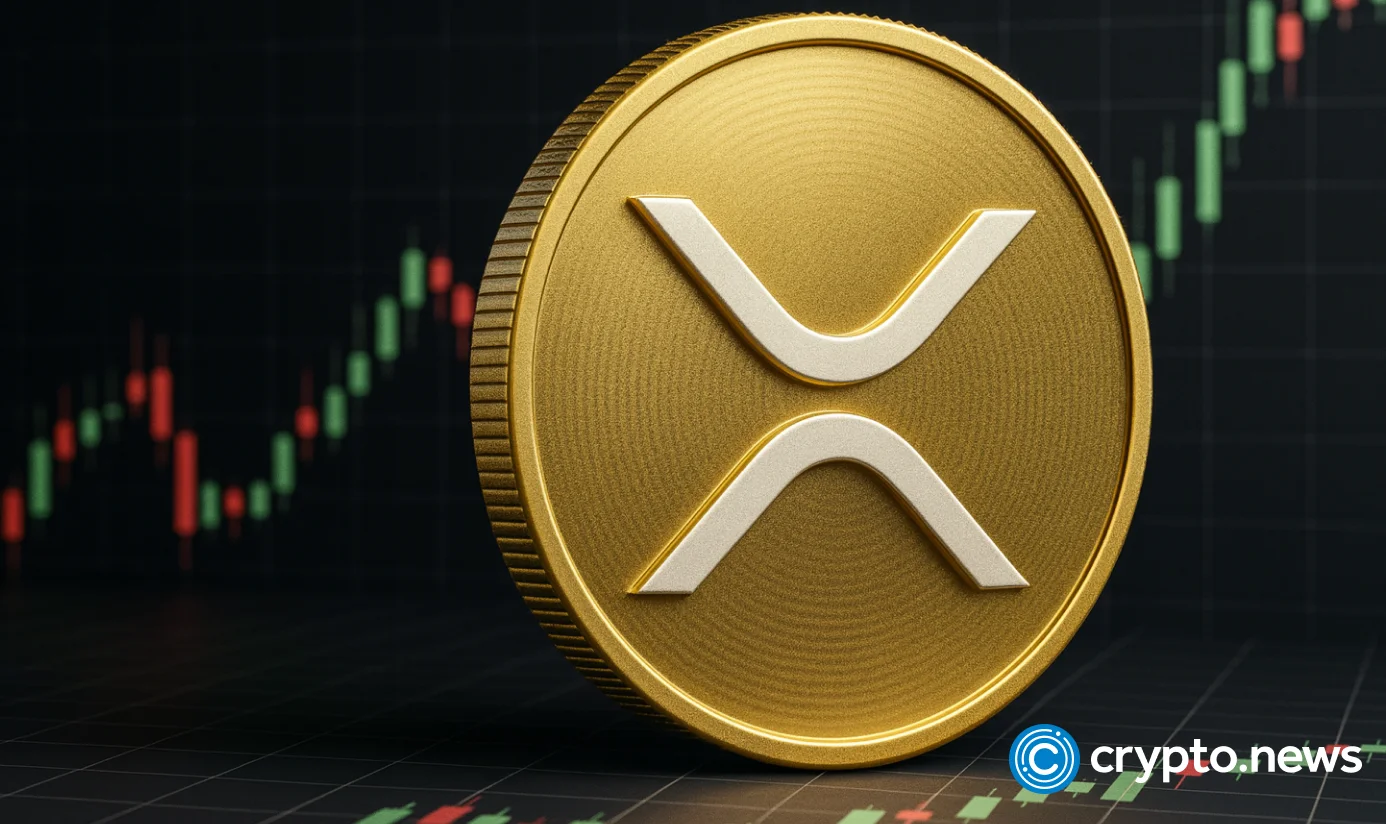
Ripple’s latest market overview confirms that US spot XRP ETFs have accumulated $1.53 billion in assets under management and 773 million XRP in custody, with Goldman Sachs leading all institutional holders through a $153.8 million position spread across four separate funds.
Summary
- US spot XRP ETFs have reached $1.53 billion in AUM and 773 million XRP in custody less than six months after the first products launched in late 2025.
- Goldman Sachs disclosed a $153.8 million position across four XRP ETFs in its Q4 2025 13F filing, making it the largest known institutional holder and accounting for roughly 73% of the top 30 institutions’ combined exposure.
- Despite the Goldman milestone, 84% of US XRP ETF assets remain retail-held, compared to 48.8% institutional participation in Solana ETF products.
Ripple’s April 17 institutional insights report confirms that US spot XRP ETFs have accumulated $1.53 billion in assets under management and 773 million XRP tokens in custody, less than six months after the first product launched in November 2025. Yahoo Finance reported that Goldman Sachs disclosed a $153.8 million position across spot XRP ETFs through its Q4 2025 13F filing, distributed across Bitwise’s XRP ETF at approximately $40 million, Franklin Templeton’s XRPZ at $38.5 million, Grayscale’s GXRP at $38 million, and 21Shares’ TOXR at $36 million.
XRP ETF Institutional Holders Led by Goldman’s Deliberately Diversified Stake
Goldman did not concentrate its XRP ETF position in a single product. The allocation is spread across four different issuers, a construction that Ripple’s report describes as reflecting a deliberate, long-duration institutional strategy rather than a tactical trading position. Of the top 30 institutional holders collectively controlling just over $211 million in XRP ETF exposure, Goldman accounts for roughly 73% of that total. As crypto.news reported, Bloomberg analysts have noted that Goldman’s position likely reflects trading desk facilitation activity rather than a direct directional bet on XRP, a distinction that matters when assessing whether the disclosure signals genuine institutional conviction or structural product demand. The Q1 2026 13F filing, due in May, will reveal whether the bank held the position through XRP’s price decline from its January peak above $2.40 to the current range near $1.44.
The Retail Gap That Still Defines the XRP ETF Market
Despite the Goldman headline, Ripple’s own data shows that 84% of domestic XRP ETF assets are held by retail investors, a figure that stands in sharp contrast to Solana ETF products where institutional participation runs at 48.8%. As crypto.news documented, XRP ETFs pulled in $55.39 million in the strongest week of 2026, their best single-week performance on record, and the funds have not recorded a single outflow day since April 9. That retail-driven demand has sustained the inflow streak, but it also means the institutional adoption story is at an earlier stage than the Goldman headline alone suggests. A Coinbase and EY-Parthenon survey of 351 institutional investors found that 25% plan to add XRP to their portfolios in 2026, with 65% citing regulatory clarity as the condition holding them back.
What the CLARITY Act Means for the Next Phase
The passage of the CLARITY Act would convert that stated institutional intent into actionable capital allocation. As crypto.news tracked, Goldman’s February 2026 disclosure was the first time the bank placed XRP alongside Bitcoin, Ethereum, and Solana in its structured product holdings, a threshold moment that Ripple described as cementing XRP’s position in the institutional allocation conversation. The SEC and CFTC jointly classified XRP as a digital commodity in March 2026, and if the CLARITY Act formalizes that classification into law, the 65% of institutional investors currently waiting for regulatory clarity would have the legal framework to move from intent to deployment.
Ripple noted that cumulative XRP ETF inflows crossed $1 billion by December 16, 2025 and surpassed $1.5 billion by early March 2026, a pace it described as among the fastest institutional adoption curves for any digital asset in regulated ETF history.
Crypto World
Casino Operators, Sportsbooks and Affiliates Get a Purpose-Built Media Distribution Service From Kooc Media
The online gambling ecosystem depends on three interconnected business types — casino operators who run the platforms, sportsbook brands who set the odds and gambling affiliates who connect players with both. Each one needs media visibility to succeed. Each one struggles to get it. Kooc Media, a PR distribution agency that has served the gambling and crypto industries since 2017, has launched a media distribution service that addresses all three at once.
The service gives casino brands, sportsbook operators and affiliate businesses guaranteed press coverage on established news publications, professional editorial support, global newswire distribution and transparent campaign reporting. It is the first time a single service has been designed to cover the full range of businesses that make the online gambling industry work.
A Shared Frustration Across the Industry
Spend enough time in online gambling marketing circles and a pattern becomes obvious. Whether someone runs an online casino, manages a sportsbook or owns an affiliate network, the frustration with PR is identical. They know press coverage would help their business. They have tried to get it. The results were either nonexistent or so poor that the entire exercise felt like a waste of money.
Casino operators have been told by agency after agency that gambling falls outside their acceptable client categories. Sportsbook brands have heard the same, sometimes with the added insult of being passed over during the exact sporting events when coverage would matter most. Affiliate businesses — despite producing editorial content as their core product — have found it almost impossible to secure press coverage that builds their own brand rather than the operators they promote.
The common denominator is an industry that generates enormous revenue but receives almost no attention from the mainstream media ecosystem. Publications that routinely cover fintech, gaming technology and digital entertainment draw a line at gambling. PR agencies that proudly serve controversial sectors in other industries refuse to touch betting or casino clients.
Kooc Media exists specifically because of this gap. The agency has provided gambling PR and crypto PR as core services since its founding and has built the distribution infrastructure needed to deliver results where other agencies consistently fail.
“Casino operators, sportsbooks and affiliates are three sides of the same industry,” said Michelle De Gouveia, spokesperson for Kooc Media. “They all need media distribution that actually works. We have built one service that handles all three.”
The Distribution Infrastructure
Kooc Media’s service runs on a combination of owned media and partner distribution that eliminates the uncertainty of traditional PR.
The agency owns and operates multiple established news websites including Blockonomi, CoinCentral, MoneyCheck, Parameter, Beanstalk and Computing. These publications have built strong domain authority and consistent readerships across finance, technology, cryptocurrency and iGaming through years of editorial output. Because Kooc Media controls these sites, every placement booked through the service is published. There is no editorial pitch. No third-party gatekeeper. No possibility of paying for coverage that never materialises.
Beyond the owned network, press releases are distributed through a partner system reaching hundreds of additional media outlets and thousands of syndication channels across multiple countries and content categories. Premium distribution packages extend reach to major international platforms including Business Insider, Bloomberg, Benzinga, MarketWatch and USA Today.
Content is produced by the agency’s in-house editorial team when clients need writing support. The writers understand the specific language, regulatory sensitivities and audience expectations of the casino, sportsbook and affiliate sectors. Clients who prefer to provide their own material can do so and use Kooc Media purely for placement and distribution.
The full cycle operates at the speed the gambling industry demands. Briefing to live publication can happen within a single day. After distribution completes, a detailed report containing live links to every published article is delivered to the client.
What Media Distribution Does for Casino Brands
The online casino market is saturated with operators competing for the same players through increasingly similar means. Bonus offers, game libraries, loyalty programmes and website designs have converged to a point where many casinos are virtually interchangeable from a player’s perspective.
Press coverage provides differentiation that product alone cannot. A casino brand covered by independent news publications carries a perception of legitimacy and establishment that uncovered competitors lack. Players searching for a new casino encounter that coverage during their research and factor it into their decision. The brand feels safer. The signup feels less risky. The deposit happens more readily.
Over time, the SEO value compounds. Each article on a strong domain generates a backlink that improves the casino’s organic search positioning. For brands targeting terms like “best online casino,” “new casino sites,” “top casino bonuses” or “online slots,” those accumulated backlinks provide a lasting competitive advantage in search rankings.
What Media Distribution Does for Sportsbook Brands
Sportsbooks face a unique combination of pressure. They need to build long-term brand trust while simultaneously capitalising on short-term windows of opportunity around sporting events. A sportsbook that is invisible during a major football tournament or boxing event misses the exact moment when potential bettors are most actively searching for a platform.
Kooc Media’s same-day distribution capability allows sportsbook brands to time PR campaigns precisely around these events. A press release can go live on the morning of a major match day, putting the sportsbook’s name in front of audiences when interest is at its peak.

Beyond event-driven campaigns, sportsbooks accumulate the same trust and search benefits as casino brands. Bettors research operators before committing funds. Coverage on trusted publications reduces hesitation. Backlinks from those publications help sportsbooks compete for terms like “best sportsbook,” “sports betting sites,” “football betting platform,” “live betting odds” and “online betting offers.”
For sportsbooks entering newly regulated markets, press coverage provides immediate positioning. A brand that arrives with published coverage across recognised publications starts ahead of competitors who enter with no media presence at all.
What Media Distribution Does for Affiliate Brands
Gambling affiliates occupy a peculiar position in the industry. They are media businesses whose entire model depends on producing content and attracting audiences. Yet most affiliates invest nothing in promoting their own brand through external media channels.
The missed opportunity is significant. An affiliate brand with press coverage on established publications gains credibility with both players and operator partners. Players encountering an affiliate’s comparison site or review platform are more likely to trust its recommendations if they have seen the brand mentioned elsewhere in independent media. The affiliate stops being just another faceless review site and becomes a recognised name in the space.
Operator partnerships benefit too. Casino and sportsbook companies evaluating potential affiliate relationships assess the affiliate’s brand strength, traffic quality and public profile. An affiliate with documented media coverage across credible publications presents a stronger case for favourable commercial terms than one with no presence beyond its own website.
The SEO advantages are particularly relevant for affiliates. The gambling affiliate market is one of the most competitive organic search environments in existence. Hundreds of sites target the same high-value keywords. Backlinks from authoritative publications built through consistent PR campaigns strengthen domain authority in ways that internal content strategies alone struggle to match.
Packages That Fit Each Business Type
Kooc Media offers standard packages and custom campaigns to suit the different needs of casino operators, sportsbook brands and affiliate businesses.
Standard packages deliver guaranteed placements across the agency’s owned sites and partner network with optional content creation and comprehensive reporting. They work for casino brands maintaining steady promotional coverage, sportsbooks keeping their name visible throughout the sporting calendar and affiliates building brand authority through regular media output.
Custom campaigns address specific strategic moments. A casino launching a new brand or entering a new market needs coordinated multi-publication coverage. A sportsbook timing a campaign around a major sporting event needs rapid distribution with precise scheduling. An affiliate network expanding its portfolio or rebranding needs press that introduces the new identity to the industry. Any of these businesses integrating cryptocurrency features needs content bridging traditional gambling and crypto audiences.
Kooc Media manages every campaign from planning through content production, distribution and final reporting.
About Kooc Media
Kooc Media is a PR distribution agency founded in 2017, specialising in online gambling, crypto, fintech and technology. The company operates its own network of news publications and distributes content through a broad global partner network to guarantee media placements. Services include press release writing, sponsored articles, homepage features, newswire distribution and complete campaign management.
Kooc Media’s gambling PR packages are available now through the company’s website at https://kooc.co.uk.
Disclaimer: This is a Press Release provided by a third party who is responsible for the content. Please conduct your own research before taking any action based on the content.
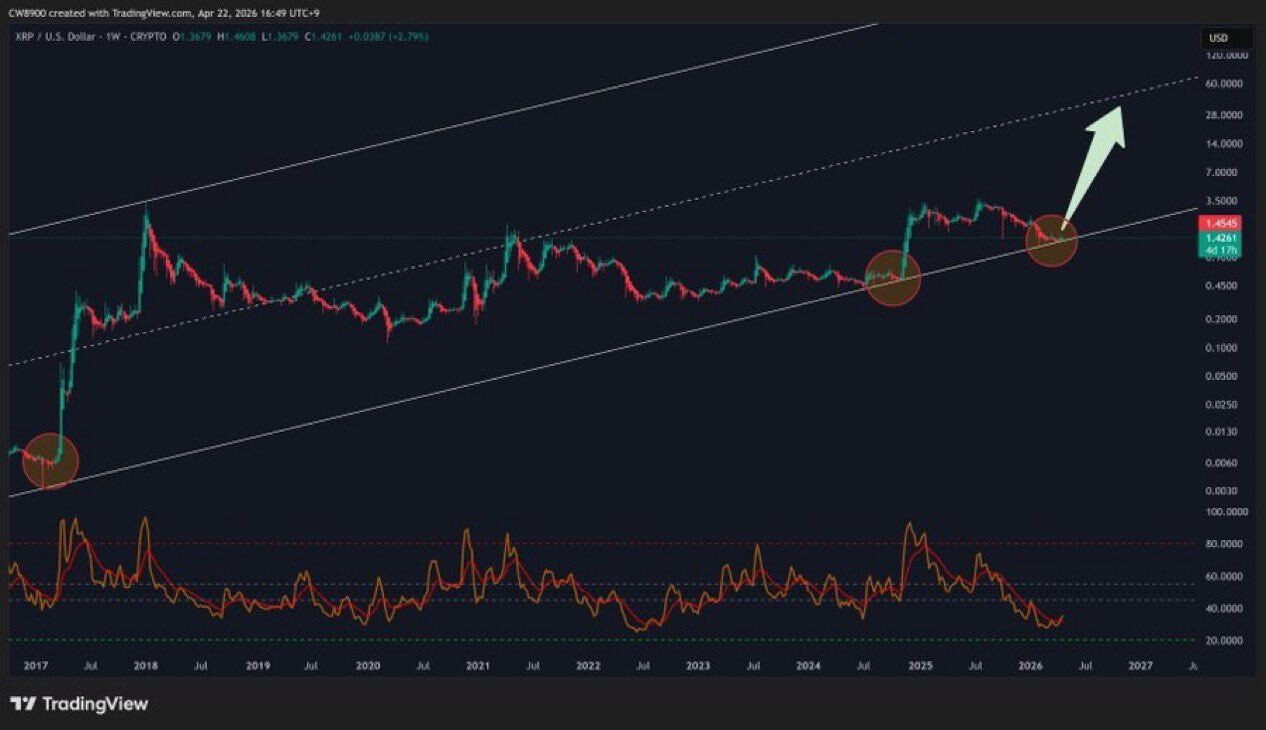
XRP (XRP) is trading near $1.43 as multiple timeframes point to an imminent directional move, with a cup and handle on the 4-hour chart targeting $1.70 and a confirmed weekly golden cross backing a longer-term bullish thesis.
Daily volatility has compressed to near record lows while the Relative Strength Index (RSI) tightens inside a triangle stretching back to mid-2025. The setup resembles a classic accumulation phase before a powerful expansion.
XRP Weekly Channel and Golden Cross Build Macro Bullish Case
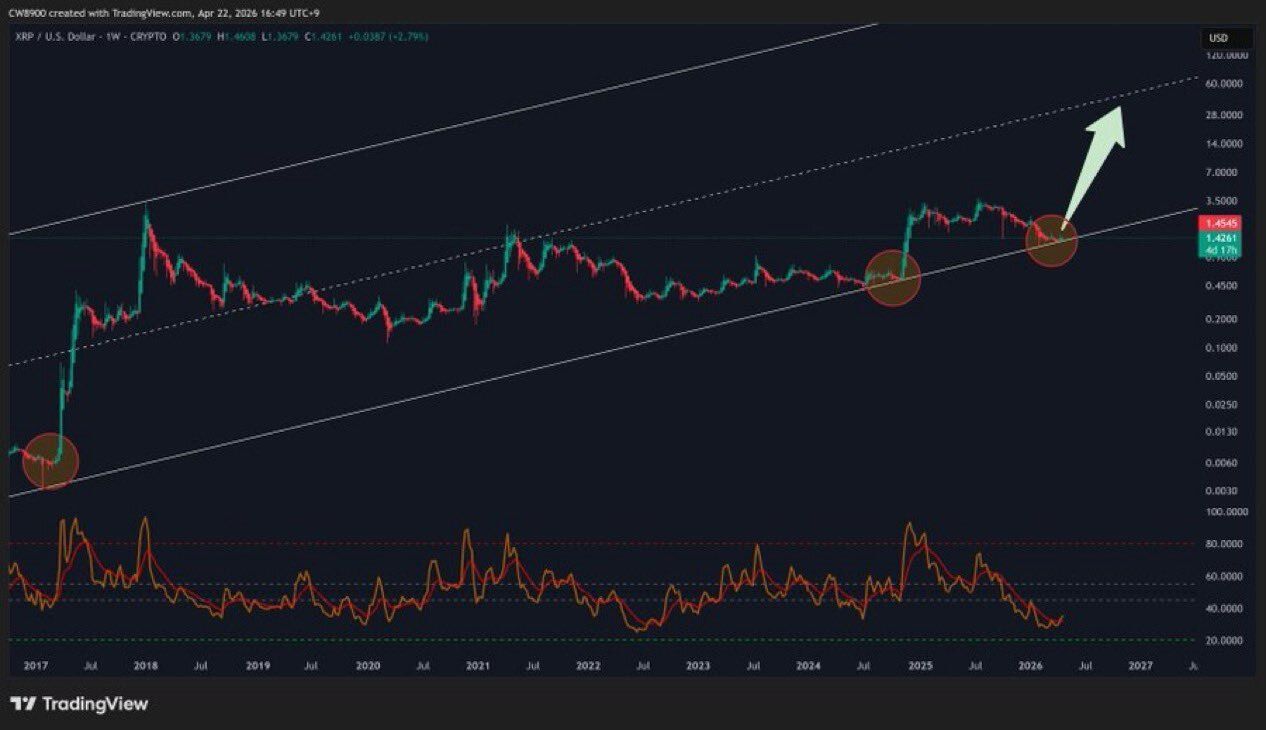
The weekly XRP chart shows the price on the lower boundary of an ascending parallel channel drawn on a logarithmic scale. The current bounce marks the third test of that support. Historically, prior tests in 2017 and mid-2024 preceded strong rallies.
A confirmed golden cross adds weight to the structure. Weekly golden crosses are rare and have marked sustained uptrends in past cycles. Crypto analyst XrpUdate expects XRP to run toward the channel midline, which currently sits in the $30 range.
Meanwhile, a clean loss of the channel support would invalidate the bullish case. Such a breakdown could open the door for a return to cycle lows.
“$XRP JUST CONFIRMED A GOLDEN CROSS Years of consolidation → ready to expand. The structure is screaming continuation. This is where smart money loads…”
Daily Volatility Collapse and RSI Triangle Point to Expansion
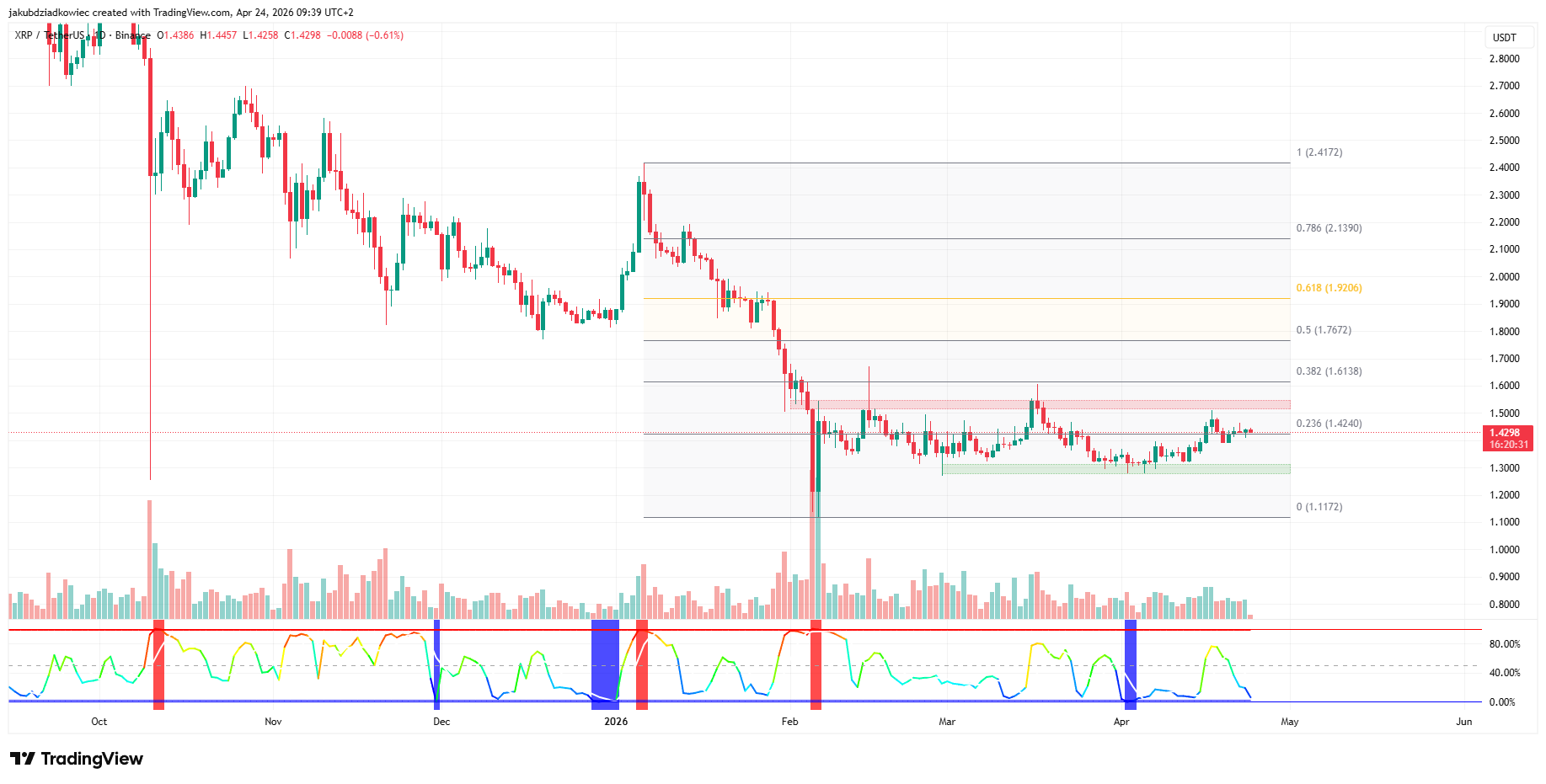
The daily chart shows XRP pinned to the 0.236 Fibonacci retracement at $1.42. Support sits at $1.30, and resistance at $1.53. The Fibonacci grid is anchored to the January rally top at $2.42.
Beneath the price panel, the Bollinger Band Width Percentile (BBWP) reading has collapsed toward zero and is flashing blue. Volatility this compressed has historically preceded sharp directional moves in either direction.
Declining volume through April reinforces the accumulation thesis. Long-term holders tend to absorb supply quietly during these phases before retail catches on.
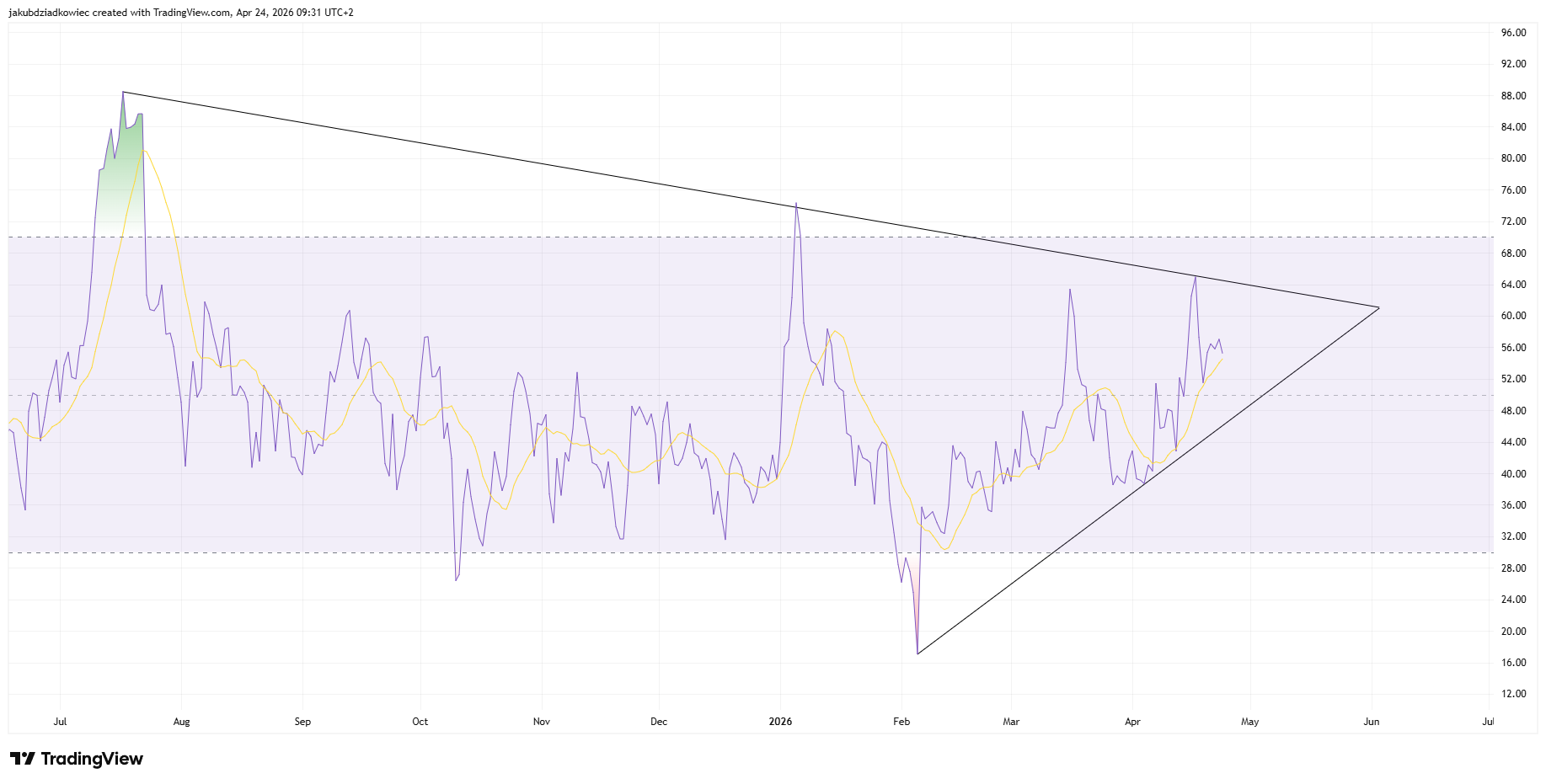
Confirming the setup, the daily RSI has formed a contracting triangle since July 2025. Resistance slopes down from the 88 print last summer. Support rises from the February 2026 low near 18.
The indicator currently sits around 55, almost dead-center inside the apex. A break above 60 would align with a bullish momentum shift. However, a drop under 45 would warn of further downside.
XRP Price Prediction and the $1.70 Cup and Handle Target
The 4-hour XRP/USDT chart on Binance shows a cup and handle formation taking shape. The cup stretches from the March low near $1.30 to the April peak at $1.50. The handle is forming right on the 0.236 Fibonacci line at $1.42.
A clean break above the $1.50 neckline measures to a target of $1.6933. That target sits between the 0.382 and 0.5 Fibonacci retracements of the recent leg down. It represents roughly 18% upside from current levels.
The 4-hour RSI sits near 50, matching the neutral momentum seen on higher timeframes. That reading aligns with a late-stage accumulation pattern rather than exhaustion.
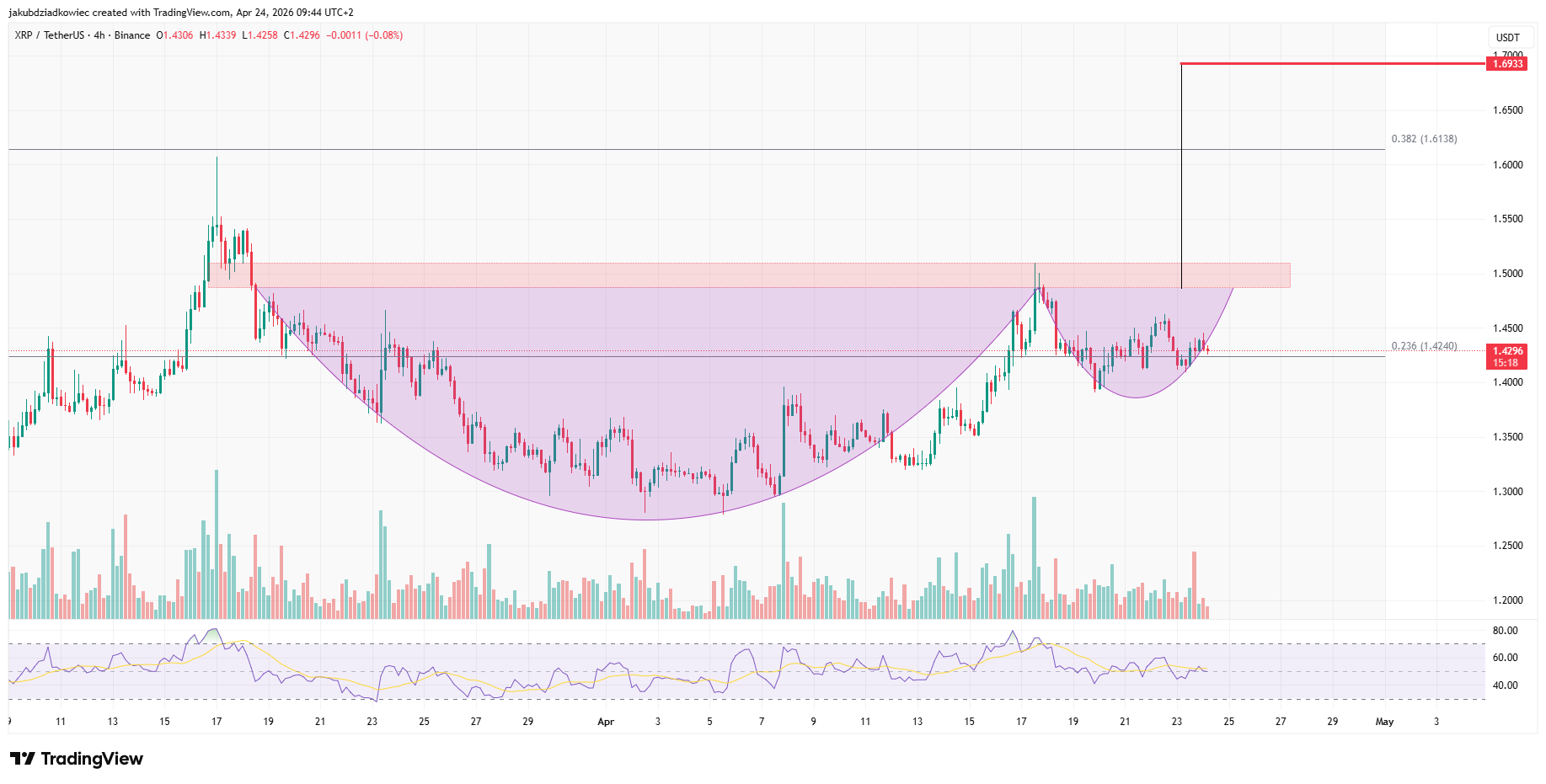
If $1.30 gives way before the breakout, the cup and handle get invalidated. Hold the $1.30 floor, and the alignment across weekly, daily, and 4-hour charts favors a breakout.
The post XRP Gears Up for Breakout as Cup and Handle Targets $1.70 appeared first on BeInCrypto.


The quantum attack Bitcoin has spent years treating as tomorrow’s problem just got a little less theoretical.
Quantum security startup Project Eleven said it awarded its 1 bitcoin Q-Day Prize to independent researcher Giancarlo Lelli on Friday after he broke a 15-bit elliptic curve key on publicly accessible quantum hardware, deriving a private encryption key from its public counterpart.
The bounty is worth roughly $78,000 at current prices. It is said to be the largest public demonstration of the attack class that could one day threaten bitcoin, ether (ETH) and most major blockchains.
Project Eleven Awards 1 BTC Q-Day Prize for Largest Quantum Attack on Elliptic Curve Cryptography to Date
Researcher breaks 15-bit ECC key on publicly accessible quantum hardware in a 512x jump from the previous public demonstration.
Project Eleven today awarded the Q-Day…
— Project Eleven (@projecteleven) April 24, 2026
Elliptic curve cryptography is the math that lets a crypto wallet prove it controls funds without revealing its private key. A public key can be visible to everyone, but deriving the corresponding private key is supposed to be impossible in practical terms.
Quantum computers running Shor’s algorithm, a quantum technique first proposed in 1994, challenge that assumption by attacking the underlying logic that secures those signatures.
Lelli’s result does not mean bitcoin is close to being cracked. Bitcoin uses 256-bit elliptic curve security. A 15-bit key has a search space of 32,767 possibilities, tiny by comparison. The prize was designed to measure whether quantum attacks on real cryptography-based products are moving from white papers into public hardware experiments.
The previous public break was a 6-bit demonstration by Steve Tippeconnic in September 2025 using IBM’s 133-qubit quantum computer. Lelli’s 15-bit result expanded that by a factor of 512 in seven months.
A bit is the smallest unit of information in a regular computer, a qubit is the quantum computing equivalent.
Read more: A simple explainer on what quantum computing actually is, and why it is terrifying for bitcoin
Theoretical resource estimates have dropped even faster. A Google Research paper last month put the cost of a full 256-bit attack below 500,000 physical qubits, down from earlier estimates in the millions.
“The resource requirements for this type of attack keep dropping, and the barrier to running it in practice is dropping with them,” Project Eleven CEO Alex Pruden said.
Pruden noted the winning submission came from an independent researcher working on cloud-accessible hardware, not a national laboratory or a private quantum chip.
The concern is sharpest for wallets whose public keys are already visible on-chain. Project Eleven estimates roughly 6.9 million bitcoin sit in such addresses, about one-third of total supply, including Satoshi Nakamoto’s estimated 1 million bitcoin untouched since the network’s earliest years. Any quantum computer capable of breaking 256-bit ECC could work through those wallets at leisure.
Bitcoin developers have proposed migration paths including BIP-360, a Bitcoin Improvement Proposal that would add quantum-safe address types. Ethereum, Tron, StarkWare, and Ripple have each published post-quantum transition plans.
Fifteen bits is not 256 bits, but is the latest in a rapidly heating up point of interest for bitcoin developers and the broader community.

Fannie Mae, Freddie Mac to allow credit scores, including rent, utilities
Bitcoin and Risk Assets Halt Their Surge With BTC Support at Risk

The Raunchy Film Career Of Jerry Seinfeld’s Infamous On-Screen Girlfriend

Manchester United reach agreement with Casemiro over contract clause amid transfer speculation

US brings back mandatory military draft registration

Steven Gerrard disagrees with Gary Neville over ‘shock’ Chelsea and Arsenal claim | Football


-

 Business5 days ago
Powerball Result April 18, 2026: No Jackpot Winner in Powerball Draw: $75 Million Rolls Over
-

 Politics7 days ago
Palestine barred from entering Canada for FIFA Congress
-
Entertainment5 days ago
NBA Analyst Charles Barkley Chimes in on Ice Spice McDonald’s Fiasco
-

 Tech6 days ago
Auto Enthusiast Scores Running Tesla Model 3 for Two Grand and Turns It Into Bare-Bones Go-Kart
-

 Politics5 days ago
Zack Polanski demands ‘council homes not luxury flats for foreign investors’
-

 Crypto World7 days ago
Russia Pushes Bill to Criminalize Unregistered Crypto Services
-

 Politics4 days ago
Gary Stevenson delivers timely reminder to register to vote as deadline TODAY
-

 Business2 days ago
Rolls-Royce Voted UK’s Most Iconic Trade Mark as IPO Register Hits 150
-

 Politics2 days ago
Making troops accountable for war crimes threatens US alliance, ex-SAS colonel warns
-

 Politics2 days ago
Disabled people challenge government SEND proposals over segregation concerns
-

 Crypto World7 days ago
Russia Introduces Bill To Criminalize Unregistered Crypto Services
-

 Politics2 days ago
Zack Polanski responds to home secretary’s taser threat
-

 Politics2 days ago
Starmer handler McSweeney to be dragged from shadows by Foreign Affairs Committee
-
Politics2 days ago
Wings Over Scotland | How To Get Away With Crimes
-
Crypto World6 days ago
Kelp DAO rsETH Bridge Hack Drains $292M as DeFi Losses Top $600M in Two Weeks
-

 Politics2 days ago
‘Iran is still a nuclear threat’
-

 News Videos7 days ago
AP Politics, Buggana Analyzes Reasons For Financial Instability Due To Amaravati
-

 Crypto World3 days ago
New York sues Coinbase, Gemini over prediction market offerings
-

 Business2 days ago
The Job Benefits Most Men Don’t Know to Negotiate
-

 Crypto World8 hours ago
Michael Saylor says BTC winter is over. Market analyst disagrees, says bitcoin was in a pullback
You must be logged in to post a comment Login