
Crypto World
A Solana oracle’s support ends today. Who still relies on its prices?


Switchboard’s September 25 support deadline has turned a six-day migration warning into a test of Solana’s price feeds. Current public documentation shows where its data remains part of an application’s design, but those pages cannot prove that a live market is still using the feed. Jito and marginfi provide two sharply different views of the exposure.
Summary
- Switchboard said technical support would end on September 25, 2026, after its September 19 wind-down announcement.
- Jito’s Tip Router documentation still names Switchboard as a pricing source for vault weights, although the overview is 9 months old.
- Marginfi’s September upgrade describes 9 new oracle setups that do not depend on Switchboard.
- A stale price feed can affect collateral checks, while Jito documents a separate fallback for reward-weight pricing.
- No live protocol-wide count of unmigrated Switchboard feeds was verified for the September 25 deadline.
Switchboard has reached its stated September 25 end of technical support, leaving Solana applications to verify the price sources configured in their live programs.
The oracle project’s September 19 statement, as reproduced in coverage of the announcement, said its core development contributor Switchboard Technology Labs would wind down and all implementations were deprecated immediately. The team urged integrators to migrate to other providers, naming Pyth and RedStone. September 25 was described as the last day for existing support. A company ending support is a real operational milestone. It does not, by itself, prove that every onchain feed stopped updating at midnight or that every application once associated with Switchboard remained dependent on it.
Switchboard’s own documentation has named Kamino, Jito, marginfi and Drift as users. Those are historical integration claims from a provider that was selling an oracle service, not a real-time inventory of active feeds on September 25. Checking each project’s current documentation reveals a more complicated picture. Jito’s Tip Router pages still describe Switchboard in their pricing flow; marginfi’s September technical upgrade adds paths designed to avoid that dependency. One document can be stale while another anticipates a migration. Neither substitutes for an inspection of live account configuration.
The earlier Switchboard funding round was $7.5 million in May 2024. The amount is useful background on the venture’s history, but it gives no measure of today’s protocol exposure. The relevant count is the number and value of live markets whose risk calculations still take data from a feed that cannot be reliably updated, and that count cannot be inferred from a customer logo.
A listed integration is not an active feed
Switchboard’s public introduction describes on-demand feeds: applications create or call the data they need, and a price is made available through Solana accounts. Documentation can identify where a protocol knows how to read a Switchboard feed. It may not identify which option a particular market currently selects. A software development kit may support an oracle type long after the last bank switches away from it. Conversely, a website may change while a live reserve retains its older oracle account.
Three levels of evidence need to be kept apart. First is a marketing or integration page, which shows a relationship existed. Second is a program’s supported configuration, visible in technical documentation or code. Third is the live configuration and recent update history of the actual market. Only the third can support a claim that a named market still relied on Switchboard at a given time. Even then, a backup source may be configured, so the impact of a stopped primary feed must be checked against the relevant fallback and freshness rule.
Consider marginfi’s protocol documentation. Its oracle table retains SwitchboardPull and venue variants among available setups. It says a caller must crank a Switchboard pull feed just before use. The same table lists Pyth push feeds and Scope accounts as other setups. A reader could mistake the continued Switchboard row for proof that every marginfi bank still uses it. The table describes supported types, not a complete list of which bank uses which feed today.
Marginfi’s separate Program 0.1.11 note is more current and more specific. It instructed developers to upgrade the SDK to at least version 2.8.0 before September 4, saying banks would begin moving to new oracle setups from that date. The release added nine variants that do not depend on Switchboard, including Kamino Scope feeds and exchange-rate based pricing for certain liquid staking and principal tokens. The note does not say every bank had migrated by September 25. It does show that a project publicly documented a route away from the threatened dependency before the shutdown announcement.
The migration carries a surprising second failure mode. Marginfi says older SDKs cannot decode a bank configured with one of the new oracle enum values. A single bank with an unsupported value can prevent Project0Client.initialize and bank reads, not merely an action involving that bank. In other words, changing an oracle can fix one infrastructure dependency while breaking an integrator that has not updated its software. Marginfi’s document tells integrators how to avoid the SDK problem; it is not evidence that any particular user suffered it.
Project 0 has described unified margin across Solana venues, including Kamino and Drift. Cross-protocol interfaces create another layer at which an oracle migration must be read correctly. The note about older SDK versions is concrete evidence of an integration hazard, without proving a failure in Project 0 or any other named app. A responsible audit would check software versions and live lending-bank configurations before claiming an outage.
Jito’s Tip Router still documents Switchboard
Jito Foundation’s Tip Router overview says Switchboard determines the relative weight of assets such as JitoSOL and JTO held in vaults linked to the Tip Router. The overview identifies an onchain Tip Router program, a node-operator client and a permissionless cranker. Its pricing documentation names Switchboard as the current oracle feed and describes backup weights when feeds are unavailable.
The documents place Switchboard in a specific job: pricing vault assets for weight calculations in a tip distribution and restaking system. They do not say that an unavailable Switchboard feed would automatically liquidate a Solana lending position. Jito’s pricing page describes a fallback mechanism, which weakens the simplistic claim that a support sunset necessarily makes all Tip Router operations stop. The exact fallback values, activation conditions and current live oracle accounts still need a current program-state check.
The Tip Router overview showed a last-updated marker of nine months ago when checked on September 25. That age changes how it can be used. It establishes a documented design and identifies where to ask a technical question. It cannot establish that the present program has the same feed configuration. Jito may have updated onchain accounts without revising the page, or it may still use Switchboard with a fallback. Without a recent transaction inspection or a current statement from Jito, a named live dependency remains unverified.
Jito’s public GitHub release notes for Tip Router refer to retrying Switchboard oracle gateways in keeper operations. A codebase containing such logic likewise demonstrates technical integration, not necessarily a dependency of every vault at the time of publication. Code can preserve a compatibility path for months. The live question is whether recent price update transactions target a Switchboard account used by a vault still carrying value, and whether that account advances after the support deadline.
The distinction is often lost when all oracle users are placed in a single list. Jito’s described calculation affects relative asset weights in a distribution system. A lending market’s described calculation determines collateral value and borrower health. Both consume price data, but their failure paths differ. An audit that counts logos would assign the same severity to fundamentally different uses.
Kamino’s Scope is an aggregator, not a provider label
Kamino Finance’s public Scope repository describes an onchain aggregator that copies values from multiple oracle accounts into one price feed and validates updates under preset rules. Its README says a feed supports up to 512 prices and that the association between an index and a token pair is not wholly stored onchain. A downstream program may point to Scope while Scope itself relies on other feeds for the selected asset. Seeing Scope in a bank configuration is thus a starting point for tracing the actual data source, not the end.
The September marginfi note lists Scope as an option that does not depend on Switchboard for the new setup it describes. That does not imply every deployment of Scope on every date excludes every Switchboard source. An aggregator can change its underlying inputs. A complete dependency check needs both the consumer’s selected Scope account and the source mapping used to populate its entry. Kamino’s repository supplies the architecture, not a timestamped inventory of current mainnet sources for every application.
Kamino has continued bringing institutions into its lending ecosystem. Galaxy opened two stablecoin vaults on the platform in September. The existence of new vaults shows why naming a whole protocol as exposed without checking its individual assets would be unsound. A USDC vault, a liquid staking token reserve and a tokenized equity market can use different oracle paths. We have not verified that Galaxy’s vaults use Switchboard, so they are not included in a count of affected positions.
Similarly, the older list of Kamino, Jito, marginfi and Drift in Switchboard’s introductory material does not tell us the distribution of exposure among them. A project may use an oracle only for one market, use it as a fallback, or retain code after switching live feeds. The only defensible unit of analysis is a specific market or vault and its configured feed at a specified time. Without that unit, claims about funds at risk are marketing arithmetic run backward.
A stale feed has more than one possible effect
The technical consequence of a feed falling behind depends on the consuming protocol. A lending program generally needs a price to determine collateral value and borrowing capacity. If it rejects an old value, an action may fail or a market may pause under its rules. If it accepts stale data, a borrower might transact against a price that no longer matches the market. A fallback source may keep the market operating but introduce a new update rhythm or confidence rule. The protocol’s documentation and onchain configuration decide which path applies.
Marginfi explicitly says Switchboard pull feeds need to be cranked before use. An integrator must therefore supply a fresh update as part of its transaction path. Pyth push feeds, by contrast, are described as being kept fresh through Pyth’s infrastructure. Scope uses an aggregated account value selected by a configured entry index. Moving between these types changes the accounts a transaction needs and the code that checks them. The September SDK warning is one visible example of those changes reaching application software.
For Jito Tip Router, the public docs describe backup weights for unavailable feeds. Whether those backups preserve accurate reward allocation through a sustained outage is a question for live configuration and Jito’s operators, not something a documentation sentence resolves. If a feed keeps updating through independent node operators after the company stops support, no fallback may be triggered immediately. If updates cease but the backup is active, operations may continue with a different pricing method. These are conditional paths, not a prediction of the system’s present state.
An unrelated oracle incident led to liquidations on Vesu earlier in September. It illustrates that incorrect pricing can have economic effects, but it is not evidence of an incident at Switchboard, Jito or marginfi. A shutdown notice should not be turned into a liquidation claim by analogy. The sign of an actual event would be stale account timestamps, failed transactions, a protocol pause or identified losses, none of which has been shown here for the September 25 deadline.
Solana’s move to 250 millisecond slots changed the pace at which blocks are produced, but it did not guarantee that an external price source updates. Faster slots can carry a new price sooner when one exists. They cannot manufacture a price when the node supplying it stops. A protocol’s freshness test may be measured by slot, time or another rule, so a change in the network clock may alter how developers interpret old feed configurations.
Who bears the migration work?
The oracle operator publishes or coordinates data, but the consuming protocol chooses the account its program reads and the limits it places on that price. A lending protocol can require governance or an administrator to change oracle addresses for its markets. Its front end and third-party integrators then have to construct transactions with the right additional accounts. Users may only notice a rejected borrow or a paused market, long after the operator and protocol have made their technical decisions.
An operator ending support does not necessarily have the power to rewrite a customer’s program configuration. The Switchboard notice urged users to migrate because integration owners must act. Projects should be assessed by the addresses and account updates they control. If an application already moved to Pyth before September 19, the later support deadline has no direct effect on that market. If it still selects a Switchboard feed and has no working backup, the feed’s behavior after September 25 is the concrete issue.
The strongest opposing reading of the shutdown alarm follows from marginfi’s own September note and Jito’s documented backup. Applications can design redundancy or move ahead of a vendor exit; the code and documents show mechanisms for doing so. Switchboard’s on-demand model can leave some feed infrastructure running independently even if the core contributor has stopped support. The notice did not publish a verified schedule at which every account would halt, and we found no primary evidence establishing such a universal cutoff.
There is a different kind of continuity question for a protocol that made its own fallback. A backup price can prevent a total stop while pricing an asset less frequently or with a different source set. For a reward distribution process, a temporary backup weight may keep epoch accounting moving, although the allocation may then rely on the backup’s assumptions. For a lending market, the fallback could change the price used in a health check. These are not claims about current Jito or marginfi settings. They show what a maintainer must disclose before users can judge whether a migration is complete in operational terms, not merely whether transactions still execute.
A provider wind-down can have delayed effects as well. Code written to request on-demand prices may succeed while an independent gateway answers, then fail when that gateway is retired or its operators stop updating a specific asset. An observer needs several post-deadline timestamps, not a single successful transaction, to infer continued service. The same discipline applies to a failed transaction: one user’s error may arise from a stale SDK or insufficient account input instead of an unavailable oracle. Marginfi’s migration document supplies an explicit example of a software decoding failure that could otherwise be mislabeled as an oracle outage.
There is a limit to that reassurance. A fallback described nine months earlier needs validation against current state, and a migration option described in September is not proof every bank took it. The two documents supply credible reasons not to assume catastrophe, while leaving a measurable gap. The fair conclusion is narrower than both the promotional and alarmist versions: public documents identify candidate dependencies and escape routes; a current market-by-market configuration audit is needed to establish any remaining exposure.
The live inventory is still the missing document
The original reporting here compares Switchboard’s list of four prominent integrators with current primary documents from Jito, marginfi and Kamino. It yields two verified documentary findings. Jito’s older Tip Router documentation names Switchboard for vault pricing and a fallback for unavailable feeds. Marginfi’s September 0.1.11 note describes nine new setups independent of Switchboard and warns of a separate SDK break if integrators do not upgrade. Kamino’s Scope repository explains why an aggregator label alone cannot identify every upstream data source.
The work does not produce a count of live unmigrated feeds, user funds exposed or an outage at any named protocol. The available public pages do not contain a synchronized September 25 snapshot of all oracle accounts, latest successful updates, fallback settings and amounts supported by each market. Claiming a specific dollar total from protocol TVL would be indefensible, because the whole protocol’s assets do not necessarily share the same oracle. The precise headline question remains open at the live-account level.
A proper count would use the market as the row, not the protocol. For each active lending bank, derivative market or reward vault, the auditor would record its program address, selected oracle type, oracle account, backup source if any, latest successful price update, maximum permitted age and the value of positions actually dependent on that particular price. Duplicate markets that share one oracle account should not be counted as distinct feeds; one market using two independent oracles should not be counted as wholly dependent on either without reading its fallback logic. The timestamp of the market configuration matters because an administrator could change a feed after the observation.
This method explains why even a true statement such as a protocol supported 550 feeds in the past is insufficient for the present question. A feed can exist without an active borrower, can have a price update without a consuming market, or can be referenced only in dormant code. A count of feed accounts measures infrastructure. A count of configured markets measures dependency. A count of positions and collateral actually touching those markets measures economic exposure. None is interchangeable with total assets deposited in all products run by a project.
There is a further verification step when a source is an aggregator. The consumer may identify a Scope account and entry index, while the Scope mapping points onward to one or more providers. An update in the Scope account after September 25 proves an aggregator produced a value, but it does not by itself prove Switchboard continued to supply the underlying price. The investigator needs the selected entry and source configuration for that update. Kamino’s repository notes that token-pair labels are not entirely stored onchain, so external configuration or maintainer documentation may be needed to map an index to its asset. Where that mapping is unavailable, the result should be recorded as unknown, not silently attributed to Pyth or Switchboard.
What to watch
- Market oracle addresses: Compare each active bank or vault’s configured feed with the documented Switchboard accounts.
- Price update timestamps: Check whether an identified feed continues publishing fresh values after September 25.
- Fallback configuration: Look for the source and freshness limit used if a primary feed falls behind.
- Recent program transactions: Check whether borrowing, settlement or tip distribution still completes for the affected market.
- Dated maintainer updates: Look for a named migration, market pause or remaining dependency, supported by an account or program address.
Record the observation time for each check; a screenshot without a block or timestamp can quickly become stale.
Marginfi’s upgrade note states that a bank using a new oracle enum value can make an older SDK fail to initialize its client, even if a user does not interact with that particular bank. The instruction to use SDK version 2.8.0 or later was published ahead of September 4’s migration start, three weeks before Switchboard’s support deadline.
FAQ
When did Switchboard say support would end?
The shutdown announcement was made on September 19, 2026, and identified September 25 as the end of existing technical support. The notice deprecated implementations immediately.
Did all Switchboard oracle feeds stop on September 25?
The support deadline alone does not establish that every onchain account stopped updating. Current transaction and feed timestamps are needed to make that claim.
Does Jito still use Switchboard?
Jito’s Tip Router documentation still names Switchboard in vault pricing, but its overview is marked as last updated nine months earlier. The pages do not prove the live September 25 configuration.
Did marginfi migrate off Switchboard?
Marginfi’s September upgrade documents nine new oracle setups that do not depend on Switchboard and says banks began moving from September 4. It does not state that every bank completed a migration.
Why can an oracle migration break an SDK?
Marginfi says older SDKs do not recognize the enum values used by its nine new setups. A bank configured with one can make an old client’s initialization fail; version 2.8.0 or later supports the variants.
Is Kamino Scope independent of every external oracle?
Scope aggregates values from other oracle accounts. Its presence in a consumer’s configuration does not identify every upstream source without examining the specific entry mapping.
How can users check whether a market is affected?
The market’s configured oracle account, latest update and fallback settings provide a stronger answer than a historical provider list. Protocol announcements can confirm whether a specific market has migrated.
Have losses been verified from this shutdown?
No losses at a named protocol were verified for this feature. An earlier incident at another protocol cannot prove one occurred here. This is educational analysis, not investment advice.
Disclaimer: This article is for information and educational purposes only and does not constitute financial or investment advice. Figures reflect regulatory filings and reporting available at the time of writing and change with each disclosure. Nothing here is a recommendation to buy, sell, or hold any security or asset. Always do your own research. Information is accurate as of September 25, 2026.

Crypto and DeFi projects continue to be hacked at a dizzying pace, and few days in recent weeks have been incident-free.
That said, Thursday was a particularly busy day, with three projects hit for a total of more than $11 million worth of crypto.
By the end of play, Payy Network had lost $1.8 million, Duelbits $7 million, and Meter $2.3 million.
Payy Network
The bridge connecting Payy Network, a rollup which offers on-chain payroll/treasury services, and Ethereum was first to be hit.
Pseudonymous on-chain investigator Specter first flagged suspicious withdrawals in a message to its Telegram group. Funded via privacy protocol Railgun, the attacker swapped $1.8 million of USDC for ETH.
The firm later confirmed the exploit, which drained the entire balance of its bridge, and paused all operations. It then clarified that the funds were “users’ non-custodial deposits to Payy Network/Payy Wallet,” but is yet to disclose the cause of the loss.
Read more: Across, Allbridge, TeleSwap lost $5.7M to bridge hacks in past week
Duelbits
Crypto casino and sports betting platform Duelbits was next up in a suspected private key compromise.
The estimated losses stacked up from blockchain security auditor PeckShield’s first tally of $4.3 million. Specter upped the ante to $4.9 million and then $5.9 million after identifying affected addresses on Bitcoin and Solana.
Duelbits’ own co-founder put the final number at approximately $7 million.
Read more: $2M stolen in triple attack on Fetch.ai, NuNet, and SingularityNET
The project was previously hacked for $4.6 million in 2024. At the time, auditor CertiK also suspected the loss to be due to a private key compromise.
Meter.io
EVM blockchain Meter.io also fell victim to a bridge attack, but this time, unbacked tokens were minted instead of existing deposits being drained.
Addressing the incident via X, the team pointed to a “block validation flaw” and informed users that “we’ve preserved the chain state. The recovery method is still to be decided.”
Tokens worth a reported $2.3 million were minted out of thin air before being dumped on the PancakeSwap decentralized exchange.
The sales crashed the price of both MTR and MTRG tokens, which are down almost 80% and 75%, respectively.
Meter has also been hacked before, for $4.4 million back in 2022, in what was also a bridge hack.
Got a tip? Send us an email securely via Protos Leaks. For more informed news and investigations, follow us on X, Bluesky, and Google News, or subscribe to our YouTube channel.

Sudan’s bloody war has raged for more than three years, and the need for an armistice is urgent. In September 2025, the United States, the United Arab Emirates, Saudi Arabia and Egypt, who are leading mediation efforts, proposed a humanitarian truce. The effort failed. Other diplomatic initiatives have tried to bring civilians into the conversation. An April conference in Berlin included women’s groups and other organizations, but it failed to persuade the warring parties to engage with anyone, much less with civil society. For now, even progress toward a basic ceasefire seems unattainable, making a broader approach to ending the violence ever more distant.
Diplomats with involvement and knowledge of the Sudan talks describe gender as a “non-starter” with the Sudanese Armed Forces and Rapid Support Forces. Both factions have an interest in avoiding accountability for sexual violence and other atrocities while remaining focused on retaining their power. As Sudanese communities endure the war, diplomats are pursuing a narrow but pragmatic goal: finding a path to ceasefire while preserving space for later talks on who will have a voice in Sudan’s political future.
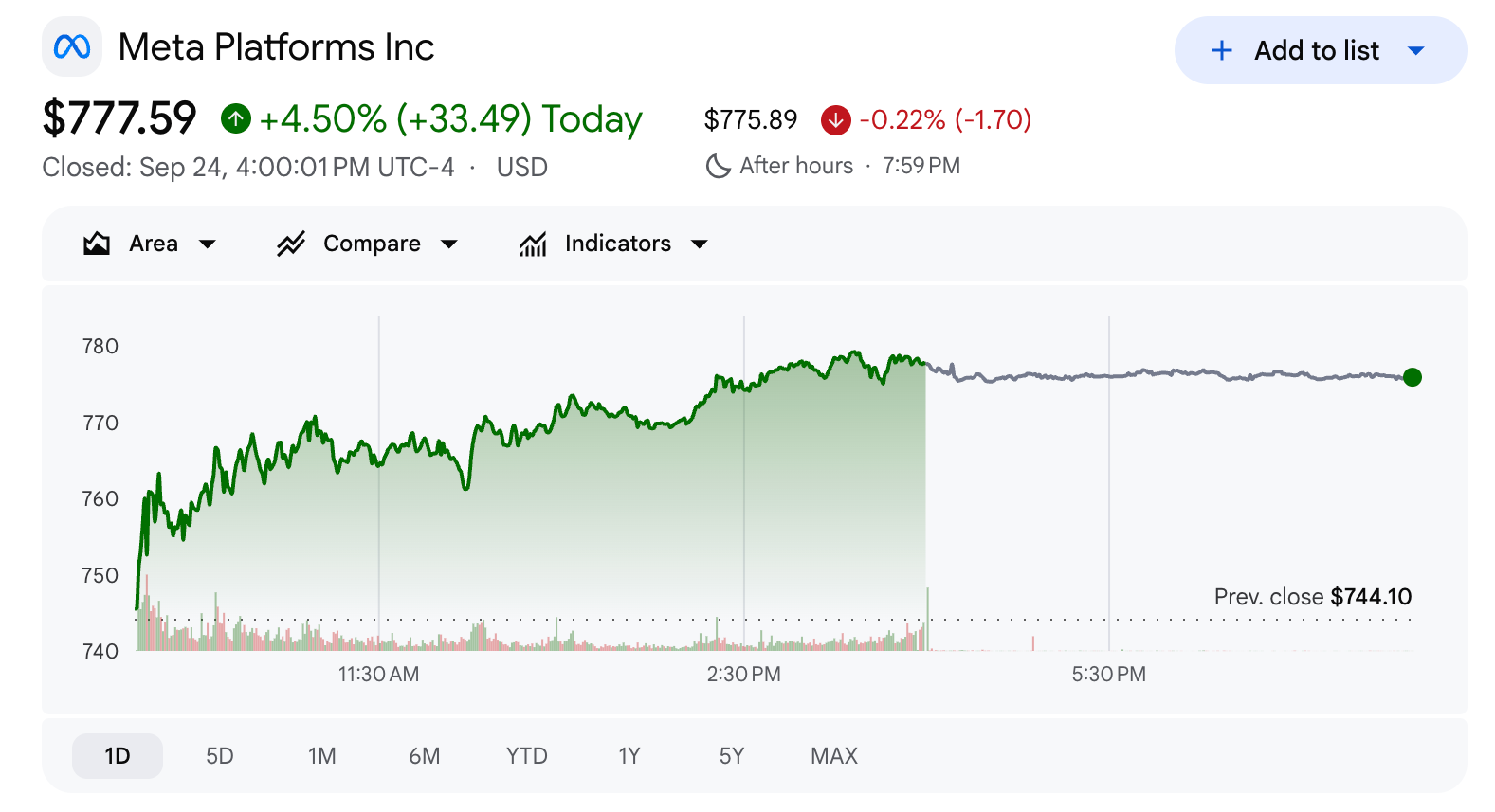
JPMorgan raised its price target for Meta Platforms’ stock to $920 from $820 on Thursday, maintaining an overweight rating. The bank thinks Meta’s new Muse agent could become the most widely used consumer AI app since ChatGPT.
The target implies about 18% upside from Meta’s Thursday close. It also lands one day after Meta used its Connect conference to unveil a batch of Muse upgrades.
Meta’s Best Month in 13 Years Is Within Reach
Meta shares have climbed more than 30% in September, putting them on pace for their strongest month since July 2013.
The sharpest move came on September 21, when shares jumped 11% to close at $741.25. It marked Meta’s biggest single-day gain since April 2025.
On Thursday, Meta shares closed 4.5% higher at $777.59. Meanwhile, LSEG data shows 57 of the 63 analysts covering Meta rate it a buy or strong buy.
Follow us on X to get the latest news as it happens

Why Wall Street Keeps Pinning Its Meta Targets on Muse
The new targets arrive following the release of Muse on September 8. It works as a personal agent that sends emails, books travel, and makes purchases. It runs on Muse Spark, Meta’s multimodal model.
JPMorgan analyst Doug Anmuth wrote that the agent is off to a strong start and expanding quickly. According to Anmuth, Meta is moving toward superintelligence.
The bank says Muse connected with more than 2,000 applications in two weeks. It also has major integrations with Walmart, Best Buy, Sephora, and Wayfair.
“…we expect Muse engagements to be handled less through browsing or calling, and more through agent-to-agent interactions. Meta will then be able to monetize on a take-rate or commission model,” the note read. “While it is still early, we believe that Muse has the potential to become the most widely used consumer AI application since ChatGPT.”
Wells Fargo made a similar case earlier. Analyst Ken Gawrelski raised his target to $796 from $640, citing early demand for Muse. The app had briefly topped Apple’s US App Store chart for free apps.
Later this year, Meta plans to launch Muse Confidential VM, which encrypts user data with a key only users hold. Meta also unveiled Muse Charm, a small device that gives users access to Muse.
Reports say it will ship around the holidays. Official figures will show whether JPMorgan’s ChatGPT comparison holds up.
Subscribe to our YouTube channel to watch leaders and journalists provide expert insights
The post Can Meta Stock Keep Climbing After a 30% Month? JPMorgan Raises Its Price Target appeared first on BeInCrypto.

Republicans remained overwhelmingly skeptical of socialism, with just 14% viewing it positively. Large majorities of Republicans continued to have positive views of small business, free enterprise, and capitalism, while 62% of Republicans viewed big business positively.
Still, Americans’ economic views are more complicated than the results might initially suggest, according to a Gallup analysis from August. The report, based on open-ended survey responses, found there is broad support for free-market principles like economic competition and market choice, despite concerns about capitalism spurring economic inequality and excessive corporate power.
The CBS/YouGov poll, meanwhile, found that support for government intervention crossed party lines, with 75% of Democrats, 62% of independents, and 54% of Republicans supporting government price controls.
And the Data for Progress survey showed 70% of 1,257 respondents said the U.S. economic system is “rigged in favor of corporations and the wealthy” and favored replacing it with one that “gives working people a fair shot,” including 67% of independents and 58% of Republicans. Additionally, 83% of respondents, including 81% of independents and 80% of Republicans, agreed that social work and mental health are necessary parts of a public safety budget.
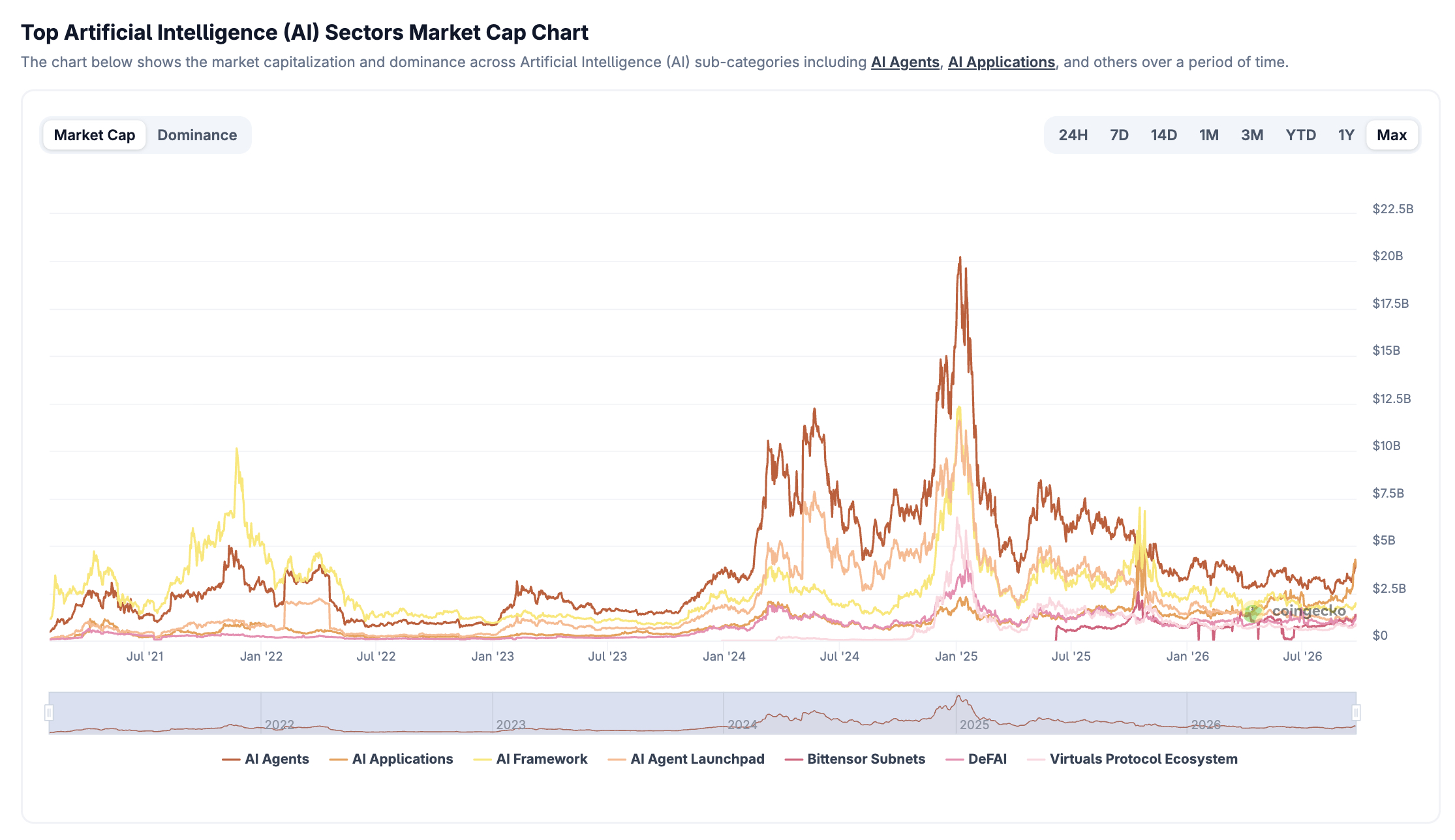
The AI coin crypto sector sits at $24-25 billion, with a total crypto market of approximately $2.86 trillion. Anthropic reportedly raised $65 billion at a $965 billion valuation in May, and Nvidia posted $96.2 billion in quarterly revenue in July, up 106% year over year, yet most major AI-related tokens remain 70%-90% below their 2024-2025 highs.
Does AI growth create direct demand for tokens, or does it primarily enrich the companies building chips, cloud infrastructure, models, and enterprise software?
The pattern already showing up in stablecoin rails is instructive. Large AI-agent payment volumes have not yet clearly translated into demand for Solana or other underlying tokens, which is exactly the disconnect now visible across the AI-coin basket.
A recent BlackRock research paper frames AI and digital assets as the two technologies defining the current era, stating that AI represents machine-native intelligence, while digital assets represent machine-native money.
“this alignment becomes particularly important with the rise of agentic AI…with blockchains providing the programmable infrastructure that connects intelligence with economic activity.”
That framing matters because it separates two distinct exposures that traders often conflate. AI companies monetize through cloud contracts, hardware sales, and enterprise licensing; token value depends entirely on protocol usage, fee capture, and emissions. This is a sharp gap that shows up in the contrasting case where AI-driven stablecoin payments could generate direct demand for a major asset like Ethereum, rather than for a narrower AI-labeled coin.
Discover: The Best Token Presales
Attention Is High, but Capital Favors Revenue and Infrastructure
AI coins captured 35.7% of crypto-market narrative attention in Q1 2026, ahead of meme coins at 27.1%, according to CoinGecko’s quarterly narrative report. Combined, those two categories commanded 62.8% of reported mindshare, yet that attention has not translated into proportional capital retention across the sector’s roughly $24-25 billion market cap.
Venture capital tells a sharper story about where the money is actually going. AI captured approximately $240 billion, or 80% of global VC funding, in Q1 2026, and AI-blockchain companies specifically received 40% of crypto-related VC funding, more than double the 18% share a year earlier.
Gartner projects global AI spending is climbing from $1.76 trillion in 2025 to $2.52 trillion in 2026 and $3.34 trillion by 2027, with AI infrastructure taking the largest share.
CoinGecko lists 1,473 projects at the intersection of AI and blockchain, but investors are objectively prioritizing compute, agents, and measurable workloads over tokens that merely carry the AI label.
Earn $50 and Enter $300K Prize Draw on EdgeX
Why AI and Crypto Need Activity, Not Just a Label?
Crypto’s structural pitch to AI is straightforward: smart contracts and stablecoins provide the execution layer autonomous agents need to transact cheaply and continuously. BlackRock’s paper notes that stablecoins, native cryptoassets, and other on-chain instruments can serve as machine-native tools for payment and settlement, with compute spending forecast to reach $1 trillion by 2030.
— Crypto Banter (@crypto_banter) September 24, 2026
 BLACKROCK SAYS AI WILL USE CRYPTO!@cryptomanran on the BlackRock report:
It’s the same thesis crypto’s been running. AI agents have to pay other machines and banks weren’t built for that.
BlackRock says that demand hits blockchains, stablecoins, and on-chain assets.
Watch… pic.twitter.com/VnCIzS5DTu
None of that guarantees uniform gains across AI coins. The sector’s next moves should be judged on transaction volume, fee generation, and partnership activity rather than category labels. Continued agent usage and revenue capture would strengthen the case for token value, while attention without those metrics would leave the $24-25 billion basket exactly where it is now.
Trade AI Coins on Bybit and Get a Chance to Win Our $1,000 USDT Airdrop
The post AI Crypto Coins Revenue Gap Puts Token Value to the Test appeared first on Cryptonews.
Crypto World
Catastrophic Zcash (ZEC) Prediction, Bullish Bitcoin (BTC) Factors, and More: Bits Recap September 25
ZEC has retraced from its 10-year high above $1,650, with one analyst envisioning a potential collapse to $200 under certain conditions. BTC has also slipped over the past few days, but whale activity and other factors suggest the overall bullish trend remains intact.
Solana’s native token has been making headlines, too, as some market observers believe it could be on the verge of exploding to $500.
Brutal Crash for ZEC Comes Next?
Just a few days ago, the popular privacy coin surpassed $1,600 for the first time since 2016, but bulls couldn’t hold the momentum, and it corrected to under $1,500. Over the past 24 hours, ZEC headed north again and is currently worth roughly $1,590 (per CoinGecko).
The asset’s overall uptrend is undeniable, with the valuation skyrocketing by 2,600% on a yearly scale. Still, X user Crypto Patel thinks that after this “extraordinary move,” it might be time for a major pullback.
The analyst argued that a cup-and-handle structure suggests that the $1,600-$2,000 range might have marked the top of the cycle, adding that ZEC has started showing signs of “extreme extension from a psychological perspective.”
That said, they envisioned a potential collapse to $500 if the coin enters a distribution and downtrend phase, and a meltdown to $200 if the long-term structure completely reverses.
Just a Healthy Correction for BTC?
At the start of the business week, the primary cryptocurrency reached $87,000, marking its highest level since January. Its positive performance continued over the next few days before bears finally reclaimed some control. Currently, BTC is worth $84,600, but certain elements suggest this could be a temporary pullback before a new leg up.
The first one is the whale activity. Santiment recently revealed that large investors (those holding between 100 and 1,000 coins) have accumulated almost 114,000 units since July 15. For his part, Ali Martinez said these market participants have purchased over 30,000 BTC (worth more than $2.5 billion) over the past 96 hours.
Other bullish factors include the declining amount of coins stored on crypto exchanges (which reduces immediate selling pressure) and the solid institutional interest. Spot BTC ETFs have registered six green days in a row, attracting nearly $3 billion within that period.

SOL Price Outlook
Solana’s native token has surged by 12% over the last week, currently trading just south of $120. Not long ago, X user Ash Crypto claimed that the asset has one of the most bullish setups among altcoins after reclaiming the weekly MA200, briefly hitting $120 for the first time in eight months, and forming a weekly golden cross.
Veteran trader Peter Brandt and Gerla also chipped in. The former spotted a textbook cup-and-handle pattern on SOL’s price chart, which is typically a precursor to a rally, while the latter envisioned a massive jump to $500.
Meanwhile, September has been a highly positive period for Solana, suggesting that it may indeed finish in the green. CryptoRank data shows the asset has posted gains in five of the past six Septembers.

The post Catastrophic Zcash (ZEC) Prediction, Bullish Bitcoin (BTC) Factors, and More: Bits Recap September 25 appeared first on CryptoPotato.

Ethereum price trades at $2,675 after clearing a bull-flag structure that had capped its bullish prediction for weeks. The breakout is real. But whether it holds is the question we are now asking.
ETH broke out of its bull-flag formation at $2,660, shifting the market’s focus from downside continuation to upside targets near $3,050. The move came alongside a broader risk-off tone across equities, where rising Treasury yields and a stronger dollar pressured both stocks and crypto simultaneously.
ETH isn’t trading in a vacuum, and macro headwinds have already knocked the price back below $2,700 once this week after leveraged longs got flushed out. Bond market volatility isn’t going away soon, and that keeps ETH’s breakout on probation.
The next section breaks down what needs to happen for the rally to extend, and what would kill it.
Discover: Best Crypto IPO this September
Ethereum Price Prediction: Can ETH Hit $3,000 Next Week?
ETH is consolidating in the $2,626–$2,700 range after the bull-flag breakout, with immediate resistance clustered near $2,800. Our analyst describes the structure as “rally-base-rally,” with a base forming between roughly $2,385 and $2,600. This is a pattern that, if it holds, typically resolves higher. Our analyst also points to $2,550 as the level that matters most: a weekly close above it opens the door toward $3,000.
Earn $50 and Enter $300K Prize Draw on EdgeX
Bull case happens if a sustained close above $2,800 confirms the breakout, targeting the $3,050–$3,445 zone outlined by Reuters. The likely scenario is ETH chops between $2,560 and $2,800 while the market digests bond-yield volatility.
However, a break below $2,560–$2,565 weakens the setup, and a fall under $2,350–$2,360 would invalidate the rally structure entirely. More context on ETF flows and whale accumulation is available in this Ethereum price prediction covering key levels.
Trade Ethereum on Bybit and Get a Chance to Win Our $1,000 USDT Airdrop
LiquidChain Targets Early Mover Upside as Ethereum Tests Key Levels
ETH holders who bought the breakout are sitting on gains, but let’s be honest about the math: a move from $2,671 to $3,050 is just 14%. Solid, not life-changing.
At Ethereum’s market cap, outsized returns increasingly come from elsewhere, which is why traders scanning for asymmetric upside keep rotating capital into early-stage infrastructure plays while the majors consolidate.
The King. — LiquidChain (@getliquidchain) September 19, 2026
 ⟁https://t.co/vqvBcdSQYC pic.twitter.com/TDTxXzjhRu
LiquidChain ($LIQUID), a Layer 3 infrastructure project, is positioning itself as the connective tissue between Bitcoin, Ethereum, and Solana liquidity, fusing all three into a single execution environment rather than forcing developers to build separate integrations.
The presale is priced at $0.014959, with $970K raised so far. Its Unified Liquidity Layer and Deploy-Once Architecture let builders ship once and reach all three ecosystems, a genuinely useful pitch if adoption follows.
Research LiquidChain directly before the IPO window closes.
Earn $50 and Enter $300K Prize Draw on EdgeX
The post Ethereum Price Prediction: ETH Finally Breaks the Bear Pattern appeared first on Cryptonews.
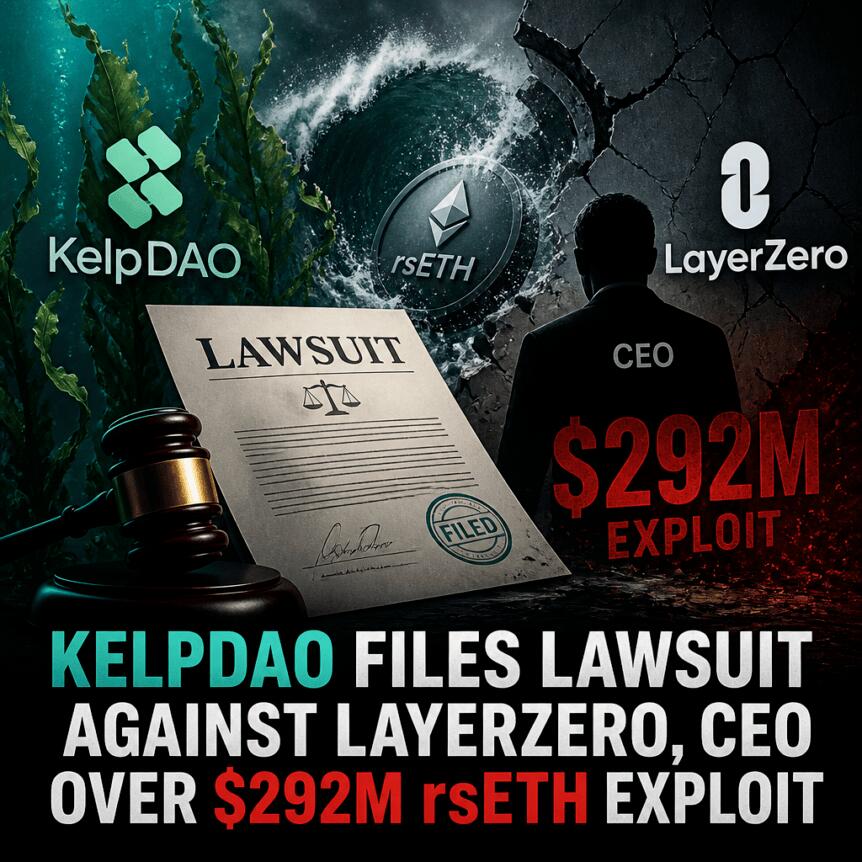
KelpDAO has escalated its dispute with cross-chain protocol LayerZero by filing a lawsuit tied to the roughly $292 million exploit that hit its rsETH bridge earlier this year. In the complaint, the restaking and tokenization platform alleges that shortcomings in LayerZero’s security infrastructure helped enable the attack.
According to KelpDAO, LayerZero failed to properly disclose risks in its technology and did not stop attackers from compromising components of its infrastructure. The filing also names LayerZero co-founder and CEO Bryan Pellegrino as a defendant, setting up a legal fight over who—if anyone—bears primary responsibility for the loss.
Key takeaways
- KelpDAO’s lawsuit targets LayerZero and names CEO Bryan Pellegrino over the April 18 rsETH bridge exploit.
- The complaint alleges LayerZero did not disclose key risks and that attackers were able to compromise LayerZero’s infrastructure.
- KelpDAO also claims LayerZero reviewed and endorsed Kelp’s bridge deployment and configuration in writing.
- LayerZero’s prior incident report attributed the theft to compromise of its internal nodes and the subsequent approval of a forged cross-chain message.
- The case reflects a broader pattern in DeFi cross-chain disputes: responsibility is contested between protocol infrastructure failures and application-level design choices.
The lawsuit: allegations of undisclosed risks and infrastructure compromise
KelpDAO said in its filing that LayerZero did not adequately disclose risks associated with its technology and did not prevent attackers from compromising the systems underlying its cross-chain verification process.
The lawsuit further alleges that LayerZero reviewed and supported KelpDAO’s deployment and configuration before the exploit, according to a document made available by KelpDAO. This is a central part of the dispute because it challenges LayerZero’s narrative that the loss was primarily driven by how KelpDAO configured its bridge.
KelpDAO framed the legal action as both a security-focused effort and an attempt to correct what it views as an inaccurate account of the incident. It said holding LayerZero and Pellegrino accountable is necessary to address the harm caused to KelpDAO and to parts of the broader DeFi ecosystem.
LayerZero’s leadership has denied the core allegations. Pellegrino characterized the claim as “meritless” and indicated he would defend the case in Vancouver, signaling that the protocol intends to contest the complaint rather than pursue a settlement immediately.
What happened in April—and why the blame is contested
On April 18, an attack on KelpDAO’s LayerZero-powered bridge led to the theft of 116,500 rsETH, which was valued at about $292 million at the time, according to earlier reporting by Cointelegraph. The loss centered on the way cross-chain messages were verified and approved before funds moved.
LayerZero’s final incident report, as described by Cointelegraph, stated that attackers compromised internal nodes and caused a verifier to approve a forged cross-chain message. In that account, the theft was enabled by the bridge’s reliance on a single decentralized verifier network (DVN) as its only verification path.
In practical terms, once LayerZero’s verifier approved the forged message, Kelp’s bridge released rsETH. LayerZero argued that the risk of this outcome was tied to the bridge architecture—specifically, the lack of a second independent verification step.
LayerZero said it had recommended using multiple DVNs and later stopped serving as the sole required verifier for applications that depend on a single DVN arrangement. That position effectively shifts responsibility toward KelpDAO’s configuration choices, even if LayerZero acknowledges that its infrastructure components were involved.
KelpDAO contests that shift. In May, KelpDAO said its DVN configuration had been discussed with LayerZero and “confirmed as secure,” while accusing LayerZero of failing to adequately warn it about relevant risks. KelpDAO has since announced plans to migrate the rsETH bridge to Chainlink’s Cross-Chain Interoperability Protocol, reflecting a move away from the LayerZero-dependent architecture that was implicated in the dispute.
Why configuration decisions matter in cross-chain security
This case highlights a persistent tension in cross-chain protocols: even when a cross-chain platform provides verification infrastructure, the security outcome can depend heavily on how applications select and combine verification paths.
LayerZero’s incident narrative emphasizes that using only one DVN created a structural vulnerability—meaning that if that verification path were compromised, the bridge could still process fraudulent messages. KelpDAO’s counter-narrative focuses on what it says were assurances and endorsements from LayerZero, arguing that the risks were not properly communicated and that LayerZero accepted responsibility for the setup.
For investors and users, the distinction is not academic. Cross-chain incidents rarely fit neatly into a single bucket of “infrastructure failure” versus “application misconfiguration.” Instead, the legal question tends to revolve around whether the infrastructure provider warned partners about known failure modes and whether the integration conformed to what both sides understood to be secure at the time.
That uncertainty is also a practical concern for builders operating in this space: a protocol’s incident report may focus on one set of technical causes, while an application’s complaint may spotlight integration assumptions, documentation, and prior guidance.
What to watch next as the dispute moves into court
With KelpDAO now asking the court to rule on LayerZero’s alleged failures—alongside the decision to include Pellegrino personally—the next phase of the case will likely center on evidence about risk disclosure and integration oversight. KelpDAO’s claims that LayerZero reviewed and endorsed the deployment in writing will be particularly important if the parties present documentary records.
At the same time, LayerZero’s defense will need to reconcile its earlier incident framing—compromised internal nodes and a forged message—with KelpDAO’s argument that the configuration was previously validated. Readers should watch for how each side explains the boundary between verifier-level security and application-level bridge design, because that boundary may determine whether the court treats the incident as primarily an infrastructure problem, a configuration problem, or a combination of both.
Zcash co-founder Eli Ben-Sasson has backed Shielded Bitcoin, a proposal that adds private transfers to Bitcoin’s base layer. He also says Zcash (ZEC) is on track to hit his $5,000 year-end target.
Ben-Sasson, who also co-founded StarkWare, co-wrote the Zerocash paper that preceded Zcash. His original goal, he says, was to bring that privacy to Bitcoin.
Shielded Bitcoin Brings Zcash-Style Privacy to Layer 1
Research firm Alloc Init published the proposal on September 24. Its authors are Misha Komarov, Aleksei Moskvin, and Clara Shikhelma.
According to the whitepaper, the design combines encrypted notes, public nullifiers, and zero-knowledge (ZK) proofs. Nullifiers stop the same hidden coins from being spent twice. It needs no soft fork, BitVM, or consensus change. Instead, it relies on Bitcoin PIPEs, a tool built on witness encryption. As a result, all protocol data lives on Bitcoin itself, the team says.
That matters because standard Bitcoin payments stay visible on-chain and can reveal sensitive business payment details to outsiders.
Ben-Sasson admits he has not read the paper yet. Still, he welcomed the direction and hopes to see ZK privacy and scaling reach Bitcoin’s base layer.
Ben-Sasson Predicts $5,000 ZEC After Earlier Call Held
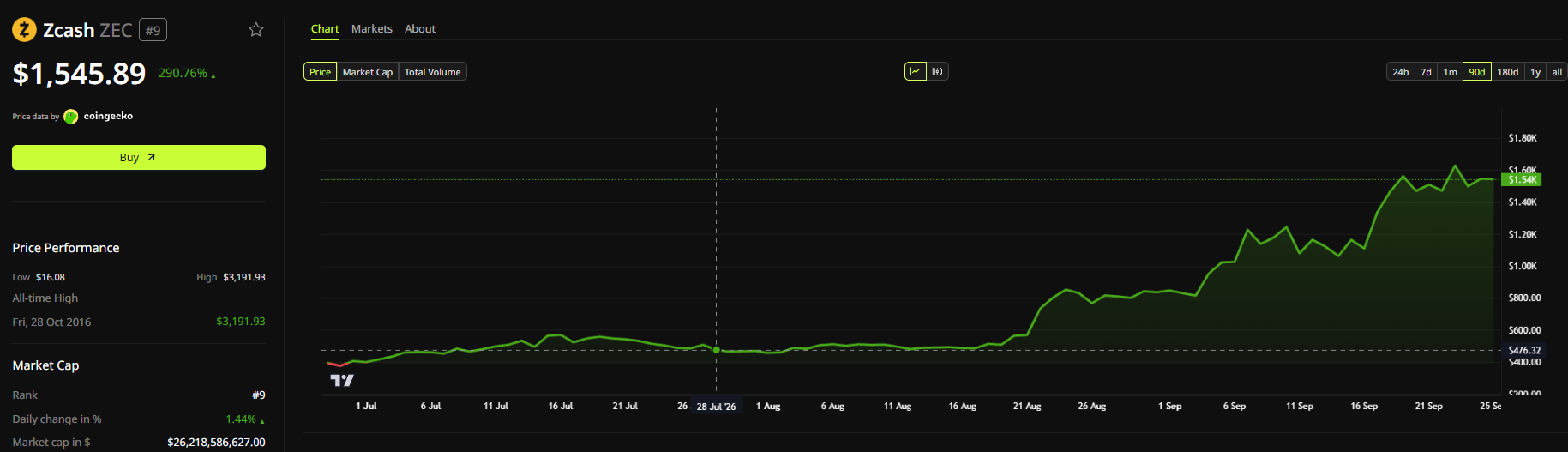
On September 9, Ben-Sasson predicted ZEC would trade above $1,200 by September 25. That call has held. ZEC now trades at $1,545.89, up 1.44% in 24 hours. It has gained nearly 291% over 90 days. The token ranks ninth by market capitalization.
Reaching $5,000 would still require a gain of roughly 223%. Meanwhile, he says more whales now ask him what drives the rally. He admits he has no answer and has asked followers for theirs.

Several catalysts have surfaced in September, however. Zcash spot funds drew $98.2 million in one week through September 18, the largest inflow among 14 crypto products. Ledger also added private Zcash balances to its desktop app. At the same time, the rally has punished traders shorting ZEC, with one position closing at a $10.68 million loss.
Ben-Sasson frames his target as a personal bet, not investment advice. Whether ETF demand holds through December could decide if ZEC gets close.
The post Zcash Co-Founder Backs Shielded Bitcoin, Says His ZEC Year-End Target Is Still in Play appeared first on BeInCrypto.

The Federal Reserve’s two September 24 proposals describe more than the assets behind a dollar token. One proposal sets the terms for an insured state member bank to seek approval for a stablecoin subsidiary; the other would govern the issuer, its reserves and its capital. The distinction determines which firms can use the Fed’s application route at all.
Summary
- The Fed released 2 proposed stablecoin rules at 2:30 p.m. EDT on September 24, 2026.
- An insured state member bank would seek Fed approval for a subsidiary, with 120 days for a decision after a complete application.
- The proposed initial capital floor is $5 million for a newly approved issuer during its first 3 years.
- A proposed 2% capital charge on uninsured reserve deposits would equal $20 million on a $1 billion exposure.
- A state issuer passing $10 billion in outstanding coins would face a proposed 360-day transition or stop net new issuance.
The Federal Reserve has proposed two stablecoin rule packages that put an approval test in front of insured state member banks and an operating rule around issuers under its supervision.
The Board of Governors published the proposals on September 24 at 2:30 p.m. Eastern time. Its 60-page application notice is Docket R-1900, RIN 7100-AH30. A separate, 392-page notice would implement reserve, capital, redemption, custody and related requirements under the GENIUS Act. Both are proposals open for comment, not licenses granted or final regulations. The comment period closes 60 days after publication in the Federal Register, a date the notices had not supplied when released.
The scope deserves care. The application notice addresses an insured state member bank seeking permission for a subsidiary to issue payment stablecoins. It does not offer every fintech a direct route to the Fed. The broader operating notice covers issuers supervised by the Board through the paths described in that proposal. An OCC application, a state-qualified issuer and a state member bank subsidiary do not become the same legal entity simply because all three propose dollar tokens.
Crypto.news reported the Fed proposals on September 24. Reading the two notices side by side reveals a more useful question than whether a proposed issuer can buy Treasury bills. Which legal entity submits the application, who controls the subsidiary, when does the review clock actually start, and how much capital would its chosen reserve mix consume?
The application belongs to the bank
The GENIUS Act permits three domestic issuer categories described in the Fed’s application notice: a qualifying subsidiary of an insured depository institution approved by its primary federal regulator, a federal qualified issuer approved by the Office of the Comptroller of the Currency, and a state-qualified issuer approved by its state regulator. Different supervisors handle the different paths. An insured state member bank applies to the Federal Reserve for approval of its subsidiary under section 5 of the statute, codified at 12 U.S.C. 5904.
That legal distinction can be obscured by a familiar phrase, a bank stablecoin. In the Fed’s proposed application procedure, the bank is the applicant and its controlled subsidiary is the contemplated issuer. A technology company supplying wallets or software is not the applicant on that basis. A bank with a national charter has a different primary regulator. An uninsured state member bank does not use the insured-bank procedure in this notice. The notice says such a bank may approach its home state stablecoin regulator, while its existing Federal Reserve obligations continue to apply.
The proposed rule defines control using existing bank holding company concepts. Ownership or voting power of at least 25% of a class of voting securities is one path; control over a majority of directors is another; a controlling influence determined by the Board after notice and hearing is a third. A prospective issuer formed by multiple banks raises a practical question: which bank controls the company, and which regulator reviews it? The Fed asks that question explicitly in Questions 1 through 4 of its application notice.
For a consortium, the Board says it may accept one application on behalf of multiple insured state member banks if the venture counts as a subsidiary of each. The notice does not say that every multi-bank venture automatically meets that test. A structure in which a bank owns a small minority interest and a separate commercial company directs issuance needs analysis of who actually controls the issuer. A named bank on a consortium’s promotional list does not settle the question.
The distinction is timely because 21 financial institutions committed in September to form a stablecoin company, with a proposed launch in the first half of 2027 subject to conditions. The announcement is evidence of a planned venture, not evidence that its eventual entity will apply through the Fed’s insured state member bank route. Banks can collaborate through a company that uses another licensing path. The proposal leaves the legal design consequential.
The 120-day clock starts after a completeness decision
The proposed application process contains two clocks. Under section 247.30, the Board would tell an applicant within 30 days of receiving its materials whether the filing is substantially complete and identify missing information if it is not. The 120-day decision period runs from the submission date of a substantially complete application. If the Board does not decide a complete application within that period, the proposal restates the statute’s deemed-approval provision.
Filing a letter on day one therefore does not guarantee approval on day 120. The Fed says the submission date is the date its Reserve Bank received the final material needed for substantial completeness, not the later date when the Board sends its completeness notice. An application with omitted material needed to evaluate statutory factors is not substantially complete. A material change can cause a previously complete application to be treated as new if the information on hand is no longer sufficient.
The notice supplies examples: deteriorating financial condition, a material change to the issuer’s business plan, or another change affecting review. This is a procedural limit on a headline claim that applications are approved automatically if the Fed waits. Automatic approval is tied to a complete application and a defined 120-day period. A company cannot make the clock run by sending an incomplete business plan and calling it a filing.
Nor can the Board deny a substantially complete application for any reason it likes. The GENIUS Act, as described in the notice, limits denial to a determination that the applicant’s activities, including those of the proposed issuer, would be unsafe or unsound based on statutory factors. The proposal supplies a process for a denied applicant to seek a hearing and appeal. Those limits support the opposing reading of the application rule: the 30-day notification, 120-day decision period, limited denial grounds and appeal procedures constrain regulatory delay as much as they screen applicants.
There is an important difference between missing a deadline and refusing an application. The deemed-approval provision addresses a regulator’s failure to issue a decision on a complete file within 120 days. A timely denial triggers a separate process in which the applicant can contest the grounds. The proposed procedural rule details hearings and final determinations, while the statute restricts the substance of a denial. A prospective issuer should therefore distinguish three statuses in any public account of its progress: submitted, substantially complete and approved. None can safely be substituted for another. A press release that says an application was filed tells readers nothing by itself about when the 120-day clock began.
The Board says an applicant should send its letter to the appropriate Federal Reserve Bank, which would forward a copy to the Board. The applicant has to sign, describe the proposal, state the action sought and explain why approval meets the statutory factors. Existing information that the supervisor already holds can in some cases reduce duplication, but the proposed rule still requires the information needed to assess the stablecoin subsidiary. The detail becomes especially relevant where an established bank launches a new entity: examination history for the parent does not itself supply a business plan, governance scheme and redemption process for the proposed issuer.
The disclosure burden remains substantial. The proposed application includes a business plan, financial information, policies and procedures, relevant agreements, governance and material third-party relationships. It asks who does what across the proposed program. A bank can outsource technical tasks, but the Board still wants to see the issuer’s operating structure and the bank’s oversight of it. The notice invites pre-filing feedback for complex proposals, an option that does not itself constitute approval.
Reserve choice changes the capital calculation
The operating proposal separates the dollars backing outstanding tokens from the issuer’s own loss-absorbing capital. A dollar of qualifying reserves for a dollar of coins is a backing requirement. Capital is a second layer, intended to absorb risks to the issuer’s continued operations and certain exposures. Describing a fully reserved issuer as needing no capital confuses those two accounts.
The Fed proposes a $5 million initial minimum during a three-year de novo period, indexed to nominal U.S. GDP. The applicable minimum would be the higher of that floor and a calculated risk-based requirement. The Board could set a different amount in specified circumstances, including when the calculated minimum does not match an issuer’s exposures. The $5 million is neither an application fee nor a universal final capital requirement. It is a proposed floor for a newly approved Board-supervised issuer in its initial period.
One line of the 392-page notice makes the reserve decision measurable. Proposed section 247.17(a)(1) assigns a 2% capital requirement to uninsured eligible deposit claims held as reserve assets. The Fed links that treatment to bank credit risk. A bank failure could delay recovery or leave a loss in the issuer’s reserves. The notice specifically recalls Circle’s approximately $3.3 billion in uninsured USDC reserves held at Silicon Valley Bank when regulators closed that lender in March 2023.
Apply the proposed rate to simple, hypothetical exposures. If an issuer holds $250 million in uninsured eligible deposits, the 2% component is $5 million. At $1 billion, it is $20 million. At $3.3 billion, matching the approximate historical exposure cited in the notice without implying that today’s Circle would hold that sum in such accounts, the arithmetic reaches $66 million. These are illustrations of one proposed component, not complete regulatory capital calculations, final costs or findings about a named issuer.
The arithmetic exposes the point at which the initial $5 million floor ceases to tell a reader much about the reserve bank choice. Even before operational risk and any other applicable charges enter, a hypothetical $1 billion uninsured deposit exposure produces a $20 million component. The proposal asks whether the 2% calibration should instead range from 1% to 4%, or vary with the credit standing of the deposit bank. At 1% the same $1 billion example produces $10 million; at 4% it produces $40 million. Those alternative rates are questions for commenters, not adopted rules.
The Fed’s framework considers other categories as well, including undercollateralized reverse repurchase agreements, eligible funds, operational risk and non-reserve assets. The calculation uses different measurement periods for some exposures. It would be false precision to treat the deposit example as the entire capital bill. The comparison does show why a prospective issuer should model its custody and reserve structure alongside its licensing application. A plan naming a reserve bank but leaving the size of uninsured exposure unspecified omits information central to its capital needs.
The proposal’s treatment of operating risk cannot be replaced with the usual argument that short Treasury bills have little credit risk. A redemption desk must work on weekends when a Treasury market does not; software access, failed transfers, custody controls, reconciliation and customer screening can each demand money even when reserves remain intact. The Fed’s separate capital calculation for operational risk therefore depends on inputs other than the market value of government securities. The agency proposes quarterly measurement for the revenue-based component and asks whether other measurement frequencies would work better.
The choice between depositing cash at a bank and holding short government securities is not binary in practice. An issuer needs settlement balances to pay redemptions, while it can hold another part of its backing in permissible liquid instruments. A design promising rapid redemptions but putting every dollar into instruments that must first be sold depends on the sale and payment chain working when customers want out. Conversely, an issuer that keeps large uninsured bank deposits may have immediate access to cash in normal conditions but incurs the proposed deposit credit-risk component. Neither observation proves one reserve mix is right for every program. Both follow from the Fed’s distinct treatment of liquidity and bank exposure.
Custody creates another decision. Proposed sections on covered custodians describe protection for reserve property and for the private keys that allow token issuance. An issuer that relies on an outside bank to hold Treasury securities and a separate technology firm to manage minting permissions needs to map which party controls each asset, who can authorize movement, and how the issuer reconciles outstanding coins with eligible backing. The application asks for material third-party relationships and relevant agreements for that reason. A marketing statement that the reserves are safe does not disclose the chain of authority.
The Fed describes a possible increase or decrease in the de novo capital requirement when it finds a different amount sufficient to support operations. It asks commenters whether the three-year period is appropriate and whether the initial $5 million level, indexed to nominal GDP, should be higher or lower. For a prospective issuer, a model that merely budgets $5 million as a fixed, permanent cost misses both the proposed higher-of test and the regulator’s reserved authority. The precise requirement would emerge from the adopted rule and the issuer’s actual exposures.
Different agencies have already taken their own steps. The FDIC proposed bank issuer standards in April, and the OCC published its stablecoin proposal in February. The Fed notice compares its proposed $5 million starting floor with those agencies’ approaches. Similar figures across proposals do not remove the differences in jurisdiction, application process or final text. None of these proposals should be described as a final license for a specific company.
The $10 billion boundary is a second eligibility test
State supervision is a route for eligible issuers below a statutory scale threshold. Proposed section 247.51 addresses a state-qualified issuer whose consolidated outstanding issuance passes $10 billion. The Board proposes a transition to its federal framework within 360 days, unless the issuer stops issuing new payment stablecoins on a net basis while above the line or obtains an available waiver permitting continued state supervision.
The notice asks an issuer crossing that level to notify the Board within five calendar days. Its notice would identify the supervising state, the outstanding amount, the crossing date and whether it has stopped net new issuance. A capital analysis would follow within 270 days. A request for a waiver, if sought, would be due within 240 days under the proposed procedure. A transition is not simply a new label on the same business; the issuer would need to meet the applicable federal requirements within the timetable.
Consider an issuer at $9.9 billion. A $200 million net issuance would take it to $10.1 billion, above the threshold, under a simple point-in-time calculation. The proposal asks whether measurement should instead use a rolling average and whether issuance by nonconsolidated affiliates should count. Those questions remain open. It is therefore premature to assert that splitting tokens among subsidiaries would keep a program permanently below the line. The Board expressly asks commenters how affiliated issuance should be treated.
The U.S. stablecoin licensing landscape already includes different supervisors and unfinished implementing rules. A growing state issuer faces the timing question earlier than a startup seeking its first license. It may need to prepare for federal supervision while current growth, reserve composition and capital remain moving targets. The $10 billion provision does not mean a coin above that value instantly becomes illegal. The notice specifies a transition period, a possible waiver and an alternative of halting net new issuance.
A promise to redeem has its own operating requirements
The proposed reserve rule would require eligible assets backing outstanding coins on a one-to-one basis. The Board would require a public redemption policy setting out a timeframe, fees, minimum redemption quantity and procedures. Proposed section 247.12 says timely redemption may not exceed two business days after a request, subject to applicable requirements. Onboarding and customer screening still apply. An exchange customer who can sell a token in seconds is not necessarily the same person as an eligible customer redeeming directly with its issuer.
That distinction can be missed when an issuer’s market price stays close to one dollar. Secondary-market trading shows what buyers and sellers will accept; it does not answer who has a contractual redemption claim on the issuer and through which channel. The application notice asks about redemption policies precisely because the issuer needs an operational route from token presentation to payment. A banking partner, custodian and transfer system sit in that route.
Safekeeping requirements in the other notice reach reserve assets, tokens used as collateral and private keys used to issue payment stablecoins. The Fed would apply requirements to certain Board-supervised custodians holding covered assets, including protections intended to keep customer property separate from a custodian’s creditors. The scope differs from a generic wallet software provider that does not control the customer’s keys. The proposal asks where those boundaries should fall.
Governor Michael Barr, in his September 24 statement accompanying the notices, supported safeguards that address runs and payment system risks. The strongest case for the Fed’s approach is therefore operational: clear redemption terms, eligible liquid reserves, capital where bank deposits are uninsured and documented custody arrangements could make an issuer’s promise easier to evaluate before a stress event. The strongest concern from a prospective entrant is the amount of upfront work and uncertainty while separate agencies finish rules that are meant to fit together. Both readings are compatible with the text; the eventual requirements depend on comments and final decisions.
What the proposal cannot tell applicants yet
The Fed has not published a list of approved issuers under these new proposals. Its application notice does not reveal which prospective companies will apply through a state member bank, an OCC-supervised entity or a state regulator. A charter, a pending application, a partnership announcement and permission to issue under a final regime are distinct milestones.
Several variables remain open on the face of the notices: the final capital calibration, whether the $10 billion threshold uses a momentary observation or an average, how multi-bank issuers document control, and how final rules across agencies line up. The notices are extensive because the Board is asking questions on these points, not because it has resolved all of them. A claim that a specific issuer qualifies today would require its organizational documents, supervisory status, application and regulator decision.
There is a checkable way to follow the process. Federal Register publication starts the stated 60-day comment period. Final rule text determines whether the proposed $5 million floor and 2% deposit charge survive. Application notices and decisions would show which banks actually seek approval. Consortium ownership documents would show whether a bank controls the issuer. Outstanding issuance disclosures would identify state issuers nearing $10 billion.
The Fed’s application notice says it will notify an applicant within 30 days whether its filing is substantially complete. Once the final required materials reach the appropriate Reserve Bank, the proposal defines the submission date from that receipt, which starts the statutory 120-day decision period.
What to watch
- Federal Register publication: Check the publication date to calculate the 60-day comment deadline.
- Final Fed rules: See whether the $5 million initial floor, 2% deposit charge and 360-day state-issuer transition survive.
- Public application decisions: Look for an identified insured state member bank and the subsidiary it proposes to control.
- Issuer ownership disclosures: Check public filings for who controls any multi-bank venture before assigning it a Fed application route.
- Outstanding coin disclosures: Track whether a state-qualified issuer approaches or crosses $10 billion in consolidated issuance.
FAQ
Can any stablecoin company apply directly to the Fed?
No. The proposed application route in Docket R-1900 addresses an insured state member bank seeking approval for a subsidiary. Other potential issuers use the regulator applicable to their legal structure.
Does the bank or its subsidiary submit the application?
The insured state member bank submits it. The proposed subsidiary would issue the payment stablecoin if the relevant approvals are obtained.
Is an application approved automatically after 120 days?
The statute’s deemed-approval provision applies when the Board does not decide within 120 days of a substantially complete application’s submission date. The Fed proposes a separate 30-day notice about completeness and can identify missing information.
Is $5 million enough capital for every issuer?
No. The proposed $5 million floor applies during an initial three-year period, and an issuer would need the higher of that figure and its calculated requirement. The Board could require a different amount in specified circumstances.
How would uninsured reserve deposits affect capital?
The proposal assigns a 2% component to eligible uninsured deposit claims held in reserves. On a hypothetical $1 billion exposure, that component alone is $20 million, before other applicable requirements.
Can a bank consortium apply through one filing?
The Fed says it may accept one filing on behalf of multiple insured state member banks if the issuer qualifies as a subsidiary of each. The notice seeks comment on how control works in a consortium.
What happens when a state issuer passes $10 billion?
The proposal describes a 360-day transition to federal supervision, an option to stop net new issuance while above the threshold, and a possible waiver. It asks for notification within five calendar days of crossing the line.
Are the Fed’s September 24 rules already in force?
No. They were published as proposals for comment, and the actual comment deadline depends on Federal Register publication. This is educational analysis, not investment advice.
Disclaimer: This article is for information and educational purposes only and does not constitute financial or investment advice. Figures reflect regulatory filings and reporting available at the time of writing and change with each disclosure. Nothing here is a recommendation to buy, sell, or hold any security or asset. Always do your own research. Information is accurate as of September 25, 2026.

John Wick’ Meets ‘Constantine’ in Paul Bettany’s Fantasy Epic Surging on Free Streaming

Frugal Friday’s Workwear Report: Short Puff-Sleeve Sweater

New sporting area for coastal town with ‘insufficient’ facilities

Weekend Open Thread – Corporette.com

Weekend Open Thread: Talbots – Corporette.com

Memory prices are slowing because buyers ran out of money

Domain Squatting EXPLAINED #money #moneyhackstiktokcontest

CRYPTO Altcoins That You Can’t Ignore!! – The ONLY Coins I’m Holding Now!!

How about some financial instability #cat #funny #shorts TikTok original audio: The Vibe With Ky
-
 Fashion7 days ago
Weekend Open Thread: Talbots – Corporette.com
-

 Crypto World3 days ago
Goldman Sachs and Deutsche Bank Agree: The S&P 500 Rally Isn't Over
-

 Tech5 days ago
Researchers escape OpenAI Codex sandbox to run commands on host
-

 Fashion1 day ago
8 iPhone Accessories That Add Personality
-

 Crypto World5 days ago
Who Needs CLARITY Anyway? ARB Could See 70X Increase: Hodler’s Digest
-

 Crypto World6 days ago
Circle launches Arc Studio AI agent for building onchain apps
-
 NewsBeat7 days ago
Trump says US has reached an agreement to take permanent control of Greenland’s security
-

 Crypto World7 days ago
Trading Bitcoin on Robinhood? Why 2% Spread Has Traders Worried
-

 Tech6 days ago
Trump suggests rebranding AI with a new name, says he’s also creating an AI Force
-

 Crypto World6 days ago
Bitcoin price breaks channel as RSI climbs to 63
-

 Business5 days ago
Analog Devices (ADI) Bets $1.35 Billion on Chips that Let Machines Think for Themselves
-

 Crypto World4 days ago
Coinbase, Robinhood, Circle Seen as Tokenized-Stock Winners
-

 Tech4 days ago
Google’s $899 Googlebook is a bet that you’ll buy a new laptop for Gemini
-

 Crypto World2 days ago
This Bearish Netflix Stock Trade Can Cash In On Video Streaming Giant’s Woes
-
 Business2 days ago
Oil Price Today (September 23): Crude oil below $100 on hopes of US-Iran talks. What did Trump say?
-

 Entertainment2 days ago
These 17 Fall Amazon Dresses Seriously Look Like Anthropologie
-

 Crypto World2 days ago
Crude Oil Prices Pressured by Diplomatic Hopes in the Middle East
-

 Crypto World3 days ago
Trump-Xi Polymarket Odds for Handshake Hit 50%
-

 Crypto World6 days ago
World Money launches in 150+ countries with Stripe
-

 Crypto World2 days ago
Bitcoin Threatens Sub-$84,000 Breakdown as Long Liquidations Spike
You must be logged in to post a comment Login