

Crypto World
Aave Founder Maps Hub-And-Spoke Plan To Bring Securities Finance On-Chain


TLDR:
- Repo averages $12.6 trillion in daily U.S. exposures, the largest market V4 targets
- Aave V4 uses hubs and spokes to isolate risk across asset categories and venues
- Lending agents currently keep 20-30% of revenue that could instead reach owners
- Tokenized real-world assets are projected to reach $16 trillion in value by 2030
Aave founder Stani Kulechov outlined a plan to bring securities finance on-chain using Aave V4. The proposal targets repo, securities-based lending, and securities lending markets.
These markets move tens of trillions of dollars through layers of intermediaries. Kulechov says Aave V4 can replace that stack with shared liquidity and transparent settlement.
Market Size And Current Structure
Securities finance covers some of the largest credit markets in traditional finance. Repo alone averages roughly $12.6 trillion in daily exposures across the United States.
Margin lending has reached a record $1.3 trillion, while wealth-management securities-based loans add more than $400 billion. Securities lending keeps about $4.6 trillion of assets on loan and generated $15 billion in revenue during 2025.
Almost none of this activity currently touches a blockchain. Kulechov described the layers sitting between borrowers and lenders, noting that “each layer of the stack takes a fee, adds a settlement delay, and obscures information.” Collateral often gets locked inside bilateral relationships with little visibility into how it moves.
Kulechov argues that onchain rails are already large enough to absorb this volume. The stablecoin market has crossed $322 billion in total supply.
Aave secures close to $23 billion in liquidity, and its native stablecoin GHO is live across the protocol. Aave Horizon, which supports real-world-asset-backed loans, has surpassed half a billion dollars in deposits.
How Aave V4 Organizes The Market
Aave V4 separates its system into liquidity hubs and spokes. A hub holds deep, shared capital, while spokes are modular venues with their own risk parameters and asset scope. This structure mirrors how securities financing already separates collateral pools from specific trading venues.
Three flows are proposed to run through this structure. Securities-backed lending lets owners post tokenized securities as collateral and borrow stablecoins or GHO without selling assets.
Repo becomes short-dated, collateralized cash borrowing against tokenized Treasuries, settled atomically rather than over one or two days.
Securities lending turns tokenized securities into borrowable assets, with fees routed directly to suppliers instead of intermediaries.
Kulechov called repo the largest opportunity in the proposal, writing that “the market that most needs clean settlement and live collateral visibility is the one V4 serves best.”
He proposed two structural options for organizing liquidity. One design uses a single shared hub for maximum depth and simplified accounting.
The other splits liquidity into multiple hubs by asset category and risk level, such as separate pools for Treasuries, credit instruments, and equities.
Roles And Settlement Changes
Under this model, traditional finance roles shift into protocol functions. Lending agents become risk managers tuning hub parameters.
Tri-party collateral managers become the protocol’s accounting and liquidation engine. Prime brokers and clearing houses become operators running permissioned venues, while custodial ledgers move onto the blockchain itself.
Settlement speed changes substantially under this structure. Securities in the United States currently settle one day after a trade, while European markets often take two days.
The recent industry shift to one-day settlement cost market participants close to $30 billion to implement, according to the proposal.
Kulechov summarized the broader shift in roles, stating that under this structure “the work survives while the rent does not.”
Lending agents currently keep roughly 20 to 30 percent of securities-lending revenue before asset owners receive any return, a share Aave V4 aims to route back to owners instead.
The proposal frames real-world asset tokenization as a growth driver for this system. Tokenized assets are projected to reach $16 trillion by 2030, expanding the pool of collateral available for onchain securities finance.
Aave Horizon’s existing deposit growth is cited as early evidence of institutional demand for this type of infrastructure.


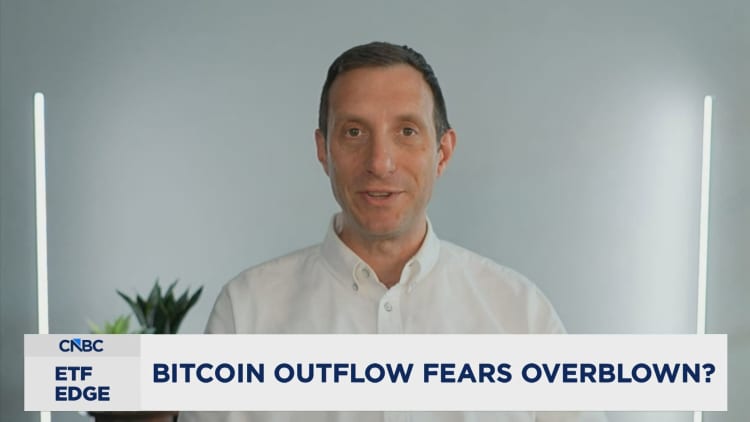

CoinDesk’s president of indices and data has a message for investors: Don’t count out bitcoin.
“When I got my first smartphone, which is a great example of a disruptive technology that has been incorporated into my life, I didn’t get the smartphone and say, ‘This thing is garbage because I can’t get a taxi in front of my home whenever I want it.’ I was very excited that I didn’t have to carry an MP3 player and my cellphone at the same time,” David LaValle told CNBC’s “ETF Edge” on Monday.
LaValle’s call comes during a rough time for bitcoin. The cryptocurrency is off almost 2% over the shortened holiday week. Plus, bitcoin is down almost 50% since its all-time high of $126,279 hit on Oct. 6, 2025, as of Thursday’s close.
Bitcoin crossed over the key level of $65,000 on Monday, but by Thursday it dipped back into the $63,000 range.

Bitcoin performance
Despite the losses, LaValle thinks the downturn, which is often referred to as a “crypto winter,” won’t permanently discourage institutional and retail investors from boosting exposure to the asset.
“As it pertains to the future of the digital asset, a lot has transpired, and there have been downdrafts over the past eight years,” he said. “Unlike previous crypto winters, this is like, ‘Hey, when do I get back in as opposed to whether or not there’s a future.’ We look at this as a point of credibility.”
TMX VettaFi’s head of research and editorial, Todd Rosenbluth, sees a promising trend among bitcoin ETF investors. He finds they’re largely holding onto them despite the ongoing market uncertainty, which is a sign of optimism.
The iShares Bitcoin Trust ETF (IBIT) “actually just crossed into the net outflows, despite bitcoin itself having been down for much of the year,” Rosenbluth said in the same interview. “So, people were still holding on, and in fact buying IBIT through the initial downdraft. That’s encouraging to me that people were holding on.”
He pointed to a VettaFi survey of 104 financial advisors in early May. According to Rosenbluth, it revealed where the firm’s clients stand on digital assets. It showed almost half of them were watching the stock from the sidelines while just 22% were actively investing or building.
“A [crypto] pullback has created a buying opportunity for some people. Others, it might reinforce that they don’t want to be near it when something sells off too strongly,” Rosenbluth said. “But I do think we’re going to see continued evolution of the demand.”
Meanwhile, the losses have been impacting some of the largest bitcoin ETFs, which includes the iShares Bitcoin Trust ETF and Grayscale Bitcoin Trust ETF (GBTC). They’ve fallen 40% over the past 52 weeks.


In May, the European Commission opened a comment period, seeking feedback on regulations for the cryptocurrency and blockchain industries.
The comment period will precede eventual revisions and additions to the Markets in Crypto Assets (MiCA) legislative framework. Some have already dubbed the expected new framework “MiCA 2.0.”
Katie Harries, director and head of policy for Europe at Coinbase, told Cointelegraph that there are several key areas where “refinements could help ensure the framework remains competitive in the next phase of digital asset regulation.”
With an updated version of EU crypto law, the crypto industry is looking for more regulatory clarity in DeFi, stablecoins and tokenization.
MiCA was just the first step
Full application and enforcement of MiCA rules began on December 30, 2024, with the first licenses issued in the first months of 2025.
While the legislative process was long and complex, the EU still managed to create a regulatory framework for crypto ahead of the United States. Per Harries, “MiCA helped set an early global benchmark for digital asset regulation and gave the EU a first-mover advantage.”
It represented an “important first move” for the EU which created a “a single, harmonised rulebook for crypto” among its member states. “It gave consumers greater protection and transparency, while providing businesses with the regulatory clarity needed to build, invest and grow across the bloc.”
Harries said that, for Coinbase, MiCA provided a foundation on which it can expand its business in Europe into “the next phase of adoption across both retail and institutional markets.”
Now, Brussels is looking to recalibrate its landmark legislation. The consultation is split into four parts:
- Regulatory scope and definitions for crypto assets other than asset-referenced tokens (ARTs) and e-money tokens (EMTs)
- Requirements for EMTs, ARTs and their issuers
- Defining legal framework for crypto-asset service providers (CASPs)
- Topics that MiCA 1.0 didn’t cover e.g., DeFi and prediction markets
Stablecoin discussion has regulatory consequences
Per Catarina Veloso, director of regulatory and compliance at Notabene, part 2, which would affect stablecoins, is “longest and arguably the most politically charged section of the consultation.”
How stablecoins are used, be it as a mainstream retail payment instrument, a wholesale settlement rail, or a “complement to existing payment methods for cross-border payments,” could have a significant effect on how stablecoin policy is made.
“If stablecoins are treated mainly as crypto trading instruments, the focus is likely to remain on investor protection and market integrity. If they are treated as payment infrastructure, then redemption, liquidity, reserve management, operational resilience and supervisory reporting become much more central.”
What risks they carry “depend heavily on how they are used, at what scale, by whom, and in connection with which parts of the financial system.”
Harries said that Coinbase would like to see MiCA 2.0 “make euro stablecoins more competitive by recalibrating rules around reserves, rewards and the multi-issuance model.” Allowing a greater share of stablecoin reserves to be held in “high-quality sovereign assets could reduce risk without compromising safety.”
Another aspect is stablecoin rewards. Currently, EMT issuers are prohibited from offering interest. But, per Veloso, “this can weaken the competitiveness of euro-denominated stablecoins and push users either toward foreign-currency stablecoins or toward yield structures outside the regulated perimeter.”
Harries said that “MiCA should allow non-interest incentives such as cashback and loyalty programmes, which are standard features across payments and help drive competition and consumer choice.”
Bringing DeFi and prediction markets into the fold
Presently, MiCA does not cover CASPs that are fully decentralized and operate without any kind of intermediary. Veloso noted that, while it sounds simple, “decentralisation is rarely binary.”
To form an informed policy around DeFi, EU regulators must know how to assess whether a CASP is fully decentralized and “what indicators should matter: control over the protocol, governance rights, admin keys, front-end control, revenue capture, upgradeability, or the ability of identifiable persons to influence outcomes.”
According to Miroslav Đurić, a senior associate at Taylor Wessing, many CAPSs already connect their clients with DeFi platforms. But since these platforms are exempt from MiCA, regulators are now asking “whether CASPs should meet their fiduciary duty vis-à-vis clients by conducting due diligence over DeFi platforms that they make accessible to their clients.”
“The Commission appears to be ready to explore different approaches incl. some that might only permit CASPs to connect their clients with DeFi platforms that are certified (under some new certification regime).”
Prediction markets are also a hot topic currently considered in the EU. Currently there is no unified regulatory structure, and prediction markets are banned in some countries.
The Commission is seeking comments on whether these offer any economic benefit for consumers, and whether they fall under MiCA or Markets in Financial Instruments Directive (MiFD).
Đurić said this will depend on the nature of the contracts themselves. “Depending on the event contracts available on the platform […] a platform operator can easily become subject to requirements stipulated under different, sometimes conflicting regulatory frameworks: ranging from MiFID II over gambling to MiCA regulatory framework.”
What’s next?
Crypto industry observers say they intend to remain in dialogue with Brussels throughout the process. Harries said that a new, effective MiCA will require “dialogue between industry, policymakers and regulators, learning from how the framework is working in practice and refining areas where greater clarity or flexibility can help support the next phase of growth across the region.”
The period for comment ends on Aug. 31, but according to Đurić, the total process could take years.
“Given the level of complexity of the points raised in the consultation as well as the usual pace at which the EU legislative process moves […] it is hardly expectable that any concrete legislative proposals will be adopted before 2028.”


Urbelis said he believes AI could eventually reshape the standard of care around smart contract development. Historically, teams could point to the cost and complexity of audits as a reason certain reviews were not performed. That argument becomes more difficult when sophisticated security analysis is available on demand.
“A clean AI report will be seen as no defense,” he said. “A plaintiff may well argue it the other way: the tool existed, it was cheap, and you should have caught it.”
The prospect raises broader questions for the industry: if AI-powered security reviews become ubiquitous, will investors expect them before funding projects, and could failing to run AI-assisted audits eventually be viewed as negligence?
Despite the technology’s promise, neither researcher said he believes AI is poised to replace human auditors.
While machines excel at identifying coding flaws, Urbelis said they remain weaker at spotting the economic and incentive-based vulnerabilities that have contributed to some of crypto’s largest losses. “The bugs that drain treasuries often turn on intent and adversarial incentives,” he said. “Those still need an experienced human in the room.”
Schwed offered a similar warning. “‘Claude, audit my smart contract, make no mistakes’ is not a security program,” he said. “If the person running the tool can’t evaluate what comes back, you haven’t bought security, you’ve bought a false sense of it.”

Bitcoin’s next major leg down might not come from miners, ETF exodus, macro data, unknown large whales, or even wars and worsening economic conditions. Instead, it could be from the market’s largest and most famous corporate BTC buyer if it indeed turns into a recurring seller, as many critics and experts fear.
As such, we decided to ask ChatGPT about its take on the matter: how viable is the threat, and how low can BTC go if Strategy indeed begins disposing of some of its crypto holdings to pay off dividends or other expenses?
Is Strategy a Threat to BTC’s Price?
Consistent crypto critic Peter Schiff is not the only person who has sounded the alarm on Strategy’s strategy (no pun intended) to raise funds through its STRC to accumulate more bitcoin. Just earlier, we reported that a popular crypto analyst, Kaleo, warned that the company would need to sell at least 50,000 bitcoin in the next couple of years to fund dividend payments and other expenses.
ChatGPT warned that if the largest corporate holder of BTC indeed starts offloading more significant portions, not just the 32 units it sold several weeks ago, the initial market shock could send the asset tumbling toward multi-year lows at $52,000. That would be just the base-case scenario and first reaction, before a more profound correction driven by a deeper loss of confidence in Strategy’s capital structure could tumble bitcoin toward $45,000.
The popular AI solution noted that it’s highly unlikely that Strategy will offload “hundreds of thousands of coins,” but the real danger for the asset’s price will stem from the narrative shift.
“For years, Strategy was the market’s most reliable corporate buyer of bitcoin. When BTC dipped, investors expected Michael Saylor’s company to raise capital and buy more. That created a psychological floor. If the same market starts believing Strategy must sell BTC to service its own financial instruments, that floor can quickly turn into resistance.”
Why STRC Matters
Also referred to as Stretch, STRC is the company’s variable-rate perpetual preferred stock. Simply put, investors buy STRC for cash yield, while Strategy uses the capital raised through the instrument to support its bitcoin-focused balance sheet. It’s designed around a $100 stated amount.
The company can adjust the dividend rate to keep STRC trading close to that level. When the shares trade near or above $100, the model operates as designed: the company can issue more preferred shares through at-the-market programs, raise cash, buy more BTC, and keep the machine working.
When that $100 par breaks, the structure is in danger. At current prices of under $90, STRC is no longer behaving like a stable high-yield instrument. Instead, it trades at a meaningful discount relative to the level the firm wants to hold, creating several issues.
Strategy’s ability to issue more STRC becomes weaker as selling new shares below the intended $100 zone would violate the product’s design or signal that investors are demanding a much larger discount.
Additionally, the dividend rate may need to rise to attract buyers back. Lastly, instead of using STRC proceeds to buy more BTC, Strategy may have to utilize its cash reserves, common-stock sales, or, as threatened above, BTC sales, to keep dividends current.
The post What Happens to Bitcoin’s Price if the Biggest Corporate Buyer Becomes a Seller? appeared first on CryptoPotato.


Iran’s Khatam al-Anbiya Central Headquarters announced on June 20, 2026, that the Strait of Hormuz is closed to vessel traffic. The command cited alleged violations of the Islamabad Memorandum of Understanding by the United States and Israel.
This declaration directly challenges the recent de-escalation framework and reintroduces risks to global oil transit at a moment when markets had priced in relief.
The Official Declaration
Iran’s Khatam al-Anbiya Central Headquarters, which coordinates the Islamic Revolutionary Guard Corps and regular armed forces, issued the statement through state media.
It described the closure as the “first step” in response to breaches of the ceasefire agreement. The command warned that further measures would follow if aggression continues.
Iranian outlets including Mehr News carried the announcement.
Follow us on X to get the latest news as it happens
The Strait of Hormuz serves as a critical chokepoint. Approximately 20 million barrels of oil pass through it daily.
This volume accounts for roughly 20-25% of global seaborne oil trade. Significant liquefied natural gas exports from Qatar and the UAE also transit the waterway.
Historical disruptions in the region have driven sharp spikes in energy prices and shipping costs worldwide.
The post Iran Closes Strait of Hormuz, Shattering Fragile Ceasefire appeared first on BeInCrypto.

Pudgy Penguins is pushing its NFT identity deeper into mainstream retail with a new chapter for its trading card game. The Ethereum-based NFT brand says its Vibes Series 3 rollout is arriving at Target stores across the United States, marking what it calls the largest retail expansion for the card game so far.
In a press release shared with Cointelegraph, the company said the launch adds new gameplay mechanics and fresh artwork, alongside characters from its Moonbirds NFT collection. With Series 3, Pudgy Penguins also reports that a total of 15 million trading cards have been circulated.
Key takeaways
- Pudgy Penguins’ Vibes Series 3 is being rolled out nationwide at Target, expanding retail distribution beyond earlier launches.
- The company says total circulated Vibes cards will reach 15 million with the new set.
- Series 3 introduces additional gameplay mechanics and features artwork and appearances tied to the Moonbirds collection.
- Pudgy Penguins continues building a consumer franchise around its NFT IP via toys, licensing, and games—not just on-chain collectibles.
Vibes Series 3 arrives at Target
Vibes began as a way to translate Pudgy Penguins’ NFT ecosystem into a physical collectible format. With Series 3, the project is broadening its consumer reach through a major U.S. retailer.
According to the press release provided to Cointelegraph, the Target rollout is positioned as the biggest retail expansion to date for the Vibes trading card game. The set is designed to be more than a simple collectible: Pudgy Penguins says it includes additional gameplay mechanics, which can help keep the physical product connected to the broader “play-to-collect” narrative behind the project.
The new release also leans on cross-collection recognition. Pudgy Penguins says Series 3 incorporates original artwork and characters from its Moonbirds collection, adding a visible bridge between separate NFT communities in a format that doesn’t require buyers to navigate a crypto wallet.
Turning NFT IP into retail products
The Target push reflects a strategy Pudgy Penguins has been pursuing for years: use its NFT-born intellectual property as the foundation for consumer entertainment. While the trading card game is still rooted in its NFT universe, the company is increasingly developing physical and mainstream digital products that can appeal to audiences who may not engage with NFTs directly.
That approach has already shown up in retail. Pudgy Penguins has expanded into toys and other merchandising, and it previously announced that its physical toys entered more than 2,000 Walmart stores in 2023. In May 2024, CEO Luca Netz said in remarks to PRNewswire that more than 1 million toys had been sold over the preceding 12 months.
Pudgy Penguins also highlighted a licensing model that ties ownership to physical product value. The company says NFT holders can receive 5% of net revenue from physical products featuring their individual penguins, creating a continued link between on-chain ownership and offline sales.
For investors and traders watching NFT sector developments, this kind of mainstream retail rollout matters because it suggests a revenue model that is not solely dependent on market activity for the underlying NFTs. If adoption of physical products grows, it can reduce how directly the brand’s audience and monetization are tied to NFT speculation cycles—though the long-term economic balance remains something the market will need to monitor.
Series 3 follows earlier releases—and a gaming push
Pudgy Penguins’ Vibes rollout comes after two earlier trading card game releases, with Series 3 now positioned as the next step in the product roadmap. The brand says Vibes was developed in partnership with Orange Cap Games, and that Series 3 is the latest installment in a system meant to extend the IP beyond simple digital collectibles.
Beyond cards, Pudgy Penguins has also been working to bring its characters into blockchain gaming. In 2025, the company launched the skill-based game Pengu Clash on The Open Network. Netz described gaming as a way to expose the project’s intellectual property to wider audiences, treating play as a growth channel for the IP.
More recently, Pudgy Penguins expanded into mobile gaming with Pudgy Party. The company said in August 2025 that downloads for the title had exceeded 1 million. However, it later announced that it would halt further development of the game and redirect resources toward a browser-based project called Pudgy World, according to earlier Cointelegraph coverage.
This shift—expanding into new formats and then consolidating efforts—highlights a pattern common to emerging entertainment products: not every title keeps its original roadmap, and resources often move toward the games that show the clearest traction or fit with the brand’s longer-term distribution goals. For readers following Pudgy Penguins, the immediate question is whether the combined push across retail and gaming will reinforce each other, driving brand awareness that translates back into the community around Pudgy NFTs.
Where Pudgy Penguins sits in the NFT landscape
Even as the company emphasizes consumer products, Pudgy Penguins remains an established NFT brand in market terms. The press release points to NFT Price Floor data, noting that the project is the fourth-largest NFT collection by market capitalization, based on the tracker.
That positioning can be important context for why partnerships and cross-collection collaborations are feasible in physical formats. Large, recognizable NFT collections typically have more leverage to coordinate with other communities and to attract retail-facing distribution opportunities, especially when the product framing is tied to brand familiarity rather than crypto mechanics alone.
At the same time, the Vibes Series 3 announcement doesn’t specify how physical sales will translate into measurable on-chain outcomes. While the licensing structure suggests a direct economic bridge for holders, the broader impact on NFT demand, secondary-market behavior, or user conversion will likely be something to watch over the coming retail cycle—particularly after the Target rollout begins.
Next, investors and collectors will likely focus on how quickly Vibes cards sell through at Target, whether Series 3’s additional gameplay mechanics drive repeat purchases, and if Pudgy Penguins’ gaming and retail efforts continue to strengthen the brand’s customer funnel rather than fragment it across too many initiatives.


Attorney Ian R. Cohen has filed a new court rebuttal opposing efforts to revive a lawsuit that seeks control of roughly 3.8 million Bitcoin worth an estimated $238 billion, including wallets linked to Bitcoin creator Satoshi Nakamoto.
Summary
- Ian Cohen has opposed efforts to revive a lawsuit targeting 39,069 Bitcoin wallets holding an estimated $238 billion.
- Cohen argues dormant self-custodied Bitcoin does not qualify as abandoned property under New York law.
- Galaxy researchers found recent activity in dozens of targeted wallets, challenging claims that the coins were abandoned.
According to a June 20 X thread posted by Galaxy Digital research head Alex Thorn, Cohen’s June 19 filing pushes back against attempts by plaintiffs’ attorney David Lin to overturn a court-ordered stay in a New York case involving 39,069 Bitcoin wallet addresses.
The lawsuit was brought by anonymous plaintiffs identified as ABC Company, XYZ Company, and Noah Doe, who argue the wallets should be treated as abandoned property under New York law.
Earlier this month, New York Justice Kathy King granted a stay after Cohen sought permission to participate in the case as amicus counsel. A hearing related to the amicus application has been scheduled for July 14.
Cohen argued in his latest filing that the stay was issued by the court itself after reviewing the matter and was not simply granted at his request. According to the filing, the court exercised its authority under New York procedural law when it paused the proceedings.
Cohen says dormant wallets do not qualify as abandoned property
At the center of the dispute is the plaintiffs’ claim that long-inactive Bitcoin wallets can be classified as abandoned assets and transferred through a court order. Court documents cited by crypto.news previously showed that the plaintiffs contend the original owners can no longer access the funds because of an alleged technical flaw.
Among the addresses listed in the lawsuit are wallets associated with Satoshi Nakamoto and the “1Feex” address, which blockchain researchers and crypto investigators have linked to Bitcoin stolen during the Mt. Gox breach.
Cohen has repeatedly challenged the legal basis of the case. In earlier statements, he argued that New York’s lost-property laws do not apply to self-custodied Bitcoin, that inactivity alone does not establish abandonment, and that private keys fall outside the jurisdiction of New York courts.
His latest filing also disputes the practicality of the lawsuit. According to Cohen, the defendants are not identifiable individuals but 39,069 pseudonymous Bitcoin addresses, making it unlikely that the affected parties would appear in court to defend their interests.
The filing argues that lifting the stay could allow plaintiffs to secure a default judgment against the wallet addresses without meaningful opposition, potentially affecting property rights tied to billions of dollars worth of Bitcoin.
Recent blockchain activity challenges abandonment claims
Elsewhere in the filing, Cohen challenged the factual foundation of the abandonment argument by pointing to evidence that some of the targeted wallets have recently been active on-chain.
According to the filing, the complaint itself identified addresses that recorded outbound transactions, indicating that someone with access to the associated private keys had moved funds. Cohen cited those transactions as evidence that at least some wallet owners remain capable of controlling their Bitcoin.
Galaxy researchers reached a similar conclusion. Thorn said Galaxy identified 52 named addresses that collectively moved 34,335 BTC, while 29 of those addresses transferred 12,302 BTC after receiving notice of the lawsuit.
Criticism of the case has also emerged elsewhere in the crypto industry. Last month, Ripple CTO Emeritus David Schwartz questioned how a New York court could assert authority over Bitcoin wallets whose owners are unknown and scattered across a decentralized network.
According to Schwartz, the lawsuit’s jurisdictional argument was one of its most serious weaknesses, and he warned that the legal theory could ultimately result in people losing control of their crypto assets.
The debate has even drawn comparisons to future discussions about dormant Bitcoin holdings. Recently, Binance founder Changpeng Zhao suggested that wallets linked to inactive owners, including those believed to belong to Satoshi, could one day be frozen after a transition to quantum-resistant cryptography if their holders fail to move funds within a designated migration period.
Zhao said any such change would require community consensus and would not be decided by a single individual.
Bio Protocol has launched OpenLabs, a platform that combines AI-assisted research development, community funding, and on-chain governance as its ecosystem surpasses $33 million in capital raised.
Summary
- Bio Protocol launched OpenLabs, combining AI-assisted research development, collaboration, and funding in one platform.
- Researchers can seek funding through community voting, with BIO token holders participating in governance decisions.
- Bio Protocol said its BIO Genesis initiative has raised over $33 million to support decentralized science projects.
According to Bio Protocol, the platform was introduced on June 19 during DeSci.Berlin 2026, an event held at KÖNIG GALERIE as part of Berlin Blockchain Week.
The project said OpenLabs is designed to let researchers develop scientific ideas, coordinate with contributors, and seek funding through a single interface rather than relying on separate grant applications, governance platforms, and collaboration tools.
At the event, Bio Protocol presented OpenLabs as an alternative to traditional research funding processes, which often involve lengthy review cycles and institutional oversight. The project stated that community members can vote on research proposals while AI-powered workflows assist researchers in developing and refining projects.
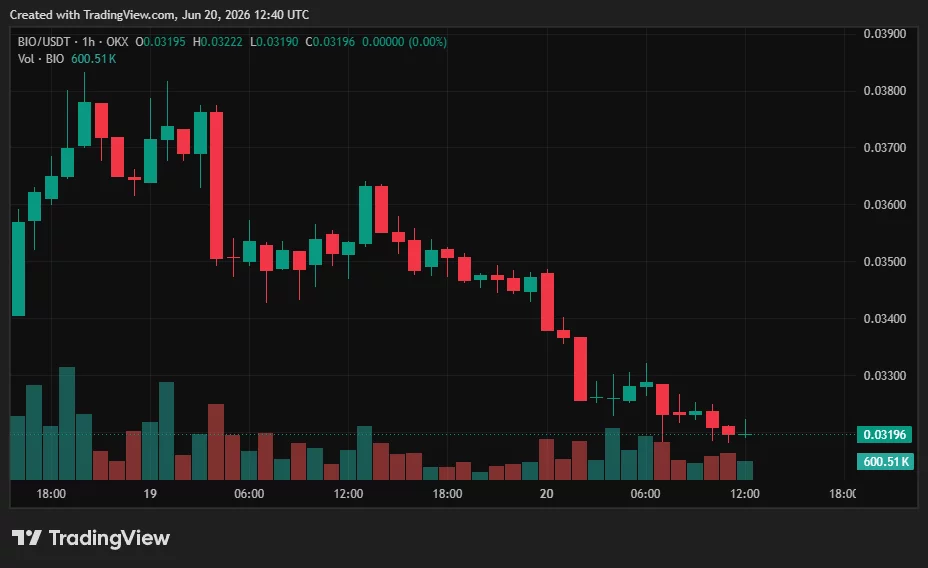
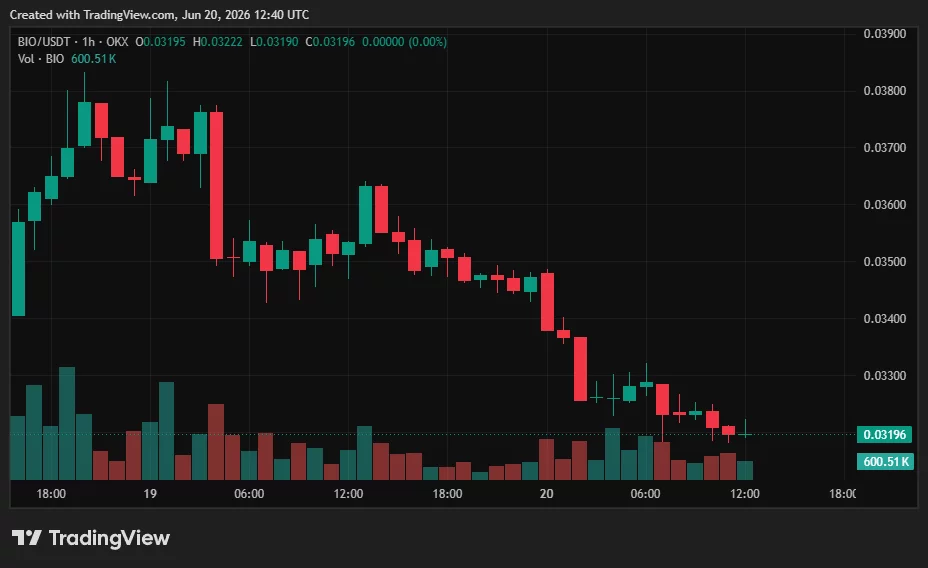
Despite the launch, Bio Protocol (BIO) continued to trade lower alongside the broader crypto market. The token declined more than 8% in the past 24 hours as investors assessed the hawkish tone adopted by Federal Reserve Chair Kevin Warsh and uncertainty surrounding the implementation of the proposed U.S.-Iran peace framework.
OpenLabs combines research collaboration with funding decisions
Under the model described by Bio Protocol, researchers and community participants work within the same platform where project development and funding decisions occur. The BIO token functions as the governance and utility asset used in voting and ecosystem participation.
Bio Protocol highlighted two projects during the launch. According to the team, RheumaAI is being developed as an AI agent focused on rheumatology research, while PeptAI is focused on peptide discovery.
The project stated that OpenLabs integrates AI-driven processes into scientific collaboration while allowing token holders and community members to participate in funding decisions. Rather than relying solely on traditional grant committees, project proposals can be reviewed and supported through community governance mechanisms built into the platform.
DeSci.Berlin has previously served as a venue for decentralized science initiatives. According to Bio Protocol, earlier editions of the conference helped incubate projects, including Molecule Labs.
Bio Protocol expands its decentralized science infrastructure
OpenLabs forms part of Bio Protocol’s existing decentralized science strategy. According to the project, it has been developing infrastructure that uses tokenized intellectual property and BioDAOs to direct funding toward biotechnology and scientific research programs.
Bio Protocol said its BIO Genesis initiative has raised more than $33 million to date. The project describes BIO Genesis as a fundraising mechanism that supports research-focused organizations operating within its ecosystem.
Bio Protocol’s work with AI research tools predates OpenLabs. In August 2025, the project launched the Ignition Sale for Aubrai, a decentralized BioAgent developed with VitaDAO for longevity research. According to Bio Protocol, Aubrai functions as an on-chain AI co-scientist capable of generating hypotheses and helping design laboratory experiments.
According to Bio Protocol, the decentralized science sector seeks to apply blockchain-based systems to research funding, governance, and intellectual property management. Supporters of the model argue that transparent funding records and community participation can provide alternatives to conventional research financing structures.
Regulatory questions remain a potential challenge as these models evolve. Tokenized intellectual property tied to biotechnology projects intersects with securities regulations, patent frameworks, and pharmaceutical oversight requirements.
As research programs progress from early-stage concepts to commercial development, legal and compliance obligations could become more complex for projects operating in the decentralized science sector.
Crypto World
A look at how falling Bitcoin prices, capital structure changes pushed STRC below $83 in just five weeks.


May 26: The company confirmed it had used its cash reserve to finance the bond repurchase. The transaction had reduced the fund to $871 million.
The buyback reduced that reserve to roughly six months of STRC dividend coverage. The company had previously said the plan was to maintain about 24 months of dividend coverage.
STRC traded at $99.33, bitcoin hovered around $77,000.
June 1: Strategy sold 32 BTC, its first bitcoin sale since 2022. The move appeared intended to demonstrate that the company was willing and able to sell the token if necessary to fund dividend obligations.
The sale accounted for just 0.0038% of the company’s holdings. Nevertheless, the company’s common stock (MSTR) dropped 5.9% and bitcoin fell to as low as $70,500 before closing at $71,286. STRC closed at $98.07.
June 5: Bitcoin fell below $60,000 for the first time since October 2024, closing around $61,000, according to CoinDesk data. STRC dropped to as low as $90 to end the day at $93.40.
June 8: Strategy shareholders approve the plan to pay STRC dividends twice a month. Strategy bought 1,550 BTC and said the balance of its dollar reserve had risen to $1 billion.
June 15: Strategy bought another 1,587 BTC and said the balance of its dollar reserve was now $1.1 billion.

Pudgy Penguins is taking another step to move its NFT brand into mainstream retail with a new nationwide rollout at Target stores in the United States. The project says its Vibes Series 3 trading card set will be released through Target, expanding the reach of the trading card game beyond its earlier distribution.
According to a press release shared with Cointelegraph, Vibes Series 3 represents the biggest retail expansion Pudgy Penguins has made for the card line so far and brings the total number of circulated cards to 15 million. The set is also positioned as a more feature-rich edition, adding new gameplay mechanics alongside original artwork, plus appearances from characters associated with the Moonbirds collection.
Key takeaways
- Pudgy Penguins is expanding its Vibes trading card game into U.S. retail via a nationwide Target rollout.
- Vibes Series 3 is described as the project’s largest retail push to date and lifts total circulated cards to 15 million.
- The new card set includes additional gameplay mechanics and original artwork tied to Moonbirds characters.
- Pudgy Penguins continues to market its NFT IP as a broader entertainment franchise through toys, licensing, and blockchain gaming.
A trading card push with retail-first distribution
The move to Target is important because trading cards—unlike on-chain collectibles—rely heavily on physical availability, in-store discovery, and shelf presence. By tying Vibes Series 3 to a major U.S. retailer, Pudgy Penguins is effectively widening the funnel from NFT holders and crypto-native audiences toward casual consumers who may never interact with the underlying Ethereum-based collection.
The project developed Vibes in partnership with Orange Cap Games, and Series 3 is the next step after two prior releases. Pudgy Penguins previously framed Vibes as an avenue to extend its intellectual property beyond digital ownership, and the retail rollout underscores that strategy by prioritizing distribution and physical engagement.
With Vibes Series 3, the project also emphasizes creative integration: the set features original artwork and includes appearances from Moonbirds characters. That kind of cross-collection presence is a way to tap into existing fan communities while giving the franchise a reason to be collected and discussed in the broader collectible market.
From Ethereum collectibles to consumer goods
Pudgy Penguins has spent several years translating its Ethereum NFT brand into consumer products and entertainment experiences. The trading cards arrive after earlier expansion into toys and retail distribution.
In 2023, Pudgy Penguins’ physical toys entered more than 2,000 Walmart stores, and in May 2024 CEO Luca Netz said that more than 1 million toys had been sold during the preceding 12 months, according to a statement shared with Cointelegraph (see PR Newswire).
There is also an incentive layer tied to NFT ownership. The project’s licensing model allows NFT holders to receive 5% of net revenue from physical products featuring their individual penguins. That approach is designed to maintain a connection between on-chain holders and off-chain merchandise—while still building a consumer-friendly storefront.
In other words, Pudgy Penguins is trying to sustain two value paths at once: mainstream retail can expand awareness and adoption of the brand, while its licensing structure aims to keep NFT communities financially and emotionally engaged.
Gaming and entertainment extensions—plus shifting priorities
Retail is only one front in Pudgy Penguins’ efforts to build an entertainment franchise. The project has also pushed into blockchain gaming, describing games as a way to bring its characters to wider audiences.
In 2025, Pudgy Penguins launched the skill-based game Pengu Clash on The Open Network, and at the time Netz pointed to gaming as a vehicle for reaching broader audiences (as covered in a press release shared with Cointelegraph via PR Newswire).
Later, the project released a mobile title called Pudgy Party in August 2025. Pudgy Penguins said at launch that downloads exceeded 1 million. However, the company later said on Monday that it would halt further development of Pudgy Party and redirect resources to a browser-based game called Pudgy World, according to earlier coverage from Cointelegraph (Pudgy Penguins winds down Pudgy Party mobile game).
This pattern—launching one experience while eventually reallocating effort to another—suggests the brand is treating games as iterative experiments. The Target rollout for Vibes Series 3 can be viewed through the same lens: test, measure consumer response, and focus distribution where engagement is strongest.
Why this matters for NFT-linked brands
For NFT projects, the critical question has often been whether their IP can live credibly outside crypto rails. Pudgy Penguins’ strategy—physical products, retail partnerships, and entertainment formats layered around its characters—reflects a broader industry push toward “utility” that doesn’t depend solely on token markets.
The Target expansion is likely to be watched closely because it signals a shift from niche trading circles to mass retail visibility. If the cards perform well, it strengthens the case that NFT-derived IP can function like a conventional entertainment brand, complete with recurring releases, collector mechanics, and cross-brand artwork.
Still, the durability of that model depends on more than shelf placement. Investors and users will likely focus on whether Pudgy Penguins can maintain repeat consumer interest across series, expand its retail presence sustainably, and keep enough momentum in its games and merchandise to avoid the stop-start churn that can affect entertainment launches.
Readers should watch next for how Vibes Series 3 performs in-store and whether Pudgy Penguins’ retail push influences other collectible releases tied to its franchise—especially given the project’s history of shifting resources between gaming products as it searches for the most durable audience fit.

Every new iOS 27 feature that’s worth knowing about

Jupiter Transit Effect: Financial Prosperity for Virgo Starting June 19! #zodiacsigns #acharyaritu
“Will & Grace” stars Debra Messing and Eric McCormick remember James Burrows: 'Thank you for everything you gave us'


-

 Business6 days ago
No Jackpot Winner as $257 Million Prize Rolls Over to $269 Million Monday Draw
-

 Fashion21 hours ago
Weekend Open Thread: Miami – Corporette.com
-
Crypto World6 days ago
Zimbabwe Requires Crypto Businesses to Register Annually Under New FIU Regulations
-
 Entertainment6 days ago
Matt Damon’s Viral Sci-Fi Thriller Has Taken Over HBO Max
-

 Tech6 days ago
As AI companies race to go public, who else is along for the ride?
-

 Business6 days ago
Anthropic staff to meet White House officials next week, Axios reports
-
 NewsBeat6 days ago
what doctors are seeing in ebike crashes
-
 Crypto World6 days ago
Bitcoin could crash to $48,000, if this historical pattern is triggered
-

 Entertainment7 days ago
Deion Sanders Shares Powerful Post After Viral Advice To Deiondra
-
 NewsBeat6 days ago
Warning of disruption as Cardiff Crossrail works to start
-
 NewsBeat6 days ago
Tributes to former deputy head teacher at Cambridge school among death and funeral notices
-

 Politics6 days ago
“Israel’s” ban on ICRC visits ruled illegal, but Knesset moves to stop them permanently
-

 News Videos6 days ago
Financial Accounting | Last Day Revision Strategy and Booster | CMA Inter – June 2026
-
 Entertainment6 days ago
Kate Middleton Glare Goes Viral After Kids Booed At Royal Event
-

 Tech6 days ago
Over 400 Arch Linux packages compromised to push rootkit, infostealer
-

 Crypto World6 days ago
XRP ETFs Outperform As Bitcoin And Ethereum Funds Extend Outflow Trend
-

 Business6 days ago
Invesco Quality Income Fund Q1 2026 Commentary
-

 NewsBeat6 days ago
Singer Oliver Tree dies aged 32 in helicopter crash in Brazil
-
 Crypto World6 days ago
Market Preview: SpaceX (SPCX) IPO Record, Federal Reserve Meeting, and Iran Nuclear Agreement
-

 Sports6 days ago
Dick Advocaat’s Curacao scores first-ever World Cup goal against Germany
You must be logged in to post a comment Login