
Crypto World
Adam Back says 15-bit quantum hack does not threaten Bitcoin



A debate has started in the crypto market after researcher Giancarlo Lelli received a 1 BTC reward from Project Eleven.
Summary
- Project Eleven awarded 1 BTC after a researcher cracked a 15-bit ECC key using quantum tools.
- Adam Back said the result looked more like statistical guessing than a real quantum breakthrough.
- Critics said Bitcoin’s 256-bit keys remain far beyond the scale of the latest experiment.
The prize followed his reported success in cracking a 15-bit ECC key using a cloud-based quantum computer.
Project Eleven said Lelli used a modified version of Shor’s algorithm for the test. The group also said its challenge had moved from 6-bit keys to 15-bit keys within seven months, showing faster progress in quantum testing.
Adam Back disputes quantum breakthrough claim
Blockstream CEO Adam Back challenged the idea that the test marked a real quantum attack on crypto. He argued that the result did not prove a useful quantum method against Bitcoin or modern cryptographic systems.
Back said the test looked closer to statistical guessing than a technical breach. In his view, the quantum computer did not solve the kind of hard problem that protects Bitcoin private keys.
Meanwhile, the main criticism focused on the small 15-bit key size. A key of that size has a limited search space, which makes it far easier to test possible answers than real Bitcoin keys.
Former Bitcoin Core developer Jonas Schnelli also questioned the result. He said the researcher checked about 20,000 possibilities out of 32,497, giving the method a high chance of success without quantum advantage.
Schnelli described the result as similar to “flipping a coin.” He also said, “Quantum computing contributed nothing useful here,” arguing that the experiment did not show a real threat to crypto security.
Bitcoin security debate continues
The claim has raised fresh discussion about quantum computing and Bitcoin. Some market watchers see the Project Eleven result as a step toward future risks, while critics say it does not apply to full-strength cryptography.
Back maintained that Bitcoin remains far from the reach of current quantum machines. He said quantum systems would likely target state secrets or banking systems before becoming a practical concern for Bitcoin.
Bitcoin uses far larger key sizes than the one tested in the experiment. For that reason, Back and other skeptics view the challenge as a small-scale test rather than proof that Bitcoin faces an immediate quantum threat.
The episode shows growing interest in post-quantum security across crypto. However, experts remain divided on whether the Project Eleven result marks real progress or only a controlled experiment with limited market relevance.



Banking Circle’s stablecoin settlement launch follows its CASP approval, entering a crowded market with SocGen, Sygnum and a 12-bank euro stablecoin consortium.
Crypto World
MicroStrategy Purchases 3,273 Bitcoin for ~$255 Million; Polymarket Odds Show 10% Chance of Sale This Year
MicroStrategy has acquired an additional 3,273 Bitcoin in a new purchase valued at approximately $255 million, while prediction market Polymarket sets 10% odds on the company selling any Bitcoin before year-end.
MicroStrategy purchased an additional 3,273 Bitcoin for approximately $255 million, according to a Polymarket announcement on April 27, 2026. The acquisition marks the latest expansion of MicroStrategy’s Bitcoin holdings, which have become a cornerstone of the company’s treasury strategy.
Polymarket, a cryptocurrency prediction market, has priced the odds of MicroStrategy selling any Bitcoin in 2026 at 10%, indicating strong market confidence in the company’s continued hodling stance. MicroStrategy has been one of the largest corporate Bitcoin accumulators since 2020, using the digital asset as a primary vehicle for treasury management.
Sources: Polymarket | Polymarket
This article was generated automatically by The Defiant’s AI news system from publicly available sources.


South Korean internet-only bank Kbank has signed a strategic partnership with blockchain payments company Ripple to test blockchain-based overseas remittances.
According to local media outlets like News1, The Korea Herald and Maeil Business, Kbank CEO Choi Woo-hyung and Fiona Murray, Ripple’s Asia-Pacific managing director signed the agreement at Kbank’s Seoul headquarters. The bank said the partnership will use Ripple’s global network and blockchain infrastructure to test whether overseas remittances can be made faster, cheaper and more transparent.
The companies are already conducting a phased technical verification. The first phase reportedly tested a separate app-based remittance structure, while the second phase is digitally linking customer accounts and internal systems to test remittance stability. It includes onchain transfers to countries such as the United Arab Emirates and Thailand, according to local reports.
The tie-up comes as South Korean financial companies test blockchain-based cross-border payment infrastructure while the country’s stablecoin and digital asset rules remain under discussion.
South Korea companies prepare for stablecoin rules
South Korea is weighing how to regulate stablecoins under broader digital asset legislation. On April 8, South Korea’s ruling Democratic Party prepared a draft bill that would classify stablecoins as foreign exchange payment instruments and require tokenized real-world assets to be backed by assets held in trust.
Citing an integrated draft of the proposed Digital Asset Basic Act, the Seoul Economic Daily previously reported that stablecoins used in cross-border transactions would be treated as a “means of payment” under the country’s Foreign Exchange Transactions Act.
Related: South Korea tightens crypto withdrawal-delay exemptions after scam losses
The policy backdrop may explain why stablecoin and blockchain-payment tie-ups are accelerating before the rules are final. Banks, card companies and payment firms appear to be testing infrastructure, partners and use cases while avoiding full commercial launches ahead of legislation.
On March 16, Hana Financial Group, one of South Korea’s largest financial conglomerates, signed a business agreement with the United Kingdom’s Standard Chartered Group for cooperation on various sectors, including foreign exchange and digital assets.
The South Korean conglomerate also previously partnered with USDC-issuer Circle and major US crypto exchange Crypto.com to promote stablecoin-based payments for foreign visitors in the country, according to The Korea Times.
On March 5, Asia Business Daily reported that South Korean payments company Danal will officially launch a digital asset payments service for foreign visitors in Korea in partnership with Binance Pay.
Magazine: Adam Back says current demand is ‘almost’ enough to send Bitcoin to $1M


A new Blockchain for Europe report says MiCA has made euro stablecoins safer but less competitive, and urges targeted reforms to reserves and remuneration.
International stablecoin payments among businesses will total $5 trillion by 2035, fintech analysts Juniper Research said in a new report.
That figure would be 373 times greater than the estimated total value of $13.4 this year.
“Stablecoins are increasingly embedded in cross-border business-to-business (B2B) transactions, treasury operations, and supply chain settlements, where their programmability and 24/7 settlement finality offers advantages over correspondent banking rails,” the research firm said, adding they are “causing disruption to correspondent banking channels.”
Juniper said the growth is driven by stablecoins increasingly addressing the current inefficiencies within cross-border payments that traditional finance handles.
The firm estimates that 85% of the total stablecoin transaction value in 2035 will come from B2B, with the fiat-pegged cryptocurrencies shifting from a speculative asset to a foundational layer of institutional payment infrastructure.
Stablecoins are increasingly integrated in international payments among businesses, treasury operations, and supply chain settlements, because their speedy 24/7 settlement finality offers advantages over correspondent banking rails, the firm said.
“Stablecoins are not replacing payments infrastructure; they are being adopted where the advantages are most pronounced,” said Juniper Research Analyst Jawad Jahan. “Cross-border B2B is where those advantages are greatest, and where we expect the most sustained volume growth over the forecast period.”
He suggested stablecoin issuers should focus on enterprise integrations and treasury partnerships to capture the majority of this value.
Earlier this month, Chainalysis said stablecoins were on track to become a foundational layer of global finance, with adjusted transaction volumes projected to reach $719 trillion by 2035. The blockchain intelligence firm also said that when crypto becomes the default for the next generation, “the question is no longer if stablecoins compete with traditional rails, but how quickly they replace them.”

The Ethereum Economic Zone aims to unify fragmented rollups, but its broader goal is to extend interoperability to other blockchains, says Ernst.
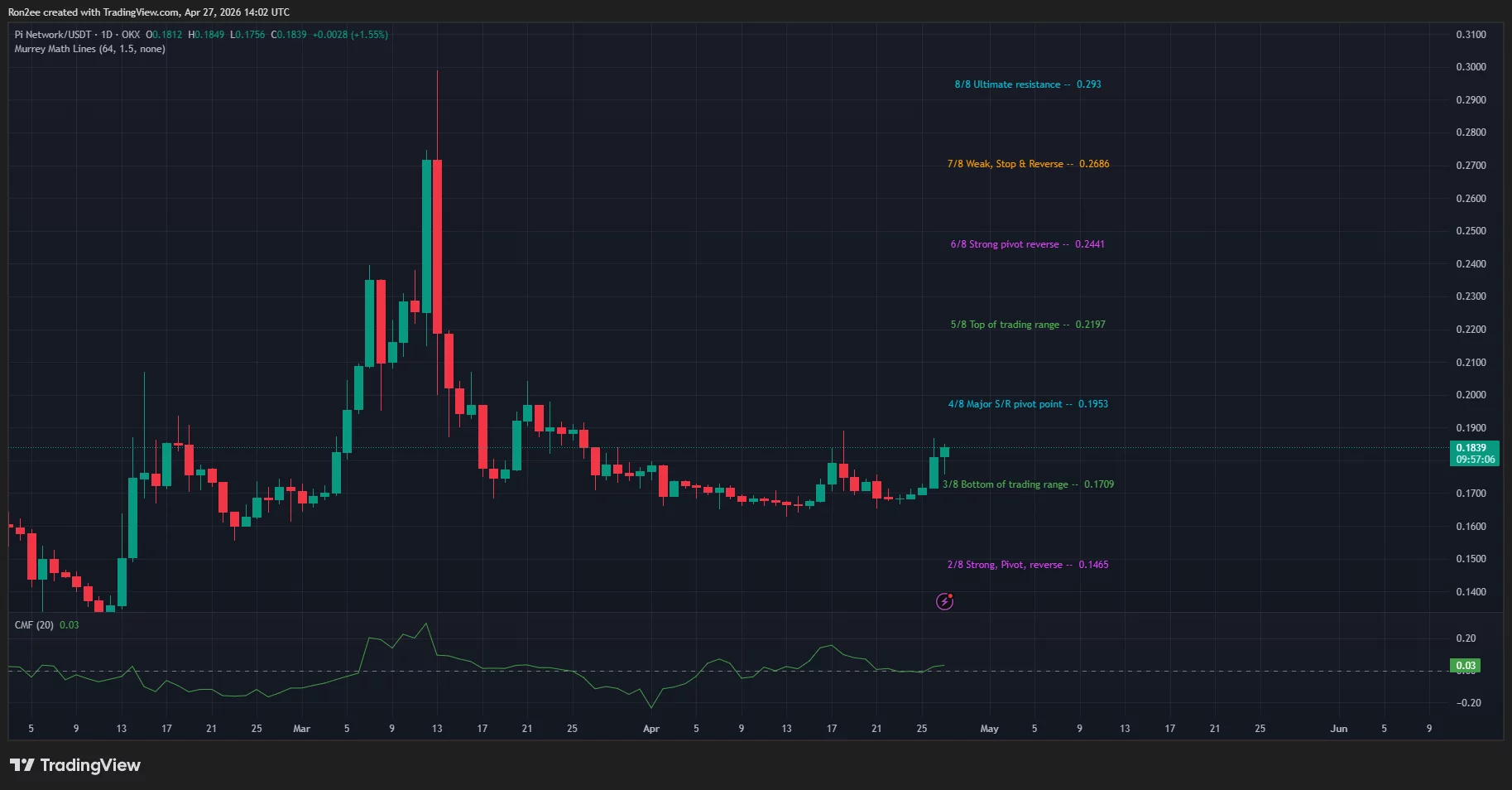
Pi Network price rallied over 6% in the past week as anticipation for its upcoming mainnet upgrades spurred demand for the token.
Summary
- Pi Network price rose over 6% this week to $0.186 as demand increased ahead of its Protocol 22 mainnet upgrade.
- Upgrade roadmap and upcoming Consensus 2026 appearance by co-founders boosted sentiment around scalability, security, and ecosystem expansion.
- Technical indicators show strengthening momentum, with potential upside toward $0.20, while loss of $0.170 support could trigger a pullback toward $0.155.
According to data from crypto.news, Pi Network (PI) price rallied from a weekly low of $0.166 to $0.186 on Friday, bringing the token’s total market cap to over $1.89 billion.
Pi Network price rose as investor demand for the token rose ahead of its mainnet upgrade to version 22 or Protocol 22, which will reportedly streamline transaction processing and enhance the network scalability for decentralized applications. This technical leap is a major step toward the Open Mainnet phase that the community has long awaited.
The upgrade also prepares the network for Protocol 23, which is expected in May and would mark the completion of critical security audits and enable cross-chain interoperability for the first time. This transition is seen as the final bridge before the ecosystem opens up to the broader crypto market.
The token’s price has also gained traction as the team prepares for a high-profile appearance at Consensus 2026 in Miami. As per reports, the project’s two co-founders, Nicolas Kokkalis and Chengdiao Fan, will speak at the event with a core focus on Pi’s blockchain infrastructure, digital identity, artificial intelligence, and future application development.
Pi Network price analysis
On the daily chart, Pi Network price has broken above the 3/8 Murrey Math line and therefore signals that the bulls have regained control of the immediate trend.
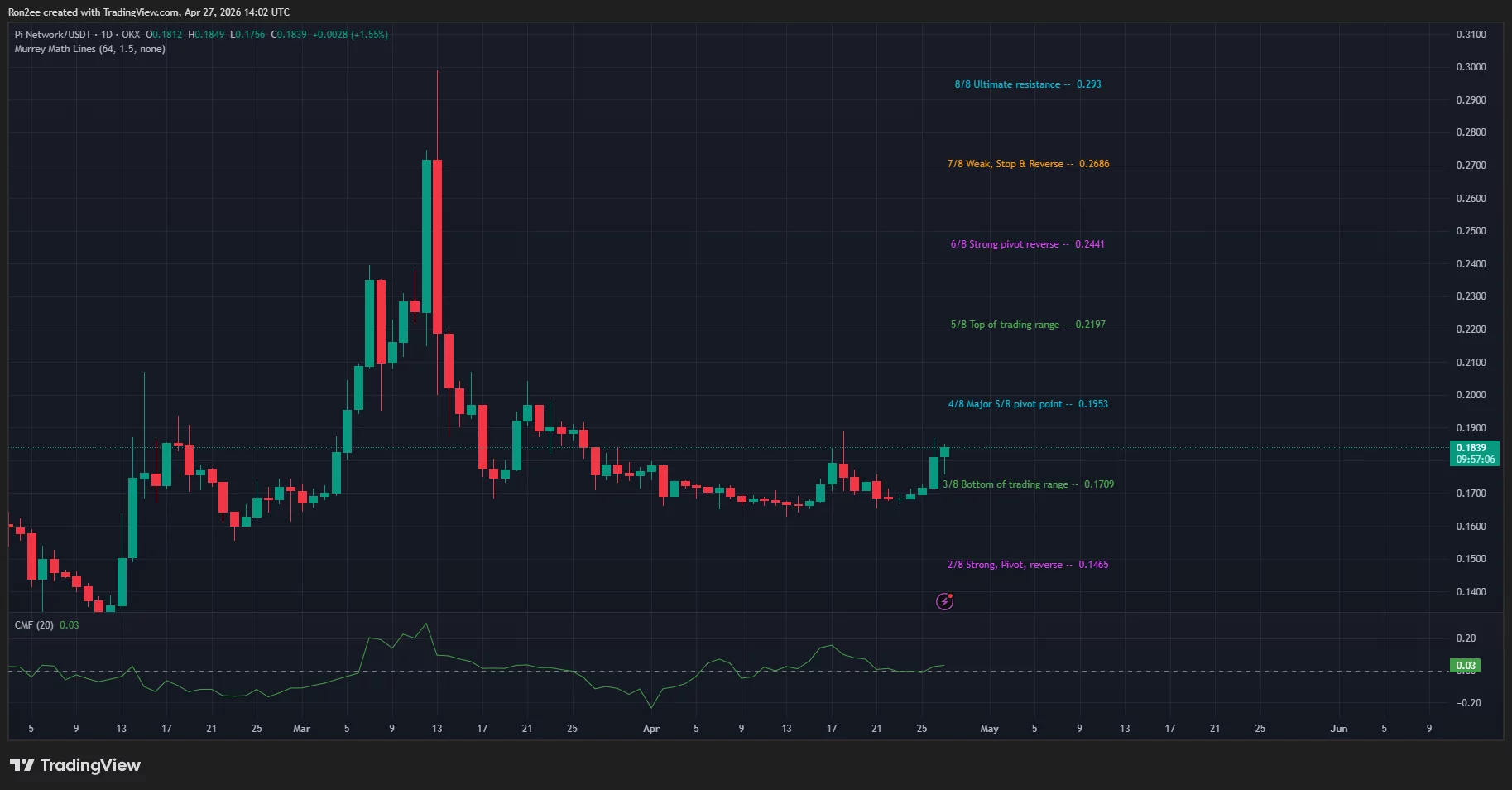
The Chaikin Money Flow index, which indicates whether capital is flowing into or out of the asset, has also turned positive, confirming that buyers are accumulating at current levels.
Hence, Pi Network price is positioned to rise toward $0.195 next and potentially push past the major psychological resistance at $0.20 if the positive news cycle continues through the week.
However, if the token loses the $0.170 support, then the bullish momentum would likely fade, leading to a period of consolidation or a retracement toward $0.155.
Disclosure: This article does not represent investment advice. The content and materials featured on this page are for educational purposes only.


Michael Saylor’s Strategy bought 3,273 Bitcoin for $255 million between April 20 and 26, bringing total holdings to 818,334 BTC.
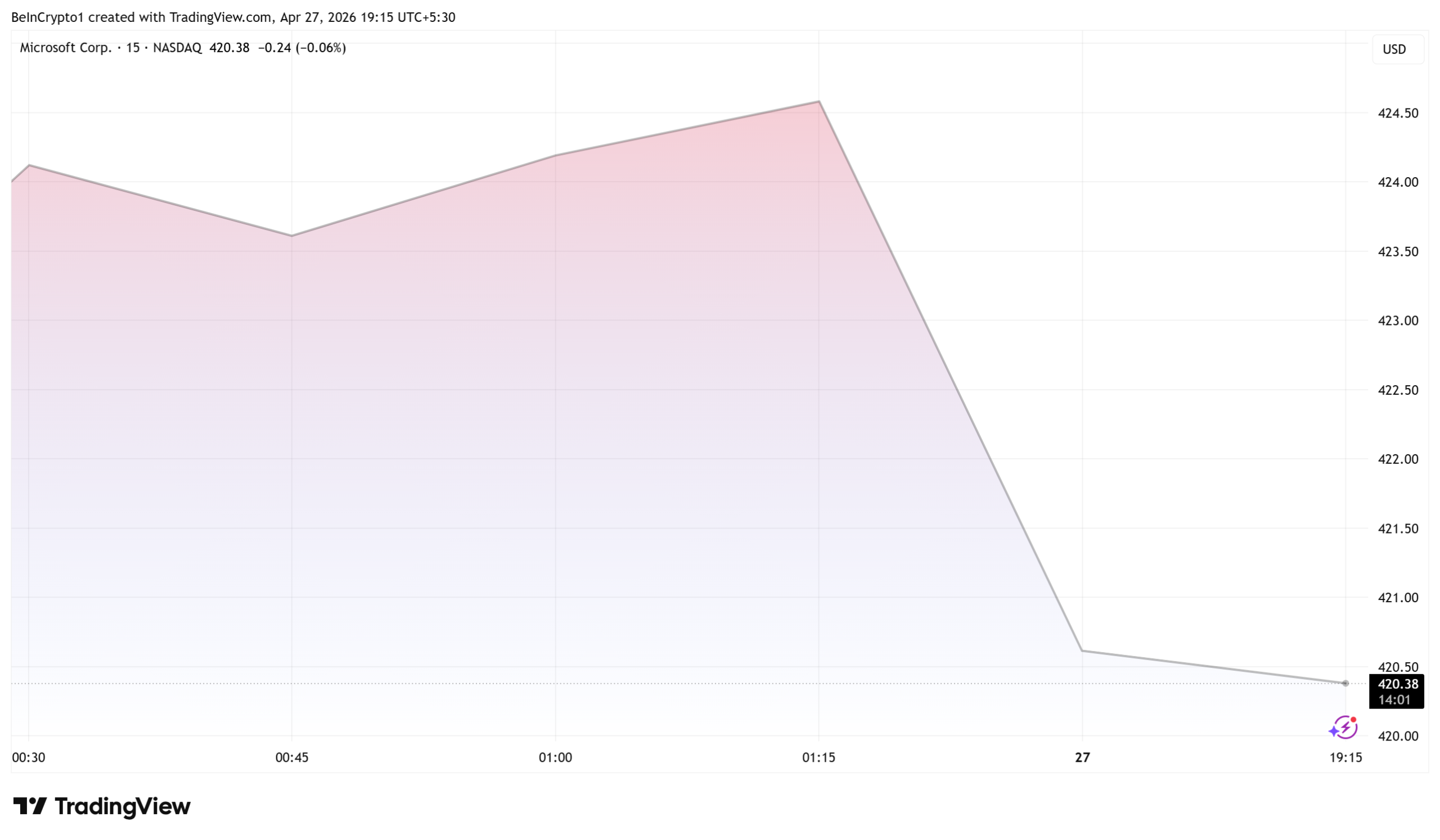
OpenAI CEO Sam Altman said that the company has updated its partnership with Microsoft (MSFT), ending Azure cloud exclusivity and clearing OpenAI to sell products across competing providers.
Microsoft stock slipped on the news, with traders citing the loss of an Azure-only edge for OpenAI’s flagship artificial intelligence (AI) products.
What Changed in the Updated Partnership
Per Altman’s post, Microsoft remains OpenAI’s primary cloud partner, but the license is now non-exclusive. OpenAI can offer models through Amazon Web Services, Google Cloud, Oracle, and other rivals.
The terms keep cash flowing both ways. OpenAI will supply Microsoft with models through 2032 and pay a revenue share to its largest backer through 2030.
Microsoft will no longer pay a revenue share back to OpenAI, removing one outflow from its income statement.
Why MSFT Stock Sold Off
MSFT shares dropped as much as 5% intraday before paring losses, with the chart still pointed lower into the close.
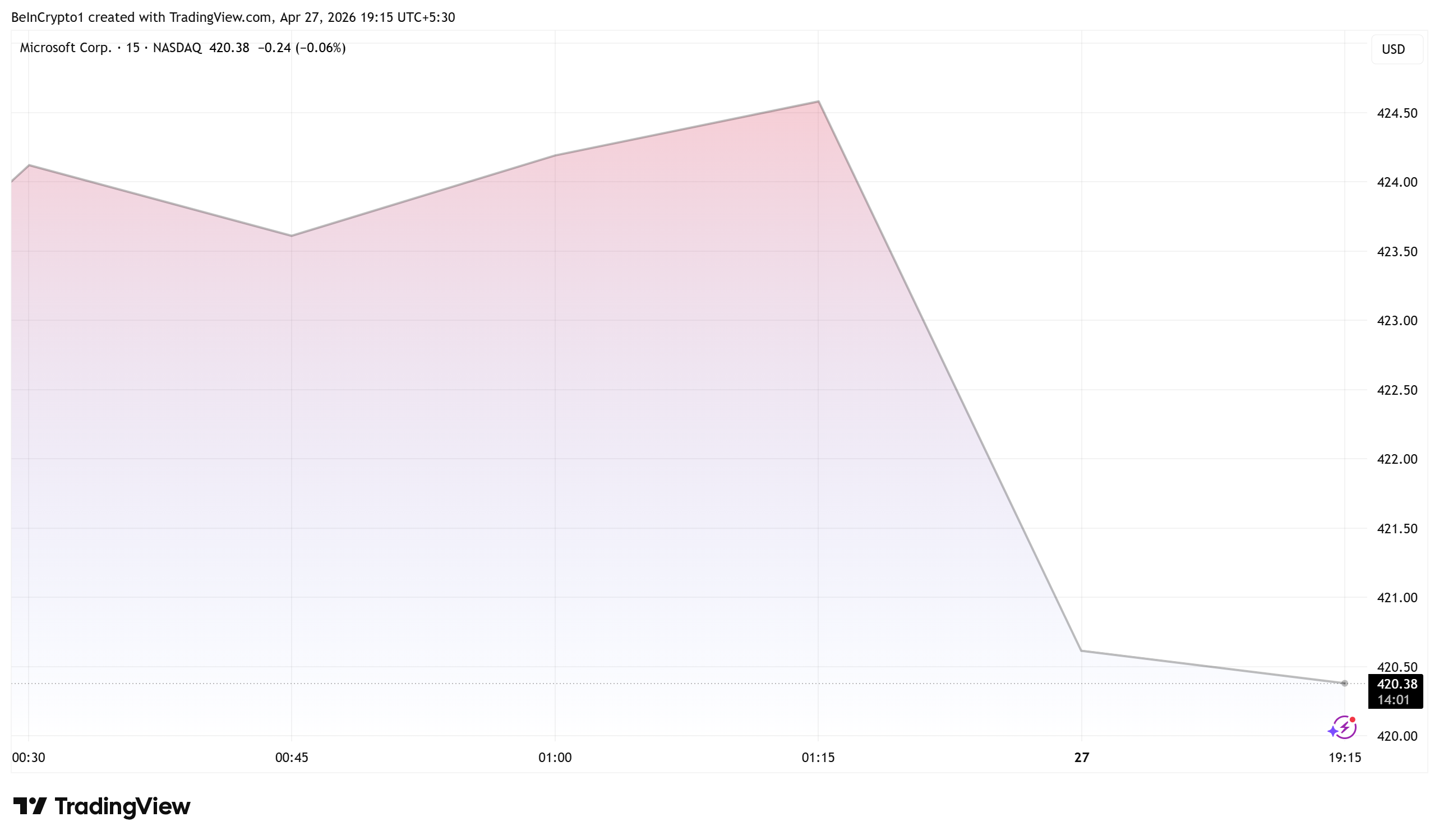
Investors had treated OpenAI workloads as a structural Azure differentiator. Removing exclusivity opens that book of business to AWS, Google Cloud, and Oracle, each of which has courted frontier AI labs.
Not every analyst read the move as bearish. CFA Palwinder Singh argued that the selloff overlooked the value Microsoft retains as the lab’s largest equity holder.
“Investors are crying about exclusivity while ignoring that Microsoft still has a 27% stake in OpenAI valued at $135 Billion, This 5% dip is a gift for anyone who can read a balance sheet instead of just a headline,” wrote Singh.
Microsoft keeps ChatGPT’s intellectual property rights through 2032 alongside that equity stake.
Investors must weigh whether discontinued payments and a longer model runway can offset the cloud-exclusivity hit across the broader AI sector, including Altman-linked projects such as Worldcoin.
The post Microsoft Stock Price Drops Sharply After OpenAI Revises Partnership appeared first on BeInCrypto.


Tether has launched an open-source Mining Development Kit that collapses Bitcoin mining’s fragmented hardware dashboards into a single JavaScript and React-based stack.
Summary
- Tether has launched an open-source Mining Development Kit (MDK) to unify Bitcoin mining infrastructure management.
- MDK gives miners and developers a single JavaScript and React-based layer to automate fleets from home rigs to gigawatt-scale farms.
- The move deepens Tether’s push into mining, following its MiningOS (MOS) release and CEO Paolo Ardoino’s ambition to become the world’s largest Bitcoin miner.
Tether pushes deeper into mining software stack
Stablecoin issuer Tether has launched a new open-source Mining Development Kit (MDK), a full-stack framework designed to give Bitcoin miners unified control over their hardware, power systems and monitoring tools from a single software layer, according to a company announcement.
The MDK rollout on April 27 follows Tether’s earlier decision in February to open-source its MiningOS (MOS) platform, positioning the company as both a major Bitcoin miner and a key software provider for the industry.
Built as a modular framework, MDK lets operators and developers manage everything from small home setups to industrial-scale farms using a JavaScript backend SDK and React-based interface components rather than siloed, proprietary dashboards tied to specific hardware vendors.
MDK targets fragmented mining infrastructure
Tether says MDK is intended to solve what it describes as a fragmentation problem in Bitcoin mining, where fleets often rely on a patchwork of OEM firmware, vendor-specific monitoring suites, legacy GUIs and custom scripts that do not communicate cleanly with each other.
The company’s documentation describes MDK as a “device capabilities + central orchestration” architecture: individual machines, power distribution units, cooling systems and sensors expose standardized capabilities, while a central engine coordinates them through a unified control plane.
MDK is designed to run on Windows, macOS and Linux and is explicitly pitched at both home miners and “gigawatt-scale” industrial operations, reflecting Tether’s claim that the same stack should scale from a handful of ASICs to hundreds of thousands of machines spread across multiple sites.
According to Tether, developers can use the JavaScript SDK to integrate MDK with external services, automation tools or AI-driven agents, while the React component library provides pre-built elements for dashboards, alert panels and configuration views.
In a statement highlighted by industry outlet Techflame, Tether CEO Paolo Ardoino said MDK will offer “infrastructure support for the next generation of Bitcoin mining focused on automation and optimization,” framing the toolkit as a way to standardize and upgrade operational control across the sector.
MDK is also positioned as a companion to MiningOS, which Tether open-sourced in February under an Apache 2.0 license; MOS provides the operating system layer for monitoring and managing mining installations, while MDK offers a programmable development layer on top of that environment.
The launch comes as Tether is already a central player in digital asset markets, with its USDT stablecoin maintaining a market capitalization above $100 billion in recent months, and trading volumes on par with or exceeding those of bitcoin itself on some days, according to market data tracked by sites like CoinGecko.
From stablecoins to industrial control
Tether’s move into open-source mining software is part of a broader strategy to push beyond stablecoin issuance into energy, mining and infrastructure, a shift Ardoino has been signaling publicly since at least 2025.
In a 2025 speech reported by Bitcoin Magazine, Ardoino said Tether had invested more than $2 billion into energy production and Bitcoin mining, and predicted the company could become “the biggest Bitcoin miner in the world, even including all the public companies,” by the end of that year.
He has also framed Bitcoin mining in explicitly energy-centric terms; in a February 2026 post on X, Ardoino described Bitcoin as “energy harvested from the universe,” arguing that mining converts abundant power resources into a scarce digital asset secured by proof-of-work.
Tether’s open-sourcing of MOS and now MDK therefore serves two purposes: reducing its own reliance on proprietary third-party software as it scales out mining operations, and inserting its technology into the wider mining ecosystem as a de facto standard.
Industry publications such as Bitcoin Magazine have noted that MOS uses a self-hosted, peer-to-peer architecture based on Holepunch protocols, allowing miners to manage operations without depending on centralized cloud services or external SaaS platforms.
By pairing MOS with MDK, Tether is effectively trying to occupy both the operating system layer that runs on mining rigs and the orchestration layer that coordinates devices, power, and automation policies across entire fleets.
That combination could make Tether a critical software vendor for miners at the same time as it continues to dominate the stablecoin market through USDT, raising questions about how much influence one company should have over both digital asset liquidity and the physical infrastructure securing Bitcoin.
Automation, AI and centralization concerns
Tether has emphasized that MDK is open-source and extendable, with support for integrating automation and AI-driven optimization agents that can, for example, dynamically adjust hashrate, shift load in response to power prices or schedule maintenance windows using data from sensors and error logs.
According to the company, the framework is designed so that developers do not have to rebuild basic device integrations each time they create new monitoring or control software, potentially shortening development cycles for more advanced energy and strategy management tools.
However, as highlighted by energy and mining analysts quoted in recent coverage of Tether’s push into this space, the creation of a widely adopted, unified orchestration layer for mining infrastructure also concentrates technical risk: a bug, exploit or misconfiguration in MDK-based systems might impact multiple operators at once if they standardize on the same stack.
At the same time, if MDK and MOS gain significant traction, Tether would gain visibility into, and indirect influence over, how large segments of global hash power are monitored and optimized, even if miners run the software on their own infrastructure and retain operational control.
That possibility is especially sensitive given Tether’s scale in the stablecoin market and its growing role in cross-border dollar liquidity, as documented in numerous regulatory and market reports covered by outlets including the Financial Times and Bloomberg.
Ardoino and Tether have argued in previous public comments that their mining and infrastructure investments are driven by a desire to reinforce Bitcoin’s security model and energy footprint rather than simply chase yield, but the MDK launch underscores how tightly the company is now tying its future to the physical underpinnings of the Bitcoin network.
For miners, the calculus will be straightforward and unforgiving: if MDK and MOS deliver more efficient operations, better integration with power markets and a faster path to automation, adoption will likely follow, even as debates over concentration of power and software risk intensify across the Bitcoin ecosystem.

MiCA-licensed Banking Circle joins bank stablecoin settlement race in Europe

Star Trek Producers Were Warned About Starfleet Academy Over 60 Years Ago

Veradermics Stock Explodes 43% After Positive Phase 3 Hair Loss Drug Trial Results

Manchester United reach agreement with Casemiro over contract clause amid transfer speculation

US brings back mandatory military draft registration

Steven Gerrard disagrees with Gary Neville over ‘shock’ Chelsea and Arsenal claim | Football


-

 Politics7 days ago
Gary Stevenson delivers timely reminder to register to vote as deadline TODAY
-

 Fashion3 days ago
Weekend Open Thread – Corporette.com
-
 Crypto World2 days ago
Hyperliquid $HYPE Rally Builds Momentum as AI Sector Enters Prove-It Phase
-
Crypto World7 days ago
Bank of Hawai’i (BOH) Q1 2026: Net Income Drops to $57.4M as Net Interest Margin Expands
-

 Politics5 days ago
Making troops accountable for war crimes threatens US alliance, ex-SAS colonel warns
-

 Politics5 days ago
Disabled people challenge government SEND proposals over segregation concerns
-

 Business5 days ago
Rolls-Royce Voted UK’s Most Iconic Trade Mark as IPO Register Hits 150
-

 Business4 days ago
Patterson-UTI Energy, Inc. (PTEN) Q1 2026 Earnings Call Transcript
-

 Politics5 days ago
Zack Polanski responds to home secretary’s taser threat
-
 Crypto World6 days ago
Five Value Stocks with Recovery Potential in 2026: PayPal (PYPL), Nike (NKE), and More
-

 Politics5 days ago
Starmer handler McSweeney to be dragged from shadows by Foreign Affairs Committee
-
 Sports1 day ago
IPL 2026: Ruturaj Gaikwad registers slowest fifty of the season, enters all-time unwanted list | Cricket News
-
Politics5 days ago
Wings Over Scotland | How To Get Away With Crimes
-

 Crypto World6 days ago
New York sues Coinbase, Gemini over prediction market offerings
-
Entertainment6 days ago
Sydney Sweeney cameo cut from “The Devil Wears Prada 2”, source explains why (exclusive)
-
 Business5 days ago
HCL Tech share price tank over 9% after weak Q4. JPMorgan, HSBC & 3 others cut target price
-

 Politics5 days ago
‘Iran is still a nuclear threat’
-

 Crypto World6 days ago
Crypto’s great hope in Senate’s Clarity Act still has a path to survive tight calendar
-
 Sports5 days ago
Tim Bradley names the current best in the world: “Better than Inoue and Usyk”
-

 NewsBeat1 day ago
LK Bennett closes all stores after entering administration
You must be logged in to post a comment Login