

Crypto World
AI Agents are Starting to Handle Money. This Blockchain Wants to Build Their Bank



For now, most AI agents still live inside safe boxes. They summarize documents. Write code. Search databases. Help customer support teams move faster.
In finance, they are already creeping into fraud detection, compliance, research, and back-office workflows. Cambridge Judge Business School found this year that 52% of financial firms are actively adopting agentic AI, with 23% already scaling or transforming around it.
Bond Labs, a blockchain superapp network, is betting on the next step. It wants AI agents to trade, borrow, lend, move funds, and eventually spend money across crypto and traditional payment rails.
The company has launched on 0G, an AI-native blockchain network, with a DeFi platform designed for both humans and autonomous AI agents.
Bond says its platform combines
- A spot decentralized exchange,
- Perpetuals exchange
- Lending and borrowing markets,
And also a planned neobank layer with fiat on/off ramps, global transfers, on-chain IBAN access, Visa debit cards, and yield-bearing accounts.
That is a large promise. It also arrives at a moment when the financial industry is trying to work out how much autonomy it can safely give to software that can reason, plan, and act.
The Agent Needs a Wallet
The idea behind Bond is simple enough. If AI agents are going to become economic actors, they need financial infrastructure.
A chatbot can tell a user how to rebalance a portfolio. An agent could, in theory, do it. It could move idle funds into a yield account, borrow against collateral, hedge exposure, or route money across chains and payment systems.
That shift requires more than a prompt window. It needs liquidity, execution venues, credit markets, identity checks, payment access, and risk controls.
Bond is trying to put those pieces into one environment.
Its DeFi layer includes a spot DEX based on Uniswap V3-style automated market-making, a perpetual DEX using a central limit order book model, and lending markets with dynamic interest rates.
The company also plans to add a neobank layer within the next three months, bringing fiat access, global transfers, Visa card functionality, and accounts connected to 0G Chain.
Bond also says it will build a real-world asset division, giving users and agents exposure to tokenised assets for trading, settlement, and investment.
In plain terms, Bond wants to be the financial operating system for AI agents.
The Money Is Following the Thesis
The launch comes with direct ecosystem support from 0G Labs.
Bond is backed by a $10 million incentive programme from 0G Labs, a $3.5 million direct investment, and a stated $50 million TVL target. The incentive programme will run over 12 months and will be tracked on-chain. Bond says AI-agent trades will be included in the rewards structure.
The goal is liquidity. Without it, an agent-facing financial platform is just an interface. With it, agents can actually execute trades, access lending markets, and move value without waiting for a human to manually approve every step.
“The vision of AI agents managing someone’s finances has been held back by fragmented infrastructure,” said Bond Labs CEO Taweh Beysolow. “Bond provides the missing layer DeFi primitives and a neobank where agents can trade, borrow, spend, and earn, all within a single platform.”
Michael Heinrich, CEO of 0G Labs, framed Bond as part of a wider AI economy.
“0G is building the foundational infrastructure for an AI-native economy, and a core part of that vision is giving autonomous agents the ability to transact, manage assets, and access financial services as easily as any human,” Heinrich said. “Bond is the first platform to fully realize that vision, combining institutional-grade DeFi with a user-friendly neobank, all on a blockchain designed from the ground up for AI agents.”
The Pipes Behind the Platform
Bond has also lined up infrastructure and liquidity partners.
The company says Turtle will support liquidity and incentive distribution, Re7 will act as a DeFi vault curator, Midas will provide vault infrastructure, and Wormhole will support cross-chain interoperability.
It has also named Cicada Capital, Diffuse, GSR, and Flow Traders as liquidity providers.
Those names are important because AI-agent finance will not work without deep markets. An agent that manages capital needs execution quality, reliable settlement, and enough liquidity to avoid poor pricing.
Essi, CEO of Turtle Club, said the pre-deposit campaign had to work for different types of participants.
“Bond is building a superapp for an audience that spans retail and institutional. The pre-deposits campaign needed DeFi-native LPs who could underwrite both ends. We structured it with the Bond team until the economics held without compromising what Bond was committing to its users. Proud to be working alongside them.”
The Risk Is No Longer Theoretical
Deloitte’s 2026 enterprise AI survey found that 74% of companies expect to use AI agents at least moderately by 2027. In finance, Cambridge found agentic AI adoption is already further along among fintechs than traditional institutions.
Regulators are watching the same trend. The Financial Stability Board has warned that AI is spreading across AML, KYC, fraud detection, credit risk, cybersecurity, portfolio management, and compliance.
The Bank of England has gone further, warning that autonomous agents could eventually transact for consumers, execute trading strategies, and amplify market volatility if many systems behave in similar ways.
That makes security central to Bond’s pitch. The company says it has taken a security-first approach, including smart contract audits by Hashlock. That will matter as DeFi platforms remain exposed to exploits, oracle failures, bridge risk, liquidity shocks, and bad incentive design.
The harder question is governance. If an AI agent makes a trade, approves a payment, or borrows against collateral, the system needs clear rules for consent, limits, liability, and emergency shutdowns.
Bond’s launch is an early test of whether AI agents can move from assistants to financial actors. The infrastructure is starting to appear.
But the market now has to prove that autonomous finance can work without turning speed into fragility.
The post AI Agents are Starting to Handle Money. This Blockchain Wants to Build Their Bank appeared first on BeInCrypto.



To support its case, the report highlighted Ethereum’s technical track record, noting that the network has maintained uninterrupted uptime since launching in 2015. Citing a recent OpenZeppelin report, the foundation said Ethereum was secured by roughly $76 billion worth of staked ETH as of March 2026, while emphasizing its geographically distributed validator network, multiple independent client implementations and large developer ecosystem.
Beyond technical metrics, the report framed Ethereum as digital public infrastructure rather than simply a financial network. It pointed to existing deployments, including decentralized identity initiatives in Bhutan and Buenos Aires and Ethereum-based land registry projects in India, as examples of governments already experimenting with the technology.
The publication comes as governments around the world increasingly explore blockchain-based infrastructure for identity, asset tokenization and public records. The Ethereum Foundation said policymakers should distinguish between decentralized public blockchains and networks that remain controlled by corporations or foundations, arguing that governance structures will play a critical role in determining which platforms are suitable for long-term public sector use.
Read more: Ethereum gets a new nonprofit focused on institutional adoption

Bitcoin has made its way back into market conversations following some interesting developments in South Korea’s equity markets, which could indicate that investors are gradually increasing their appetites for risky assets. In particular, while the benchmark KOSPI has seen wide-ranging losses from various companies listed, the tech-heavy KOSDAQ saw an impressive rally.
This contrast may lead market participants to speculate whether the improvement in risk appetite could possibly move into other asset classes, including digital currencies like Bitcoin. There is no indication of any capital inflow into cryptos at the moment, but previous developments have been similar in nature.
Rotation of Capital Pushes Up KOSDAQ Index
According to market information provided by CryptoSavingExpert, about $65 billion worth of market capitalization was lost by firms listed on the KOSPI during the latest market trading session. On the other hand, KOSDAQ gained over $100 billion worth of market capitalization while appreciating by roughly 7.5%.
The trend did not indicate a general pullback from the South Korean stock market. Instead, it pointed to investors shifting their capital from big companies to small companies with high growth prospects. It indicated growing confidence among speculators and their preference for companies with higher risks but potentially bigger gains.
Pressure on Large-Cap Stocks From All Sides
Market heat maps highlighted weaknesses of major stocks in the Korean market, showing mostly red across major industry groups.
Samsung Electronics, the biggest listed firm in South Korea based on its market capitalization, saw a decline of 0.93%, which was one of the causes of weakness for the KOSPI index. The list of weak firms includes many others.
Among the biggest losers:
- Samsung Electronics – 0.93%
- SK Hynix – 0.97%
- Kumho Tire – 1.30%
- Hyosung – 0.90%
The companies belong to various industries, such as technology, manufacturing, automotive, and industrial. This indicates that institutions were selling off large-cap stocks rather than anything specific going on within a certain company.
Bitcoin Under Investor Watch Again
The equity rotation cycle has put the spotlight back on Bitcoin, as the question remains whether improved risk sentiment will extend into crypto assets.
It has been observed in the past that during periods of high interest in risky assets, crypto assets—especially Bitcoin—have occasionally seen positive performance, as they are considered high-risk assets. When investors start being more risk-tolerant, their attention tends to move towards alternate asset classes outside traditional stocks. Nevertheless, there is no certainty involved.
Prices of cryptocurrency will still be determined by a host of other factors, such as liquidity conditions in the global economy, monetary policies, macroeconomic trends, institutional involvement, and investor positioning in general. Equity rotation alone will not suffice in driving flows into Bitcoin.
Market Sentiment Might Give Early Indications
Even though Bitcoin has not enjoyed any particular upside because of changes in South Korea’s market dynamics, there is another way changing investor sentiment can be tracked through equity rotation.
The performance of the KOSDAQ and selling pressure in the KOSPI are indicators that investors have become more comfortable taking risks following a period when they preferred safe havens.
Market players will keep track of how far this changing sentiment spreads into other financial markets around the world before it starts affecting cryptocurrencies. If speculative demand strengthens, Bitcoin might be one of the coins set to gain as investor sentiment shifts toward risky assets.
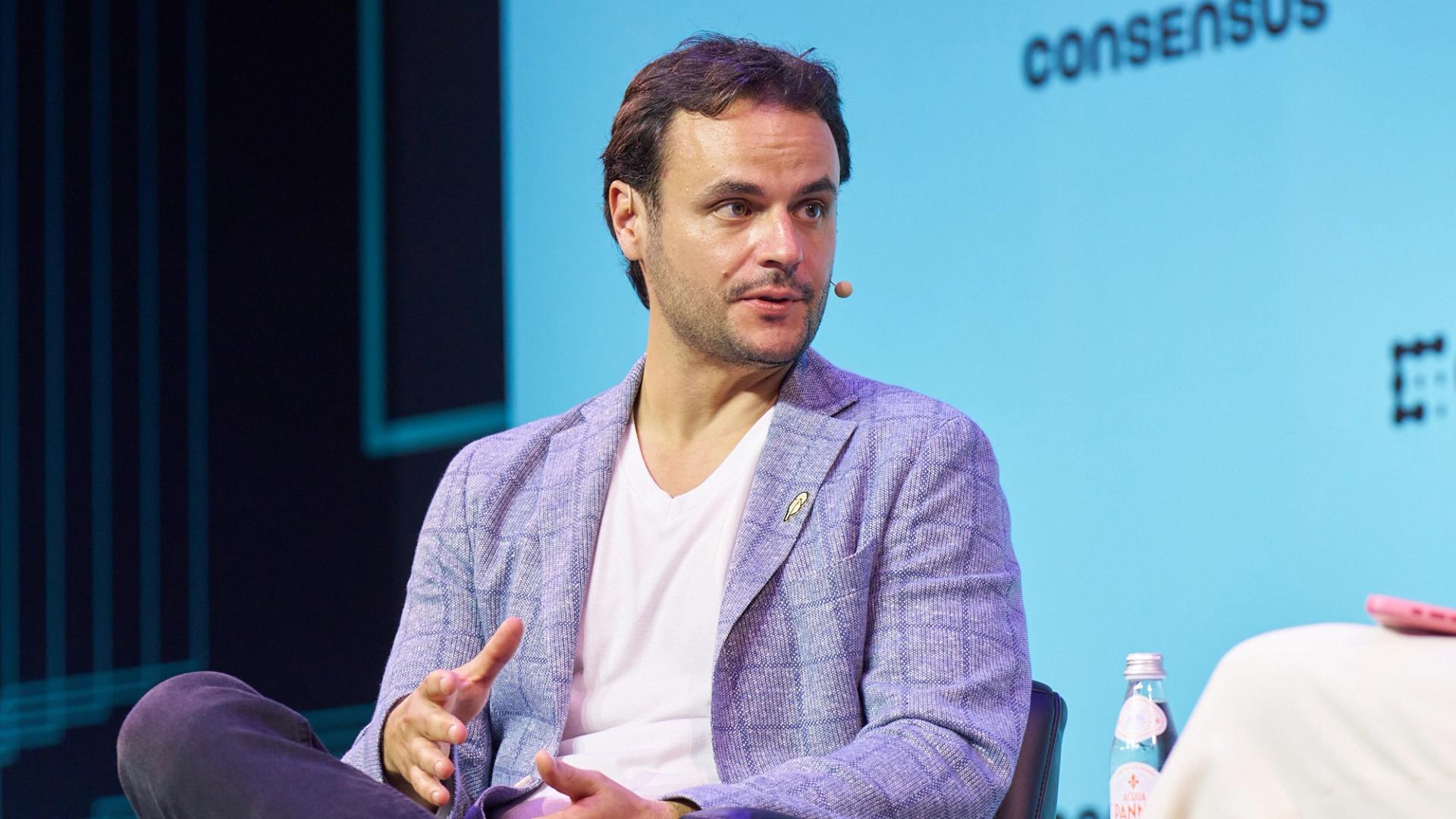
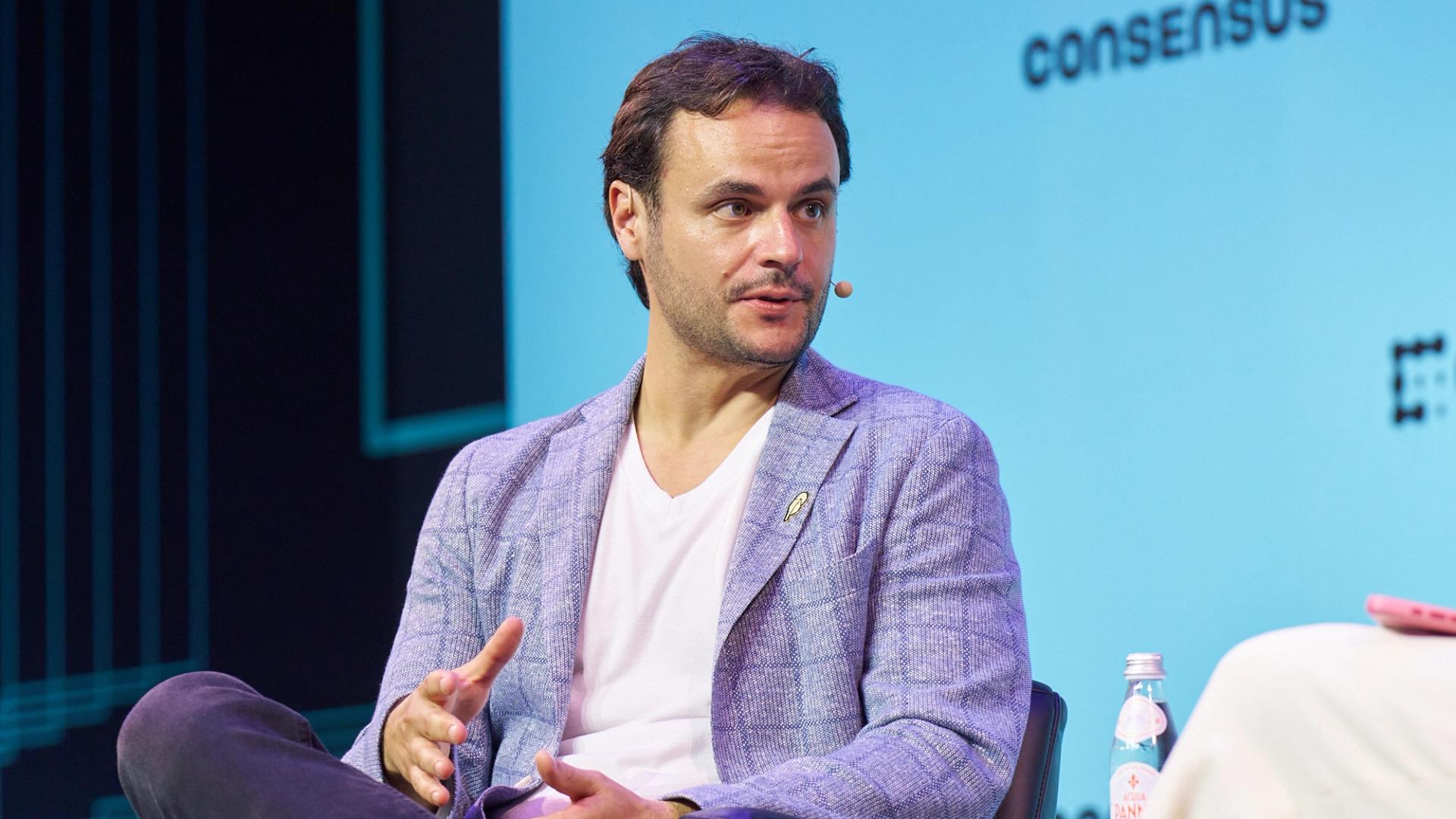
Beyond the Robinhood Chain ecosystem, the company announced several additional product launches and international expansion efforts. Robinhood said it is expanding perpetual futures trading in Europe to include commodities, ETFs and foreign exchange markets alongside crypto. It also plans to launch crypto trading in the U.K. and said its services are now available in Canada following its acquisition of WonderFi.
The company also unveiled Agentic Accounts for crypto, an AI-powered trading tool that will allow eligible U.S. users to connect AI models to Robinhood’s trading infrastructure while retaining control over capital allocation and trading parameters.
“Decentralized finance unlocks possibilities beyond what traditional finance can offer, but historically, it has required technical expertise to navigate,” Johann Kerbrat, Robinhood’s senior vice president of crypto.
Robinhood’s product push shows how the lines between crypto and traditional finance are continuing to blur. The brokerage has steadily expanded beyond stocks and spot crypto trading into tokenized equities, derivatives and event contracts, better known as prediction markets. That strategy fits into the race for the “everything exchange” to host all kinds of trading and financial activity under one roof, increasingly on top of blockchain rails.
At the same time, the company also said last month it would lay off 10% of its workforce, some 290 employees, to streamline its organization and management structure.

Crypto ATM availability is shrinking in the United States as new state laws designed to curb fraud and tighten consumer protections move into force. Tennessee and Georgia are the latest states to impose restrictions effective this week, following earlier actions in Indiana and upcoming enforcement in Minnesota.
The changes reflect a broader pattern: regulators and lawmakers across the US are targeting kiosks after scammers used them—often to trick vulnerable residents—into sending funds. For operators, the result is a more complex compliance landscape and, in some cases, an unsustainable business model.
Key takeaways
- Tennessee has implemented a statewide ban that prohibits the use and installation of crypto ATMs and kiosks.
- Georgia allows crypto ATMs to operate but introduces transaction caps, customer warnings, and reporting requirements, with provisions that can include refunds in certain fraud cases.
- Earlier state bans include Indiana (effective in March), while Minnesota is set to enforce a ban on Aug. 1.
- Regulatory pressure is already showing up financially, with Bitcoin Depot filing for Chapter 11 bankruptcy after signaling “substantial doubts” about its future.
Tennessee and Georgia tighten rules on crypto kiosks
Georgia and Tennessee each passed crypto ATM legislation that takes effect on Wednesday, but the approaches differ sharply. Tennessee’s law—signed by Governor Bill Lee in April—implements a complete prohibition on both installing and using cryptocurrency ATMs and kiosks.
Georgia’s law is more permissive while still aiming to reduce consumer harm. It requires operators to limit the amount of money sent by users, issue warnings to customers, and in some scenarios refund people who may have been defrauded.
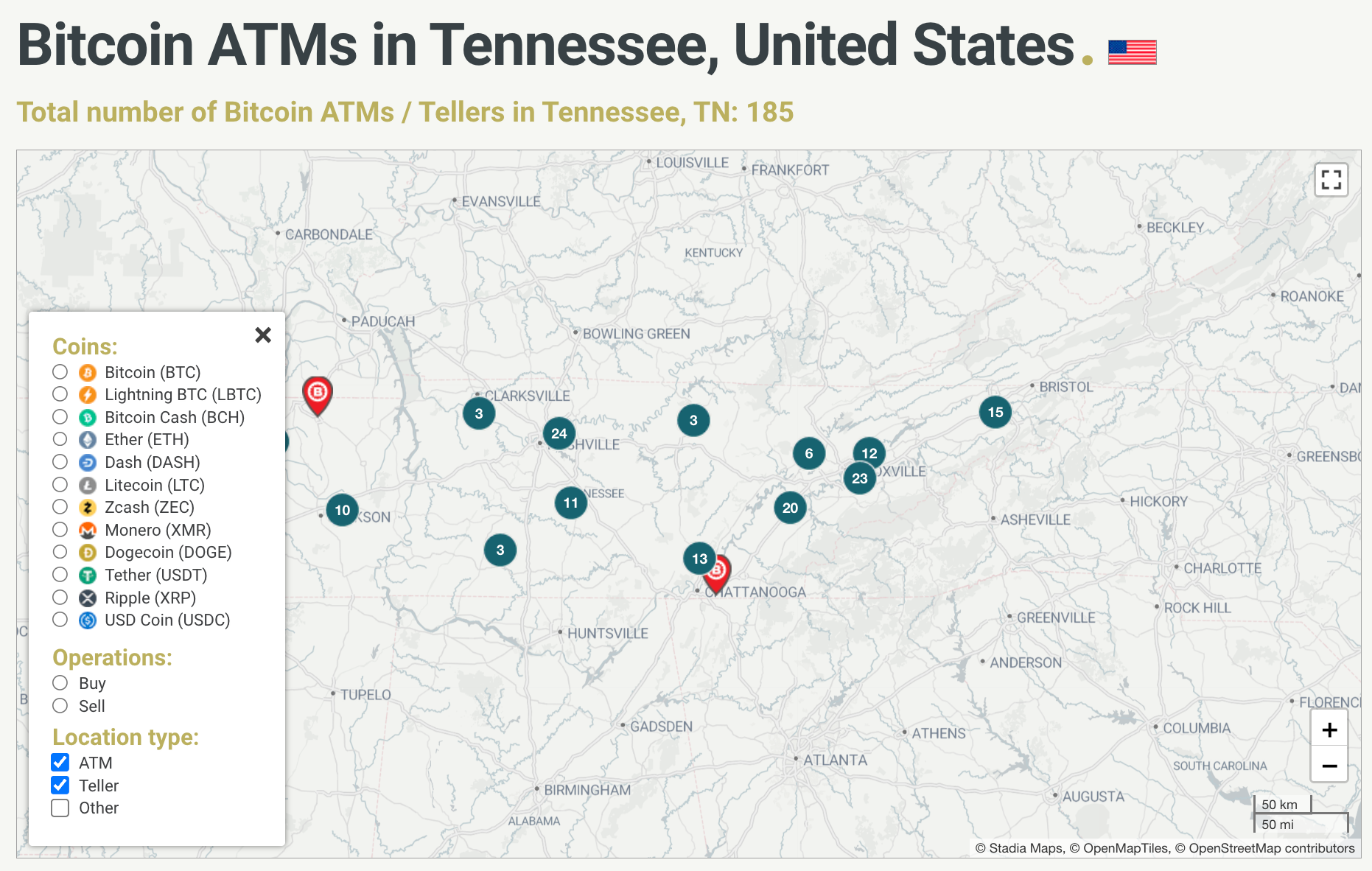
Before Tennessee’s statewide ban took effect on July 1, CoinATMRadar data cited by CoinATMRadar’s Tennessee listing indicates there were 185 crypto ATMs and kiosks operating in the state.
Why lawmakers are moving from “local bans” to statewide action
The Tennessee and Georgia measures follow a wave of earlier regulatory efforts aimed at crypto ATM operators. Cointelegraph previously reported that multiple jurisdictions and municipalities have begun cracking down on kiosks, largely in response to scams in which victims—particularly older adults—were persuaded to send cryptocurrency through ATM-style machines.
Delaware and New Jersey, for example, have considered proposals that would impose complete bans, according to earlier coverage referenced in the original reporting. The direction of travel is consistent: lawmakers increasingly view crypto ATMs as high-risk access points for fraud rather than neutral on-ramps.
As these restrictions expand, operators face more than just reduced machine counts. Compliance obligations—such as monitoring transactions, handling fraud-related disputes, and meeting consumer protection requirements—can increase costs while limiting revenue options.
Regulation’s downstream effects: bankruptcy risk for operators
For the industry, the regulatory tightening is not only theoretical. The restrictions may have already contributed to at least one major operator’s distress.
In May, Bitcoin Depot filed for Chapter 11 bankruptcy. In the days leading up to the filing, the company disclosed that it had “substantial doubts” about its future amid a challenging regulatory environment and ongoing litigation.
Roshan Dharia, CEO of Echo Base and a restructuring adviser, told Cointelegraph after the Chapter 11 filing that Bitcoin Depot’s bankruptcy likely foreshadows broader pressure on the crypto ATM sector. Dharia argued that the traditional operator model relied on relatively high transaction spreads and fewer regulatory constraints, which helped offset the high costs of compliance, cash logistics, fraud remediation, and retail revenue-sharing arrangements.
That equation, Dharia said, is breaking down as states increasingly impose consumer-protection standards. Those standards can compress fees while increasing operator liability for scam-related activity and raising expectations for transaction monitoring and reimbursement—factors that can strain business viability, especially for operators with thinner margins.
Canada signals a wider policy debate
While the latest developments are focused on US states, Canada’s regulatory conversation is also moving toward harsher restrictions. Earlier, federal policymakers in Canada proposed a total ban on crypto ATMs across the country.
The proposal would still allow Canadians to buy digital assets from brick-and-mortar money services businesses, but it would remove the kiosk pathway. Officials described crypto ATMs as the “primary method” used by scammers to defraud victims and as a channel for criminals to put cash proceeds of crime into the digital asset ecosystem.
What to watch next
With Tennessee now operating under a full ban and Georgia enforcing limits and reporting, attention will likely shift to how quickly other states follow suit—particularly Minnesota ahead of its Aug. 1 deadline—and whether operators adjust by exiting certain markets or restructuring their compliance and fraud-handling processes.


Reform UK has removed a proposed crypto bill from its website amid ongoing controversy around billionaire Tether investor Christopher Harborne’s secret £5 million “gift” to the party’s leader, Nigel Farage.
The Cryptoassets and Digital Finance Bill was announced last year during the Bitcoin 2025 conference in Las Vegas. However, The Nerve reports that the bill was scrubbed from the website on May 30 this year.
The Nerve also notes that the bill’s PDF can still be found online but is no longer present on Reform UK’s own website.
A month before the bill’s removal, The Guardian revealed that Reform leader Farage was given £5 million by billionaire Christopher Harborne before he ran for election in June 2024.
Read more: Nigel Farage: £5M Christopher Harborne gift was ‘reward’ for Brexit
The gift from Harborne, who holds a 12% stake in billion-dollar stablecoin firm Tether, was kept a secret and not declared on the parliamentary register of interests.
Weeks after this report, the UK’s Parliamentary Standards Commissioner launched a probe to determine whether or not the gift breached any rules. Farage maintains it never had to be declared, and how he spends it isn’t “the public’s business.”
Reform UK crypto bill appears ‘made up by a schoolkid’
The now-deleted bill made numerous promises in a seeming attempt to portray Reform UK favorably in the eyes of crypto traders.
For example, it promised to reduce the crypto capital gains tax to 10%, introduce a UK BTC reserve, and bar banks from restricting services based on crypto transactions.
The Nerve spoke to various finance and law experts who reviewed the bill and determined that it would benefit the super-rich while failing to do little to protect users from fraud and scams.
Read more: Nigel Farage said shady alleged crypto ATM owner is ‘like a son to me’
Professor of finance at Sussex University, Carol Alexander, told The Nerve that the bill appears like it was “made up by a schoolkid.”
Meanwhile, financial economist Frances Coppola said the bill features policies “which, from an economic standpoint — even from a welfare standpoint — really make little sense.”
Dr Philipp Paech, an associate professor of law at the London School of Economics, said, “It is a nonsensical proposal in terms of public policy and would directly benefit a specific clientele.”
The Nerve also notes that across the entire bill, stablecoins are mentioned once within a list of definitions. This is despite the highly-publicised stablecoin lobbying Farage undertook against the Bank of England last year.
Many believe that the controversy over the gift has been the reason for Farage drastically cutting back on his media duties. Indeed, The Financial Times reports that he reduced his interactions with the press from 20 conferences between January and April 2026 to just one in May.
Read more: UK’s Liberal Democrats want inquiry into Nigel Farage’s £2M bitcoin purchase
Now, according to a Reform UK insider interviewed by The i Paper, Farage is scared that he may face a by-election in his constituency if the parliamentary probe concludes that he broke the rules.
One potential punishment is a 10-day suspension from Parliament. If this happens, The i Paper reports that a successful recall petition could trigger a by-election if it receives signatures from more than 10% of eligible voters
Got a tip? Send us an email securely via Protos Leaks. For more informed news and investigations, follow us on X, Bluesky, and Google News, or subscribe to our YouTube channel.

Anchorage Digital says it has integrated its off-exchange settlement system with Binance, enabling select institutional clients to trade on Binance without depositing their crypto or cash directly onto the exchange. Instead, clients’ assets and funds can remain in qualified custody at Anchorage—a federally chartered US crypto bank—until settlement.
The arrangement is built around margin and collateral mechanics: institutions can use crypto assets or US dollar deposits held with Anchorage to satisfy Binance’s margin requirements, without moving those holdings to Binance first. Anchorage and Binance framed the workflow as a separation of custody from trade execution, aiming to reduce the operational friction—and counterparty exposure—that can come with pre-funding trades on exchanges.
Key takeaways
- Anchorage integrated its off-exchange settlement platform with Binance to support institutional trading while keeping custody at Anchorage.
- Clients can use Anchorage-held crypto or US dollar deposits as collateral for Binance margin without transferring assets to the exchange.
- The model is positioned as a response to exchange counterparty risk and aims to improve capital efficiency by avoiding pre-funding.
- Anchorage’s Atlas platform is cited as the infrastructure behind this first off-exchange settlement implementation.
- Financial terms of the partnership were not disclosed.
How the Anchorage–Binance model changes custody and collateral
In traditional exchange-based workflows, institutions typically pre-fund trading accounts—transferring assets to the venue where trades are executed. Anchorage’s stated objective with this integration is to shift that balance. Under the collaboration, institutional clients can maintain crypto and cash in qualified custody with Anchorage while accessing trade execution through Binance.
Practically, the integration focuses on margin: Binance’s margin requirements are met using collateral held with Anchorage. The companies say this keeps assets in an independent custodian until settlement, rather than routing custody into the exchange account itself. By design, it also reduces the need for institutions to move holdings between custody providers and the trading venue ahead of every trade.
Anchorage said the rollout is available initially to select institutional clients, marking the first off-exchange settlement deployment for its Atlas platform—an infrastructure Anchorage describes as supporting institutional trading, settlement, lending, and collateral management using custody-based building blocks.
Why “off-exchange settlement” is drawing institutional attention
Exchange counterparty risk has long been one of the main frictions for institutions considering larger allocations to crypto trading. When assets must be deposited to an exchange to enable trading, risk is concentrated at the execution venue. Off-exchange settlement attempts to address that by keeping custody separate from the trading leg, with settlement handled via a different mechanism.
Anchorage and Binance framed their setup as moving closer to the custody-and-execution structure common in traditional financial markets, where institutions can separate where assets are held from where trades are executed and settled. The proposed benefit is twofold: it reduces exposure tied to pre-funding and may also improve capital efficiency by relying on custody-based collateral rather than tying funds to exchange balances.
While the companies did not disclose financial terms, they emphasized the core operational change: trades can be executed on Binance while crypto and cash remain with Anchorage through settlement—an approach intended to make institutional participation smoother without requiring full custody migration to the exchange.
Off-exchange settlement expands across major venues
This Anchorage–Binance integration sits within a broader industry pattern. Off-exchange settlement has been gaining traction among institutional crypto trading platforms throughout 2026, with multiple firms announcing similar custody-and-trade separation approaches.
According to earlier coverage from Cointelegraph, in April BitMEX partnered with Zodia Custody to allow institutional clients to trade derivatives while keeping collateral in segregated custody rather than depositing it onto the exchange. Under that structure, traders could access perpetual swaps and futures while collateral remained with Zodia and was mirrored for trading. BitMEX said the design eliminated the need to prefund exchange accounts and improved capital efficiency, while also reducing operational risks tied to moving assets between custody and trading venues.
In June, Bitget adopted a comparable model by integrating Fireblocks Off Exchange. Bitget said that its integration enables clients to execute trades from MPC-based wallets while keeping assets in trader-controlled collateral vaults rather than transferring them to the exchange. The company also claimed the platform can verify trading accounts are fully collateralized in real time without taking custody of client assets.
Separately, KuCoin Institutional expanded its custody offering earlier in the year by integrating Ceffu’s MirrorX platform in January. That system, according to the linked Ceffu and KuCoin Institutional material, is designed for institutional trading while digital assets remain in third-party custody, with funds mirrored for trading and settled off-chain every four hours.
Taken together, these deployments show a recurring theme: institutions increasingly want the flexibility of exchange liquidity and execution alongside custody structures that better match their risk controls. Off-exchange settlement is becoming a practical pathway to combine those priorities—at least for use cases offered through specific integrations between exchanges, custodians, and settlement platforms.
What investors should monitor next
For institutions, the most important questions now are likely operational and risk-related: which collateral types are supported end-to-end for margin, how settlement timing works in practice for different product categories, and how widely Anchorage’s off-exchange service will be rolled out beyond the initial select client group. Readers should also watch whether more major venues add similar custody-separated settlement layers, as that trend would further define how institutional crypto trading infrastructure evolves.

Key Takeaways
- Walmart shares plummeted more than 5% Wednesday, reaching their lowest point in eight months following a six-session losing streak
- Cleveland Research identified a deceleration in U.S. comparable store sales that may threaten analyst consensus figures, especially in July
- Shares began trading at $113.26, significantly beneath the 50-day moving average of $123.25
- Company insiders offloaded more than $1.06 billion worth of shares during the previous three months without any reported purchases
- Wall Street maintains a Moderate Buy rating with a consensus price target of $138.85, though valuation concerns have emerged
Shares of Walmart began Wednesday’s session at $113.26, representing a decline exceeding 5% and positioning the stock for its weakest closing price in eight months. This marked the sixth straight trading day of declines for WMT.
The catalyst behind the selloff was research from Cleveland Research, which identified signs of decelerating U.S. comparable store sales. The research firm cautioned that this trajectory may negatively impact consensus forecasts, with July’s performance being particularly critical.
In response to inventory challenges, Walmart has implemented price reductions and leveraged tariff refunds to cushion margin pressure. While this represents a strategic response, it underscores the genuine cost and demand challenges confronting the retailer.
The share price deterioration persists even after a robust first-quarter performance. The company delivered earnings of $0.66 per share in May, aligning with analyst projections, while revenue of $177.75 billion surpassed the anticipated $174.84 billion — representing a 7.4% year-over-year gain. Management also maintained its fiscal 2027 guidance of $2.75–$2.85 in earnings per share.
However, investors appear focused on future challenges rather than recent accomplishments.
Significant Insider Transactions Draw Attention
Insider trading patterns have been notably lopsided. Throughout the past quarter, company insiders divested more than $1.06 billion in WMT shares. No insider purchases were documented during this timeframe.
Executive Vice President Christopher Nicholas disposed of 2,900 shares at $123.92 on May 21st. Fellow EVP Latriece Watkins subsequently sold 11,000 shares at $118.97 on May 28th. Both transactions occurred through pre-established Rule 10b5-1 trading arrangements.
Although scheduled sales are standard practice, the substantial magnitude of insider selling has attracted investor scrutiny.
The stock currently trades at a P/E ratio of 39.74 — representing a premium valuation that several analysts question in light of potential growth deceleration. While its GF Score of 86/100 indicates strong long-term fundamentals, near-term momentum has turned decidedly negative.
Analyst Community Maintains Optimistic Stance
Notwithstanding the downturn, Wall Street analysts haven’t abandoned Walmart. The stock maintains a Moderate Buy consensus rating with an average price objective of $138.85 — substantially above present trading levels.
Recent analyst ratings feature a $145 Buy target from BTIG, $140 from Truist, and $137 Outperform ratings from both Wolfe Research and Royal Bank of Canada. Among 36 tracked analysts, 31 maintain Buy ratings and four recommend Hold. A single analyst assigns a Strong Buy rating.
Several institutional investors expanded positions during the first quarter. Littlejohn Financial Services established a fresh $2.81 million position, while Union Bancaire Privee UBP SA increased its holdings by 253.3%.
Walmart’s 52-week high stands at $135.15. The stock’s 200-day moving average rests at $122.22, a threshold now breached to the downside.
With a 1-year low of $94.23, there’s context for evaluating potential downside if selling momentum persists.



Miles Guo, the exiled Chinese businessman who built a following as a critic of Beijing, was sentenced to 30 years in prison for a fraud scheme that raised more than $1 billion from investors. Part of that scheme ran through a fake cryptocurrency called Himalaya Coin. US District Judge Analisa… Read the full story at The Defiant
Cryptocurrency ATMs are fast disappearing from the American landscape as kiosk operators in two US states face bans and restrictions as new laws go into effect.
Crypto ATM laws passed by Tennessee and Georgia went into effect on Wednesday, imposing a complete ban in the former and requiring transaction limits and reporting in the latter. The measures by the two states followed bans in Indiana, which went into effect in March, and Minnesota, set to enforce an ATM ban on Aug. 1.
The Tennessee law, signed by Governor Bill Lee in April, bans the use and installation of cryptocurrency ATMs and kiosks, while the Georgia law requires that ATM operators cap money sent for new and existing users, issue warnings to customers and in some cases refund those who may have been the victim of fraud.
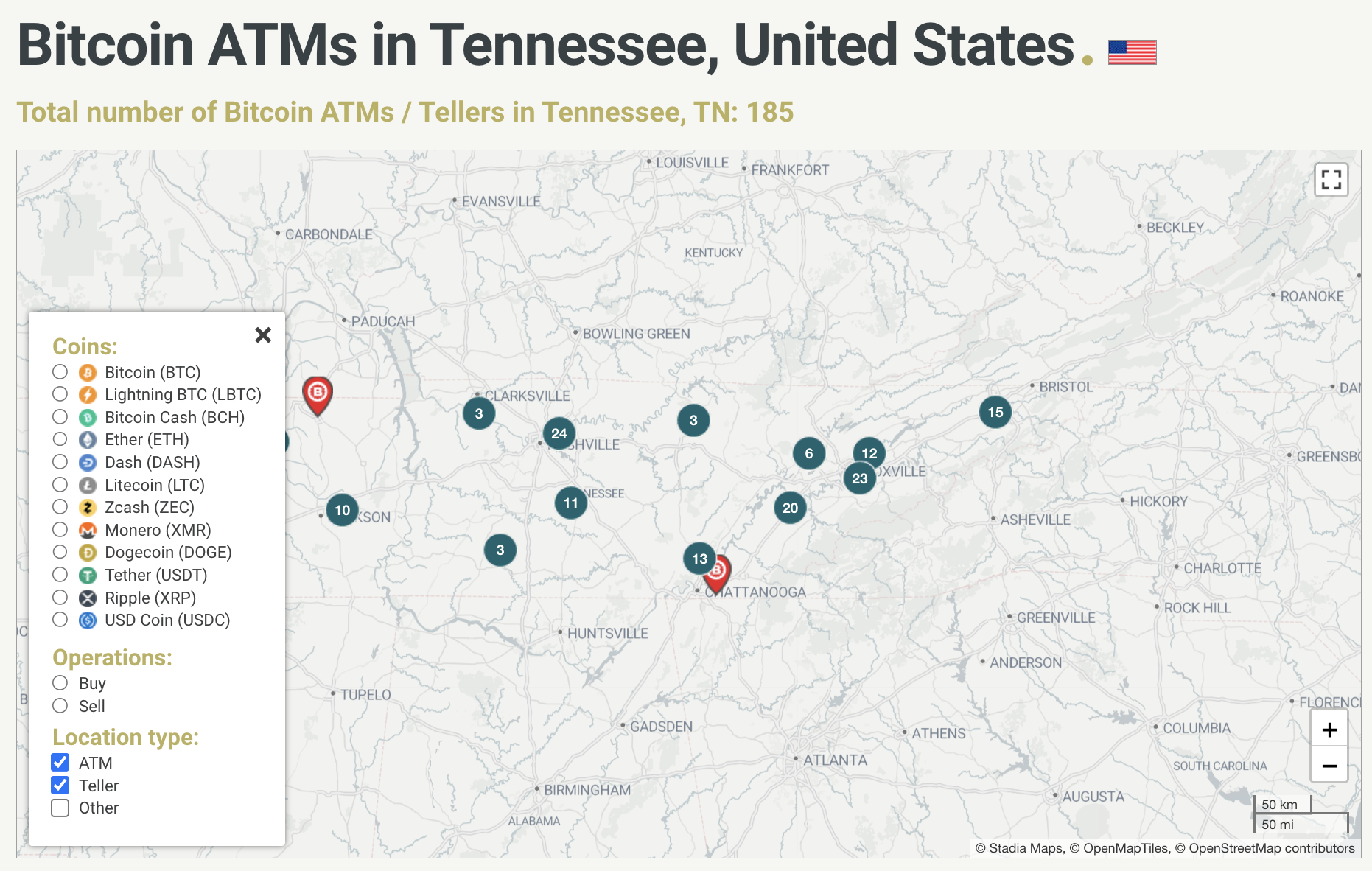
There were 185 crypto ATMs and kiosks operating in Tennessee before the statewide ban took effect on July 1. Source: CoinATMRadar
Many US state governments and municipalities have individually begun cracking down on crypto ATM operators in response to incidents of residents, particularly senior citizens, being conned into sending funds to scammers. Delaware and New Jersey lawmakers have proposed similar measures completely banning the machines.
Related: Massachusetts city to weigh crypto ATM ban, citing financial risks
The restrictions may have already contributed to at least one ATM operator going under. In May, Bitcoin Depot filed for Chapter 11 bankruptcy. The company had disclosed just days before that it had “substantial doubts” about its future amid a challenging regulatory environment and lawsuits.
“Bitcoin Depot’s bankruptcy is likely a preview of what the broader crypto ATM industry will face in the US over the next several years,” Roshan Dharia, CEO of Echo Base and a restructuring adviser, told Cointelegraph following the Chapter 11 filing. “The traditional model depended on high transaction spreads and limited regulatory scrutiny to offset unusually high compliance, cash logistics, fraud remediation, and retail revenue sharing costs. That equation is breaking down as states increasingly impose consumer protection standards that compress fees, expand operator liability for scam related activity, and raise expectations around transaction monitoring and reimbursement.”
Canada weighs countrywide ATM ban
Although not in effect yet, federal policymakers in Canada proposed a total ban on crypto ATMs across the country. The proposed policy, which would still allow Canadians to buy digital assets from brick-and-mortar money services businesses, was in response to what officials called the ATMs being the “primary method for scammers to defraud victims and for criminals to place their cash proceeds of crime.”
Magazine: Bitcoin slides to $58K, XRP hits $1 but onchain data promising: Market Moves
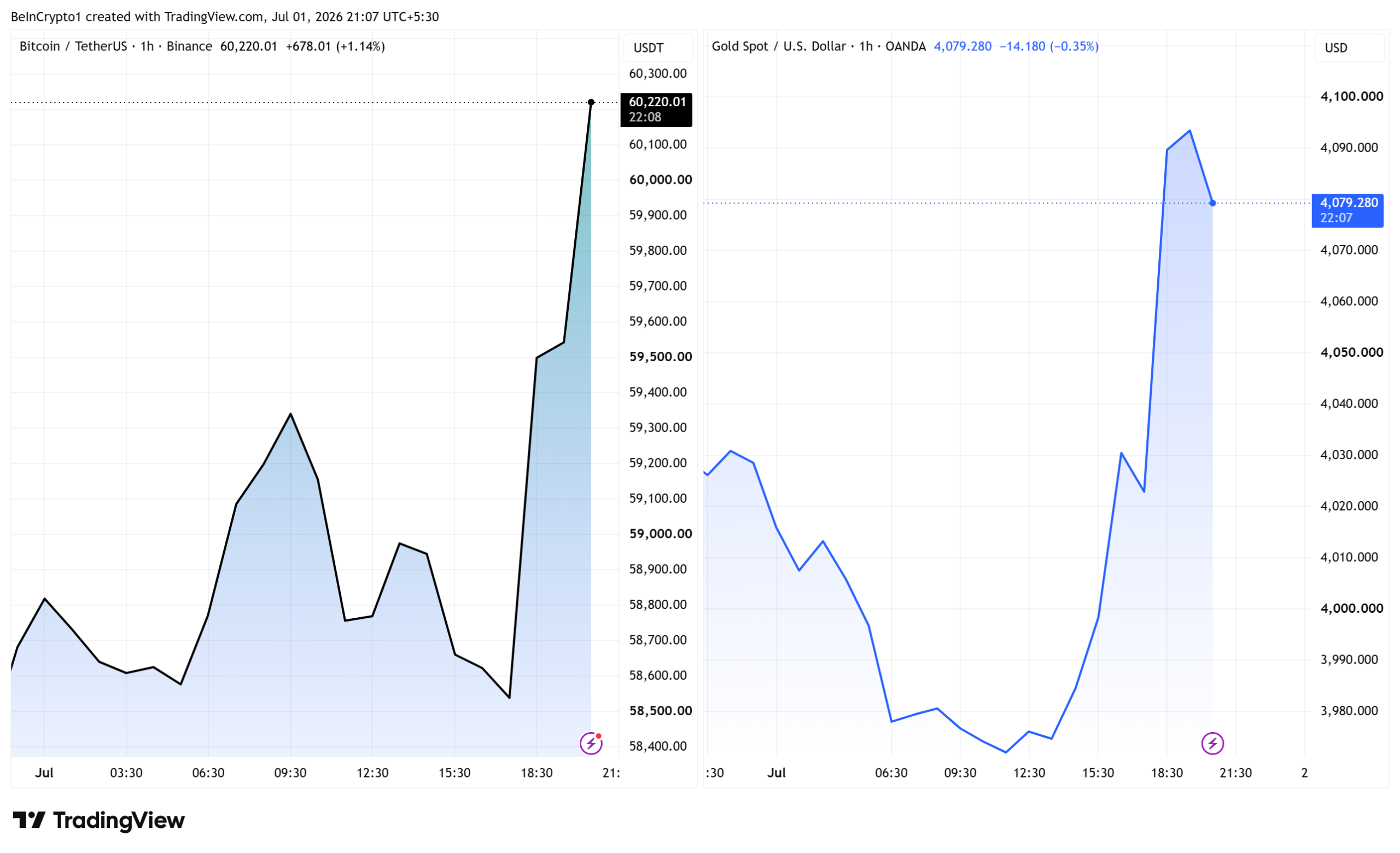
Bitcoin (BTC) reclaimed $60,000 on Wednesday after Federal Reserve Chair Kevin Warsh said inflation risks had eased and struck an open-minded tone on artificial intelligence (AI), reviving appetite for risk assets and precious metals.
The Fed chief declined to call the AI spending boom inflationary and flagged easing price risks, a tone traders judged less hawkish than his June debut. Gold also climbed alongside Bitcoin.

Kevin Warsh Cools Fears of Higher Rates
Warsh spoke at the ECB Forum on Central Banking in Sintra, Portugal, his first international appearance as Fed chair. A longtime inflation hawk, he served on the Fed board through the 2008 crisis. He resigned in 2011 over a $600 billion bond-buying plan.
His words carried weight because US inflation has run hot. Consumer prices rose 4.2% in the year to May, the fastest since 2023, as the war with Iran lifted oil.
That drove the Fed to hold rates at 3.5% to 3.75% in June and signal a possible hike. Those fears eased after oil prices retreated in late June.
Speaking on a panel in Sintra, Warsh pointed to easing price pressures since he took over.
“Inflation risks have come down.”
Yet he insisted the work was not done, recommitting to price stability.
“We’re all in the price stability business … we’ve all looked around and we’ve seen that prices are too high.”
On AI, Warsh was upbeat, calling it a driver of productivity while leaving its inflation impact open.
Notably, some Fed officials have tied AI-driven inflation concerns to the case for hikes.
“What they say is that the demand is insatiable, that these companies, these hyperscalers, will pay almost any price for those inputs, and they need things built yesterday,” Cleveland Federal Reserve President Beth Hammack said recently.
Bitcoin Reclaims $60,000 as Gold Rebounds
Bitcoin traded near $60,088, up about 2.8% in 24 hours, while Ethereum rose about 3.3% to near $1,619. The gains lifted Bitcoin back above $60,000 and its market value over $1.2 trillion.
The bounce followed a steep month. Bitcoin had slid to its 2026 low near $58,000 last week, after hot May inflation triggered $1.26 billion in liquidations. It remains down about 16% from a month ago.
Meanwhile, gold rebounded to an intra-day high of $4,115 after sliding to multi-month lows this week. Silver and other precious metals gained as bets on aggressive tightening eased.
The bond market was less convinced. Treasury yields rose, with the 10-year note near 4.46%. Rising Treasury yields mean bond investors were pricing in higher-for-longer interest rates.

It follows Warsh stressing that prices are “too high” and signaling no rate cut, a hawkish read that ran opposite to the risk-on rally in Bitcoin and gold.
Warsh held a firm line on prices and gave no hint of a July cut. This week’s US jobs report and the Fed’s next meeting, about four weeks away, will test the rally.
The post Kevin Warsh Reignites Risk Appetite: Gold Surges While Bitcoin Reclaims $60,000 appeared first on BeInCrypto.

National Lottery results live – Lotto and Thunderball numbers for Wednesday, July 1

Ampco-Pittsburgh: A Tale Of Potential Value Unlock If Debts Are Managed

Foundation unveils policy guide for governments and institutions





-

 Fashion5 days ago
Weekend Open Thread: Staud – Corporette.com
-

 Politics6 days ago
The House | Manchesterism won’t survive the painful trade-offs unless it gets citizens on board
-

 Crypto World2 days ago
Strategy authorizes up to $1.25B in Bitcoin sales under new capital plan
-

 Politics6 days ago
Potential 2028er World Cup attendee leaderboard
-

 Business5 days ago
Asia stock markets slide as tech shares slump
-

 News Videos3 days ago
MAJOR BITCOIN & MARKET UPDATE!!!! (MUST WATCH ASAP!!!)
-

 Tech6 days ago
A Look At A Gaggle Of Transputer Boards
-
 Crypto World6 days ago
Dell (DELL) Shares Tumble Over 5% Following Analyst Downgrade to Hold
-

 Crypto World4 days ago
Coinbase, Circle Deepen Crypto Stock Losses Despite Resilient S&P 500
-

 Business2 days ago
Australia treasurer says alleged access of prime minister’s bank data ’incredibly concerning’
-

 Crypto World5 days ago
Kraken's xStocks Opens Bending Spoons IPO Registration to EEA Retail
-

 Sports5 days ago
FIH Pro League: India defeat Pakistan 7-1, register biggest win of campaign | Other Sports News
-
 Crypto World6 days ago
Bitcoin Sparks $600M Hourly Liquidations With $65,000 Set To Become Resistance
-

 Tech4 days ago
Bluekit phishing kit adopts browser-in-the-middle for login theft
-

 Tech4 days ago
Russian hackers now target Signal backup recovery keys
-
 Crypto World5 days ago
Hyperliquid Named on Singapore MAS Investor Alert Register
-

 Crypto World5 days ago
RTX holders must register wallets before token distribution begins
-

 Crypto World7 days ago
Ripple and SBI launch RLUSD in Japan after JFSA approval
-

 Tech2 days ago
Anonymous researcher drops 0-day ‘exploitarium’ repo
-

 Sports6 hours ago
Broncos roster: OL Ben Powers (No. 74) entering final year of contract
You must be logged in to post a comment Login