
Crypto World
AI Agents Could Wipe Out $1.4 Trillion in Wall Street Fees, Sharplink CEO Says

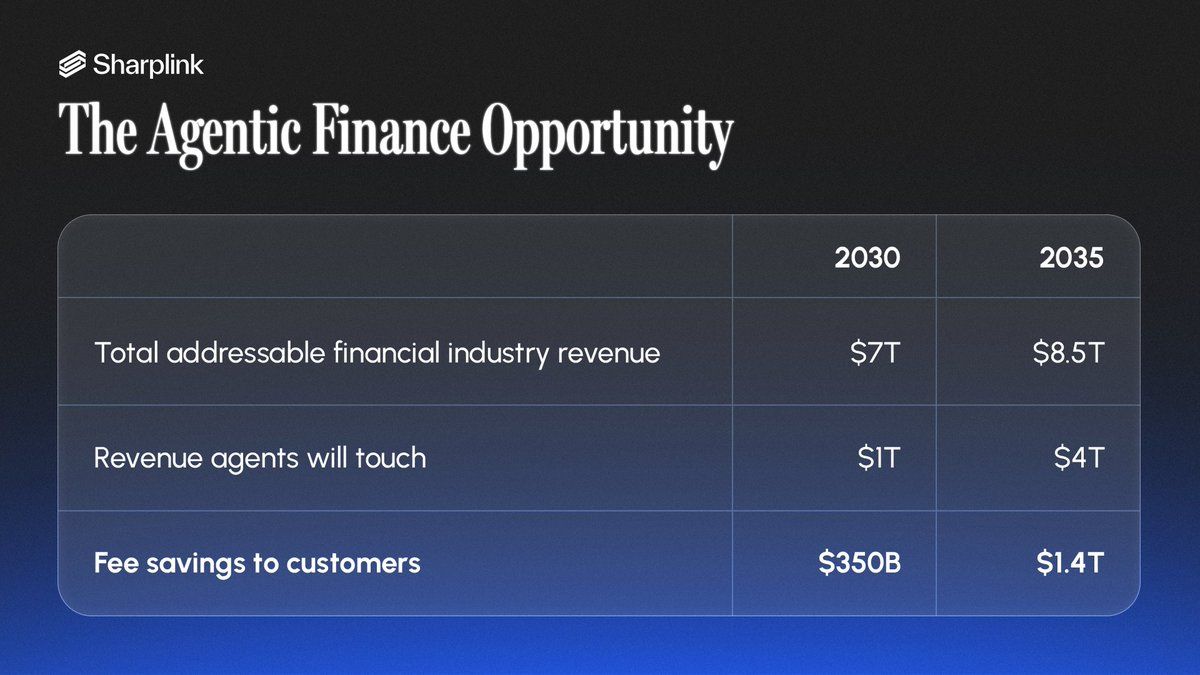
Sharplink CEO Joseph Chalom projects that AI agents will eliminate nearly a quarter of global finance fees by 2035.
His team’s model puts the resulting investor savings at $1.4 trillion a year. Chalom, a former BlackRock executive, set out the forecast in an X post on Wednesday.
A $4 Trillion Prize and a $180 Billion Blind Spot
Chalom’s team modeled 10 financial verticals through 2035. The model puts more than $1 trillion in annual financial services revenue up for grabs by 2030. Chalom expects that figure to reach $4 trillion a year by 2035.

The model assumes agents will make financial providers compete more aggressively on fees. Consumers would then keep an extra $350 billion a year by 2030, before the figure climbs to $1.4 trillion.
Chalom also points to roughly $15 trillion that US households hold in checking, savings, and short-term deposits. Much of it earns well below money-market rates, which he says costs savers at least $180 billion a year.
“Over $1 trillion of annual global financial services revenue is going to be up for grabs by 2030, growing to $4 trillion annually by 2035. Every major bank, broker, payments firm, and digital assets company is racing to capture a share in one of the most important battles over money and value we will see in our time,” he said.
Follow us on X to get the latest news as it happens
Visa, Coinbase, and Circle Race for the Agent’s Wallet
Chalom says the contest to control these agents has already begun. He names Visa, Mastercard, Stripe, PayPal, Circle, Tether, Robinhood, Coinbase, and Binance among the contenders.
In his view, the winner would also decide which products agents recommend and where idle cash gets swept.
“Whoever owns the infrastructure, owns the agent, and therefore the customer,” Chalom added.
BlackRock’s research paper this week made a related case, naming stablecoins as the leading candidate for agent payments.
Chalom argues that agentic transactions will predominantly occur where stablecoins, tokenized assets, and DeFi liquidity are concentrated, with much of that activity currently centered in the Ethereum (ETH) ecosystem. He points to Ethereum’s record of 3.6 million daily transactions in April as evidence of the network’s growing activity.
That outlook lines up with Sharplink’s balance sheet. The company held 891,714 ETH as of September 14, according to its dashboard.
Fidelity Digital Assets offered a more cautious read in August. Senior research analyst Max Wadington warned that closed systems run by tech and fintech firms could instead absorb agent activity.
Subscribe to our YouTube channel to watch leaders and journalists provide expert insights
The post AI Agents Could Wipe Out $1.4 Trillion in Wall Street Fees, Sharplink CEO Says appeared first on BeInCrypto.

Crypto World
Zcash (ZEC) Slips 8% Daily: Here’s Why One Analyst Believes the Price Could Crash to $200
The popular privacy coin has stunned the crypto community after its price exploded by over 2,600% over the past year. Its market capitalization briefly exceeded $25 billion, making it one of the 10 biggest digital assets.
The main catalysts for its impressive rally included the broader market’s resurgence, the debut of the ZEC ETP in Europe, the launch of a spot Zcash ETF, and other factors. However, the crypto sector has seen a substantial correction over the last 24 hours, dragging the privacy coin down with it, and some analysts think the bull run may now turn into a violent crash.
Is the Rally Over?
Earlier this week, ZEC surpassed $1,600 for the first time since 2016. And while many expected the upswing to continue, the whole market headed south, and now the privacy token is worth roughly $1,470 (per CoinGecko).
X user Crypto Patel noted that ZEC has already delivered an “extraordinary move,” adding that anyone who accumulated during 2024-2025 has witnessed a massive return.
At the same time, the analyst warned people to be highly cautious in the $1,600-$2,000 range, claiming that a cup-and-handle structure suggests this could mark the local top. The market observer argued that ZEC has started showing signs of “extreme extension from a psychological perspective” following the major rally.
Crypto Patel then shared a long-term prediction that is clearly bearish. They believe that if the current cycle eventually enters a distribution and downtrend phase, the price could dump below $500 in the next 1-3 years. The analyst made an even grimmer forecast, envisioning a collapse to $200 if the long-term structure completely reverses.
For their part, X user Zayn recently revealed that they made $30,000 after opening a short position on ZEC. They later said the paper profit has risen above $60,000, calling it one of their “biggest wins this year” and wondering whether to keep the position open until they potentially make $100K.
Are the Bulls Coming Back?
ZEC’s recent correction shouldn’t be directly interpreted as the end of the overall upward trajectory. After all, the asset has been on a tear for quite some time, and pullbacks are an inevitable part of the whole move.
Meanwhile, some investors have started abandoning centralized platforms and shifting into self-custody solutions after a period of flocking into exchanges. The latest development is clearly bullish, as it reduces immediate selling pressure and could open the door to a rebound.

The post Zcash (ZEC) Slips 8% Daily: Here’s Why One Analyst Believes the Price Could Crash to $200 appeared first on CryptoPotato.

UK bank Revolut has revealed that its customers data was breached twice this month after the firm’s former third-party US broker, DriveWealth, suffered a social engineering attack.
The breach, revealed today by both Revolut and DriveWealth, happened on September 4 and September 5, and reportedly saw names, emails, ages, genders, citizenship information, postal addresses, and employment details compromised.
Earlier this month, Revolut revealed that hackers used an Italian government email to gain access to the company’s data.
Read more: Revolut faces $3M ransom demand after data breach, report
The newly-revealed breach does not include data from affected European Economic Area customers past 2023.
Neither Revolut nor DriveWealth disclosed how many users were impacted or what happened during the social attack.
Revolut stressed that core infrastructure, funds, and accounts weren’t impacted.
Negotiations with Revolut ‘didn’t go as planned’
Reported ransom demands following the email attack ranged from $760 million in BTC, to just $3 million in XMR days later.
However, the hacker now claims that “negotiations didn’t go as planned” and has published the so-called “Italy Files,” which include the data of 680 crypto whales.
Journalist Jason Mikula noted that the hacker is selling the data 10x cheaper than their ransom, suggesting “the group is struggling to monetize the data they have exfiltrated.”
They are also supposedly offering impacted users, including Mt. Gox CEO Mark Karpelès, the opportunity to pay to prevent their information from being leaked.
Got a tip? Send us an email securely via Protos Leaks. For more informed news and investigations, follow us on X, Bluesky, and Google News, or subscribe to our YouTube channel.
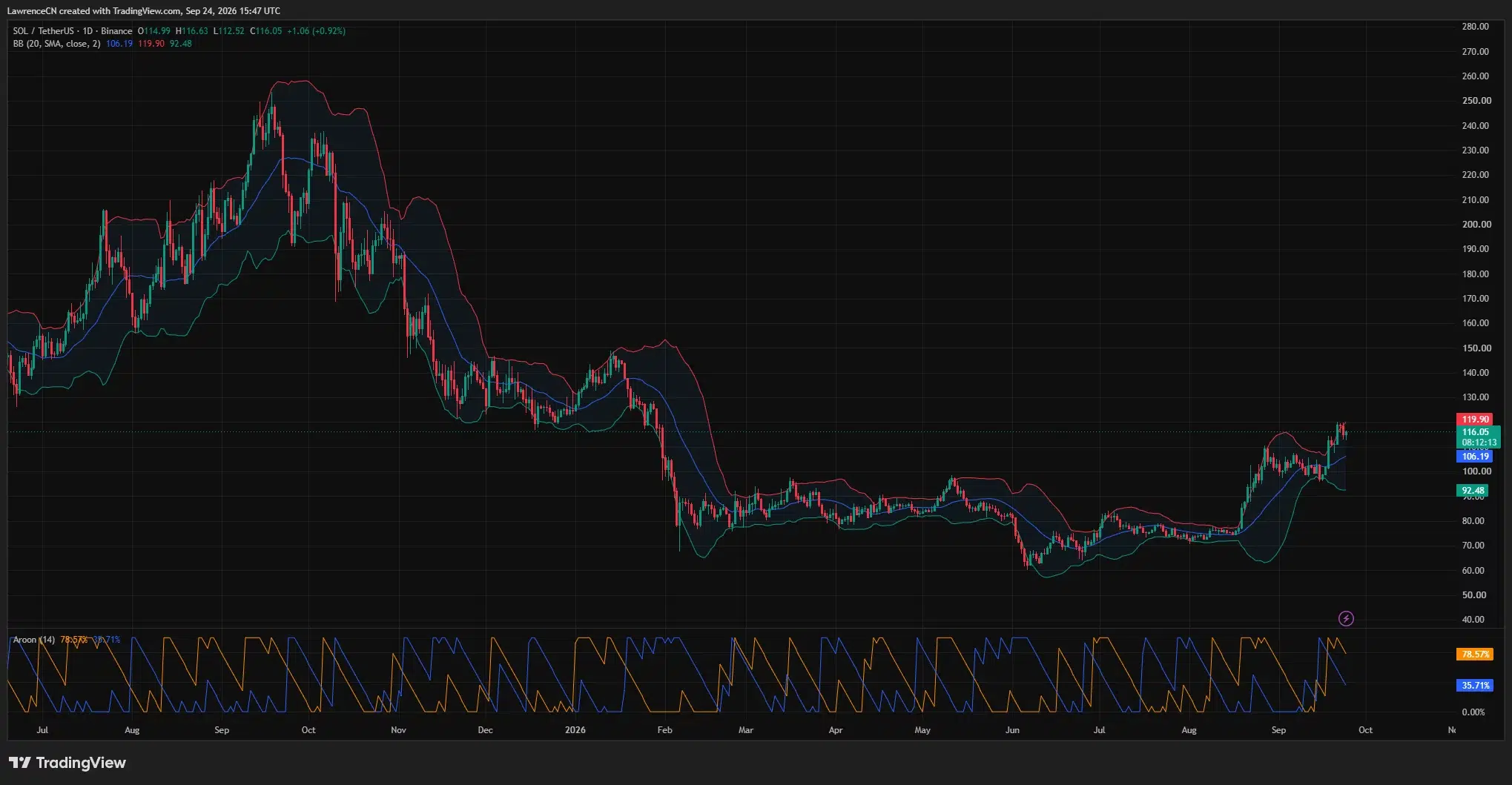
Solana price rebounded to about $116 on Sep. 24 after falling from a recent high near $120. The recovery put SOL back above a key 4-hour trend indicator, but the daily chart shows price approaching resistance where the latest rally stalled.
Summary
- Solana price traded near $116 after falling as low as $112.52 during the daily session.
- The 4-hour Supertrend remained bullish at $112.38, while RSI eased to 55.58.
- The daily Bollinger Band placed nearby resistance at $119.90.
- CoinGlass’s 3-day heatmap showed a dense liquidation cluster around $120.
Solana price recovers from $112.52 low
Solana daily chart showed SOL price at $116.05 on Sep. 24, up 0.92% from its daily open of $114.99. Price had reached $116.63 after touching $112.52 earlier in the session. The move followed a retreat from the roughly $120 high reached during the preceding rally.
The latest decline interrupted a sharp advance from below $100 in mid-September. SOL remains above the daily Bollinger Band midpoint at $106.19, though it has pulled back from the upper band at $119.90. The space between price and the midpoint shows how far the recent rally carried SOL; it does not establish whether the next move will be a deeper correction or another test of $120.
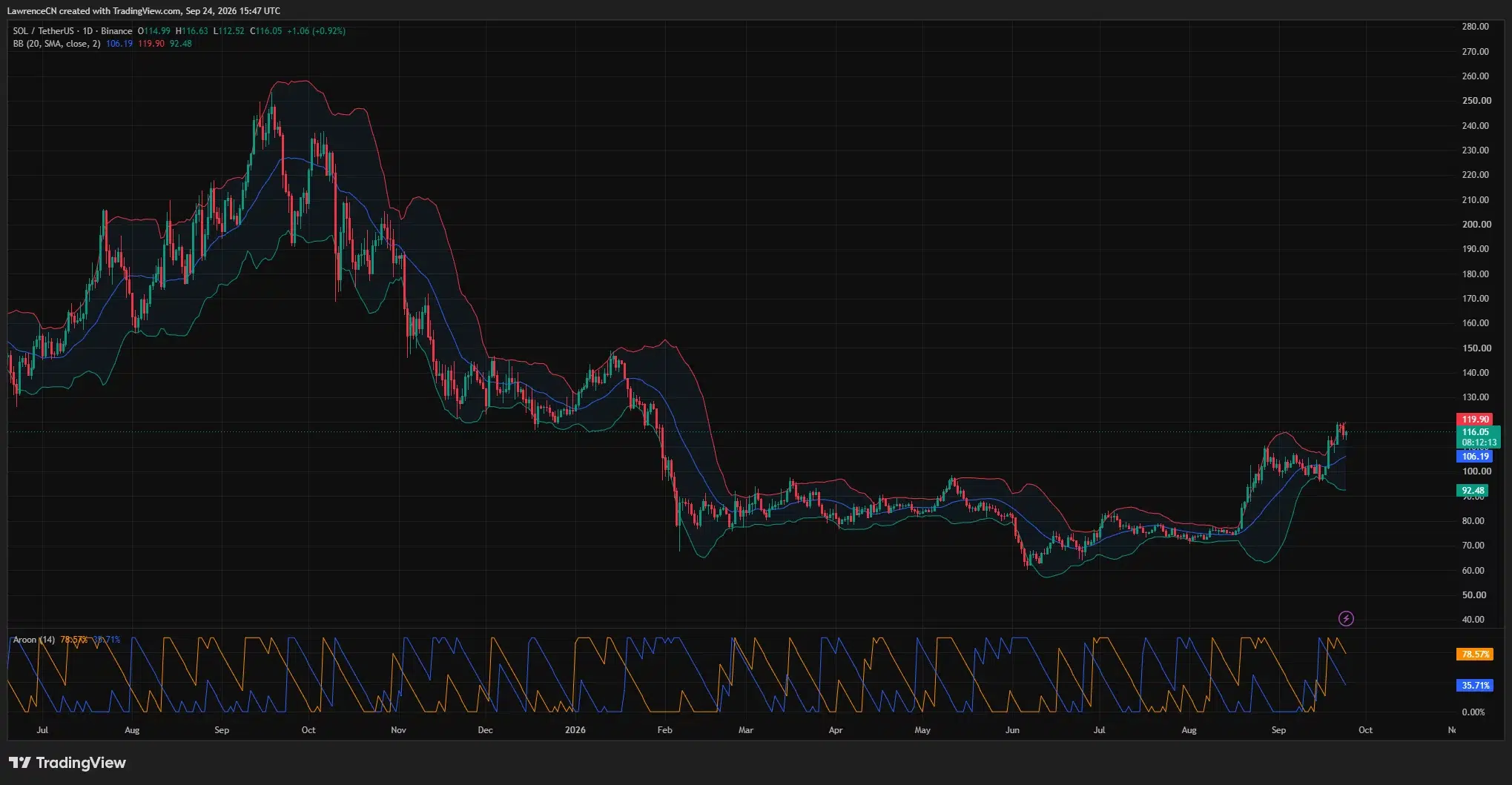
The daily Aroon readings were 78.57% and 35.71% on the TradingView chart, reflecting a strong recent upside move alongside the pullback. Buyers would need to clear the recent high to extend that move. A further retreat would bring the $110 area into view before the Bollinger midpoint near $106.
The price dip came after the rally met resistance near $120, but the charts alone cannot establish how much of the selling came from profit-taking or forced closures of leveraged positions. The distinction matters because a liquidation heatmap maps estimated positions at risk; it does not measure how much was actually liquidated.
The 4-hour chart keeps $112.38 in focus
On TradingView’s 4-hour chart, SOL recovered to $116.07 after briefly trading near $113. The Supertrend line stood at $112.38 beneath price, leaving the short-term signal bullish despite the drop from $120. A sustained move below that line would weaken the current 4-hour setup.
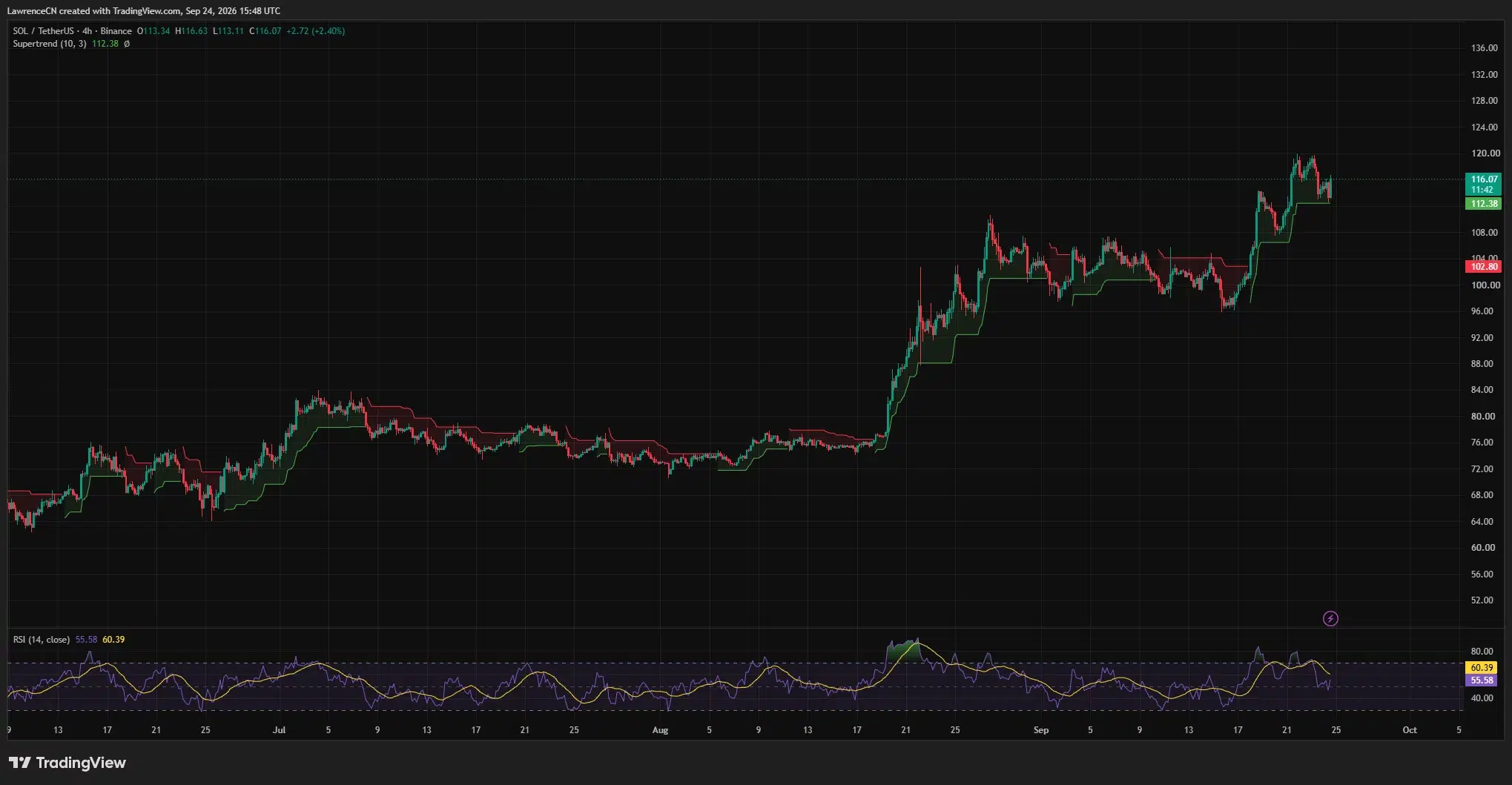
The 4-hour relative strength index stood at 55.58, below its moving average of 60.39. RSI had eased from its recent highs, indicating that upside momentum cooled during the pullback even as the indicator stayed above the neutral 50 mark.
A return toward $119.90–$120 would test both the daily upper Bollinger Band and the area where sellers halted the latest advance. If SOL fails to hold $112.38, traders may look next to $110, a level identified by market analyst AltCryptoGems as important to the bullish structure. The analyst warned that a break below it could expose a gap toward $96; that is a scenario, not a confirmed price target.
Crypto Patel offered a wider view of the trend, placing a higher-timeframe resistance zone at $138–$149 and a structural level at $148.73. Those levels remain well above the immediate $120 test and would become more relevant only if SOL first extends its current recovery.
CoinGlass heatmap places the largest nearby cluster at $120
CoinGlass’s three-day SOL liquidation heatmap showed a bright band of estimated leveraged positions around $120, above the roughly $116 price shown at the chart’s right edge. Smaller bands appeared around $117–$118, while estimated positions also clustered below price near $112–$113.
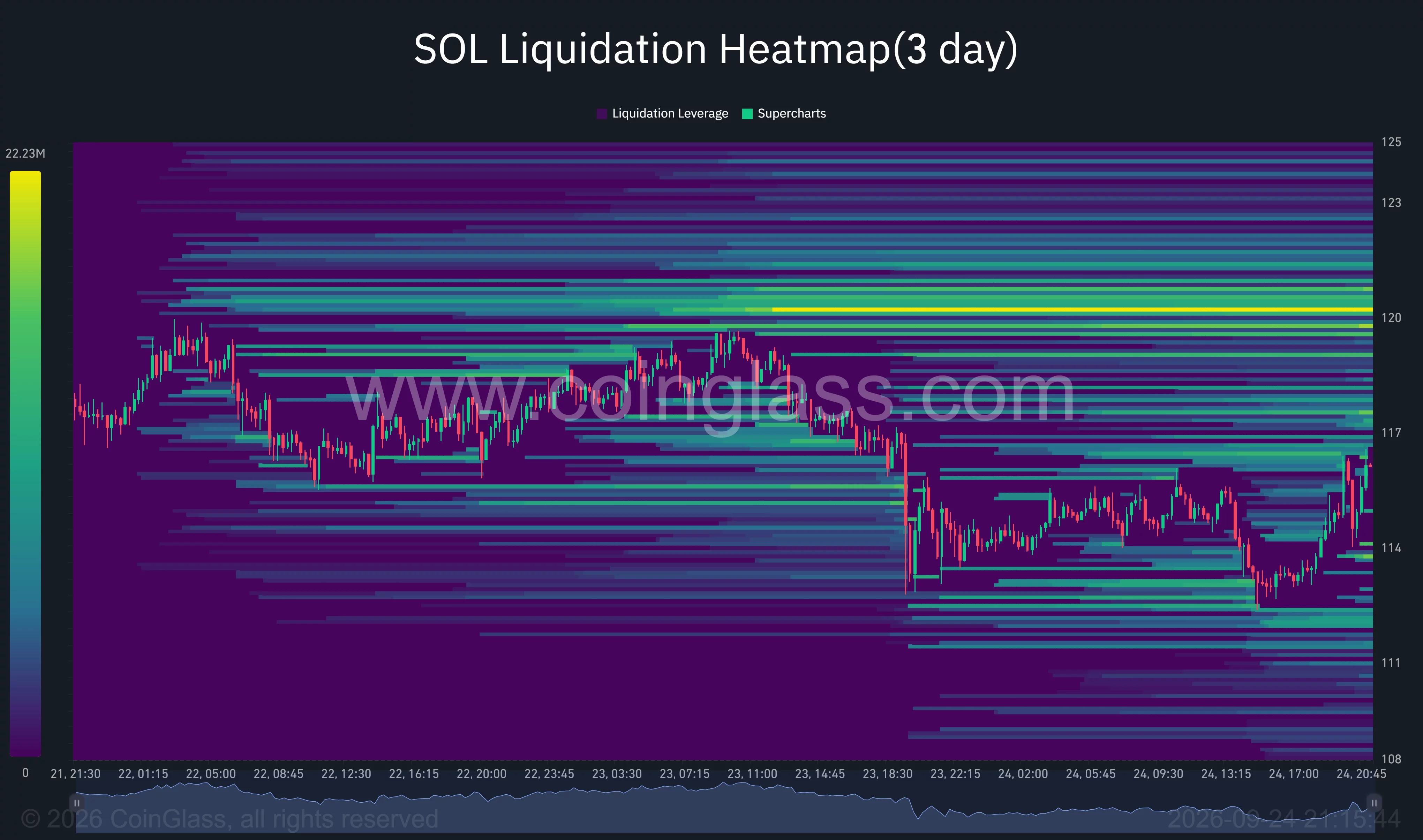
A move into any of those bands could trigger position closures, but the heatmap cannot show that price will reach them. The recent slide through $114 and rebound toward $116 demonstrate why both sides of the market remain exposed to quick moves around nearby levels.
The heatmap also shows SOL trading near $119 on Sep. 22 and 23 before falling toward $112–$113 on Sep. 24. Price then recovered by the end of the displayed period. The separate daily chart was captured later and put SOL near $116, so its session gain should not be confused with the decline from the earlier $120 high.
US policy remains a backdrop, not a confirmed cause
The US Senate failed to advance the Digital Asset Market Clarity Act on Sep. 15 in a 49–50 procedural vote. The bill would have set a statutory framework for oversight of digital assets. Its failure remains relevant to US crypto investors, although the vote occurred more than a week before SOL’s latest retreat and does not by itself explain the Sep. 24 move.
The Federal Reserve raised its target interest-rate range by a quarter point to 3.75%–4% on Sep. 16. The decision is another part of the US market backdrop, but the available price and liquidation charts do not establish a direct link between that decision and Thursday’s Solana pullback.
For now, the nearer signals are on the charts: SOL held the $112 area after its intraday drop, while $119.90–$120 remains the first resistance to clear. A break on either side would give traders a clearer test of whether the rebound can continue.
Disclosure: This article does not represent investment advice. The content and materials featured on this page are for educational purposes only.

Qivalis, the independent euro-pegged stablecoin builder with a growing number of banks as shareholders in the project, has also been undergoing a transformation. Sell notes that one year ago he was the only employee; now Qivalis has grown to about 40 staffers and is close to securing an Electronic Money Institution (EMI) license in the Netherlands. The aim is to go live with a regulated euro stablecoin by the end of this year.
In the past, business blockchain firms like R3 and Hyperledger were working on streamlining the paper-based side of transactions, instruments like letters of credit, for instance. But they didn’t have the cash leg and payment side onchain, Sell pointed out.
“Now there are stablecoins with liquidity, so you’ve got the payment side as well, which was the piece that was missing. So, it’s really interesting to hear from people who are at the coal face about how much it’s changing their business,” he said.
The stablecoin market is dominated by USD-pegged tokens, particularly the ones issued by the two stablecoin giants, Tether and Circle. But in the end, Europeans are not going to live in dollars, Sell said. That might be fine for some places like Africa and South America, where the local currency is volatile, but not for the EU.

ARK Invest has tokenized its ARK Venture Fund through Securitize on Ethereum, giving eligible investors a blockchain-based way to hold an interest in a portfolio that includes OpenAI and Anthropic.
Summary
- ARKVX holds private and public technology companies, including OpenAI, Anthropic, Stripe, and Databricks.
- Securitize will handle the fund’s onchain issuance and investor access, beginning on Ethereum.
- Investors receive an interest in the fund, rather than tokens representing its portfolio companies.
- A Sep. 21 SEC order permits ARK to offer a tokenized share class under specified conditions.
According to a Sep. 24 announcement from Securitize and ARK Invest, eligible investors accessing ARKVX through Securitize can hold a tokenized interest in the actively managed fund. Securitize will provide the systems for issuing those interests on Ethereum and managing the investor experience. ARK said the fund’s holdings may change as its managers buy and sell investments.
ARKVX gives investors fund-level exposure to private tech
ARK Venture Fund invests in both private and public companies. Its named holdings include OpenAI, Anthropic, Stripe and Databricks, but buying into ARKVX does not give an investor direct ownership of shares in any one of those businesses. The tokenized interest represents an investment in the fund, whose managers decide how to allocate its portfolio.
The fund is a continuously offered, closed-end interval fund. Under that structure, investors may buy shares on an ongoing basis, while the fund makes periodic offers to repurchase them. ARK’s fund disclosures warn that investors should not expect to sell their shares whenever they choose. Repurchase offers can also receive more requests than the fund agrees to meet.
Those limits matter for the Ethereum rollout. Recording a fund interest on a blockchain does not, by itself, create an open market for the shares. In its announcement, Securitize said ARKVX shares are not listed on a securities exchange and that no secondary market is expected to develop. Access through Securitize remains subject to investor eligibility and other restrictions.
Cathie Wood, ARK’s founder, CEO and chief investment officer, said the tokenization puts the firm’s view of changing capital markets into practice. She said ARK’s research points to potential changes in how investors access private and public markets, presenting the onchain fund as one way to pursue that view.
SEC order allows ARK to offer a tokenized share class
The U.S. Securities and Exchange Commission approved an amended order for ARK Venture Fund on Sep. 21. It permits the fund to offer a tokenized share class that may trade on one or more alternative trading systems or be quoted through other permitted channels. The order also permits a separate class that could be listed on a national securities exchange. Each class remains subject to the conditions in ARK’s application.
Earlier in September, crypto.news covered ARK’s application, which proposed using blockchain technology to record ownership of the new class. The application sought a change to the relief the SEC had granted in November 2025. At that stage, ARK had not identified the blockchain or the provider it would use; the new announcement names Ethereum and Securitize.
The SEC said no one requested a hearing after it published notice of ARK’s application. Its Sep. 21 order took effect immediately, though the regulator’s permission to offer the classes does not establish that shares are already trading on an alternative trading system. Securitize’s announcement describes the tokenized fund’s availability to eligible investors through its platform.
ARK’s SEC application sets out how purchases from the fund would work. An investor buying directly from ARK would pay the applicable share class’s net asset value, plus any sales or distribution charge. Once the investor’s funds clear and the fund accepts the purchase, the investor becomes a shareholder, including for tax purposes. The application also says costs specific to a tokenized class could include transfer-agent charges and blockchain transaction fees.
Separately, the SEC has granted five years of conditional relief for qualifying venues to trade tokenized versions of certain U.S.-listed stocks. That order addresses tokenized shares of individual companies on specified trading venues. ARK’s venture fund received its amended order through an Investment Company Act application covering the fund’s share classes.
Securitize builds on its existing ARK relationship
ARK’s choice of Securitize follows a strategic investment announced in October 2025. The companies said at the time that they would work on regulated tokenized investment products and the systems used to issue them. ARK Venture Fund also held Securitize equity and a $10 million convertible note, according to ARK’s filing reviewed in the earlier crypto.news report.
Securitize has since pursued a public listing. An October 2025 report detailed its agreement to combine with a Cantor Fitzgerald-backed special purpose acquisition company, alongside a planned $225 million private investment. The report identified ARK Invest among the company’s existing backers. Securitize’s Sep. 24 announcement identifies the company by the New York Stock Exchange ticker SECZ.
For ARKVX, the immediate arrangement keeps ARK in charge of the fund’s investments while Securitize supplies the tokenization systems. Securitize CEO Carlos Domingo described the launch as bringing an established ARK investment product onto onchain infrastructure. The companies said Ethereum would support the tokenized fund at release.
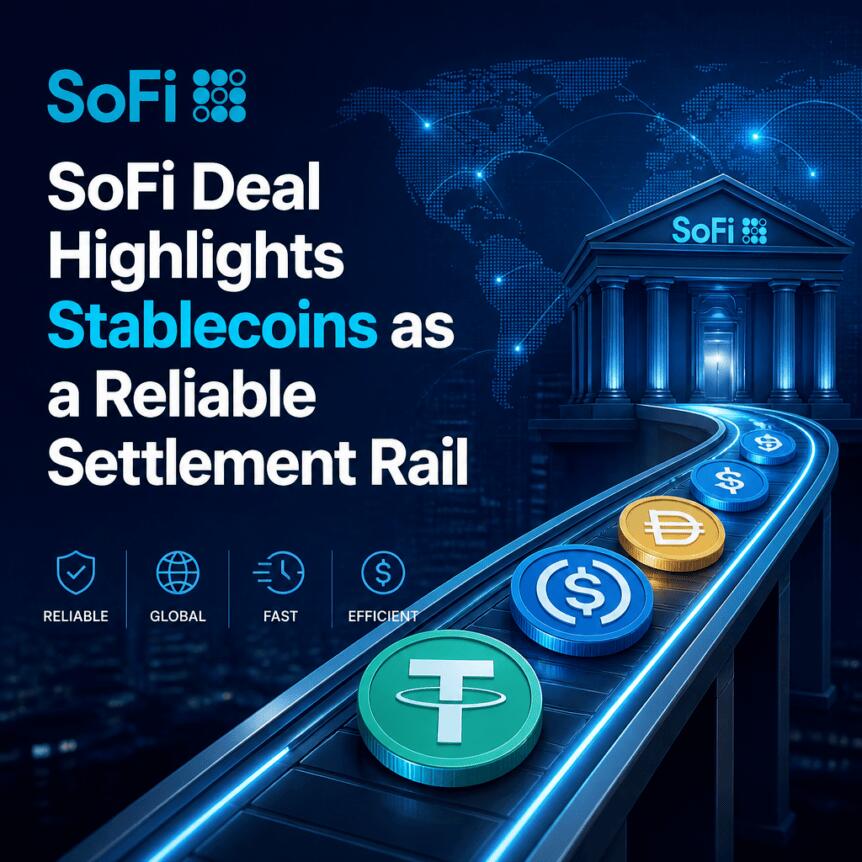
Stablecoins are finding a practical use case in payments: not necessarily to change how consumers pay with their cards, but to alter the settlement rail banks use behind the scenes. The latest example comes from SoFi, which says it has begun settling debit and credit card transactions with Mastercard using its SoFiUSD stablecoin.
According to a SoFi spokesperson, the bank is migrating its entire card program—expected to process more than $25 billion in annualized volume—to this blockchain-based settlement approach. Importantly, the bank does not expect the change to remove intermediaries from card payments. Instead, it replaces part of the transaction settlement process with an alternative rail designed to complete obligations faster.
Key takeaways
- SoFi is moving settlement of its debit and credit card transactions to Mastercard using its SoFiUSD stablecoin, while card usage for customers remains unchanged.
- SoFi expects its card program to reach more than $25 billion in annualized processing volume as it migrates the system.
- Payments experts argue this is not “disintermediation” in the card networks’ core operations—Visa/Mastercard and banks still calculate obligations and manage interactions.
- Faster blockchain settlement may reduce timing and some capital friction, but does not automatically guarantee cheaper payments end-to-end due to conversion, compliance, and integration costs.
- Dollar stablecoins can move quickly, but completing payments in local currencies may still require access to domestic liquidity and banking rails.
SoFi’s onchain card settlement shift
SoFi’s update is part of a broader trend in which stablecoins are tested and deployed as settlement mechanisms rather than as consumer-facing payment tools. The bank says it has begun settling debit and credit card transactions with Mastercard using its SoFiUSD stablecoin and is migrating its full card program to the same system.
From the perspective of cardholders, the change is largely invisible. The spokesperson told Cointelegraph that SoFi customers will continue using debit and credit cards normally, while the settlement process is moved onchain to enable faster completion between participants.
That distinction matters for how investors and builders interpret “adoption.” The stablecoin is operating in the plumbing of payments—where obligations between financial institutions are settled—rather than replacing consumer interfaces.
Not a clean break from Visa, Mastercard, or banks
Stablecoin settlement can sound like a direct challenge to traditional intermediaries, but the current card deployments appear to follow a more incremental path. A Federal Reserve note published in March suggested stablecoins could change the economics of payments without necessarily eliminating banks, and the latest industry commentary aligns with that view.
Cointelegraph spoke with Martins Benkitis, co-founder and CEO of emerging-markets liquidity provider Gravity Team. He argued that this stage should not be described as disintermediation: “I wouldn’t call it disintermediation at this stage,” he said. “Visa and Mastercard are still there. The banks are still there. The network is still calculating the obligations, managing the transaction and deciding how participants interact with it.”
In other words, stablecoins are being used to complement existing payment infrastructure, particularly at the settlement layer. That may still meaningfully increase stablecoin usage even if merchants and consumers never interact with the technology directly.
Benkitis added that if stablecoins become a major part of payments, businesses may not care where the stablecoin exists in the process as long as settlement availability matches operational needs. “They’ll care that settlement is available when they need it and that the money arrives,” he said.
The promise: smoother settlement and less capital friction
While cards remain intermediated, faster settlement is a key selling point. Varun Datta, a venture capitalist and founder of Truth Ventures, agreed that moving to continuous settlement can reduce delays and potentially cut the amount of capital financial firms must maintain across locations—an issue that can be especially acute when payments cross borders.
However, Datta cautioned that “speed” alone does not automatically translate into lower costs for end users. Payments still involve conversion steps, compliance requirements, systems integration, and stablecoin-management overhead. In his view, it is not enough to demonstrate operational improvement onchain; the industry needs evidence that these changes reduce total costs and improve liquidity management at scale.
Datta said he would want to see proof of lower end-to-end payment costs before concluding that the economic case is fully established. That framing is significant because many real-world payment projects live or die on unit economics—particularly if costs merely shift from settlement timing to operational complexity elsewhere.
Liquidity doesn’t disappear—especially across currencies
Another practical limitation emerges when stablecoin settlement eventually has to translate into local currency payments. Benkitis emphasized that while dollar-denominated stablecoins can move between balance sheets quickly, completing payments in emerging markets can remain more complex.
His concern is tied to local liquidity and the banking ecosystem that ultimately delivers the payment in the relevant currency. In markets where local currency liquidity is thinner, fewer banks may handle flows, and access to domestic banking rails remains necessary. “The stablecoin gets the value there quickly,” Benkitis said. “You still need the local liquidity to finish the payment.”
This is where the “rail change” narrative can diverge from adoption expectations. Onchain speed may improve settlement between participants, but it does not automatically solve downstream currency conversion, liquidity sourcing, or integration constraints in every geography.
Broader momentum: Visa’s parallel stablecoin efforts
SoFi’s move follows similar experimentation from card-network infrastructure. In April, Visa said its stablecoin settlement pilot had reached a $7 billion annualized run rate after expanding support to nine blockchains, describing blockchain settlement as a “viable complement to traditional settlement rails.” Visa also characterized its approach as an addition to existing settlement methods rather than a replacement of the broader ecosystem.
Taken together, these developments suggest a shared industry view: stablecoins are being tested where they can improve the settlement mechanics of large payment networks without requiring immediate removal of core participants.
Readers should watch whether these pilots expand beyond the largest corridors and what happens when stablecoin settlement meets local-currency liquidity constraints—if the industry can demonstrate not just faster settlement, but reliably lower total operating costs across geographies, stablecoin settlement could move from “complement” to a more durable part of the payments stack.

His mother washed hair in a South Philadelphia barbershop and later worked a makeup counter in a department store. “Neither my father nor his father finished high school. In fact, nobody in my family before me had ever had a university education,” he says. He would later attend Villanova, the Catholic college also attended by the first American Pontiff, Pope Leo XIV. “We make Popes and admirals,” he says of his alma mater.
He joined TOPGUN, whose exacting culture left a lasting impression. “What the school confers is attention to detail, dedication to execution, dedication to getting better, and being introspective and running to your own problems, of seeking the perfect flight that you’ll never get,” he adds. He flew F-14, F-15, and F/A-18 jets, and clocked more than 6,000 flight hours and 1,100 carrier landings. He says he initially aimed to serve as long as his father. “Serving for four years was intentional, and serving for 40 was a blessing,” he adds.
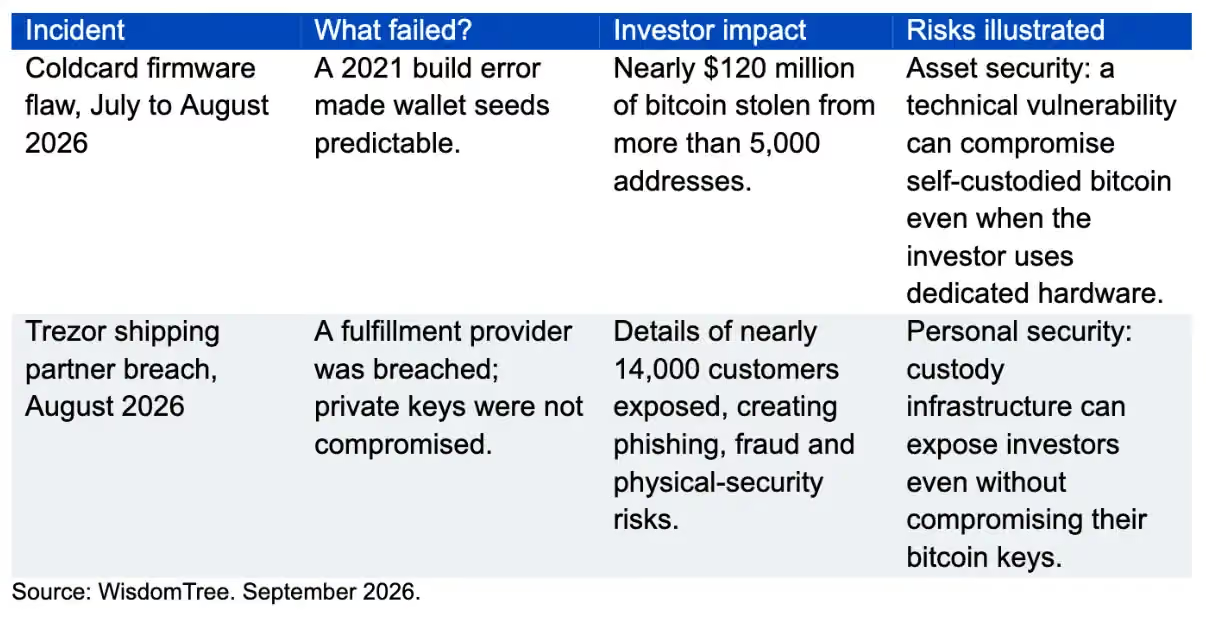
Hardware wallets can reduce certain risks, but they do not make operational security foolproof. The attack surface also extends beyond the device itself: backup phrases, personal data, software updates and transaction hygiene all matter.
Self-custody can expose investors to multiple forms of security risk

For an investor making a modest portfolio allocation, that is an uncomfortable mismatch. The operational burden does not improve bitcoin’s expected return. It is simply the cost of a direct bitcoin ownership model.
Bitcoin is not static
Bitcoin is built to resist arbitrary change, but it still evolves. Software upgrades, wallet compatibility issues and occasional chain splits can create decisions for direct holders.
A blockchain split can be particularly complex; it may create rights to assets on competing networks, leaving holders to decide whether to claim, hold, sell or ignore them. Security, liquidity, wallet support, transaction replay risk and tax treatment can all matter.
This is where the romantic version of self-custody collides with reality. Holding bitcoin directly means owning not only the asset, but also the operational consequences of its ecosystem.
Exposure and ownership are different decisions
Investors should separate two questions that are too often bundled together:
- Do I want bitcoin exposure?
- Do I want to manage bitcoin directly?
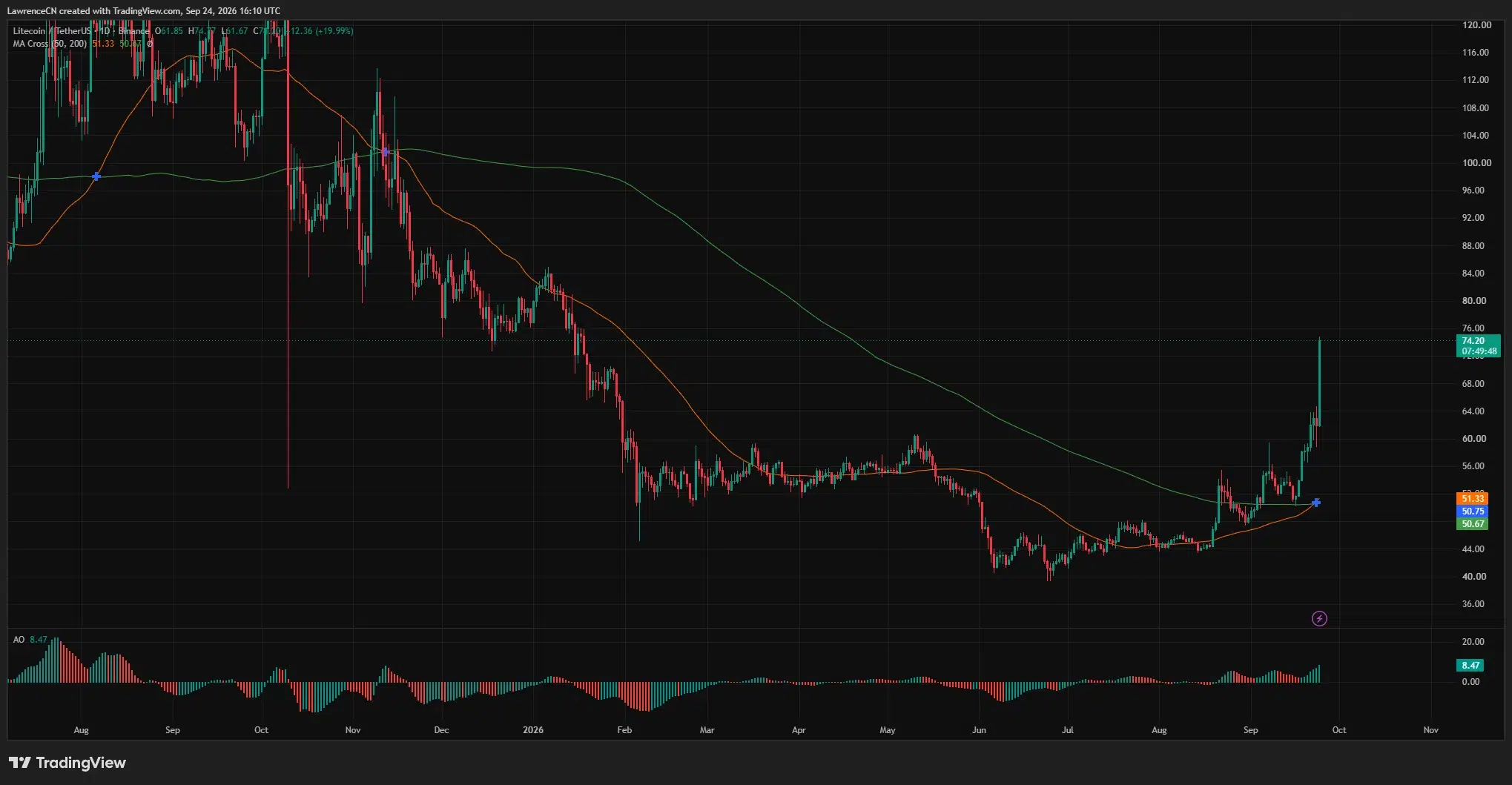
Litecoin price has climbed above $74 after breaking through the $64–$65 resistance area, while a golden cross on the daily chart has given traders another reason to watch whether the rally can clear $75.
Summary
- Litecoin price reached about $74.77 on Sep. 24 after opening near $61.85.
- The daily 50-day moving average has crossed above the 200-day average near $51.
- The 4-hour chart places immediate resistance at $75, followed by $78.13.
- CoinGlass’s three-day heatmap shows potential liquidation leverage around $75–$77.
Litecoin (LTC) price traded near $74.20 when the daily LTC/USDT chart was captured, up about 20% from its daily open. The price had briefly reached $74.77, extending a recovery from the mid-September lows and pushing well beyond the $64–$65 area that had held back earlier gains.
The daily chart also shows the 50-day moving average at about $51.33, above the 200-day average near $50.67. Traders call that crossing a golden cross. Both averages sit far below the current price, so the immediate question is whether buyers can hold the breakout near $70 and push through $75.
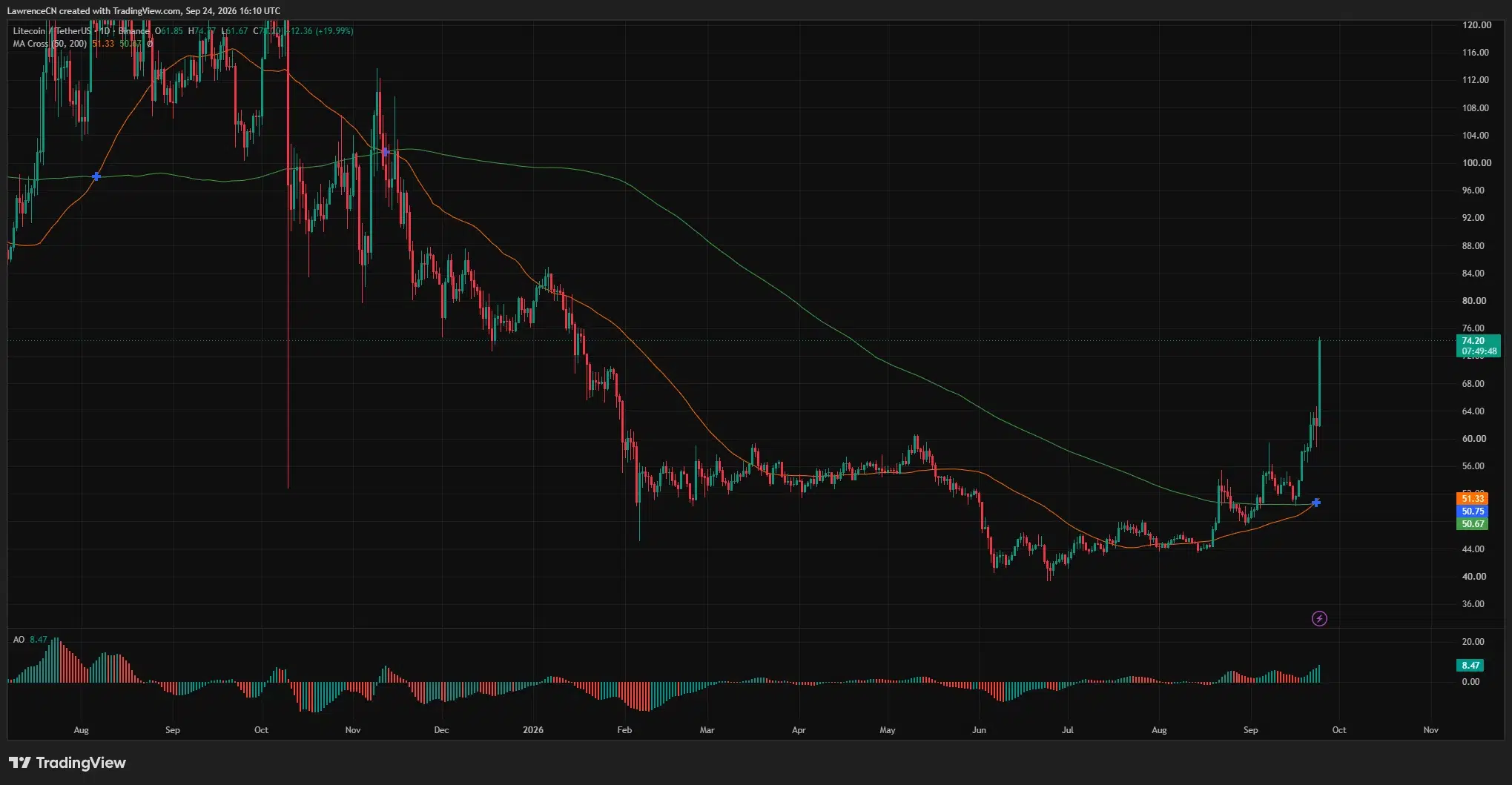
Litecoin Foundation data added to the activity surrounding the move. The organization reported on Sep. 23 that more than 17 million LTC, worth over $1 billion, had moved across the network within 24 hours. The measure tracks blockchain transfers rather than purchases on exchanges, so it does not establish how much of the price gain came from spot demand.
Litecoin’s $75 test comes after a sharp 4-hour advance
The 4-hour chart shows LTC moving rapidly through several marked price levels. After trading below $65 earlier in the session, it cleared the $65.63 trading-range boundary, moved above the $68.75 pivot and passed $71.88.
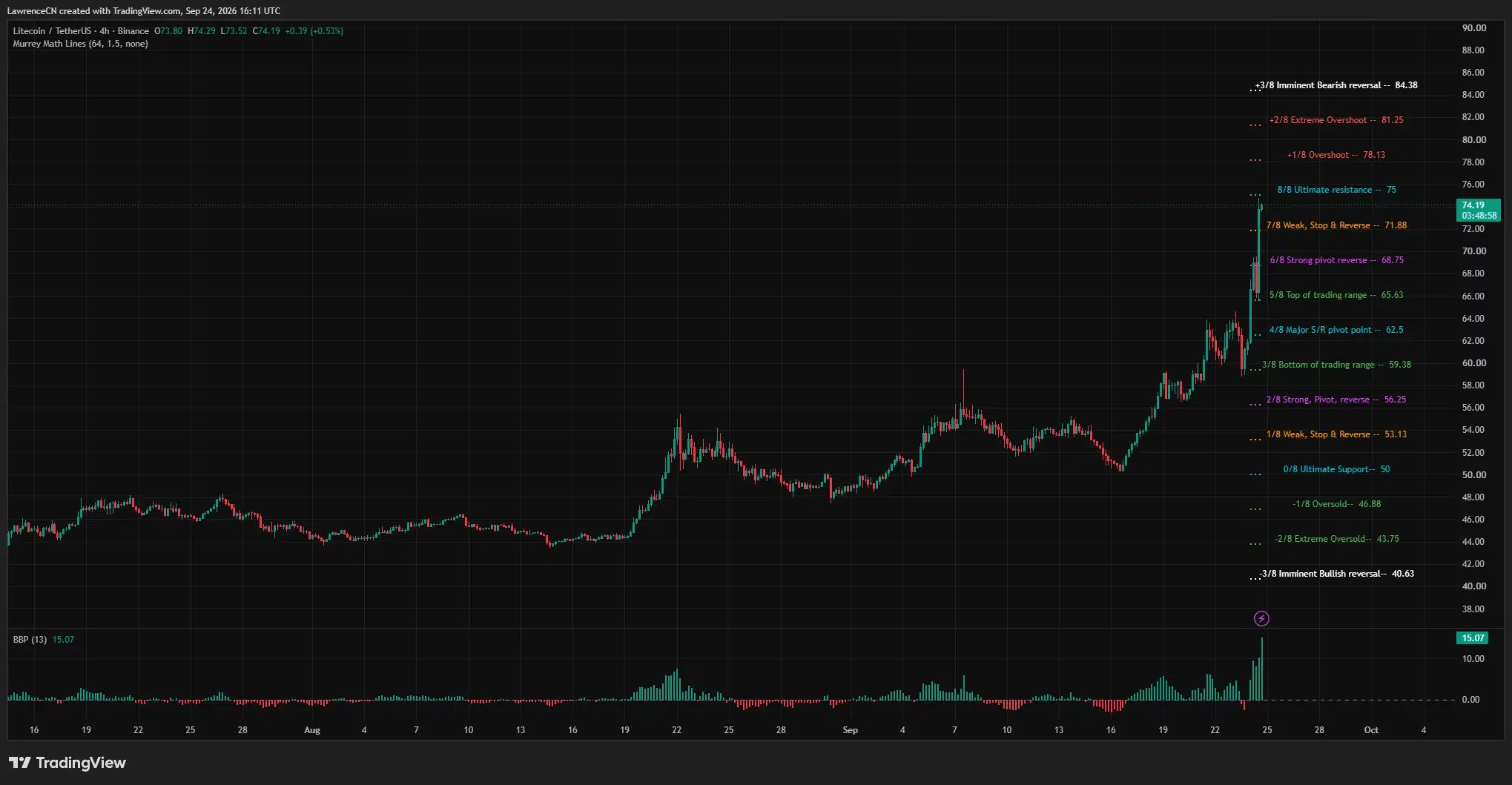
The latest 4-hour candle reached about $74.29 and stood near $74.19 when the chart was captured. Price was therefore close to $75, the next resistance marked by the chart’s Murrey Math levels. A move above $75 that holds could bring $78.13 into focus.
The pace of the climb matters for that test. The 4-hour BBP momentum reading rose to 15.07 as LTC approached $75, reflecting how far and how quickly the price had moved above its recent range. Strong momentum can carry a breakout further, but buyers would still need to defend the levels cleared during the rise.
The daily AO indicator also climbed to 8.47, one of its highest visible readings in months. Its rise supports the change in momentum shown by the price candles, while the golden cross reflects a slower shift in the daily trend. Neither signal confirms that $75 has been broken.
CoinGlass’s three-day liquidation heatmap shows bands of potential liquidation leverage near $75 and higher toward $77. If LTC rises into those bands, short positions may face pressure to close. The bands mark possible liquidation levels, however, rather than liquidations that have already occurred.
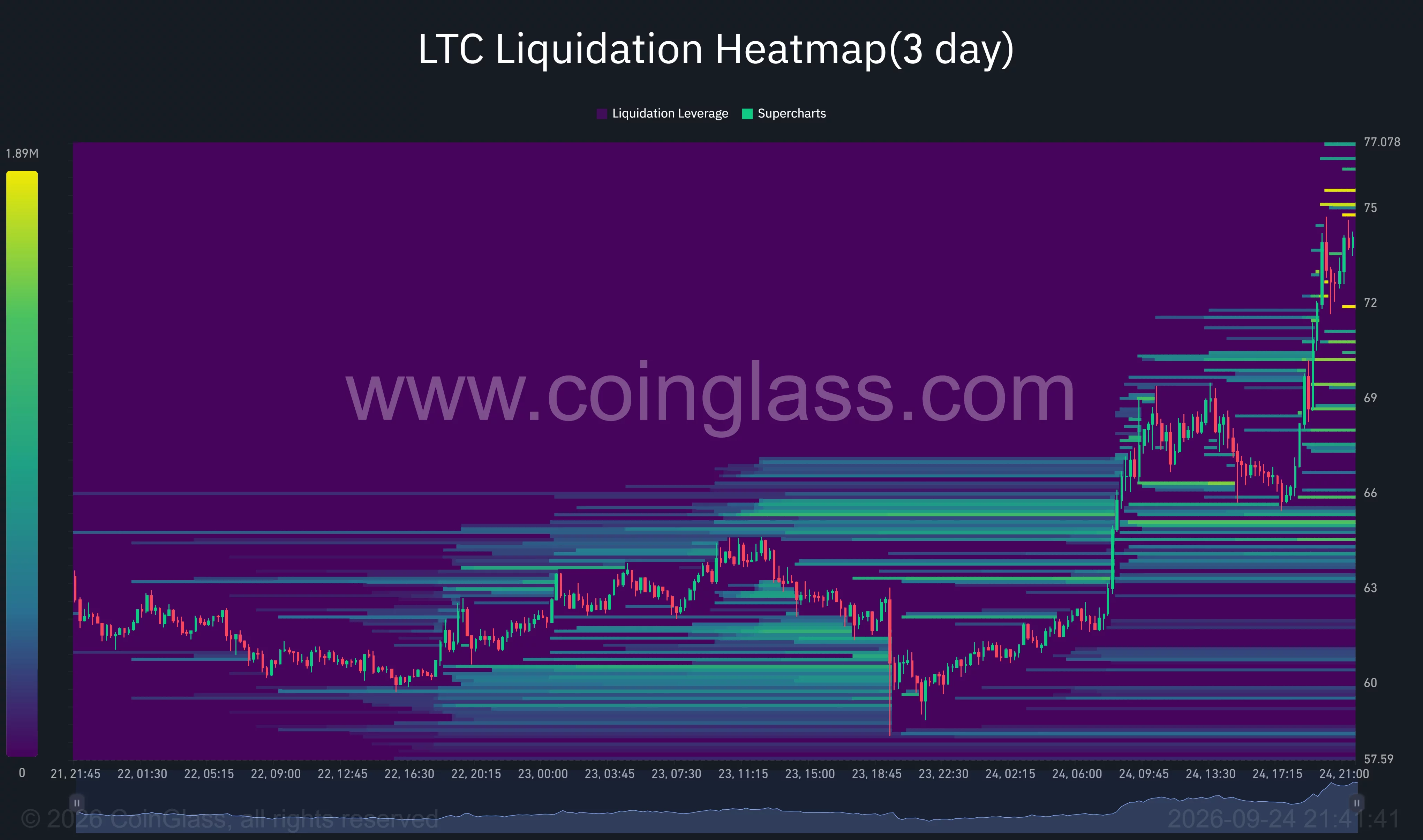
Earlier trading showed how quickly short covering could affect LTC. A one-hour rise from roughly $61.92 to $66.36 early on Sep. 24 coincided with reported short liquidations across major exchanges. CoinGlass data also showed Litecoin futures open interest above $500 million, pointing to substantial outstanding positions as the rally developed. Open interest does not reveal whether those traders expect a rise or fall.
What happens if LTC cannot hold the breakout?
If LTC turns lower before clearing $75, the 4-hour chart puts $71.88 at the first marked level below the current price. A drop through it would shift attention to the $68.75 pivot, followed by the former trading-range boundary at $65.63.
The heatmap shows potential liquidation leverage below price as well, with bands around $69–$71 and $64–$66. A decline into those areas could add to volatility. Their presence does not mean LTC must revisit them.
The $64–$65 area is especially relevant because it capped the previous advance before the Sep. 24 surge. Holding above it on a pullback would show that buyers continue to defend the breakout. Falling back below it would put LTC inside its old range, even though the daily moving averages have crossed.
Coinbase’s U.S. lending service provides a separate use for Litecoin. The exchange lists LTC as eligible collateral for USDC loans through Morpho on Base for qualifying customers, excluding residents of New York. That availability does not establish a link to Sep. 24 buying, leaving the $75 price test and the levels beneath it as the clearer near-term measures of the rally.
Disclosure: This article does not represent investment advice. The content and materials featured on this page are for educational purposes only.

The same zoning strategy applies to the lawn: “I start to cut back—not cut the lawn back, but cut back on how often I mow,” Phillips says of the turf her family still uses. As growth slows in the fall, she spaces out mowing and leaves the grass a little taller. A patch set aside as habitat is different: Once insects have settled in, leave it undisturbed through the winter rather than mowing it down.
Rake leaves into beds instead of bags
Eierman would like to rebrand “leaf litter” as “nature’s gold.” Fallen leaves insulate bumblebee queens near the soil surface where they hibernate and shelter butterflies, moths, caterpillars, and many other invertebrates. As the leaves break down, they also return nutrients to the soil, suppress weeds, and become free mulch and compost. “Nature knows what it’s doing,” Costanzo says. “We don’t have to clean it up.”
The most practical approach isn’t necessarily to leave every leaf exactly where it lands. The National Wildlife Federation recommends moving leaves off turf, pavement, driveways, and other places where a thick or slippery layer would create problems. Rake them beneath trees or into garden beds, aiming for a layer about 3 to 5 inches deep. If you still have extras, pile them in a little-used corner and let them slowly become leaf mold. Lightly spray newly placed leaves with a hose to keep them from blowing away on a windy day.

Complete TRADING GUIDE for Forex and Crypto 2026!

CAMRA Good Beer Guide 2027 – Four Bolton pubs feature

Japan's Next Chapter




-

 Fashion6 days ago
Weekend Open Thread: Talbots – Corporette.com
-

 Tech4 days ago
Researchers escape OpenAI Codex sandbox to run commands on host
-

 Crypto World2 days ago
Goldman Sachs and Deutsche Bank Agree: The S&P 500 Rally Isn't Over
-

 Crypto World6 days ago
Circle launches Arc Studio AI agent for building onchain apps
-

 Crypto World4 days ago
Who Needs CLARITY Anyway? ARB Could See 70X Increase: Hodler’s Digest
-
 NewsBeat6 days ago
Trump says US has reached an agreement to take permanent control of Greenland’s security
-

 Crypto World7 days ago
Mortgage and refinance interest rates today, Thursday, September 17, 2026
-

 Crypto World6 days ago
Trading Bitcoin on Robinhood? Why 2% Spread Has Traders Worried
-

 Fashion6 hours ago
8 iPhone Accessories That Add Personality
-

 Crypto World6 days ago
Bitcoin price breaks channel as RSI climbs to 63
-

 Business4 days ago
Analog Devices (ADI) Bets $1.35 Billion on Chips that Let Machines Think for Themselves
-

 Tech3 days ago
Google’s $899 Googlebook is a bet that you’ll buy a new laptop for Gemini
-

 Tech5 days ago
Trump suggests rebranding AI with a new name, says he’s also creating an AI Force
-

 Crypto World4 days ago
Coinbase, Robinhood, Circle Seen as Tokenized-Stock Winners
-
 Business2 days ago
Oil Price Today (September 23): Crude oil below $100 on hopes of US-Iran talks. What did Trump say?
-

 Tech7 days ago
GPT-6 Astra Reached the Nether in Minecraft, Lost Its Stash to a Creeper, and Farmed Potatoes for Hours
-

 Crypto World6 days ago
World Money launches in 150+ countries with Stripe
-

 Crypto World6 days ago
Silver prices recover quickly, hitting weekly high today
-

 Crypto World2 days ago
Trump-Xi Polymarket Odds for Handshake Hit 50%
-

 Crypto World19 hours ago
Bitcoin Threatens Sub-$84,000 Breakdown as Long Liquidations Spike
You must be logged in to post a comment Login