Connect with us

Business

‘Bring banks back to the high street’: Bev Craig’s call to save town centres

Published

on

Business Live

Mayor says ‘I’ve spoken to so many people, who look at their high street, and see a physical sign decline on their doorstep’

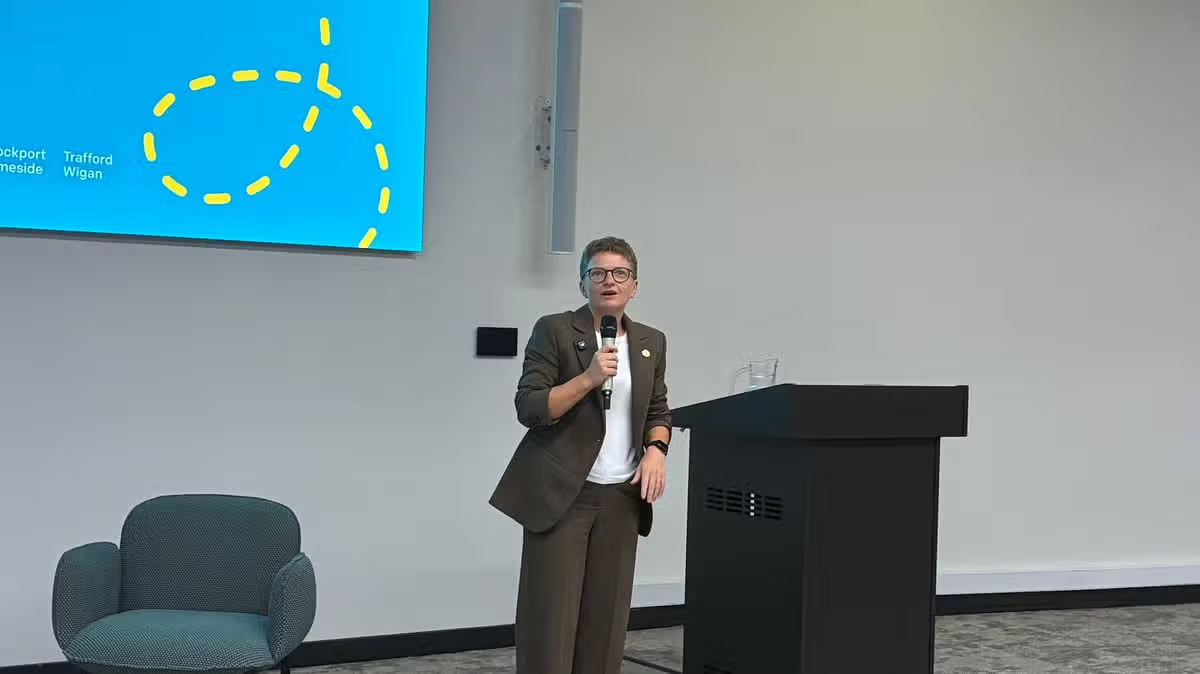
Bev Craig at the Cost of Living Summit

Bev Craig at the Cost of Living Summit(Image: Local Democracy Reporting Service)

The Greater Manchester Mayor has pledged to ‘bring banks back to the high street’ as part of efforts to tackle dying town centres and the cost of living crisis.

Advertisement

The GMCA is working with the Manchester Building Society to increase access to explore turning public spaces into community banking sites. This could include making space in libraries, leisure centres, or Post Offices for banking desks to combat the growing number of towns left without access to in-person services.

Banks have closed down more than 500 branches across the UK in the last year alone, with North West classified as the worst-affected area. Government research shows these closures can exacerbate financial exclusion of vulnerable groups, impact negatively on small businesses, and speed up the decline of high streets.

Ms Craig said: “I’ve spoken to so many people, who look at their high street, and see a physical sign decline on their doorstep. At the same time, they’re being told the city is growing in prosperity. Community banking for me is a massive priority in plugging that gap.

“GMCA and the Manchester Building Society will work together to see how we can expand community banking. I’m particularly interested in the model of shared space, working with charities, working with leisure centres and libraries. Obviously, Manchester Building Society is a business, so, they will cover their costs. But in terms of education, financial inclusion, and outreach into communities, there is an opportunity for working together.

Advertisement

“My challenge is to any other banking institution who wants to get back involved in putting people before profit, and investing in the high street, we’ll welcome it.”

The GMCA is joining forces with the Manchester Building Society, who has already participated in similar schemes with four local authorities across the UK.

Andrew Haigh from MBS said: “We have lost nearly two thirds of our high street bank branches. In many places, that means communities are being left with no services in their area. This isn’t just about access to cash. It’s about the services and support provided. And the people who are most affected by this are the most vulnerable.

“We’re taking away the ability to build trust, to get advice. We can’t simply watch this tragedy happen as more and more people get isolated from in person services and support.”

Advertisement

Mr Haigh spoke at the brand new ‘Cost of Living Summit’ called by the Greater Manchester Mayor. Around 300 businesses and charities attended the event at the Renold Building in the city centre with the aim of getting the private sector involved in ‘tackling the crisis and putting money into people’s pockets’.

Manchester Building Society is opening a new flagship branch  in King Street, in Manchester city centre. Bev Craig, Leader of Manchester City Council, left, with Andrew Haigh, Chief Executive, Newcastle Building Society Group

Manchester Building Society opened its flagship branch in King Street, in Manchester city centre, in 2025. Bev Craig, then leader of Manchester City Council, left, was pictured with Andrew Haigh, CEO at Newcastle Building Society Group(Image: Manchester Building Society)

Addressing the summit, Ms Craig said Cost of Living remained persistent, with residents increasingly feeling like ‘the deal we have, that if you work hard, things will be better for the next generation, is fragile and eroding’, with 43 per cent of Greater Manchester families struggling to cover the bills. She shared memories from her childhood in Greenisland, outside Belfast.

Ms Craig said: “When I was growing up, I didn’t think I was poor. I thought every kid took less food to the harvest festival than they took home. I thought every child had a church helper visit them with parcels and food. I didn’t think it was unusual that you would get your first computer from a skip when the university was throwing it away.

“It taught me resilience, the same resilience I see across Greater Manchester now.”

Advertisement

But the Mayor called for ‘more support’ from both the public and private sectors to bring ‘greater dignity and hope’ to families struggling in the region.

As well as courting more support from private firms, GMCA is setting up a new website, everydaysupport.org.uk, to pool advice and support from dozens of different local, regional and national sources into a single location.


Continue Reading
Click to comment

You must be logged in to post a comment Login

Leave a Reply

Business

Canadian business leader warns US trade uncertainty risks ‘capital chill’ amid global push

Published

on

Canadian business leader warns US trade uncertainty risks 'capital chill' amid global push

Canada’s push to expand its economic relationships around the world should not be mistaken for a retreat from the U.S., a leading Canadian business voice told FOX Business, warning that continued uncertainty over North American trade risks creating a “capital chill” that could weigh on investment.

Goldy Hyder, president and CEO of the Business Council of Canada, said Canadian companies continue to view the U.S. as their most important market even as Prime Minister Mark Carney’s government accelerates efforts to attract investment and expand trade with Europe and other markets.

Advertisement

“Even a kid with a lemonade stand would know, it’s not good for business to just have one customer,” Hyder said, describing Canada’s approach as a “U.S. Plus” strategy.

“The United States is and will be our most important trading partner,” he added.

The push comes amid a sharp deterioration in the trading relationship between the longtime allies. Nearly 68% of Canadian exports have gone to the U.S. this year, with roughly 80% of those shipments moving duty-free under exemptions provided by the U.S.-Mexico-Canada Agreement, according to Canadian and U.S. government data cited by Reuters.

WHAT ARE THE MAIN STICKING POINTS IN THE TRUMP ADMIN’S TRADE NEGOTIATIONS WITH CANADA, MEXICO?

Advertisement
canada's goldy hyder

Goldy Hyder, president and chief executive officer of Business Council of Canada, speaks at a panel discussion themed on “Revitalizing APEC: towards the Vision of an Asia-Pacific Community” during the Boao Forum for Asia BFA Annual Conference 2026 in (Wang Yiliang/Xinhua via Getty Images)

Washington and Ottawa have exchanged new trade restrictions in recent weeks after negotiations broke down, adding uncertainty over the future of USMCA. The agreement remains in force, although the U.S. declined to renew it in its current form during a July review and has continued negotiations with its North American partners.

“Business does not welcome uncertainty, it shuns uncertainty, and there’s too much of that,” Hyder said.

EU OPENS DOOR TO UNPRECEDENTED ‘ASSOCIATE MEMBER’ STATUS FOR CANADA AMID US TRADE SPAT

“The key here is the uncertainty can create capital chill, it will create hesitancy because we just can’t be sure the environment in which we’re dealing.”

Advertisement

That concern is shared by the U.S. Chamber of Commerce, which is urging all three governments to quickly resolve the issue.

canadian prime minister eu parliament

Canada’s Prime Minister Mark Carney (L) during the European Commission President’s annual State of the Union address at a plenary session of the European Parliament in Strasbourg, eastern France on Sept. 16, 2026.  (Jean-Christophe VERHAEGEN / AFP via Getty Images)

“For businesses and investors, it is essential to restore certainty to a North American economic partnership on which 13 million U.S. jobs depend,” Neil Herrington, the Chamber’s senior vice president for the Americas, told FOX Business.

Herrington said the Chamber wants the process concluded in a way that eliminates tariffs and broader trade restrictions while ensuring the relationship “remains trilateral.”

Carney, meanwhile, is attempting to position Canada as a more diversified destination for global capital. His government has set a goal of helping catalyze 1 trillion Canadian dollars in investment over five years, with a focus on sectors including energy, mining, technology and infrastructure.

Advertisement
Donald Trump and Mark Carney

President Donald Trump meets with Canadian Prime Minister Mark Carney in the Oval Office at the White House on May 6, 2025, in Washington, DC. (Anna Moneymaker/Getty Images)

Canada has also pursued deeper ties with Europe. The EU is Canada’s second-largest trading partner after the U.S., accounting for $178 billion in total trade last year, Global Affairs Canada spokesperson Renelle Arsenault told FOX Business.

Arsenault said Ottawa remains committed to a “fair and stable economic relationship” with the U.S. while simultaneously diversifying its trade and investment relationships.

Hyder similarly cautioned against interpreting Canada’s outreach abroad as an alternative to North American economic integration.

“I don’t believe there’s any scenario in which we seek to have more regulatory and/or tax or other types of integration with Europe because it’s nowhere near as competitive as we are, and certainly you are in terms of what we have going when it comes to the USMCA,” he said.

Advertisement

“That is the foundational trade architecture under which we operate.”

Hyder also dismissed concerns that Washington’s separate negotiations with Canada and Mexico signal that the three-country framework is fragmenting.

Parts of the Enbridge Line 3 pipeline.

Sections of the Enbridge Line 3 pipeline are seen on the construction site on the White Earth Nation Reservation near Wauburn, Minnesota, on June 5, 2021. (Kerem Yucel/AFP via Getty Images)

“All roads point to a merger. All roads point to this coming together trilaterally,” Hyder said, adding that businesses are seeking a “timely, trilateral, tariff-exempt” review and renewal of the USMCA.

Global Affairs Canada likewise said all three countries “would benefit from restoring greater certainty” to the North American free-trade arrangement.

Advertisement

Looking beyond the current dispute, Hyder pointed to energy, nuclear power, food security and critical minerals as areas where the three countries could deepen cooperation and strengthen North American supply chains.

CLICK HERE TO GET FOX BUSINESS ON THE GO

“It shouldn’t be… America at the expense of Mexico and Canada,” Hyder said. “It should be America, Mexico and Canada thinking as North Americans that we can work together to compete with the rest of the world.”

Reuters contributed to this report. 

Advertisement
Continue Reading

Business

Pacific defence ministers briefed on El Nino, fuel fears

Published

on

Pacific defence ministers briefed on El Nino, fuel fears

Defence ministers from Australia and other Pacific nations have jointly condemned China’s recent ballistic missile test following a meeting in Fiji this week.

Continue Reading

Business

Improve whole grain flour through new process

Published

on

Improve whole grain flour through new process

SEATTLE — Awakened Grains has introduced a process for controlled germination and starch conversion that transforms whole grains into baking flour that provides better flavor, nutrition and performance, according to the Seattle-based grain technology company. Food manufacturers may use the process to make whole grain bread, pastries, snacks, breakfast cereal, pancake mixes, pizza crusts and pasta.

A patent for the process covers cereal and non-cereal grains, ancient grains, legumes, pulses and seeds. Two applications for the Awakened Grains processing technology are in the pipeline. Imperial Flour is available for licensing to baked foods companies, blenders and dry ingredient companies. The company also plans to introduce Power Flour, which is designed to deliver more protein and fiber, as well as less starch, than standard bread flour.

“Awakened Grains exists to help consumers enjoy the bread, cookies, cakes, donuts, pastries, pasta and pancakes they crave while getting more of the whole grain nutrition they need,” said David Naccarato, chief operating officer, inventor and founding partner of Awakened Grains. “Parents and schools no longer have to choose between foods kids will eat and foods that support better nutrition. Our patented process improves grains and legumes by removing natural digestive blockers, making more nutrients metabolically available and creating products that are both comfortable to digest and enjoyable to eat.”

Advertisement
Continue Reading

Business

Japan's Next Chapter

Published

on

CIO Weekly: Japan - Intervention Adds To Policy Pressure

Japan's Next Chapter

Continue Reading

Business

Bahamas accuses DEA agents of illegal "rogue" operations on its soil

Published

on


Bahamas accuses DEA agents of illegal "rogue" operations on its soil

Continue Reading

Business

What to think about when buying travel insurance

Published

on

Consumer expert Harry Kind is walking, pulling a suitcase with his left hand. He's wearing a red jacket over a white t-shirt.

Consumer expert Harry Kind walks through what to do when buying travel insurance.

Continue Reading

Business

Darden Restaurants (DRI) Q1 2027 earnings

Published

on

Darden Restaurants (DRI) Q1 2027 earnings

Darden Restaurants on Thursday reported quarterly earnings and revenue that narrowly missed analysts’ expectations as same-store sales growth at Olive Garden slows.

Shares of the company fell as much as 5% in premarket trading but pared back their losses as executives reassured investors on the company’s earnings conference call. The stock was down about 2% in morning trading.

Short-term challenges like consumers’ cyclospora concerns and the World Cup tournament weighed on Darden’s same-store sales during the quarter, executives said. However, CEO Rick Cardenas said that Darden’s restaurant chains are performing better in September, and costs of key commodities, like beef, are projected to improve later in the fiscal year.

Here’s what the company reported for the quarter ended Aug. 30 compared with what Wall Street was expecting, based on a survey of analysts by LSEG:

Advertisement
  • Earnings per share from continuing operations: $2.05 vs. $2.06 expected
  • Revenue: $3.20 billion vs. $3.21 billion expected

Darden reported fiscal first-quarter net income of $233.4 million, or $2.04 per share, down from $257.8 million, or $2.19 per share, a year earlier.

Net sales rose 5.1% to $3.20 billion.

The company’s same-store sales increased 3.1% during the fiscal quarter as each of Darden’s business units reported growth. But the World Cup weighed on demand for Darden’s restaurants early in the quarter, dragging the company’s same-store sales down by 80 basis points, or 0.8%, CFO Raj Vennam said.

LongHorn Steakhouse was once again the top performer of the portfolio this quarter, as same-store sales rose 6.2%. The chain has overtaken Olive Garden to become Darden’s top performer, although it still accounts for a smaller share of the company’s overall revenue.

Olive Garden saw its same-store sales inch up 1.1%. While it is still the company’s largest chain by both number of locations and sales, Olive Garden has seen its growth weaken as diners have become more choosy about their spending.

Advertisement

And while many consumers may think about pasta or breadsticks when they consider dining at Olive Garden, the chain was not immune to industry concerns about the deadly cyclospora outbreaks this summer tied to fresh produce.

“During the quarter, Olive Garden was prepared to communicate about one of its core brand equities, unlimited soup, salad and breadsticks, but quickly pivoted away from their planned marketing support in response to external events that led to broader consumer concern about lettuce,” Cardenas told analysts on the company’s quarterly earnings call.

Instead, Olive Garden will run the campaign during the current quarter.

To fuel sales further, Olive Garden is going to lean into weekday lunch occasions. Cardenas said the team is working on “several opportunities” focused on value to drive more traffic during the relatively sleepy daypart.

Advertisement

Darden’s fine-dining business reported same-store sales growth of 1.6%. The segment includes chains like The Capital Grille and Ruth’s Chris.

Executives said that traffic to the company’s fine-dining restaurants is still below pre-pandemic levels. However, traffic trends have been improving, and those restaurants have taken lower price increases than the rest of Darden’s portfolio.

“We are seeing that business spending is still low,” Cardenas said. “We’re starting to see some growth in private dining.”

The company’s remaining chains, which are grouped under its “other business” division, saw same-store sales grow 3.8% in the quarter. The segment includes Yard House, which saw same-store sales climb 10%, fueled by the World Cup. It was the only Darden chain to report a benefit from the tournament.

Advertisement

“Yard House is a high potential growth brand,” Cardenas said, adding that the beer-centric chain is the company’s third billion-dollar brand, as of last week.

Yard House will open 13 new restaurants in fiscal 2027. Five of those openings will be conversions from Darden’s now-shuttered Bahama Breeze chain.

Darden also reiterated its forecast for fiscal 2027. The company is projecting total sales of $13.60 billion to $13.75 billion and net earnings per share from continuing operations in a range of $11.10 to $11.35. 

Advertisement
Continue Reading

Business

Christian Bolding on Building a Business That Can Keep Growing

Published

on

Christian Bolding on Building a Business That Can Keep Growing

Christian Bolding has learned that growth can also create an entirely new set of challenges. The systems that work for a small company may become less effective as the organization expands, and a founder who once had a hand in nearly every decision eventually has to learn where to focus his attention.

Bolding has experienced that transition as the founder and CEO of a Texas-based smart home automation and security company. His approach to growth is not built around complicated management theories. Instead, he focuses on manageable goals, customer feedback, personal discipline, and continuous learning as his responsibilities change.

When asked how he approaches large goals, Christian Bolding explained that he does it “by taking the short-term goals first to reach the long-term.” It is a simple philosophy, but it has remained relevant through several stages of his career.

Free newsletters
Advertisement

The stories that matter to UK business, straight to your inbox.

Advertisement

What Business Growth Changed for Christian Bolding

Bolding did not begin his career in the smart home industry. He entered the workforce as a teenager and held several service-oriented positions before eventually moving into marketing. He later founded Legacy Acquisitions, a marketing company that expanded into multiple regions. That experience gave him an early look at what happens when a business grows beyond its original size.

He eventually founded his company in Texas and entered the smart home and security industry. According to a previously published company profile, his company doubled both its client base and employee pool within a year and expanded through satellite locations around Austin.

Those figures tell part of the growth story, but Bolding does not rely on size alone to determine whether the company is doing well. When asked how he measures success in business, his answer was straightforward: “By the feedback from the client.”

That measurement can become even more important as a company grows. Increasing sales or adding employees does not necessarily mean that customers are having a better experience. Expansion can expose weak processes, communication problems, or gaps that were easier to manage when the business was smaller. Listening to clients gives Bolding another way to understand whether growth is actually improving the company.

Advertisement

Why Customer Experience Remains a Leadership Priority

Smart home technology sits at an interesting intersection between technology and personal service. Homeowners may want security systems, automation, and greater control over their homes, but the technology is only part of the experience. They also have to trust the people who recommend, install, explain, and support those systems.

For Bolding, that makes understanding people an important part of leadership. When asked which qualities he believes matter most, he identified “character, passion, understanding.”

Understanding can be especially valuable in a service business because customers do not necessarily approach technology with the same level of knowledge or confidence. Something that seems routine to a professional who works with smart home systems every day may feel unfamiliar to a homeowner. Listening carefully and explaining things clearly can therefore be just as important as knowing the product.

Bolding’s earlier career exposed him to very different people and work environments. He started in fast food, later worked one-on-one with people with disabilities, and eventually moved into marketing before becoming an entrepreneur. While those roles may seem unrelated on paper, each required him to understand people, communicate effectively, and adapt his approach to the person in front of him.

Advertisement

Why Bolding Continues Learning as a CEO

One challenge of becoming a founder or CEO is that fewer people may eventually be in the room who are willing or able to challenge your assumptions. Bolding tries to avoid becoming too comfortable with his own experience by deliberately seeking environments where he can continue learning.

“I continue putting myself in better environments to grow and learn,” he said, citing mentors and conferences as examples.

That approach reflects a practical reality of entrepreneurship. The skills required to start a company are not always the same skills required to manage one after it grows. A strong salesperson may need to learn how to develop other salespeople. A founder who once made every decision personally may need to learn how to delegate. A strategy that produced results at one stage of a company may become less useful at another.

Bolding applies a similar mindset to mistakes. When asked about a time when failure eventually contributed to success, he did not identify one dramatic turning point. Instead, he answered, “Every day. You have to take it as a learning lesson.”

Advertisement

That answer reflects the less glamorous side of running a business. Most lessons do not arrive through one major failure followed by a breakthrough. They come from decisions you could have handled differently, conversations that reveal a problem, customer feedback, hiring choices, and strategies that need adjusting.

How Discipline Shaped Bolding’s Approach to Business

Long before Bolding became an entrepreneur, sports gave him an early framework for thinking about discipline and performance. Basketball was a major interest during his childhood, and he spent time studying the NBA and the habits of successful athletes. He also pursued football seriously.

Bolding still sees a link between the habits people develop outside of work and how they perform professionally. “You perform the way you live life in general, in my opinion,” he said.

That perspective carries additional weight given his upbringing. Bolding spent much of his childhood in the foster care system and grew up without the consistent family environment that many people rely on for stability. When asked about the biggest influence on his life, he answered, “Not having anyone in my life as family.”

Advertisement

Rather than making that experience the centerpiece of his professional identity, Bolding appears to have carried certain lessons from it into his career. He values environment, stability, personal accountability, and the people he chooses to learn from.

How Christian Bolding Defines Success Today

Business performance can be measured through revenue, customers, employees, and expansion. Bolding pays attention to growth, but his personal definition of success extends beyond those measurements.

When asked what success means to him, he answered, “By what you give back, not what you get.”

That belief has increasingly influenced his interest in giving back and youth empowerment. It also offers some insight into how Bolding thinks about leadership after progressing from entry-level work to entrepreneurship and eventually the CEO role.

Advertisement

His career has involved very different industries, responsibilities, and challenges, but his approach has remained relatively consistent. He breaks larger ambitions into smaller goals, listens to customers, seeks out people he can learn from, and treats mistakes as information rather than endpoints.

For Bolding, becoming a CEO did not mean reaching the point where there was nothing left to learn. If anything, growth has made continued learning more important. The long-term vision still matters, but his approach remains grounded in something much simpler: focus on the next goal, learn from what happens, and keep moving forward.

Advertisement
Continue Reading

Business

Hyundai set to outsell Ford in Q3 as Detroit automakers lack hybrids

Published

on

Hyundai set to outsell Ford in Q3 as Detroit automakers lack hybrids

Hyundai signage at the New York International Auto Show on April 2, 2026.

Danielle DeVries | CNBC

DETROIT — Hyundai Motor is expected to outsell Ford Motor in quarterly sales for the first time ever, according to a new forecast released Thursday by Cox Automotive.

The South Korean automaker is expected to report a 6.5% increase in year-over-year sales from July through September to 511,421 units. That compares with an expected 7.1% decline for Ford over the third quarter to 504,172 new vehicles sold, according to Cox predictions.

Advertisement

The expected leaderboard change would make Hyundai the third best-selling automaker in the U.S. behind General Motors and Toyota Motor.

That change comes as new vehicle sales have been stronger than expected this year. Cox on Thursday raised its 2026 forecast by roughly 2%, to 16.1 million units.

“The automotive market this year has been pretty resilient,” Jeremy Robb, Cox chief economist, said Thursday during a media call. “New and used sales are both down year over year, but they’re not down really that much.”

Hyundai’s hot streak

Hyundai, including its luxury Genesis brand and corporate sibling Kia, has been making major inroads in the U.S. this year. Ford, meanwhile, has struggled with production of its crucial F-Series pickup trucks following two supplier fires last year that disrupted production and sales.

Advertisement

Hyundai CEO José Muñoz told CNBC last month that topping Ford in U.S. sales isn’t a goal but if it happens, it’s because of the company’s continued focus on products and execution.

Hyundai CEO José Muñoz on U.S. expansion and its new luxury Genesis EV

“We focus on delivering, the best, safe products to the customer with the highest possible quality,” Muñoz said, noting the company is No. 3 in sales globally. “And we end up achieving unbelievable goals.”

Aside from pickup production troubles, Cox analysts said sales for Ford and its crosstown rival GM are being hindered by a lack of hybrid vehicles — a rapidly growing market in the U.S. amid inflated gas prices.

“If you don’t have vehicles to catch [consumers] where they are, then there are other manufacturers that likely would step into the gap,” Erin Keating, a Cox executive analyst, said Thursday during a media call.

GM only offers a hybrid version of its Corvette, while Ford’s hybrids include its Maverick and F-150 pickup trucks.

Advertisement

Toyota gains on GM

Hybrid leader Toyota Motor also has been narrowing its sales gap with No. 1 sales leader GM. Cox said last quarter that GM could be overtaken by the Japanese automaker this year in annual sales.

GM is expected to report a year-over-year sales decline of 5.2% to 671,706 new vehicles sold during the third quarter, while Toyota is predicted to report a 2.2% gain to 642,707 units. For the year, Toyota is trailing GM by fewer than 121,100 units.

If Toyota can top GM, it would mark the second time Toyota has ever outsold GM in annual U.S. sales. The first time was in 2021 when supply chain disruptions affected vehicle production.

Cox experts noted that fuel prices — at a AAA national average of $4.48 per gallon — are impacting the sales of big trucks and SUVs, which are crucial to sales for the Detroit automakers.

Advertisement

GM, Ford and Chrysler parent Stellantis also have renewed their focus on gas-guzzling V-8 engines in their larger pickups and SUVs amid deregulation of emissions and fuel economy standards by the Trump administration.

“I think that’s probably one of the callouts for the domestics is that they have made some interesting decisions around product,” Keating said.

Cox expects Stellantis to report a 1.3% decline in U.S. vehicle sales during the third quarter, with total sales for the year expected to be up 2.8% as the automaker orchestrates a companywide turnaround plan.

Advertisement
Continue Reading

Business

Mortgage rates rise to 7.03%: Freddie Mac

Published

on

Mortgage rates rise to 6.69%: Freddie Mac

Mortgage rates rose to more than 7% for the first time since January 2025, mortgage buyer Freddie Mac said Thursday.

Freddie Mac’s latest Primary Mortgage Market Survey, released Thursday, showed the average rate on the benchmark 30-year fixed mortgage rose to 7.03% from last week’s reading of 6.95%.

Advertisement

The average rate on a 30-year loan was 6.3% a year ago.

A real estate agent adjusts a sign outside a home.

A real estate agent sets up for an open house in Rancho Cucamonga, California, on May 9, 2026. (Kyle Grillot/Bloomberg via Getty Images / Getty Images)

AMERICA’S BEST AND WORST CITIES FOR HOUSING AFFORDABILITY RANKED

The average rate on a 15-year fixed mortgage climbed to 6.42% from last week’s reading of 6.26%.

THE US CITIES WHERE HOME PRICES ARE FALLING THE FASTEST

Advertisement

Mortgage rates are affected by several factors, including the Federal Reserve and geopolitics. Though mortgage rates are not directly affected by the Fed’s interest rate decisions, they closely track the 10-year Treasury yield. The 10-year yield hovered around 5.1% as of Thursday afternoon.

“Rates entered the week just 5 basis points below that line after jumping 19 basis points to 6.95%, the largest one-week move since April 2025,” said Realtor.com senior economist Anthony Smith. “The 10-year Treasury yield drove most of that increase and has kept climbing, with inflationary pressure building and Brent crude oil prices hovering above $100 per barrel again. With the 10-year Treasury surging 15 bps on Wednesday, to 5.11 percent, a 19-year high, upward mortgage rate pressure seems likely to linger.”

GET FOX BUSINESS ON THE GO BY CLICKING HERE

Advertisement
Continue Reading

Trending

Copyright © 2025