

Crypto World
AI Momentum Fuels Market Rally: Snowflake (SNOW) Soars 35% on Earnings Blowout


Key Highlights
- Major indices approached all-time highs fueled by robust corporate results and artificial intelligence enthusiasm
- Snowflake (SNOW) skyrocketed more than 35% following stellar quarterly results and a massive $6 billion Amazon Web Services partnership
- Unusual Machines soared up to 67% amid speculation about Pentagon funding for domestic drone production
- Crude oil prices experienced dramatic volatility, with Brent briefly hitting $93 before retreating on diplomatic developments between Washington and Tehran
- Semiconductor leaders like Marvell and AMD remained in focus as the AI infrastructure buildout continued
Equity markets extended their advance Thursday as impressive quarterly earnings and renewed artificial intelligence optimism bolstered investor sentiment. The S&P 500 and Nasdaq Composite both flirted with record territory throughout trading.
Oil emerged as the session’s most volatile asset. Brent crude temporarily spiked to $93 per barrel following escalating geopolitical tensions in the Middle East involving Iran. However, prices reversed course after media reports indicated potential diplomatic progress between the United States and Iran.
Energy markets remain under close scrutiny by market participants. A sustained climb in petroleum prices could reignite inflationary pressures and potentially alter the Federal Reserve’s monetary policy trajectory.
Snowflake (SNOW) Rockets 35% Following Stellar Earnings and Major AWS Partnership
Thursday’s standout performer was undoubtedly Snowflake. The cloud-based data platform provider exploded higher by more than 35% after delivering quarterly earnings that substantially exceeded analyst projections and upgrading its full-year revenue guidance.
Snowflake simultaneously unveiled a five-year AI infrastructure collaboration with Amazon Web Services valued at approximately $6 billion.
The impressive performance eased investor anxieties that artificial intelligence advancements might undermine established software enterprises. Company executives emphasized that customer appetite for AI-powered solutions is intensifying rather than diminishing.
The positive momentum rippled through the broader software sector. Oracle, MongoDB, and ServiceNow all registered gains in Snowflake’s wake.
Numerous software companies had faced headwinds throughout 2026 amid concerns that generative AI applications could cannibalize traditional revenue streams. Snowflake’s quarterly performance suggested the contrary, demonstrating that AI is functioning as a growth catalyst rather than a disruptive threat.
Defense Drone Stocks Skyrocket on Government Funding Speculation
Military and drone-related stocks posted explosive gains Thursday. Market chatter intensified around potential increased federal funding earmarked for American-based drone manufacturers.
Unusual Machines surged as much as 67% intraday. The dramatic price movement followed reports suggesting the company could be positioned to benefit from anticipated Pentagon procurement initiatives.
The buying frenzy extended throughout the defense technology space. AeroVironment and Kratos Defense & Security Solutions also attracted strong investor demand as traders positioned for companies likely to capture expanded military and intelligence surveillance budgets.
Heightened Middle Eastern geopolitical instability has amplified investor attention toward defense technology equities. Market observers note the unmanned aerial vehicle sector has emerged as one of the equity market’s most dynamic investment themes as nations worldwide expand defense appropriations.
Semiconductor Stocks Maintain Strength Amid Persistent AI Demand
Semiconductor equities remained prominently featured throughout the trading session. Marvell Technology advanced after posting quarterly results that exceeded Street estimates.
Advanced Micro Devices climbed as capital continued flowing into AI infrastructure-focused investments.
Thursday’s trading action underscored a marketplace still predominantly oriented toward artificial intelligence expansion and earnings strength. Crude oil volatility and Middle Eastern geopolitical developments represent ongoing risks commanding investor attention.
For the present, solid corporate profitability continues underpinning the market’s upward trajectory.



Solana News: The Solana Foundation and Toss Bank signed a Memorandum of Understanding, marking the first direct partnership between a South Korean internet-only bank and the Solana ecosystem, and positioning the deal squarely inside parent company Viva Republica’s pre-IPO technology narrative.
SOL sitting at $74 on the announcement, with trading volume rising 8% over 24 hours, though concurrent US-Iran peace talk developments complicate clean attribution of that volume spike to the MOU alone.
Toss Bank serves 15 million customers across South Korea as the country’s third-largest internet-only bank, and its overseas remittance service already covers 30 countries and 7 major currencies.
That existing footprint gives the Solana-based proof of concept a non-trivial addressable base from day one; this is not a greenfield experiment.
Discover: The Best Token Presales
Solana News: MOU Scope, Four Workstreams, One Live PoC
The MOU covers four areas: a proof of concept for global remittance and settlement infrastructure built on Solana; joint research into blockchain-based payment and settlement models; exploration of stablecoin and digital asset financial services; and a longer-term cooperation framework that includes integration with overseas banking partners and AML/KYC compliance systems.
The immediate live work is the PoC, everything downstream of that depends on what it produces.
Jin-hyun Park, head of strategy at Toss Bank, said the partnership launches “a phased pilot within the innovative services already provided by Toss Bank,” with the stated goal of delivering “quicker and more economical global digital finance through Solana” to its 15 million customers.
The framing is deliberate: this is positioned as an upgrade to existing infrastructure, not a speculative pivot into crypto.

Solana’s technical case here is straightforward: sub-second finality and transaction fees measured in fractions of a cent make it a credible rail for high-volume cross-border settlement, where SWIFT-era correspondent banking costs are the baseline to beat.
The tokenization roadmap comes later, contingent on PoC outcomes and regulatory clearance. An MOU is a narrative event; live PoC results are execution events. The market will need to see the latter before the former carries durable weight.
The Solana Foundation had already been building Korean institutional infrastructure before this deal. A separate MOU with local firm Wavebridge targets a KRW-pegged stablecoin designed to be “issued, validated, regulated, and suitable for institutional applications,” with on-chain settlement and tokenized deposit functionality involving major Korean banks. The Toss Bank partnership slots into that broader Korea strategy rather than standing alone.
Why the Solana Bet Lands Now: Viva Republica’s $10B IPO Play
Viva Republica, the parent company behind Toss Bank and the broader Toss super-app ecosystem, is targeting a US IPO in 2026 at a valuation exceeding $10 billion.
The firm has raised over $1.2 billion from investors, including GIC, Sequoia China, and Kleiner Perkins, and boosted Toss Bank’s paid-in capital to roughly 1.4 trillion won (~$1 billion) across six funding rounds to support growth and listing readiness.
The Solana MOU serves three functions in that IPO story. First, it reframes Viva Republica as a cross-border payments platform tapping a projected $320 trillion global payments market, not merely a domestic Korean neobank, which commands a tighter multiple on a US exchange. Second, the compliance-first architecture (AML/KYC integration, bank license, regulated stablecoin rails) places Toss in the regulated-innovator category rather than alongside unregulated crypto firms, a meaningful distinction for US institutional allocators.
— Cryptothreads.io (@CryptoThreadsX) June 22, 2026
 A bank with 15M users just picked Solana for cross-border payments.
 South Korea's Toss Bank signed an MOU with the Solana Foundation to pilot stablecoin-powered international remittances – the first of its kind between a Korean digital bank and Solana.
 Why #Solana?… pic.twitter.com/zLTuALSc1r
Third, blockchain settlement rails lower marginal cost per remittance transaction, supporting the margin expansion narrative that pre-IPO models need.
This is legitimate strategic positioning, not window dressing, but the distinction between a partnership announcement and shipped infrastructure matters for any investor reading the prospectus. Viva Republica is telling a story that the PoC needs to eventually validate.
The regulatory context adds urgency. South Korea plans to impose foreign exchange controls on crypto transfers starting December 2026.
Toss Bank moving now, via a licensed, compliance-integrated framework, positions it ahead of that cutoff rather than scrambling to retrofit after the rules land. The Bank of Korea’s concurrent wholesale CBDC and tokenized deposit pilot with 100,000 users provides the policy backdrop that makes a bank-grade stablecoin remittance product politically viable rather than speculative.
Discover: The Best Crypto to Diversify Your Portfolio
The post Solana Foundation and Toss Bank Sign MOU to Rebuild Korean Remittance Rails appeared first on Cryptonews.
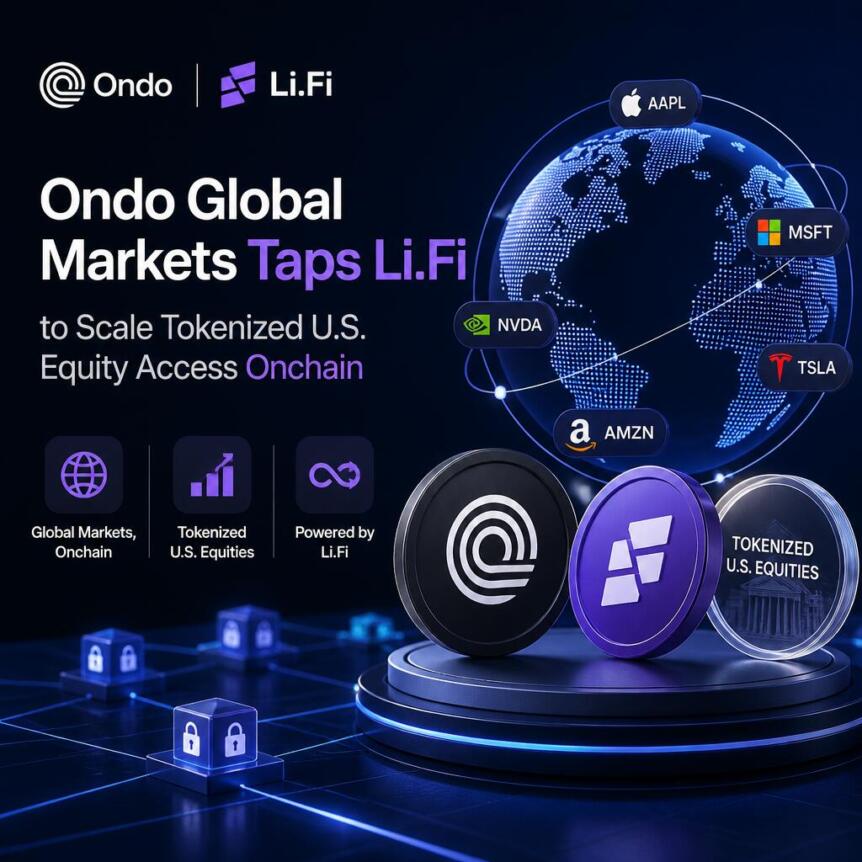
Ondo Global Markets has integrated with LI.FI to widen access to tokenized U.S. stocks and ETFs across major crypto applications. The integration covers Ethereum and BNB Chain at launch, while Solana support will follow later. Ondo says the platform now gives LI.FI’s partner network direct access to more than 438 tokenized securities. The move places tokenized equities deeper into cross-chain wallets, apps, and trading infrastructure.
Ondo Adds LI.FI Access for Tokenized Securities
Ondo Global Markets brings tokenized exposure to U.S. public securities through blockchain-based tokens backed by underlying assets. The available products include tokenized versions of Tesla, Nvidia, and Apple shares. The platform also lists broad market ETFs such as QQQ and SPY.
LI.FI gives Ondo a distribution route across more than 1,000 partner platforms in its ecosystem. These partners include wallets and apps that already use LI.FI for execution. The integration allows users to access tokenized stocks and ETFs without leaving supported applications. It also gives partner platforms a ready route to add equity-linked assets through existing LI.FI connections.
Ondo reports more than $1 billion in total value locked on Ondo Global Markets. The platform also reports tens of thousands of holders and more than $20 billion in cumulative trading volume since its September 2025 launch. Those figures show the scale of activity behind the tokenized securities platform.
LI.FI Connects Partners Across Ethereum and BNB Chain
LI.FI operates as a cross-chain execution network for same-chain and cross-chain token transfers. The protocol uses an intent-based model where users set their desired outcome, while professional solvers handle routing and execution. That design removes the need for users to choose bridges or routes manually. It also supports best-price, gasless, and near-instant execution where the connected application enables those features.
The network has processed more than $80 billion in volume across over 100 million transfers. LI.FI also powers infrastructure for platforms such as MetaMask, Robinhood Wallet, and Binance. Its role gives Ondo a wider route into crypto applications that already serve large user bases.
Ethereum and BNB Chain support start the integration, while Solana support remains planned for a later rollout. This staged approach gives Ondo access to two active blockchain ecosystems before expanding to another major network. The integration also connects tokenized securities with users who already move assets across chains.
Key Insights
- Ondo Global Markets integrated LI.FI across Ethereum and BNB Chain, with Solana support planned soon.
- LI.FI’s 1,000-plus partners can now access 438 tokenized U.S. stocks and ETFs directly today.
- Available assets include tokenized Tesla, Nvidia, Apple, QQQ, and SPY through Ondo Global Markets now.
- Ondo reports over $1 billion in TVL and $20 billion in cumulative volume since launch.
- LI.FI has processed over $80 billion across more than 100 million crypto transfers to date.
Tokenized Stocks Expand Across Crypto Apps
Ondo Global Markets tokenizes U.S. public securities and makes them usable in DeFi-compatible formats. Each tokenized asset has backing from underlying securities held with one or more U.S. broker-dealers. Ondo also says the assets use daily verification and investor protection standards.
The LI.FI integration gives developers and platforms a direct path to add tokenized equity exposure. Wallets and applications can present tokenized stocks and ETFs alongside other digital assets. This structure may reduce integration work for platforms that already connect with LI.FI. It also keeps tokenized security access inside familiar crypto products used by retail and institutional users.
The development comes as tokenized real-world assets draw more activity from crypto platforms and traditional finance firms. Ondo’s tokenized stock platform focuses on listed U.S. equities and ETFs, while LI.FI focuses on cross-chain access and execution. Together, the integration links tokenized securities with a wider app network across Ethereum and BNB Chain, with planned Solana support.
Crypto World
Charles Hoskinson Says Cardano Needs AI Agents to Run “Midnight City”: Will Roadmap Move ADA’s Price?
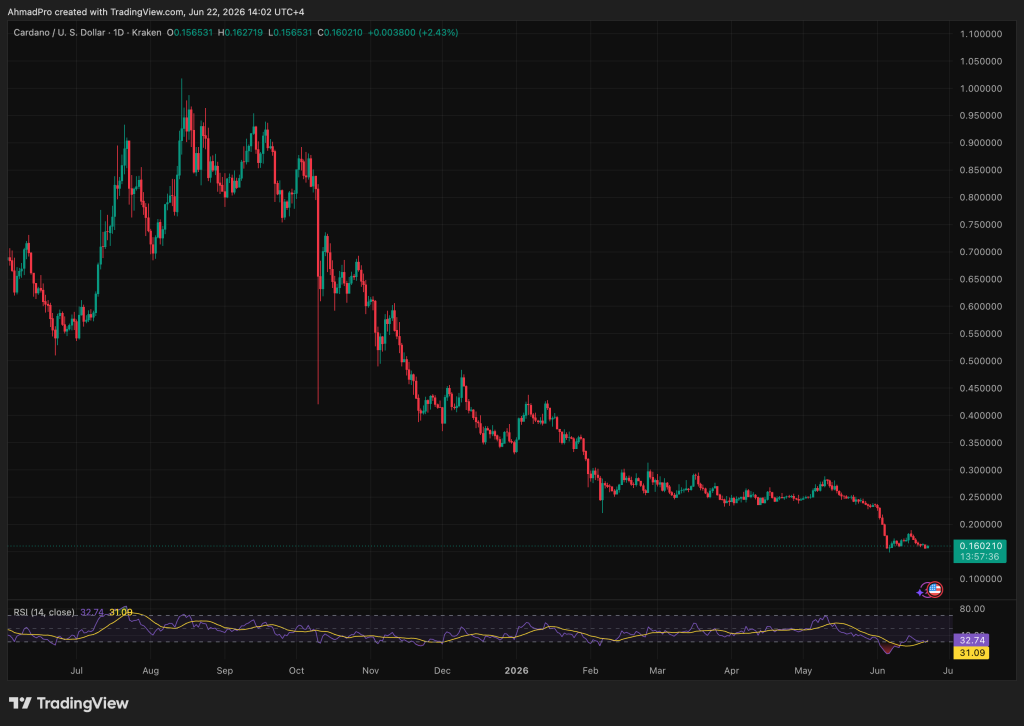
Charles Hoskinson is repositioning AI agents as core infrastructure for Cardano, not a side experiment. ADA is trading around $0.160, down 1% over 24 hours, a modest downtrend that tracks the broader market rather than any Cardano-specific catalyst.
The question traders are actually asking: does Midnight City development translate into price, or does it stay a roadmap story while ADA grinds sideways?
Hoskinson recently defended Cardano’s use of a synthetic AI influencer on the Input Output account after community pushback, framing it as deliberate public experimentation rather than a misstep.
He also pointed to OpenClaw, an open-source agent project gaining traction at speed, as evidence of where this is heading.
“We’re going to need agents and AI to be able to organize and sort all that out and broadcast on a regular basis what’s going on in Midnight City,” he said directly.
That’s not vision-casting, that’s an infrastructure call. The van Rossem hard fork sits in the background as a secondary technical catalyst, and Hoskinson’s broader governance positioning has been building toward this moment for months.
Can Cardano Price Break $0.17 Before the Next Hard Fork?
ADA is sitting at $0.1602 on the daily chart, and this is one of the most punishing downtrends in the large-cap space, with price collapsing from over $1.00 at the August peak to current levels, a loss of roughly 84% over 10 straight months with barely any meaningful relief along the way.
The recent breakdown below $0.20 in early June was the latest leg lower, taking ADA to fresh lows around $0.155 before a small bounce to current levels, and that $0.155 area is now the only reference point for support on this entire chart.
RSI sitting at 31 shows the selling pressure has been persistent without ever reaching the kind of extreme oversold capitulation readings that typically mark a durable bottom, which suggests this slide has been controlled distribution rather than panic selling, and that kind of grind can continue longer than expected.
The immediate resistance is $0.20, which was the floor that just broke and would need to reclaim to suggest any stabilization, and above that $0.25 to $0.27 is the next level from the May consolidation range.
There is no real structural support below the current ADA price until much lower levels from 2023, so a continued breakdown has very little to slow it down.
Ten months of lower highs and lower lows with no sign of base building yet make this one of the weaker charts in the space right now, and a bounce here would need real volume and a multi-week hold above $0.20 before it means anything more than a dead cat bounce in a still-active downtrend.
Smart Money Rotating Out Of Old Dying Chains to New Shiny Memecoins Like Maxi Doge
ADA’s upside from here is mathematically compressed in the near term; even the bull case scenario requires a hard fork execution and a broader altcoin cycle to materialize.
Traders watching established layer-1s grind through resistance sometimes rotate into early-stage assets where the risk-reward math looks different. That’s the structural logic behind presale positioning, for those who allocate that way.

Maxi Doge (MAXI) is a meme token on Ethereum built around a trading-community identity — the “240-lb canine juggernaut” framing is intentional, targeting the high-conviction leverage-trading crowd with holder-only competitions, leaderboard rewards, and a Maxi Fund treasury structured for liquidity and partnerships.
The numbers: presale price sits at $0.0002825, with $4,809,039.80 raised to date. Dynamic staking APY is live for participants. (Capital rotation into this stage has been the consistent pattern as larger meme coins consolidate post-listing.) Meme tokens carry substantial risk, low liquidity, sentiment-driven volatility, and no fundamental floor.
Research Maxi Doge before any allocation decision.
The post Charles Hoskinson Says Cardano Needs AI Agents to Run “Midnight City”: Will Roadmap Move ADA’s Price? appeared first on Cryptonews.
-
Search results are becoming part of the crypto attack path
Search engine results have quietly become one of the most underestimated weaknesses in cryptocurrency security.
The usual understanding of crypto security focuses on protecting seed phrases, using hardware wallets, enabling multi-factor authentication and being careful with suspicious links sent through email or direct messages. What is often missed is the role of search engines as an entry point for attacks.
For years, platforms such as Google have been seen as neutral gateways to the internet. Users are used to searching for their bank, favorite restaurant or a decentralized finance (DeFi) protocol, assuming the results are reliable. Scammers are now taking advantage of that behavior in crypto.
Recent incidents involving fake ads that impersonate major cryptocurrency platforms show that search engines are no longer just neutral information tools. Scammers have turned them into part of the attack surface targeting crypto users.
A wallet compromise does not always begin when a user connects to a malicious site. It may start several minutes earlier, with a normal search query and one wrong click.
-
How search engines became a crypto security risk
Traditional cyberattacks usually focused on technical weaknesses, such as software flaws, server exploits and malware. Modern crypto fraud works differently.
Instead of targeting systems, attackers target behavior.
Decades of internet use have trained users to trust search results, especially the ones that appear at the top of the page. A “Sponsored” label does not always make users more careful. Some may even see it as a sign that the listing is legitimate. They may also wrongly assume that the company behind the ad has been verified.
Neither assumption is always safe.
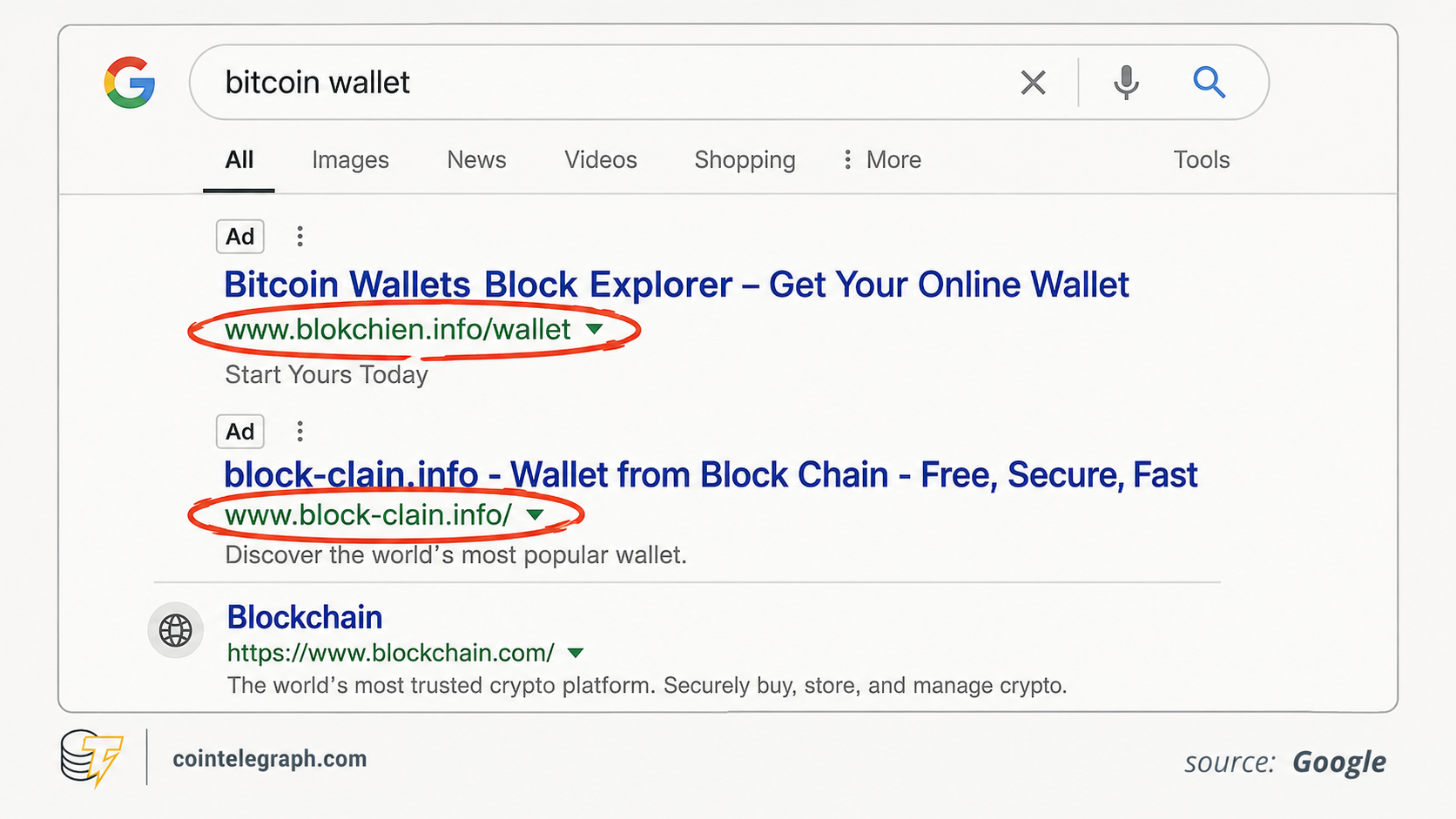
Search engines are designed to organize information and sell ads. Skilled bad actors understand both systems well. They can buy ad placements, manipulate visibility, copy trusted brand identities and reach users when they are most likely to act.
In crypto, that can be dangerous. A single transaction can move large sums instantly and usually cannot be reversed. That means one wrong click can have serious financial consequences.
Did you know? Google was not originally called Google. Its founders developed it as a research project called “BackRub,” named after its ability to analyze backlinks. Today, that same search system influences trillions of dollars in online activity, including crypto transactions.
-
The Uniswap impersonation campaign
A recent incident shows how effective this method can be. According to recent reports, attackers stole at least $400,000 from a trader through fake Google ads that impersonated the decentralized exchange Uniswap.
The method was simple. A user searching for “Uniswap” would see what appeared to be an official sponsored listing near the top of the results. The branding looked familiar and the message seemed credible. This gave users little reason to be suspicious.
Clicking the ad took users to a cloned interface that closely copied the real Uniswap platform. From there, the experience looked genuine. Users connected their wallets, started what seemed like normal transactions and granted the required approvals.
The consequences became clear only later. The users had unknowingly approved permissions that allowed the attackers to withdraw funds directly from their wallets.
What makes this attack different is the lack of technical intrusion. The attackers did not need seed phrases, malware or broken encryption. The victims themselves signed the transactions that enabled the theft.
-
Why even experienced users fall victim
It is easy to assume that only newcomers to cryptocurrency fall for such schemes. In reality, even experienced users can be tricked under the right conditions.
One reason is authority bias. People naturally place trust in established institutions and systems. Google, in particular, is widely seen as a reliable way to find information. Users often assume that top search results are checked carefully before they appear.
Habit makes the problem worse.
For decades, the search bar has been the default way to move around the internet. Many users no longer memorize URLs. They simply search for the platform they want to visit.
Convenience also encourages speed.
Regular DeFi users often move quickly between exchanges, staking services, governance portals and bridge interfaces. The more urgent the action feels, the less likely users are to check every detail in front of them.
Attackers know this. They spend time and money creating convincing copies of trusted platforms. A fake interface that closely matches a familiar platform can lower even an experienced user’s guard, especially when that user is distracted or in a hurry.
There is also optimism bias. People may know that a threat exists but still believe they are unlikely to become the victim. Crypto’s track record gives little reason for such confidence.
-
The limits of hardware wallets
Hardware wallets are often described as the gold standard in cryptocurrency security. In many ways, that label is fair. By keeping private keys offline, they offer strong protection against many types of malware and unauthorized access attempts.
However, they have one major limit.
A hardware wallet cannot reliably judge whether a transaction benefits the user. If a user approves a malicious request through a phishing interface, the device will usually carry out the instruction exactly as submitted.
The hardware wallet protects the keys. It cannot always protect the judgment of the person using them.
This difference has become more important. The main threat is not always an attacker stealing credentials by force. Sometimes, the attacker simply persuades the target to use those credentials on a compromised platform.
Did you know? The first phishing attacks predate Bitcoin by decades. In the mid-1990s, attackers targeted AOL users by pretending to be employees and asking for passwords. The techniques have changed, but the basic idea remains similar: exploiting trust rather than technology.
-
Why search advertising appeals to bad actors
Search ads give criminals a mix of advantages that few other channels can match. For crypto scammers, that makes them especially attractive.
First, they offer access to large audiences. Millions of users search every day for terms linked to crypto wallets, exchanges and DeFi protocols.
Those users also have clear intent. A person searching for “Uniswap,” “MetaMask download” or “Ledger Live download” is already trying to take action. The attacker does not need to create interest. The possible victim is already ready to engage.
The barrier to entry is also relatively low. Phishing emails may be blocked by spam filters or ignored by recipients. Search ads, however, reach users at the exact moment they are looking for a destination.
Fraudulent campaigns can also be rebuilt quickly. When fake ads are taken down, attackers often return with new accounts, newly registered domains or slightly changed versions of the same scheme.
For criminals, the economics can be hard to ignore.
Did you know? Search results can vary from person to person. Location, browsing history and device type can all affect what users see. A scam ad seen by one crypto user may not appear for another user making the same search.
-
A problem that goes beyond Google
Search-based fraud is part of a much wider problem facing online platforms. It is not limited to search engines.
Redditors have repeatedly reported seeing fake cryptocurrency ads next to legitimate community discussions. YouTube has struggled with impersonation scams involving fake livestreams that promise giveaways.
Social media platforms continue to deal with scam accounts that copy official project profiles in reply threads. Telegram channels are also often targeted by people pretending to be support representatives.
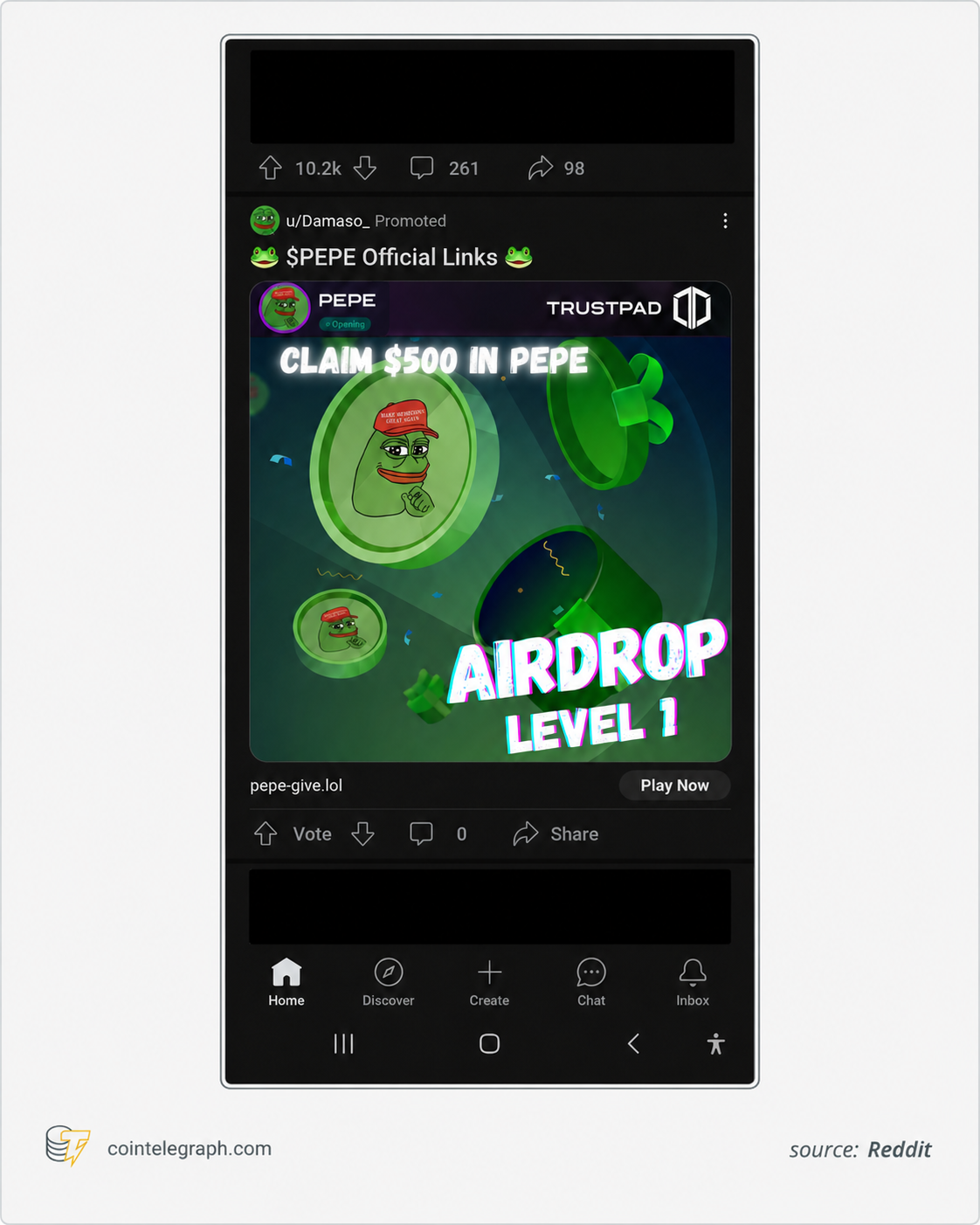
Across all these cases, the pattern is the same. The same systems built to spread legitimate content can also be used to spread fraud. Advertising systems are designed to optimize for engagement and relevance. Scammers try to exploit those systems by weakening user trust.
-
SEO poisoning and how the threat has changed
Avoiding sponsored ads may seem like an obvious solution. Unfortunately, scammers have adapted.
Search engine optimization (SEO) poisoning is the deliberate manipulation of organic search rankings so malicious pages appear near the top without paid promotion. Attackers may publish fake educational content designed to rank for popular search terms. They may also buy expired domains that already have search authority.
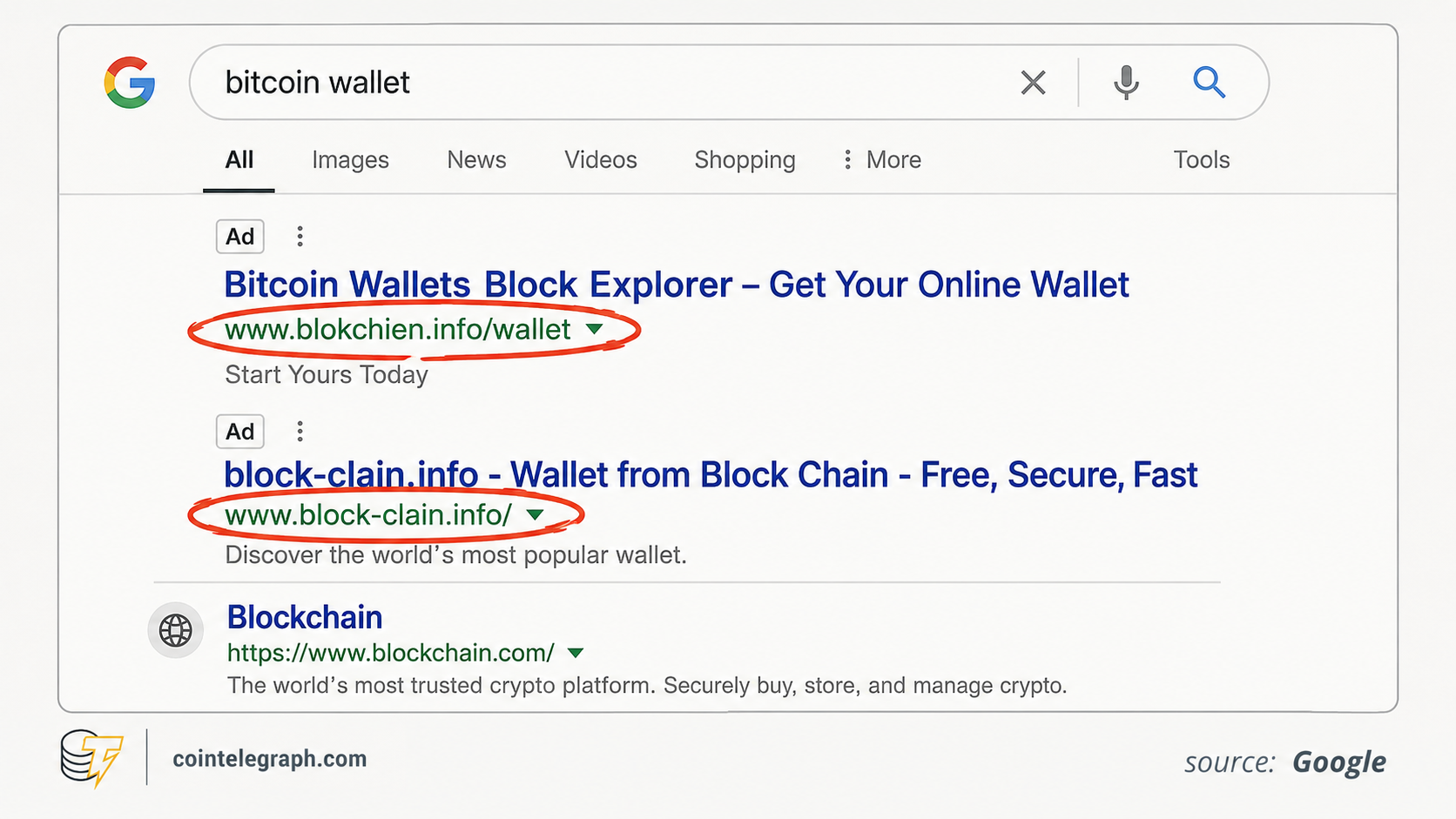
Others use typosquatting, which means registering domains with small spelling changes that are easy to miss at a quick glance. More advanced scams use lookalike characters from other alphabets to make fake URLs appear legitimate.
For the average user, the difference can be almost impossible to spot. As a result, even people who avoid paid ads may still land on phishing pages through normal search results.
-
Crypto security as a user experience challenge
Crypto security advice has traditionally focused on protecting sensitive information: safeguarding seed phrases, using strong passwords, enabling two-factor authentication and storing backups carefully. These recommendations still matter.
However, they are no longer enough on their own.
Many losses today do not happen through stolen credentials. They happen through deceptive experiences that are designed to look almost identical to legitimate ones. In these cases, the weak points are often simple user actions: searching, clicking, approving and trusting familiar-looking interfaces.
As a result, crypto security is becoming a user experience problem as much as a technical one. Real protection requires reducing confusion and deception at every step of the user journey, not just strengthening the final transaction screen.
-
Practical steps to reduce exposure
Simple precautions can greatly reduce a user’s exposure to search-based attacks. They also make rushed decisions less likely.
Bookmarking official websites directly, instead of searching for them each time, removes a major weak point. Sponsored links for wallets, exchanges and DeFi apps are best avoided entirely.
Users should check URLs carefully before connecting a wallet, with special attention to spelling errors and unusual characters. Links should come from verified project accounts and official documentation whenever possible.
Transaction requests should be reviewed carefully instead of approved quickly. When available, users should also use wallet tools that can simulate transactions and flag unusual permissions. Token approvals that are no longer needed should be revoked from time to time.
Above all, it is worth slowing down. Scammers deliberately exploit urgency. A few extra seconds spent checking details can be the difference between a normal interaction and an irreversible loss.
Even with the ongoing controversy surrounding Pi Network, its native token PI continues to attract attention and is regularly featured in price forecasts.
The asset has finally staged a rebound, and it will be interesting to see whether this proves to be only a temporary surge followed by a renewed pullback, or the beginning of a more meaningful rally.
What’s Next?
Earlier in June, the broader crypto market collapsed, and PI was not an exception. Its valuation hit a new all-time low of $0.12, while its market capitalization briefly fell below $1.3 billion. The past two weeks saw a slight recovery, with PI spiking by roughly 6% to its current level of $0.135 (per CoinGecko’s data).
Still, several market observers caution this might not be cause for celebration. X user Crypto With Gopal spotted the formation of a classic “head and shoulders pattern” on PI’s price chart: a bearish structure which suggests that a correction could be on the horizon. At the same time, the analyst claimed that buyers are fighting to defend the neckline “aggressively and bulls are trying to reclaim momentum.”
“Market psychology shows sellers losing strength as the right shoulder develops,” they added.
Another prediction came from the X account Pi Network News, which noted PI’s bounce from the $0.13 support level and claimed that $0.14 remains “a key sell wall.” They argued that bulls need Bitcoin (BTC) to hold above $60,000 so PI can benefit, too.
“Next resistance: $0.15–$0.155 if momentum builds,” the analysis reads.
Now let’s examine some important technical indicators that could provide clues about PI’s next move. First on the list is the token’s Relative Strength Index (RSI), which has dropped to around 7 on a monthly scale. This means it has entered deep into oversold territory, increasing the chance of a decisive rebound. The technical analysis tool ranges from 0 to 100, and anything above 70 is interpreted as a warning of an incoming pullback.

The upcoming token unlocks also strengthen the bullish outlook. Around 127.5 million coins will be released over the next 30 days, averaging approximately 4.2 million per day. This is far less aggressive than what we observed in the previous months and could pave the way for price stabilization.
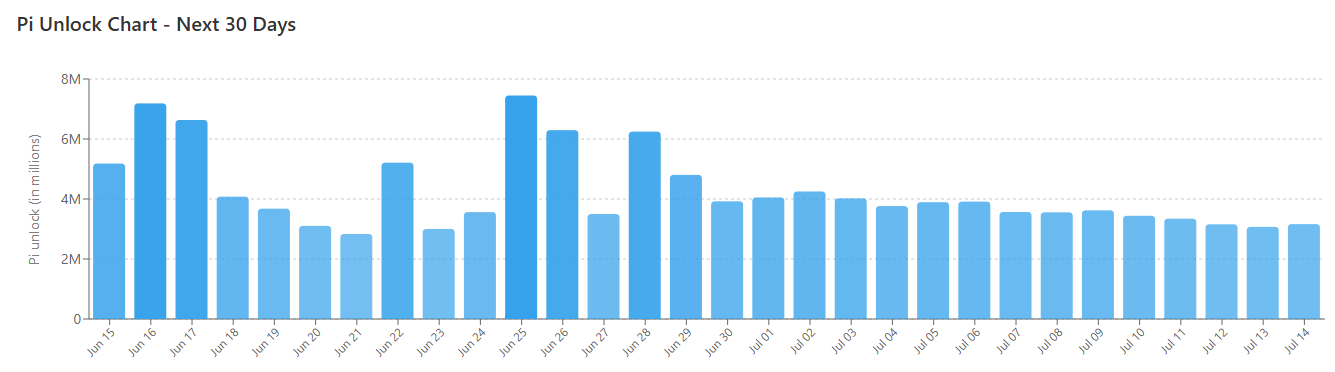
Awaiting This Date
PI is a highly speculative cryptocurrency that relies heavily on groundbreaking announcements and major updates. That is why many Pioneers are perhaps eagerly expecting Pi2Day: a symbolic date for the community celebrated annually on June 28.
Speculation is mounting that the Core Team might disclose something big on that day, including a listing on Binance, which could trigger a major price jump. As of the moment, though, it is all just rumors, so it’s sensible to approach expectations with caution.
The post Pi Network (PI) Climbs 6% in 2 Weeks: Time to Rally or Dead Cat Bounce? appeared first on CryptoPotato.
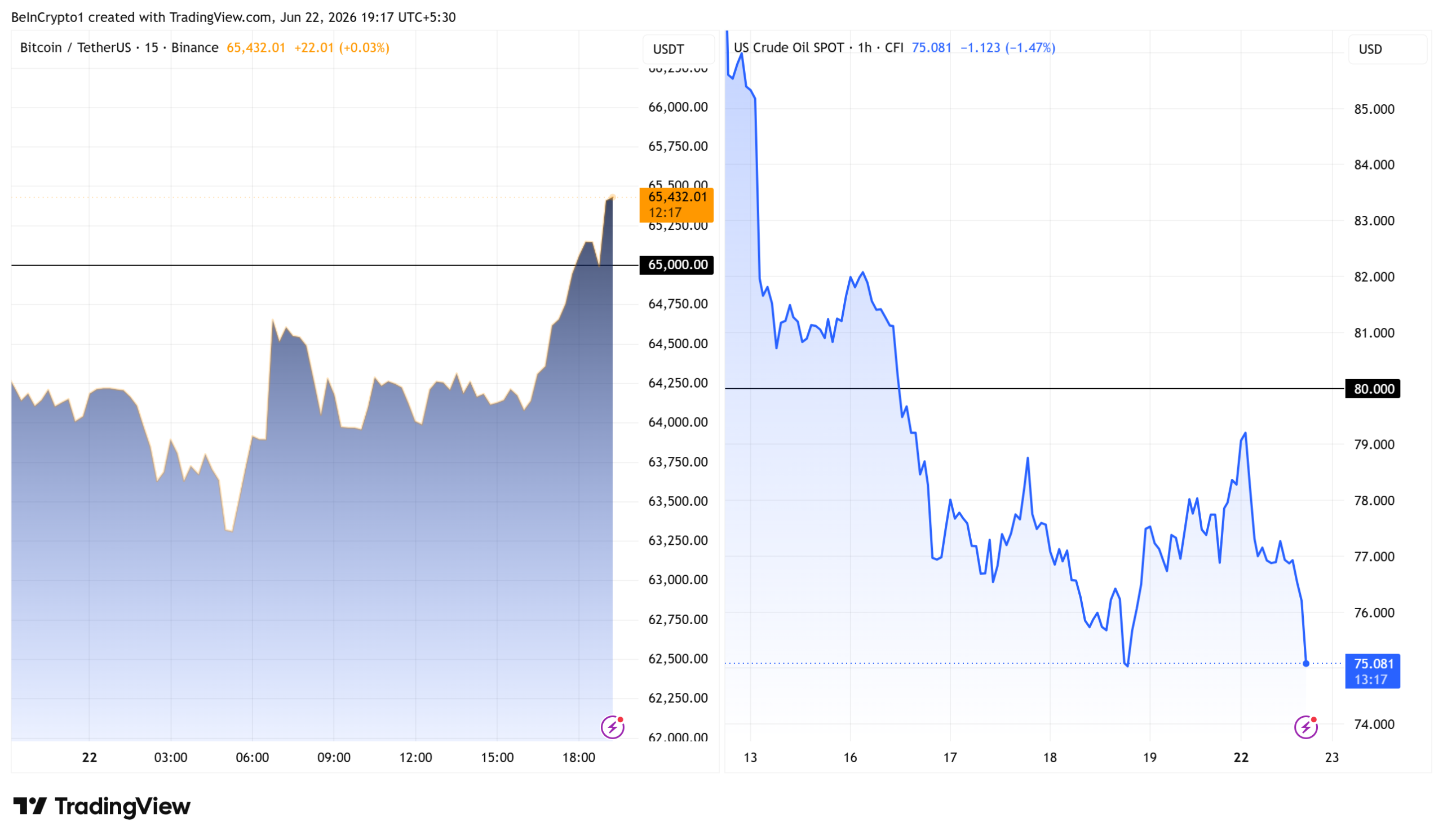
Bitcoin (BTC) reclaimed $65,000 on Monday after Vice President JD Vance said Iran agreed to readmit United Nations nuclear inspectors, a claim that Tehran’s state-linked media quickly disputed.
The pioneer crypto’s bounce tracked a wider risk-on mood as oil eased on Hormuz reopening hopes. Vance spoke in Switzerland after roughly 18 hours of negotiations.

JD Vance Says Iran Agreed to Nuclear Inspections
Vance said his team in Bürgenstock won Iran’s agreement to readmit International Atomic Energy Agency (IAEA) inspectors. He called it the first step in ending Iran’s nuclear weapons program.
The agency pulled its last inspectors in June 2025, after US and Israeli strikes hit Fordow and Natanz. Tehran’s parliament then suspended cooperation, cutting off formal monitoring for roughly a year.
This round was built on the US-Iran peace deal Trump signed earlier this month. A joint statement set a 60-day roadmap, a high-level committee, and working groups on the nuclear file, sanctions, and disputes.
“The Iranians have agreed to invite IAEA inspectors back into their country. That is a major milestone for the American people,” Vance said in an interview.
‘“A lot of the people who were pushing lies and propaganda about the talks failing yesterday, look really stupid right now!!!” Donald Trump Jr quipped.
Iranian Media Disputed the Account
However, Iranian state-linked media challenged the US version within hours. Fars News, affiliated with the Revolutionary Guard, reported the nuclear file was not on the agenda.
Parliament Speaker Mohammad Bagher Ghalibaf, who led Iran’s delegation, had warned a day earlier that Washington should mind its statements. He said Iran’s forces stood ready to respond.
Bitcoin had slid from its October record through the conflict, and traders have watched every war-driven price swing. Yet the rival accounts left any inspection deal unconfirmed.
Bitcoin Reclaims $65,000 as Oil Slides
Bitcoin traded near $65,500 at this writing, up over 2% in the past 24 hours, according to BeInCrypto data. Its recovery from recent lows still left BTC roughly 48% below its October record of $126,080.
Meanwhile, US crude oil spot prices ranged around $75 a barrel, close to their lowest since March. Traders priced in a weeks-long oil slide on bets that Hormuz shipping would recover.

The Strait of Hormuz normally carries about a fifth of the world’s oil, nearly 20 million barrels a day. Flows fell almost 30% to 14.6 million in early 2026 as the conflict disrupted traffic.
Vance also pitched an economic upside, saying any unfrozen Iranian funds would, under a Qatari-brokered plan, buy American crops.

“If Iranian assets are ever unfrozen, they’re going to go to make American farmers richer and to feed the Iranian people. That’s a very, very good and very classic Trump deal,” Vance said in Switzerland.
Follow us on X to get the latest news as it happens
Inspectors who actually arrive will likely shape both diplomacy and market mood in the days ahead.
JD Vance said some contacts with the IAEA could begin within the week.
The post JD Vance Reveals 7 Iran Negotiation Bombshells, Bitcoin Reclaims $65,000 But Oil Falls appeared first on BeInCrypto.
Key Highlights
-
South Korea’s central bank advances digital deposit token initiative for market launch.
-
Enhanced pilot phase introduces peer-to-peer transactions and expanded payment acceptance.
-
Financial institutions demand improved compliance infrastructure and extended development periods.
-
Government subsidy distribution through digital tokens will undergo practical evaluation.
-
Parallel blockchain initiatives demonstrate Korea’s commitment to digital payment innovation.
The Bank of Korea is advancing its digital currency testing program as regulators lay groundwork for uninterrupted service and mainstream adoption. The upcoming testing cycle will integrate electronic payment platforms with traditional banking infrastructure while incorporating peer-to-peer transactions, retail payments, and clearance mechanisms. This initiative signals a strategic pivot from experimental trials to comprehensive digital financial infrastructure.
Financial Institutions Ready for Uninterrupted Digital Token Operations
Korea’s central banking authority and partner financial institutions have engaged in strategic planning to enable seamless Deposit Token operations between developmental stages. These deliberations focus on establishing necessary technological frameworks and regulatory parameters for official deployment. The Korea Federation of Banks delivered comprehensive documentation detailing these strategies to parliamentary member Lee Heon-seung.
Each token issued by commercial banking institutions represents digitized funds secured within traditional deposit accounts. The framework functions through wholesale digital currency infrastructure managed by the central monetary authority. This arrangement maintains commercial banks’ accountability for client deposits while leveraging centralized settlement support.
Initial testing phases provided select participants with digital payment applications from cooperating financial institutions. Users conducted transactions using tokenized balances at designated retail locations under controlled conditions. The evaluation primarily assessed application functionality, transaction execution, and inter-institutional settlement processes.
Enhanced Testing Phase Incorporates Peer Transactions and Extended Banking Functions
The forthcoming evaluation stage will broaden consumer and merchant participation throughout the payment network. Additional features include direct user-to-user fund transfers and authorization for banks to establish proprietary token services. Financial institutions will integrate these capabilities with fundamental account infrastructure and established settlement procedures.
The augmented initiative demands reinforced financial crime prevention protocols and enhanced transaction monitoring frameworks. Banks must implement sophisticated fraud prevention mechanisms and upgrade supporting technology infrastructure before broader implementation. Consequently, participating institutions have requested allocated funding and extended development timelines from monetary authorities.
Financial institutions contended that the enhanced evaluation constitutes a distinct initiative beyond simple pilot continuation. Direct user transfers and expanded merchant acceptance introduce substantial regulatory compliance and operational demands. The central bank subsequently modified scheduling parameters and authorized advisory services connected to commercialization strategies.
Electronic Voucher System Enables Government Disbursement Evaluation
The program will additionally assess corporate treasury transactions through electronic vouchers connected to governmental funding initiatives. According to implementation plans, officials will distribute designated electric vehicle infrastructure subsidies via tokenized payments. Businesses can subsequently receive and process governmental assistance within the participating financial network.
The second evaluation cycle will examine how tokenized funds operate within conventional banking accounts and financial ecosystems. It will also analyze whether digital token infrastructure can facilitate policy disbursements and monitored public expenditure. These capabilities could deliver enhanced transaction transparency and accelerated settlement across authorized governmental programs.
Korean financial entities are simultaneously exploring public distributed ledger systems for alternative payment solutions. Toss Bank recently formalized collaboration with the Solana Foundation encompassing cross-border remittances, settlement operations, stablecoins, and tokenized securities. This initiative remains distinct as it utilizes public blockchain infrastructure rather than the central authority’s CBDC architecture.
The central bank’s program constitutes a component of South Korea’s comprehensive examination of tokenized currency and digital settlement mechanisms. Its forthcoming phase will evaluate payments, transfers, vouchers, and commercial banking operations within a unified regulatory framework. Findings will inform policymakers regarding specifications for comprehensive digital token deployment.
Key Highlights
- Stock+ enables qualified traders to purchase authentic US equities using cryptocurrency holdings.
- Platform provides genuine share ownership with dividend rights and stock split participation.
- Digital assets are converted to USDC prior to executing US equity transactions.
- Stock+ complements rTokens within Bitget’s comprehensive Stocks 2.0 initiative.
- This rollout reinforces Bitget’s expansion into traditional financial markets via crypto integration.
Bitget has introduced Stock+, a new offering that permits qualified traders to purchase authentic US stocks and exchange-traded funds using digital currencies through a unified account interface. The platform transforms cryptocurrency holdings into USDC before transmitting equity orders via authorized brokerage partners. This initiative broadens Bitget’s approach to integrate digital currencies, tokenized securities, commodities, and traditional equities within a single ecosystem.
Stock+ Delivers Authentic Ownership with Fractional Trading Capabilities
Bitget explained that Stock+ grants ownership of actual underlying securities instead of synthetic products or derivative instruments. Traders receive cash dividend payments, gain from stock split events, and obtain shareholder privileges through compliant custody frameworks. The platform additionally accommodates purchases starting from 0.0001 shares, reducing barriers for participants with limited capital.
Transactions flow through RQD Clearing and Atomic Vaults Securities before arriving at prominent US exchange venues. Traders can execute orders during pre-market, standard, after-hours, and overnight periods, subject to market conditions and instrument availability. Bitget further offers complimentary Level 1 market information, while commission rates begin at 0.1% for each completed trade.
The system accepts incoming transfers from compatible brokerage firms, enabling traders to consolidate current equity positions with digital asset portfolios. Nevertheless, Bitget has not yet clarified if outgoing stock transfers will be accessible immediately following the product debut. Availability will vary according to regional regulations, brokerage partnerships, and client qualification standards across different territories.
Stocks 2.0 Framework Advances Bitget’s Diversified Asset Approach
Stock+ represents a component of Bitget’s broader Stocks 2.0 initiative, which focuses on conventional markets and tangible assets. Previously in June, the organization unveiled Reality, a compliant tokenization infrastructure supporting its expanding rToken product suite. These instruments deliver blockchain-powered exposure to over 500 US equities and ETFs through broker-connected frameworks.
Bitget reported that total assets under management throughout its tokenized equity offerings have surpassed $50 million following their debut. The current service now positions direct equity ownership alongside tokenized options within the identical account framework. Traders can select regulated brokerage shares or blockchain-based exposure based on their preferred ownership model.
This release positions Bitget in competition with platforms already merging cryptocurrencies with equities and additional traditional financial instruments. Kraken, Robinhood, eToro, Interactive Brokers, and Public deliver various configurations of cryptocurrency and equity market connectivity. Concurrently, numerous exchanges and protocols continue advancing tokenized securities, stablecoin settlement systems, and comprehensive multi-asset trading capabilities.
Bitget employs stablecoins as a funding intermediary while preserving regulated execution for direct equity acquisitions. This framework minimizes transfers across banks, brokerages, and cryptocurrency platforms for qualified traders already maintaining digital asset positions. Stock+ consequently advances Bitget’s mission to deliver cryptocurrency and traditional market exposure via a consolidated trading interface.


Morgan Stanley filled in the blanks on its two single-asset crypto trusts last Thursday, filing amended S-1 registration statements for a spot Solana Trust and a spot Ethereum Trust that now identify the custodians, sponsor fee and tickers left open in the original January filings. The Solana… Read the full story at The Defiant

Ethereum trades at $1,733.20 after a 0.10% daily decline, with analysts now watching the $1,060 level if support at $1,731 fails. The drop coincides with $180 million in Bitcoin long liquidations hitting leveraged traders as BTC slides to $63,952, down 0.44% over 24 hours. In this environment of spot-market stress, the Gruntle ($GRUNTLE) presale has quietly accumulated $106,570 at a fixed entry price of $0.000637, positioning itself as an alternative for buyers seeking asymmetric upside without the volatility of open-market positions.
Next 100x Crypto 2026: ETH Tests $1,731 Support as Analysts Eye $1,060 Level
Ethereum’s 18% decline over the past 30 days has brought the second-largest crypto to a critical technical zone. RSI sits at 42.7, indicating neither oversold nor overbought conditions, but the price remains below both the 50-day SMA at $1,979 and the 200-day SMA at $2,357. CoinCentral’s analysis of ETH’s $1,700 support level notes that a sustained break below this zone could accelerate selling toward the $1,060 area, a level not seen since the 2023 bear market bottom.
The technical picture contrasts sharply with Gruntle’s presale mechanics. While ETH holders absorb mark-to-market losses, $GRUNTLE buyers lock in a fixed $0.000637 entry that does not fluctuate with spot volatility. The current round has raised $106,570 of its $125,664 target at 84.8% filled, with the price scheduled to rise to $0.000639 when Round 12 opens.
BTC Longs Liquidated for $180M as Traders Debate $60K Sweep
Bitcoin’s slide to $63,952 triggered $180 million in long liquidations over the past 24 hours, according to aggregated derivatives data. The wipeout hit leveraged bulls who had positioned for a breakout above $67,000, with BTC now trading 5.2% below its 20-day high of $67,420. RSI at 40.8 suggests weakening momentum, though the price remains above the recent 20-day low of $59,070.
The liquidation cascade underscores the risk embedded in leveraged spot and derivatives trading. Gruntle’s presale model, by contrast, offers no leverage and no liquidation risk. Buyers receive a fixed token allocation at the current round price, with settlement occurring at the Phase 3 DEX listing. The presale has attracted $106,570 in raised capital without the volatility that erased $180 million from overextended BTC positions.
XRP Briefly Lost $1.14 Support Before Buyers Drive Rebound
XRP dropped to $1.13 after briefly losing the $1.14 support level, marking a 1.30% decline on the day before buyers stepped in to reclaim the zone. CoinDesk’s report on XRP’s sharp rebound highlights the volatility inherent in mid-cap altcoins, where support breaks can trigger cascading stops before dip buyers emerge. XRP now sits 12.6% below its 20-day high of $1.29, with RSI at 39.9 indicating continued selling pressure.
The XRP price action illustrates the binary risk of spot trading: support either holds or it fails, and the outcome determines whether buyers profit or absorb losses. Gruntle’s presale eliminates that binary during the intake period. The $0.000637 entry holds until Round 11 closes, regardless of what XRP, ETH, or BTC do in the interim.
$GRUNTLE Presale Crosses $106,570 With Anti-Hype Positioning
Gruntle has raised $106,570 in its presale at a current price of $0.000637, with Round 11 now 84.8% filled toward its $125,664 target. The project differentiates itself through deliberate anti-hype positioning: no influencer shilling, no manufactured FOMO, and no promises of guaranteed returns. In a market saturated with meme coins promising moonshots, Gruntle’s deadpan capybara mascot and government-terminal aesthetic offer a different kind of credibility.
The project has been audited by CredShields on May 13, 2026, with the full report available via Gruntle’s CredShields audit. The ERC-20 token contract at 0x959583858090bba7e0311e4bD944311DCD827038 has been verified, and the multi-sig treasury is live. These infrastructure pieces are in place before the Phase 3 DEX listing, not after.
A $1,000 entry at the current presale price of $0.000637 acquires approximately 1,570,000 $GRUNTLE tokens. At a conservative 10x from the presale entry, that position could be worth around $10,000. The math is asymmetric: a small allocation buys a large token count while the price remains at presale entry, not post-listing market price.
Hibernation Staking Pays 5,445% APY (Variable) for Early Entrants
Hibernation Staking currently pays 5,445% APY, computed as each staker’s share of a fixed 250-million-token rewards pool. The APY is variable: it drops as more tokens stake, rewarding early entrants with a larger slice of the pool. As of the latest on-chain data, 4,591,680 tokens are already staked, and the live APY reflects that pool depth.
The staking contract at 0x780dbcbcf0eef53d03248e1561450fe87cfbd561 allows buyers to stake immediately after purchase, compounding yield while waiting for the Phase 3 DEX listing. The mechanism favors early participation: every new staker dilutes the APY for existing positions, creating a genuine incentive to enter before the pool grows larger.
Round 11 at 85% Filled With Hard Cap Mechanics
Round 11 has raised $106,570 of its $125,664 target, reaching 84.8% capacity. The round closes when the cap fills or when the round timer expires, whichever comes first. Once Round 11 closes, the price increases to $0.000639 in Round 12, a 0.3% jump that compounds across the full presale ladder. The listing price is set at $0.000713, representing an 11.9% premium to the current entry.
Check Out the Gruntle Website to Join the Presale
The presale operates alongside active peers in the current cycle. Bitcoin Hyper has raised $32.87 million from 113,462 participants at $0.013682 per token, while Pepeto has accumulated $10.30 million from 36,353 buyers at $0.00000019. Gruntle’s $106,570 raise positions it as a smaller-cap entry point in the same presale cohort, with the fixed-price mechanics and audited infrastructure already in place.
Secure your allocation before Round 11 closes.
FAQ
What is the next 100x crypto 2026 for early-stage returns?
The next 100x crypto 2026 for early-stage returns could emerge from presale-stage entries where buyers lock in fixed prices before public listings. $GRUNTLE offers a $0.000637 entry, Hibernation Staking at 5,445% APY (variable), and a CredShields audit dated May 13, 2026, with $106,570 already raised. Early presale positions may capture asymmetric upside if the token lists at a premium, though all forward-looking returns remain speculative. Details at gruntle.io.
What makes a presale a candidate for the next crypto to explode?
A presale could become a candidate for the next crypto to explode when it combines audited infrastructure, transparent tokenomics, and a clear listing roadmap. $GRUNTLE meets these markers with a verified ERC-20 contract, a 250-million-token staking pool paying 5,445% APY (variable), and Phase 3 DEX listing plans. The current $0.000637 entry holds until Round 11 closes at $125,664 raised.
What makes $GRUNTLE different from other meme coin presales?
$GRUNTLE differentiates through anti-hype positioning: no influencer shilling, no manufactured FOMO, and honest communication about what the token is. The project was audited by CredShields on May 13, 2026, and the presale has raised $106,570 at $0.000637 with Hibernation Staking paying 5,445% APY (variable, decays as more stake). The deadpan capybara mascot reflects the brand’s deliberately unbothered identity.
This article is for informational purposes only and does not constitute financial advice. $GRUNTLE is a meme coin. Cryptocurrency investments carry significant risk. Always conduct your own research before investing.
Disclaimer: This is a Press Release provided by a third party who is responsible for the content. Please conduct your own research before taking any action based on the content.

ICE: We Don’t Have A Database Of ICE Protesters, Just A Database Of People Who Are *Probably* ICE Protesters

How To Create A Faceless Finance Tips Channel : Full Guide!

Spanish airports could be in hot water over controversial ‘jacket policy’


-

 Fashion3 days ago
Weekend Open Thread: Miami – Corporette.com
-
 Tech6 days ago
The Adder At The Heart Of Intel’s 8087 FPU
-

 Entertainment2 days ago
Renter of Home in Anne Heche Crash Denies Settlement With Son
-

 Business2 days ago
Soccer-U.S. defends Iran World Cup travel restrictions, says discussions ongoing
-
 Business3 days ago
Wall Street Week Ahead: Investors see Micron earnings as pulse check of AI rally momentum
-

 Politics4 days ago
BBC Reporter Discusses Cross Party Criticism Of Trumps Iran Deal
-

 Crypto World3 days ago
HIVE shares jump as $220M AI deal speeds Bitcoin mining pivot
-

 Crypto World2 days ago
Jake Chervinsky accuses CME of protecting derivatives monopoly
-
 Crypto World2 days ago
Can Charles Hoskinson Really Rescue Cardano?
-

 Sports4 days ago
FIFA World Cup 2026: Canada beat 9-men Qatar 6-0 to register first ever win | FIFA World Cup 2026
-

 Business2 days ago
MHP SE 2026 Q1 – Results – Earnings Call Presentation (OTCMKTS:MHPSY) 2026-06-20
-

 Business4 days ago
Brexit cost 6% of UK economy, Bank of England company data suggests
-

 Crypto World4 days ago
Anthropic’s Dario Amodei Urged AI Unity at G7, Even as US Banned His Models
-

 Politics2 days ago
Andy Burnham and the meaning of Makerfield
-

 Tech4 hours ago
Microsoft accidentally kills epic Outlook email threads
-

 Crypto World7 days ago
Robinhood opens AI-powered trading to all users, sending HOOD stock past $100
-

 Tech5 days ago
Weeks Of In-The-Field Testing And A Verdict
-

 Tech4 days ago
Adobe adds its AI assistant to Premiere, Illustrator and InDesign
-
 Tech1 day ago
Signal’s Meredith Whittaker says AI chatbots ‘are not your friends’ and calls Copilot agents a backdoor
-
 Crypto World4 days ago
Iren (IREN) Stock Surges on Jefferies Buy Rating: AI Infrastructure Play Gains Momentum
You must be logged in to post a comment Login