
Crypto World
Bitcoin slides on the final day of July while equities boom

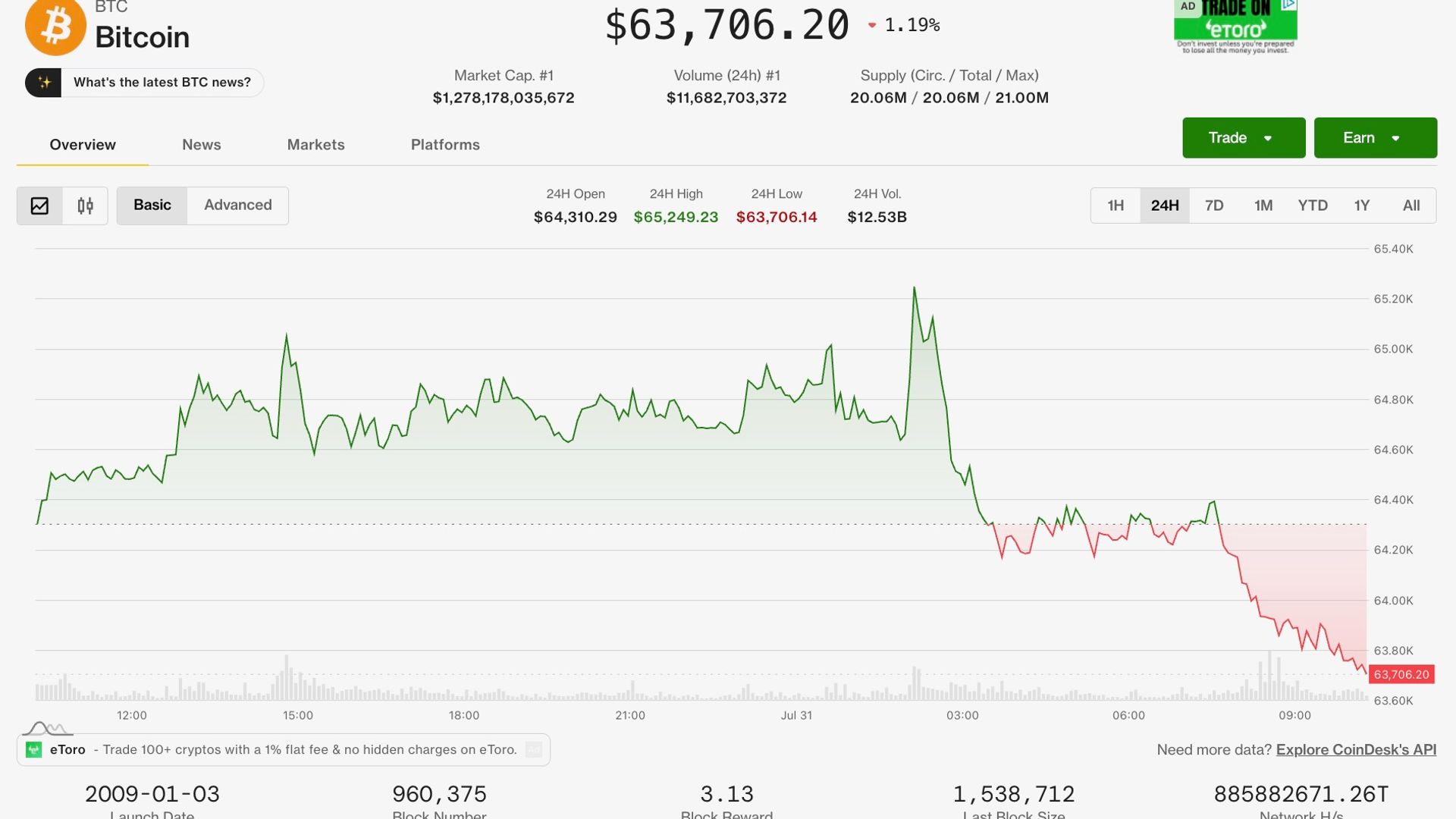
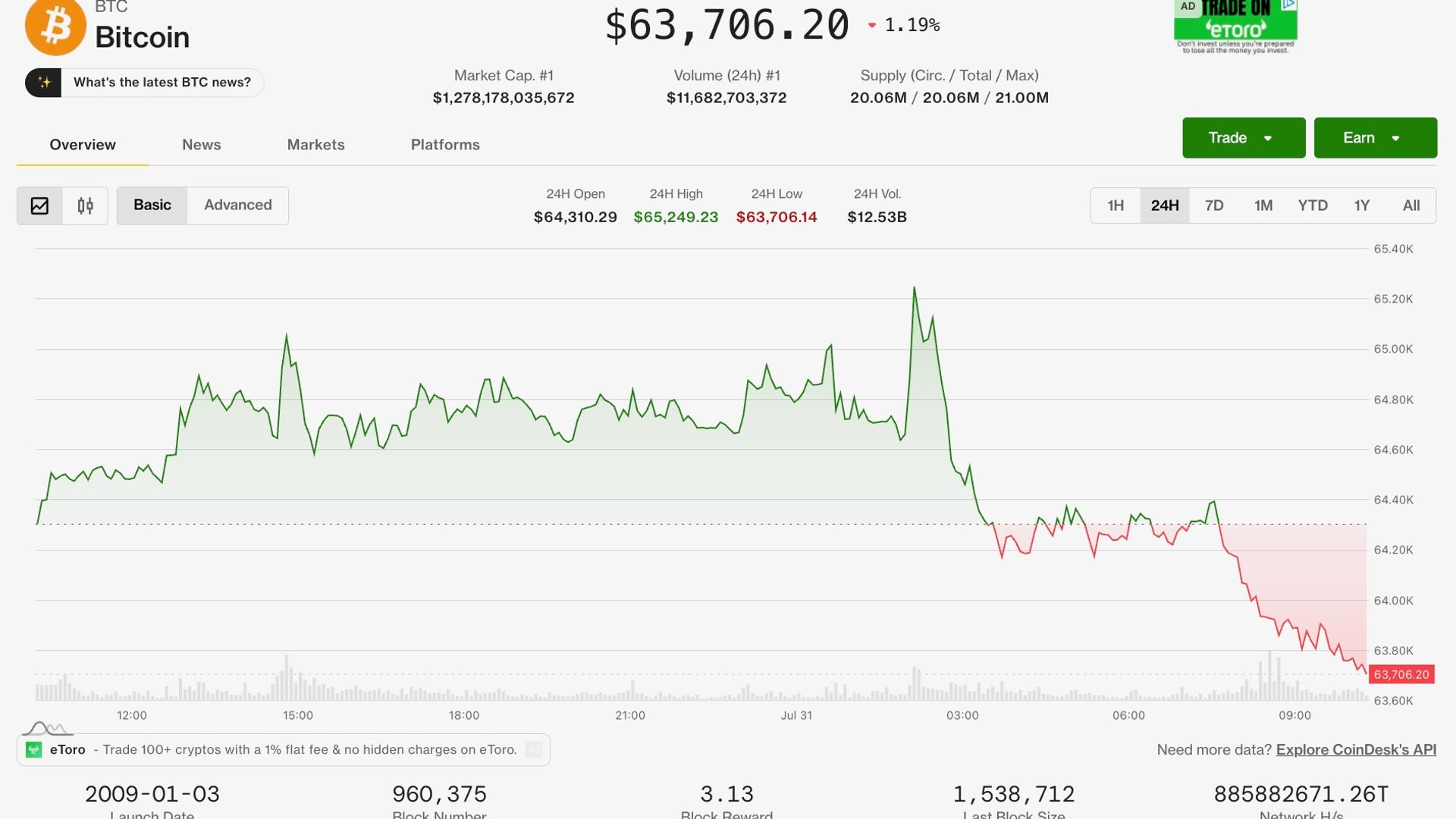
The crypto market is closing out July on the back foot, with bitcoin falling 1.31% since midnight UTC to $63,870 and ether (ETH) dropping 1.40% to $1,890 after struggling to regain the $2,000 level it touched earlier this month.
The performance is diverging from equities, with South Korea’s Kospi surging by more than 15%. Nasdaq 100 and S&P 500 index futures are also in the green.
The conflict in the Middle East and hawkish comments from the Federal Reserve committee have dented crypto’s recovery hopes this week. The CoinDesk 20 Index has dropped 2.34% since midnight Monday, though with a gain of 8.7% since June, it’s still positive for the first month in three and by the most in a year.
Derivatives positioning
- Taker long-short futures volume ratio: As the market wilts, the taker long-short futures market volume ratio continues to lean bearish, suggesting a downside bias. A taker is a market participant who executes an order immediately against an existing order in the book.
- XRP futures open interest rises: XRP’s futures open interest (OI) rose further, extending the three-week upswing to 2.27 billion tokens, the most since late June. The token’s price has declined to $1.07 from $1.13 during the period. A combination of a drop in price alongside a rise in OI is said to confirm the downtrend, a sign traders are shorting the market in anticipation of a deeper price drop.
- BTC in stasis: BTC’s OI remains static at around 750K, as it has all month. That’s a sign traders are unwilling to deploy capital in leveraged products despite signs of stability in the market. It’s no surprise that BTC’s early month bounce from under $58K has stalled in the $62K to $65K range. It’s the same story for ether and Solana.
- UNI’s OI growth: Uniswap’s UNI token is the OI growth leader for the third straight day, rising to 75.80 million UNI, a level last seen Feb. 14. This is a clear sign of investors willing to take on risk in tokens backed by positive newsflow. Recently, BlackRock decided to debut its tokenized Treasury fund on Uniswap.
- Negative cumulative volume delta: Most major tokens, including UNI, have negative 24-hour OI-adjusted cumulative volume delta, a feature consistently observed during sharp downtrends over the past year. A negative CVD means traders are shorting more at market orders than passive limit orders. In other words, bears are being more aggressive.
- Bitcoin implied volatility: Bitcoin’s BVIV, the 30-day implied volatility index, fell to 37%, the lowest since May. These levels have served as floors in recent years, bringing about a bounce in the so-called fear index. Since ETFs debuted in 2024, the BTC price correlation with the BVIV has been negative, meaning any bounce in the BVIV could be accompanied by a fresh decline in the spot price.
- Options open interest: On Deribit, bitcoin and ether options worth $10 billion expired early today. Now the distribution of open interest in remaining expiries that extend all the way to June 2027 shows a $60,000 put as the most popular bet. A put represents a bearish bet on the market.
Token talk
- Uniswap (UNI) was Friday’s standout performing altcoin, rising by 9.30% over 24 hours to $4.41 as it sustains momentum from its Robinhood layer-2 integration announced earlier this month.
- Ethena (ENA) extended its recovery, rising 1.23% since midnight UTC and 4.31% over 24 hours to $0.082, with the token now up significantly from its July lows. Keep in mind it’s still more than 90% below its all-time high.
- Lighter (LIT) fell a further 2.28% as the correction from its July peak deepened, with the token now 20% below the highs it set earlier this month after its 200% rally between May and early July.
- Zcash (ZEC) gave back 2.15% to $459 after a strong run earlier in the week, with the privacy coin sector losing ground on Friday.
- added 0.94% since midnight and 4.09% over 24 hours, quietly extending a recovery that has seen it claw back after June’s 45% plunge.



Ken Griffin’s Citadel has bought most of Situational Awareness’ AI stock portfolio at a discount, a move that represents another victory for the billionaire villain of the crypto industry.
Indeed, despite years of criticism about Griffin’s traditional finance tactics, the crypto industry keeps giving him more assets.
From a copy of the US Constitution, payment for order flow, equity in a $40 billion crypto holding company, and a new distressed portfolio of cheap AI stocks, crypto traders are far too willing to further enrich the billionaire CEO.
Margin calls gutted former FTX Future Fund member Leopold Aschenbrenner’s AI hedge fund earlier this week, turning the 25-year-old into a forced seller liquidated under a stack of self-imposed leverage to Griffin’s standing bid.
Griffin, unlike most crypto investors, had plenty of cash amid Aschenbrenner’s distress.
The New York Times reported that Citadel won the overnight auction for Situational Awareness’ AI stocks at a “considerable reduction” to market value.
Crypto has watched this movie before.
Cheap share certificates alongside a cheap US Constitution
When the crypto industry’s people, tokens, or trophies land across the negotiating table from Griffin, more often than not, traders often accept his lowball offer. At the eleventh hour, a little cash is better than nothing at all.
Consider what happened in November 2021 when ConstitutionDAO raised over $40 million of ETH to bid on a physical print of the US Constitution. Over 17,000 donors chipped in at a median of $206 apiece.
Their crowdfunded bid carried a fatal flaw, as Protos noted. Its balance sat on-chain in public view, so rival bidders like Griffin knew precisely where their money to bid would run out.
The DAO also reserved millions for fees and costs that it couldn’t spend on bids.
Griffin won the document at $43.2 million. Sotheby’s irrevocable-bid mechanics trimmed roughly $4.2 million off his final bill. This spring, he bought the only other privately owned first print, cornering the market for the immensely valuable collectible, despite crypto’s attempt to decentralize it.
Thanks for the payment for order flow
Payment for order flow is a predictable profit generator for sophisticated market-makers and quantitative trading companies like Citadel.
Whenever a stock brokerage or similar platform offers commission-free or “$0 fee” trades, they often engage in payment for order flow on the backend.
Citadel Securities has accounted for over 40% of all US payment for order flow in some years, and it’s happy to accept order flow from crypto traders who inefficiently smash buy or sell with “market” orders.
Of course, retail crypto traders also buy stocks and options — the same folks who route even more payment for order flow through Citadel.
On crypto trades, for example, Robinhood discloses that market makers pay it $0.95 per $100 of orders routed. Its SEC filings identify B2C2, Wintermute, and Citadel Securities among the companies paying for order flow.
Read more: Ken Griffin wants the SEC to follow Citadel’s advice about DeFi
Ripple equity, cheaper than its own tokens
Consider another example of Griffin’s one-sided crypto dealings.
In November 2025, Ripple raised $500 million at a $40 billion valuation. Affiliates of Citadel Securities co-led the round.
Although the valuation seemed impressive, Griffin wasn’t taking much risk. In fact, XRP was trading near $2.35 the day of the announcement.
That day, Ripple held roughly 37 billion XRP, a pile worth about $87 billion that day.
In other words, Citadel bought shares in a company valued at less than half its crypto holdings.
In addition to his incredibly discounted valuation, Griffin also received protections from the price risk of XRP itself.
Bloomberg reported the fine print that benefitted Citadel. Absent an IPO or sale within a few years, those Ripple investors would have the right to put their shares back to the company at a positive annual rate of return.
Citadel’s rights also stand ahead of existing shareholders in the event of any liquidation.
In summary, crypto has gifted Ken Griffin and Citadel a cheap portfolio of AI stocks, a cheap Sotheby’s art piece, cheap payments for order flow, and cheap equity at less than half its balance sheet.
Despite describing crypto in October 2021 as a “jihadist call” against the US dollar, it’s been paying him ever since.
Got a tip? Send us an email securely via Protos Leaks. For more informed news and investigations, follow us on X, Bluesky, and Google News, or subscribe to our YouTube channel.

In today’s fast-paced economy, waiting 30, 60, or even 90 days for invoice payments can strain a company’s cash flow. For small and medium-sized businesses (SMBs), delayed payments often mean delayed growth, missed opportunities, and increased reliance on expensive loans.
Blockchain-powered invoice financing is emerging as a modern solution that transforms unpaid invoices into liquid capital while making the financing process faster, more transparent, and significantly more secure.
What Is Invoice Financing?
Invoice financing allows businesses to borrow money against outstanding invoices instead of waiting for customers to pay.
Here’s a simple example:
- A business issues a $50,000 invoice with 60-day payment terms.
- Instead of waiting two months, it receives up to 90% of the invoice value immediately from a financing provider.
- Once the customer pays the invoice, the remaining balance is released after deducting financing fees.
This gives businesses immediate working capital without selling equity or taking on traditional debt.
The Problems With Traditional Invoice Financing
While invoice financing isn’t new, the traditional system has several inefficiencies.
Slow Verification
Financial institutions spend significant time verifying:
- Invoice authenticity
- Customer creditworthiness
- Business ownership
- Payment history
This manual process often delays funding.
Fraud Risks
Invoice fraud remains one of the industry’s biggest concerns.
Examples include:
- Fake invoices
- Duplicate financing
- Altered payment records
- Identity fraud
Because records are stored across multiple databases, detecting fraud isn’t always easy.
High Costs
Banks and factoring companies charge fees to cover operational costs and credit risk.
Smaller businesses frequently pay higher financing rates simply because they lack extensive credit histories.
How Blockchain Changes Everything
Blockchain introduces a shared, immutable ledger where invoices can be securely recorded and verified.
Instead of relying solely on paperwork, participants share a trusted source of truth.
Key benefits include:
Immutable Records
Once an invoice is recorded on-chain, it cannot be secretly altered.
This creates confidence among:
- Lenders
- Suppliers
- Buyers
- Auditors
Instant Verification
Blockchain enables participants to verify invoice ownership almost immediately.
Smart contracts can automatically confirm:
- Invoice creation
- Payment terms
- Due dates
- Financing status
This dramatically reduces manual paperwork.
Reduced Fraud
Every invoice receives a unique blockchain record.
This helps prevent:
- Double financing
- Duplicate invoices
- Unauthorized modifications
The transparent audit trail makes suspicious activity easier to detect.
Faster Settlement
Smart contracts automate funding.
Once financing conditions are met, payments can be released automatically without multiple intermediaries.
Businesses receive working capital much faster.
The Role of Smart Contracts
Smart contracts are self-executing programs stored on blockchain networks.
Instead of requiring manual approval, they automatically execute financing agreements.
For example:
- Supplier uploads invoice.
- Invoice is verified.
- Investor funds the invoice.
- Customer pays invoice.
- Smart contract distributes repayment automatically.
This reduces administrative overhead while minimizing human error.
Tokenizing Invoices
One of blockchain’s most exciting innovations is invoice tokenization.
An invoice can be represented as a digital asset on a blockchain.
This creates several new possibilities:
- Fractional ownership
- Secondary trading
- Global investor participation
- Increased liquidity
Instead of one lender financing an invoice, hundreds of investors could fund portions of it.
This opens invoice financing to decentralized capital markets.
DeFi Meets Invoice Financing
Decentralized Finance (DeFi) extends this concept even further.
Businesses may eventually:
- Tokenize invoices
- Use them as collateral
- Borrow stablecoins instantly
- Repay automatically when invoices settle
Rather than negotiating with a bank, financing could occur through decentralized liquidity pools operating around the clock.
This creates a more accessible financial ecosystem, particularly for underserved markets.
Benefits for Small Businesses
Blockchain-powered invoice financing offers several advantages.
Improved Cash Flow
Businesses gain immediate access to funds needed for:
- Payroll
- Inventory
- Marketing
- Expansion
Lower Costs
Automation reduces operational expenses, potentially lowering financing fees.
Greater Transparency
All financing activity is recorded on a shared ledger, reducing disputes between parties.
Expanded Access
Businesses with limited banking relationships may access financing through blockchain-based marketplaces rather than traditional lenders.
Benefits for Investors
Investors also benefit from blockchain-enabled invoice markets.
Potential advantages include:
- Transparent asset verification
- Automated repayments
- Diversified investment opportunities
- Global access to invoice portfolios
Tokenization may allow investors to purchase small portions of many invoices rather than concentrating risk in a single borrower.
Real-World Use Cases
Several industries stand to benefit significantly.
Manufacturing
Manufacturers often wait months for payment while continuing production.
Invoice financing bridges this gap.
Logistics
Shipping companies can unlock capital tied up in completed deliveries.
Healthcare
Hospitals and clinics frequently experience delayed insurance reimbursements.
Blockchain financing can improve liquidity.
International Trade
Cross-border invoice financing becomes more efficient through shared blockchain records that reduce paperwork and verification delays.
Challenges Ahead
Despite its promise, blockchain-powered invoice financing still faces obstacles.
Regulatory Compliance
Financial regulations differ across countries, requiring platforms to comply with local lending laws.
Digital Identity
Reliable identity verification remains essential to prevent fraud.
Enterprise Adoption
Many businesses continue using legacy accounting systems that require blockchain integration.
Legal Recognition
Some jurisdictions are still developing legal frameworks for tokenized financial assets.
The Future of Invoice Financing
As tokenization, digital identity, stablecoins, and smart contracts mature, invoice financing could become one of blockchain’s most impactful real-world financial applications.
Future platforms may combine:
- AI-powered credit scoring
- Blockchain verification
- Tokenized invoices
- Instant stablecoin settlement
- Global investor marketplaces
The result is a financing ecosystem that is faster, more transparent, and available to businesses regardless of geography.
Conclusion
Blockchain-powered invoice financing reimagines one of business finance’s oldest challenges: waiting to get paid.
By combining immutable records, smart contracts, tokenization, and decentralized liquidity, blockchain has the potential to reduce fraud, accelerate funding, and broaden access to working capital.
For businesses, this means healthier cash flow and greater flexibility. For investors, it unlocks a new class of transparent, income-generating assets. As adoption grows, blockchain may transform invoice financing from a slow, paperwork-heavy process into a seamless digital marketplace that keeps capital moving as quickly as modern commerce demands.
REQUEST AN ARTICLE


Bernstein has maintained its Outperform rating on Robinhood Markets with a $160 price target, saying the company’s crypto business has expanded beyond trading into tokenization and market infrastructure.
Summary
- Bernstein kept its Outperform rating on Robinhood and maintained a $160 price target.
- Robinhood Chain has processed more than $12 billion in DEX volume and over 150 million transactions since launch.
- Rothera has handled more than 3.5 billion contracts and generated $17 million in second quarter revenue.
- Bernstein said tokenized stocks, Robinhood Earn and exchange infrastructure are becoming key drivers of the company’s crypto business.
Bernstein said in a note to clients that Robinhood’s latest crypto products, including Robinhood Chain, tokenized stocks, Bitstamp and Robinhood Earn, are creating new growth opportunities outside its traditional trading business while supporting its long-term investment case.
Robinhood shares closed at $89.84 on Wednesday, the level Bernstein used in calculating about 78% upside to its unchanged $160 target. The stock later fell 3.6% to close at $86.60 on Thursday, implying roughly 85% upside based on the firm’s target price.
Robinhood Chain and tokenized stocks expand crypto business
Among the products highlighted in the report, Bernstein pointed to Robinhood Chain as one of the company’s largest crypto initiatives since entering tokenization. According to the brokerage, the blockchain has processed more than $12 billion in decentralized exchange volume and completed over 150 million transactions since launch.
The report also said Robinhood Earn has accumulated more than $200 million in customer deposits. Meanwhile, tokenized U.S. stocks are now available through Robinhood Wallet in more than 120 countries, extending the company’s reach beyond its core brokerage platform.
Bernstein said the latest developments continue a strategy Robinhood has been building throughout the year. In June, the firm argued that prediction markets had become one of Robinhood’s fastest-growing businesses during the FIFA World Cup, projecting the segment could generate $586 million in revenue in 2026 compared with an estimated $150 million in 2025.
At the time, Bernstein estimated prediction markets could account for about 17% of Robinhood’s transaction-based revenue and around 10% of total company revenue next year, supported by higher customer activity during major sporting events.
Rothera continues to scale prediction markets
Attention in the latest report also turned to Rothera, Robinhood’s exchange, which Bernstein said has continued expanding since going live in June.
According to the analysts, Rothera has processed more than 3.5 billion contracts so far, including 2.1 billion during the second quarter alone. The exchange generated $17 million in second-quarter revenue and has become the third-largest prediction market exchange in the United States, Bernstein said.
The research note said Robinhood expects more prediction-market activity to migrate onto Rothera over time while continuing to distribute event contracts from third-party exchanges. Bernstein added that management also sees the exchange as a potential business-to-business platform for other Futures Commission Merchants in the future.
The brokerage has previously argued that controlling more of the trading stack allows consumer platforms to retain a larger share of transaction economics. In a June research report, Bernstein said companies across crypto, brokerages and sports betting are increasingly combining brokerage, exchange and clearing functions instead of depending on outside providers.
Robinhood’s ownership of Rothera was presented as one example of that trend, alongside similar moves by Coinbase and DraftKings to build or acquire more of their own trading infrastructure.
Bernstein sees infrastructure becoming a competitive advantage
Beyond trading volumes, Bernstein said Robinhood’s strategy increasingly resembles a financial infrastructure business rather than a brokerage focused only on crypto transactions.
The analysts grouped Robinhood Chain, Bitstamp, Robinhood Earn and tokenized stocks as complementary products that could diversify revenue over time. The report follows Bernstein’s earlier research on Coinbase, where the firm argued the exchange was also expanding beyond crypto trading through tokenized equities, prediction markets, blockchain infrastructure and artificial intelligence tools.
While the companies are pursuing different strategies, Bernstein has consistently argued that digital asset platforms are competing to become broader financial marketplaces by adding infrastructure, custody, tokenization and regulated market products alongside traditional crypto services.
According to the analysts, ownership of exchange infrastructure may become increasingly valuable as companies seek to keep more execution and clearing revenue within their own platforms instead of relying on external providers.
Regulatory uncertainty remains part of the investment case
Despite maintaining its positive outlook, Bernstein outlined several risks that could affect Robinhood’s business.
The brokerage said changes affecting payment for order flow remain an important consideration because the model continues to contribute meaningfully to Robinhood’s brokerage operations.
Bernstein also noted that U.S. regulation surrounding digital assets continues to evolve. The analysts said the Securities and Exchange Commission has historically taken a strict approach toward crypto trading platforms, while uncertainty over whether certain digital assets should be classified as securities has yet to be fully resolved.
The report added that the digital asset industry remains in an early stage of development, meaning future regulatory decisions could influence the pace at which companies introduce new crypto products and expand tokenization services.
Even with those risks, Bernstein maintained that Robinhood’s expanding infrastructure business and growing portfolio of tokenized financial products continue to support its Outperform rating and unchanged $160 price target.
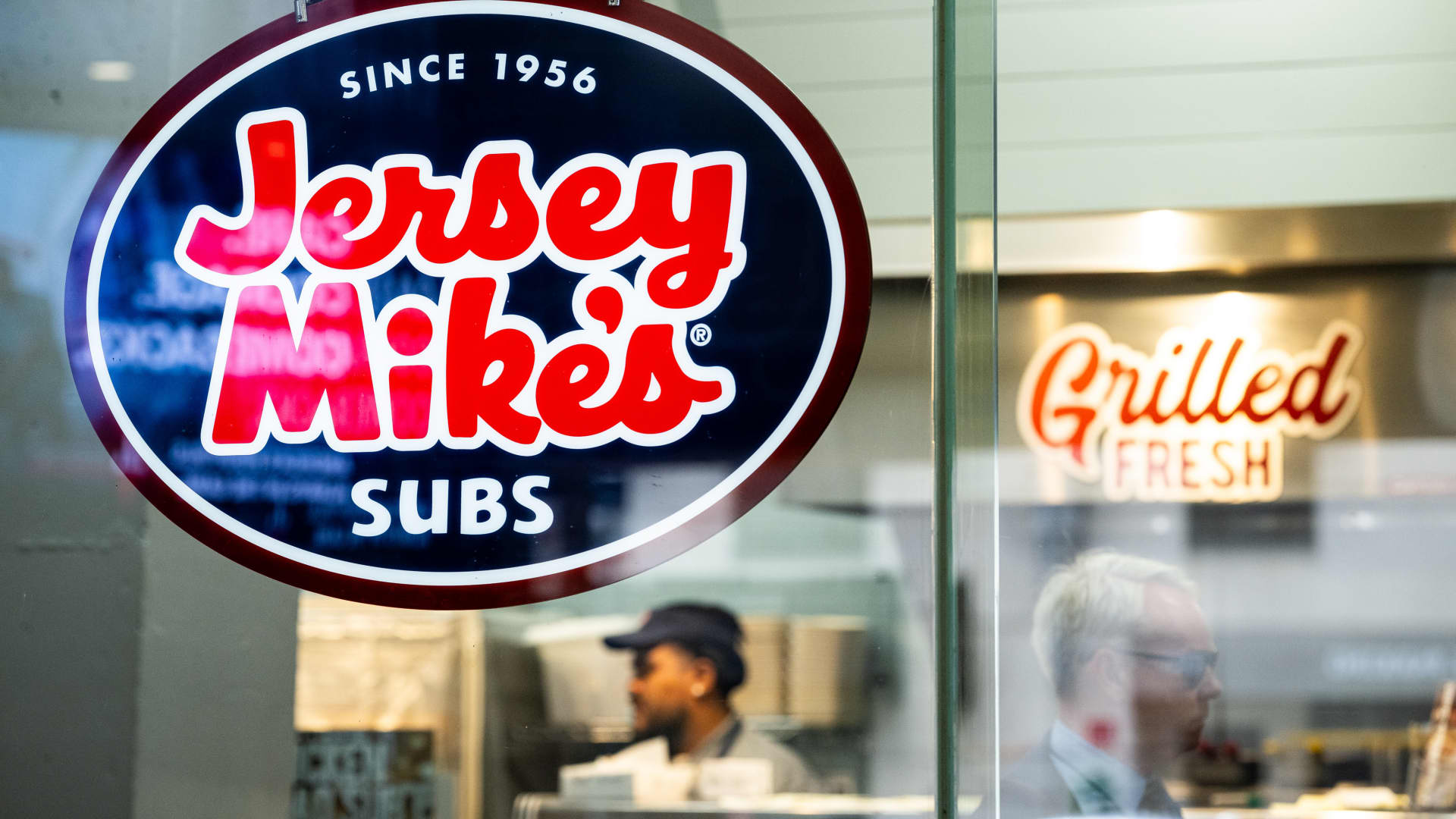
Signage at a Jersey Mike’s restaurant in Washington, July 20, 2026.
Graeme Sloan | Bloomberg | Getty Images
Five years after the initial public offering boom of 2021, public markets look a lot different as more companies are choosing to stay private for longer.
In 2021, public markets saw a multitude of companies join the ranks. The Nasdaq said it welcomed 743 IPOs that year, while the New York Stock Exchange said it added more than $1 trillion in new market capitalization, marking the second straight year of record new listings.
The biggest IPOs five years ago spanned a range of industries, including Coinbase, Roblox, Rivian, Warby Parker and more.
According to research from Morningstar, the companies that went public in 2021 raised almost $500 billion — roughly double the number of deals and capital raised in 2020, a year of intense uncertainty amid the pandemic and lowered consumer and investor confidence.
But since then, the IPO market has cooled significantly. Despite a blockbuster IPO from Elon Musk‘s SpaceX, far fewer companies are choosing to go public, and some of the ones that do have struggled to gain momentum in the current conditions.
Two consumer companies, sandwich chain Jersey Mike’s and clothing retailer Reformation, went public on Thursday. Both companies had largely uneventful IPOs, with Reformation remaining essentially flat for the day and Jersey Mike’s opening $2 below its IPO pricing and closing down nearly 6%. They join just a handful of other consumer companies that have gone public in 2026, according to Renaissance, representing a tiny slice of the overall IPO pie.
Experts say there’s a range of reasons why companies are rethinking their liquidity and capital.
“There’s under 4,000 public companies today, whereas 30 years ago, there was just under 8,000,” said Mike Dinsdale, CEO of Powerlaw, a publicly listed fund investing in private companies. “The reason for that, I think, is access to capital, and then the idea that staying private and not having any transparency into what’s happening, and then higher valuations on the public side.”
Dinsdale, who previously held executive positions at DoorDash and DocuSign, said access to capital and liquidity in nonpublic markets, along with the emergence of megafunds, have taken “the need out to rush to go public.”
He added it’s a trend he’s been seeing over the past 30 years, though the acceleration of family office interest in private companies over the past five years has contributed significantly to the trend as the private investment vehicles of the ultrawealthy look for new places to put their money.
Reformation Inc. signage during the company’s initial public offering on the floor of the New York Stock Exchange in New York, July 30, 2026.
Michael Nagle | Bloomberg | Getty Images
Secondary markets
Some of the largest consumer and retail companies have remained private, like Publix Super Markets, Sephora and Chick-fil-A.
According to Sunaina Sinha Haldea, the global head of Private Capital Advisory at Raymond James, private companies are benefitting from the rise of secondary markets.
“The secondaries market is acting as this pressure release valve to this artificial clock of having to go public,” she said. “Nobody has to go public now because of the depth of this private secondaries market.”
Venture capital has also been booming. Jason Yeh, the co-founder of Patron, a venture capital firm investing in consumer companies, told CNBC that the volatility in the public markets coupled with the stagnant performance of public consumer and retail companies has likely added to the hesitation to leave the private sphere.
“There are very large asset managers, hedge funds and other types of investors that want to buy these later-stage stakes in these large companies, and they’re able to push out having to go public longer, and you can get liquidity for earlier stage investors through that,” Yeh said.
His firm has partnered with a number of consumer companies like Sweatpals, Board, System Labs and more. He added that he believes a strong liquidity environment would mean both IPOs and acquisitions become desirable routes.
“It feels like we’re on the cusp of a handful of companies that, theoretically, on paper, should have been able to go public over the last couple of years, but will be going public ideally in the next 12 to 18 months,” Yeh said.
‘The carrot and the stick’
There are still compelling reasons for some companies to go public — an IPO is often a moneymaking move, like it was for SpaceX, which raised tens of billions of dollars when it went public.
“I do think for companies with a really strong business model of generating a lot of cash flow, eventually they will go public,” Yeh said. “Hopefully, the overall macroeconomic conditions are better when that happens, versus doing it into a weaker market.”
One of the biggest incentives to staying private is avoiding the pressure of quarterly earnings, which require revealing numbers to investors and potentially taking a hit from that visibility.
“In general, founders don’t want to go public, the majority don’t, because all of a sudden they have more visibility into what they’re doing,” Powerlaw’s Dinsdale told CNBC. “The public now has access to numbers and it has opinions on what they’re doing versus being more in control.”
To make the IPO market attractive again, he said he believes there needs to be both “the carrot and the stick,” that would make it harder to stay private while also instituting a regulatory legislative change to incentivize going public.
President Donald Trump has floated the idea of ending mandatory quarterly earnings reports, a move that was backed by the Securities and Exchange Commission earlier this year and would allow companies to report only twice a year instead. In a May statement, SEC Chairman Paul Atkins said the current rules have too much “rigidity” for companies and investors.
According to Raymond James’ Sinha Haldea, the regulation that comes with being public is a “headwind” to going down that route.
“If you are a CEO of a fast-growing company and there’s plenty of capital available, and you don’t have to deal with the governance and the reporting structures and the quarterly clock of being a public company, why would you put yourself through that?” Sinha Haldea told CNBC.
Sinha Haldea said it’s both a financial cost and a resource cost to go public rather than staying within the secondary markets and accessing capital that way. But as the milestones for companies begin to get redefined, and IPOs no longer hold quite as much weight, the “why” behind going public in every board room is no longer as simple as it used to be.
For that justification to change, and for more companies to mimic the trend of 2021 markets, she said the “operational burden of being public” has to change first.
“There is a lot of reporting compliance, litigation, dilution of management time that goes into being a public company,” Sinha Haldea said. “That equation needs to change through regulation for the decision between private and public to become more neutral.”


That didn’t happen, and probably catalyzed the closure of those bets during Friday’s 08:00 UTC expiry, which settled BTC and ether (ETH) options worth $10 billion. Notional open interest on the $70,000 call has fallen to $943 million, and on the $72,000 call to $888 million. While still significant, those levels are well below the $60,000 put.
Another interesting data point comes from seasonality. Since 2013, July has produced a median return of 8.61%. The price has risen by 8.9% this month, according to CoinDesk data. So far, so unexciting. But a positive July is usually followed by a negative August, producing a median return of -7.51%.
Median is useful here because it shows the typical outcome without being skewed by unusually large gains or losses that can distort the average. In markets like bitcoin, where a few extreme months can pull the mean up or down, the median often gives a cleaner read on what has happened most often.
That means the mood is bearish for BTC as we head into August. Stay alert!
Read more: For analysis of today’s activity in altcoins and derivatives, see Crypto Markets Today . For a comprehensive list of events this week, see CoinDesk’s “Crypto Week Ahead.”


New York has sued prediction market platform Kalshi, alleging it operates an illegal, unlicensed gambling business by offering event contracts on sports, elections and other outcomes.
The lawsuit seeks to stop Kalshi’s alleged illegal gambling operation in the state, require the company to forfeit illegal gains, pay restitution to users and pay civil penalties equal to three times those gains.
“No matter what they call themselves, prediction markets like Kalshi are gambling platforms, plain and simple,” Attorney General Letitia James said in Friday’s statement. “We are taking them to court to uphold our laws and protect New Yorkers.”
The lawsuit comes after the New York State Gaming Commission issued Kalshi a cease-and-desist order in October 2025, prompting the company to sue the regulator in federal court.
A judge denied Kalshi’s request for a preliminary injunction in July, and an appeals court later rejected its bid to block enforcement while the appeal proceeds.
Kalshi did not immediately respond to Cointelegraph’s request for comment.
CFTC defends federal oversight of prediction markets
The lawsuit adds to an escalating jurisdictional dispute over whether event contracts offered by federally regulated prediction markets are subject to state gambling laws.
Just before New York filed its case, the Commodity Futures Trading Commission (CFTC) filed an emergency motion seeking to block New York’s enforcement efforts, arguing that the state’s actions interfere with the agency’s exclusive authority under the Commodity Exchange Act to regulate designated contract markets like Kalshi.
Related: CFTC issues second warning to prediction markets on cookie-cutter self-certifications
The CFTC has taken similar positions in disputes involving at least nine states, arguing that allowing states to prohibit event contracts listed by federally regulated exchanges would create conflicting state rules and undermine federal commodities regulation.
Prediction markets continue to gain mainstream traction
Prediction markets allow users to buy and sell contracts tied to the outcome of future events, with prices reflecting the market’s estimate of the probability that an event will occur.
Kalshi’s rival, Polymarket, has also faced regulatory scrutiny, with several countries restricting or investigating its operations over gambling and licensing concerns.
Kalshi began expanding into blockchain-based infrastructure in December 2025, launching tokenized prediction markets on Solana and later adding support for multiple blockchain networks.
The broader prediction market sector has also grown alongside major sporting events.
According to analytics firm Chainalysis, blockchain-based prediction markets processed about $20 billion in trading tied to the 2026 FIFA World Cup, with more than 400,000 wallets participating.
Magazine: The 100x obsession: Fundamentals grow in importance as crypto matures

New York Governor Kathy Hochul and Attorney General Leticia James have filed a lawsuit against one of the most popular prediction market platforms, Kalshi.
The move marks the latest escalation in the growing battle over whether event contracts fall under federal commodities law or state gambling regulations.
Lawsuit Launched
The press release from the New York office informs that James and Hochul have alleged that Kalshi is operating illegal gambling products in the state without the necessary license. Filed in Manhattan state court, the complaint seeks to stop the platform from offering its event contracts to New York residents and requests financial penalties, forfeiture of profits, and restitution for affected customers.
Event contracts, as the lawsuit describes them, allow users to trade on outcomes of sports matches, elections, economic data, and other real-world events. However, they amount to unlicensed gambling under New York law, stated the PR.
Officials also argued that Kalshi permits users between the ages of 18 and 20 to participate, despite the state requiring bettors to be at least 21 years old. The platform, though, still claims that its products are federally regulated derivatives overseen by the US CFTC, not gambling products subject to state gaming laws.
The lawsuit launched by the state of New York comes just weeks after a federal judge denied Kalshi’s request to block officials from enforcing its gambling laws while the broader case proceeds.
The Bigger Fight
The explosive growth of the two major prediction market platforms, Kalshi and Polymarket, has quickly caught the attention of regulators, and this is the latest chapter in an increasingly complex jurisdictional dispute over their capabilities.
The CFTC has repeatedly defended its authority over federally registered prediction markets, but New York officials argue that event contracts resemble traditional betting. The regulator even sued New York, claiming that federal law preempts state attempts to oversee these products.
New York also sued prediction market businesses operated by Coinbase and Gemini recently, arguing that they offered the same illegal gambling services without proper authorization.
Meanwhile, Kalshi and Polymarket continue to face severe backlash outside the US as well, including some bans in jurisdictions like Argentina, Spain, Brazil, and Indonesia.
The post New York Sues Kalshi as Legal Pressure on Prediction Markets Intensifies appeared first on CryptoPotato.

Tom and Max fight. Anna drives a kitchen knife into Max’s back. He staggers outside, and Tom knocks him into the pool, which glows an unnatural aquamarine beneath the storm. “It’s a kill-or-be-killed sort of moment,” Adams says.
In the churning pool, Max grapples with Tom, who locks him in a stranglehold. Anna leaps in, and together they hold him under until his limbs finally go limp.
Moving the climax from the open waters of the Cape Fear River to the family’s backyard pool marks a decisive break from previous film adaptations. “We felt for this version of the story that it should end in their home,” Antosca explains. “Bring the storm to them.”
The scene also pays off a detail from Episode 7, when Max told Natalie he’d been baptized in the Cape Fear River as a boy but never learned to swim. “[The pool] is also the place where he’s more vulnerable,” Bardem says.
The pool fight took days to shoot, with rain pouring down and cameras rolling underwater. Staging a brawl in water demands precision from everyone in it. “You’ve got to be so in tune with your dance partner,” Wilson says. It was also a release after months of playing Tom measured. “We all had been so measured for so long … it was nice to let it rip,” he says. For all the scale, the sequence plays as a test the Bowdens narrowly pass. “There’s a killer inside of everybody,” Wilson says, but killing Max at that point would be vengeance, not self-defense. “Tom, at his core, is not someone that would kill out of revenge.”
Crypto World
Zoomex Launches “August Summer Airdrop”: New Users Can Unlock Up to $1,500 in Combined Rewards and Exclusive Benefits


Global cryptocurrency trading platform Zoomex today announced the official launch of its global onboarding initiative, the “August Summer Airdrop.” Running from July 31 to August 31, the campaign is designed to streamline the onboarding journey for new crypto traders through simplified participation steps and transparent reward structures, offering eligible new users a comprehensive reward package worth up to $1,500.
As a platform dedicated to optimizing the contract trading experience, Zoomex has structured this summer campaign to lower entry friction, dividing the initiative into three clear modules:
- Zero-Barrier Trading Experience: During the campaign period, new users can claim a $100 BTC position voucher simply by registering and completing an initial deposit of $\ge 1$ USDT. This allows them to experience live-market contract trading without risking personal capital.
- Clear Tiered Incentives: To assist users as they navigate the platform, the campaign establishes a transparent growth path. By completing tasks such as an initial deposit, KYC verification, and futures trading, users can progressively unlock corresponding cash bonuses and trading support, accumulating up to $1,500 in total rewards.
- Exclusive New-User Earn Specials: The campaign introduces a dedicated Earn channel for new registrants, featuring yield options with APYs reaching up to 666%, providing traders with flexible asset growth choices.
The design of the “August Summer Airdrop” aligns directly with Zoomex’s Q3 brand commitment: “Easy to Use. Transparent balance. Fair access to your earnings.” By featuring clear rules and transparent execution, Zoomex empowers traders at all skill levels to engage in a clear, controllable environment with tangible benefits.
Zoomex Marketing Director stated:
“Through the ‘August Summer Airdrop,’ we aim to offer global traders a sincere and user-friendly entry point into crypto trading. From the $100 BTC position voucher to our clear, condition-free tiered rewards, we are dedicated to eliminating complexity in the crypto derivatives space. At Zoomex, we firmly believe that transparent rules and clear product experiences form the cornerstone of long-term user trust.”
The event is now live on the Zoomex website and official mobile app. Users can view complete terms and join the campaign here.
About Zoomex
Founded in 2021, Zoomex is a global cryptocurrency trading platform focused on the contract trading experience, serving over 3 million users across 35+ countries and regions. Tailored for traders who value speed, clarity, and control, Zoomex delivers a high-performance trading experience with clear asset and order displays, transparent fees and rules, and a continuously evolving trust framework—including Hacken security audits, Proof of Reserves (PoR), and compliance information—to provide users with a clearer and more efficient trading environment.
Beyond trading, Zoomex creates a premium brand experience through partnerships with the Haas F1 Team, World Cup-winning goalkeeper Emiliano Martínez, and initiatives in tennis. Zoomex extends the values of elite sports—speed, precision, discipline, fair play, and rule execution—into its contract trading product, ensuring brand expression remains fully consistent with user experience.
At Zoomex: Easy to Use. Transparent balance. Fair access to your earnings.
The post Zoomex Launches “August Summer Airdrop”: New Users Can Unlock Up to $1,500 in Combined Rewards and Exclusive Benefits appeared first on BeInCrypto.


James’ office described Kalshi’s event contracts as bets and said the platform takes wagers on professional and college sports, elections and culture. The lawsuit alleges Kalshi allows users aged 18 to 20 to wager and lists markets involving New York college teams, both prohibited for licensed sportsbooks in the state.
“New York’s gambling laws protect children from underage betting and help combat gambling addiction,” James said in the statement. “No matter what they call themselves, prediction markets like Kalshi are gambling platforms, plain and simple.”
The World Cup helped boost Kalshi’s numbers, adding 3 million during the course of the tournament, according to CNBC. That’s more than double the 2 million the firm said it had at the start of May.
According to the attorney general’s statement, the lawsuit follows an October cease-and-desist order from the New York State Gaming Commission.
A federal judge denied Kalshi’s bid to block state regulators on July 7 and rejected an injunction pending appeal on July 27.
CoinDesk approached Kalshi for comment outside of regular U.S. office hours, and had not heard back by publication time.

Psychology of Money in 16 Minutes | Vaibhav Kadnar

Some progressive Democrats cite faith in fighting inequality

Bali Ha'i accused claims boss knew


-

 Fashion7 days ago
Weekend Open Thread: Brooks Brothers
-
 Sports5 days ago
Commonwealth Games boxing: Jadumani Singh seals dominant 5-0 win over Pakistan’s Sumama Rehman to enter quarter-finals | Commonwealth Games News
-

 Business2 days ago
Why Trees Belong on the Risk Register
-

 Tech4 days ago
Intel is reversing course and bringing hyper-threading back to its server chips
-

 Crypto World6 days ago
Ripple bought a bank in pieces. The $4 billion audit
-

 Politics4 days ago
Luke Littler dismantles Gerwyn Price to retain title in Blackpool
-
 Entertainment7 days ago
A New Post-Apocalyptic Gundam Anime Series Blasts Into SDCC
-

 Politics3 days ago
The Part of the Electric Transition Nobody Wants to Discuss
-

 News Videos5 days ago
BITCOIN JUST ENTERED THIS CRITICAL ZONE…
-

 Business2 days ago
Major shareholder moves on Canyon
-

 Crypto World5 days ago
XRP Ledger adds $2.6B as RWA inflows rank second
-

 News Videos1 day ago
Bitcoin Enters the 3rd Stage of the Bear Market
-

 Politics5 days ago
Spain sweeps the board at 2026 World Cup with individual awards
-
 Entertainment3 days ago
‘Stargate’ Creator’s New Sci-Fi Series Returns for Season 3 Tomorrow
-

 Entertainment5 days ago
Sara Gilson Killed By Husband After Viral “Pedophile” TikTok Video
-

 Crypto World3 days ago
Kraken Enables Retail Access to Jersey Mike’s IPO via Tokenized Shares
-

 Tech6 days ago
Anthropic launches Claude Opus 5, a cheaper AI model for coding, agents and enterprise workflows
-

 News Videos3 days ago
Claude: Build Financial Dashboards in Minutes (2026)
-

 Tech3 days ago
New macOS Sequoia & Sonoma security updates for older Macs
-

 Politics20 hours ago
Luke Littler’s dominance sparks GOAT debate
You must be logged in to post a comment Login