

Crypto World
Anchorage Digital Adds Off-Exchange Settlement for Binance


Anchorage Digital says it has integrated its off-exchange settlement system with Binance, enabling select institutional clients to trade on Binance without depositing their crypto or cash directly onto the exchange. Instead, clients’ assets and funds can remain in qualified custody at Anchorage—a federally chartered US crypto bank—until settlement.
The arrangement is built around margin and collateral mechanics: institutions can use crypto assets or US dollar deposits held with Anchorage to satisfy Binance’s margin requirements, without moving those holdings to Binance first. Anchorage and Binance framed the workflow as a separation of custody from trade execution, aiming to reduce the operational friction—and counterparty exposure—that can come with pre-funding trades on exchanges.
Key takeaways
- Anchorage integrated its off-exchange settlement platform with Binance to support institutional trading while keeping custody at Anchorage.
- Clients can use Anchorage-held crypto or US dollar deposits as collateral for Binance margin without transferring assets to the exchange.
- The model is positioned as a response to exchange counterparty risk and aims to improve capital efficiency by avoiding pre-funding.
- Anchorage’s Atlas platform is cited as the infrastructure behind this first off-exchange settlement implementation.
- Financial terms of the partnership were not disclosed.
How the Anchorage–Binance model changes custody and collateral
In traditional exchange-based workflows, institutions typically pre-fund trading accounts—transferring assets to the venue where trades are executed. Anchorage’s stated objective with this integration is to shift that balance. Under the collaboration, institutional clients can maintain crypto and cash in qualified custody with Anchorage while accessing trade execution through Binance.
Practically, the integration focuses on margin: Binance’s margin requirements are met using collateral held with Anchorage. The companies say this keeps assets in an independent custodian until settlement, rather than routing custody into the exchange account itself. By design, it also reduces the need for institutions to move holdings between custody providers and the trading venue ahead of every trade.
Anchorage said the rollout is available initially to select institutional clients, marking the first off-exchange settlement deployment for its Atlas platform—an infrastructure Anchorage describes as supporting institutional trading, settlement, lending, and collateral management using custody-based building blocks.
Why “off-exchange settlement” is drawing institutional attention
Exchange counterparty risk has long been one of the main frictions for institutions considering larger allocations to crypto trading. When assets must be deposited to an exchange to enable trading, risk is concentrated at the execution venue. Off-exchange settlement attempts to address that by keeping custody separate from the trading leg, with settlement handled via a different mechanism.
Anchorage and Binance framed their setup as moving closer to the custody-and-execution structure common in traditional financial markets, where institutions can separate where assets are held from where trades are executed and settled. The proposed benefit is twofold: it reduces exposure tied to pre-funding and may also improve capital efficiency by relying on custody-based collateral rather than tying funds to exchange balances.
While the companies did not disclose financial terms, they emphasized the core operational change: trades can be executed on Binance while crypto and cash remain with Anchorage through settlement—an approach intended to make institutional participation smoother without requiring full custody migration to the exchange.
Off-exchange settlement expands across major venues
This Anchorage–Binance integration sits within a broader industry pattern. Off-exchange settlement has been gaining traction among institutional crypto trading platforms throughout 2026, with multiple firms announcing similar custody-and-trade separation approaches.
According to earlier coverage from Cointelegraph, in April BitMEX partnered with Zodia Custody to allow institutional clients to trade derivatives while keeping collateral in segregated custody rather than depositing it onto the exchange. Under that structure, traders could access perpetual swaps and futures while collateral remained with Zodia and was mirrored for trading. BitMEX said the design eliminated the need to prefund exchange accounts and improved capital efficiency, while also reducing operational risks tied to moving assets between custody and trading venues.
In June, Bitget adopted a comparable model by integrating Fireblocks Off Exchange. Bitget said that its integration enables clients to execute trades from MPC-based wallets while keeping assets in trader-controlled collateral vaults rather than transferring them to the exchange. The company also claimed the platform can verify trading accounts are fully collateralized in real time without taking custody of client assets.
Separately, KuCoin Institutional expanded its custody offering earlier in the year by integrating Ceffu’s MirrorX platform in January. That system, according to the linked Ceffu and KuCoin Institutional material, is designed for institutional trading while digital assets remain in third-party custody, with funds mirrored for trading and settled off-chain every four hours.
Taken together, these deployments show a recurring theme: institutions increasingly want the flexibility of exchange liquidity and execution alongside custody structures that better match their risk controls. Off-exchange settlement is becoming a practical pathway to combine those priorities—at least for use cases offered through specific integrations between exchanges, custodians, and settlement platforms.
What investors should monitor next
For institutions, the most important questions now are likely operational and risk-related: which collateral types are supported end-to-end for margin, how settlement timing works in practice for different product categories, and how widely Anchorage’s off-exchange service will be rolled out beyond the initial select client group. Readers should also watch whether more major venues add similar custody-separated settlement layers, as that trend would further define how institutional crypto trading infrastructure evolves.



Its launch comes as Ethereum’s support ecosystem undergoes a broader evolution, following the debut of EthLabs and amid ongoing efforts by the Ethereum Foundation to respond to community criticism over transparency, communication and its role within the ecosystem by encouraging more independent organizations to take the lead on adoption and ecosystem growth.
Vivek Raman, CEO of Etherealize, said on X that Ethereum Institutional is another example of Ethereum’s decentralized model in action.
“Ethereum is not built by or run by a single organization,” Raman wrote. “Ethereum is a network of independent nodes that collectively make the infrastructure inevitable. Ethereum Institutional will play a key role in amplifying and growing Ethereum. Could not be more excited for this launch.”
Joe Andrews, CEO of privacy developer firm Aztec Labs, told CoinDesk that the launch reflects the continued decentralization of Ethereum’s support ecosystem rather than the emergence of a single voice.
“Over the last two weeks, the Ethereum community has further added to the decentralisation of the network,” he said. “There are now three non-profits all advocating for adoption of Ethereum. It is natural that one of these entities is focusing on institutions, as the world needs a global settlement layer and Ethereum is the only credible option.”
Crypto World
BlockDAG’s Proprietary BDAG AI Pulls Buyers in Droves! Here’s Why the $0.00000044 Entry Beats LINK & TRON Today

The Chainlink price prediction reflects tension this week, as LINK trades near $7.37 while investors weigh short-term caution against optimism tied to its growing DeFi integrations. Meanwhile, the TRON price is in bullish territory, with the network processing nearly $2 trillion in stablecoin settlements, proving that steady utility can still turn heads even when the broader market feels uncertain.
Then there is BlockDAG, entering the radar of investors searching for the best crypto to buy now. It has just rolled out BDAG AI, bringing a fresh suite of artificial intelligence tools now live on its network, adding an estimated $500 million to its valuation overnight.
And with entry still sitting at a fraction of a cent against a $0.05 buyback offer, BDAG is quickly becoming the standout name this week. Let’s see which makes the most urgent entry case today.
Chainlink Price Prediction: Consolidation Continues
The Chainlink price prediction remains mixed as LINK trades around $7.37 with a $5.51 billion market capitalization. The token is still below its 50-day SMA of $8.66 and 200-day SMA of $9.92, while the Fear & Greed Index of 12 reflects extreme caution among investors.
However, the 14-day RSI of 32.44 suggests selling pressure may be easing. In the short term, holding above $7.07 support could pave the way for a move toward $7.75, while a break lower may push LINK closer to $6.80.
From a longer-term perspective, Chainlink price prediction remains optimistic thanks to the network’s expanding role in decentralized finance and its recent integrations across 10 blockchain networks. Forecasts suggest LINK could climb to $17 in 2026, $28.53 by 2029, and potentially $52.95 by 2032, provided adoption continues and overall crypto market conditions improve.
TRON Price Rises on Stablecoin Settlement Activity
The TRON price could continue benefiting from the network’s dominance in stablecoin payments if current usage trends persist. During the first quarter of 2026, TRON processed $1.96 trillion in stablecoin settlements while hosting roughly $85–86 billion in USDT, highlighting strong demand for low-cost transfers.
Network engagement also remains healthy, with daily active users climbing 16% over the past month to around 4.4 million. However, slower user onboarding, with active addresses easing to 15.8 million, suggests growth is being driven more by existing users than newcomers.

Meanwhile, total value locked has reached about $4.4 billion, although much of it remains tied to payment activity instead of DeFi applications. For the TRON price outlook to strengthen over the long term, the ecosystem will likely need broader DeFi adoption alongside continued growth in stablecoin settlement volumes.
BlockDAG: 45x Window Ends in 24 Hours!
BlockDAG is seeing a rush of buyer interest right now, and once you look at what’s happening across the network, it’s easy to understand why. Entry currently sits at just $0.00000044 per coin, and the network just launched BDAG AI, a new set of artificial intelligence tools now built into the platform.
That move alone added an estimated $500 million to the project’s valuation. On top of this, the BlockDAG Futures & Spot Exchange is set to arrive in two weeks, a development many expect will push the entry price much higher.
Plus, for the next 24 hours, entry is even more rewarding thanks to a $0.05 buyback offer, which could translate into 45x returns for anyone who buys now and sells back at that rate. The World Cup Bonus is also live, giving buyers 50% extra BDAG on their purchase, further expanding the ROI potential.

A profit opportunity like this is rare in the market, especially for a network seeing as much demand and adoption as BlockDAG. The BlockDAG Casino also proves that, continuing to see record activity, with more than 13,000 users and over $150 million wagered in its first 30 days.
The casino runs on a high-speed network, currently processing 5,500 transactions per second, and is set to increase to 7,000 within three days. Thanks to this scalability, ROI, and technological strength, BDAG is effectively outperforming many established cryptos today.
According to experts, whether someone wants to cash out through the buyback or hold for the long term, this might be one of the most impressive entry points crypto has offered in a while.
Which Is The Best Crypto to Buy Now?
LINK and TRON are worth watching, but neither offers urgency right now. The Chainlink price prediction points to a slow grind upward, with LINK needing to reclaim key resistance before its longer-term targets of $17, $28.53, and beyond come into focus. As for the TRON price, while the stablecoin volume makes it a solid utility play, future gains depend on whether DeFi adoption can catch up to TRON’s payment dominance.
BlockDAG, on the other hand, is not asking investors to wait around. With BDAG AI just added to the network, a $500 million valuation, and the Futures & Spot Exchange launching in two weeks, the fundamentals are impressive.
And the entry won’t stay low for long. Those seeking the best crypto to buy now have already rushed in to secure $0.00000044 and position for the buyback program. Plus, the 50% World Cup Bonus means higher ROI at no extra cost. Those who miss this window risk missing out on one of the biggest opportunities of the year.

Presale: https://purchase.blockdag.network
Website: https://blockdag.network
Telegram: https://t.me/blockDAGnetworkOfficial
Discord: https://discord.gg/Q7BxghMVyu
Disclaimer: This is a Press Release provided by a third party who is responsible for the content. Please conduct your own research before taking any action based on the content.



Solana Foundation announced Wednesday that onchain governance is live on the network, letting validators propose and vote on protocol-level decisions through a system called Solana Governance Proposals, or SGPs. The mechanism is fully onchain, stake-weighted and verified by Merkle proof, according… Read the full story at The Defiant
Key takeaways:
- Persistent spot Bitcoin ETF outflows and US dollar strength reduce the odds of a quick bounce to $65,000.
- Strong AI sector earnings momentum and higher fixed-income returns pull capital from Bitcoin and gold.
Bitcoin (BTC) reacted positively to US Federal Reserve Chair Kevin Warsh’s remarks on stubborn inflation. Despite the gains on Wednesday, traders fear that incentives for fixed-income investments and strong earnings momentum in tech stocks will continue to pressure non-yield-bearing assets like cryptocurrencies.
US 5-year Treasury yield (left) vs. Bitcoin/USD. Source: TradingView
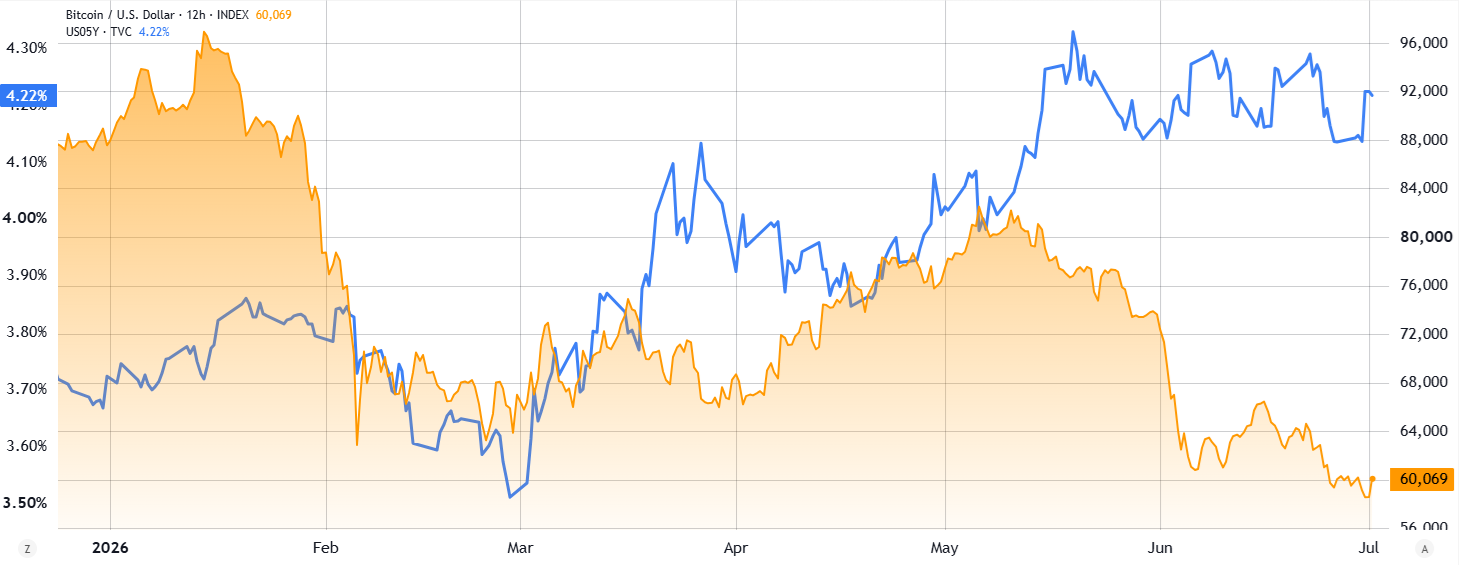
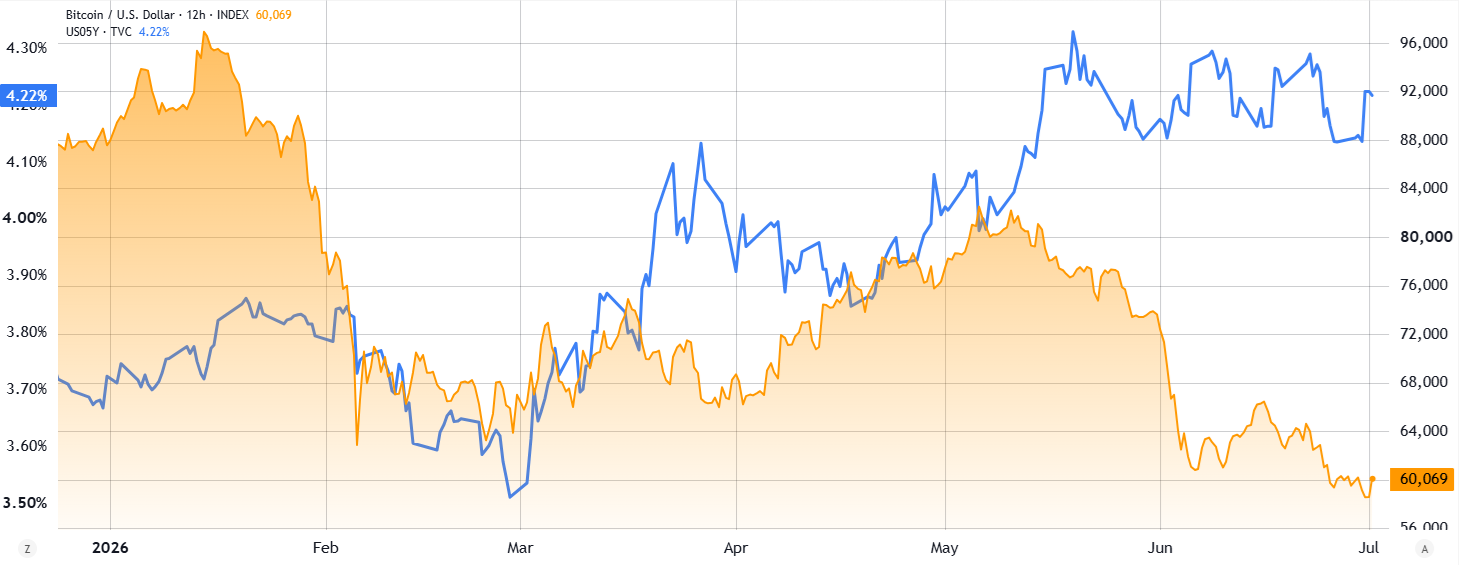
The US 5-year Treasury yield jumped to 4.22%, meaning traders demanded higher returns to hold government bonds. Even as inflation eventually eases and WTI crude oil prices fell to a 4-month low, investors anticipate monetary expansion. Regardless of how the Fed manages interest rates and its balance sheet, the US Treasury dictates debt issuance trends.
Implied odds of FED interest rates on Sept. 16. Source: CME FedWatch Tool
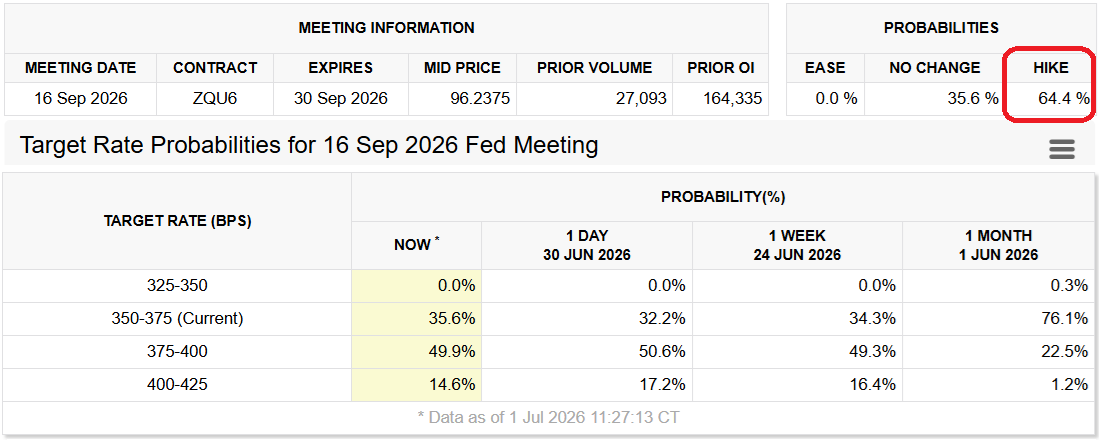
US government bond futures implied 64% odds of interest rate hikes by September, up from 23% one month prior. The higher expected return on fixed-income investments came as the US dollar strengthened against other major global fiat currencies, which is especially concerning for alternative hedges such as gold and Bitcoin.
Gold/USD (left) vs. US dollar strength (DXY). Source: TradingView
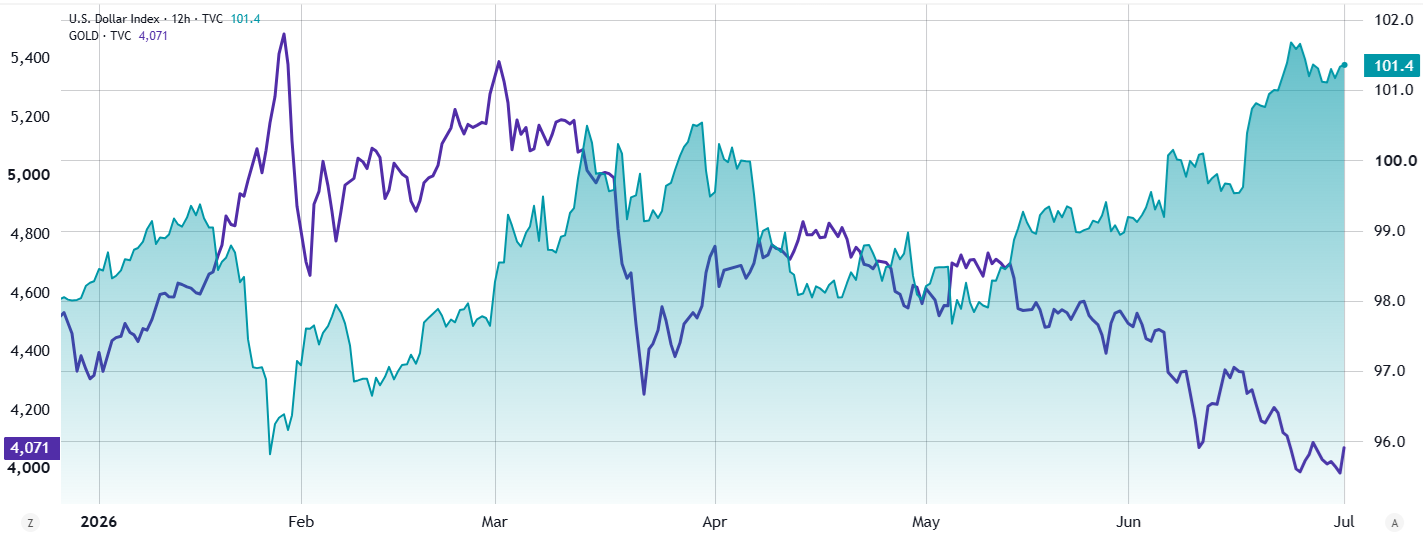
Despite the gains on Wednesday, gold prices are down 12% in two months, while the US dollar strength (DXY) nears its highest mark in one year. This vote of confidence in the US economy partly stems from AI sector strength, evident in the 25% gains in the Nasdaq 100 index. However, some specific tech sub-sectors have recently signaled weakness, which could act as a catalyst for Bitcoin and gold.
Could the AI sector cool off act as a catalyst for Bitcoin?
Micron (MU US) and SanDisk (SNDK US) shares saw intraday losses exceeding 9% on Wednesday after competitors SK Hynix (000660 KR) and Samsung (005930 KR) announced plans to expand capacity. Still, the move can hardly be deemed a trend reversal as the iShares SOX Semiconductor Index ETF (SOXX US) gained 78% in three months.
Continued outflows from US-listed spot Bitcoin exchange-traded funds (ETFs) have shattered bulls’ hopes, reinforcing a negative price spiral as negative news gets amplified while positive events barely register.
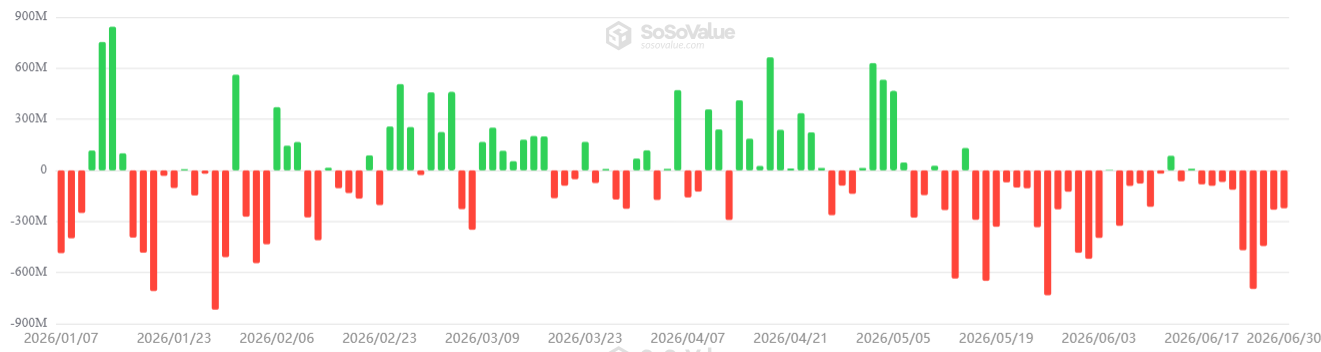
US-listed spot Bitcoin ETFs daily net flows, USD. Source: SoSoValue
Regardless of the rationale behind the sales, Bitcoin’s weakness, 53% below its all-time high, does not inspire confidence in the $60,000 support level.
Strategy (MSTR US) increased its cash position to restore a healthy 17 months of dividend coverage on Monday. However, Strategy’s variable-rate Stretch preferred stock (STRC US) continued to trade far from the $100 target required for additional issuances. The STRC dividend rose to 12% from 11.5%, which was apparently not enough to entice more buyers.
Related: Bitcoin just $5K away from ‘best investment opportunity’ of bear market
Bitcoin might have temporarily benefited from Fed Chair Warsh’s concerns about persistent inflation, but rising expectations for higher interest rates and strong earnings momentum in the AI sector may continue to exert negative pressure on Bitcoin. As a result, a sustainable rally to $65,000 could take longer.


Disclosure: This article does not represent investment advice. The content and materials featured on this page are for educational purposes only.
UmexGain offers traders access to multiple asset classes, market analysis, educational resources, and tools designed to support informed trading.
Summary
- UmexGain combines multi-asset trading, market analytics, and educational resources to support informed trading decisions.
- The platform offers diverse financial instruments, analytical insights, and learning tools for traders of all experience levels.
- It enhances trading with broad market access, educational content, and timely analytics for global investors.
When choosing a broker, traders consider the variety of assets, the quality of analytical support, the convenience of services, and the availability of learning materials. These elements offered by UmexGain are essential for making market participation both more comfortable and more productive.
The company provides a comprehensive approach to client support, combining a wide selection of instruments with up-to-date analytical resources. This format enables each user to select a suitable trading style, enhance their knowledge, and receive the timely information needed to make informed decisions.
Broad asset base
One of UmexGain’s key advantages is the extensive array of available assets. Clients can work with various financial instruments, including currency pairs, stocks, indices, commodities, and cryptocurrencies. Each tool features unique properties, allowing for versatile market applications.
The inclusion of digital assets, which continue to play a significant role in the global financial system, deserves special mention. This allows the company’s clients to use the ever-growing opportunities within modern financial markets and craft diverse trading strategies tailored to their preferences.
This broad selection of instruments helps UmexGain customers focus on areas of greatest interest. The ability to choose from various asset classes also adds flexibility to the trading process and opens up new avenues for executing individual strategies and effective portfolio diversification.
Analytics and education
High-quality information support is essential for success in financial markets. UmexGain provides clients with all the data necessary to make informed decisions in a timely manner. This includes learning materials, helping beginners master the fundamentals of trading while allowing experienced professionals to refine their strategies. This data is presented in a user-friendly format, offering an introduction to core trading principles, market specifics, analysis methods, and strategies for building a personal plan.
Timely analytics enables the assessment and comparison of different assets’ prospects. It helps users track key events, monitor the performance of various instruments, and gain insights to assess market conditions. This allows clients to quickly process current information and use the data to inform their next steps.
The combination of learning resources and analytical support creates an optimal environment where UmexGain customers can continuously expand their knowledge. This approach fosters confident skill development, regardless of the user’s experience level.
Seamless trading experience
A modern broker must provide a convenient environment for daily activities. UmexGain strives to make the trading experience as intuitive and streamlined as possible. A well-organized interface ensures that key features are easy to locate, allowing users to focus on market analysis and implementing deals.
The combination of diverse tools and comprehensive information support offers a significant advantage. This approach allows users to dedicate more time to identifying new opportunities, developing their strategies, and honing their practical skills. Regardless of experience level, every client gains access to resources that help them navigate financial markets with greater confidence.
Summing up
UmexGain is a broker that combines a wide range of assets, modern trading capabilities, and high-quality information support. A vast array of financial instruments, including cryptocurrencies, enables clients to utilize the expanding opportunities of modern financial markets and select the most promising areas for their activities.
A key advantage of the company is its comprehensive user support. UmexGain provides clients with the information needed to make well-informed decisions in a timely manner, offering learning resources to master key trading concepts and refine strategies, alongside up-to-date analytics for evaluating and comparing the prospects of various assets. The combination of a diverse range of instruments, learning materials, and current market analysis makes UmexGain an attractive choice for those seeking to expand their knowledge and confidently pursue their goals.
Disclosure: This content is provided by a third party. Neither crypto.news nor the author of this article endorses any product mentioned on this page. Users should conduct their own research before taking any action related to the company.
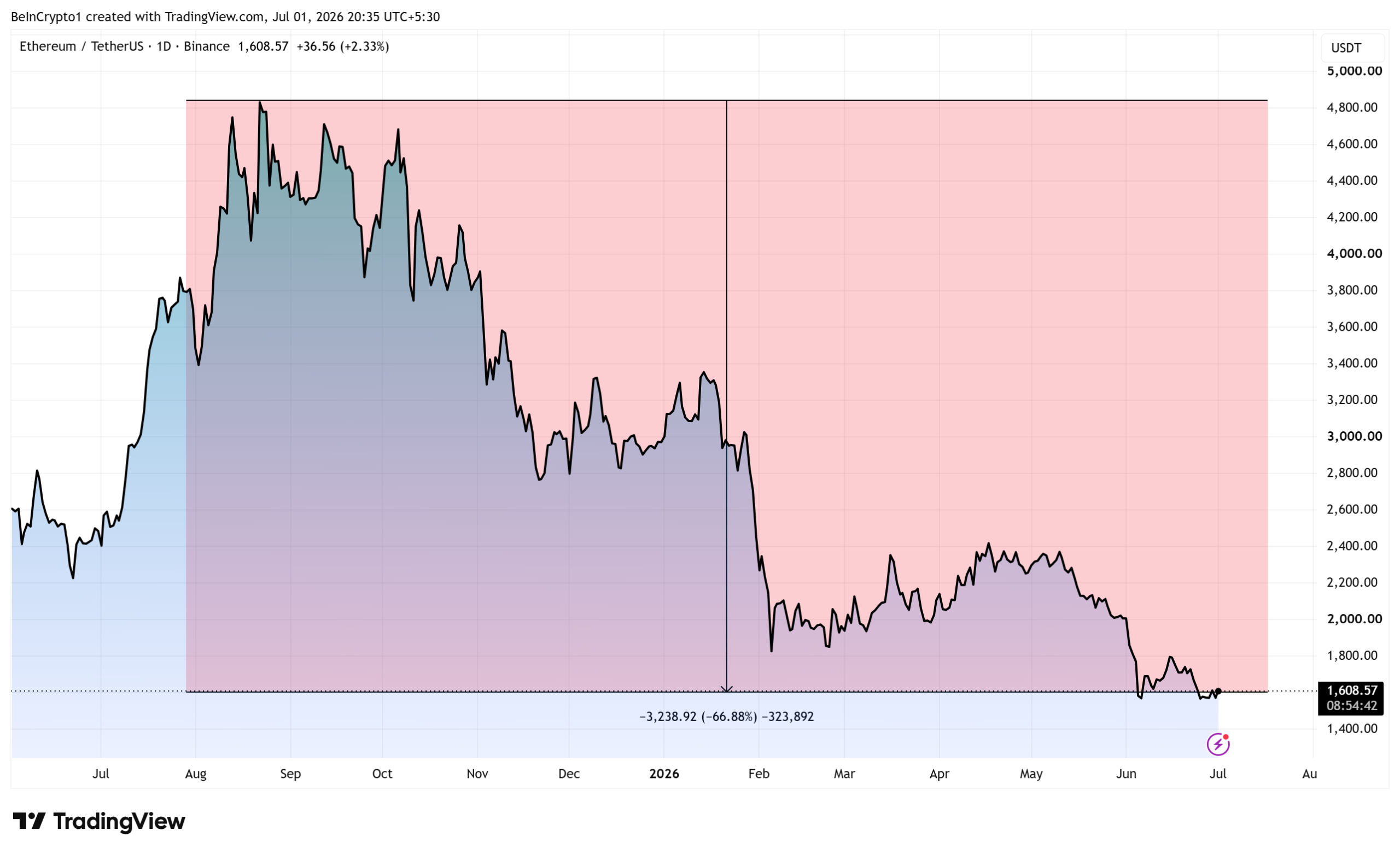
Ethereum Institutional launched Wednesday, the ecosystem’s second nonprofit in nine days, backed by Tom Lee’s BitMine, SharpLink Gaming and co-founder Joe Lubin.
The launches show the backers doubling down while price stays weak. Ether (ETH) trades near $1,600, down about 67% from its 2025 peak.

Two Nonprofits in Nine Days
Ethereum Institutional follows the research nonprofit Ethlabs, which launched on June 22. Its backers cast Ethlabs as readying the network for an institutional supercycle.
Both share the same anchor funders and the same aim, drawing institutional interest to Ethereum. The launches come as the Foundation keeps narrowing its core role to protocol stewardship.
The funders are heavily exposed to ETH. BitMine, the largest corporate holder, controls about 5.7 million ETH, or roughly 4.7% of supply, per a late-June company disclosure. SharpLink, the second-largest treasury, added 10,000 ETH just before the launch.

ETH traded near $1,610 as of this writing, up almost 5% over 24 hours. However, the largest altcoin on market cap metrics still sits about 67% below its August 2025 record high. That is a steeper drop than Bitcoin (BTC), which trades about 53% below its own peak.
The token has spent 2026 near the low end of its range. The backers are wagering that institutional demand can lift ETH before price follows.

Ethereum Institutional’s Neutral Front Door
Ethereum Institutional describes itself as a credible, independent front door for institutions assessing the network, according to its website. Its founding team previously built the Ethereum Foundation’s enterprise function.
David Walsh, Marius Smith and Matthew Dawson lead the organization. Walsh earlier ran the Foundation’s enterprise efforts.
The nonprofit set five priorities from day one. These span institutional engagement, market intelligence, ecosystem marketing, industry research and events. More supporters are expected soon.
“The world’s largest institutions are deciding where tokenization, stablecoins, and onchain markets will settle. We’re ready to make Ethereum the base layer for institutional finance,” read an excerpt in the announcement.
Follow us on X to get the latest news as it happens
Standard Chartered Sees a Bigger Opportunity
Geoff Kendrick, global head of digital assets research at Standard Chartered, called the two launches important for Ethereum’s commercialization. He said they arrive as TradFi enters the network at scale, filling a longstanding gap in Ethereum’s institutional outreach.
“This commercialization is central to ensuring Ethereum capitalizes on its current lead towards becoming the settlement layer of the global economy,” Kendrick wrote in a client note.
Kendrick sees Ethlabs and Ethereum Institutional as complementary. One readies the protocol, while the other brings institutions through the door.
Tom Lee, who chairs BitMine, welcomed the launch, after floating a long-term ETH target of $250,000, betting tokenization pulls institutions onchain.
The ambition runs ahead of the price. Whether the two nonprofits convert institutional interest into demand will show in the months ahead.
The post Ethereum Banks on Institutional Interest to Save ETH as Price Remains 70% Below Peak appeared first on BeInCrypto.
Bitcoin (BTC) traded as high as $60,200 on Wednesday, up about 2.7% over the past 24 hours after falling to a 21-month low of $57,737 earlier in the session. Ether (ETH) and Solana (SOL) also gained, up 3% and 4.85%, respectively.
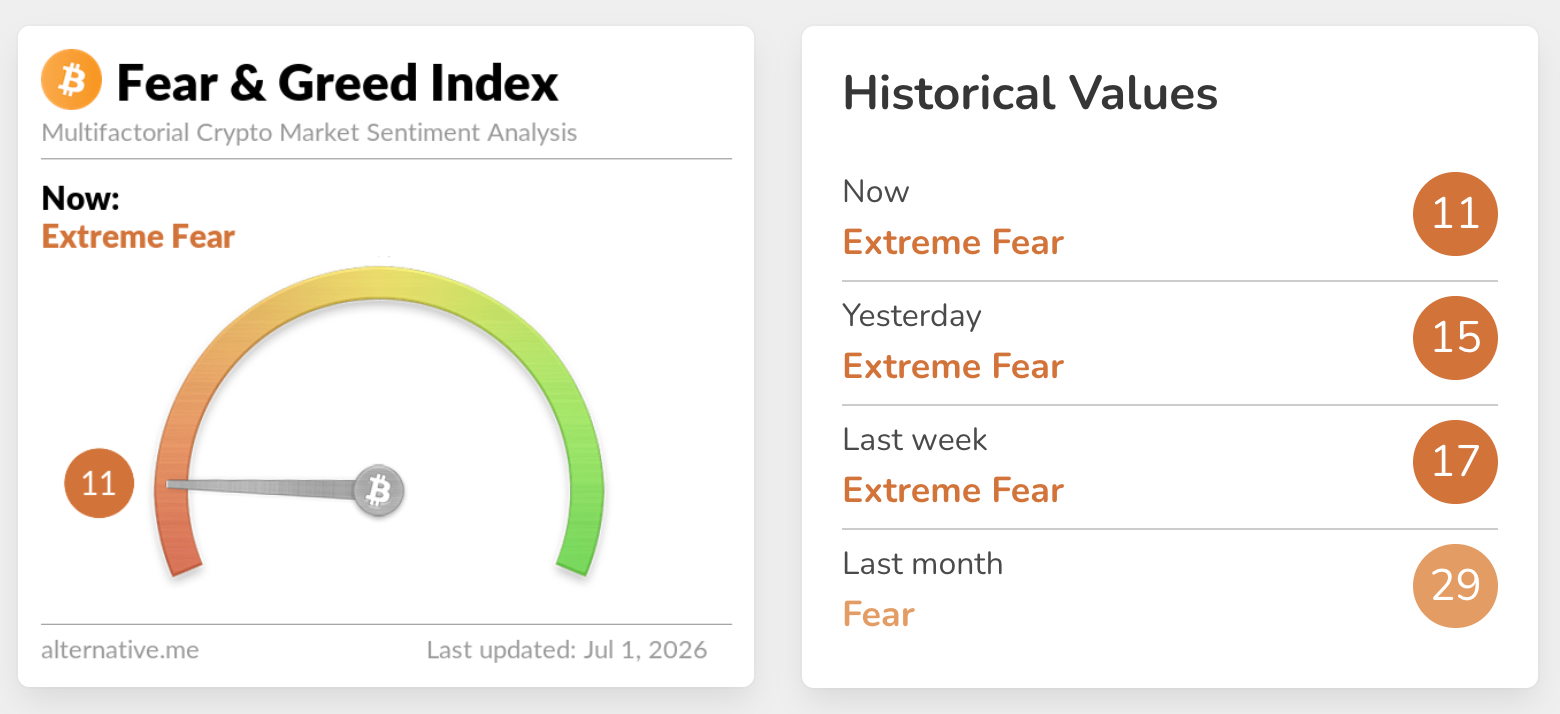
The bounce took place amid deep investor caution, with sentiment trackers gauging the balance of fear and greed in crypto markets currently reading around 11 out of 100, in “Extreme Fear” territory. Despite the rebound from the yearly low, Bitcoin remains down roughly a third since the start of the year.
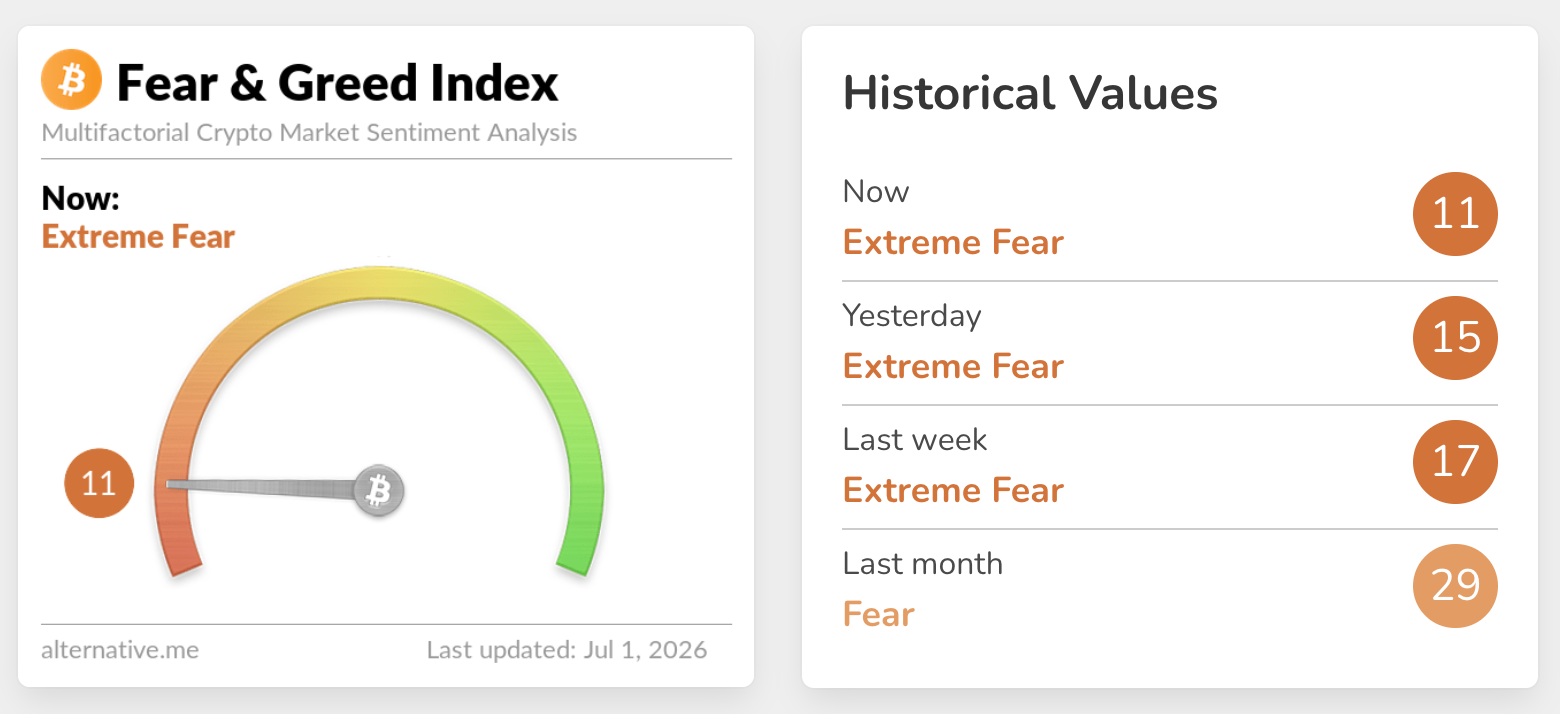
Crypto Fear & Greed Index. Source: Alternative.me
Bitcoin dip-buyers overshadowed by fear of future selling
Investors’ cautious stance shows up differently depending on what data is analyzed. US spot Bitcoin exchange-traded funds (ETFs) have seen more money leave than enter in recent weeks, including a reported $4.5 billion total outflow in June, the largest since the funds launched.
At the same time, onchain data shows that long-term holders added roughly 270,000 BTC over the past two weeks. That is generally read as a sign that some bigger investors see the recent decline as an opportunity rather than a reason to sell.
Looking at the past few days, one useful gauge is the funding rate. That figure has stayed positive for three straight days, meaning bets on rising prices have remained crowded even as Bitcoin fell to new lows. When leverage builds up on one side of the market like this while price is weak, it can add to volatility, since more traders become exposed to being forced out of their positions if the market moves further against them.
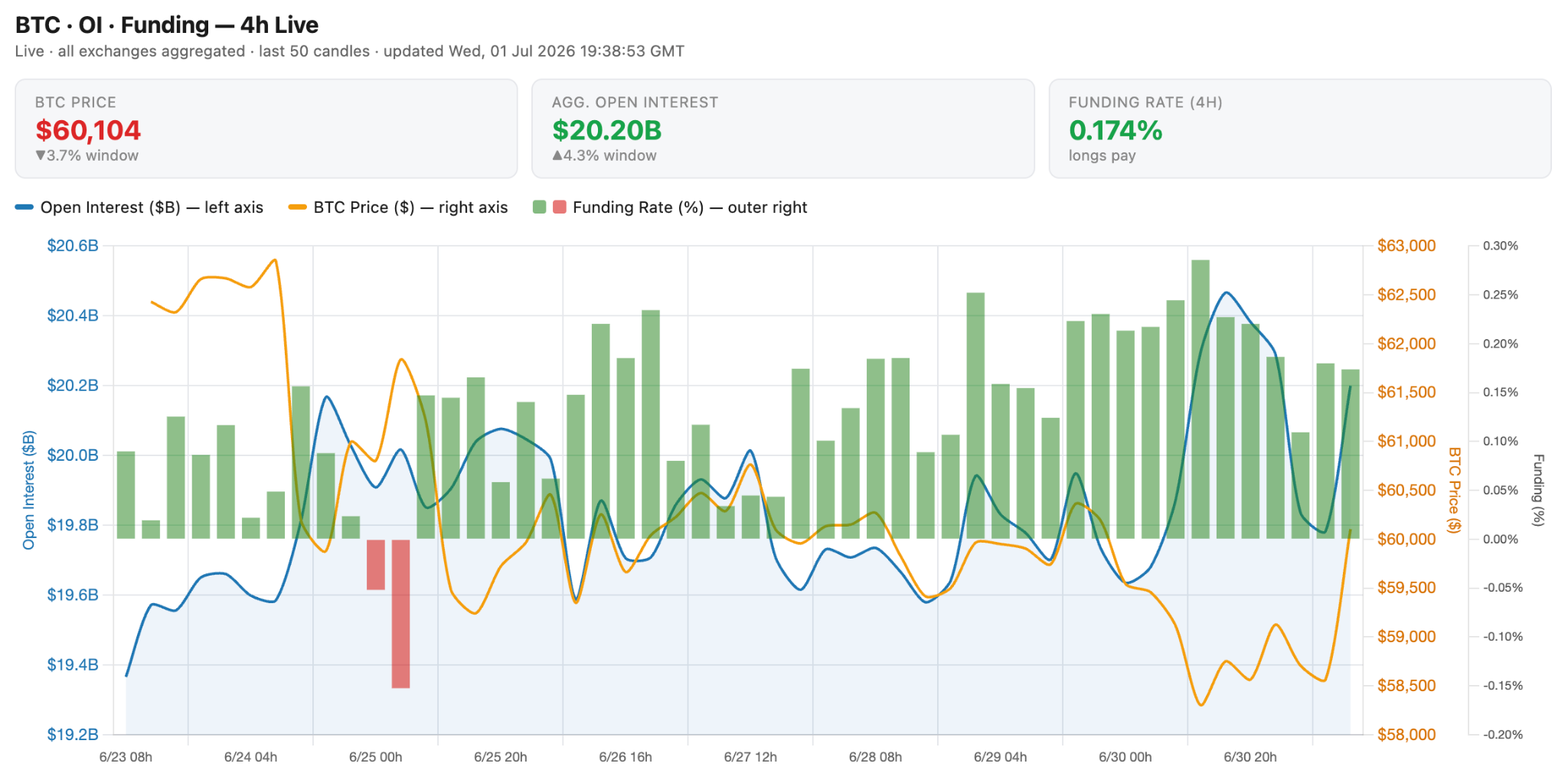
Bitcoin open interest, funding rate. Source: Hyblock
Liquidations continue to define the price action
A broader look at where leveraged positioning is concentrated, combining data from three major exchanges over the past week, shows the heaviest concentration of positioning is roughly between $57,000 and $60,500, which closely wraps around the range Bitcoin has traded in since late June. That concentration thins out noticeably above about $61,000 to $62,000, and again below about $55,000 to $56,000.
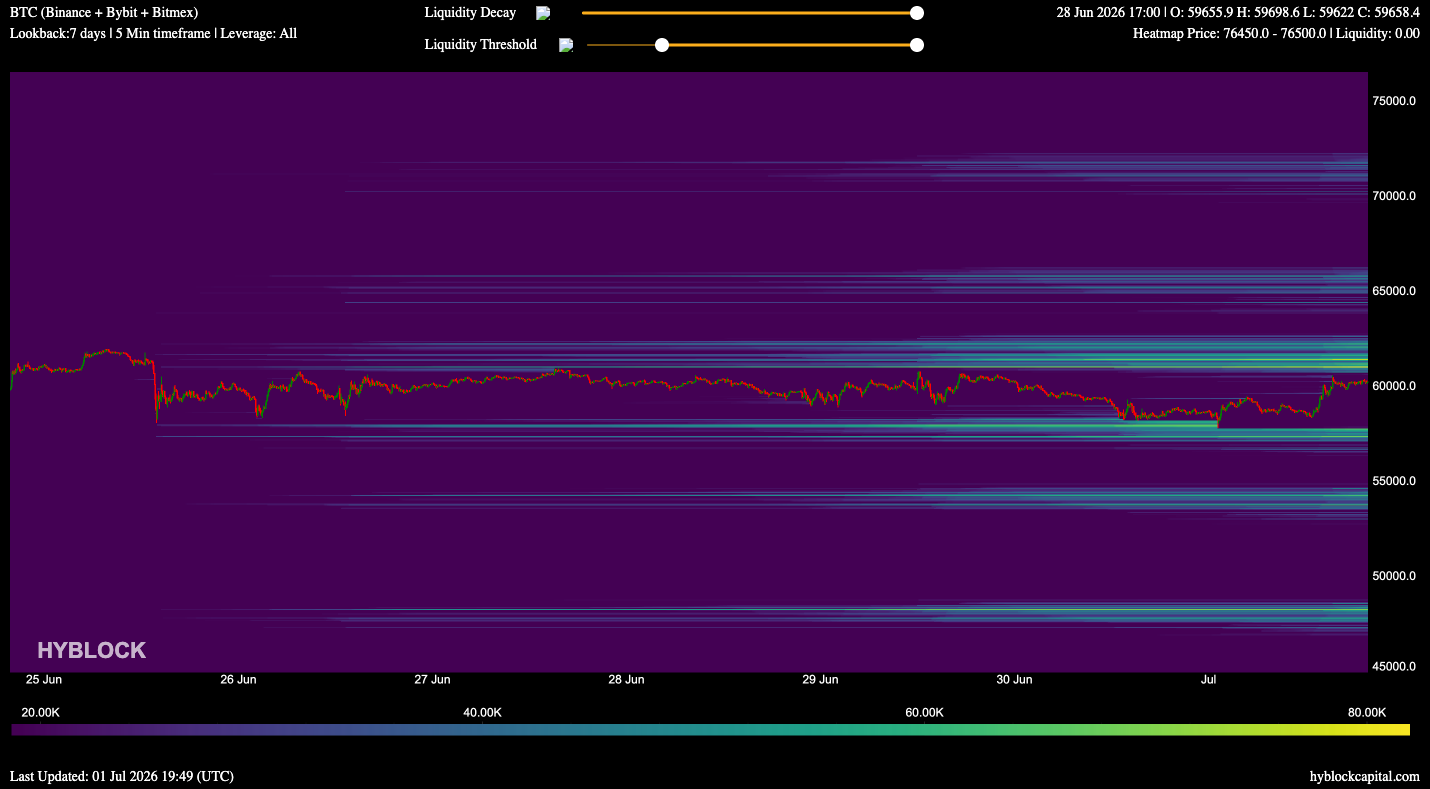
Bitcoin liquidation heatmap, 3-day look back. Source: Hyblock
In practical terms, most of the leverage that could be forced to unwind sits close to the current price rather than in a distant zone, so a decisive move beyond roughly $61,000 on the upside, or $56,000 on the downside, is where forced position closures would likely have the most room to accelerate a move.
The view for the next 24 hours leans neutral and a genuine shift in positioning would likely need to show up as rising leveraged positioning alongside a rising Bitcoin price, a combination that has not yet appeared in the data.
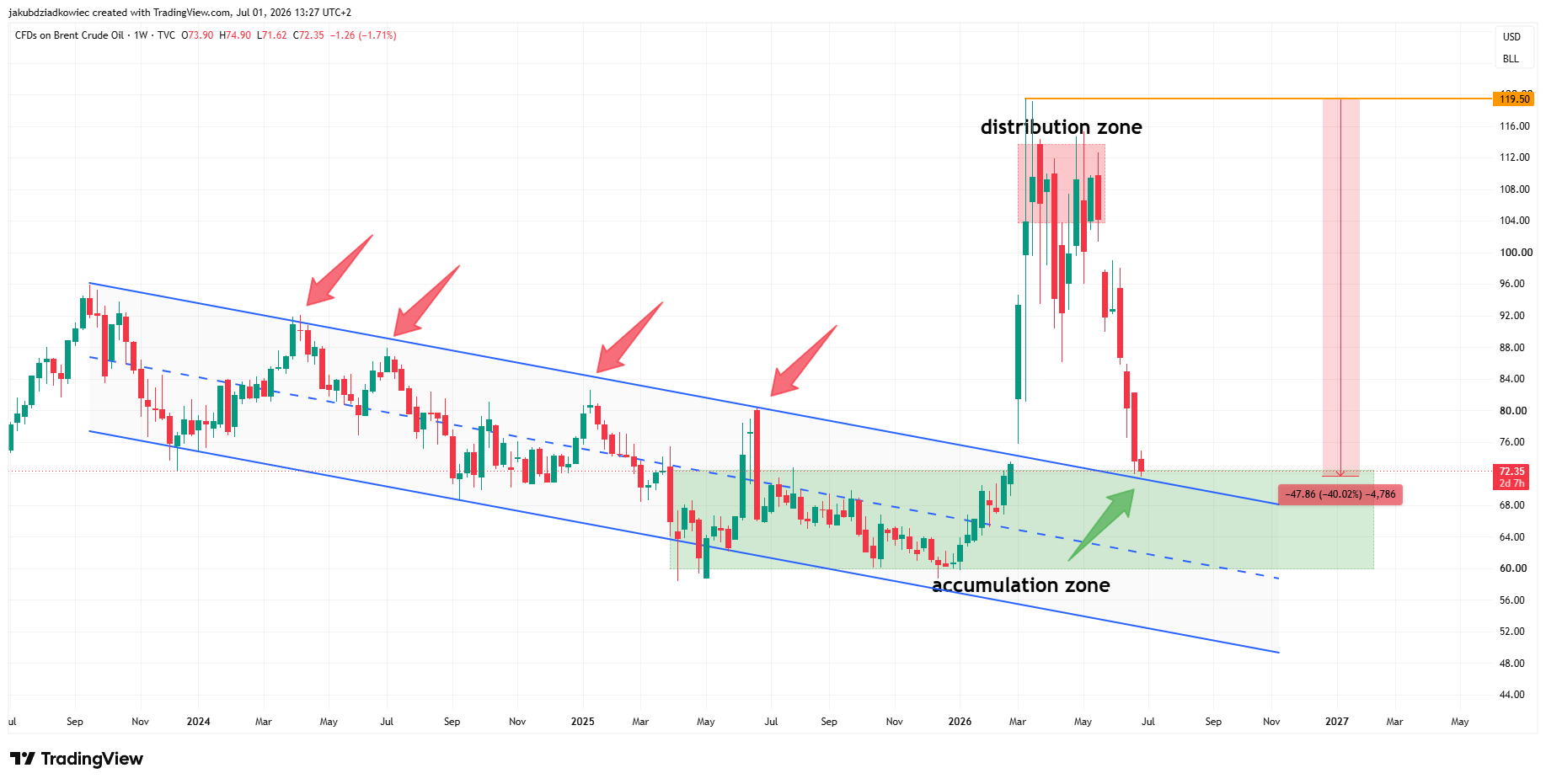
Brent crude oil has erased its entire war premium, sliding roughly 40% from its March peak near $120 to trade around $72.25 on Wednesday. The move returns oil to its pre-war support base.
The retreat follows stalled diplomacy between Iran and the United States. Traders have shifted focus away from conflict risk and back toward supply, demand, and the broader economic outlook.
Brent Crude Oil Falls Back Into Its Multi-Year Channel
The weekly chart frames the whole story. Brent crude oil has traded inside a descending parallel channel since late 2023. That structure defined the pre-war regime for more than two years.
The channel’s upper band rejected price four separate times through 2024 and early 2026. Each test capped rallies and sent oil back toward the middle of the range.
Then the conflict changed everything. Price broke out sharply after the Iran-US escalation, with the Doha talks still unresolved. Brent surged into a distribution zone between $104 and $114, peaking near $120.

That advance has now fully unwound. The weekly chart shows a 40.02% decline from the peak. Oil has fallen back into the accumulation zone between roughly $60 and $72.
The upper band of the channel now sits directly beneath the price. Old resistance can flip into support, and that band is the first line the bulls must defend.
Daily Triangle Breakdown Pushes RSI to Oversold
The weekly structure hints at support, yet the daily chart complicates that read. Momentum has turned sharply against oil.
Brent crude oil built a symmetrical triangle after the March top. Price coiled between a lower series of highs and a rising series of lows toward an apex near $108.
The pattern resolved lower. Oil broke down from the triangle in late May and fell in a near-vertical drop as war fears faded around Hormuz shipping lanes.

Price is now back on the pre-war support zone between $68 and $73. That band held as a base during January and February before the conflict began.
The daily Relative Strength Index (RSI) has fallen below 30. That marks the first oversold reading since April 2025 and signals deeply negative momentum. However, such stretched readings often precede a pause or bounce.
Oil Price Prediction Hinges on the $68 to $72 Support Zone
The two timeframes converge at a single decision point. The weekly upper band, the daily support base, and a rising trendline off the early-year lows all stack up between $68 and $72.
Brent crude oil sits at the top of that confluence near $72.25. The triangle’s widest span measured about $29, and the breakdown near $100 projected toward roughly $71. That target has now been met, suggesting much of the downside has been spent.
A hold here keeps the pre-war base intact and could open a rebound toward the $80 shelf that broke in June. A daily close back above $80 would ease the bearish pressure.
A loss of $68 would invalidate that thesis. The next support sits near $60 at the accumulation floor, with the lower channel band below it.
Fundamentals could tip the balance either way. Falling US inventories and a supply warning argue for a floor, while a fresh Iranian oil license and cooling war risk keep rallies capped.
Whether oil holds this zone or slides toward $60 now depends on the next Middle East headline, weighed against the forces of supply and demand.
The post Brent Crude Oil Erases Entire War Premium, Falls 40% to Pre-War Levels appeared first on BeInCrypto.
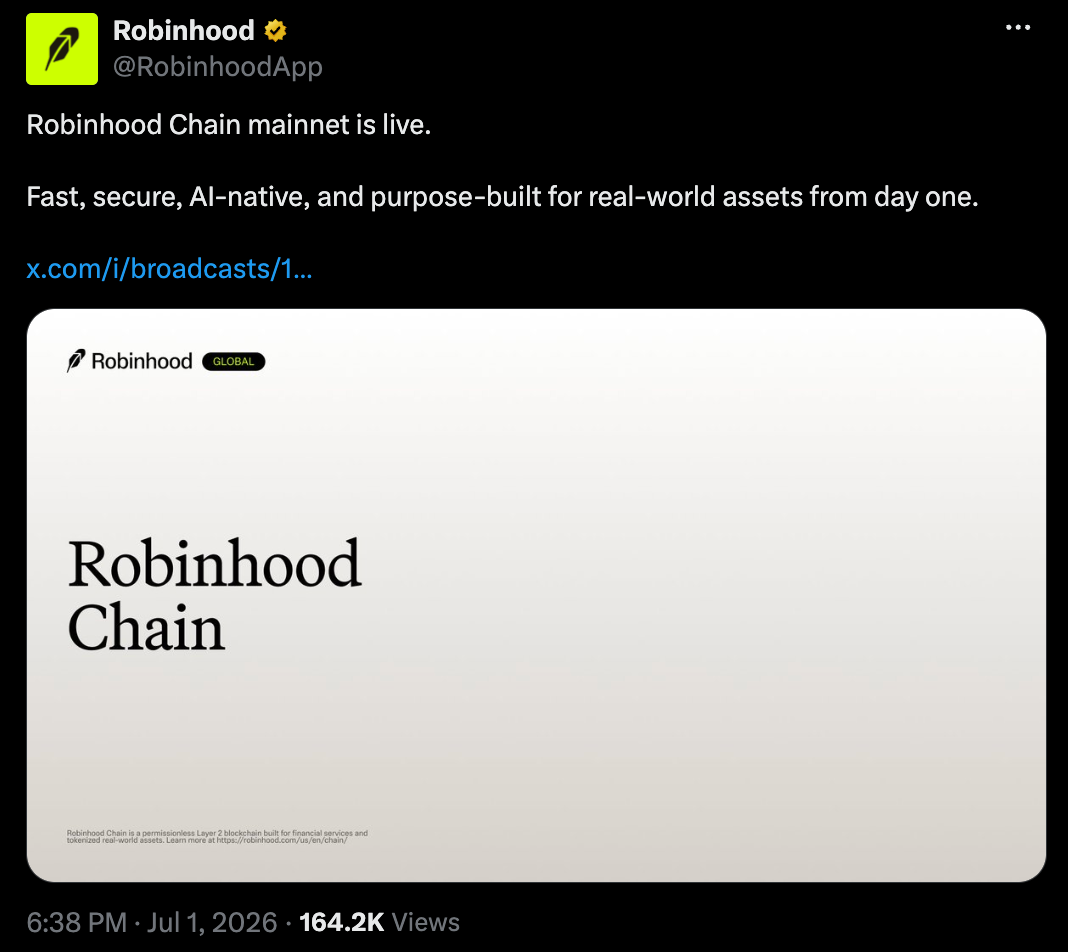
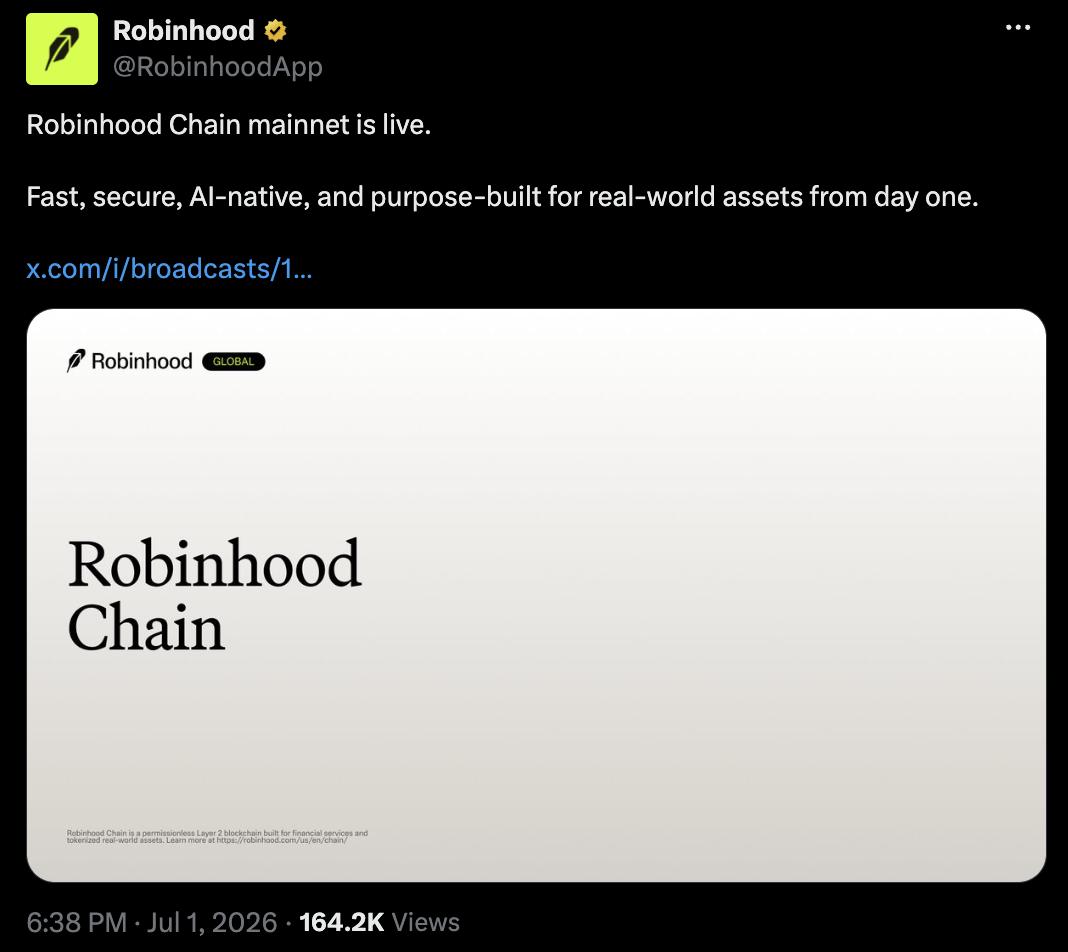
Stock and cryptocurrency trading platform Robinhood announced the launch of its public mainnet about four months after it began testing the network.
On Wednesday, the company said Robinhood Chain, a layer 2 (L2) blockchain built on Arbitrum, had officially launched after the network went live on testnet in February. The blockchain, which the company described as “AI-native and purpose-built for real-world assets,” comes amid Robinhood’s expansion of crypto- and decentralized finance-related services.
According to Robinhood, it plans to launch crypto trading in the UK soon. The company also said that its tokenized stock products were live and available through its wallet app to users in more than 120 countries. CEO Vlad Tenev called tokenized stocks “inevitable” in January, arguing that offering the products could help prevent trading freezes that sometimes occur on traditional exchanges.
Source: Robinhood
The launch of the public mainnet came just a few weeks after Tenev announced that Robinhood would cut 10% of its workforce as part of a restructuring move. The company is expected to announce its 2026 second-quarter results on July 29, but reported in April that its crypto transaction revenue dropped by almost 50% year-on-year, from $252 million to $134 million.
Related: Last-minute MiCA approvals mark end of EU transition period
The company also introduced Robinhood Earn, a decentralized product that allows users to lend USDG, a dollar-backed stablecoin, through a self-custody wallet at an estimated 7% annual percentage yield. Robinhood shares rose about 8% on Wednesday.
Base’s L2 network reports back-to-back outages
Robinhood is entering an increasingly competitive L2 market dominated by networks such as Base, the Coinbase-backed blockchain.
In June, Base experienced two outages within hours of each other, which the engineering team later reported had been the result of a sequencer bug. The mainnet is the second-largest layer 2 network by total value secured at about $11 billion.
Magazine: AI is banking the unbanked in Africa… faster than crypto
Crypto World
Kroger (KR) Stock Drops 2% Following $1.65 Billion Giant Eagle Acquisition Announcement

TLDR
- Kroger revealed plans to purchase Giant Eagle in a transaction valued at $1.65 billion, consisting of $1.25 billion cash and $400 million in liability assumption.
- The acquisition brings approximately $9 billion in yearly revenue, 197 grocery locations, and 11 independent pharmacy outlets.
- Shares of Kroger declined 2.12% during Wednesday’s session, adding to a year-to-date drop of 12.11%.
- Transaction completion is anticipated in 2027, contingent upon regulatory clearance.
- Analysts at Wolfe Research characterized the acquisition as evidence Kroger is operating “more offensively,” projecting approximately 6% revenue growth.
Shares of Kroger (KR) slipped 2.12% during Wednesday trading following the supermarket operator’s announcement that it would purchase family-run grocery chain Giant Eagle in a $1.65 billion transaction.
The transaction structure includes $1.25 billion in cash consideration alongside $400 million in liability assumption. The Cincinnati-based retailer stated the purchase won’t push its net total debt to adjusted EBITDA multiple beyond its designated target corridor of 2.3 to 2.5 times.
Giant Eagle maintains a footprint of 197 grocery stores and 11 independent pharmacy locations throughout northern Ohio, western Pennsylvania, West Virginia, Maryland, and Indiana—regions where Kroger maintains an established market position.
The regional chain generates approximately $9 billion in yearly sales—a substantial contribution to Kroger’s operations.
Greg Foran, Kroger’s Chief Executive Officer, characterized the transaction as an obvious “strategic fit,” highlighting Giant Eagle’s customer loyalty initiatives, pharmaceutical services, and proprietary brand offerings as valuable assets.
What the Numbers Look Like
Greg Badishkanian, an analyst at Wolfe Research, noted the purchase aligns with Kroger‘s leadership team’s “increased openness to do M&A” and will enable the retailer to strengthen its store concentration while expanding into neighboring territories.
Wolfe’s analysis suggests Giant Eagle’s EBIT margins fall within the 2.0–2.5% range—comparable to Albertsons—and anticipates an additional EBIT contribution between $200 million and $250 million.
With Kroger’s sales forecast to reach $151 billion by 2027, the acquisition would increase total revenue by approximately 6%, bringing it to roughly $160 billion. Badishkanian anticipates modest EPS accretion during the second complete year following transaction closure.
The 197 additional locations would expand Kroger’s total store portfolio by roughly 7% from its existing network of 2,739 stores.
When Does the Deal Close?
Kroger anticipates finalizing the Giant Eagle acquisition in 2027, pending regulatory approval and customary closing requirements.
The grocery retailer indicated the transaction will contribute positively to adjusted EPS during the second complete year post-closure—when excluding one-time transaction expenses and integration-related costs.
To reassure shareholders, the company reaffirmed its commitment to maintaining dividend distributions and continuing its $2 billion stock buyback initiative.
Wednesday’s trading volume registered approximately 1.86 million shares, significantly below Kroger’s three-month average daily volume of roughly 7.77 million.
KR shares have declined 12.11% year-to-date and dropped 20.93% over the trailing twelve-month period.
Analyst sentiment on KR reflects a Moderate Buy consensus, comprising six Buy recommendations and seven Hold ratings issued within the past three months. The mean price target stands at $69.33, suggesting potential upside of approximately 27.4% from present levels.

Sam Okwaraji U-16 School Football Championship Begins in Akwa Ibom

OverClock Checking Tool (OCCT) Download Free – 17.0.2

Bitcoin Faces A Liquidity Shock…





-

 Fashion5 days ago
Weekend Open Thread: Staud – Corporette.com
-

 Politics6 days ago
The House | Manchesterism won’t survive the painful trade-offs unless it gets citizens on board
-

 Crypto World2 days ago
Strategy authorizes up to $1.25B in Bitcoin sales under new capital plan
-

 Politics6 days ago
Potential 2028er World Cup attendee leaderboard
-

 Business6 days ago
Asia stock markets slide as tech shares slump
-

 News Videos3 days ago
MAJOR BITCOIN & MARKET UPDATE!!!! (MUST WATCH ASAP!!!)
-

 Tech6 days ago
A Look At A Gaggle Of Transputer Boards
-
 Crypto World6 days ago
Dell (DELL) Shares Tumble Over 5% Following Analyst Downgrade to Hold
-

 Crypto World4 days ago
Coinbase, Circle Deepen Crypto Stock Losses Despite Resilient S&P 500
-

 Business2 days ago
Australia treasurer says alleged access of prime minister’s bank data ’incredibly concerning’
-

 Crypto World5 days ago
Kraken's xStocks Opens Bending Spoons IPO Registration to EEA Retail
-

 Sports5 days ago
FIH Pro League: India defeat Pakistan 7-1, register biggest win of campaign | Other Sports News
-

 Crypto World6 days ago
Bitcoin Sparks $600M Hourly Liquidations With $65,000 Set To Become Resistance
-

 Tech4 days ago
Bluekit phishing kit adopts browser-in-the-middle for login theft
-

 Tech4 days ago
Russian hackers now target Signal backup recovery keys
-
 Crypto World5 days ago
Hyperliquid Named on Singapore MAS Investor Alert Register
-

 Crypto World5 days ago
RTX holders must register wallets before token distribution begins
-
 Crypto World7 days ago
Ripple and SBI launch RLUSD in Japan after JFSA approval
-

 Tech2 days ago
Anonymous researcher drops 0-day ‘exploitarium’ repo
-
 Business2 days ago
The AI boom won’t burst all at once. It will pop in ‘rolling bubbles’: Macquarie
You must be logged in to post a comment Login